
Principles and Implementation Techniques of SoftwareBased Fault Isolation
Principles and Implementation Techniques of Software-Based Fault Isolation Gang Tan Penn State University Spring 2019
![Isolation via Protection Domains 2 A fundamental idea in computer security [Lampson 74] “Protection”](http://slidetodoc.com/presentation_image_h/92bf23c5ec340fd400ca0c5ddd8f023e/image-2.jpg "Isolation via Protection Domains 2 A fundamental idea in computer security [Lampson 74] “Protection”")
Isolation via Protection Domains 2 A fundamental idea in computer security [Lampson 74] “Protection” Structure a computer system to have multiple protection domains Each domain is given a set of privileges, according to its trustworthiness

3 Example: the Separation between OS and User Applications Application 1 … Application n Syscalls OS Kernel One OS domain (the kernel mode) Privileged: execute privileged instrs; set up virtual memory; perform access control on resources; … Multiple application domains Go through OS syscalls to request access to privileged operations Application domains are isolated by OS processes
Isolating Untrusted Components 4 Using separate protection domains is a natural choice for isolating untrusted components E. g. , isolating plug-ins in a web browser Malfunctioning/malicious plug-ins would not crash or violate the security of the browser E. g. , isolating device drivers in an OS
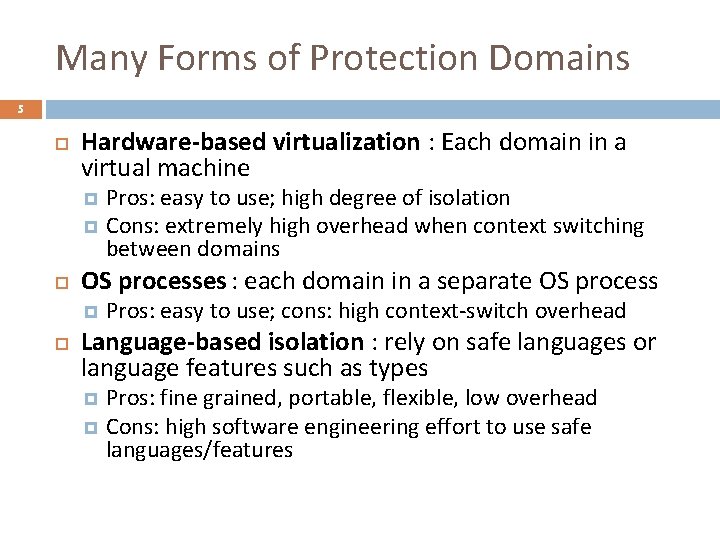
Many Forms of Protection Domains 5 Hardware-based virtualization : Each domain in a virtual machine Pros: easy to use; high degree of isolation Cons: extremely high overhead when context switching between domains OS processes : each domain in a separate OS process Pros: easy to use; cons: high context-switch overhead Language-based isolation : rely on safe languages or language features such as types Pros: fine grained, portable, flexible, low overhead Cons: high software engineering effort to use safe languages/features
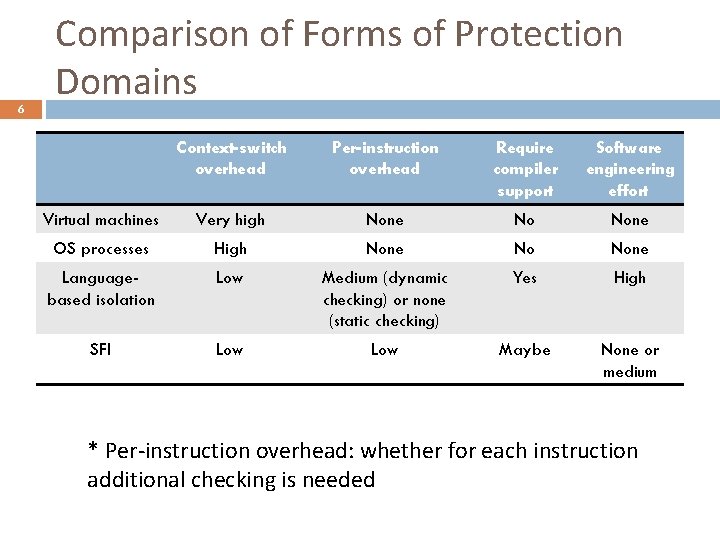
6 Comparison of Forms of Protection Domains Context-switch overhead Per-instruction overhead Require compiler support Software engineering effort Virtual machines Very high None No None OS processes High None No None Languagebased isolation Low Medium (dynamic checking) or none (static checking) Yes High SFI Low Maybe None or medium * Per-instruction overhead: whether for each instruction additional checking is needed
![Software-Based Fault Isolation (SFI) 7 Introduced by [Wahbe et al. 93] for MIPS Pitt.](http://slidetodoc.com/presentation_image_h/92bf23c5ec340fd400ca0c5ddd8f023e/image-7.jpg "Software-Based Fault Isolation (SFI) 7 Introduced by [Wahbe et al. 93] for MIPS Pitt.")
Software-Based Fault Isolation (SFI) 7 Introduced by [Wahbe et al. 93] for MIPS Pitt. SFIeld [Mc. Camant & Morrisett 06] extended it to x 86 SFI isolation is within the same process address space Each protection domain has a designated memory region Same process: avoiding costly context switches Implementation by inserting software checks before critical instructions E. g. , memory reads/writes, indirect branches. Pros: fine grained, flexible, low context-switch overhead Cons: may require some compiler support and software engineering effort

8 THE SFI POLICY
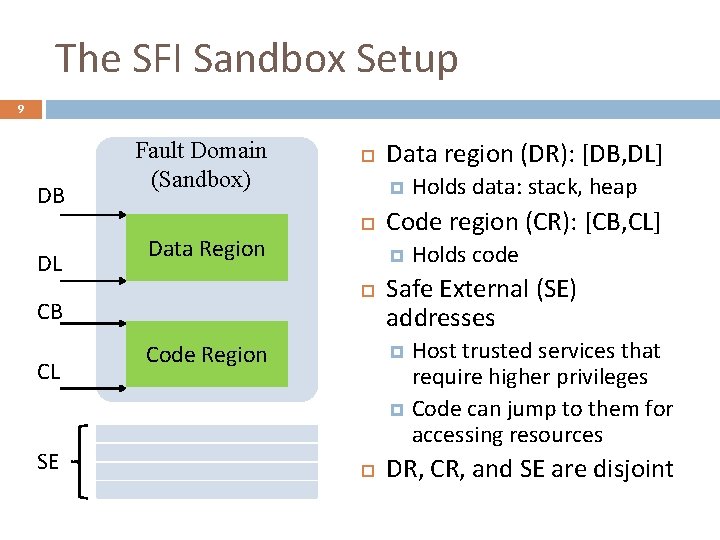
The SFI Sandbox Setup 9 DB DL Fault Domain (Sandbox) Data Region SE Data region (DR): [DB, DL] Holds data: stack, heap Code region (CR): [CB, CL] CB CL Holds code Safe External (SE) addresses Host trusted services that require higher privileges Code can jump to them for accessing resources Code Region DR, CR, and SE are disjoint
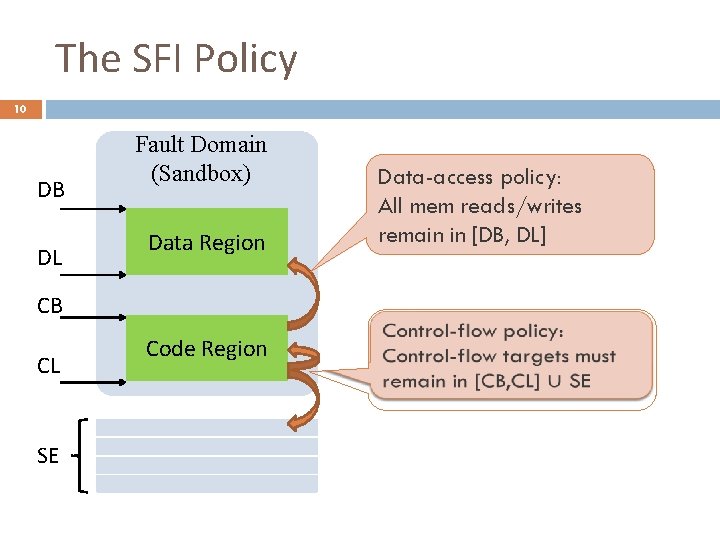
The SFI Policy 10 DB DL Fault Domain (Sandbox) Data Region CB CL SE Code Region Data-access policy: All mem reads/writes remain in [DB, DL]

Implications of the SFI Policy 11 Non-writable code All memory writes must write to DR Code region cannot be modified No self-modifying code Non-executable data Control flow cannot transfer to the data region Cannot inject data to DR and execute it as code Code injection disallowed
Stronger Policies 12 An SFI implementation might implement a stronger policy For implementation convenience For efficiency E. g. , Pitt. SFIeld [Mc. Camant & Morrisett 06] Disallow jumping into the middle of instructions on x 86, which has variable-sized instructions E. g. , Na. Cl [Yee et al. 09] Disallow system call instructions in the code region
13 SFI ENFORCEMENT OVERVIEW
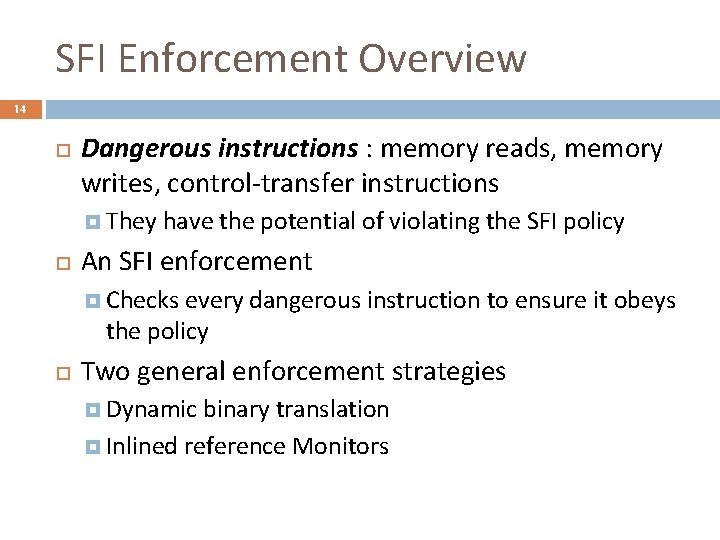
SFI Enforcement Overview 14 Dangerous instructions : memory reads, memory writes, control-transfer instructions They have the potential of violating the SFI policy An SFI enforcement Checks every dangerous instruction to ensure it obeys the policy Two general enforcement strategies Dynamic binary translation Inlined reference Monitors
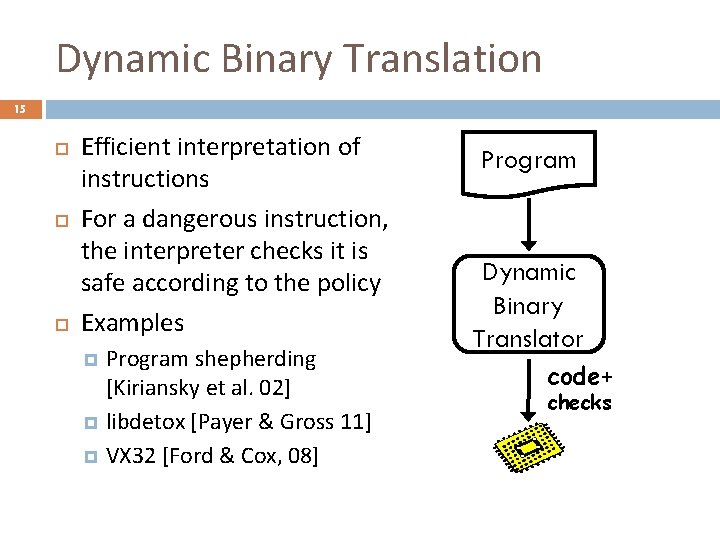
Dynamic Binary Translation 15 Efficient interpretation of instructions For a dangerous instruction, the interpreter checks it is safe according to the policy Examples Program shepherding [Kiriansky et al. 02] libdetox [Payer & Gross 11] VX 32 [Ford & Cox, 08] Program Dynamic Binary Translator code+ checks
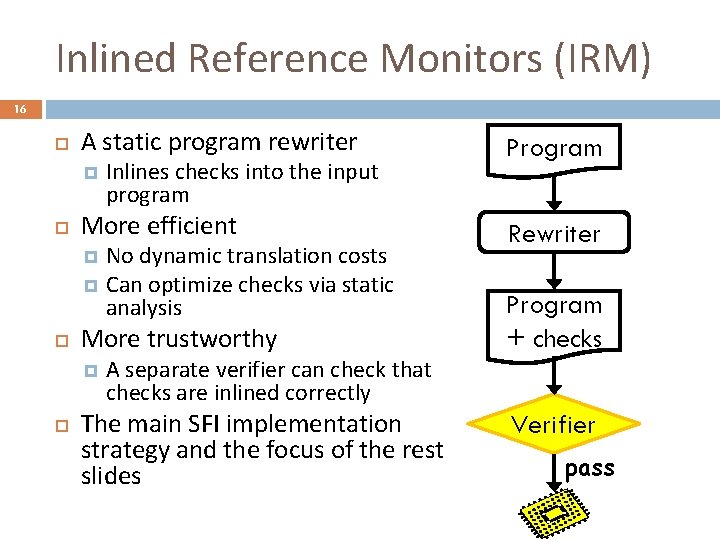
Inlined Reference Monitors (IRM) 16 A static program rewriter Inlines checks into the input program More efficient No dynamic translation costs Can optimize checks via static analysis Program Rewriter More trustworthy Program + checks A separate verifier can check that checks are inlined correctly The main SFI implementation strategy and the focus of the rest slides Verifier pass
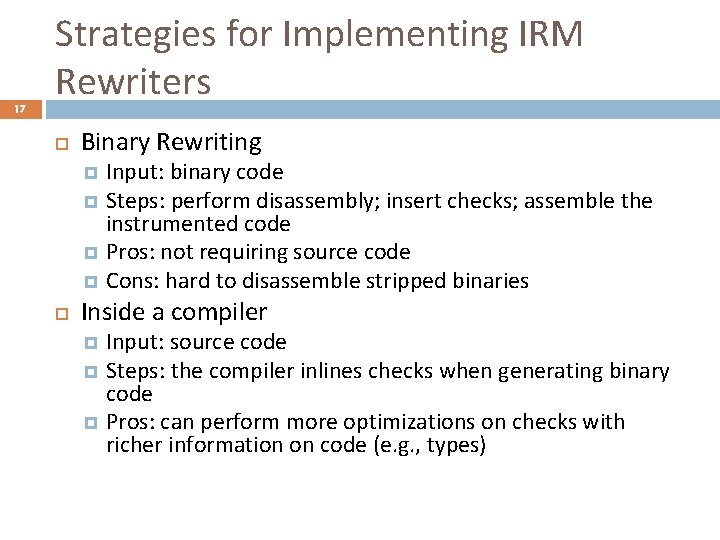
17 Strategies for Implementing IRM Rewriters Binary Rewriting Input: binary code Steps: perform disassembly; insert checks; assemble the instrumented code Pros: not requiring source code Cons: hard to disassemble stripped binaries Inside a compiler Input: source code Steps: the compiler inlines checks when generating binary code Pros: can perform more optimizations on checks with richer information on code (e. g. , types)
18 ENFORCING SFI’S DATA-ACCESS POLICY AND OPTIMIZATIONS
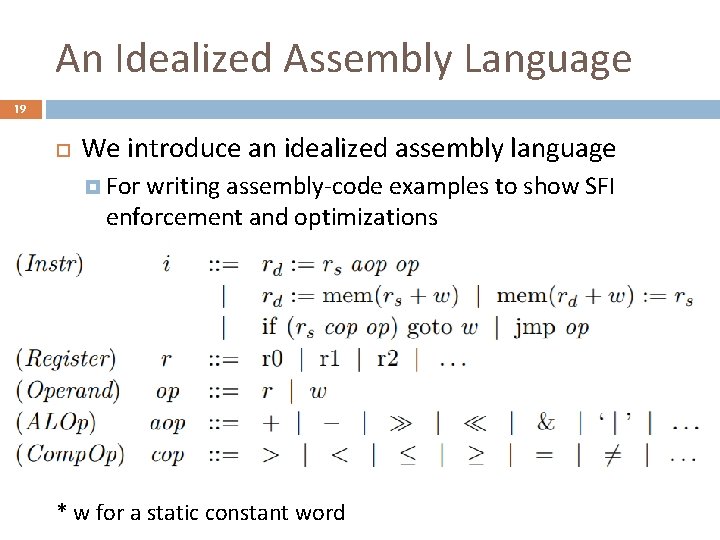
An Idealized Assembly Language 19 We introduce an idealized assembly language For writing assembly-code examples to show SFI enforcement and optimizations * w for a static constant word
Abbreviations and Terminology 20 r : = r’+0 abbreviated as r : = r’ In memory instructions, mem(r+0) abbreviated as mem(r) Direct branches: jmp w The jump target is a static constant word w Indirect branches: jmp r The jump target is in a register and cannot always be statically determined
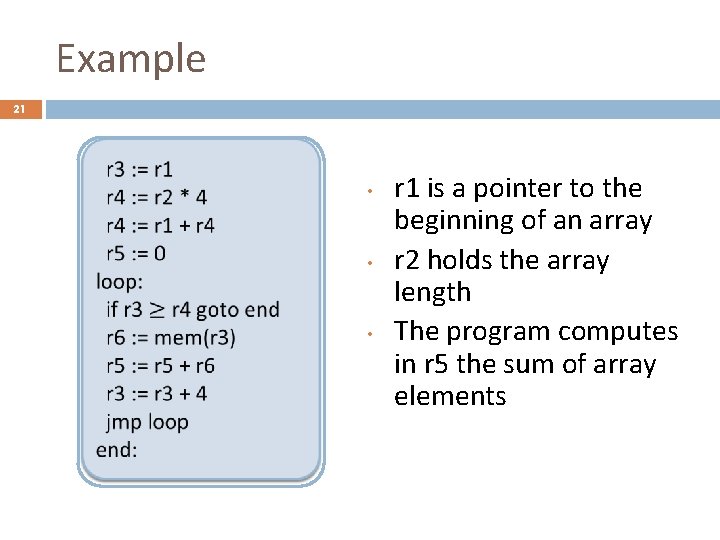
Example 21 • • • r 1 is a pointer to the beginning of an array r 2 holds the array length The program computes in r 5 the sum of array elements
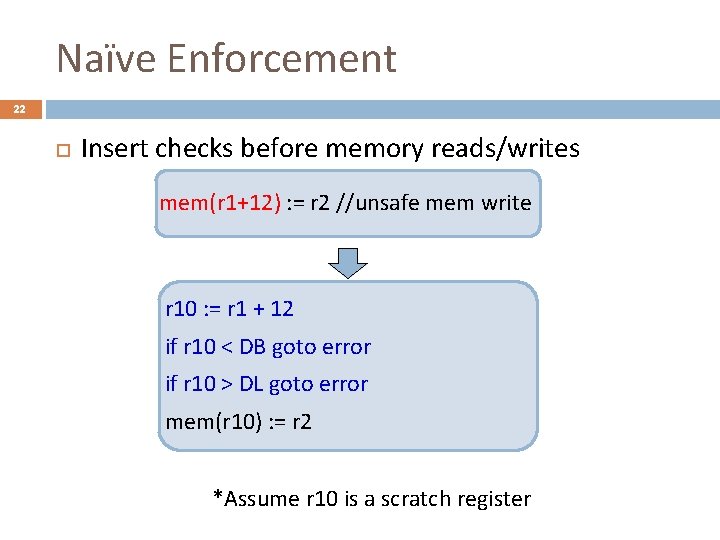
Naïve Enforcement 22 Insert checks before memory reads/writes mem(r 1+12) : = r 2 //unsafe mem write r 10 : = r 1 + 12 if r 10 < DB goto error if r 10 > DL goto error mem(r 10) : = r 2 *Assume r 10 is a scratch register
Naïve Enforcement 23 Sufficient for security Has a high runtime overhead Two checks per memory access A practical SFI implementation Need to implement a range of optimizations to drive down the cost Discussed next Side note: a good illustration of what’s needed to make a simple security scheme practical
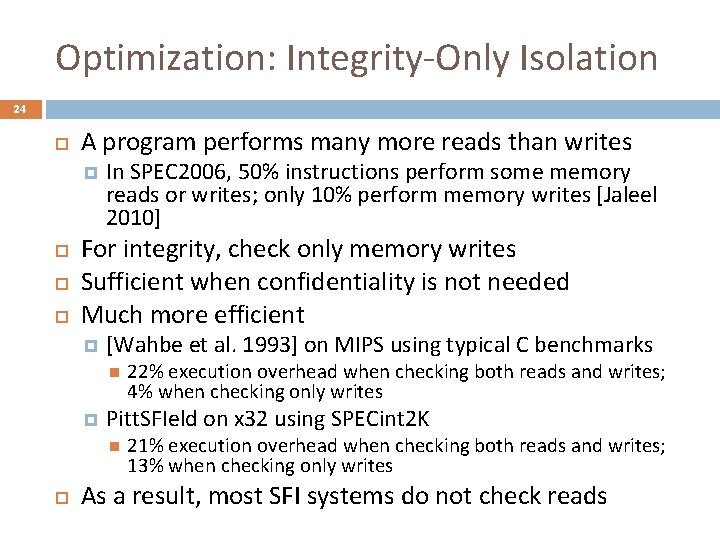
Optimization: Integrity-Only Isolation 24 A program performs many more reads than writes In SPEC 2006, 50% instructions perform some memory reads or writes; only 10% perform memory writes [Jaleel 2010] For integrity, check only memory writes Sufficient when confidentiality is not needed Much more efficient [Wahbe et al. 1993] on MIPS using typical C benchmarks Pitt. SFIeld on x 32 using SPECint 2 K 22% execution overhead when checking both reads and writes; 4% when checking only writes 21% execution overhead when checking both reads and writes; 13% when checking only writes As a result, most SFI systems do not check reads
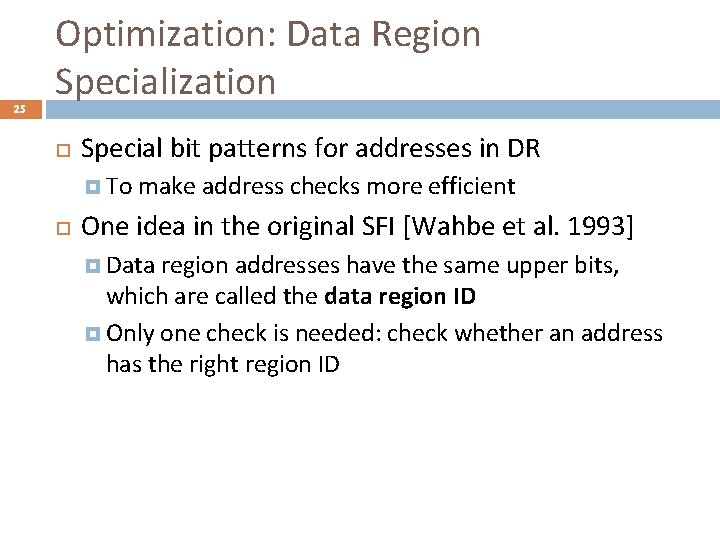
25 Optimization: Data Region Specialization Special bit patterns for addresses in DR To make address checks more efficient One idea in the original SFI [Wahbe et al. 1993] Data region addresses have the same upper bits, which are called the data region ID Only one check is needed: check whether an address has the right region ID
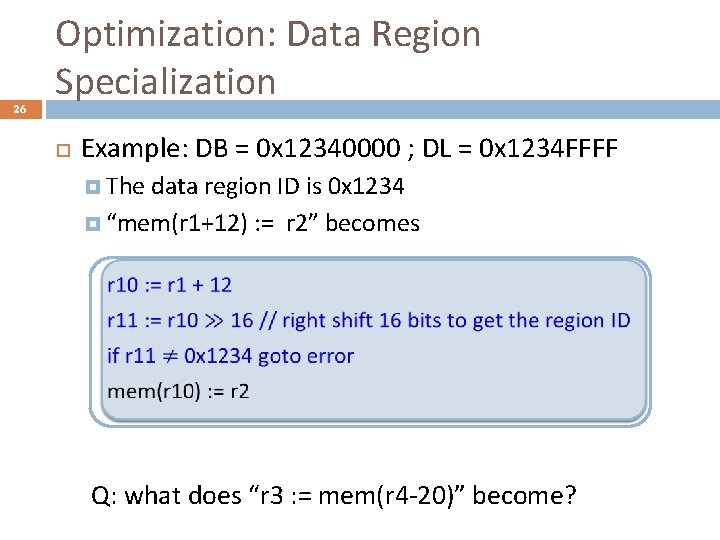
26 Optimization: Data Region Specialization Example: DB = 0 x 12340000 ; DL = 0 x 1234 FFFF The data region ID is 0 x 1234 “mem(r 1+12) : = r 2” becomes Q: what does “r 3 : = mem(r 4 -20)” become?
Optimization: Address Masking 27 Address checking stops the program when the check fails Strictly speaking, unnecessary for isolating faults A more efficient way: force the address of a memory operation to be a DR address and continue execution Called address masking “Ensure, but don’t check” When using data region specialization, just modify the upper bits in the address to be the region ID Pitt. SFIeld reported 12% performance gain when using address masking instead of checking for SPECint 2000
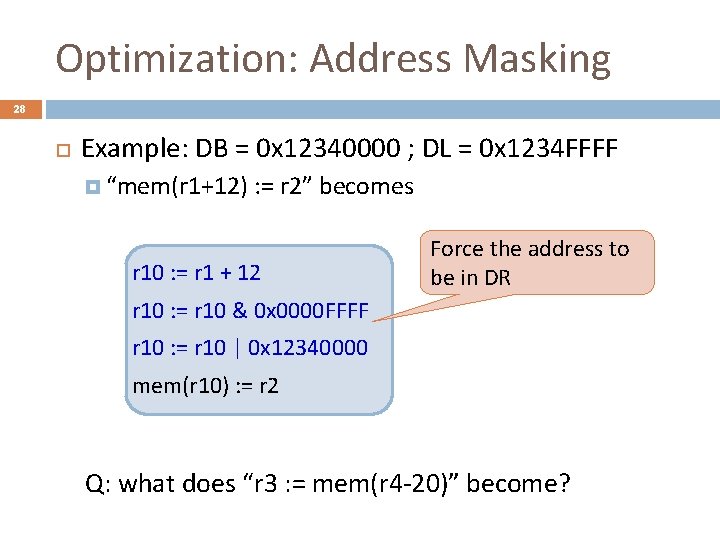
Optimization: Address Masking 28 Example: DB = 0 x 12340000 ; DL = 0 x 1234 FFFF “mem(r 1+12) : = r 2” becomes r 10 : = r 1 + 12 Force the address to be in DR r 10 : = r 10 & 0 x 0000 FFFF r 10 : = r 10 | 0 x 12340000 mem(r 10) : = r 2 Q: what does “r 3 : = mem(r 4 -20)” become?
29 Wait! What about Program Semantics? “Good” programs won’t get affected “Good” programs won’t access memory outside DR For bad programs, we don’t care about whether its semantics is destroyed Cons: does not pinpoint the policy-violating instruction A downside for debugging and assigning blame
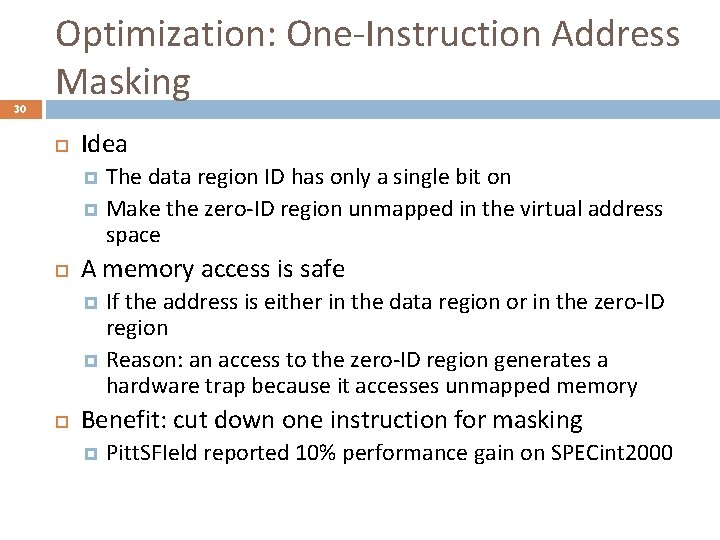
30 Optimization: One-Instruction Address Masking Idea The data region ID has only a single bit on Make the zero-ID region unmapped in the virtual address space A memory access is safe If the address is either in the data region or in the zero-ID region Reason: an access to the zero-ID region generates a hardware trap because it accesses unmapped memory Benefit: cut down one instruction for masking Pitt. SFIeld reported 10% performance gain on SPECint 2000
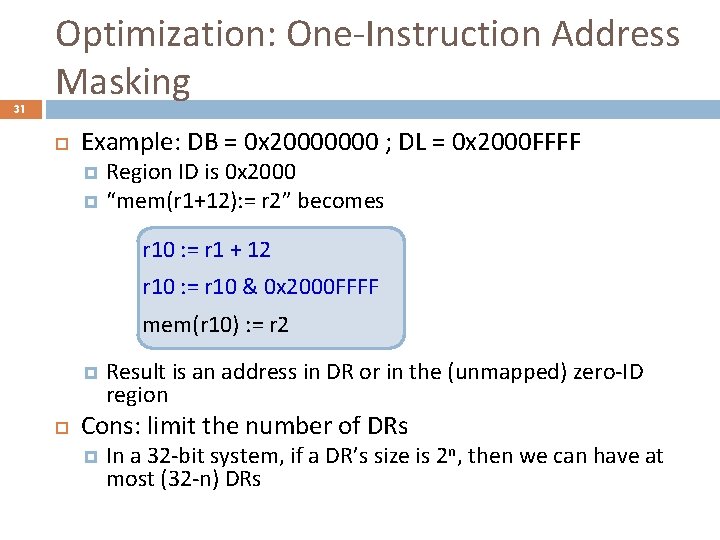
31 Optimization: One-Instruction Address Masking Example: DB = 0 x 20000000 ; DL = 0 x 2000 FFFF Region ID is 0 x 2000 “mem(r 1+12): = r 2” becomes r 10 : = r 1 + 12 r 10 : = r 10 & 0 x 2000 FFFF mem(r 10) : = r 2 Result is an address in DR or in the (unmapped) zero-ID region Cons: limit the number of DRs In a 32 -bit system, if a DR’s size is 2 n, then we can have at most (32 -n) DRs
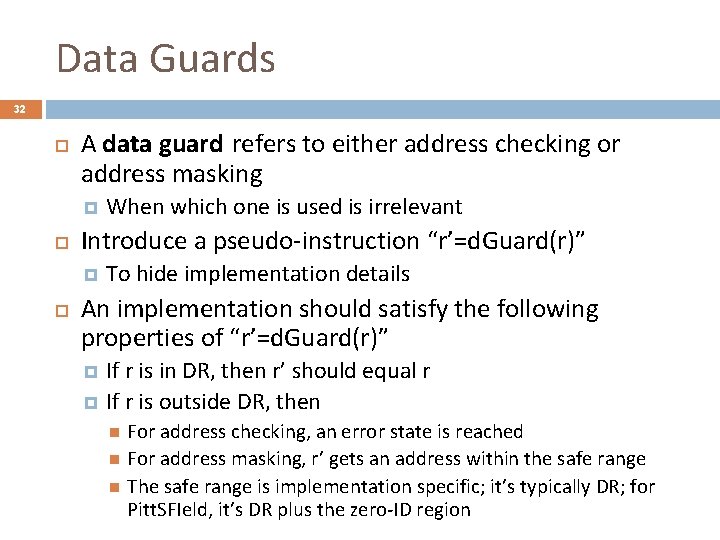
Data Guards 32 A data guard refers to either address checking or address masking Introduce a pseudo-instruction “r’=d. Guard(r)” When which one is used is irrelevant To hide implementation details An implementation should satisfy the following properties of “r’=d. Guard(r)” If r is in DR, then r’ should equal r If r is outside DR, then For address checking, an error state is reached For address masking, r’ gets an address within the safe range The safe range is implementation specific; it’s typically DR; for Pitt. SFIeld, it’s DR plus the zero-ID region
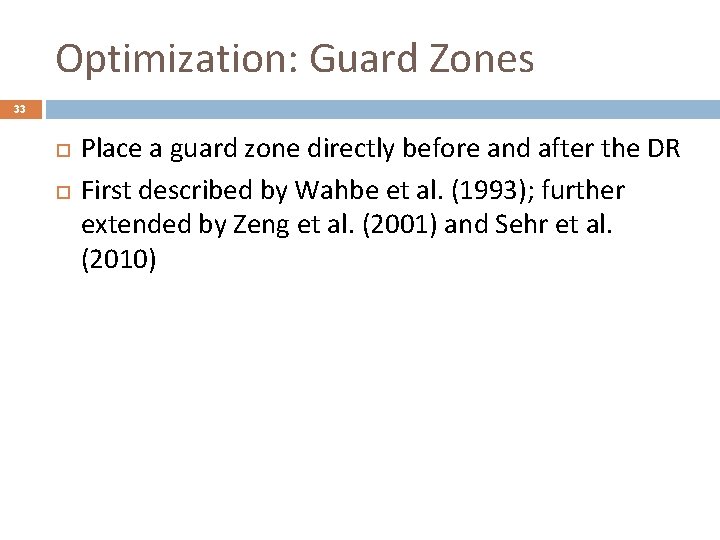
Optimization: Guard Zones 33 Place a guard zone directly before and after the DR First described by Wahbe et al. (1993); further extended by Zeng et al. (2001) and Sehr et al. (2010)
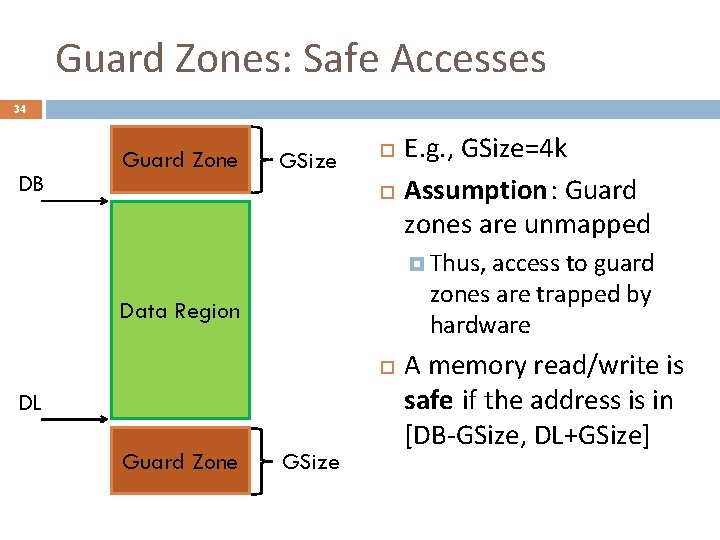
Guard Zones: Safe Accesses 34 DB Guard Zone GSize E. g. , GSize=4 k Assumption: Guard zones are unmapped Thus, access to guard zones are trapped by hardware Data Region DL Guard Zone GSize A memory read/write is safe if the address is in [DB-GSize, DL+GSize]
35 Guard Zones Enable More Optimizations In-place sandboxing Redundant check elimination Loop check hoisting Similar to those optimizations performed in an optimizing compiler, enabled by classic static analysis
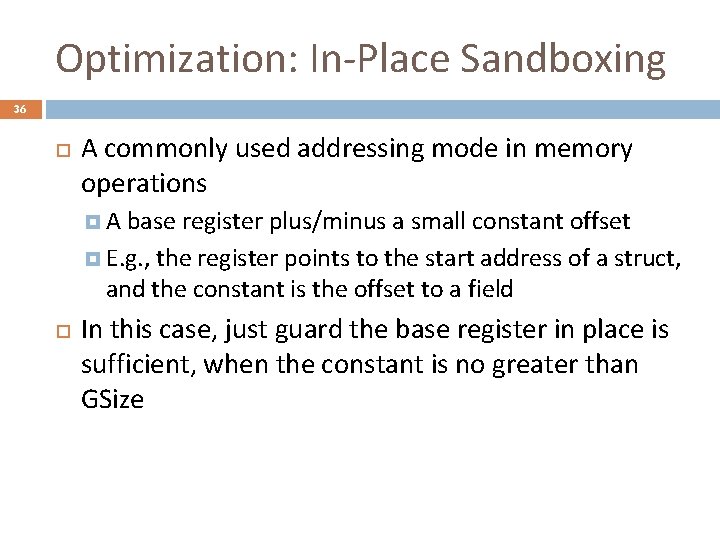
Optimization: In-Place Sandboxing 36 A commonly used addressing mode in memory operations A base register plus/minus a small constant offset E. g. , the register points to the start address of a struct, and the constant is the offset to a field In this case, just guard the base register in place is sufficient, when the constant is no greater than GSize
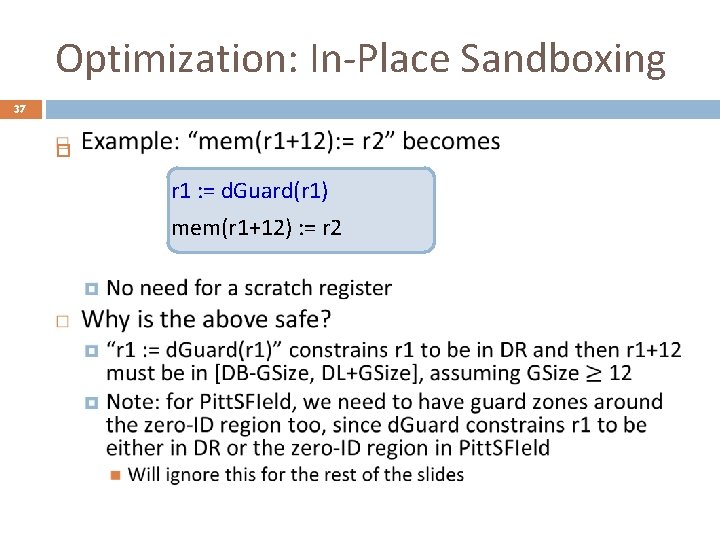
Optimization: In-Place Sandboxing 37 r 1 : = d. Guard(r 1) mem(r 1+12) : = r 2
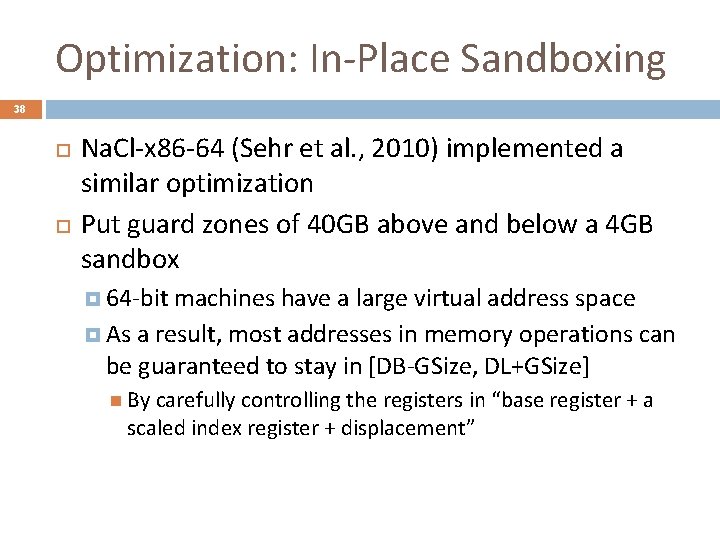
Optimization: In-Place Sandboxing 38 Na. Cl-x 86 -64 (Sehr et al. , 2010) implemented a similar optimization Put guard zones of 40 GB above and below a 4 GB sandbox 64 -bit machines have a large virtual address space As a result, most addresses in memory operations can be guaranteed to stay in [DB-GSize, DL+GSize] By carefully controlling the registers in “base register + a scaled index register + displacement”
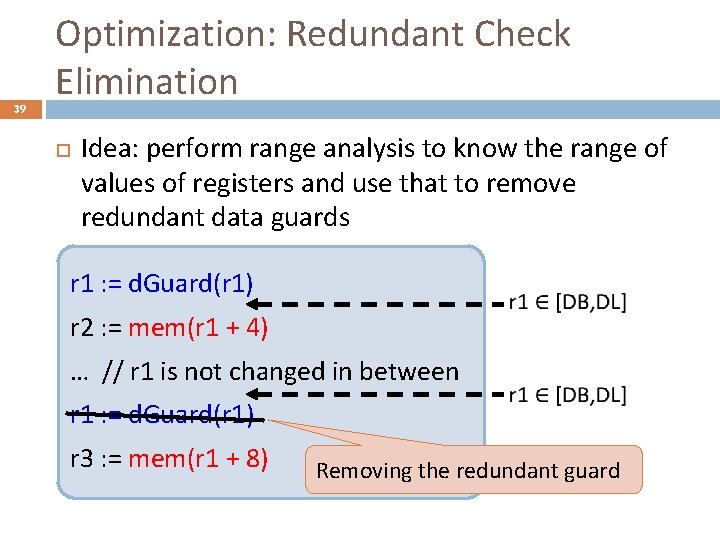
39 Optimization: Redundant Check Elimination Idea: perform range analysis to know the range of values of registers and use that to remove redundant data guards r 1 : = d. Guard(r 1) r 2 : = mem(r 1 + 4) … // r 1 is not changed in between r 1 : = d. Guard(r 1) r 3 : = mem(r 1 + 8) Removing the redundant guard
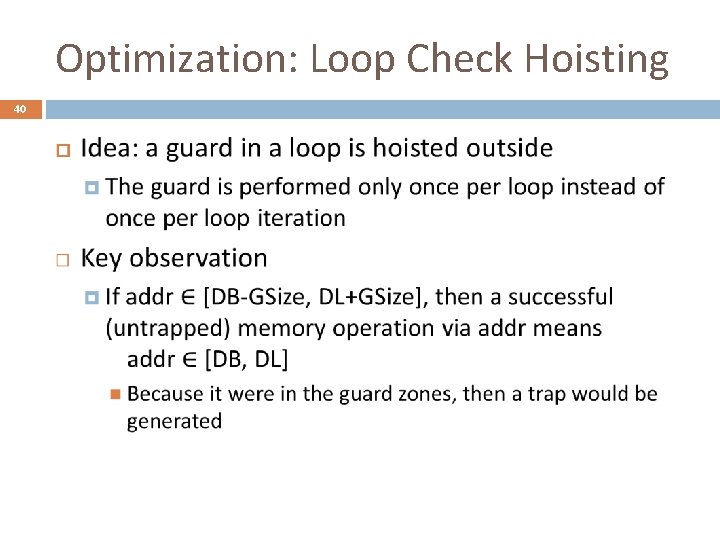
Optimization: Loop Check Hoisting 40
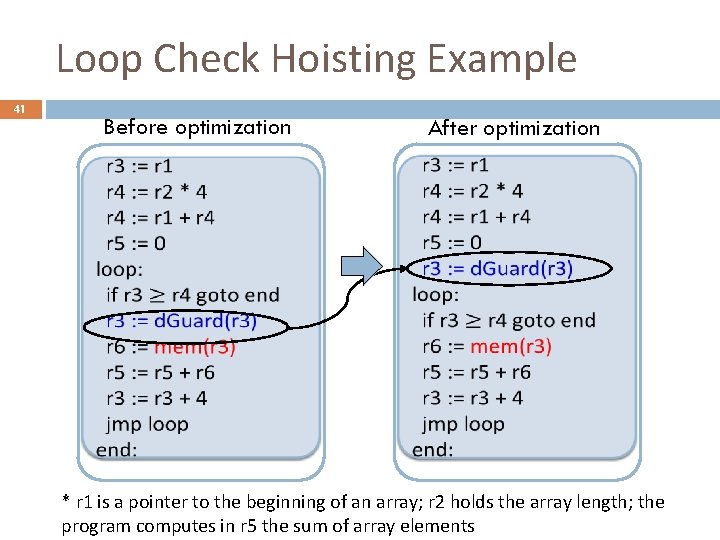
Loop Check Hoisting Example 41 Before optimization After optimization * r 1 is a pointer to the beginning of an array; r 2 holds the array length; the program computes in r 5 the sum of array elements
![42 Why is the Previous Optimized Code Safe? [DB, DL+4] µ [DB-GSize, DL+GSize]](http://slidetodoc.com/presentation_image_h/92bf23c5ec340fd400ca0c5ddd8f023e/image-42.jpg "42 Why is the Previous Optimized Code Safe? [DB, DL+4] µ [DB-GSize, DL+GSize]")
42 Why is the Previous Optimized Code Safe? [DB, DL+4] µ [DB-GSize, DL+GSize]
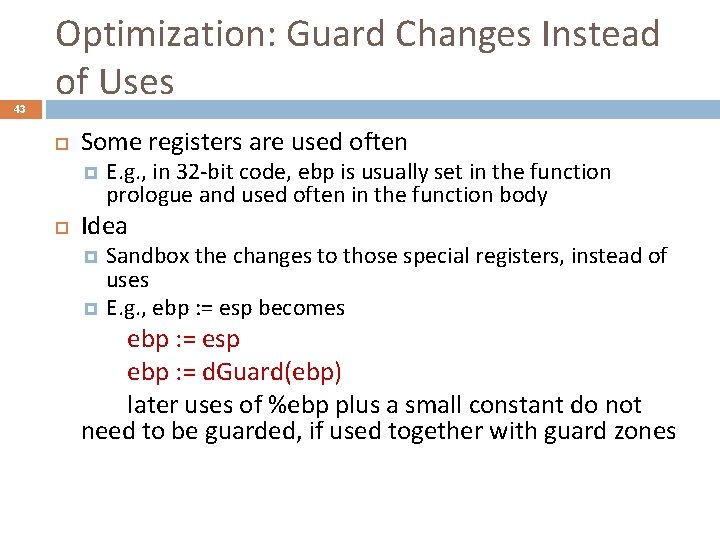
43 Optimization: Guard Changes Instead of Uses Some registers are used often E. g. , in 32 -bit code, ebp is usually set in the function prologue and used often in the function body Idea Sandbox the changes to those special registers, instead of uses E. g. , ebp : = esp becomes ebp : = esp ebp : = d. Guard(ebp) later uses of %ebp plus a small constant do not need to be guarded, if used together with guard zones
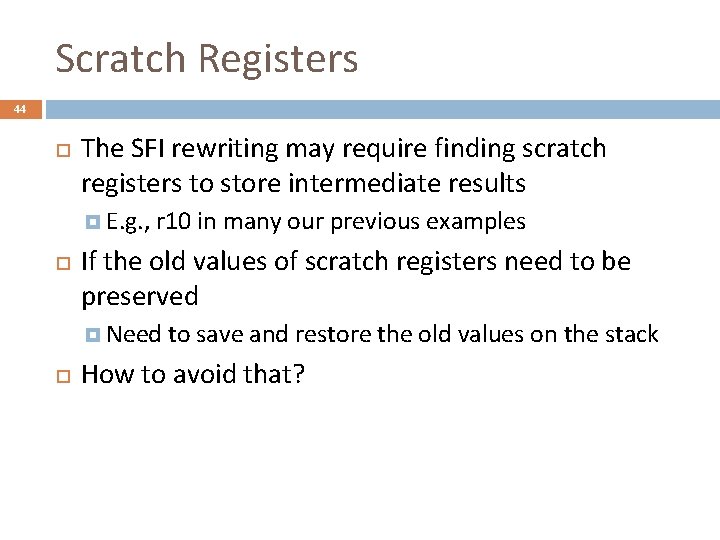
Scratch Registers 44 The SFI rewriting may require finding scratch registers to store intermediate results E. g. , r 10 in many our previous examples If the old values of scratch registers need to be preserved Need to save and restore the old values on the stack How to avoid that?
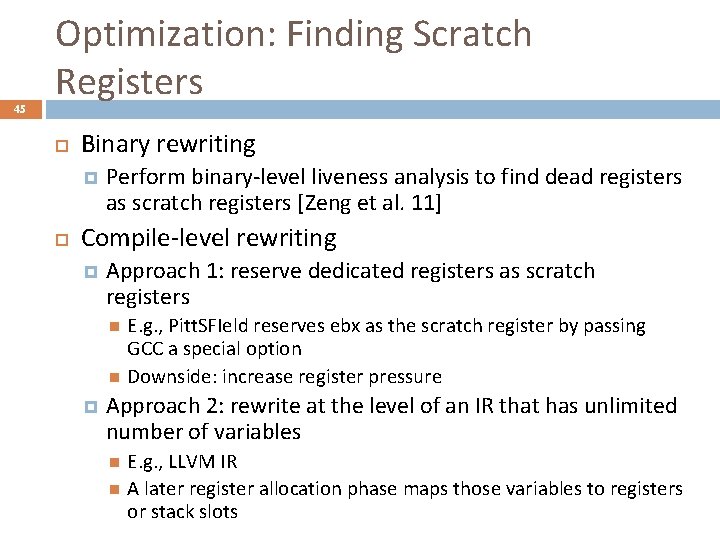
45 Optimization: Finding Scratch Registers Binary rewriting Perform binary-level liveness analysis to find dead registers as scratch registers [Zeng et al. 11] Compile-level rewriting Approach 1: reserve dedicated registers as scratch registers E. g. , Pitt. SFIeld reserves ebx as the scratch register by passing GCC a special option Downside: increase register pressure Approach 2: rewrite at the level of an IR that has unlimited number of variables E. g. , LLVM IR A later register allocation phase maps those variables to registers or stack slots
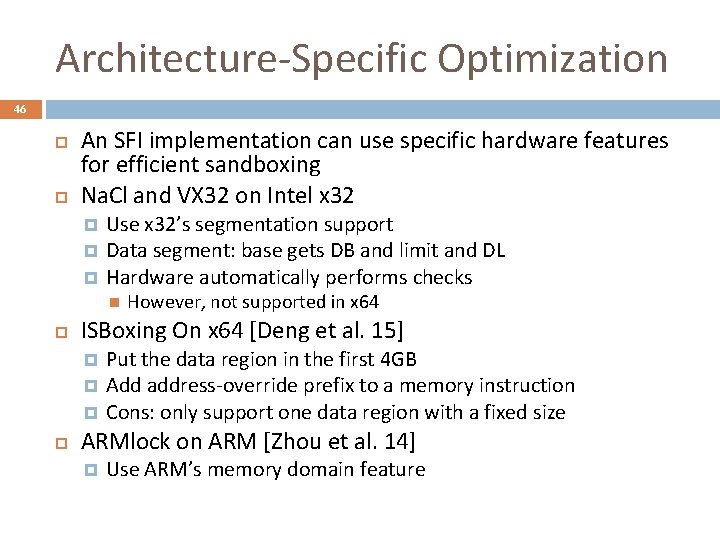
Architecture-Specific Optimization 46 An SFI implementation can use specific hardware features for efficient sandboxing Na. Cl and VX 32 on Intel x 32 Use x 32’s segmentation support Data segment: base gets DB and limit and DL Hardware automatically performs checks ISBoxing On x 64 [Deng et al. 15] However, not supported in x 64 Put the data region in the first 4 GB Add address-override prefix to a memory instruction Cons: only support one data region with a fixed size ARMlock on ARM [Zhou et al. 14] Use ARM’s memory domain feature
47 ENFORCING SFI’S CONTROL-FLOW POLICY
Control-Flow Policy 48
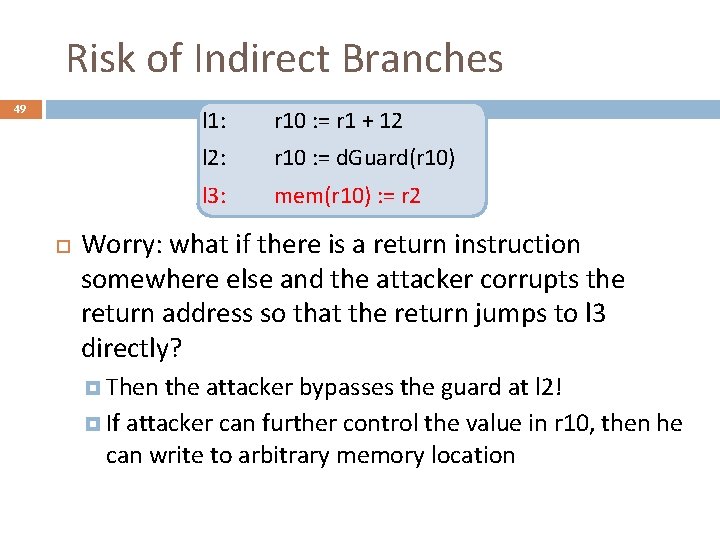
Risk of Indirect Branches 49 l 1: r 10 : = r 1 + 12 l 2: r 10 : = d. Guard(r 10) l 3: mem(r 10) : = r 2 Worry: what if there is a return instruction somewhere else and the attacker corrupts the return address so that the return jumps to l 3 directly? Then the attacker bypasses the guard at l 2! If attacker can further control the value in r 10, then he can write to arbitrary memory location
Risk of Indirect Branches 50 In general, any indirect branch might cause such a worry If not carefully checked, it may bypass the guard Indirect branches include Indirect calls (calls via register or memory operands) Indirect jumps (jumps via register or memory operands) Return instructions In contrast, direct branches are easy to deal with Targets of a direct branch encoded in the instruction; can statically inspect the target
![51 The Original SFI Solution [Wahbe et al. 93] Make r 10 (in MIPS)](http://slidetodoc.com/presentation_image_h/92bf23c5ec340fd400ca0c5ddd8f023e/image-51.jpg "51 The Original SFI Solution [Wahbe et al. 93] Make r 10 (in MIPS)")
51 The Original SFI Solution [Wahbe et al. 93] Make r 10 (in MIPS) a dedicated register r 10 only used in the monitor code, not used by application code Also maintain the invariant that r 10 always contains an address in DR before any branch So even if the attacker bypasses the guard before a memory operation, the memory access stays within DR Cons? Reduce the number of registers available to application code Allow an indirect branch to target the middle of an instruction; problem for variable-sized instruction sets
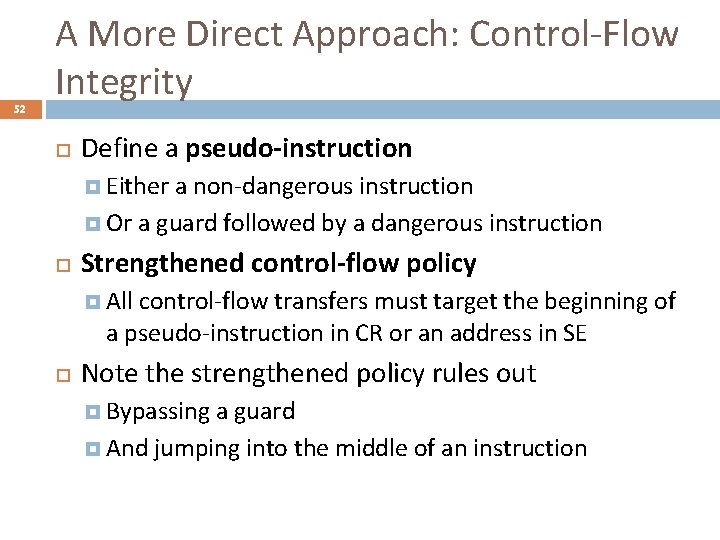
52 A More Direct Approach: Control-Flow Integrity Define a pseudo-instruction Either a non-dangerous instruction Or a guard followed by a dangerous instruction Strengthened control-flow policy All control-flow transfers must target the beginning of a pseudo-instruction in CR or an address in SE Note the strengthened policy rules out Bypassing a guard And jumping into the middle of an instruction
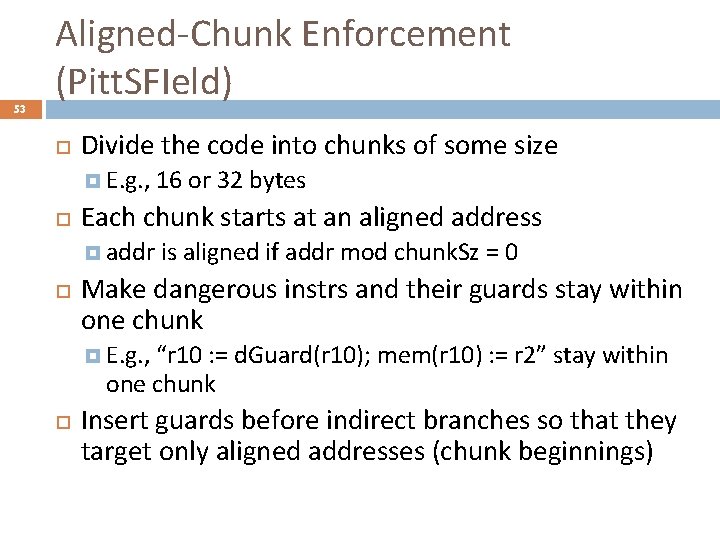
53 Aligned-Chunk Enforcement (Pitt. SFIeld) Divide the code into chunks of some size E. g. , 16 or 32 bytes Each chunk starts at an aligned address addr is aligned if addr mod chunk. Sz = 0 Make dangerous instrs and their guards stay within one chunk E. g. , “r 10 : = d. Guard(r 10); mem(r 10) : = r 2” stay within one chunk Insert guards before indirect branches so that they target only aligned addresses (chunk beginnings)
![Example 54 Assume CR is [0 x 10000000, 0 x 1000 FFFF] Chunk size](http://slidetodoc.com/presentation_image_h/92bf23c5ec340fd400ca0c5ddd8f023e/image-54.jpg "Example 54 Assume CR is [0 x 10000000, 0 x 1000 FFFF] Chunk size")
Example 54 Assume CR is [0 x 10000000, 0 x 1000 FFFF] Chunk size is 16 bytes Zero-ID region [0 x 0000, 0 x 0000 FFFF] unmapped Then “jmp r” becomes r : = r & 0 x 1000 FFF 0 jmp r Q: why does the above ensures that the target address is (1) in CR or zero-ID region, and (2) a chunk beginning - after &, r’s upper 16 bits must be either 0 x 0000 or 0 x 1000 - after &, r’s lower four bits must all be 0, meaning it’s 16 byte aligned
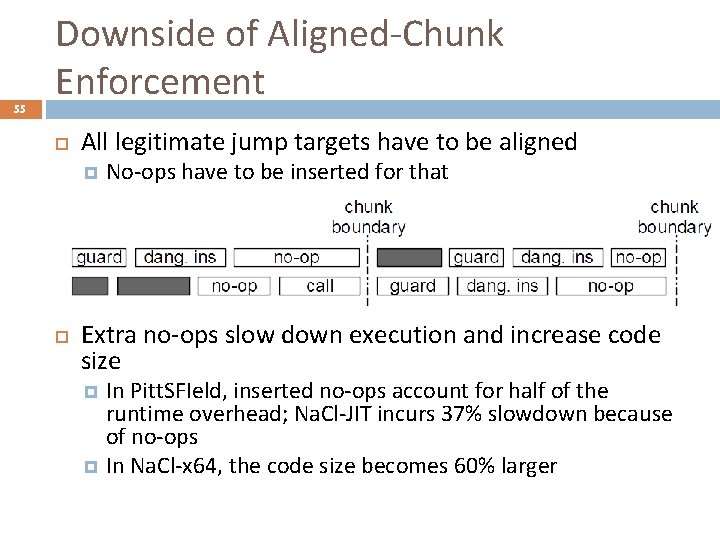
55 Downside of Aligned-Chunk Enforcement All legitimate jump targets have to be aligned No-ops have to be inserted for that Extra no-ops slow down execution and increase code size In Pitt. SFIeld, inserted no-ops account for half of the runtime overhead; Na. Cl-JIT incurs 37% slowdown because of no-ops In Na. Cl-x 64, the code size becomes 60% larger
![56 Bitmap Based Enforcement (MIP [Niu & Tan, 13]) Allow variable-sized chunks A guard](http://slidetodoc.com/presentation_image_h/92bf23c5ec340fd400ca0c5ddd8f023e/image-56.jpg "56 Bitmap Based Enforcement (MIP [Niu & Tan, 13]) Allow variable-sized chunks A guard")
56 Bitmap Based Enforcement (MIP [Niu & Tan, 13]) Allow variable-sized chunks A guard and the following dangerous instr still stay within one chunk Chunk beginnings are remembered in an immutable bitmap Before an indirect branch, insert a guard to check if b[addr] is 1, assuming addr is the target b[addr]=1 iff addr is the beginning of a chunk If not, jump to error Benefit: no need to insert no-ops MIP-x 32: 4% runtime overhead; 13% code increase MIP-x 64: 7% runtime overhead; 16% code increase
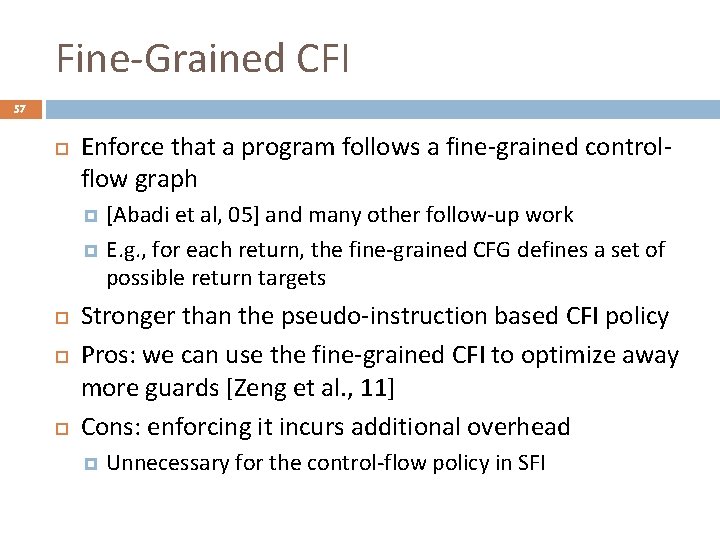
Fine-Grained CFI 57 Enforce that a program follows a fine-grained controlflow graph [Abadi et al, 05] and many other follow-up work E. g. , for each return, the fine-grained CFG defines a set of possible return targets Stronger than the pseudo-instruction based CFI policy Pros: we can use the fine-grained CFI to optimize away more guards [Zeng et al. , 11] Cons: enforcing it incurs additional overhead Unnecessary for the control-flow policy in SFI
Jumping Outside of Fault Domains 58 Total isolation is rarely what’s desired in practice Sandboxed code must interact with other parts of the system for its functionality E. g. , a browser plug-in must communicate with the browser’s core for exchanging data with the core and other plug-ins
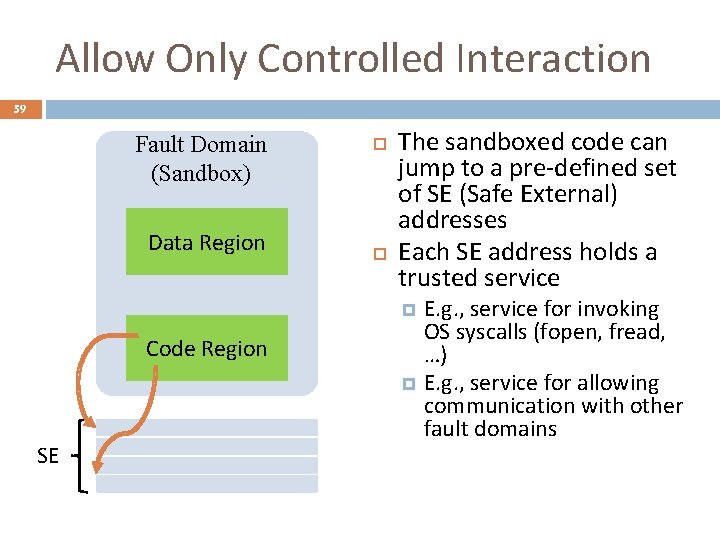
Allow Only Controlled Interaction 59 Fault Domain (Sandbox) 59 Data Region The sandboxed code can jump to a pre-defined set of SE (Safe External) addresses Each SE address holds a trusted service E. g. , service for invoking OS syscalls (fopen, fread, …) E. g. , service for allowing communication with other fault domains Code Region SE
Trusted Services 60 Implemented outside of the fault domain They can implement additional security policies E. g. , can restrict fopen to open files only in a particular directory Or can disallow fopen completely Just do not set up a service entry for fopen
61 APPLICATIONS OF SFI
SFI Applications Overview 62 Isolating OS kernel modules such as device drivers Mi. SFIT [Small 97]; XFI [Erlingsson et al. 06]; BGI [Castro et al. 09]; LXFI [Mao et al. 11] Isolating plug-ins in Chrome Na. Cl [Yee et al. 09]; Na. Cl-x 64 [Sehr et al. 10] Isolating native libraries in the Java Virtual Machine Robusta [Siefers et al. 10]; Arabica[Sun & Tan 12]
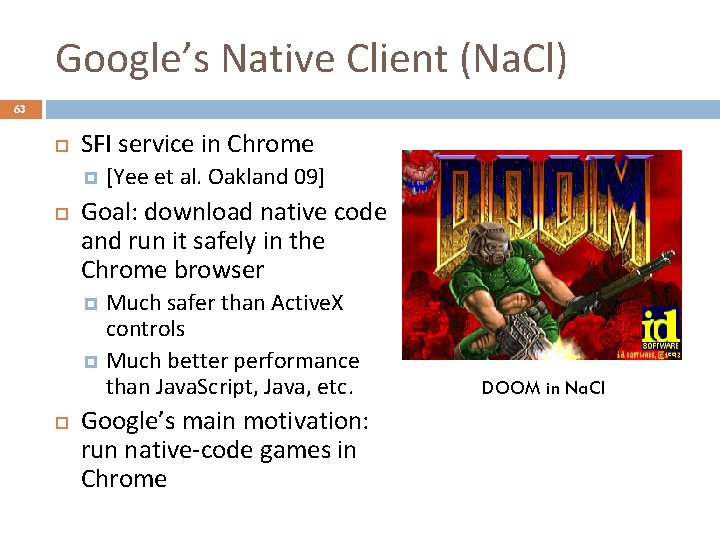
Google’s Native Client (Na. Cl) 63 SFI service in Chrome [Yee et al. Oakland 09] Goal: download native code and run it safely in the Chrome browser Much safer than Active. X controls Much better performance than Java. Script, Java, etc. Google’s main motivation: run native-code games in Chrome DOOM in Na. Cl
Na. Cl: Code Verification 64 Code is verified before running Allow restricted subset of x 86 instructions No unsafe instructions: memory-dependent jmp and call, privileged instructions, modifications of segment state, … Ensure SFI checks are correctly implemented for the SFI policy
Na. Cl Sandboxing 65 x 86 -32 sandboxing based on hardware segments Sandboxing reads and writes for free 5% overhead for SPEC 2000 benchmarks However, hardware segments not available in x 8664 or ARM Use instructions for address masking [Sehr et al. 10] x 86 -64/ARM: 20% for sandboxing mem writes and computed jumps
Na. Cl SDK 66 Modified GCC tool-chain Inserts appropriates masks, alignment requirements Trampolines allow restricted system-call interface and also interaction with the browser Pepper API: access to the browser, DOM, 3 D acceleration, etc.
![Robusta [Siefers, Tan, Morrisett 10] 67 SFI service in a Java Virtual Machine (JVM)](http://slidetodoc.com/presentation_image_h/92bf23c5ec340fd400ca0c5ddd8f023e/image-67.jpg "Robusta [Siefers, Tan, Morrisett 10] 67 SFI service in a Java Virtual Machine (JVM)")
Robusta [Siefers, Tan, Morrisett 10] 67 SFI service in a Java Virtual Machine (JVM) Allow Java code to invoke native code safely through the Java Native Interface (JNI) The basic idea Put native code in an SFI sandbox and allows only controlled access to JVM services
![Robusta [Siefers, Tan, Morrisett 10] 68 SFI sandbox Native libs JVM J N I](http://slidetodoc.com/presentation_image_h/92bf23c5ec340fd400ca0c5ddd8f023e/image-68.jpg "Robusta [Siefers, Tan, Morrisett 10] 68 SFI sandbox Native libs JVM J N I")
Robusta [Siefers, Tan, Morrisett 10] 68 SFI sandbox Native libs JVM J N I Operating q q q Native Code Threat Direct JVM mem access Abusive JNI calls OS syscalls Java code System q q q Robusta Remedy SFI: Prevent direct JVM access Perform JNI safety checking Reroute syscall requests to Java’s security manager
69 FUTURE DIRECTIONS
Future Directions 70 Tool and programming support for program partitioning How to turn a monolithic application into components in separate protection domains? Privilege separation It took Google significant effort to privilege separate Chrome into a system of cooperating processes [Barth et al. 08]
Future Directions 71 Security enforcement on interface code Trusted services in SE addresses are security critical Experience shows that bugs are plenty in such interface code Should apply program analysis/verification for bug finding Or take a specification about interface security and enforce the security a la LXFI [Mao et al. 11]
Future Directions 72 Side channel control SFI provides memory isolation but side channels are possible E. g. , we might structure a server to have a trusted core and have a sandbox to handle each client connections However, if the core maintains some state that is shared by all connections, there might be a side channel Similar channels were discovered in TCP (“Off-Path TCP Exploits: Global Rate Limit Considered Dangerous”)
Future Directions 73 Recovery mechanism Address checking terminates the sandbox when there is an illegal access May still need to release resources Address masking turns an illegal access to a legal one May cause a benign but buggy sandboxed component to misbehave It does not pinpoint the violating instruction [Seltzer et al. 96] Wrap sandbox calls in transactions Transactions are aborted when sandbox misbehavior is detected; resources are released as a result
More in the Survey Article 74 G. Tan “Principles and Implementation Techniques of Software-Based Fault Isolation”, Foundations and Trends in Privacy and Security: Vol. 1, No. 3, pp 137– 198. http: //www. cse. psu. edu/~gxt 29/papers/sfi-final. pdf SFI verifier Verifies that the result after SFI rewriting is correct Basic idea and formalization References
- Slides: 74