
PRINCIPLES A BASIC PRINCIPLES B LEGAL PRINCIPLES A


PRINCIPLES : A. BASIC PRINCIPLES B. LEGAL PRINCIPLES
(A) BASIC PRINCIPLES 1. PRINCIPLE OF CO-OPERATION 2. PRINCIPLE OF PROBABILITY

(B) LEGAL PRINCIPLE 1) Principle of insurable interest 2) Principle of indemnity 3) Principle of subrogation 4) Principle of approximate cause or cause proxima 5) Principle of contribution. 6) Principle of utmost good faith 7) Principle of mitigation of losses.
PRINCIPLE OF INSURANCE INTEREST An insurance contract will be valid only if the person getting a policy must possess an insurable interest in the subject matter. In the absence of an insurable interest, the insurance contract will be wagering contract which is invalid and unenforceable.
ESSENTIALS OF INSURABLE INTEREST There must be a subject matter to be insured. The policy holder should have monetary interest in the subject matter. The relationship between the policy holder and the subject matter should be recognized by law The economic relationship between the policy-holder and the subject matter should be such that the policy holder is economically benefitted by the existence

INSURABLE INTEREST IN LIFE INSURANCE i. iii. iv. v. vii. A person has unlimited insurable interest in his own life. A husband in the life of his wife and vice-versa. A father in the life of a dependent son and vice -versa. A partner in the lives of his co-partners. A creditor in the life of a debtor to the extent of the amount o debt. A sister in the loves of his employees. A mother and a son in the lives of each other.
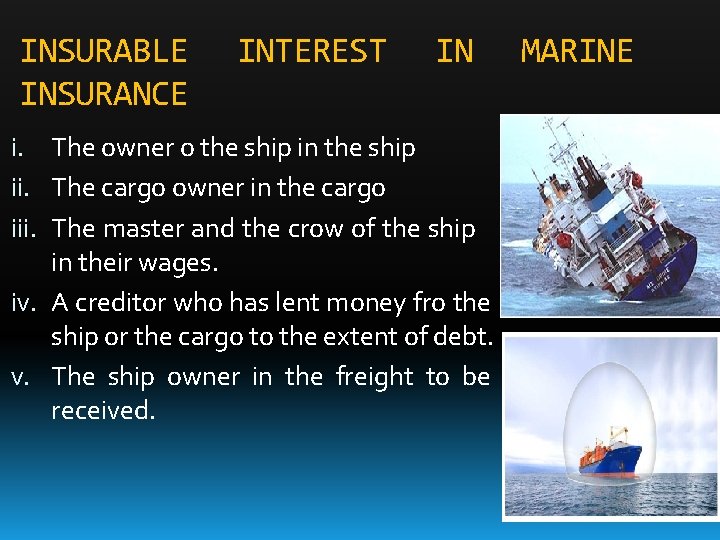
INSURABLE INSURANCE INTEREST IN i. The owner o the ship in the ship ii. The cargo owner in the cargo iii. The master and the crow of the ship in their wages. iv. A creditor who has lent money fro the ship or the cargo to the extent of debt. v. The ship owner in the freight to be received. MARINE

INSURABLE INSURANCE i. iii. iv. v. vii. INTEREST IN The owner of a property in his own property. Partners in the property of partnership. The owners of joint property A creditor having a lien on property to the extent of debt. An agent has interest in the property of his principle. A bailee in the properties bailed. A lessee on the properties under lease. FIRE

PRINCIPLE OF INDEMNITY Indemnity in simple words mean a promise to compensate the loss. Under insurance contract, the insurer undertakes to indemnify the insured against lose suffered by the latter. Prof. Hawell has defined indemnity as “an exact financial compensation.

FEATURES OF PRINCIPLE OF INDEMNITY Principle of indemnity does not apply to life insurance. There must be an actual loss and insurer has to compensate it under the policy. The loss should have occurred from the risk insured. The compensation cannot exceed actual loss. The compensation will be paid by the insurer.
CONDITIONS FOR INDEMNITY The insured has to prove that he has suffered a loss on the subject matter and if is the monetary lose. The indemnified amount cannot exceed the amount of loss suffered. The insurer has a right to recover the extra amount if it is paid to the insured. This principle is not applicable to life insurance.
ADVANTAGES OF PRINCIPLE OF INDEMNITY The amount paid to compensate the loss suffered cannot exceed actual loss, there is no temptation to show loss at higher figures. In case the insured is given a gain in compensation then anti-social elements will be tempted to destroy their property for getting more compensation than the loss suffered.
METHODS OF PROVIDING INDEMNITY i. CASH PAYMENT ii. REPAIRS iii. REPLACEMENT iv. REINSTATEMENT
PRINCIPLE OF SUBROGATION Principle of subrogation supplements the principle of indemnity. In simple words, subrogation means stepping into shoes of another. Once the insurer compensates the insured for the loss suffered by him, he will inherit all the rights available to the insured against the third parties with regard to the subject-matter.
FEATURES OF DOCTRINE OF SUBROGATION I. Corollary to principle of Indemnity II. Subrogation III. Subrogation only upto the Amount of Payment. IV. Subrogation may be applied before payment. V. Personal Insurance
ESSENTIALS OF SUBROGATION Extension of principle of indemnity. Substitutes Subrogation only upto payment Subrogation for the balance Life insurance
How does subrogation arise? ØTort ØContract ØSubject matter of insurance
Principle Of Proximate Cause According to this principle the cause or reason for the loss must be related to the subject matter of the insurance contract. If the loss is due to some other cause then the insurer can deny to pay the compensation.
Determination of proximate cause v. Single cause v. Concurrent cause vsuccessive cause
Principle of contribution states that if a person has taken more than one insurance policy for the same subject matter then all the insurers will contribute the amount of loss and compensate him for the actual amount of loss. Separately he can not claim total loss from each insurer. Formula to compute the liability of each insurer is: Sum assured with a particular insurer Total sum insured x Actual loss
Need for principle of contribution üThis principle is needed so that insured can’t claim more amount than the loss suffered by him. üIf insured receives more amount than the loss suffered by him then he will be placed in a better position that prior to the loss and thereby the basic principle of indemnity will fail. üIn case the insured collects the amount from one insurer, the insurer paying the total loss can collect it from other insurers with whom the insured has insured the same subject matter.
Pre-condition for principle of contribution üSubject matter of insurance should be same for all the policies. üThe perils which cause the loss must be common to all the policies. üThe policies must be enforceable under the law. üAll the policies must be in force at the time of loss. üThe insurable interest under all policies must be the same and all policies must be effected in favour of a common person.
Principle of utmost good faith According to this principle insurance is a contract based on faith. The insured and insurer must disclose all the material facts to each other and both the parties should not hides any fact related to insurance policy from each other. If the insured hides any material facts from the insurance company and later on the insurer comes to know about it, then he can refuse to pay compensation.

Principle of mitigation of loss According to this principle the insured must take care of his property or subject matter of insurance in the same ways as he would take care without taking the insurance policy. The insured should not become careless of his property after taking insurance policy. It is the duty of the insured to make a reasonable efforts and take all available precautions to save the insured property.

T k n a h u o y
- Slides: 26