
Principle Shells and Subshells Principle electronic shell n
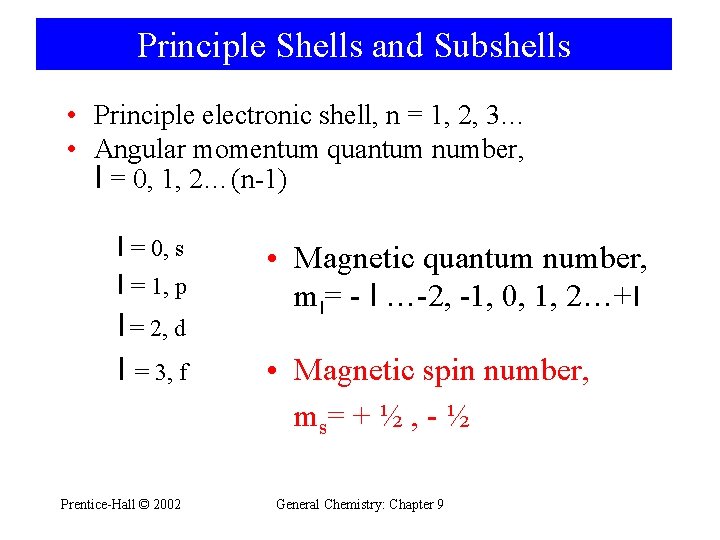
Principle Shells and Subshells • Principle electronic shell, n = 1, 2, 3… • Angular momentum quantum number, l = 0, 1, 2…(n-1) l = 0, s l = 1, p l = 2, d l = 3, f Prentice-Hall © 2002 • Magnetic quantum number, ml= - l …-2, -1, 0, 1, 2…+l • Magnetic spin number, m s= + ½ , - ½ General Chemistry: Chapter 9
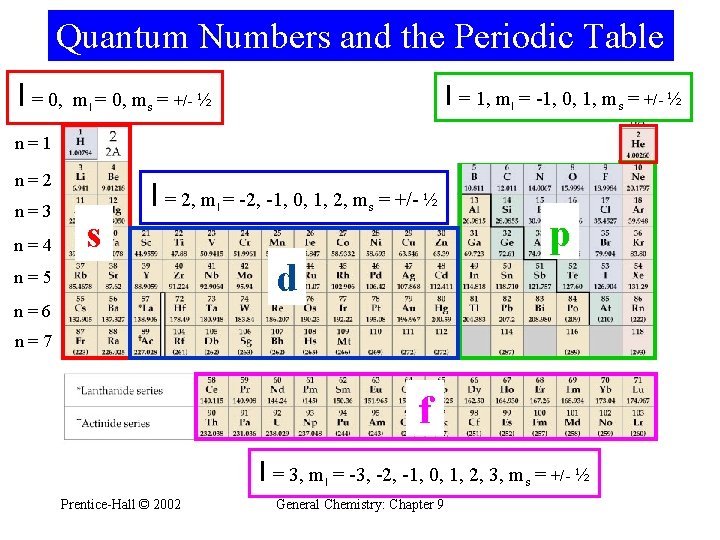
Quantum Numbers and the Periodic Table l = 0, m = +/- ½ l l = 1, ml = -1, 0, 1, ms = +/- ½ s n=1 n=2 n=3 n=4 s l = 2, m = -2, -1, 0, 1, 2, m = +/- ½ n=5 s l p d n=6 n=7 f l = 3, ml = -3, -2, -1, 0, 1, 2, 3, ms = +/- ½ Prentice-Hall © 2002 General Chemistry: Chapter 9
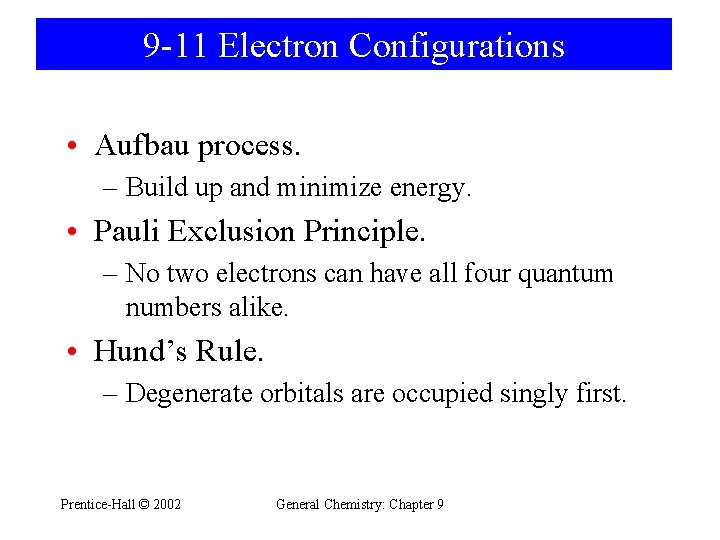
9 -11 Electron Configurations • Aufbau process. – Build up and minimize energy. • Pauli Exclusion Principle. – No two electrons can have all four quantum numbers alike. • Hund’s Rule. – Degenerate orbitals are occupied singly first. Prentice-Hall © 2002 General Chemistry: Chapter 9
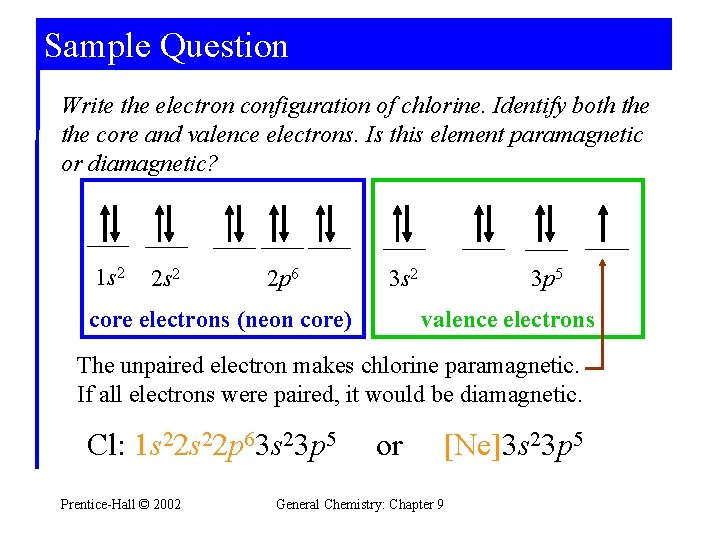
Sample Question Write the electron configuration of chlorine. Identify both the core and valence electrons. Is this element paramagnetic or diamagnetic? 1 s 2 2 p 6 3 p 5 3 s 2 core electrons (neon core) valence electrons The unpaired electron makes chlorine paramagnetic. If all electrons were paired, it would be diamagnetic. Cl: 1 s 22 p 63 s 23 p 5 Prentice-Hall © 2002 or [Ne]3 s 23 p 5 General Chemistry: Chapter 9
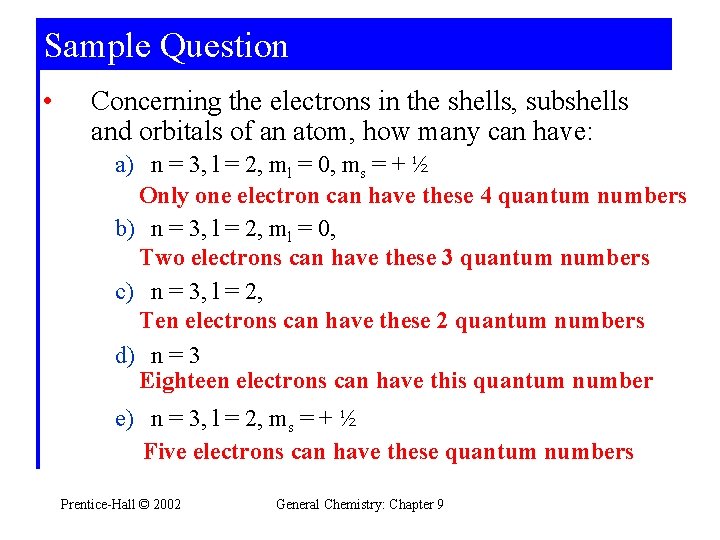
Sample Question • Concerning the electrons in the shells, subshells and orbitals of an atom, how many can have: a) n = 3, l = 2, ml = 0, ms = + ½ Only one electron can have these 4 quantum numbers b) n = 3, l = 2, ml = 0, Two electrons can have these 3 quantum numbers c) n = 3, l = 2, Ten electrons can have these 2 quantum numbers d) n = 3 Eighteen electrons can have this quantum number e) n = 3, l = 2, ms = + ½ Five electrons can have these quantum numbers Prentice-Hall © 2002 General Chemistry: Chapter 9
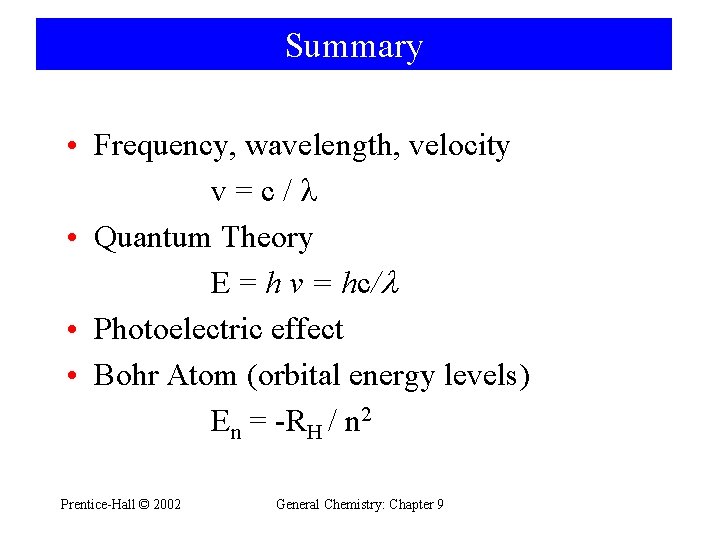
Summary • Frequency, wavelength, velocity v=c/l • Quantum Theory E = h v = hc/l • Photoelectric effect • Bohr Atom (orbital energy levels) En = -RH / n 2 Prentice-Hall © 2002 General Chemistry: Chapter 9
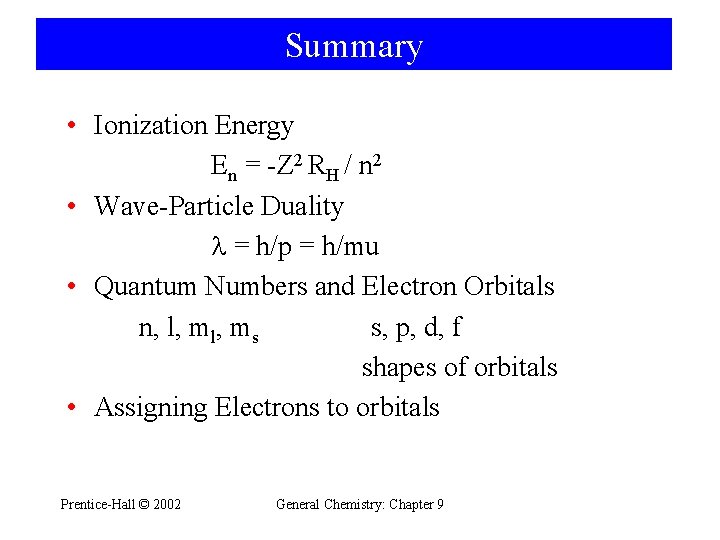
Summary • Ionization Energy En = -Z 2 RH / n 2 • Wave-Particle Duality l = h/p = h/mu • Quantum Numbers and Electron Orbitals n, l, ms s, p, d, f shapes of orbitals • Assigning Electrons to orbitals Prentice-Hall © 2002 General Chemistry: Chapter 9
Chapter 9 Questions 1, 2, 3, 4, 12, 15, 17, 19, 22, 25, 34, 35, 41, 67, 69, 71, 83, 85, 93, 98 Prentice-Hall © 2002 General Chemistry: Chapter 9
General Chemistry Principles and Modern Applications Petrucci • Harwood • Herring 8 th Edition Chapter 10: The Periodic Table and Some Atomic Properties Philip Dutton University of Windsor, Canada N 9 B 3 P 4 Prentice-Hall © 2002 (modified 2003 by Dr. Paul Root and 2005 by Dr. David Tramontozzi) General Chemistry: Chapter 10
Contents 10 -1 Classifying the Elements: The Periodic Law and the Periodic Table 10 -2 Metals and Nonmetals and Their Ions 10 -3 The Sizes of Atoms and Ions 10 -4 Ionization Energy 10 -5 Electron Affinity 10 -6 Magnetic Properties 10 -7 Periodic Properties of the Element General Chemistry: Chapter 10
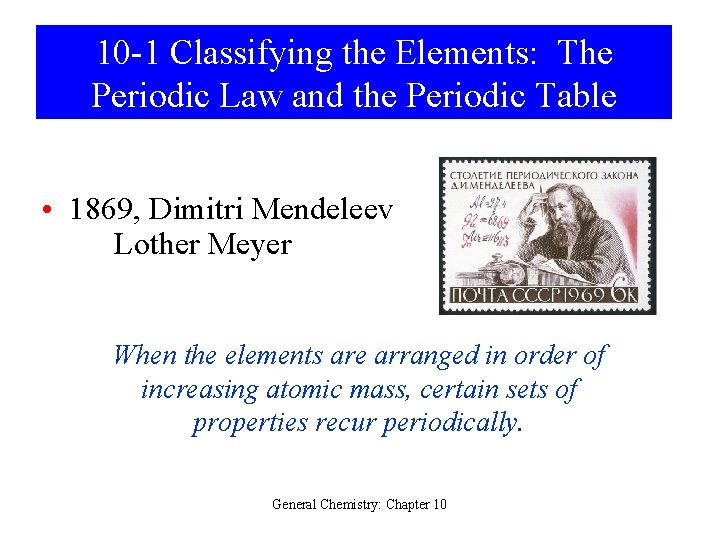
10 -1 Classifying the Elements: The Periodic Law and the Periodic Table • 1869, Dimitri Mendeleev Lother Meyer When the elements are arranged in order of increasing atomic mass, certain sets of properties recur periodically. General Chemistry: Chapter 10
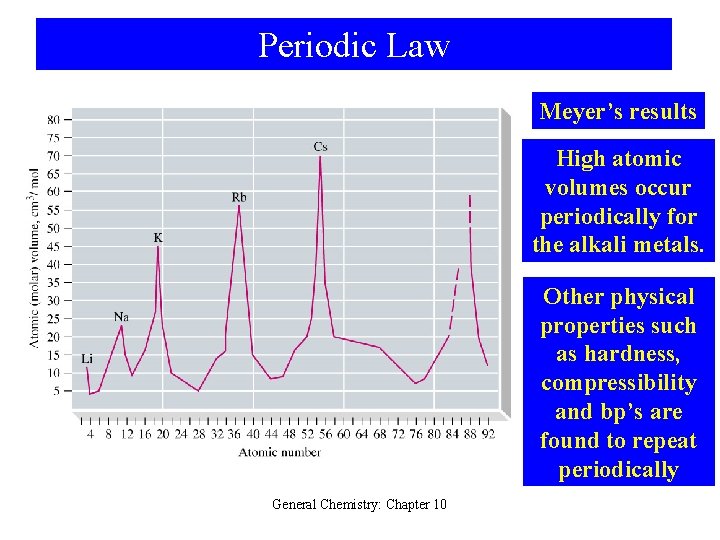
Periodic Law Meyer’s results High atomic volumes occur periodically for the alkali metals. Other physical properties such as hardness, compressibility and bp’s are found to repeat periodically General Chemistry: Chapter 10
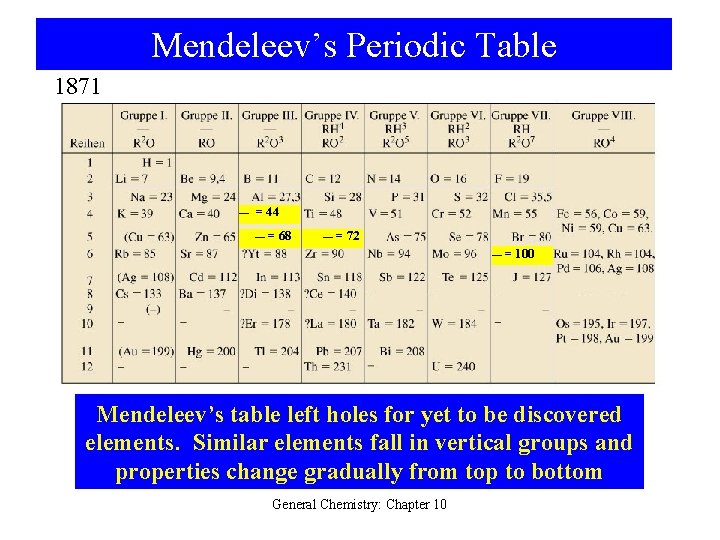
Mendeleev’s Periodic Table 1871 — = 44 — = 68 — = 72 —= 100 Mendeleev’s table left holes for yet to be discovered elements. Similar elements fall in vertical groups and properties change gradually from top to bottom General Chemistry: Chapter 10
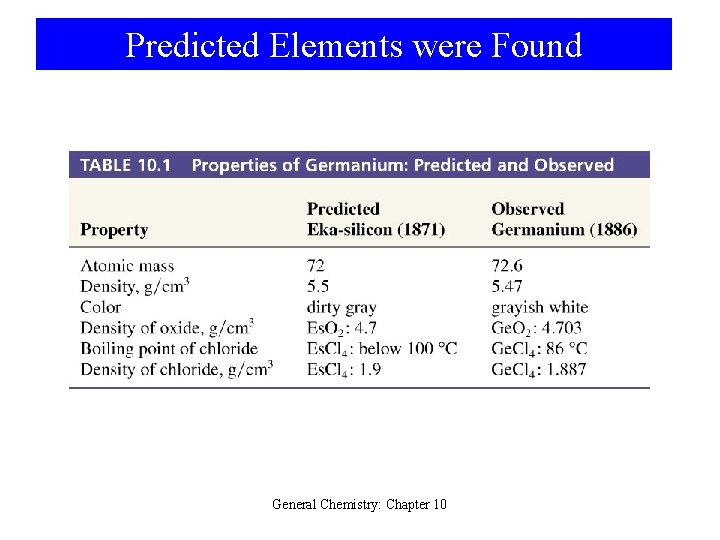
Predicted Elements were Found General Chemistry: Chapter 10
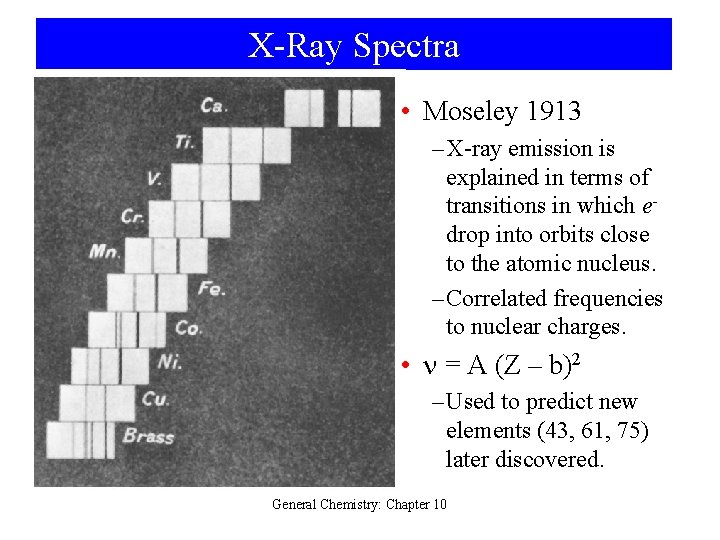
X-Ray Spectra • Moseley 1913 – X-ray emission is explained in terms of transitions in which edrop into orbits close to the atomic nucleus. – Correlated frequencies to nuclear charges. • = A (Z – b)2 – Used to predict new elements (43, 61, 75) later discovered. General Chemistry: Chapter 10
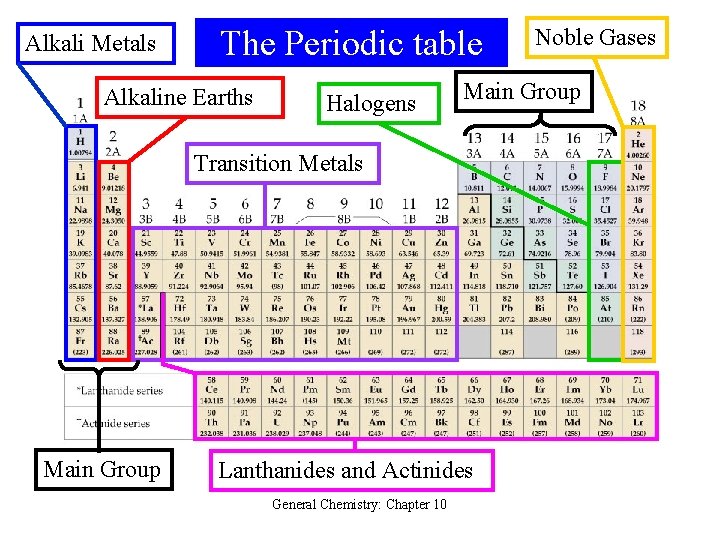
Alkali Metals The Periodic table Alkaline Earths Halogens Main Group Transition Metals Main Group Lanthanides and Actinides General Chemistry: Chapter 10 Noble Gases
10 -2 Metals and Nonmetals and Their Ions • Metals – Good conductors of heat and electricity. – Malleable and ductile. – Moderate to high melting points. • Nonmetals – Nonconductors of heat and electricity. – Brittle solids. – Some are gases at room temperature. General Chemistry: Chapter 10
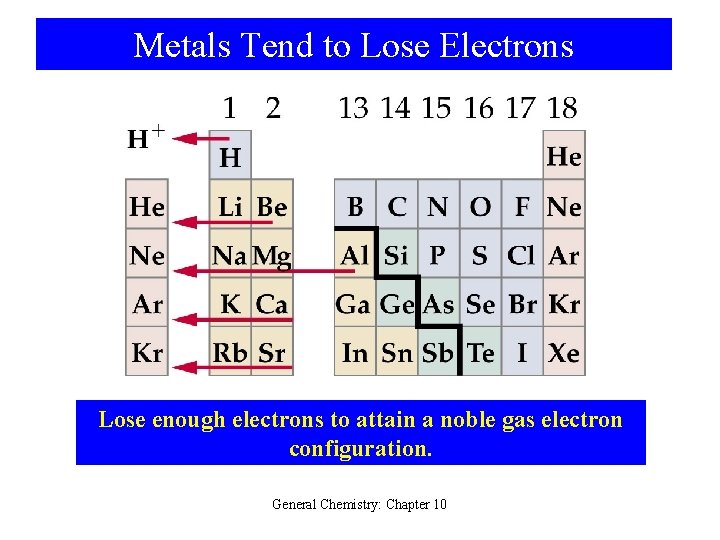
Metals Tend to Lose Electrons Lose enough electrons to attain a noble gas electron configuration. General Chemistry: Chapter 10
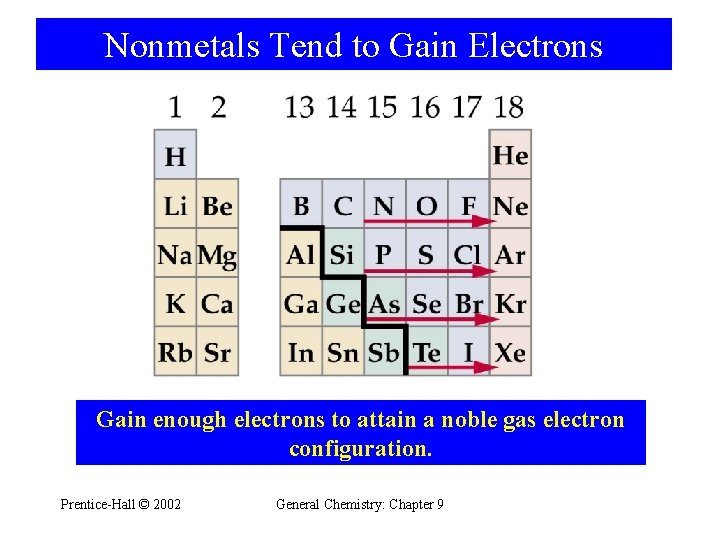
Nonmetals Tend to Gain Electrons Gain enough electrons to attain a noble gas electron configuration. Prentice-Hall © 2002 General Chemistry: Chapter 9
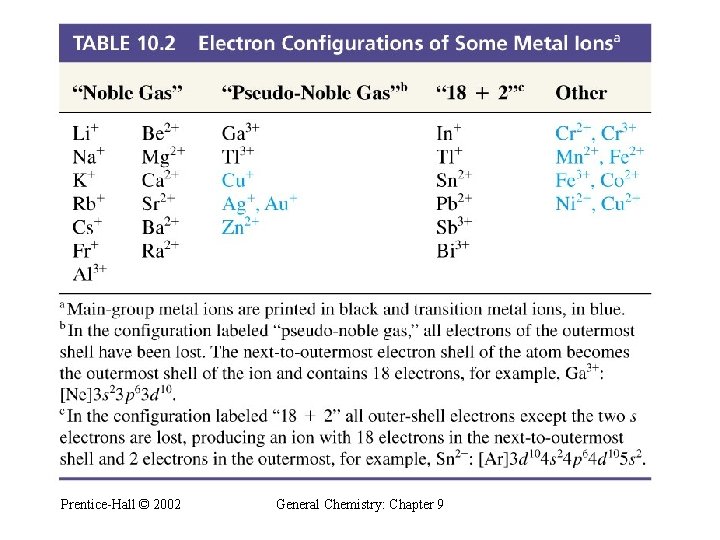
Electron Configuration of Some Ions Prentice-Hall © 2002 General Chemistry: Chapter 9
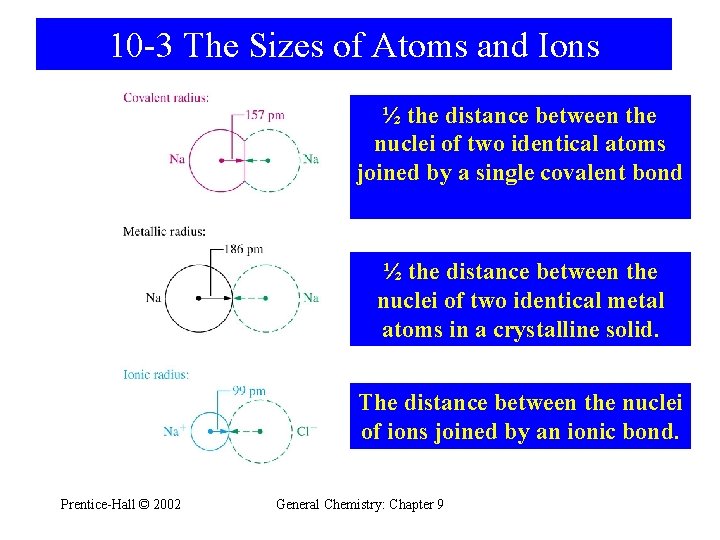
10 -3 The Sizes of Atoms and Ions ½ the distance between the nuclei of two identical atoms joined by a single covalent bond ½ the distance between the nuclei of two identical metal atoms in a crystalline solid. The distance between the nuclei of ions joined by an ionic bond. Prentice-Hall © 2002 General Chemistry: Chapter 9
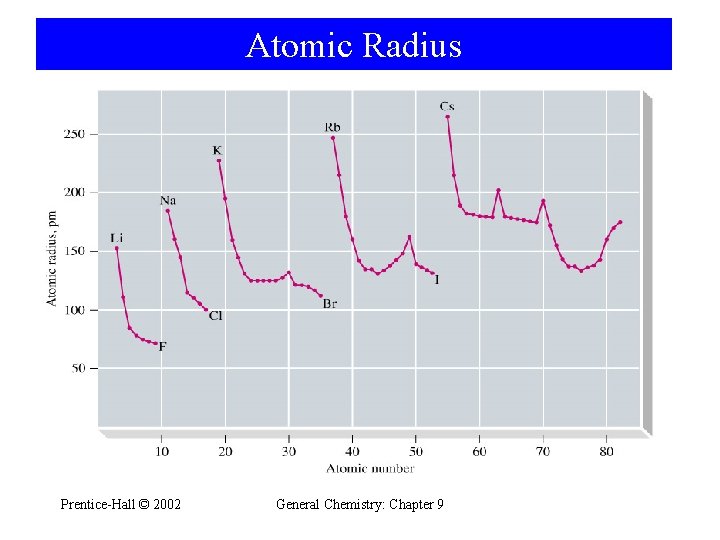
Atomic Radius Prentice-Hall © 2002 General Chemistry: Chapter 9
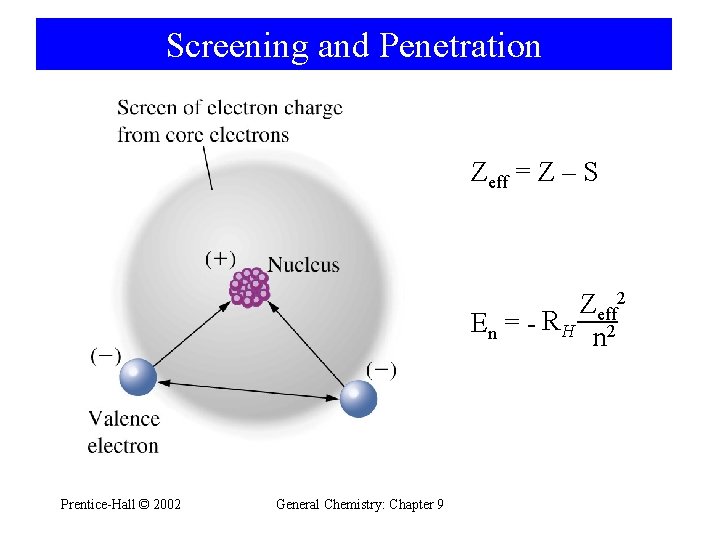
Screening and Penetration Zeff = Z – S Zeff 2 En = - RH 2 n Prentice-Hall © 2002 General Chemistry: Chapter 9
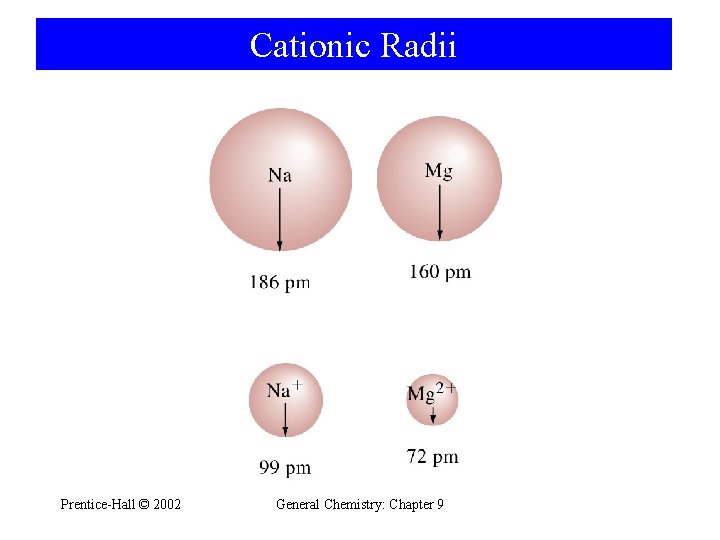
Cationic Radii Prentice-Hall © 2002 General Chemistry: Chapter 9
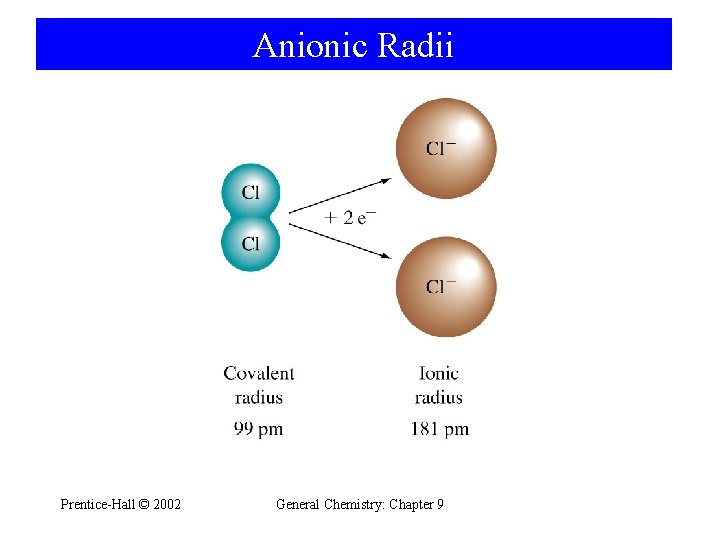
Anionic Radii Prentice-Hall © 2002 General Chemistry: Chapter 9
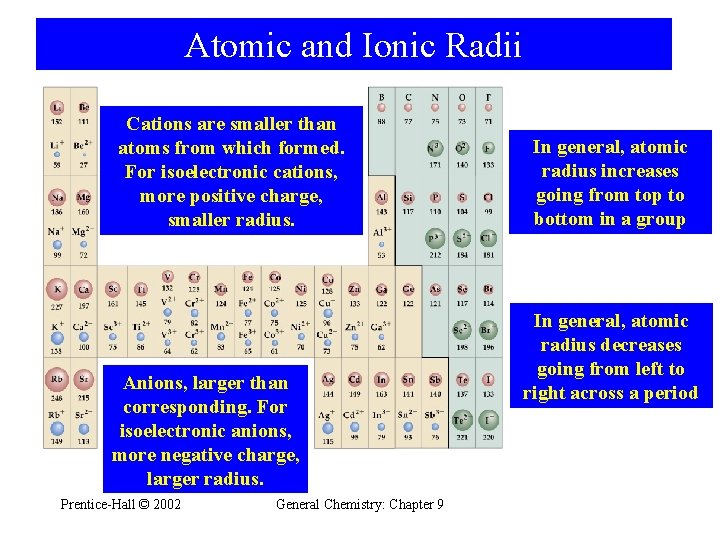
Atomic and Ionic Radii Cations are smaller than atoms from which formed. For isoelectronic cations, more positive charge, smaller radius. Anions, larger than corresponding. For isoelectronic anions, more negative charge, larger radius. Prentice-Hall © 2002 General Chemistry: Chapter 9 In general, atomic radius increases going from top to bottom in a group In general, atomic radius decreases going from left to right across a period
- Slides: 26