
Principle of the process StructureConfiguration Process modeling Defects
- Slides: 21
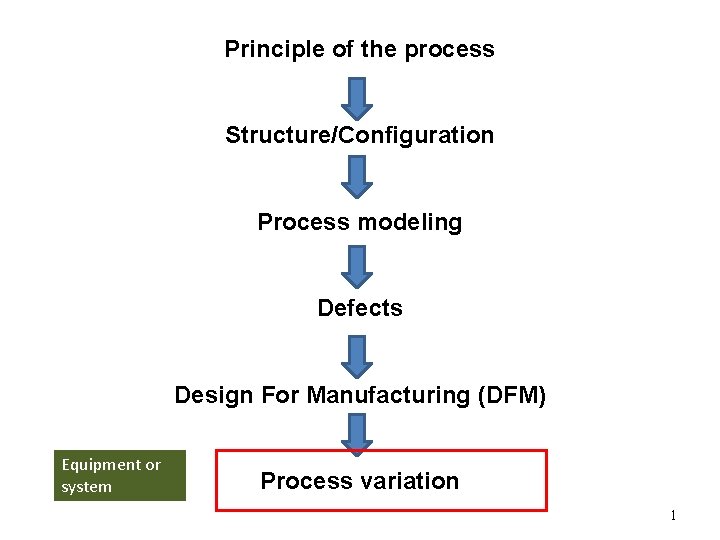
Principle of the process Structure/Configuration Process modeling Defects Design For Manufacturing (DFM) Equipment or system Process variation 1
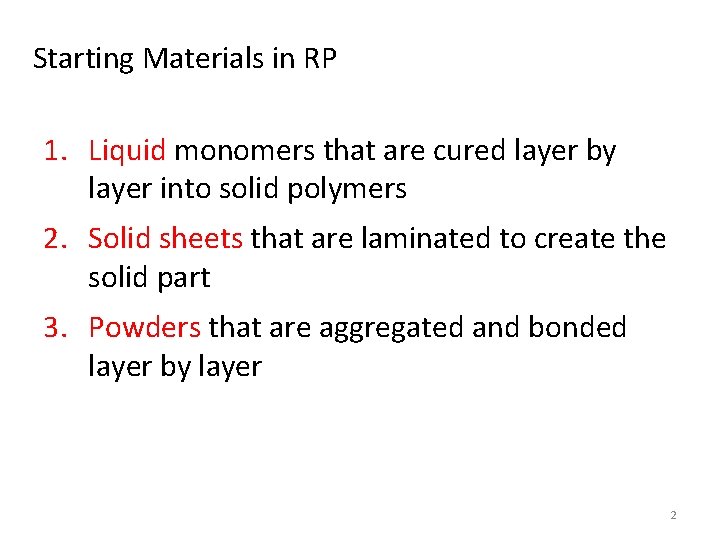
Starting Materials in RP 1. Liquid monomers that are cured layer by layer into solid polymers 2. Solid sheets that are laminated to create the solid part 3. Powders that are aggregated and bonded layer by layer 2
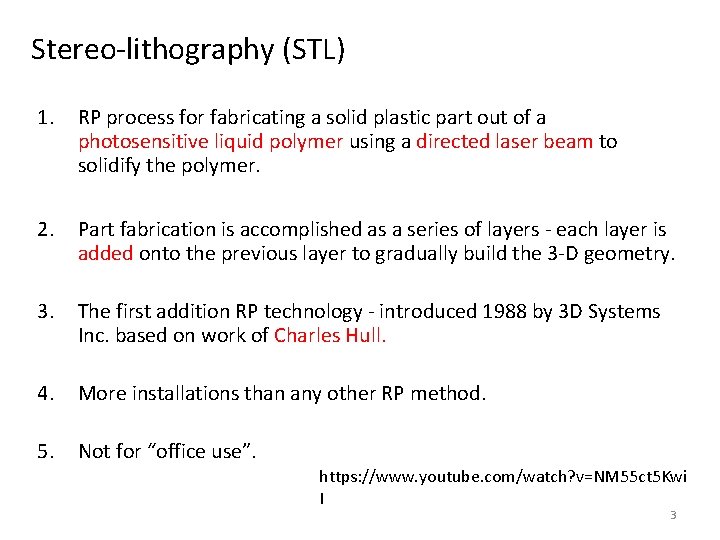
Stereo-lithography (STL) 1. RP process for fabricating a solid plastic part out of a photosensitive liquid polymer using a directed laser beam to solidify the polymer. 2. Part fabrication is accomplished as a series of layers - each layer is added onto the previous layer to gradually build the 3 -D geometry. 3. The first addition RP technology - introduced 1988 by 3 D Systems Inc. based on work of Charles Hull. 4. More installations than any other RP method. 5. Not for “office use”. https: //www. youtube. com/watch? v=NM 55 ct 5 Kwi I 3
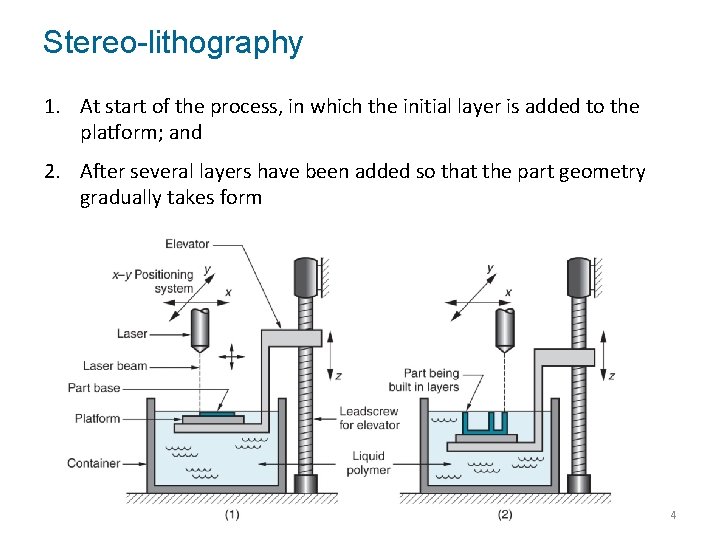
Stereo-lithography 1. At start of the process, in which the initial layer is added to the platform; and 2. After several layers have been added so that the part geometry gradually takes form 4
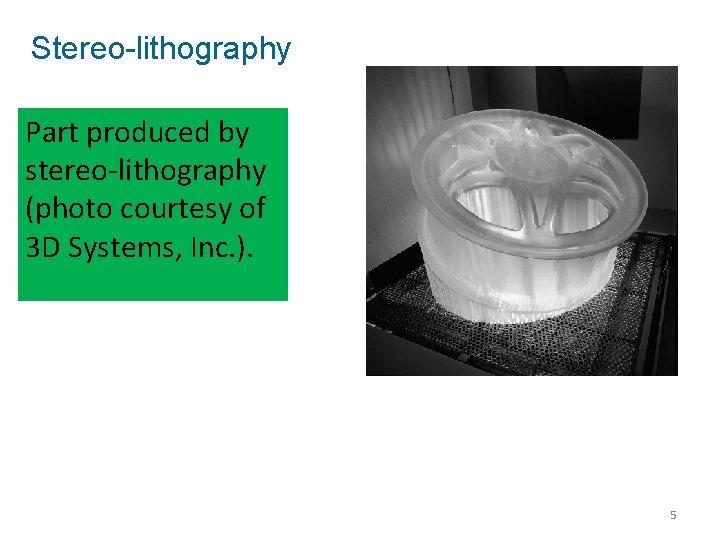
Stereo-lithography Part produced by stereo-lithography (photo courtesy of 3 D Systems, Inc. ). 5
Facts about STL 1. Each layer is 0. 076 mm to 0. 50 mm (0. 003 in to 0. 020 in. ) thick – Thinner layers provide better resolution and more intricate shapes, but processing time is longer 2. Starting materials are liquid monomers – Polymerization occurs on exposure to UV light produced by laser scanning beam • Scanning speeds ~ 500 to 2500 mm/s 6
Solid Ground Curing (SGC) q Like stereo-lithography, SGC works by curing a photosensitive polymer layer by layer to create a solid model based on CAD geometric data. q Instead of using a scanning laser beam to cure a given layer, the entire layer is exposed to a UV source through a mask above the liquid polymer. q Hardening takes 2 to 3 s for each layer. 7
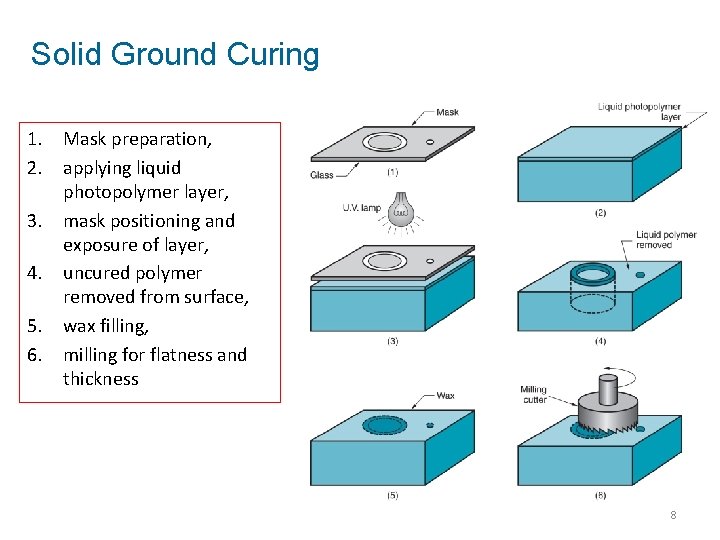
Solid Ground Curing 1. Mask preparation, 2. applying liquid photopolymer layer, 3. mask positioning and exposure of layer, 4. uncured polymer removed from surface, 5. wax filling, 6. milling for flatness and thickness 8
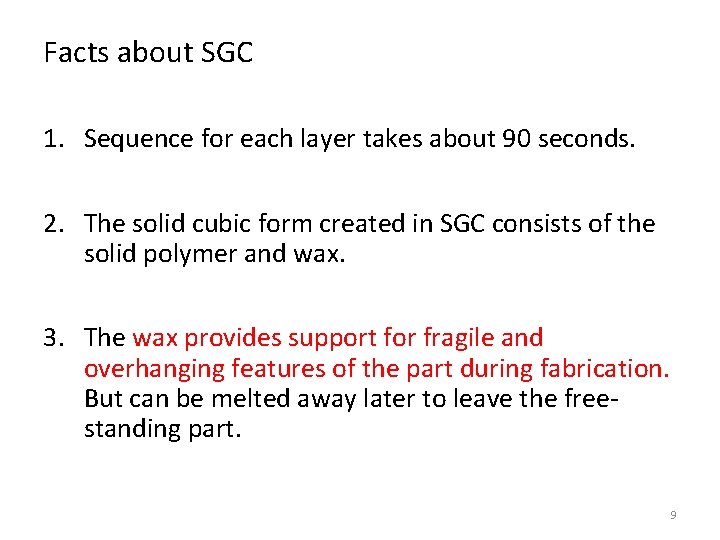
Facts about SGC 1. Sequence for each layer takes about 90 seconds. 2. The solid cubic form created in SGC consists of the solid polymer and wax. 3. The wax provides support for fragile and overhanging features of the part during fabrication. But can be melted away later to leave the freestanding part. 9
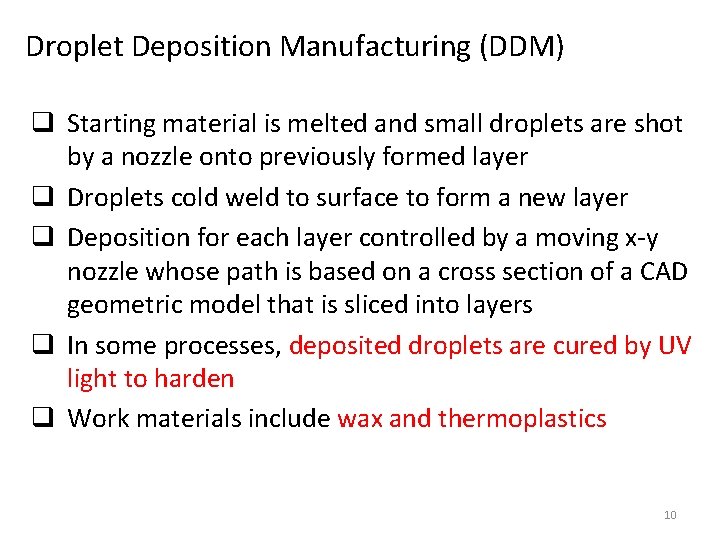
Droplet Deposition Manufacturing (DDM) q Starting material is melted and small droplets are shot by a nozzle onto previously formed layer q Droplets cold weld to surface to form a new layer q Deposition for each layer controlled by a moving x-y nozzle whose path is based on a cross section of a CAD geometric model that is sliced into layers q In some processes, deposited droplets are cured by UV light to harden q Work materials include wax and thermoplastics 10
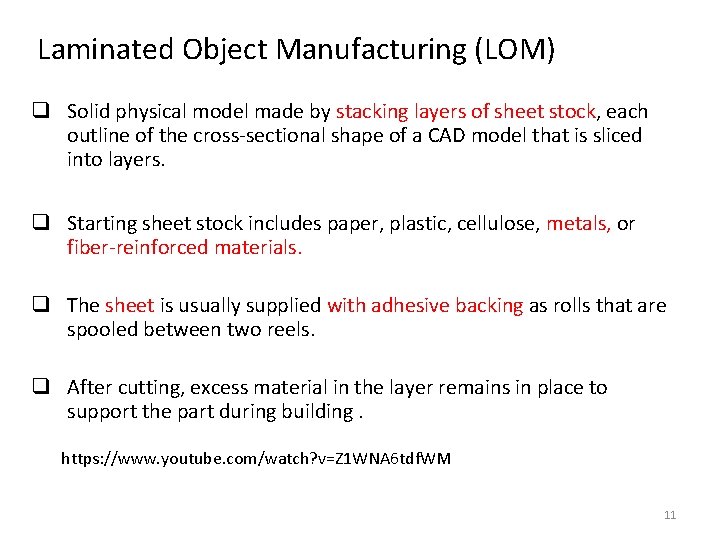
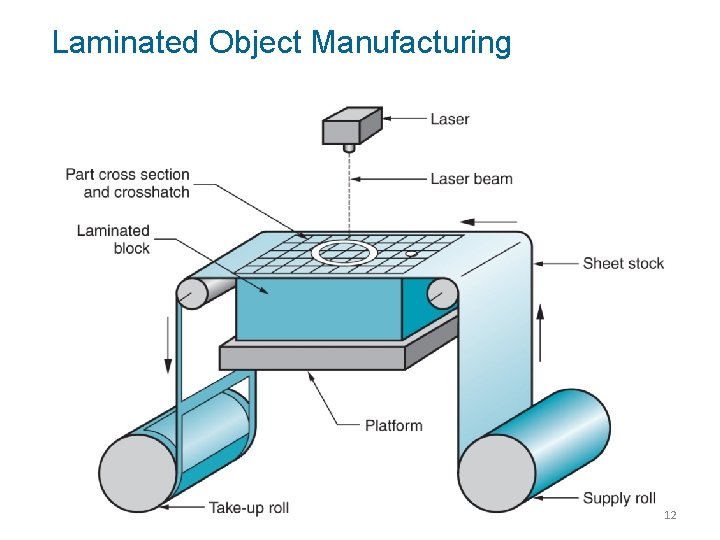
Laminated Object Manufacturing (LOM) q Solid physical model made by stacking layers of sheet stock, each outline of the cross-sectional shape of a CAD model that is sliced into layers. q Starting sheet stock includes paper, plastic, cellulose, metals, or fiber-reinforced materials. q The sheet is usually supplied with adhesive backing as rolls that are spooled between two reels. q After cutting, excess material in the layer remains in place to support the part during building. https: //www. youtube. com/watch? v=Z 1 WNA 6 tdf. WM 11
Laminated Object Manufacturing 12
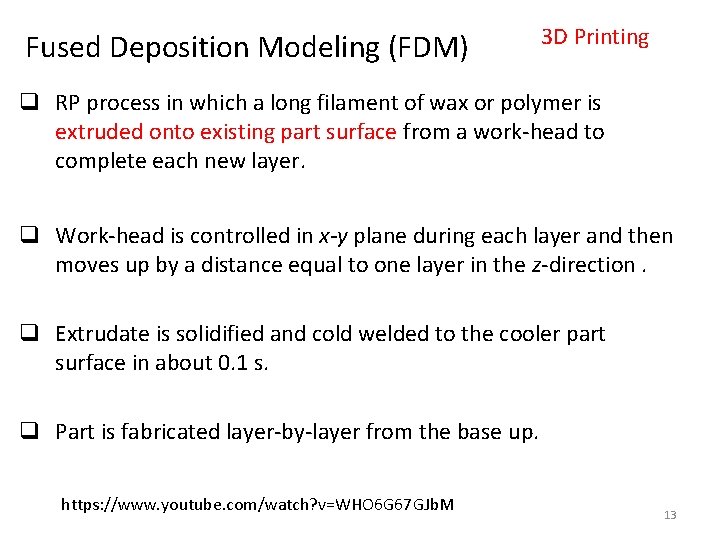
Fused Deposition Modeling (FDM) 3 D Printing q RP process in which a long filament of wax or polymer is extruded onto existing part surface from a work-head to complete each new layer. q Work-head is controlled in x-y plane during each layer and then moves up by a distance equal to one layer in the z-direction. q Extrudate is solidified and cold welded to the cooler part surface in about 0. 1 s. q Part is fabricated layer-by-layer from the base up. https: //www. youtube. com/watch? v=WHO 6 G 67 GJb. M 13
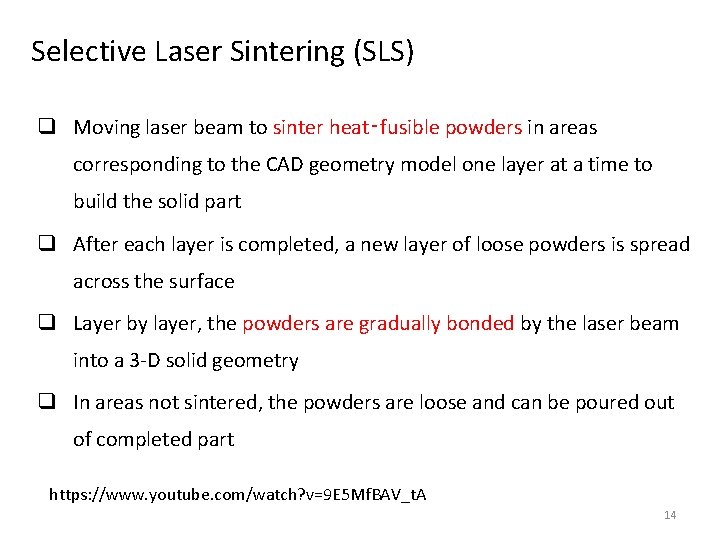
Selective Laser Sintering (SLS) q Moving laser beam to sinter heat‑fusible powders in areas corresponding to the CAD geometry model one layer at a time to build the solid part q After each layer is completed, a new layer of loose powders is spread across the surface q Layer by layer, the powders are gradually bonded by the laser beam into a 3 -D solid geometry q In areas not sintered, the powders are loose and can be poured out of completed part https: //www. youtube. com/watch? v=9 E 5 Mf. BAV_t. A 14
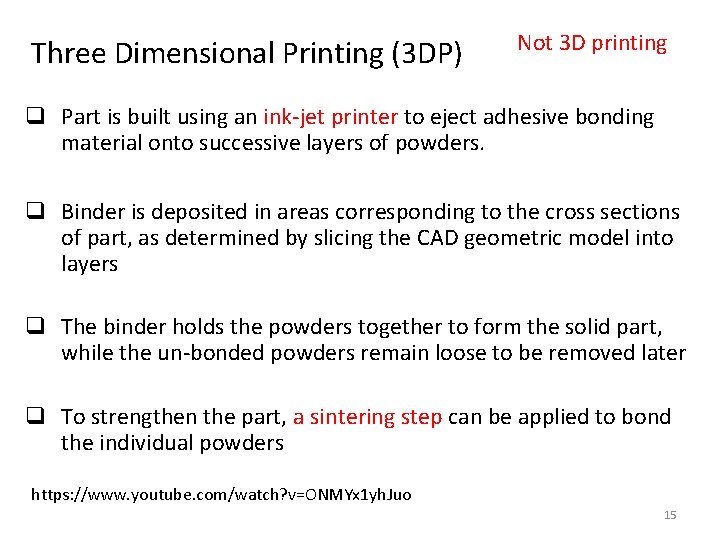
Three Dimensional Printing (3 DP) Not 3 D printing q Part is built using an ink-jet printer to eject adhesive bonding material onto successive layers of powders. q Binder is deposited in areas corresponding to the cross sections of part, as determined by slicing the CAD geometric model into layers q The binder holds the powders together to form the solid part, while the un-bonded powders remain loose to be removed later q To strengthen the part, a sintering step can be applied to bond the individual powders https: //www. youtube. com/watch? v=ONMYx 1 yh. Juo 15
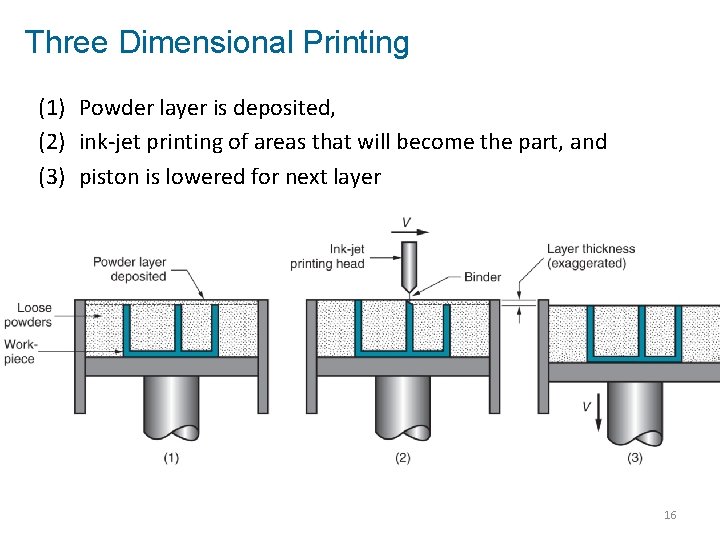
Three Dimensional Printing (1) Powder layer is deposited, (2) ink-jet printing of areas that will become the part, and (3) piston is lowered for next layer 16
Where to print? q Companies exist that you can submit your design and they print and mail to you the final product. http: //www. ponoko. com/ http: //i. materialise. com/ http: //www. shapeways. com/ q Can print certain plastics, metals, glass, and ceramics 17
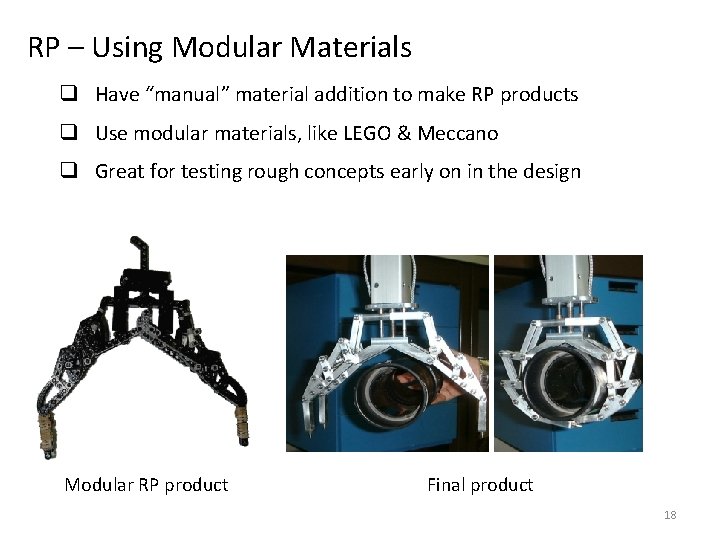
RP – Using Modular Materials q Have “manual” material addition to make RP products q Use modular materials, like LEGO & Meccano q Great for testing rough concepts early on in the design Modular RP product Final product 18
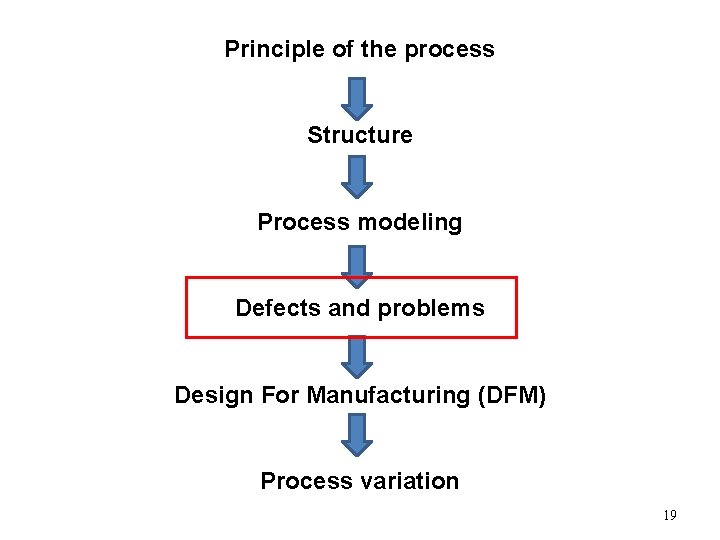
Principle of the process Structure Process modeling Defects and problems Design For Manufacturing (DFM) Process variation 19
Problems with Rapid Prototyping 1. Part accuracy A. Staircase appearance for a sloping part surface due to layering B. Some parts made by certain processes have q Shrinkage q Distortion, which can happen over time, especially with thin parts 2. Limited variety of materials in RP 3. Mechanical performance of the fabricated parts is usually less than the starting material 20
Driving Costs 4. Cost of part is driven by q Print material Use less where possible, such as scaling the part to be printed. Scaled objects carries same form & functionality as full sized object q Time to print: Reduce print times by 1. Orientate object so tall objects lay flat 2. Use scaling to decrease size of part, hence time to print 3. Print many items at once 21