
PRINCIPLE OF OPERATION OF SYNCHRONOUS RELUCTANCE MOTOR AND

![REFERENCES [1] Srge Edward Lyshevski, Alexander Nazarov, Ahmed El. Antably, Charles Yokomoto, A. S.](https://slidetodoc.com/presentation_image_h/f8a02d84f6945fe151fd2e58bbe7181d/image-20.jpg "REFERENCES [1] Srge Edward Lyshevski, Alexander Nazarov, Ahmed El. Antably, Charles Yokomoto, A. S.")


- Slides: 22
PRINCIPLE OF OPERATION OF SYNCHRONOUS RELUCTANCE MOTOR AND MATHEMATICAL MODEL By JAIKRISHNA. V Edited By Sarath S Nair www. technologyfuturae. com
OUTLINE � Introduction � Principle of Operation � Mathematical Model of Synchronous Reluctance Motor � Advantages and Disadvantages � Comparison with other motors � Summary � References www. technologyfuturae. com
INTRODUCTION �Synchronous reluctance motor is a true ac motor �Synchronous reluctance motors were developed to provide an efficient constant speed machine. �There are no brushes, slip rings etc. �Its principle is almost similar to salient pole synchronous motor. www. technologyfuturae. com
PRINCIPLE OF OPERATION In principle, the Synchronous Reluctance Motor is similar to the traditional salient pole synchronous motor but does not have an excitation winding in its rotor. The rotor is constructed with salient poles The Syn. RM includes a squirrel cage on the rotor to provide the starting torque for line-start. The squirrel cage was also needed as a damper winding in order to maintain synchronism under sudden load torques When 3 phase supply is given to the stator, a rotating flux is produced. Initially emf is induced in damper winding and the motor starts like an induction machine. As it approaches synchronous speed the reluctance torque takes over and the motor locks into synchronous speed. www. technologyfuturae. com
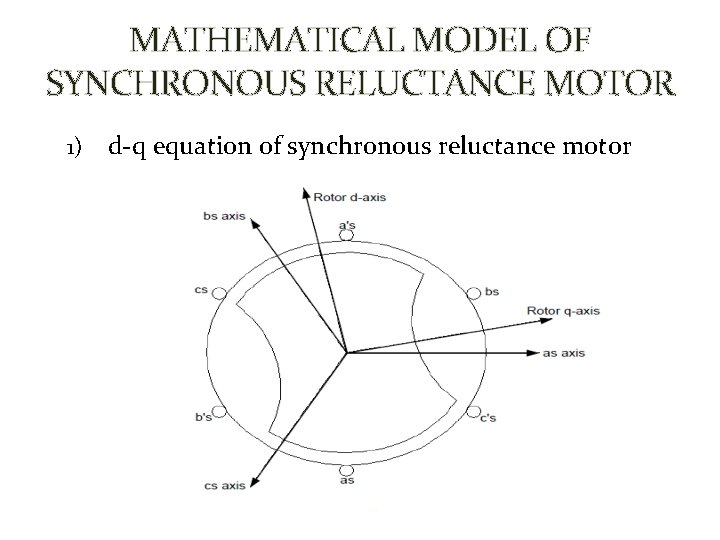
MATHEMATICAL MODEL OF SYNCHRONOUS RELUCTANCE MOTOR 1) d-q equation of synchronous reluctance motor www. technologyfuturae. com
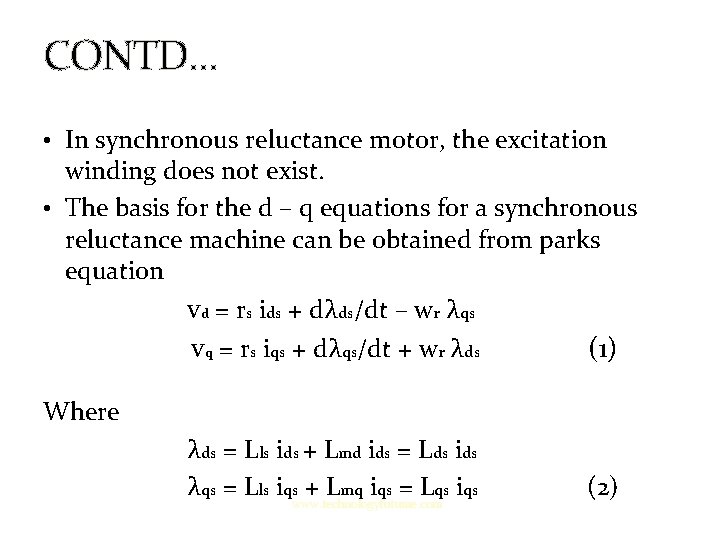
CONTD… • In synchronous reluctance motor, the excitation winding does not exist. • The basis for the d – q equations for a synchronous reluctance machine can be obtained from parks equation vd = rs ids + dλds/dt – wr λqs vq = rs iqs + dλqs/dt + wr λds (1) λds = Lls ids + Lmd ids = Lds ids λqs = Lls iqswww. technologyfuturae. com + Lmq iqs = Lqs iqs (2) Where
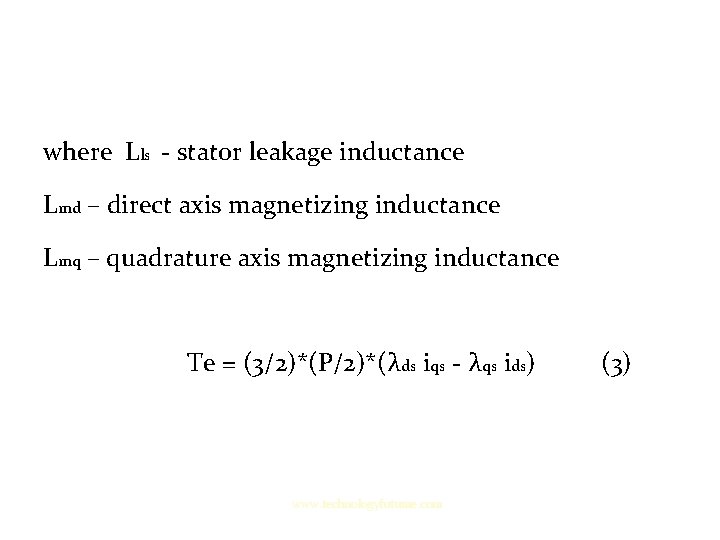
where Lls - stator leakage inductance Lmd – direct axis magnetizing inductance Lmq – quadrature axis magnetizing inductance Te = (3/2)*(P/2)*(λds iqs - λqs ids) www. technologyfuturae. com (3)
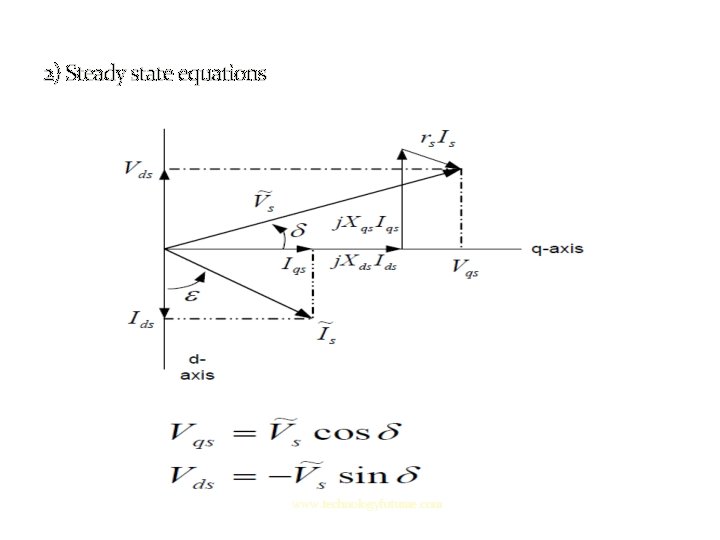
2) Steady state equations www. technologyfuturae. com
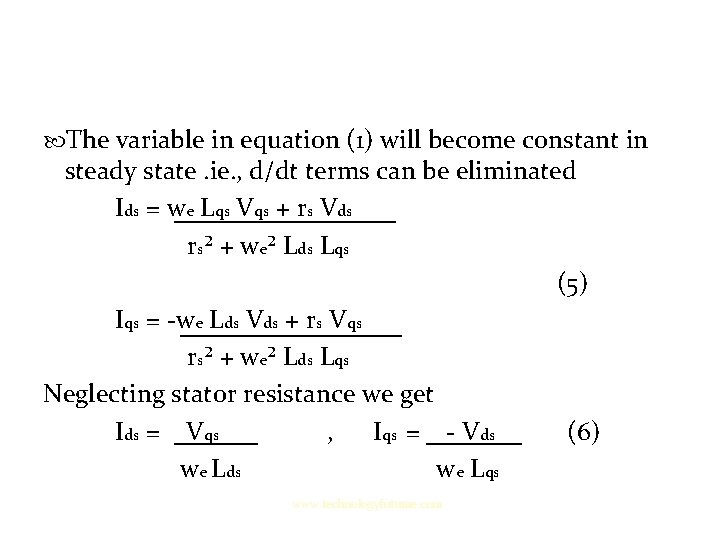
The variable in equation (1) will become constant in steady state. ie. , d/dt terms can be eliminated Ids = we Lqs Vqs + rs Vds rs² + we² Lds Lqs (5) Iqs = -we Lds Vds + rs Vqs rs² + we² Lds Lqs Neglecting stator resistance we get Ids = Vqs , Iqs = - Vds (6) we Lds w e Lqs www. technologyfuturae. com
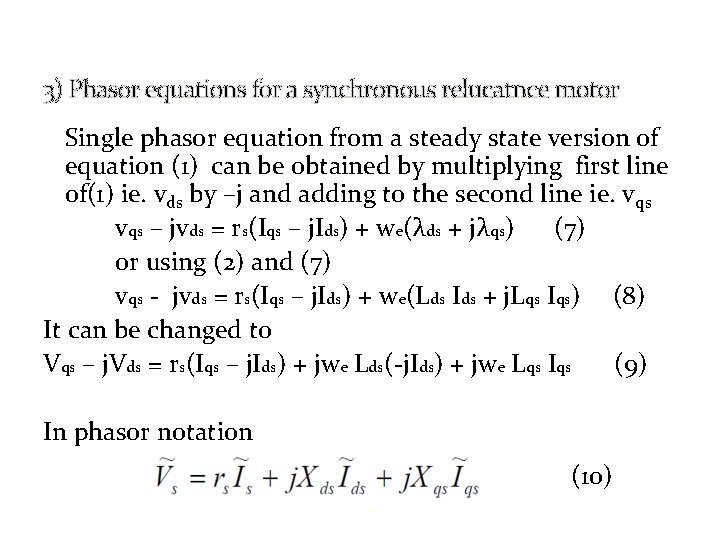
3) Phasor equations for a synchronous relucatnce motor Single phasor equation from a steady state version of equation (1) can be obtained by multiplying first line of(1) ie. vds by –j and adding to the second line ie. vqs – jvds = rs(Iqs – j. Ids) + we(λds + jλqs) (7) or using (2) and (7) vqs - jvds = rs(Iqs – j. Ids) + we(Lds Ids + j. Lqs Iqs) (8) It can be changed to Vqs – j. Vds = rs(Iqs – j. Ids) + jwe Lds(-j. Ids) + jwe Lqs Iqs (9) In phasor notation (10) www. technologyfuturae. com
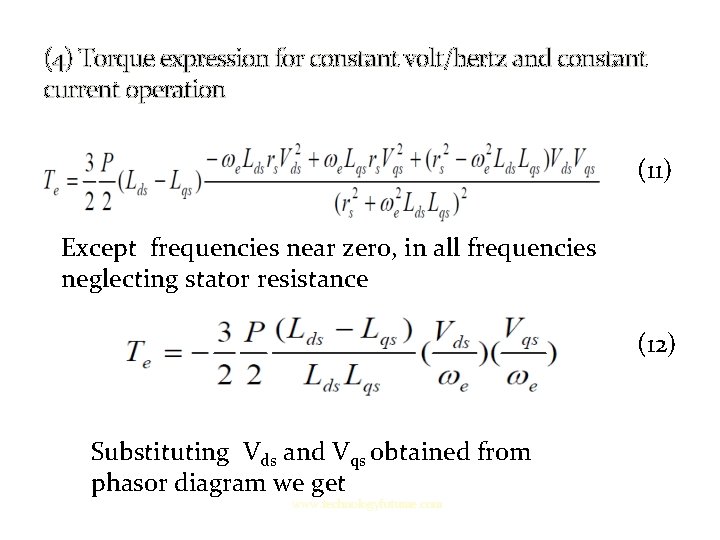
(4) Torque expression for constant volt/hertz and constant current operation (11) Except frequencies near zero, in all frequencies neglecting stator resistance (12) Substituting Vds and Vqs obtained from phasor diagram we get www. technologyfuturae. com
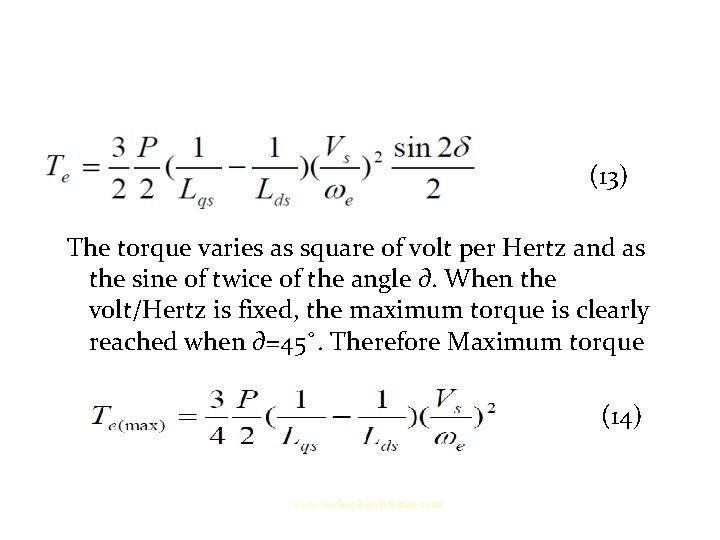
(13) The torque varies as square of volt per Hertz and as the sine of twice of the angle ∂. When the volt/Hertz is fixed, the maximum torque is clearly reached when ∂=45˚. Therefore Maximum torque (14) www. technologyfuturae. com
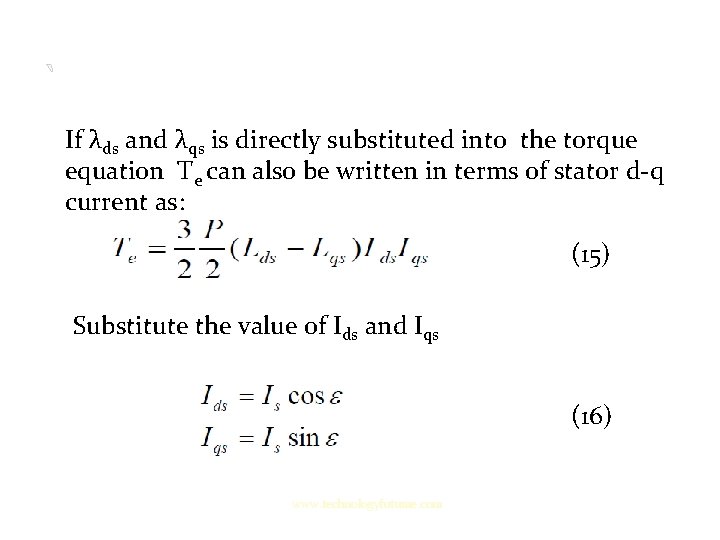
` If λds and λqs is directly substituted into the torque equation Te can also be written in terms of stator d-q current as: (15) Substitute the value of Ids and Iqs (16) www. technologyfuturae. com
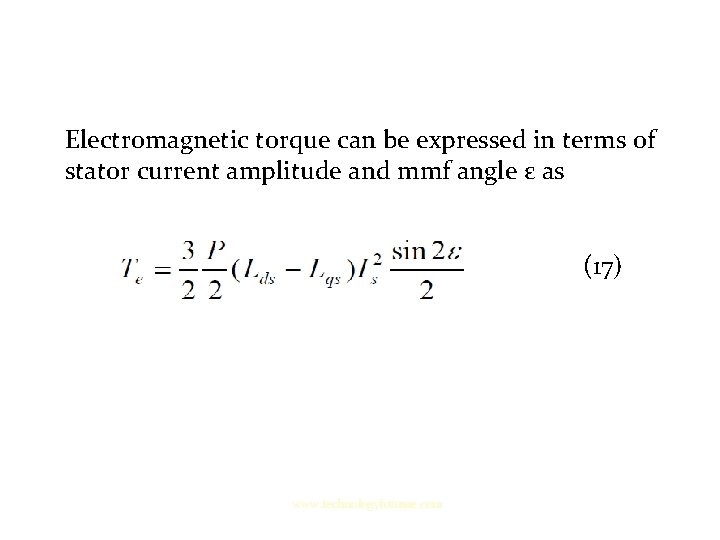
Electromagnetic torque can be expressed in terms of stator current amplitude and mmf angle ε as (17) www. technologyfuturae. com
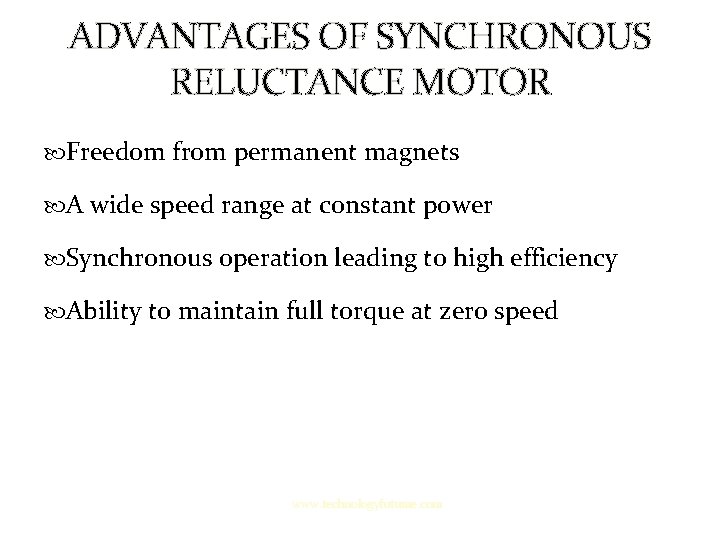
ADVANTAGES OF SYNCHRONOUS RELUCTANCE MOTOR Freedom from permanent magnets A wide speed range at constant power Synchronous operation leading to high efficiency Ability to maintain full torque at zero speed www. technologyfuturae. com
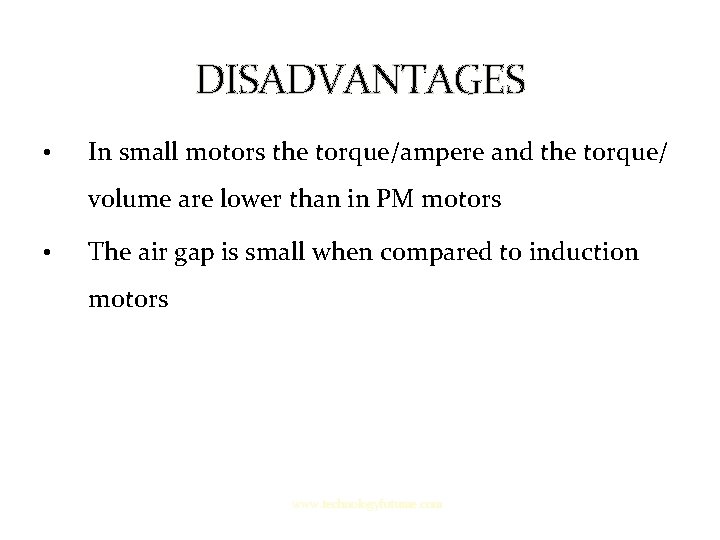
DISADVANTAGES • In small motors the torque/ampere and the torque/ volume are lower than in PM motors • The air gap is small when compared to induction motors www. technologyfuturae. com
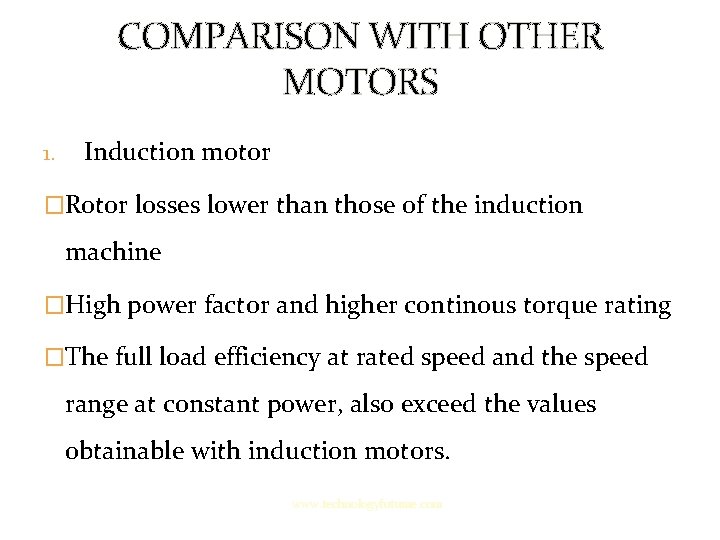
COMPARISON WITH OTHER MOTORS 1. Induction motor �Rotor losses lower than those of the induction machine �High power factor and higher continous torque rating �The full load efficiency at rated speed and the speed range at constant power, also exceed the values obtainable with induction motors. www. technologyfuturae. com
Contd… 2. Switched reluctance motors • does not suffer from high torque ripple. • Power density lower than Switched reluctance motor www. technologyfuturae. com
SUMMARY Principle of operation of synchronous reluctance motor are discussed. The mathematical model of Synchronous reluctance motor was also discussed. Comparisons with different motors has been done www. technologyfuturae. com
REFERENCES [1] Srge Edward Lyshevski, Alexander Nazarov, Ahmed El. Antably, Charles Yokomoto, A. S. C. Sinha, Maher Rizkalla and Mohamed El – Sharkawy, “Design and Optimization, Steady. State and Dynamic Analysis of Synchronous Reluctance Motors Controlled by Voltage-Fed Converters With Nonlinear Controllers”, IEEE Trans. Industry Applications, Sept. 1999. [2] Peyman Niazi, “Permanent Magnet Assisted Synchronous Reluctance Motor Design And Performance Improvement”, Texas A&M University [3] R. E. Betz, R. Lagerquist, M. Jovanovic, T. J. E. Miller and R. H. Middleton, “Control of synchronous reluctance machines, ” IEEE Trans. Industry Applications, vol. 29, no. 6, pp. 11 10 -1 122, 1993. www. technologyfuturae. com
Technical Presentations, Research Reviews, New designs & Developments Technology Futurae Log On to www. technologyfuturae. com
THANK YOU… www. technologyfuturae. com