
Principle of Mineral Processing Chapter 3 Gravity concentration


- Slides: 52
“Principle of Mineral Processing”
Chapter 3 Gravity concentration methods, Tabling, Jigging, Heavy media separation, Separation in vertical and streaming currents, Sedimentation, Dewatering techniques, Thickener, Filtration and Drying, Stokes and Newton's law, Motion of solid in fluid Free and hindered settling, Thickening, Batch and continuous settling Chambers
Settling • Classificaton – separating mixtures on the basis of velocity falling through a medium ( air /water) • Since velocity of particles not only depends on size but also on shape & sp. gravity , principles of classification are important in mineral separation utilising gravity concentration methods • Principles When a lump of lead and feather – in vacuum ? In viscous medium ( air / water) – when fluid resistance & gravitational force equal- V constant 10/19/2021 3
Settling • Nature of fluid resistance – at low velocity of particle-fluid in contact moves with adjacent fluid motionless – shear forces – viscous resistance ( laminar flow ) -at high velocity –resistance due to displacement of fluid by body – turbulent resistance -whether viscous/turbulent , acceleration reduces & terminal velocity is reached quickly 10/19/2021 4
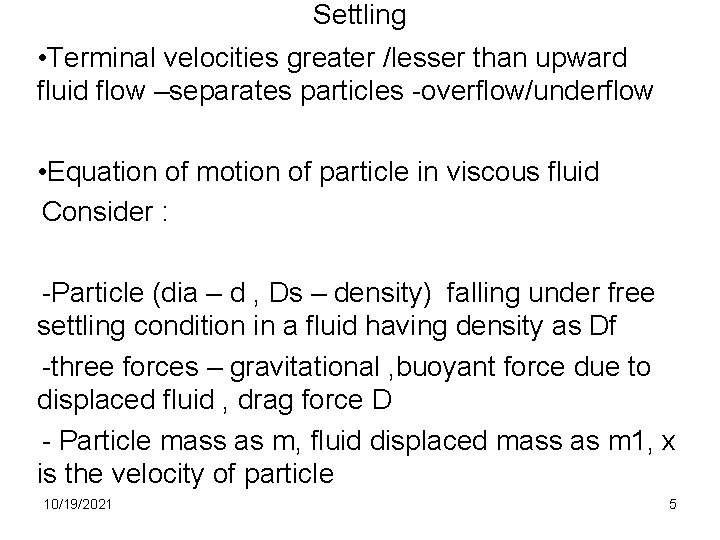
Settling • Terminal velocities greater /lesser than upward fluid flow –separates particles -overflow/underflow • Equation of motion of particle in viscous fluid Consider : -Particle (dia – d , Ds – density) falling under free settling condition in a fluid having density as Df -three forces – gravitational , buoyant force due to displaced fluid , drag force D - Particle mass as m, fluid displaced mass as m 1, x is the velocity of particle 10/19/2021 5
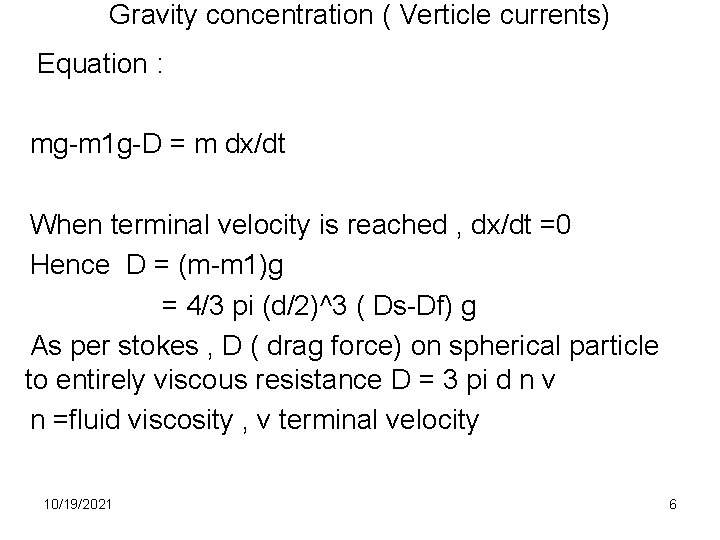
Gravity concentration ( Verticle currents) Equation : mg-m 1 g-D = m dx/dt When terminal velocity is reached , dx/dt =0 Hence D = (m-m 1)g = 4/3 pi (d/2)^3 ( Ds-Df) g As per stokes , D ( drag force) on spherical particle to entirely viscous resistance D = 3 pi d n v n =fluid viscosity , v terminal velocity 10/19/2021 6
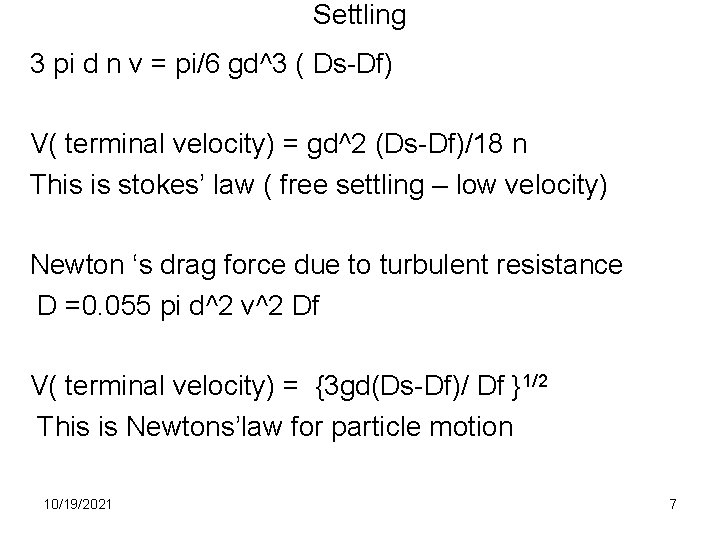
Settling 3 pi d n v = pi/6 gd^3 ( Ds-Df) V( terminal velocity) = gd^2 (Ds-Df)/18 n This is stokes’ law ( free settling – low velocity) Newton ‘s drag force due to turbulent resistance D =0. 055 pi d^2 v^2 Df V( terminal velocity) = {3 gd(Ds-Df)/ Df }1/2 This is Newtons’law for particle motion 10/19/2021 7
Settling 3 pi d n v = pi/6 gd^3 ( Ds-Df) V( terminal velocity) = gd^2 (Ds-Df)/18 n This is stokes’ law ( free settling – low velocity) Newton ‘s drag force due to turbulent resistance D =0. 055 pi d^2 v^2 Df V( terminal velocity) = {3 gd(Ds-Df)/ Df }1/2 This is Newtons’law for particle motion 10/19/2021 8
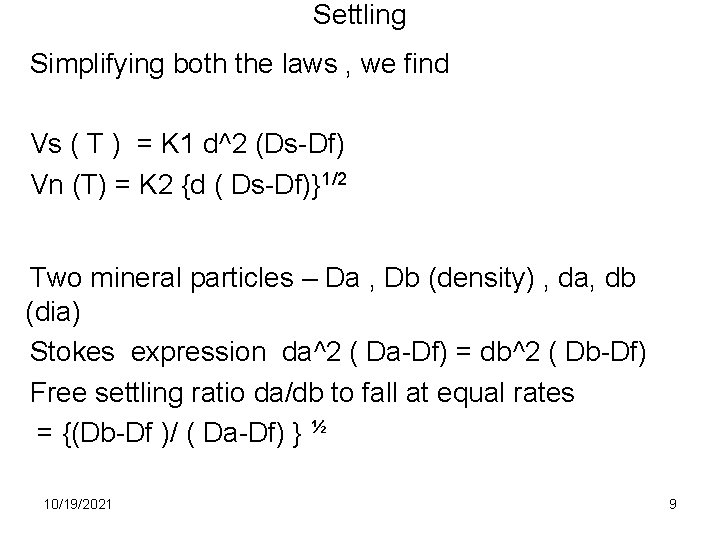
Settling Simplifying both the laws , we find Vs ( T ) = K 1 d^2 (Ds-Df) Vn (T) = K 2 {d ( Ds-Df)}1/2 Two mineral particles – Da , Db (density) , da, db (dia) Stokes expression da^2 ( Da-Df) = db^2 ( Db-Df) Free settling ratio da/db to fall at equal rates = {(Db-Df )/ ( Da-Df) } ½ 10/19/2021 9
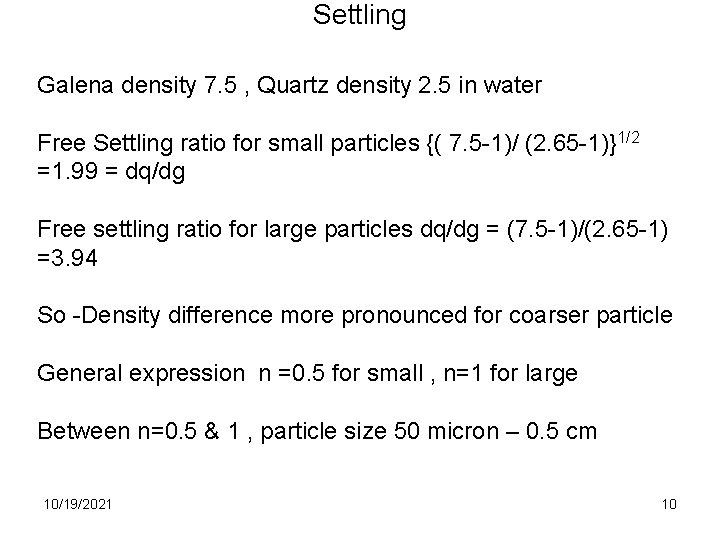
Settling Galena density 7. 5 , Quartz density 2. 5 in water Free Settling ratio for small particles {( 7. 5 -1)/ (2. 65 -1)}1/2 =1. 99 = dq/dg Free settling ratio for large particles dq/dg = (7. 5 -1)/(2. 65 -1) =3. 94 So -Density difference more pronounced for coarser particle General expression n =0. 5 for small , n=1 for large Between n=0. 5 & 1 , particle size 50 micron – 0. 5 cm 10/19/2021 10
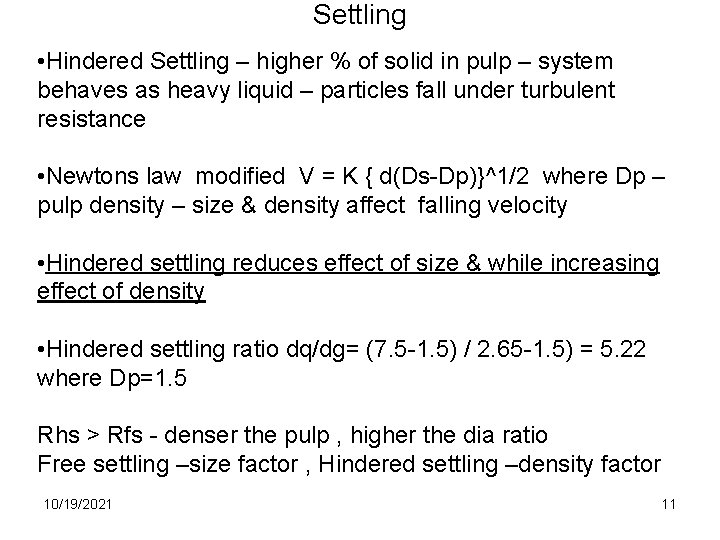
Settling • Hindered Settling – higher % of solid in pulp – system behaves as heavy liquid – particles fall under turbulent resistance • Newtons law modified V = K { d(Ds-Dp)}^1/2 where Dp – pulp density – size & density affect falling velocity • Hindered settling reduces effect of size & while increasing effect of density • Hindered settling ratio dq/dg= (7. 5 -1. 5) / 2. 65 -1. 5) = 5. 22 where Dp=1. 5 Rhs > Rfs - denser the pulp , higher the dia ratio Free settling –size factor , Hindered settling –density factor 10/19/2021 11
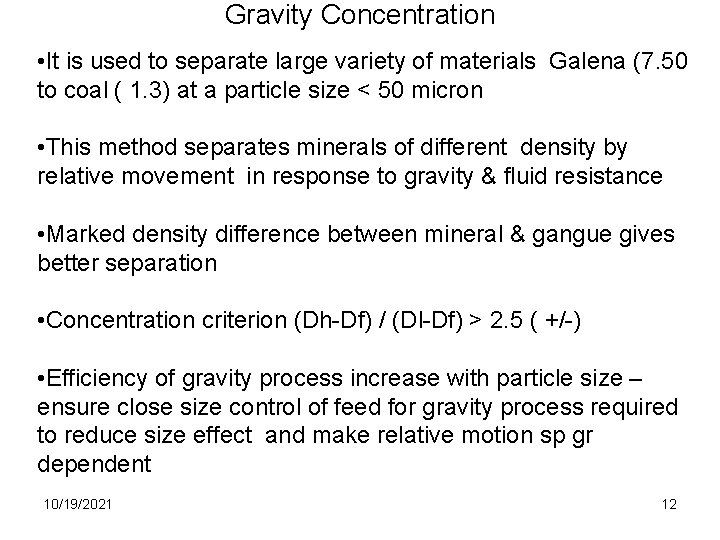
Gravity Concentration • It is used to separate large variety of materials Galena (7. 50 to coal ( 1. 3) at a particle size < 50 micron • This method separates minerals of different density by relative movement in response to gravity & fluid resistance • Marked density difference between mineral & gangue gives better separation • Concentration criterion (Dh-Df) / (Dl-Df) > 2. 5 ( +/-) • Efficiency of gravity process increase with particle size – ensure close size control of feed for gravity process required to reduce size effect and make relative motion sp gr dependent 10/19/2021 12
Gravity concentration ( Verticle currents) Jigging ( one of oldest method ) -Hindered settling – stratification of particles into layers due to upward & downward current of fluid - Pulsator force water up through screen – particles in suspension and then suction -During cycle - fine dense particle trickle through big ones Three products during jigging -Gangue tailing over weir -Concentrate - Middlings – dense fines at the bottom 10/19/2021 13
Gravity Concentration • Jig bed ( over screen) consists of coarse & heavy particles • Heavy particles penetrate through screen and drawn off as concentrate • If feed particles are larger than screen apertures, jigging ‘over the screen’ is used and concentrate grade is partly governed by thickness of bottom layer – rate of withdrawal of concentrae through discharge port –Harz / Denver jigs 10/19/2021 14
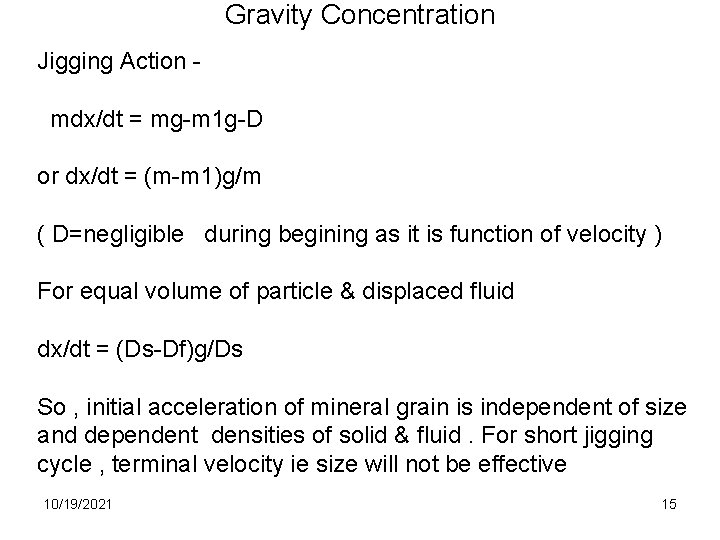
Gravity Concentration Jigging Action mdx/dt = mg-m 1 g-D or dx/dt = (m-m 1)g/m ( D=negligible during begining as it is function of velocity ) For equal volume of particle & displaced fluid dx/dt = (Ds-Df)g/Ds So , initial acceleration of mineral grain is independent of size and dependent densities of solid & fluid. For short jigging cycle , terminal velocity ie size will not be effective 10/19/2021 15
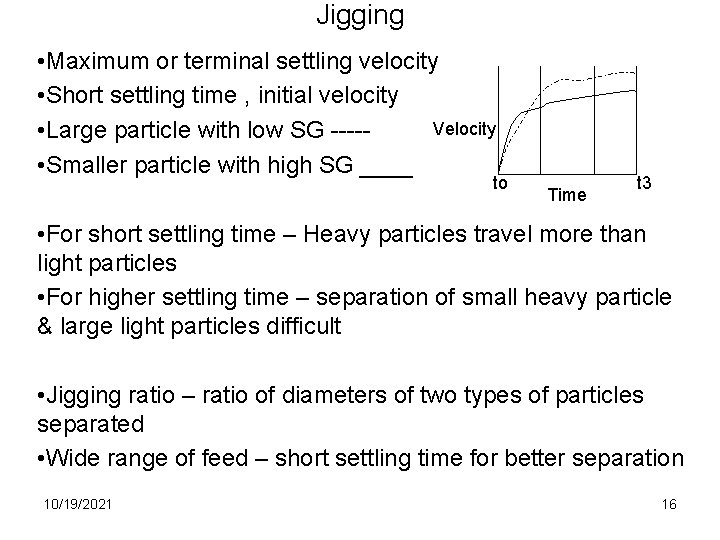
Jigging • Maximum or terminal settling velocity • Short settling time , initial velocity Velocity • Large particle with low SG ---- • Smaller particle with high SG ____ to Time t 3 • For short settling time – Heavy particles travel more than light particles • For higher settling time – separation of small heavy particle & large light particles difficult • Jigging ratio – ratio of diameters of two types of particles separated • Wide range of feed – short settling time for better separation 10/19/2021 16
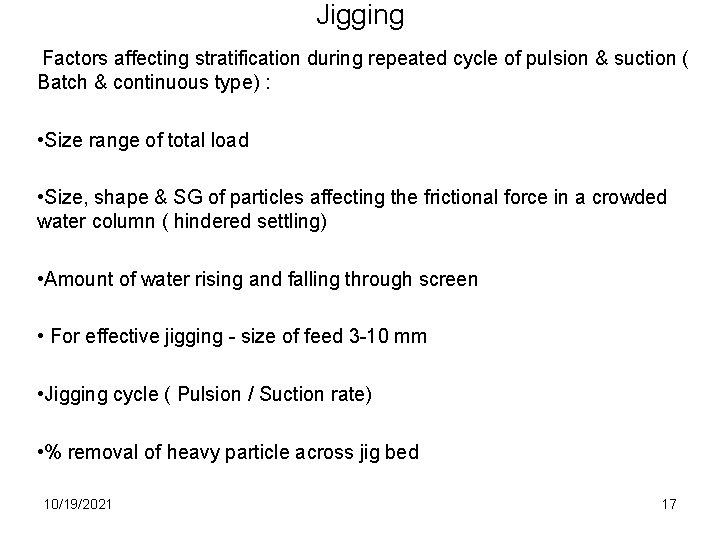
Jigging Factors affecting stratification during repeated cycle of pulsion & suction ( Batch & continuous type) : • Size range of total load • Size, shape & SG of particles affecting the frictional force in a crowded water column ( hindered settling) • Amount of water rising and falling through screen • For effective jigging - size of feed 3 -10 mm • Jigging cycle ( Pulsion / Suction rate) • % removal of heavy particle across jig bed 10/19/2021 17
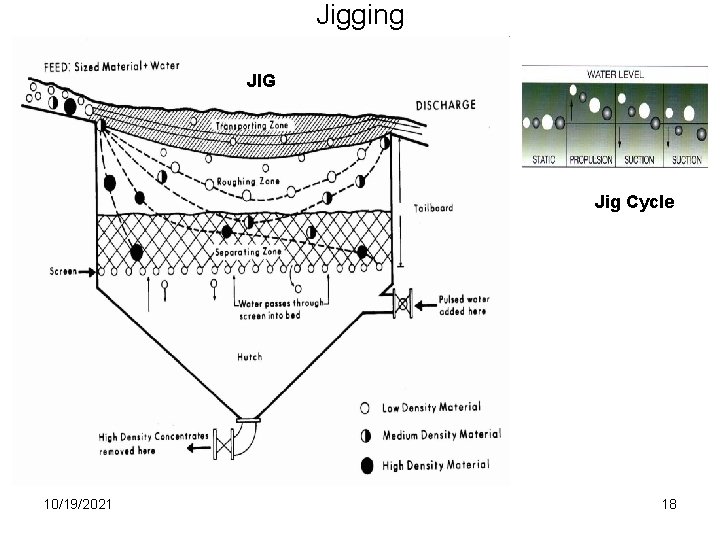
Jigging JIG Jig Cycle ( low & high density) JIG 10/19/2021 18
Jigging • During jigging cycle when screen is open ( pulsion ) – Coarse heavy grains at the bottom , the fine –light grains at the top , coarse –light & small –heavy in the middle • When screen is close ( suction ) -Fine –heavy grains at the bottom , coarse –light grains at the top and coarse- heavy and fine –light grains in the middle Consolidation trickling – small particles pack the voids between the large ones 10/19/2021 19
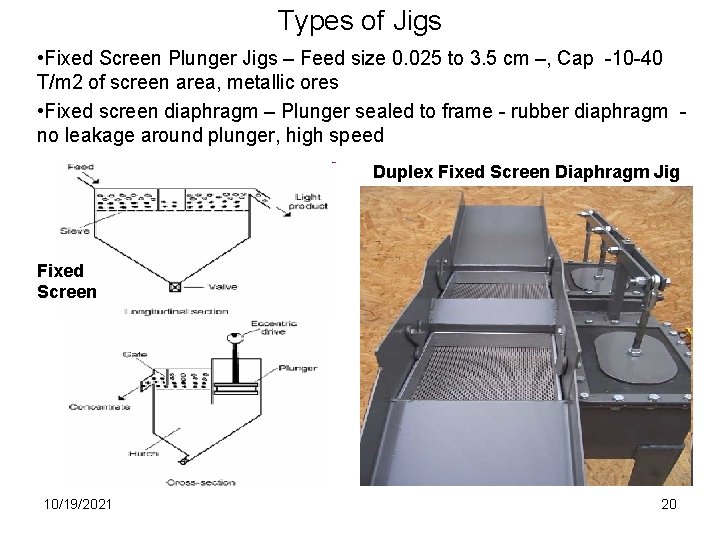
Types of Jigs • Fixed Screen Plunger Jigs – Feed size 0. 025 to 3. 5 cm –, Cap -10 -40 T/m 2 of screen area, metallic ores • Fixed screen diaphragm – Plunger sealed to frame - rubber diaphragm no leakage around plunger, high speed Duplex Fixed Screen Diaphragm Jig Fixed Screen 10/19/2021 20
Jigging • Operation of Fixed screen type: • Feed charged gently at head of Ist compartment • Max amplitude in the Ist comp. & least in the 4 th • High grade conc at bottom of Ist comp. • Lighter fraction upward – to last box as tailing • Opening of hutch discharge – control over pulsion/suction • Tailing ( upper layer) – discharge to weir • Concentrate ( lower layer) discharge – to gate ( feed coarser than screen size) OR to hutch valve ( feed finer than screen size) 10/19/2021 21
Types of Jigs • Fixed Sieve Air Pulse Jig : - water pulsing by compressed air -Treatment of 0. 06 to 15 cm particle – cleaning of coal • Movable screen jig : -Screen box moved upward & downward – different compartments ( conc, middlings , tailing) - small amount of ore treated • Pneumatic Jigs : -Air used for startification – inferior separation due to lower fluid density ( low fluidisation )– sulphide ore concentration – closer feed range suitable 10/19/2021 22
Jigs ( Merits & Demerits) Pneumatic jigs – Adv -Dry finished product – e. g. Fine coal , Desert countries Disadv –Dust removal required, multiple jigs to treat range of 200 microns to 4 cm Hydraulic Jigs – Adv- Simple & cheap, easy maintenance , flexibility of using heavy suspension ( in place of water) for coarse material Disadv –Large quantity of water, Fines not treatable , concentrate separated not clean , 10/19/2021 23
Jigging Operation Control : • Sp Gravity of Coarse particles • Thickness of bedding material • Water flow & quantity , Rate of feed • Rate of concentrate removal (heavy product) • Suitable bedding material for proper hutch product • Suitable to application –heavy minerals ( sulphides ) or light minerals ( coal) for optimum jig volume • Use – coal cleaning & non-magnetic Iron ores , tin & tungsten ores • No more for sulphide minerals due to flotation process 10/19/2021 24
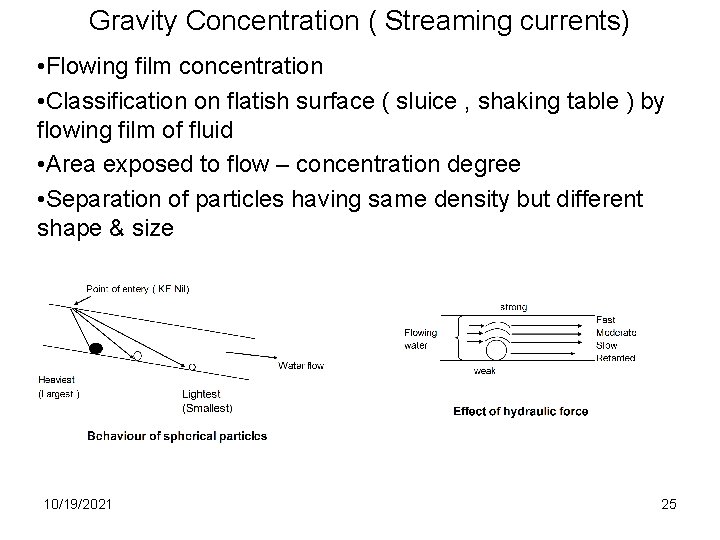
Gravity Concentration ( Streaming currents) • Flowing film concentration • Classification on flatish surface ( sluice , shaking table ) by flowing film of fluid • Area exposed to flow – concentration degree • Separation of particles having same density but different shape & size 10/19/2021 25
Gravity Concentration ( Streaming currents) • Shape important for ease of rolling • Flattest flake , cube , sphere – increasing order of roll • Riffles – turbulence & vortex formation – lighter particle climbing over obstacle & heavier ones into the pocket • Separation factors – Water film thickness , roughness of separating surface , pulp density, shape & size of particles • Deck without riffles -particle size < film thickness • Riffle-decked table – particle size equal to riffle depth and 1/3 of riffle width to avoid bridging 10/19/2021 26
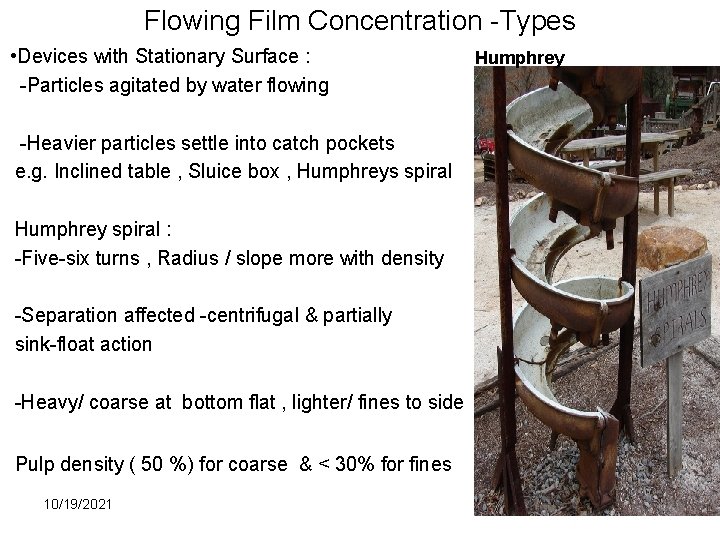
Flowing Film Concentration -Types • Devices with Stationary Surface : -Particles agitated by water flowing Humphrey -Heavier particles settle into catch pockets e. g. Inclined table , Sluice box , Humphreys spiral Humphrey spiral : -Five-six turns , Radius / slope more with density -Separation affected -centrifugal & partially sink-float action -Heavy/ coarse at bottom flat , lighter/ fines to side Pulp density ( 50 %) for coarse & < 30% for fines 10/19/2021 27
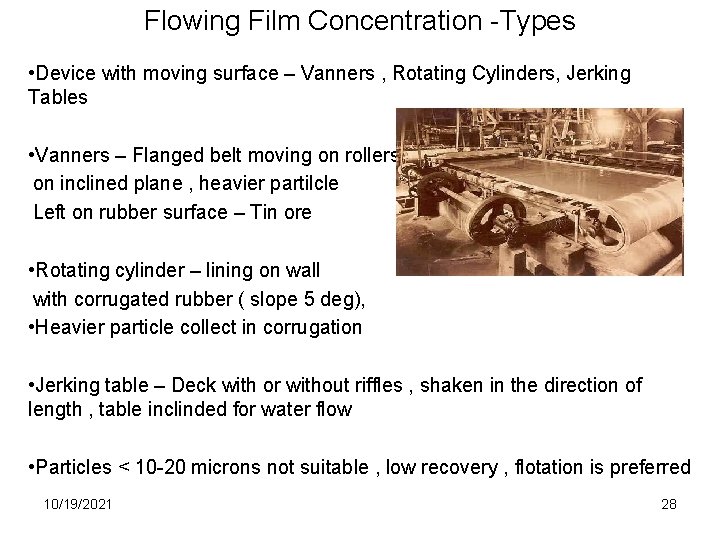
Flowing Film Concentration -Types • Device with moving surface – Vanners , Rotating Cylinders, Jerking Tables • Vanners – Flanged belt moving on rollers on inclined plane , heavier partilcle Left on rubber surface – Tin ore • Rotating cylinder – lining on wall with corrugated rubber ( slope 5 deg), • Heavier particle collect in corrugation • Jerking table – Deck with or without riffles , shaken in the direction of length , table inclinded for water flow • Particles < 10 -20 microns not suitable , low recovery , flotation is preferred 10/19/2021 28
Flowing Film Concentration – Shaking Table • Flat surface ( Deck) inclined ( 5 deg) - both front to back & left to right • Surface roughened or riffles formed 2 cm wide / 1 cm height at starting point and tapering down to zero at lowest end • Motion is parallel or at an angle to the channels • Riffles – spread entering feed , in between channels place for hindered settling & consolidation trickling , exposing of top layer to cross flow down the deck 10/19/2021 29
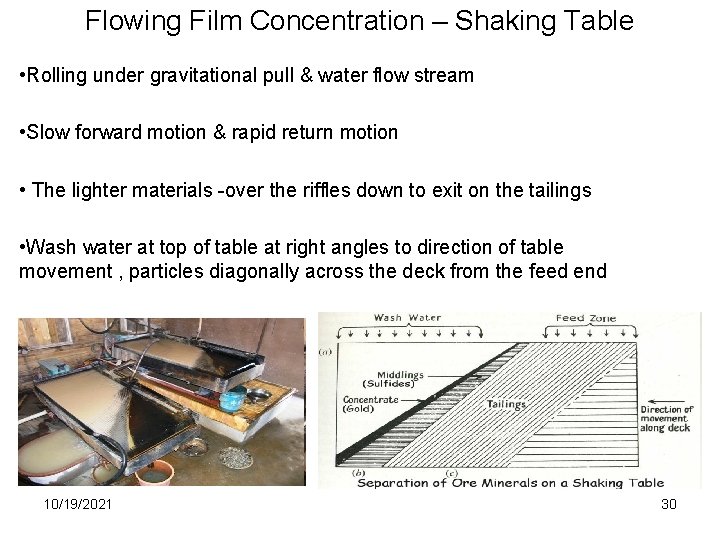
Flowing Film Concentration – Shaking Table • Rolling under gravitational pull & water flow stream • Slow forward motion & rapid return motion • The lighter materials -over the riffles down to exit on the tailings • Wash water at top of table at right angles to direction of table movement , particles diagonally across the deck from the feed end 10/19/2021 30
Flowing Film Concentration – Shaking Table • Fastest moving along riffles ( less horizontal movement ) –Coarse light grains ( Usually gangue ) • Medium moving – Fine light & coarse heavy ( Middlings) • Slowest moving ( Fine heavy ) – maximum horizontal movement • Movement of particle – table slope, velocity & quantity of water • Best particle range 3 mm to 50 microns & high density minerals such as Gold , Garnet 10/19/2021 31
Flowing Film Concentration – Shaking Table • Table used in series : - Ist group -low grade concentrate & tailing – Roughing -Treatment of low grade on smaller table – Cleaning -Tailing during cleaning sent to Roughing feed • Roughing operation - High feed rate , more tilt & riffles, • Cleaning – less water , less feed , shorter stroke • Wilfley table – Higher capacity , Riffles for coarser material & rugged head motion -Riffles in parallel with long axis and tapered , deck tilted transversely , 2/3 rd of deck riffled, cleats 1. 5 cm H /0. 75 W 10/19/2021 32
Wilfley Table 10/19/2021 33
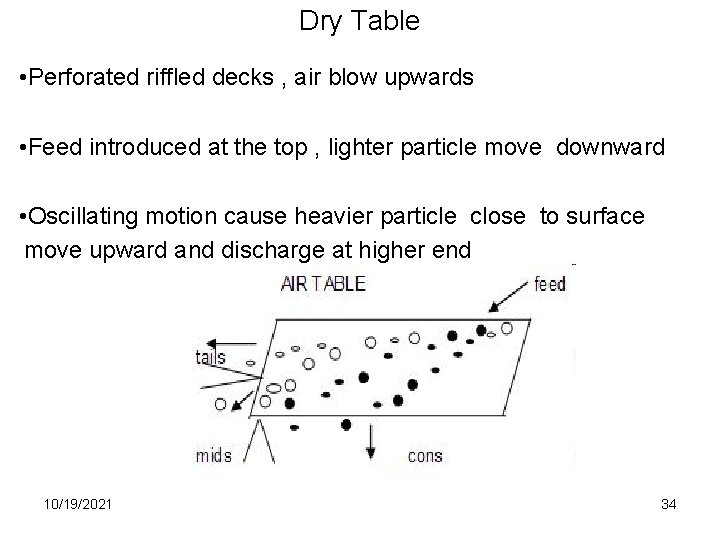
Dry Table • Perforated riffled decks , air blow upwards • Feed introduced at the top , lighter particle move downward • Oscillating motion cause heavier particle close to surface move upward and discharge at higher end 10/19/2021 34
Shaking Table Demerits of Wet Tabling : Use of large amount of water , product property affected due to soluble salts , additional cost of dry of product Difference Wet Vs Dry Table : Wet – Particle size increase & density decrease from top of conc band towards tailing Dry – Particle size & density decrease from top end to tailing similar to hydraulic classification Application : Galena / Sphalerite, Barytes , Fluorsapar , Gold ores , non-metallics – Silica sand , Chromite ores, Iron ores 10/19/2021 35
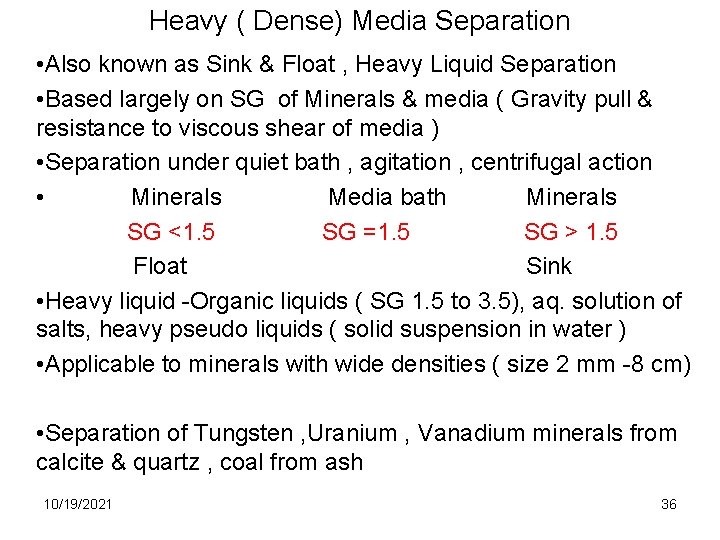
Heavy ( Dense) Media Separation • Also known as Sink & Float , Heavy Liquid Separation • Based largely on SG of Minerals & media ( Gravity pull & resistance to viscous shear of media ) • Separation under quiet bath , agitation , centrifugal action • Minerals Media bath Minerals SG <1. 5 SG =1. 5 SG > 1. 5 Float Sink • Heavy liquid -Organic liquids ( SG 1. 5 to 3. 5), aq. solution of salts, heavy pseudo liquids ( solid suspension in water ) • Applicable to minerals with wide densities ( size 2 mm -8 cm) • Separation of Tungsten , Uranium , Vanadium minerals from calcite & quartz , coal from ash 10/19/2021 36
Types of Media • Soluble salts ( 1. 3 -1. 4) – Zn. Cl 2 , Ca. Cl 2 – cleaning of coal • Organic Liquids ( SG 1. 4 -3) – CHBr 3 ( Bromoform 2. 89) , Ch 2 Br 2 ( Methylene Bromide 2. 48 ) • Solid suspension for producing dense media : -Soild –hard , unbreakable , non wear , non corrosive , resulting viscosity of media low , stable pulp with coarse particle as fine material result in high viscosity -Galena ( SG 7. 4 -7. 6) for lead –zinc ores - Ferro silicon ( magnetic , non oxidising , SG 6. 7 -7) used for suspension having >3. 2 SG 10/19/2021 37
Types of DMS process • Process using heavy liquids – organic& salt solution -Lessing & Bertand process ( coal / Ca. Cl 2 / 1. 4) - Du Pont Process ( Organic media – Halogenated Hydrocarbon ) , uneconomical • Process using solids for suspension – Galena , Fe-Si -Vooys Process ( Coal /Clay & Baryte /1. 5) -Differential Density Process ( Cyanamide Process) – Conical separating tank , media used – magnetite or Fe-Si, Cap 200 t/day , Stirring mechanism present, Fe-Si particle size ( 150 200 microns) , Fine Ore separation 10/19/2021 38
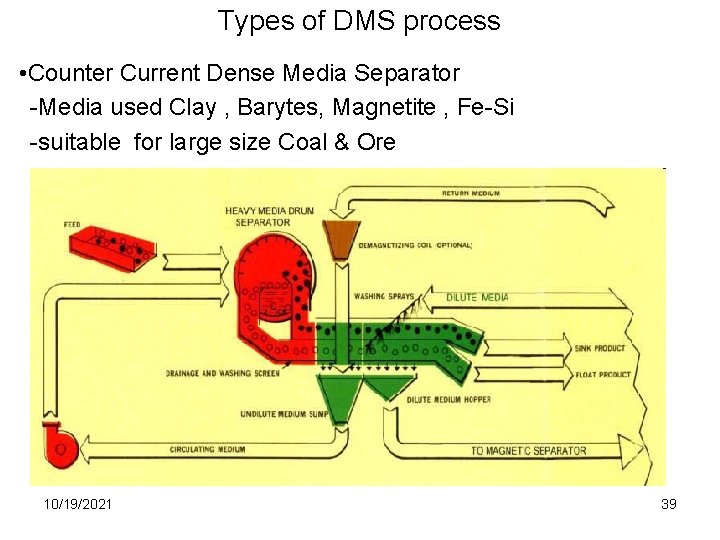
Types of DMS process • Counter Current Dense Media Separator -Media used Clay , Barytes, Magnetite , Fe-Si -suitable for large size Coal & Ore 10/19/2021 39
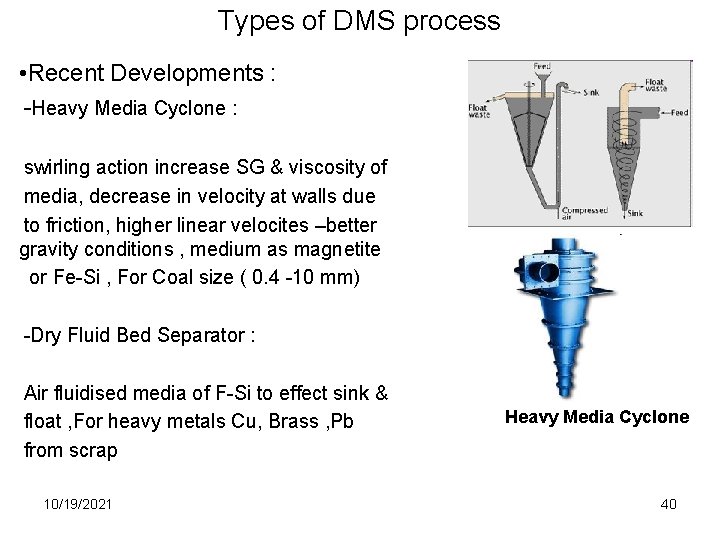
Types of DMS process • Recent Developments : -Heavy Media Cyclone : swirling action increase SG & viscosity of media, decrease in velocity at walls due to friction, higher linear velocites –better gravity conditions , medium as magnetite or Fe-Si , For Coal size ( 0. 4 -10 mm) -Dry Fluid Bed Separator : Air fluidised media of F-Si to effect sink & float , For heavy metals Cu, Brass , Pb from scrap 10/19/2021 Heavy Media Cyclone 40
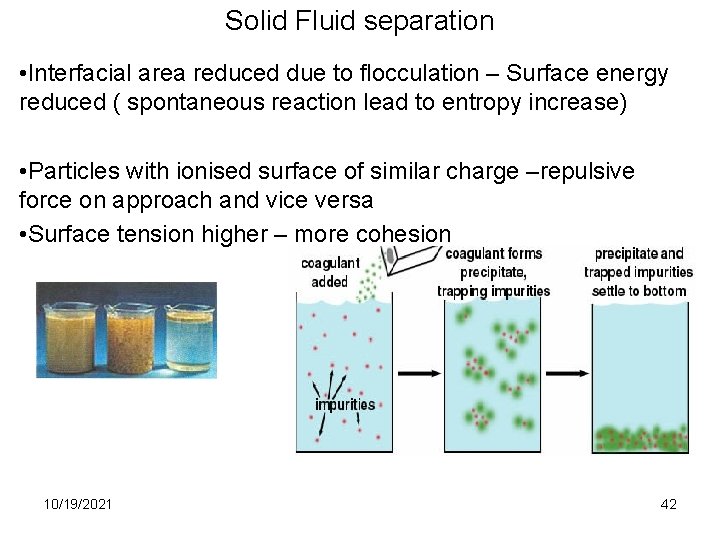
Solid Fluid separation • Sedimentation ( Thickening ) – either increasing solid or decreasing solid ( clarification) to produce liquid • Factors – flocculation of fine particles, separation & compaction of flocs , withdrawal of fluid & thickened slurry • Flocculation – fine particles grouped together to form flocules ( flocs) of large size • Mechanism -Finely divided mineral particle in water , variety of ions associated with water present -Ions & water molecules attach /detach from mineral particles 10/19/2021 41
Solid Fluid separation • Interfacial area reduced due to flocculation – Surface energy reduced ( spontaneous reaction lead to entropy increase) • Particles with ionised surface of similar charge –repulsive force on approach and vice versa • Surface tension higher – more cohesion 10/19/2021 42
Solid Fluid separation • Favourable condition for flocculation – Electrical Neutrality of particles – Iso –electric point – p. H ~7 • Near iso-electric point of particles , a colloid coagulates & pulp tends to flocculate • Factors : -surface tension between particles 7 aqueous phase of pulp -high pulp density -Low temp reduce stirring effect -p. H ( measure of ionisation or electrical charge) –addition of electrolyte providing opposite ions , increase in ionic valency -Mix of coarse and fines help 10/19/2021 43
Solid Fluid separation • Flocculants – Glues, Starch , lime , H 2 SO 4, Alum , Gypsum , Cu. SO 4, Sodium Aluminate ( trivalent ions more effective) • Floccules –aggregate of soild particles with interstitial fluid • Dewatering in thickening by : - Free settling of flocs – possible in water clarification only , velocity of slow settling flocs decides rate of dewatering -Hindered settling of flocs –Fast settling flocs retarded by slow settling flocs , velocity is more than in free settling - Exudation of water from settled flocs under pulp pressure – after hindered settling -Flocs rigid – further dewater- filtration 10/19/2021 44
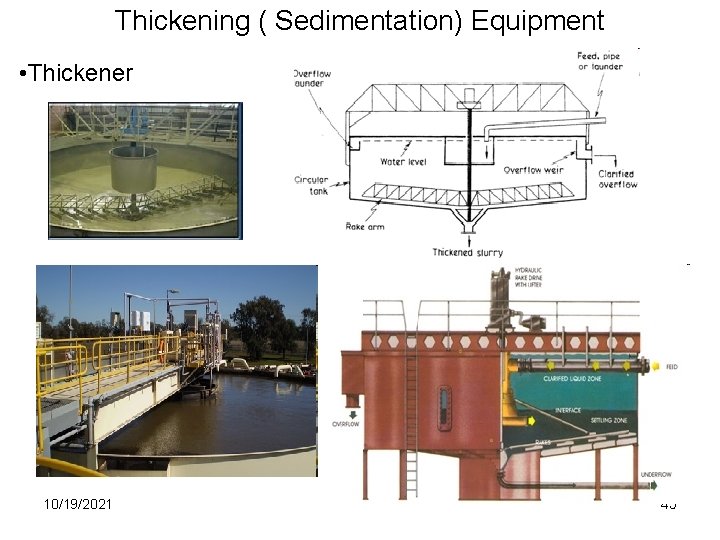
Thickening ( Sedimentation) Equipment • Thickener 10/19/2021 45
Filtration • Process of separating solid particle from fluid through membrane , cloth , synthetic porous material • The filter bed derived from suspension subjected to filtration • For bridging of pore by solids – diameter of coarsest particle > 1/3 of pore size • Porosity of filter bed decrease with time resulting in clean filtrate Rate of filtration : Filtering area , pressure difference , no of pores per unit area, thickness of filtered cake layer , higher pulp temperature , slow rate for fines , slow rate for dispersed cake ( pores rapidly clogged by finer particles ) , high rate for flocculated cake 10/19/2021 46
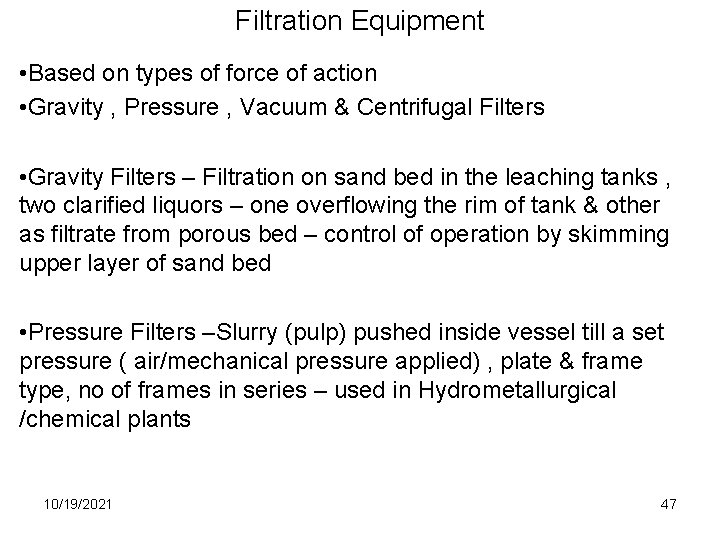
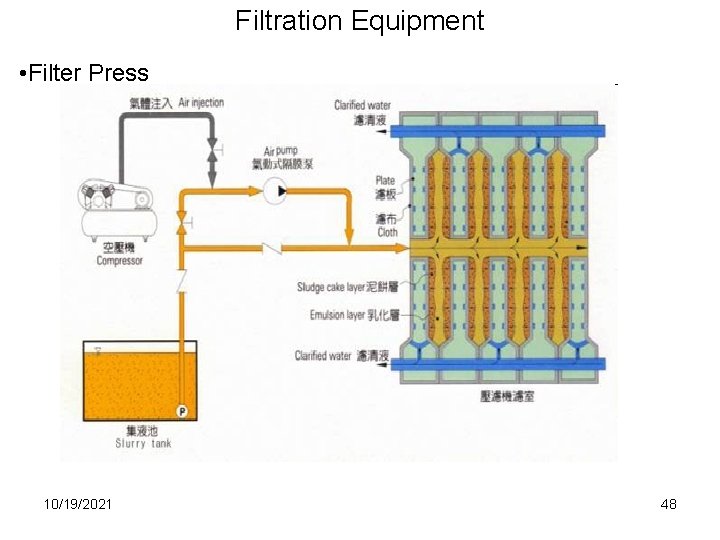
Filtration Equipment • Based on types of force of action • Gravity , Pressure , Vacuum & Centrifugal Filters • Gravity Filters – Filtration on sand bed in the leaching tanks , two clarified liquors – one overflowing the rim of tank & other as filtrate from porous bed – control of operation by skimming upper layer of sand bed • Pressure Filters –Slurry (pulp) pushed inside vessel till a set pressure ( air/mechanical pressure applied) , plate & frame type, no of frames in series – used in Hydrometallurgical /chemical plants 10/19/2021 47
Filtration Equipment • Filter Press 10/19/2021 48
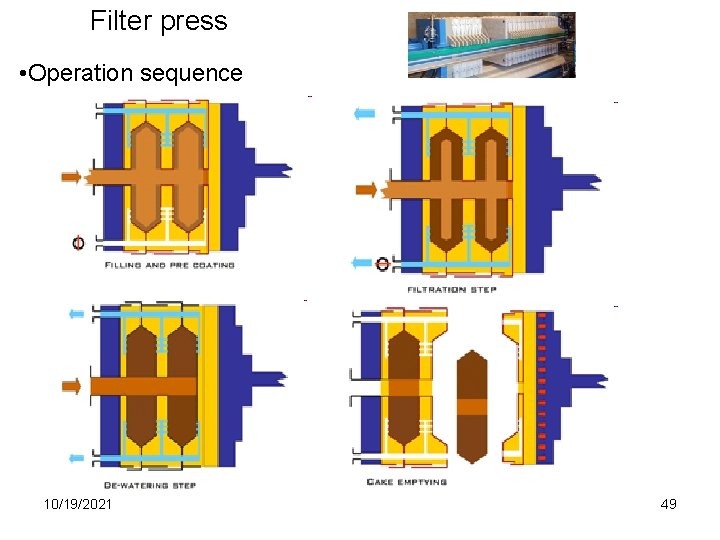
Filter press • Operation sequence 10/19/2021 49
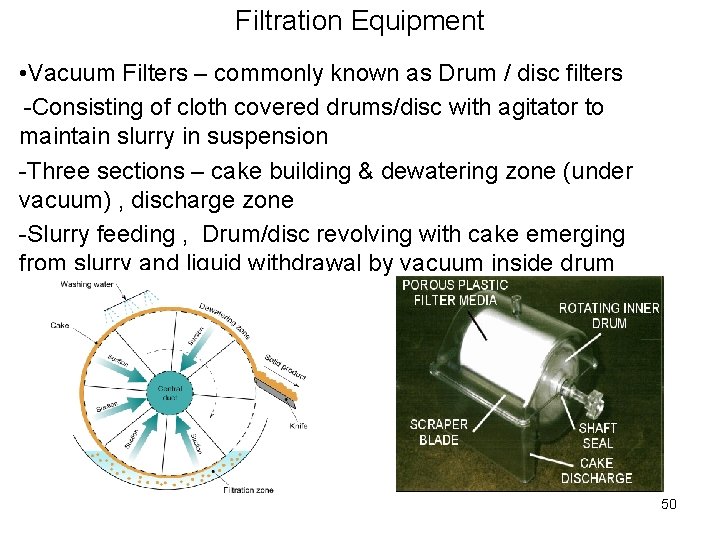
Filtration Equipment • Vacuum Filters – commonly known as Drum / disc filters -Consisting of cloth covered drums/disc with agitator to maintain slurry in suspension -Three sections – cake building & dewatering zone (under vacuum) , discharge zone -Slurry feeding , Drum/disc revolving with cake emerging from slurry and liquid withdrawal by vacuum inside drum 10/19/2021 50
Filtration Equipment • Centrifugal filters – Horizontal / vertical basket of cylindrical or cylindroconical shape rotating at high speed, pulp introduced at the centre , liquid pass through filtering surface ( cloth , membrane) -Used for dewatering granular coal & metal powders -Limited for small scale / chemical plants 10/19/2021 51
De watering by Drying -Evaporation of liquid by heating -Flash Drying – hot gases dry the dropped wet material -Rotary Drying – Horizontal cylinder in rotation – hot gas in contact with wet material -Hearth Drying – Hot gases with mechanical turning over 10/19/2021 52