
Principle of Microcomputer Based on ARM Technology 30

Principle of Microcomputer Based on ARM Technology (30) 主讲人:陈桂友
CONTENTS • Bridge-in • Objectives • Overview of STM 32 timers • Introduction of General-purpose timer • Structure of General-purpose timer • Calculation of period • Using General-purpose timer • Summary 2 /30
1. Objectives After learning this section, you will be able to: - know the structure of general purpose timers in STM 32; - know the counter mode of timers in STM 32; 3 /30
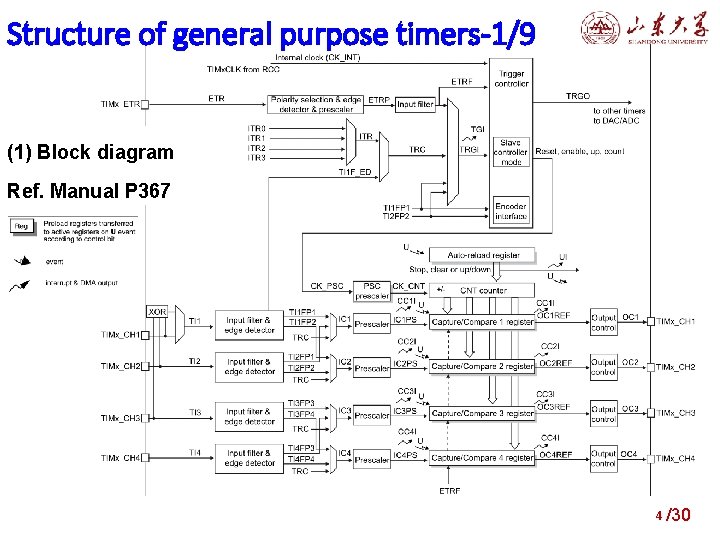
Structure of general purpose timers-1/9 (1) Block diagram Ref. Manual P 367 4 /30

Structure of general purpose timers-2/9 (2) Clock selection The counter clock can be provided by the following clock sources: u Internal clock (CK_INT) u External clock mode 1: external input pin (TIx) u External clock mode 2: external trigger input ETR u Internal trigger inputs (ITRx): using one timer as prescaler for another timer, for example, you can configure Timer 1 to act as a prescaler for Timer 2. 5 /30
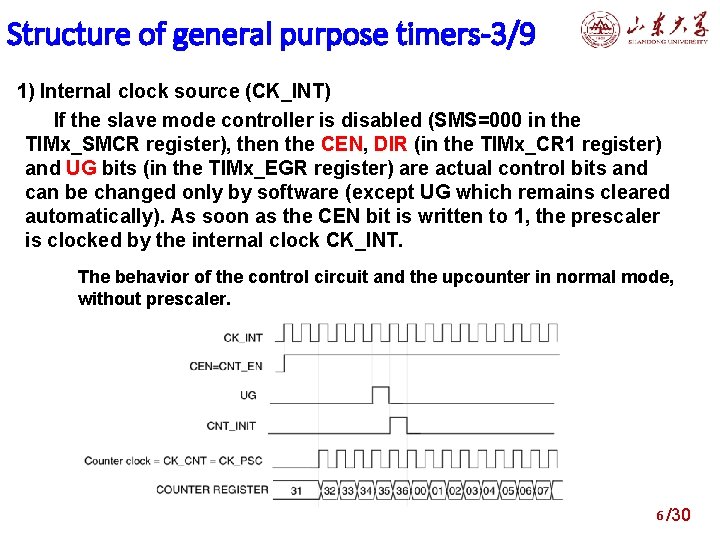
Structure of general purpose timers-3/9 1) Internal clock source (CK_INT) If the slave mode controller is disabled (SMS=000 in the TIMx_SMCR register), then the CEN, DIR (in the TIMx_CR 1 register) and UG bits (in the TIMx_EGR register) are actual control bits and can be changed only by software (except UG which remains cleared automatically). As soon as the CEN bit is written to 1, the prescaler is clocked by the internal clock CK_INT. The behavior of the control circuit and the upcounter in normal mode, without prescaler. 6 /30
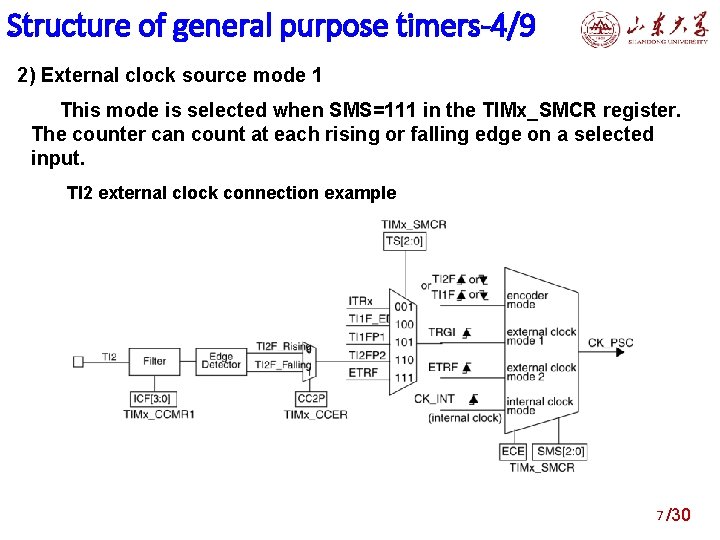
Structure of general purpose timers-4/9 2) External clock source mode 1 This mode is selected when SMS=111 in the TIMx_SMCR register. The counter can count at each rising or falling edge on a selected input. TI 2 external clock connection example 7 /30
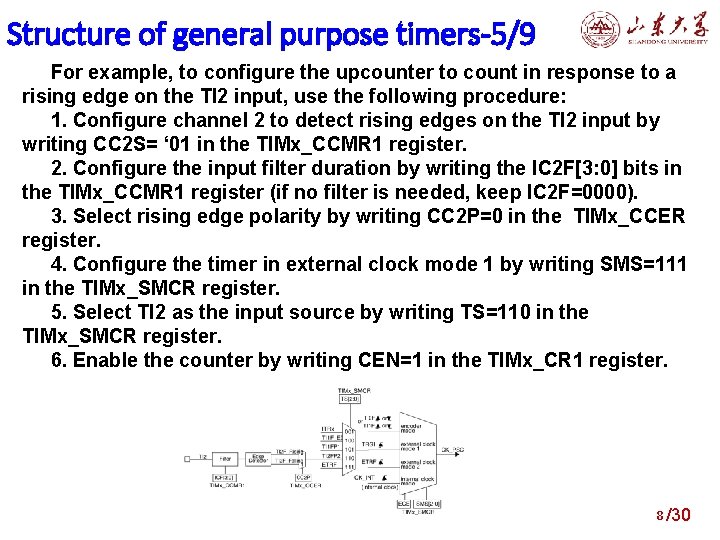
Structure of general purpose timers-5/9 For example, to configure the upcounter to count in response to a rising edge on the TI 2 input, use the following procedure: 1. Configure channel 2 to detect rising edges on the TI 2 input by writing CC 2 S= ‘ 01 in the TIMx_CCMR 1 register. 2. Configure the input filter duration by writing the IC 2 F[3: 0] bits in the TIMx_CCMR 1 register (if no filter is needed, keep IC 2 F=0000). 3. Select rising edge polarity by writing CC 2 P=0 in the TIMx_CCER register. 4. Configure the timer in external clock mode 1 by writing SMS=111 in the TIMx_SMCR register. 5. Select TI 2 as the input source by writing TS=110 in the TIMx_SMCR register. 6. Enable the counter by writing CEN=1 in the TIMx_CR 1 register. 8 /30
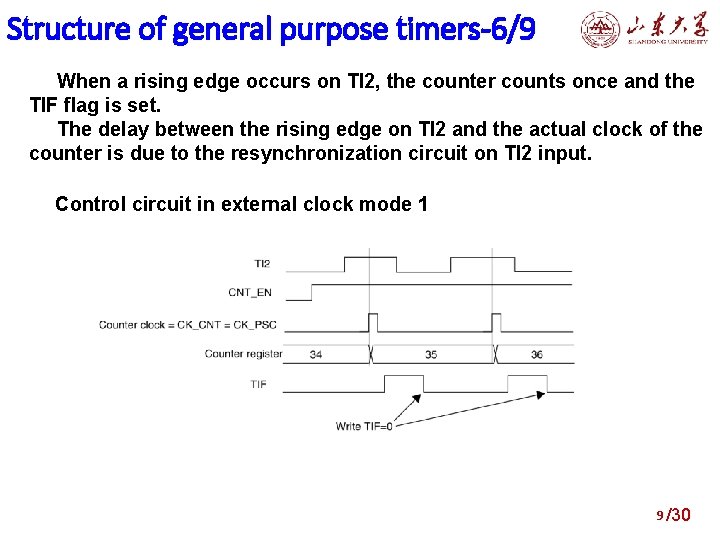
Structure of general purpose timers-6/9 When a rising edge occurs on TI 2, the counter counts once and the TIF flag is set. The delay between the rising edge on TI 2 and the actual clock of the counter is due to the resynchronization circuit on TI 2 input. Control circuit in external clock mode 1 9 /30
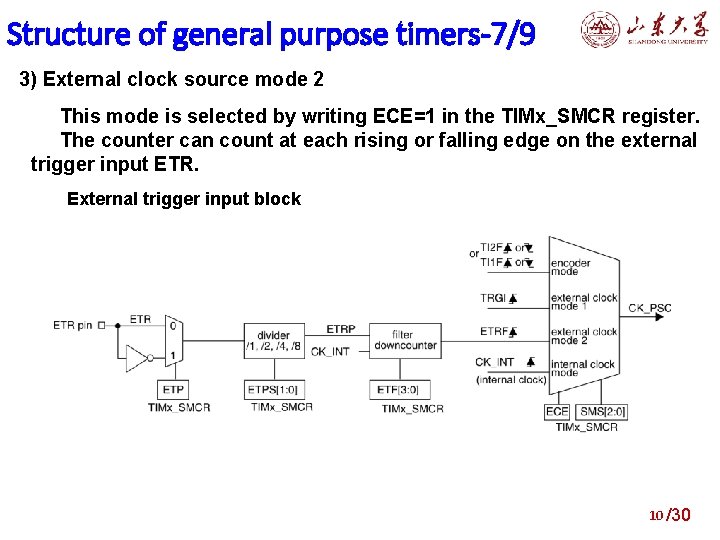
Structure of general purpose timers-7/9 3) External clock source mode 2 This mode is selected by writing ECE=1 in the TIMx_SMCR register. The counter can count at each rising or falling edge on the external trigger input ETR. External trigger input block 10 /30
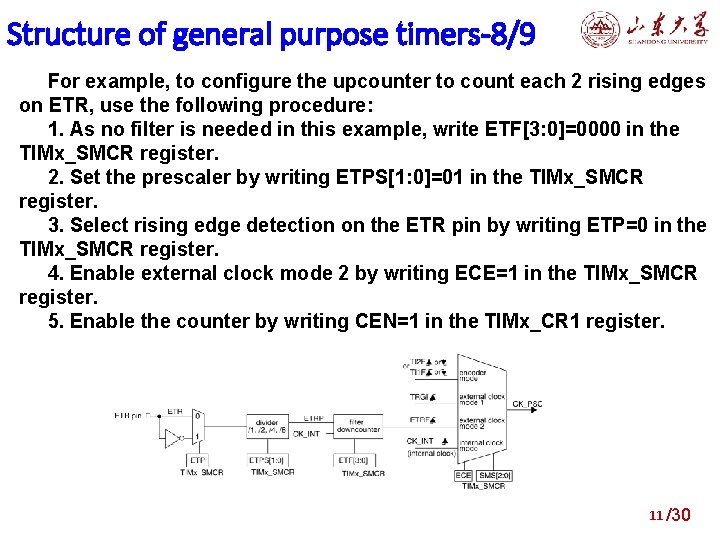
Structure of general purpose timers-8/9 For example, to configure the upcounter to count each 2 rising edges on ETR, use the following procedure: 1. As no filter is needed in this example, write ETF[3: 0]=0000 in the TIMx_SMCR register. 2. Set the prescaler by writing ETPS[1: 0]=01 in the TIMx_SMCR register. 3. Select rising edge detection on the ETR pin by writing ETP=0 in the TIMx_SMCR register. 4. Enable external clock mode 2 by writing ECE=1 in the TIMx_SMCR register. 5. Enable the counter by writing CEN=1 in the TIMx_CR 1 register. 11 /30
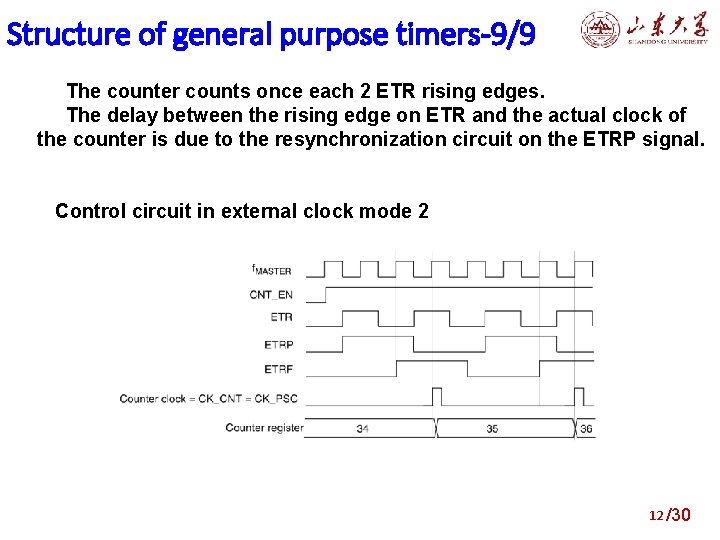
Structure of general purpose timers-9/9 The counter counts once each 2 ETR rising edges. The delay between the rising edge on ETR and the actual clock of the counter is due to the resynchronization circuit on the ETRP signal. Control circuit in external clock mode 2 12 /30
Counter modes-1/17 The counter can count up, down or both up and down. u In upcounting mode, the counter counts from 0 to the auto-reload value (content of the TIMx_ARR register), then restarts from 0 and generates a counter overflow event. u In downcounting mode, the counter counts from the auto-reload value (content of the TIMx_ARR register) down to 0, then restarts from the auto-reload value and generates a counter underflow event. u In center-aligned mode, the counter counts from 0 to the autoreload value (content of the TIMx_ARR register) – 1, generates a counter overflow event, then counts from the auto-reload value down to 1 and generates a counter underflow event. Then it restarts counting from 0. 13 /30
Counter modes-2/17 1) Upcounting mode In upcounting mode, the counter counts from 0 to the auto-reload value (content of the TIMx_ARR register), then restarts from 0 and generates a counter overflow event. An Update event can be generated at each counter overflow or by setting the UG bit in the TIMx_EGR register (by software or by using the slave mode controller). The UEV event can be disabled by software by setting the UDIS bit in TIMx_CR 1 register. This is to avoid updating the shadow registers while writing new values in the preload registers. Then no update event occurs until the UDIS bit has been written to 0. However, the counter restarts from 0, as well as the counter of the prescaler (but the prescale rate does not change). In addition, if the URS bit (update request selection) in TIMx_CR 1 register is set, setting the UG bit generates an update event UEV but without setting the UIF flag (thus no interrupt or DMA request is sent). This is to avoid generating both update and capture interrupts when clearing the counter on the capture event. 14 /30
Counter modes-3/17 1) Upcounting mode When an update event occurs, all the registers are updated and the update flag (UIF bit in TIMx_SR register) is set (depending on the URS bit): ● The buffer of the prescaler is reloaded with the preload value (content of the TIMx_PSC register) ● The auto-reload shadow register is updated with the preload value (TIMx_ARR) 15 /30
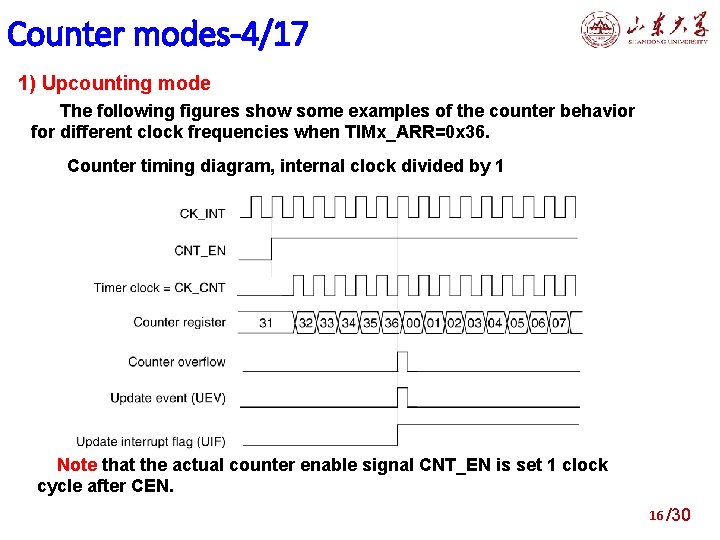
Counter modes-4/17 1) Upcounting mode The following figures show some examples of the counter behavior for different clock frequencies when TIMx_ARR=0 x 36. Counter timing diagram, internal clock divided by 1 Note that the actual counter enable signal CNT_EN is set 1 clock cycle after CEN. 16 /30
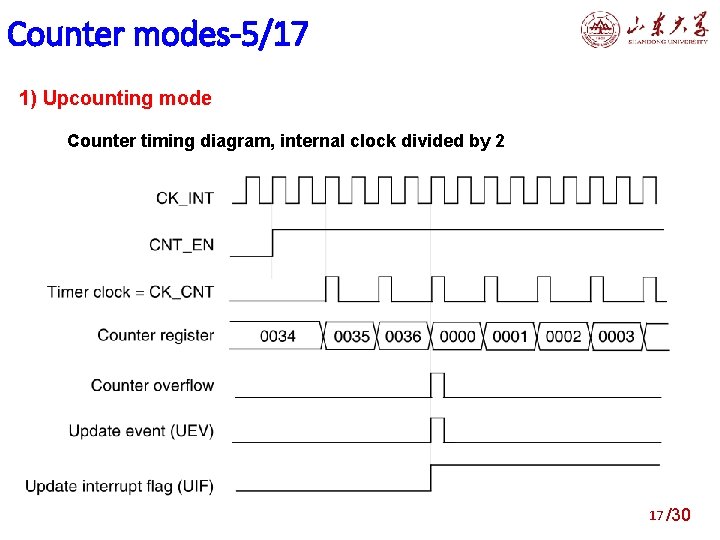
Counter modes-5/17 1) Upcounting mode Counter timing diagram, internal clock divided by 2 17 /30
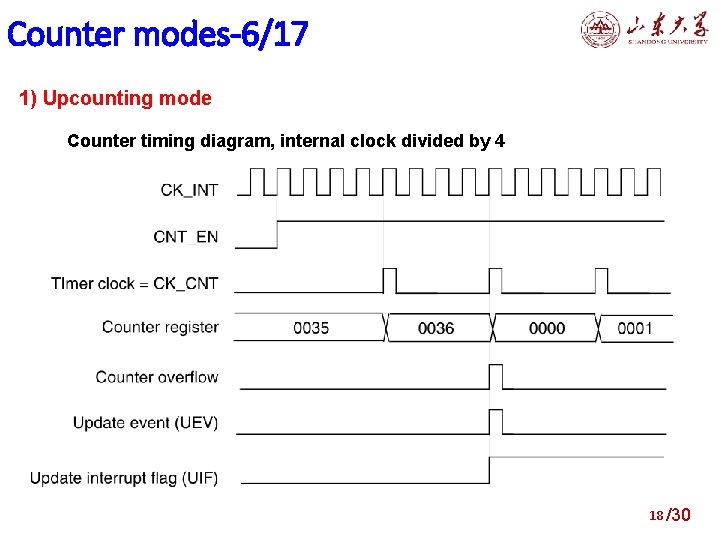
Counter modes-6/17 1) Upcounting mode Counter timing diagram, internal clock divided by 4 18 /30
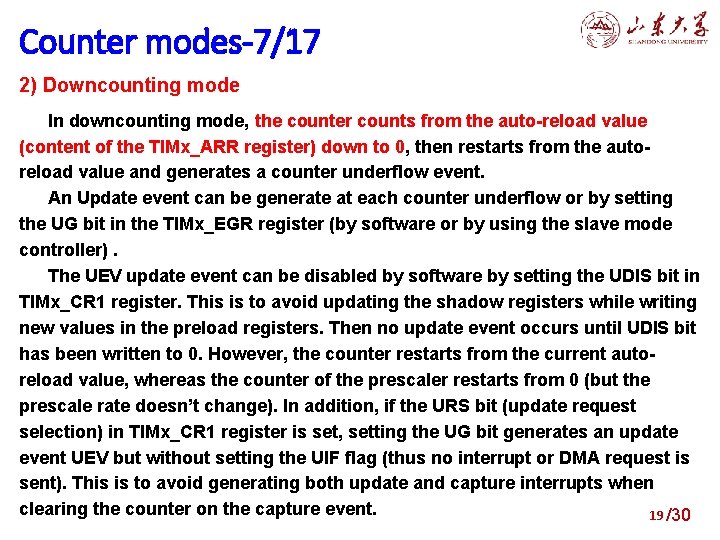
4. modes-7/17 Structure of general purpose timers Counter 2) Downcounting mode In downcounting mode, the counter counts from the auto-reload value (content of the TIMx_ARR register) down to 0, then restarts from the autoreload value and generates a counter underflow event. An Update event can be generate at each counter underflow or by setting the UG bit in the TIMx_EGR register (by software or by using the slave mode controller). The UEV update event can be disabled by software by setting the UDIS bit in TIMx_CR 1 register. This is to avoid updating the shadow registers while writing new values in the preload registers. Then no update event occurs until UDIS bit has been written to 0. However, the counter restarts from the current autoreload value, whereas the counter of the prescaler restarts from 0 (but the prescale rate doesn’t change). In addition, if the URS bit (update request selection) in TIMx_CR 1 register is set, setting the UG bit generates an update event UEV but without setting the UIF flag (thus no interrupt or DMA request is sent). This is to avoid generating both update and capture interrupts when clearing the counter on the capture event. 19 /30
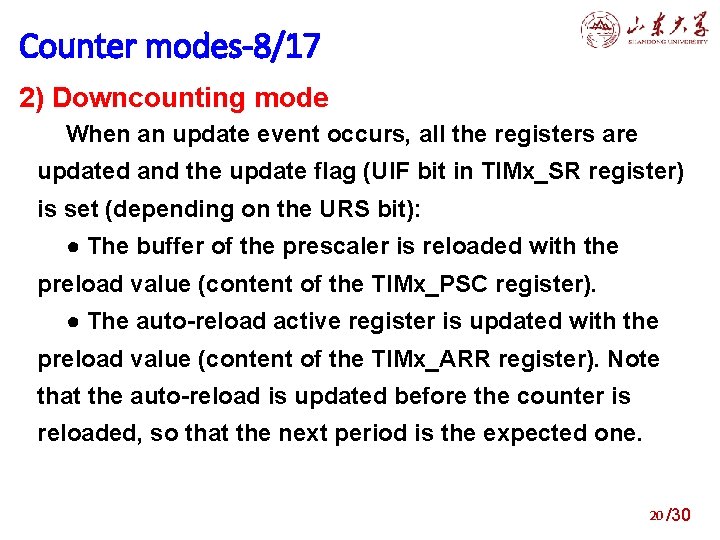
4. modes-8/17 Structure of general purpose timers Counter 2) Downcounting mode When an update event occurs, all the registers are updated and the update flag (UIF bit in TIMx_SR register) is set (depending on the URS bit): ● The buffer of the prescaler is reloaded with the preload value (content of the TIMx_PSC register). ● The auto-reload active register is updated with the preload value (content of the TIMx_ARR register). Note that the auto-reload is updated before the counter is reloaded, so that the next period is the expected one. 20 /30
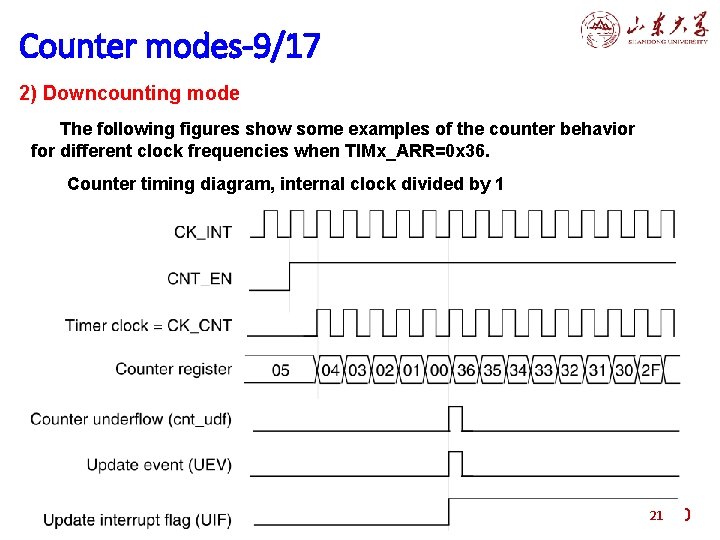
4. modes-9/17 Structure of general purpose timers Counter 2) Downcounting mode The following figures show some examples of the counter behavior for different clock frequencies when TIMx_ARR=0 x 36. Counter timing diagram, internal clock divided by 1 21 /30
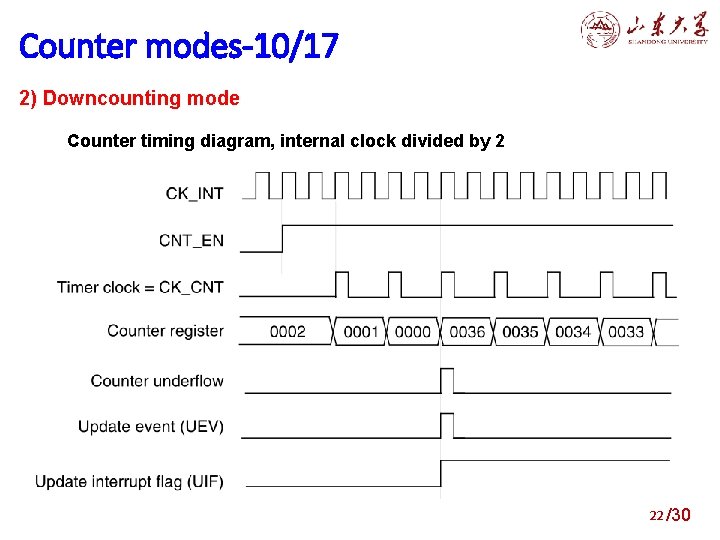
4. modes-10/17 Structure of general purpose timers Counter 2) Downcounting mode Counter timing diagram, internal clock divided by 2 22 /30
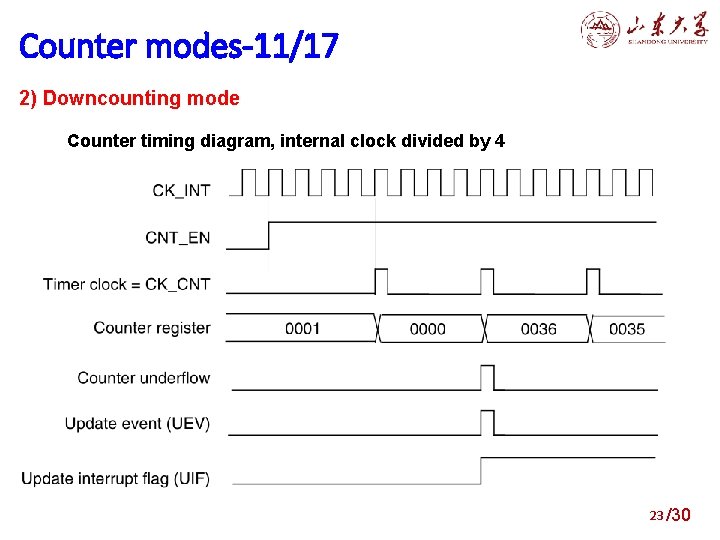
4. modes-11/17 Structure of general purpose timers Counter 2) Downcounting mode Counter timing diagram, internal clock divided by 4 23 /30
4. modes-12/17 Structure of general purpose timers Counter 3) Center-aligned mode (up/down counting) In center-aligned mode, the counter counts from 0 to the auto-reload value (content of the TIMx_ARR register) – 1, generates a counter overflow event, then counts from the auto-reload value down to 1 and generates a counter underflow event. Then it restarts counting from 0. Center-aligned mode is active when the CMS bits in TIMx_CR 1 register arenot equal to '00'. The Output compare interrupt flag of channels configured in output is set when: the counter counts down (Center aligned mode 1, CMS = "01"), the counter counts up (Center aligned mode 2, CMS = "10") the counter counts up and down (Center aligned mode 3, CMS = "11"). In this mode, the direction bit (DIR from TIMx_CR 1 register) cannot be written. It is updated by hardware and gives the current direction of the counter. The update event can be generated at each counter overflow and at each counter underflow or by setting the UG bit in the TIMx_EGR register (by software or by using the slave mode controller) also generates an update event. In this case, the counter restarts counting from 0, as well as the counter of the prescaler. 24 /30
4. modes-13/17 Structure of general purpose timers Counter 3) Center-aligned mode (up/down counting) The UEV update event can be disabled by software by setting the UDIS bit in TIMx_CR 1 register. This is to avoid updating the shadow registers while writing new values in the preload registers. Then no update event occurs until the UDIS bit has been written to 0. However, the counter continues counting up and down, based on the current autoreload value. In addition, if the URS bit (update request selection) in TIMx_CR 1 register is set, setting the UG bit generates an update event UEV but without setting the UIF flag (thus no interrupt or DMA request is sent). This is to avoid generating both update and capture interrupt when clearing the counter on the capture event. 25 /30
4. modes-14/17 Structure of general purpose timers Counter 3) Center-aligned mode (up/down counting) When an update event occurs, all the registers are updated and the update flag (UIF bit in TIMx_SR register) is set (depending on the URS bit): ● The buffer of the prescaler is reloaded with the preload value (content of the TIMx_PSC register). ● The auto-reload active register is updated with the preload value (content of the TIMx_ARR register). Note that if the update source is a counter overflow, the auto-reload is updated before the counter is reloaded, so that the next period is the expected one (the counter is loaded with the new value). 26 /30
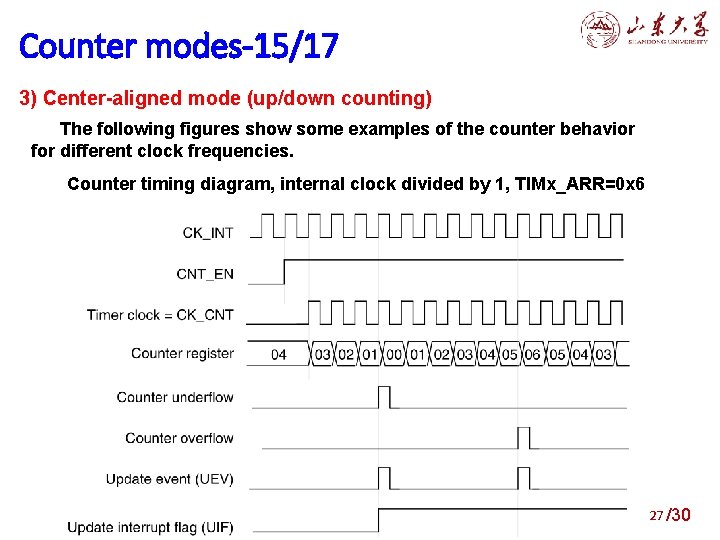
4. modes-15/17 Structure of general purpose timers Counter 3) Center-aligned mode (up/down counting) The following figures show some examples of the counter behavior for different clock frequencies. Counter timing diagram, internal clock divided by 1, TIMx_ARR=0 x 6 27 /30
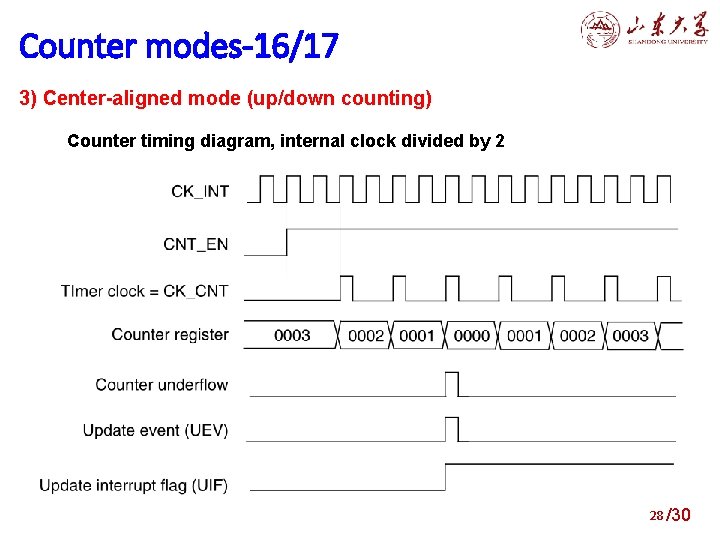
4. modes-16/17 Structure of general purpose timers Counter 3) Center-aligned mode (up/down counting) Counter timing diagram, internal clock divided by 2 28 /30
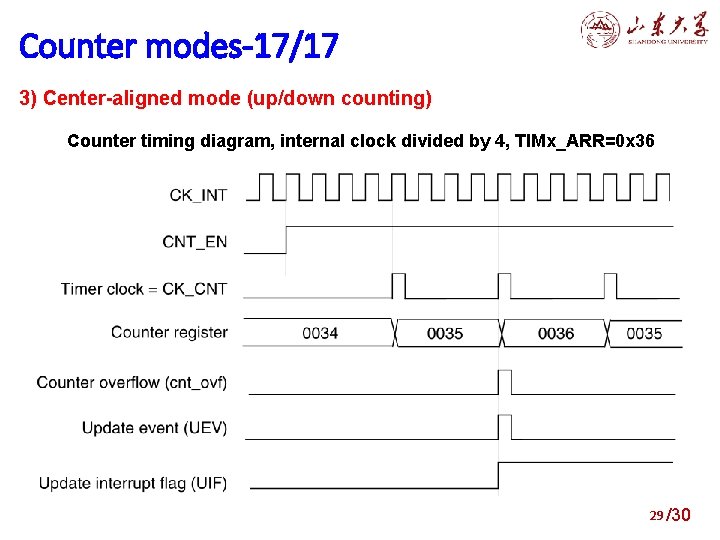
4. modes-17/17 Structure of general purpose timers Counter 3) Center-aligned mode (up/down counting) Counter timing diagram, internal clock divided by 4, TIMx_ARR=0 x 36 29 /30
Next lecture chapter 9 STM 32 Timer-3 30 /30
- Slides: 30