
PRINCIPLE OF MANAGEMENT BFT 109 Hirwan Jasbir Bin
PRINCIPLE OF MANAGEMENT BFT 109 Hirwan Jasbir Bin Jaafar 4 th Lecture
PLANNING IN THE CONTEMPORARY ORGANIZATION CHAPTER 4
Planning in the Contemporary Organization
The managerial function of planning and why planning is critical for effective leadership.

Short Term Operational Plans Tactics Planning Long Term Overarching plan
Managerial Planning • Planning Defined Ø The process of outlining the activities that are necessary to achieve the goals of the organization. • A Plan Ø A blueprint for action that prescribes the activities necessary for an organization to realize their goals. • Purpose of Planning Ø The purpose of planning is simple—to ensure that the organization is both effective and efficient in its activities for stakeholder benefit.
• Goals ØProvide a clear, engaging sense of direction and specify what is to be accomplished. • Control ØMonitor the extent to which goals have been achieved and ensure the organization is moving in the right direction.
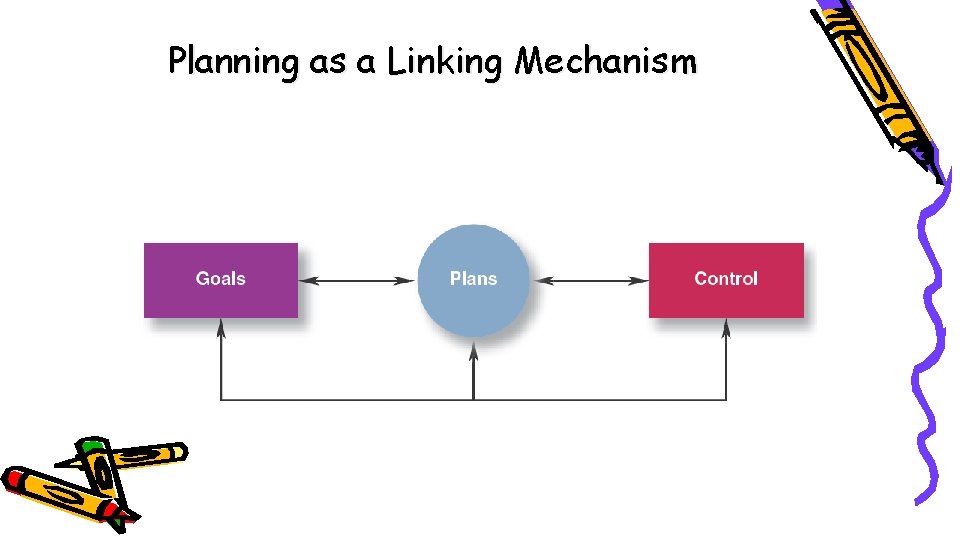
Planning as a Linking Mechanism

The benefits and costs of planning.
WHY PLANNING • Better Coordination • Focus on Forward Thinking • More Effective Control System
The Benefits of Planning • Better Coordination Ø Planning provides a foundation for the coordination of a broad range of organizational activities. Ø A plan helps to define the responsibilities of individuals and work groups and helps coordinate their activities. • Focus on Forward Thinking Ø The planning function forces managers to think ahead and consider resource needs and potential opportunities or threats that the organization may face in the future. © 2016 Wessex Press, Inc. All rights reserved.
The Benefits of Planning (cont’d) • More Effective Control Systems Ø An organization’s plan provides a foundation for control of the processes and progress of the company. Ø The implementation of the plan can be evaluated and progress toward the achievement of performance objectives can be monitored. Ø Controls provide mechanism for ensuring that the organization is moving in the right direction and making progress toward achieve its goals. © 2016 Wessex Press, Inc. All rights reserved.
The Costs of Planning • Management Time Ø Done properly, the planning process requires a substantial amount of managerial time and energy. • Delay in Decision Making Ø Planning can result in delays in decision making, which must be weighed against the importance of speed in response time. © 2016 Wessex Press, Inc. All rights reserved.
Planning: Benefits Versus Costs • In the final analysis, managers plan because planning leads to higher performance. • Planning also helps managers cope with the challenges they face and ensures the long-term success of their companies. 4– 14 © 2016 Wessex Press, Inc. All rights reserved.
The potential advantages and disadvantages of top -down and bottom-up planning.
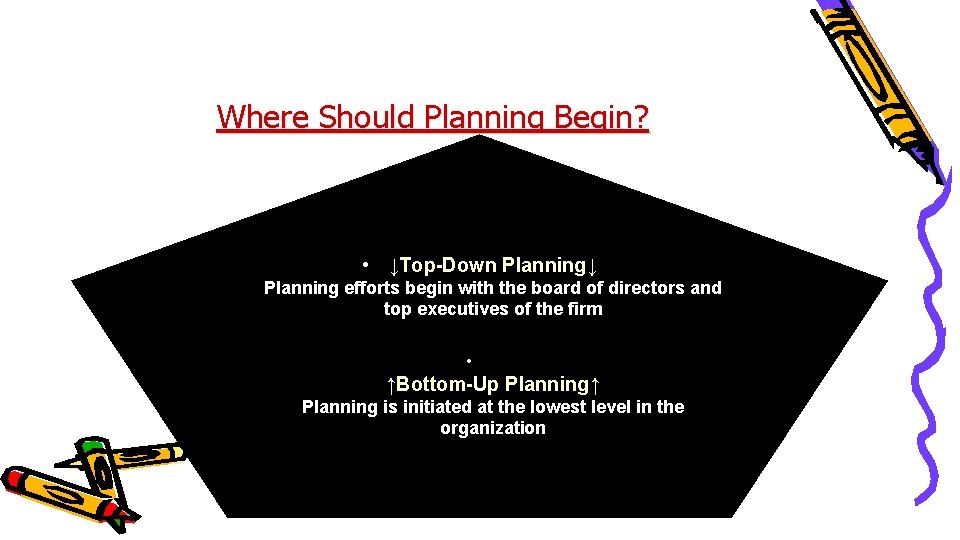
Where Should Planning Begin? • ↓Top-Down Planning↓ Planning efforts begin with the board of directors and top executives of the firm • ↑Bottom-Up Planning↑ Planning is initiated at the lowest level in the organization
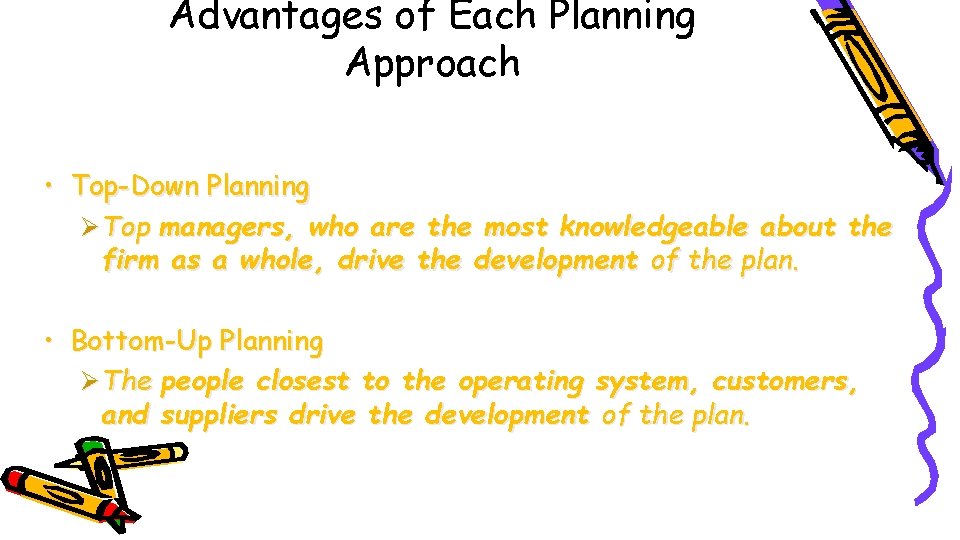
Advantages of Each Planning Approach • Top-Down Planning Ø Top managers, who are the most knowledgeable about the firm as a whole, drive the development of the plan. • Bottom-Up Planning Ø The people closest to the operating system, customers, and suppliers drive the development of the plan.
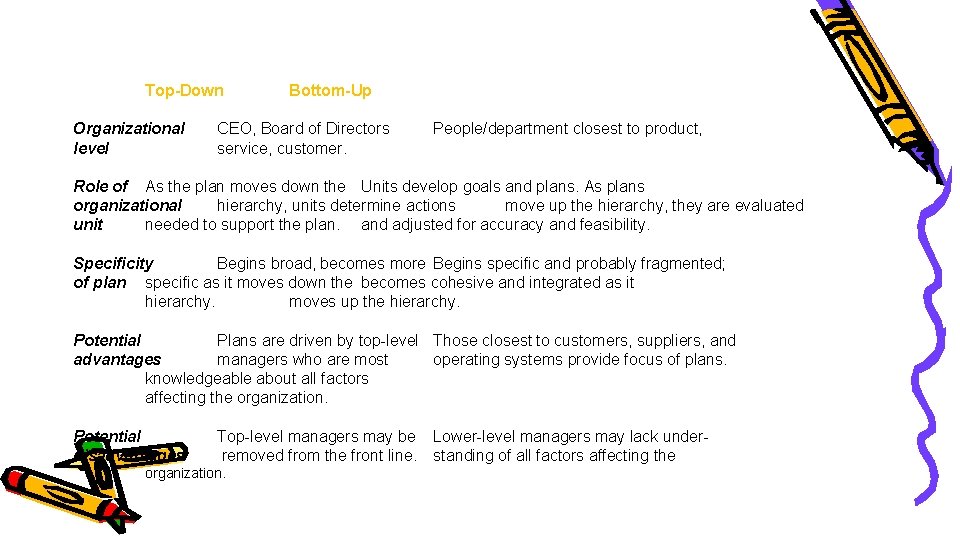
Top-Down Organizational level Bottom-Up CEO, Board of Directors service, customer. People/department closest to product, Role of As the plan moves down the Units develop goals and plans. As plans organizational hierarchy, units determine actions move up the hierarchy, they are evaluated unit needed to support the plan. and adjusted for accuracy and feasibility. Specificity Begins broad, becomes more Begins specific and probably fragmented; of plan specific as it moves down the becomes cohesive and integrated as it hierarchy. moves up the hierarchy. Potential Plans are driven by top-level Those closest to customers, suppliers, and advantages managers who are most operating systems provide focus of plans. knowledgeable about all factors affecting the organization. Potential disadvantages Top-level managers may be removed from the front line. organization. Lower-level managers may lack understanding of all factors affecting the
Strategic planning vs. Operational planning.
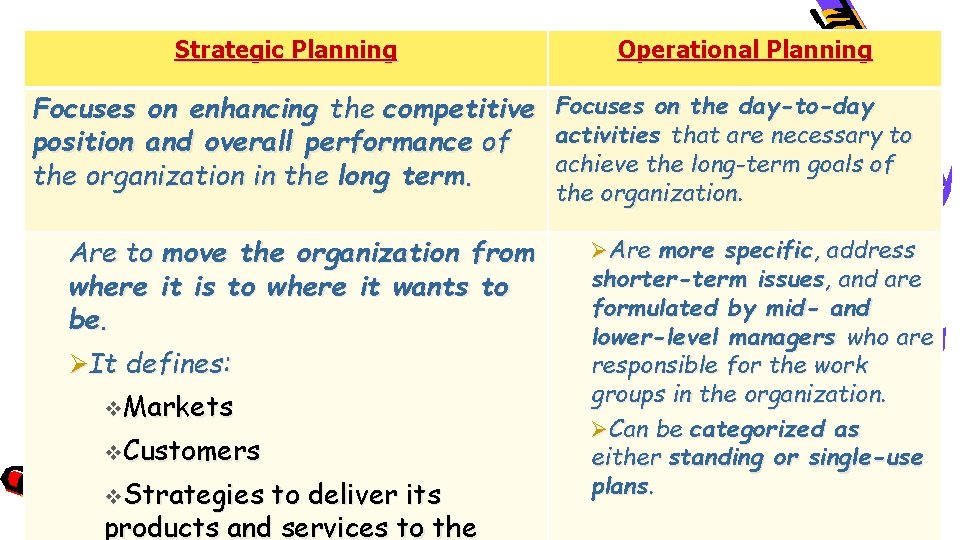
Strategic Planning Operational Planning Focuses on enhancing the competitive position and overall performance of the organization in the long term. Focuses on the day-to-day activities that are necessary to achieve the long-term goals of the organization. Are to move the organization from where it is to where it wants to be. ØAre more specific, address ØIt defines: Markets Customers Strategies to deliver its products and services to the shorter-term issues, and are formulated by mid- and lower-level managers who are responsible for the work groups in the organization. ØCan be categorized as either standing or single-use plans.
Operational planning and standing or single-use plans.
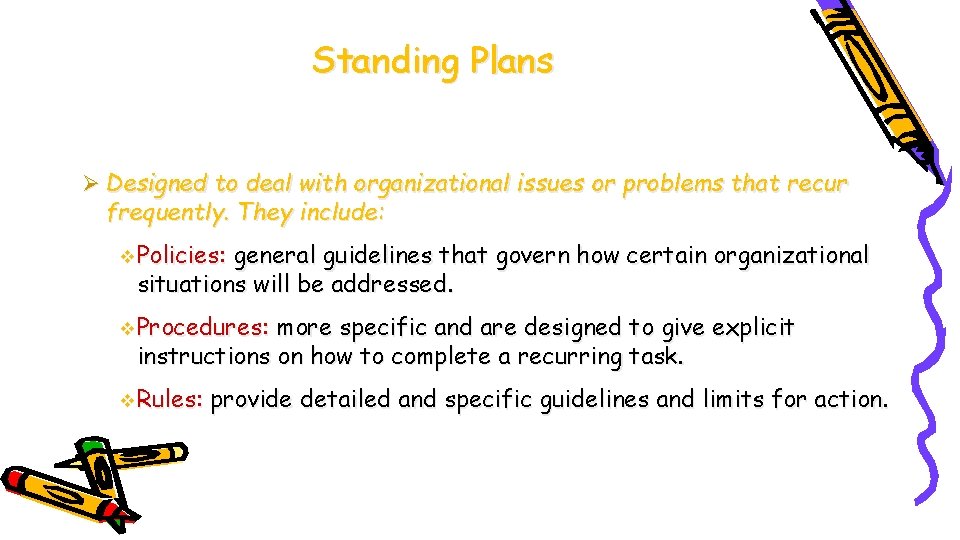
Standing Plans Ø Designed to deal with organizational issues or problems that recur frequently. They include: Policies: general guidelines that govern how certain organizational situations will be addressed. Procedures: more specific and are designed to give explicit instructions on how to complete a recurring task. Rules: provide detailed and specific guidelines and limits for action.
Single-Use Plans Ø Are developed to address a specific organizational situation. They include: Programs: govern a relatively comprehensive set of activities that are designed to accomplish a particular set of goals. Projects: direct the efforts of individuals or work groups toward the achievement of specific, well-defined objectives. Budgets: specify how financial resources should be allocated.
Individual planning systems such as management by objectives and the Balanced Scorecard.
Individual Plans • Increasingly, organizations are looking for ways to translate boarder organizational plans to the level of individual employees. Ø Two approaches for doing so include: Management The by Objectives Balanced Scorecard © 2016 Wessex Press, Inc. All rights reserved.
Management by Objectives (MBO) • A method for developing individualized plans which guide the activities of individuals. Ø MBO benefits: Provides a foundation for a more integrated and system-oriented approach to planning. Requires communication between employees and their managers since they must agree on the performance goals outlined in the plan. Creates a participatory work environment where employees have a voice in the design of their jobs and setting their performance targets. © 2016 Wessex Press, Inc. All rights reserved.
MBO Disadvantages • Requires time and commitment of top management. • May require excessive paperwork. • May create a tendency to focus on short-term planning rather than long-term planning. • Can be difficult to establish and operationalize. © 2016 Wessex Press, Inc. All rights reserved.
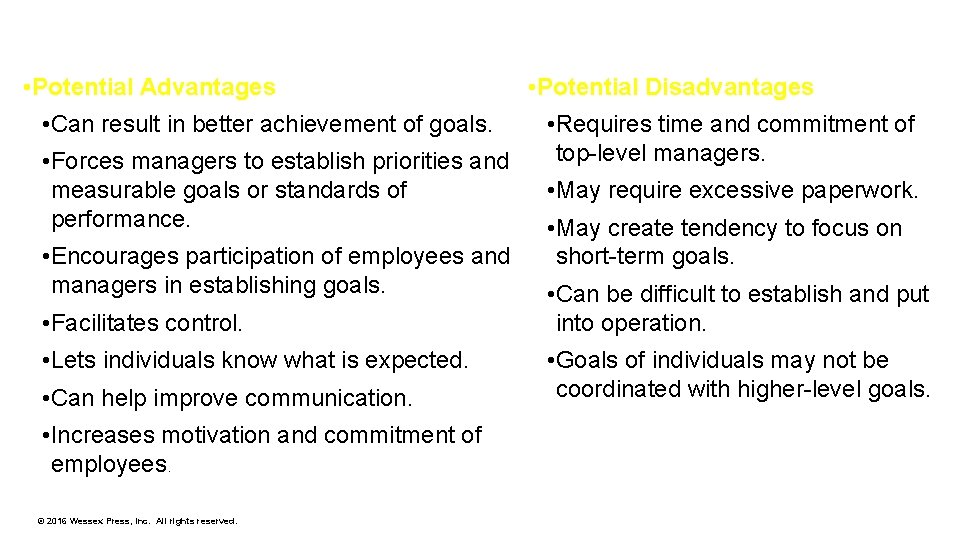
• Potential Advantages • Can result in better achievement of goals. • Forces managers to establish priorities and measurable goals or standards of performance. • Encourages participation of employees and managers in establishing goals. • Facilitates control. • Lets individuals know what is expected. • Can help improve communication. • Increases motivation and commitment of employees. © 2016 Wessex Press, Inc. All rights reserved. • Potential Disadvantages • Requires time and commitment of top-level managers. • May require excessive paperwork. • May create tendency to focus on short-term goals. • Can be difficult to establish and put into operation. • Goals of individuals may not be coordinated with higher-level goals.
The Balanced Scorecard (BSC) • A system-wide performance measurement process that aligns individual goals with the strategic goals of the organization. ØAllows an organization to translate strategy into operational actions at every level. ØEnsures employees that their individual action plans and goals are consistent with the overall strategic direction of the organization. © 2016 Wessex Press, Inc. All rights reserved.
Contingency planning and the circumstances under which contingency planning would be appropriate. © 2016 Wessex Press, Inc. All rights reserved.
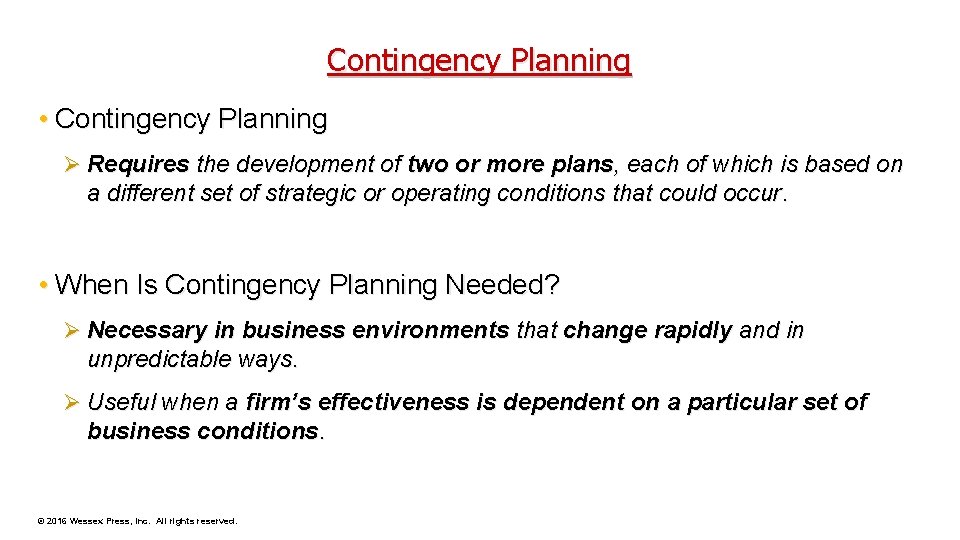
Contingency Planning • Contingency Planning Ø Requires the development of two or more plans, each of which is based on a different set of strategic or operating conditions that could occur. • When Is Contingency Planning Needed? Ø Necessary in business environments that change rapidly and in unpredictable ways. Ø Useful when a firm’s effectiveness is dependent on a particular set of business conditions. © 2016 Wessex Press, Inc. All rights reserved.
How advances in information technology have affected the planning process.
The Impact of Information Technology on Planning • Advances in information technology have improved both the effectiveness and efficiency of the planning function. • Information technology can be used to establish and implement the strategic and operational plans of an organization.
Common barriers to effective planning and ways to reduce these barriers.
• Demands on the manager’s time • Ambiguous and uncertain operating environments • Resistance to change Barriers to Effective Planning © 2016 Wessex Press, Inc. All rights reserved.
Overcoming the Barriers to Planning • Involve Employees in Decision Making ØInput from all levels of a firm is essential for successful planning. • Take Advantage of a Diversity of Views ØDiverse views lead to a broader assessment of organizational problems and opportunities. • Encourage Strategic Thinking ØEffective strategic thinking can be developed through training and practice. © 2016 Wessex Press, Inc. All rights reserved.
Implications for Leaders • Recognize and communicate the importance of planning in achieving organizational success. • Understand appreciate the relationship between strategic and operational planning. • Involve those responsible for implementing the plan in the planning process. • Use contingency planning as a means of maintaining flexibility in rapidly changing business environments. © 2016 Wessex Press, Inc. All rights reserved.
Implications for Leaders • Utilize technology to enhance the effectiveness and efficiency of the planning process. • Remove the barrier to planning at the work group and individual levels. • Reward those who think strategically and follow through with operational planning. © 2016 Wessex Press, Inc. All rights reserved.
Strategic Analysis: Assessing The Organization
Strategic Analysis: Assessing The Organization • The important components of strategic analysis include : i. An Assessment of the organizations’ mission, vision and values ii. An assessment of the internal environment for the organization iii. The review of external environmental trend that impact the strategy of the organization.
Mission Statement • A statement outlining the purpose of an organization and the fundamental reason why the organization exists. • Create by owner, top management or boad of director. • Foundation upon which its strategy will be built.
Vision Statement • A statement describing what the organization aspires to become overtime.
CONDUCTING AN ANALYSIS
ANALYSIS METHOD • S – Strength • W – Weakness • O - Opportunities • T - Thread
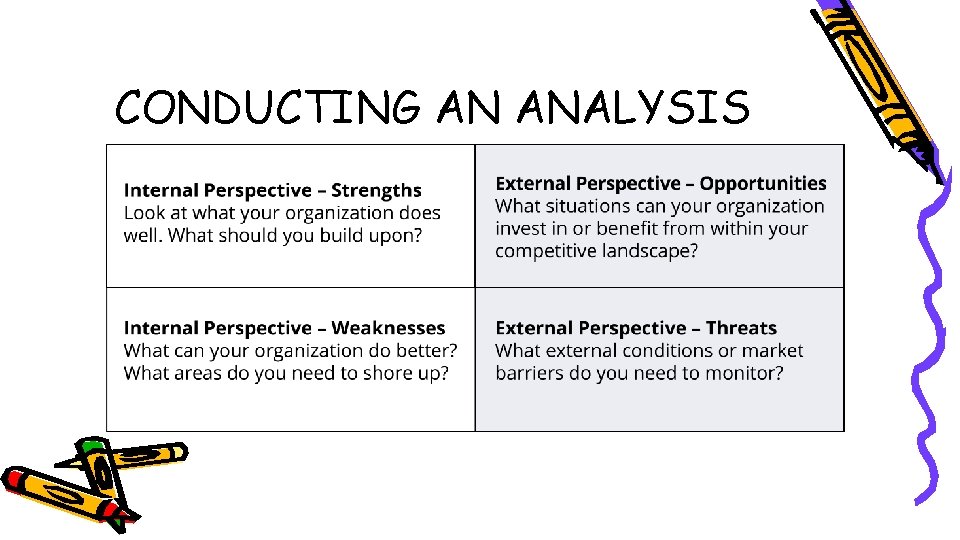
CONDUCTING AN ANALYSIS
STRATEGY FORMULATION
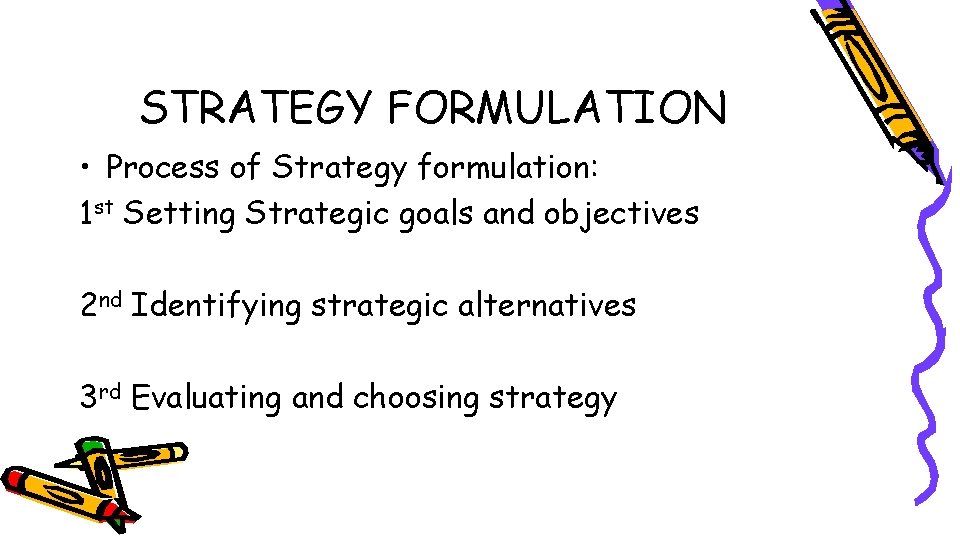
STRATEGY FORMULATION • Process of Strategy formulation: 1 st Setting Strategic goals and objectives 2 nd Identifying strategic alternatives 3 rd Evaluating and choosing strategy
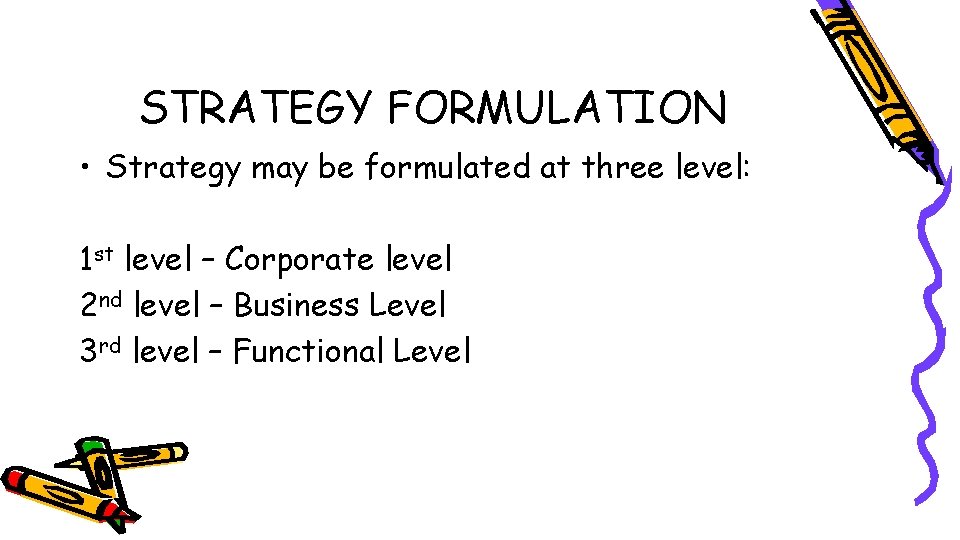
STRATEGY FORMULATION • Strategy may be formulated at three level: 1 st level – Corporate level 2 nd level – Business Level 3 rd level – Functional Level
1 st level – Corporate level • The highest level of strategy formulation, answer the question “ What business should we be in? ” • The common purpose of corporate level strategy is to diversify an organization’s operations.
2 nd level – Business Level • Strategy that answers the question “How do we run the business we are in? ” Has a more specific focus than corporate strategy.
3 rd level – Functional Level • Strategy that addresses the production, research and development, financial, human resource management and marketing activities necessary to implement an organization’s corporate and business strategies
THE STRATEGY FORMULATE PROCESS
The Strategy Formulate Process • The most important step in the strategic planning process. • Once an organization has clearly delineated its mission, vision and values and has conducted a through strategic analysis, it is prepared to develop its strategy for organization success
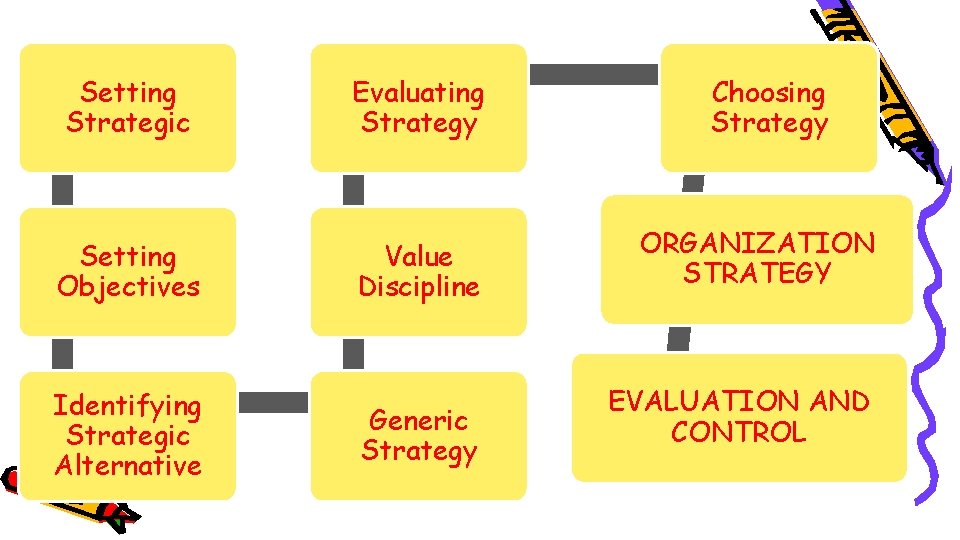
Setting Strategic Evaluating Strategy Setting Objectives Value Discipline Identifying Strategic Alternative Generic Strategy Choosing Strategy ORGANIZATION STRATEGY EVALUATION AND CONTROL
EVALUATION AND CONTROL
EVALUATION AND CONTROL • Final step strategy formulation is evaluation and control. • To make sure the strategy is effective and efficient
Organizing for Effectiveness and Efficiency CHAPTER 5
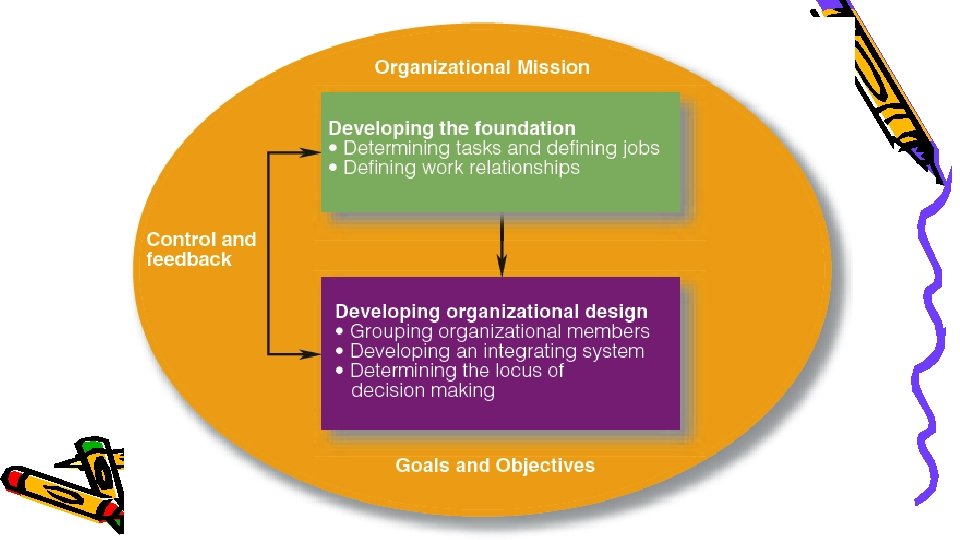
Why organizing is an important managerial function and the process of organizing, and outline the primary stages of the process.
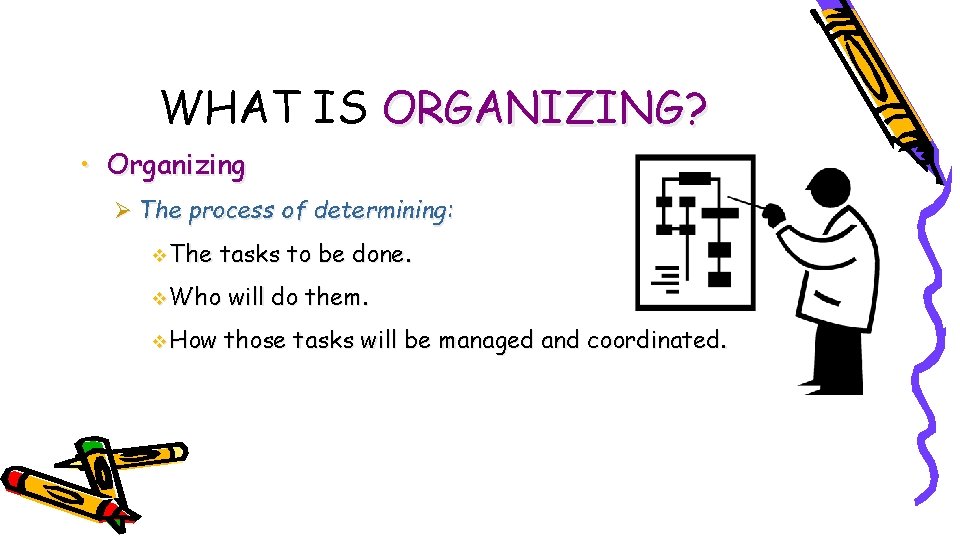
WHAT IS ORGANIZING? • Organizing Ø The process of determining: The tasks to be done. Who will do them. How those tasks will be managed and coordinated.
The concept of job design and the core job dimensions that define a job.
Job Design • The set of tasks and activities that are grouped together to define a particular job. • Job descriptions detail the responsibilities and tasks associated with a given job.
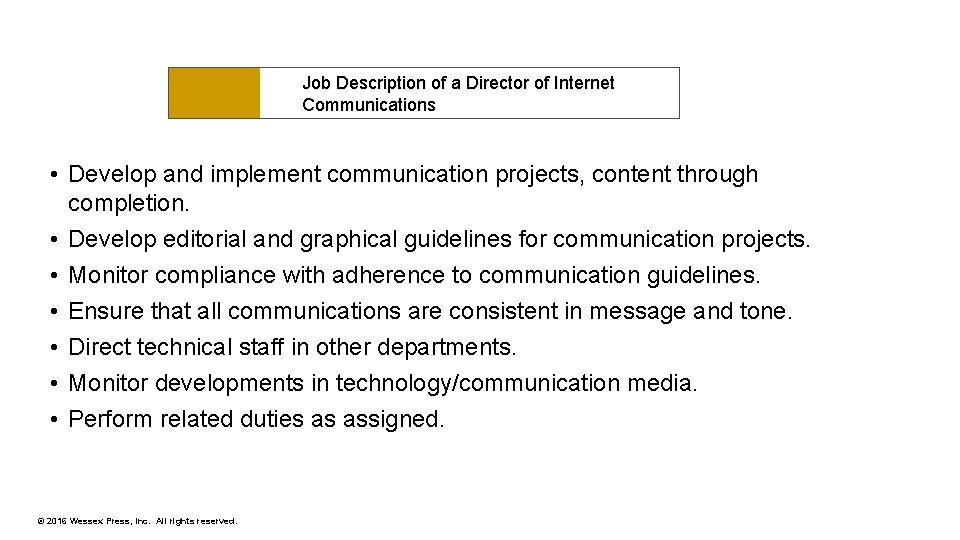
Job Description of a Director of Internet Communications • Develop and implement communication projects, content through completion. • Develop editorial and graphical guidelines for communication projects. • Monitor compliance with adherence to communication guidelines. • Ensure that all communications are consistent in message and tone. • Direct technical staff in other departments. • Monitor developments in technology/communication media. • Perform related duties as assigned. © 2016 Wessex Press, Inc. All rights reserved.
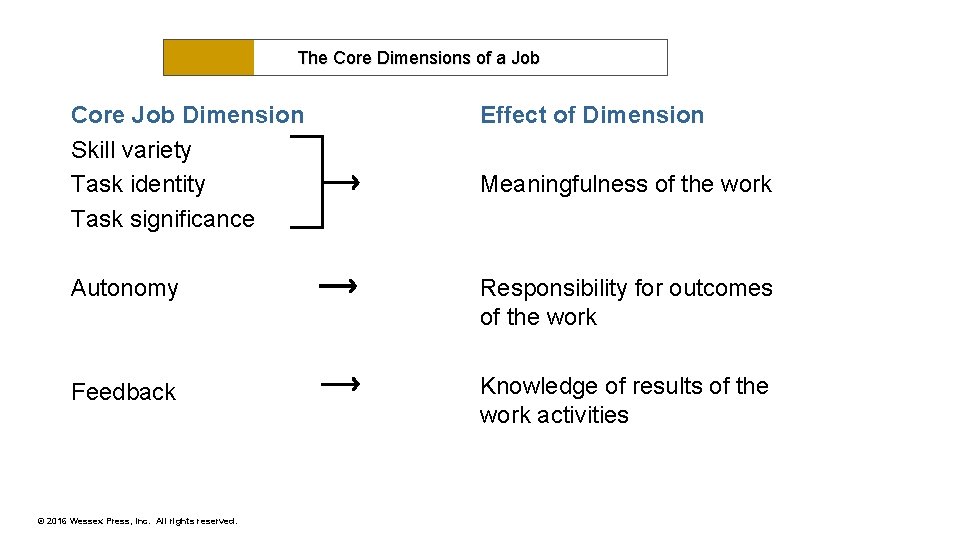
The Core Dimensions of a Job Core Job Dimension Skill variety Task identity Task significance Effect of Dimension Autonomy Responsibility for outcomes of the work Feedback Knowledge of results of the work activities © 2016 Wessex Press, Inc. All rights reserved. Meaningfulness of the work
Core Job Dimensions • Skill Variety Ø The degree to which a job challenges the job holder to use various skills and abilities. • Task Identity Ø The degree to which a job requires the completion of an identifiable piece of work. • Task Significance Ø The degree to which a job contributes to the overall efforts of the organization. © 2016 Wessex Press, Inc. All rights reserved.
Core Job Dimensions (cont’d) • Autonomy Ø The degree to which job holders have freedom, independence, and decision-making authority. • Feedback Ø The information provided to job holders regarding the effectiveness of their efforts. © 2016 Wessex Press, Inc. All rights reserved.
How and why the perspectives on job design have evolved.
The Evolution of Job Design Perspectives • The production worker has now become the knowledge worker. Ø Classical Perspectives Ø Behavioral Management Perspectives Ø Employee-Centered and Team-Centered Perspectives
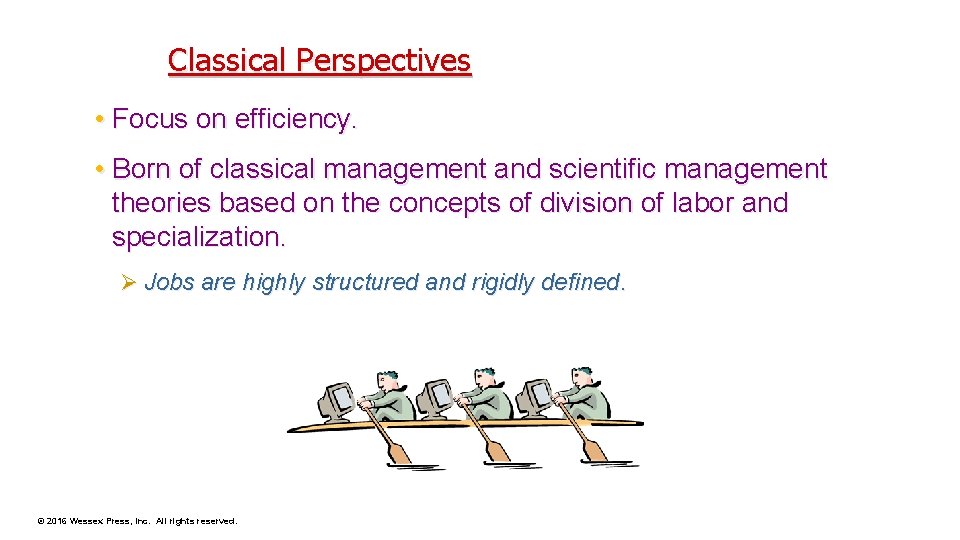
Classical Perspectives • Focus on efficiency. • Born of classical management and scientific management theories based on the concepts of division of labor and specialization. Ø Jobs are highly structured and rigidly defined. © 2016 Wessex Press, Inc. All rights reserved.
Behavioral Perspectives • Focus on motivation, satisfaction, and productivity. Ø Became popular during the movement toward the human relations school of thought. Ø Led to the development of more innovative approaches to job design including: Job enlargement Job enrichment Job rotation © 2016 Wessex Press, Inc. All rights reserved.
Job Enlargement • Programs designed to broaden job scope. Ø Job scope refers to the number of different activities required in a job and the frequency with which each activity is performed. Ø While job enlargement programs have typically been considered as a means of enriching jobs, sometimes reducing job scope has a positive impact on productivity and job satisfaction. © 2016 Wessex Press, Inc. All rights reserved.
Job Depth and Job Enrichment • Job Depth Ø Refers to the degree of control given to a job holder to perform their job. Ø Closes the gap between planning, doing and controlling a particular set of activities. Ø Jobs that have high job depth typically rate more favorably on the core job dimensions than jobs with low job design. • Job Enrichment Ø Can be an effective means of motivating employees and improving job satisfaction. © 2016 Wessex Press, Inc. All rights reserved.
Job Rotation • Assigning individuals to a variety of job positions. Ø Employees rotate through a number of job positions that are at approximately the same level and have similar skill requirements. Ø While job rotation has proven particularly beneficial in manufacturing settings, it can also be used effectively in service organizations. © 2016 Wessex Press, Inc. All rights reserved.
Employee-Centered Work Redesign • Links the mission of the organization with the needs of the individual by allowing employees to design their work roles to benefit the organization and themselves. • Benefits of redesign include: Ø Improved productivity and job satisfaction. Ø Fosters a climate that supports cooperation between individuals and work groups. Ø Consistent with quality improvement efforts. Ø Helps employees achieve work/life balance. © 2016 Wessex Press, Inc. All rights reserved.
Self-Managed Teams • Shifts the focus from the individual to the work group. Ø Responsibility for a substantial portion of the organization’s activities is assigned to a team of individuals who must determine the best way to fulfill those responsibilities. Ø Self-managed teams are considered cross-functional teams. © 2016 Wessex Press, Inc. All rights reserved.
Both the vertical and horizontal associations that exist between individuals and work groups within the organization.
Organizational Relationships • The working relationships that exist within an organization affect how its activities are accomplished and coordinated. • These relationships are defined by: Ø Chain of command Ø Span of control Ø Line and staff responsibilities Ø Delegation
Chain of Command Unity of Command • Chain of Command Ø The line of authority and responsibility that flows throughout the organization. • Unity of Command Ø A principle that each employee in the organization is accountable to one, and only one, supervisor.
Span of Control • The number of employees reporting to a particular manager. Ø In theory, when tasks are very complex, span of control should be relatively narrow. Ø In contrast, where jobs are highly standardized and routine (low complexity), a manager will not need to spend as much time supporting individual subordinates, and the span of control may be larger.
Line and Staff Responsibilities • Line Departments Ø Those organizational members that are directly involved in delivering the products and services of the organization. • Staff Departments Ø Those organizational members that are not directly involved in delivering the products and services to the organization, but provide support for line personnel.
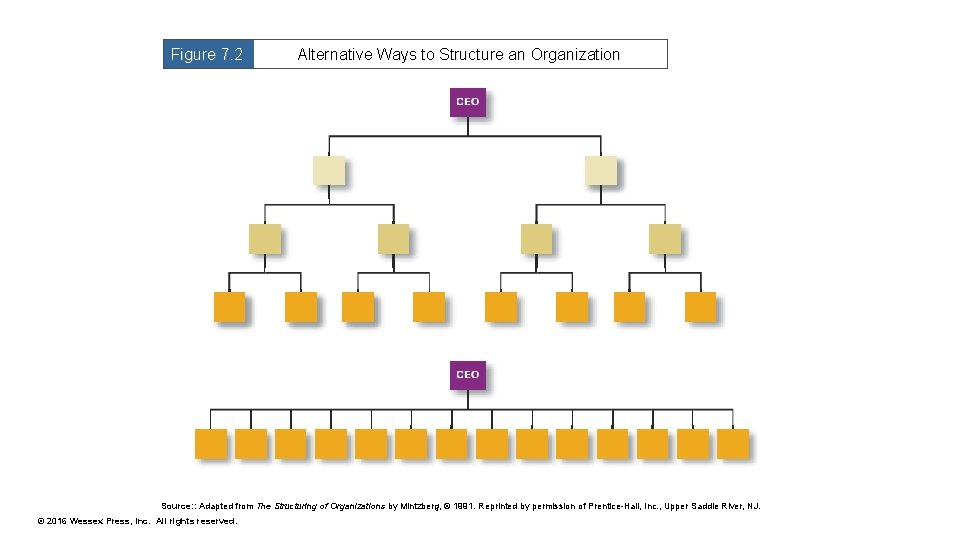
Figure 7. 2 Alternative Ways to Structure an Organization Source: : Adapted from The Structuring of Organizations by Mintzberg, © 1991. Reprinted by permission of Prentice-Hall, Inc. , Upper Saddle River, NJ. © 2016 Wessex Press, Inc. All rights reserved.
Delegation Why it is important for managers to delegate.
Authority and Responsibility • Authority Ø The formal right inherent in an organizational position to make decisions. • Formal authority Ø Authority inherent in an organizational position. • Informal authority Ø Ability to influence others that is based on personal characteristics or skills. • Responsibility Ø The obligation to perform the duties assigned.
Accountability and Delegation • Accountability Ø Responsibility to the supervisor for results of decisions made and actions taken with delegated authority. © 2016 Wessex Press, Inc. All rights reserved.
Accountability and Delegation • Delegation Ø The process of transforming the responsibility for a specific activity or task to another member of the organization, and… Ø Empowering that individual to accomplish the task effectively. © 2016 Wessex Press, Inc. All rights reserved.
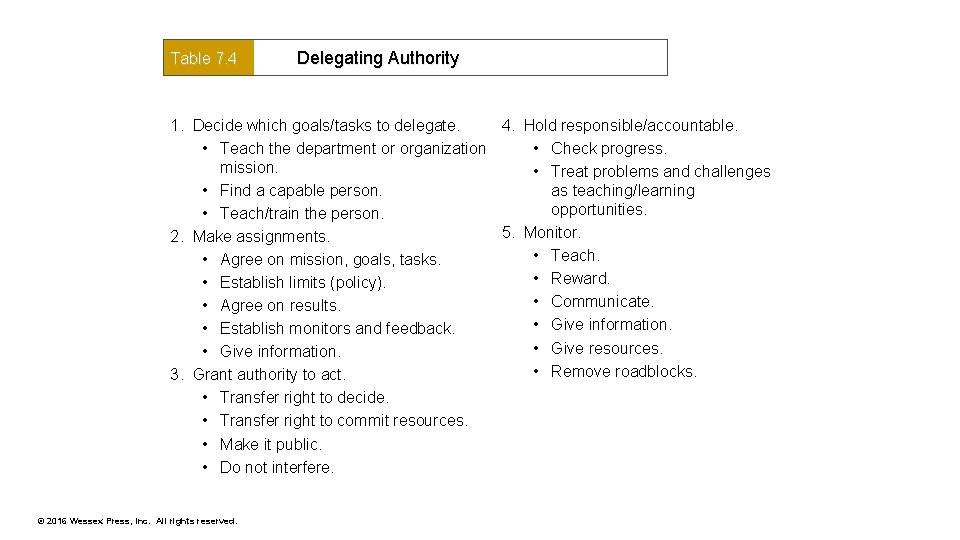
Table 7. 4 Delegating Authority 1. Decide which goals/tasks to delegate. 4. Hold responsible/accountable. • Teach the department or organization • Check progress. mission. • Treat problems and challenges • Find a capable person. as teaching/learning opportunities. • Teach/train the person. 5. Monitor. 2. Make assignments. • Teach. • Agree on mission, goals, tasks. • Reward. • Establish limits (policy). • Communicate. • Agree on results. • Give information. • Establish monitors and feedback. • Give resources. • Give information. • Remove roadblocks. 3. Grant authority to act. • Transfer right to decide. • Transfer right to commit resources. • Make it public. • Do not interfere. © 2016 Wessex Press, Inc. All rights reserved.
Why managers often fail to delegate and methods for improving delegation skills
Benefits of Delegation • Leads to a more involved and empowered workforce. • Improved response time as a result of decisions and information not needing to be passed up and down the organization. • Leads to better decision making. • Provides opportunity for employee to develop analytical and problem solving skills. • Provides managers the opportunity to accomplish more complicated, difficult, or important tasks. © 2016 Wessex Press, Inc. All rights reserved.
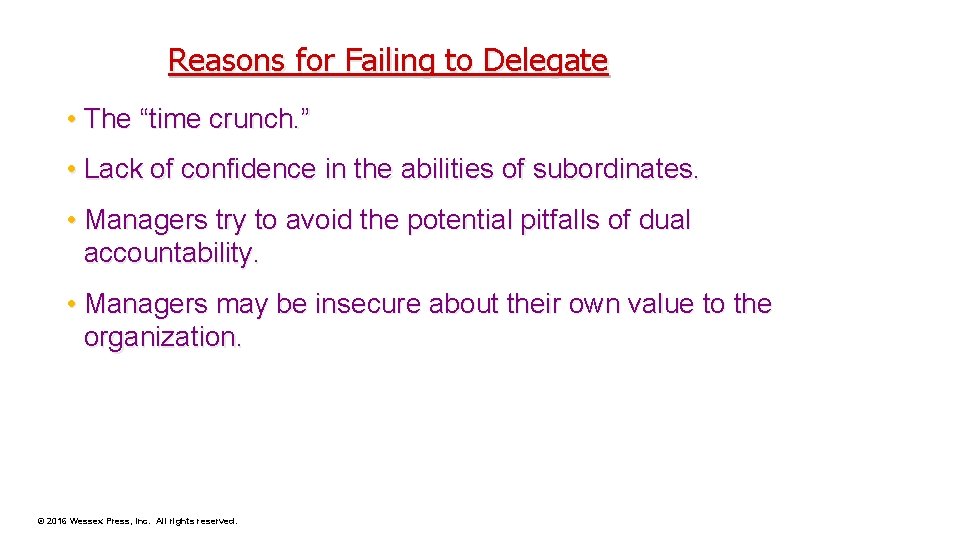
Reasons for Failing to Delegate • The “time crunch. ” • Lack of confidence in the abilities of subordinates. • Managers try to avoid the potential pitfalls of dual accountability. • Managers may be insecure about their own value to the organization. © 2016 Wessex Press, Inc. All rights reserved.
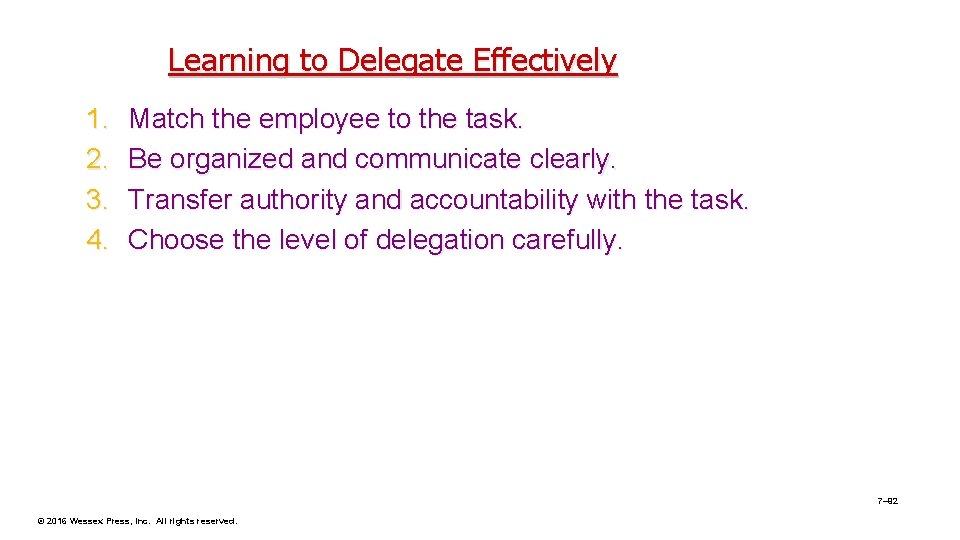
Learning to Delegate Effectively 1. 2. 3. 4. Match the employee to the task. Be organized and communicate clearly. Transfer authority and accountability with the task. Choose the level of delegation carefully. 7– 92 © 2016 Wessex Press, Inc. All rights reserved.
Organizational Design CHAPTER 6
Why organizational design is important for organizational success.
Introduction • Managers are questioning and re-evaluating traditional approaches to organizing work in their search for organizational structures that can achieve efficiency but also have the flexibility necessary for success in today’s dynamic environment. • Recall from Chapter 1 that organizing is defined as the process of creating an organization’s structure. That process is important and serves many purposes. • The challenge for managers is to design an organizational structure that allows employees to work effectively and efficiently.
What is organizational structure? It is how job tasks are formally divided, grouped, and coordinated within an organization. When managers develop or change the structure, they are engaged in organizational design, a process that involves decisions about six key elements: i. work specialization ii. Departmentalization iii. chain of command iv. span of control v. centralization and decentralization, and vi. formalization.
Organizational Design • Organizational Design Defined Ø A plan for arranging and coordinating the activities of an organization for the purpose of fulfilling its mission and achieving its goals. the configuration of organizational members the types of mechanisms used to integrate and coordinate the flow of information, resources, and tasks between organizational members the locus of decision making © 2016 Wessex Press, Inc. All rights reserved.
The three major components of organizational design.
Components of Organizational Design • Overall organizational design is defined by three primary components: Ø Organizational structure Ø Integrating mechanisms Ø Locus of decision making 8– 99 © 2016 Wessex Press, Inc. All rights reserved.
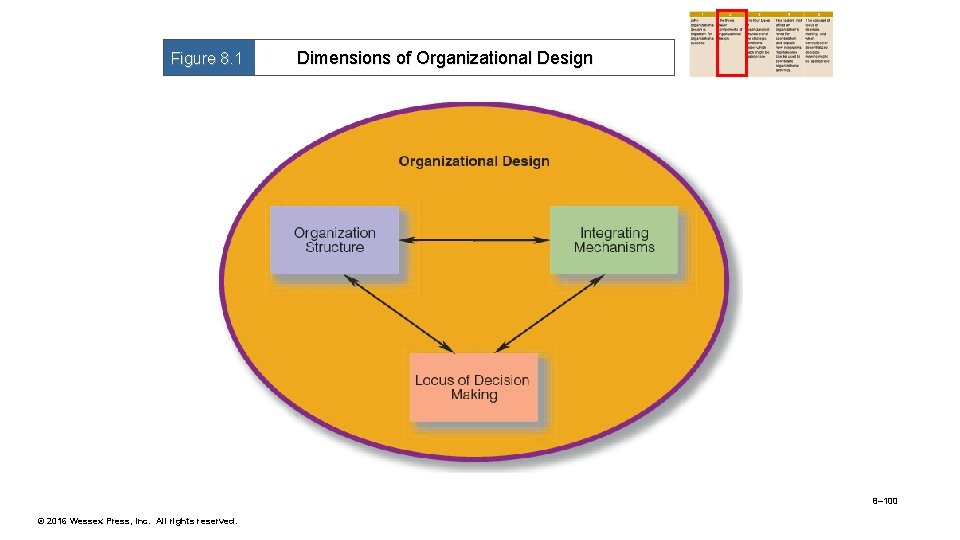
Figure 8. 1 Dimensions of Organizational Design 8– 100 © 2016 Wessex Press, Inc. All rights reserved.
The four types of organizational structure and the strategic conditions under which each might be appropriate.
Organizational Structure • Defines the primary reporting relationships that exist within an organization. Ø The chain of command hierarchy of responsibility, authority, and accountability are established through organizational structure. • Common Forms of Organizational Structure Ø Functional structure Ø Divisional structure Ø Matrix structure Ø Network structure © 2016 Wessex Press, Inc. All rights reserved.
Functional Structure: Specialization and Efficiency • Members of the organization are grouped according to the particular function that they perform within the organization. Ø Appropriate when an organization’s greatest source of complexity comes from the diverse tasks that must be performed rather than from its products, geographic markets, or consumer groups. © 2016 Wessex Press, Inc. All rights reserved.
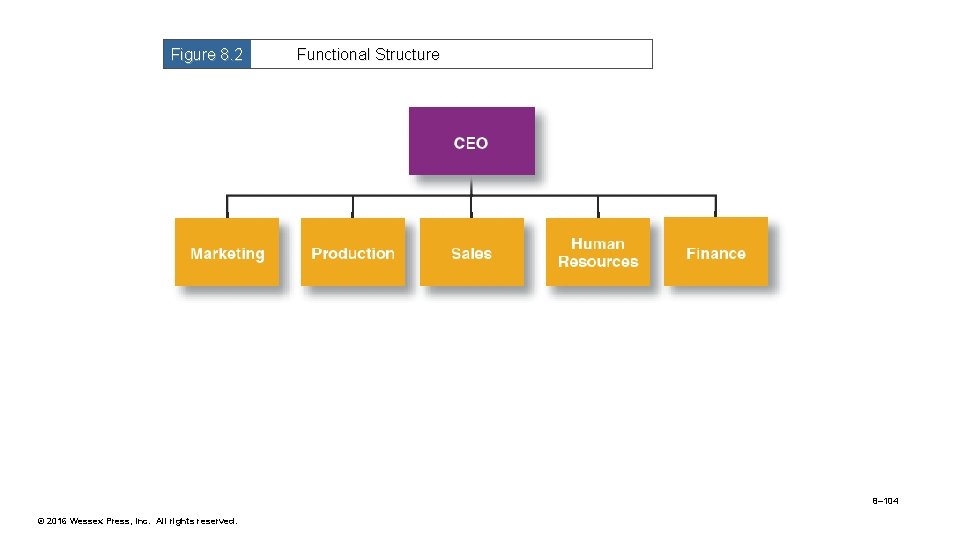
Figure 8. 2 Functional Structure 8– 104 © 2016 Wessex Press, Inc. All rights reserved.
Functional Structure • Advantages • Disadvantages Ø Facilitates specialization Ø Focus on departmental Ø Cohesive work groups versus organizational issues Ø Difficult to develop generalists needed for top-level management Ø Only top-level management held accountable for profitability Ø Improved operational efficiency © 2016 Wessex Press, Inc. All rights reserved.
Divisional Structures: Providing Focus • Members of the organization are grouped on the basis of: Ø Common products Ø Geographic markets Ø Customers served © 2016 Wessex Press, Inc. All rights reserved.
Types of Divisional Structure • Product Divisions Ø For organizations with relatively diverse product lines that require specialized efforts to achieve high product quality. • Geographic Divisions Ø For organizations with limited product lines that either have wide geographic coverage or desire to grow through geographic expansion. • Customer Divisions Ø For organizations that have separate customer groups with very specific and distinct needs. © 2016 Wessex Press, Inc. All rights reserved.
Product Divisional Structure • Advantages Ø Enhanced coordination. Ø Better assessment of manager performance and responsibility. Ø Development of generalist managers. • Disadvantages Ø Managers may lack expertise to operate in wide geographic areas. Ø Duplication of resources. © 2016 Wessex Press, Inc. All rights reserved.
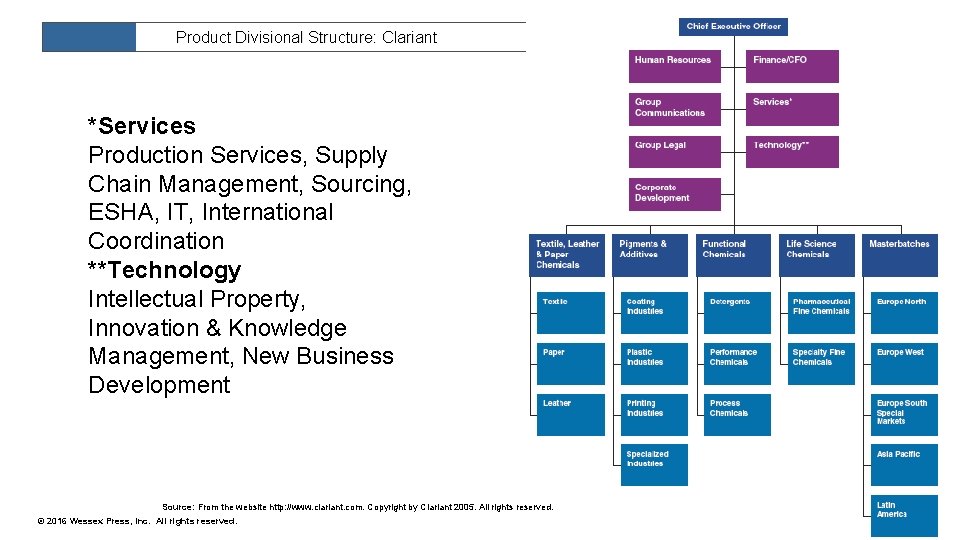
Product Divisional Structure: Clariant *Services Production Services, Supply Chain Management, Sourcing, ESHA, IT, International Coordination **Technology Intellectual Property, Innovation & Knowledge Management, New Business Development Source: From the website http: //www. clariant. com. Copyright by Clariant 2005. All rights reserved. © 2016 Wessex Press, Inc. All rights reserved.
Geographic Divisional • Advantages Ø Allows for focus on specific new markets. Ø Good structure for growth along geographic lines. Ø Adaptable to local needs. • Disadvantages Ø Duplication of product or product/technology efforts. Ø Coordination and integration are difficult. Ø May be difficult to manage diverse product lines. © 2016 Wessex Press, Inc. All rights reserved.
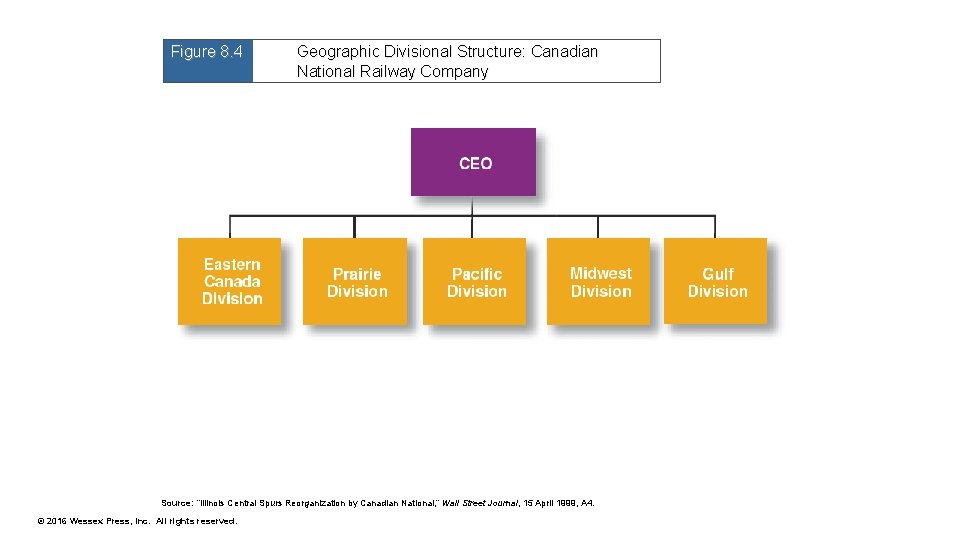
Figure 8. 4 Geographic Divisional Structure: Canadian National Railway Company Source: “Illinois Central Spurs Reorganization by Canadian National, ” Wall Street Journal, 15 April 1999, A 4. © 2016 Wessex Press, Inc. All rights reserved.
Customer Divisional • Advantages Ø Good structure for serving large customer groups. Ø Helps allocate resources to meet demands of specific customer groups. Ø Best for growth by targeting new and distinct groups. • Disadvantages Ø Ineffective and inefficient use of resources if most customer groups served are small. Ø Internal competition for resources to serve customers groups may cause loss of market focus. © 2016 Wessex Press, Inc. All rights reserved.
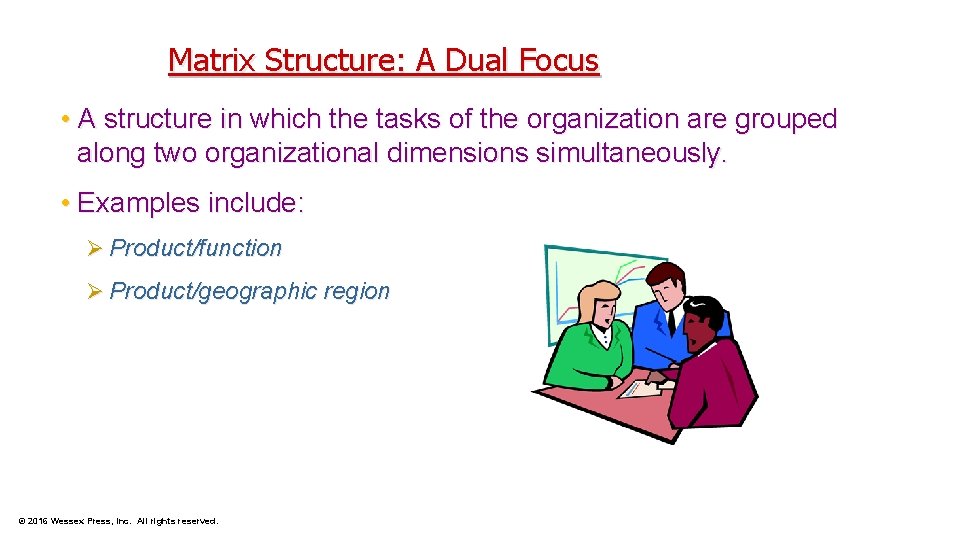
Matrix Structure: A Dual Focus • A structure in which the tasks of the organization are grouped along two organizational dimensions simultaneously. • Examples include: Ø Product/function Ø Product/geographic region © 2016 Wessex Press, Inc. All rights reserved.
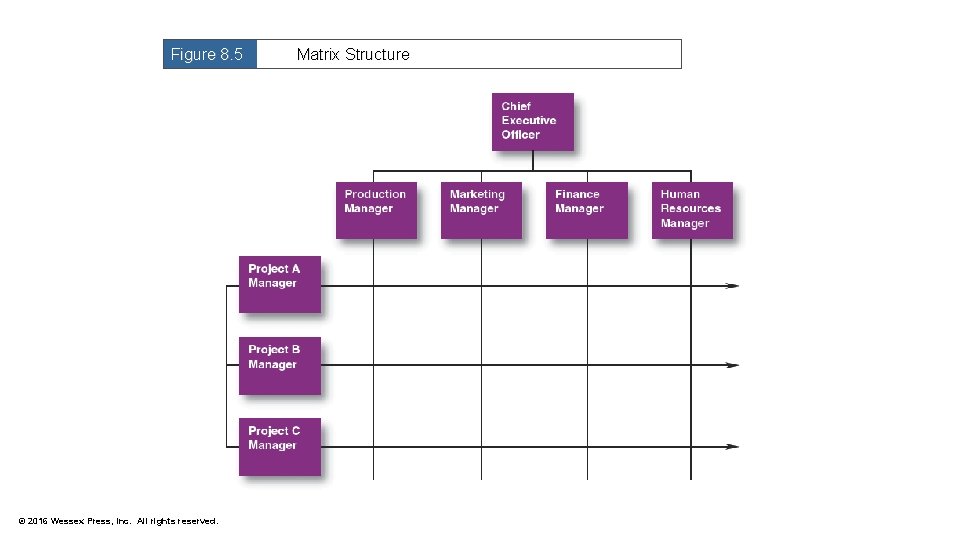
Figure 8. 5 © 2016 Wessex Press, Inc. All rights reserved. Matrix Structure
Matrix Structure (cont’d) • Disadvantages Ø Complex, leading to difficulties in implementation Ø Behavioral difficulties from “two bosses” Ø Time consuming from a planning/coordination perspective • Advantages Ø Can achieve simultaneous objectives Ø Managers focus on two organizational dimensions, resulting in more specific job skills © 2016 Wessex Press, Inc. All rights reserved.
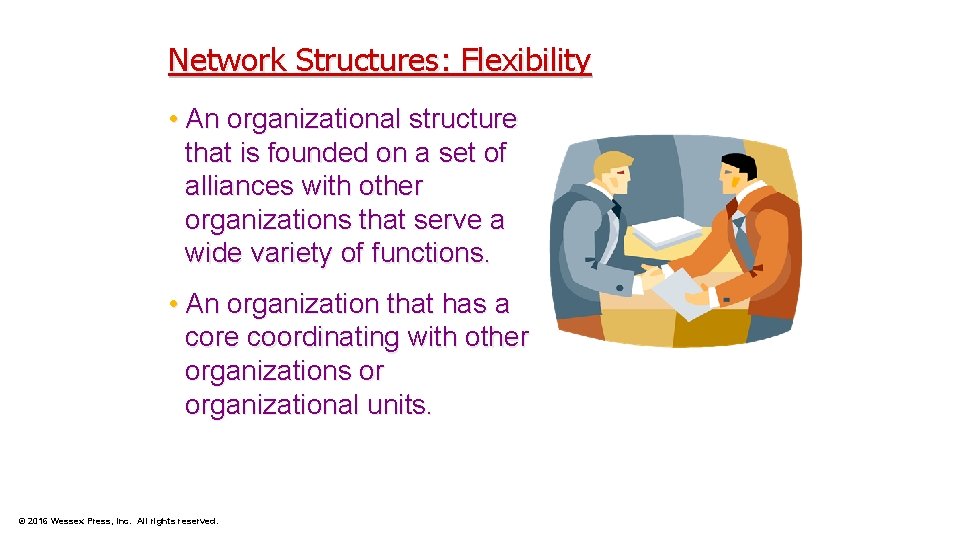
Network Structures: Flexibility • An organizational structure that is founded on a set of alliances with other organizations that serve a wide variety of functions. • An organization that has a core coordinating with other organizations or organizational units. © 2016 Wessex Press, Inc. All rights reserved.
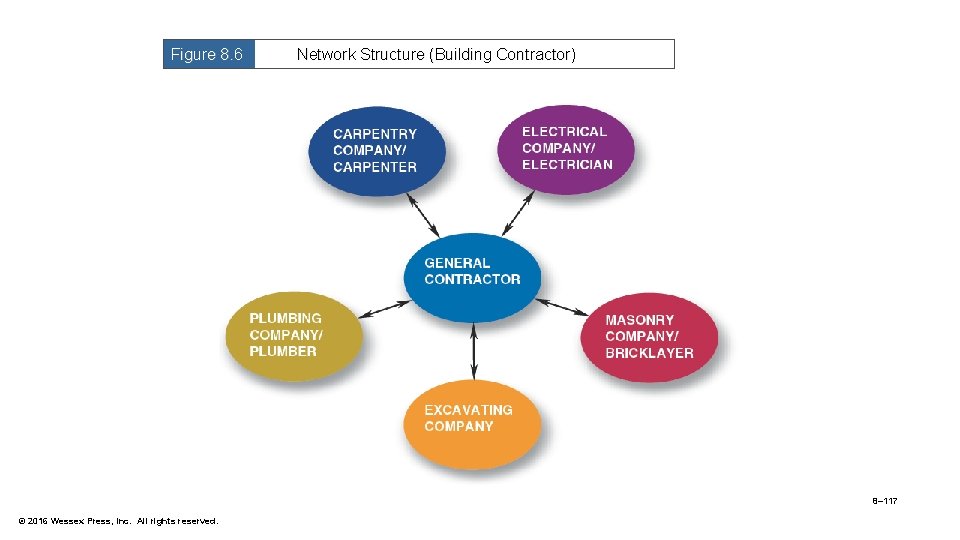
Figure 8. 6 Network Structure (Building Contractor) 8– 117 © 2016 Wessex Press, Inc. All rights reserved.
Types of Network Structure • Internal Network Ø A network structure that relies on internally developed units to provide services to a core organizational unit. • Stable Network Ø A network structure that utilizes external alliances selectively as a mechanism for gaining strategic flexibility. • Dynamic Network Ø A network structure that makes extensive use of outsourcing through alliances with outside organizations. 8– 118 © 2016 Wessex Press, Inc. All rights reserved.
Network Structure (cont’d) • Advantages Ø Maximizes the effectiveness of the core unit Ø Do more with less resources Ø Flexibility • Disadvantages Ø Fragmentation makes it difficult to develop control systems Ø Success is dependent on ability to locate sources Ø Difficult to develop employee loyalty 8– 119 © 2016 Wessex Press, Inc. All rights reserved.
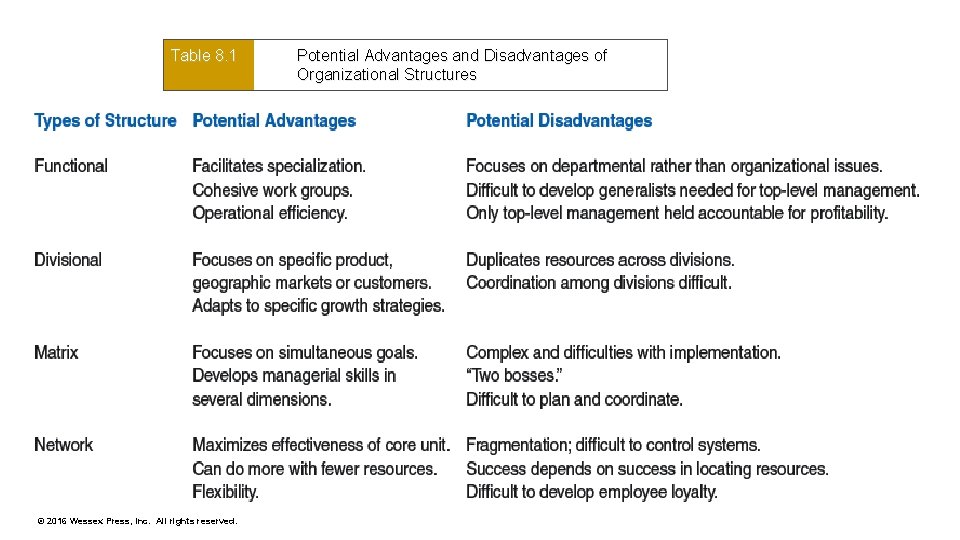
Table 8. 1 © 2016 Wessex Press, Inc. All rights reserved. Potential Advantages and Disadvantages of Organizational Structures
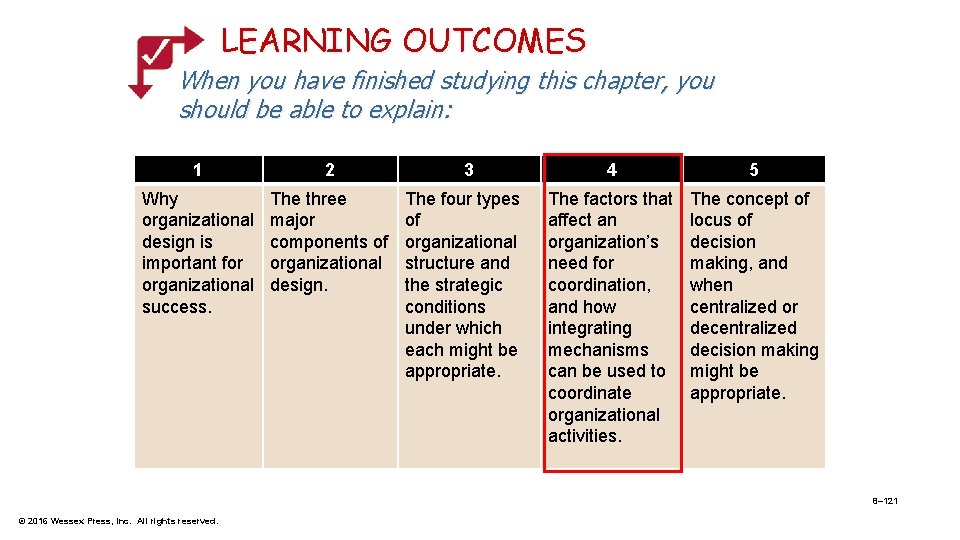
LEARNING OUTCOMES When you have finished studying this chapter, you should be able to explain: 1 2 Why organizational design is important for organizational success. The three major components of organizational design. 3 The four types of organizational structure and the strategic conditions under which each might be appropriate. 4 5 The factors that affect an organization’s need for coordination, and how integrating mechanisms can be used to coordinate organizational activities. The concept of locus of decision making, and when centralized or decentralized decision making might be appropriate. 8– 121 © 2016 Wessex Press, Inc. All rights reserved.
Managing Complexity Through Integration • Interdependence Ø The degree to which work groups are interrelated. • Primary levels of work group integration: Ø Pooled interdependence Ø Sequential interdependence Ø Reciprocal interdependence 8– 122 © 2016 Wessex Press, Inc. All rights reserved.
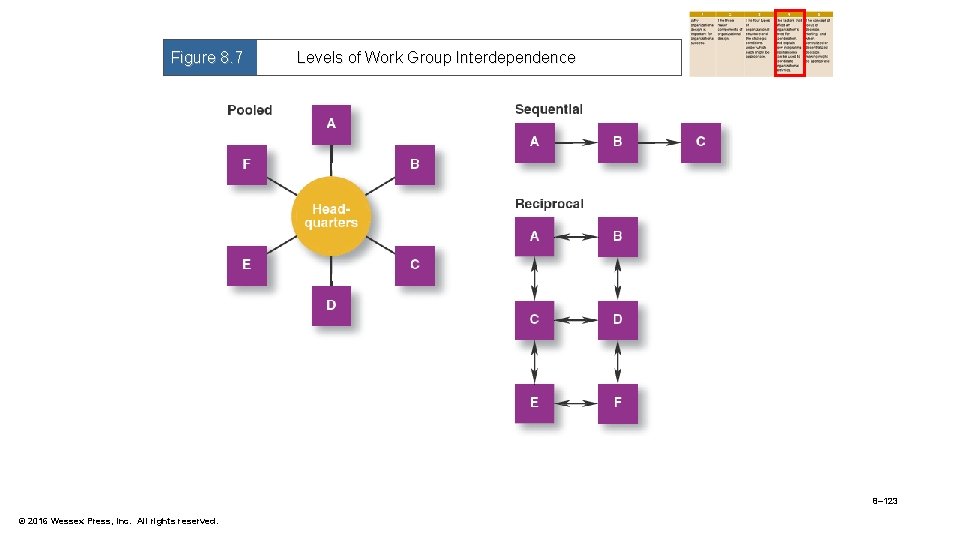
Figure 8. 7 Levels of Work Group Interdependence 8– 123 © 2016 Wessex Press, Inc. All rights reserved.
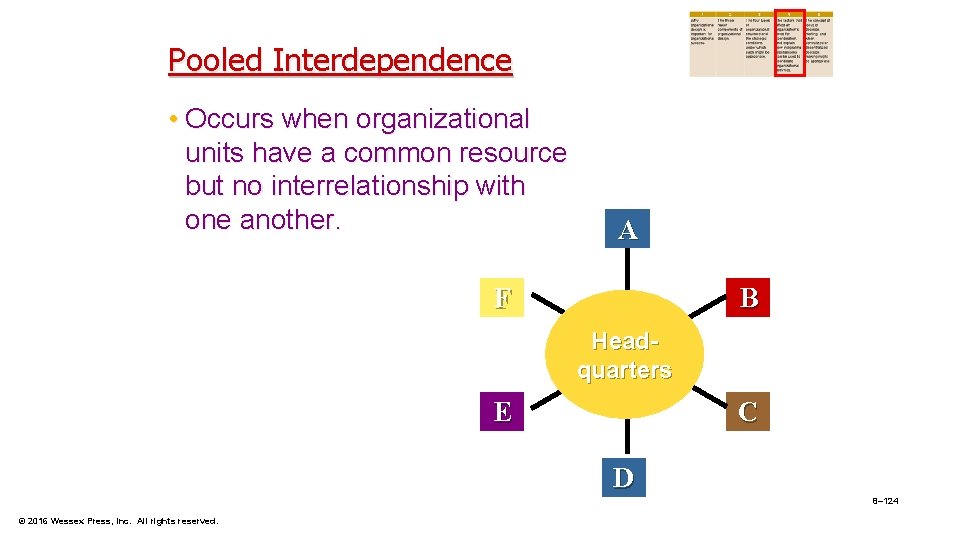
Pooled Interdependence • Occurs when organizational units have a common resource but no interrelationship with one another. A F B Headquarters E C D 8– 124 © 2016 Wessex Press, Inc. All rights reserved.
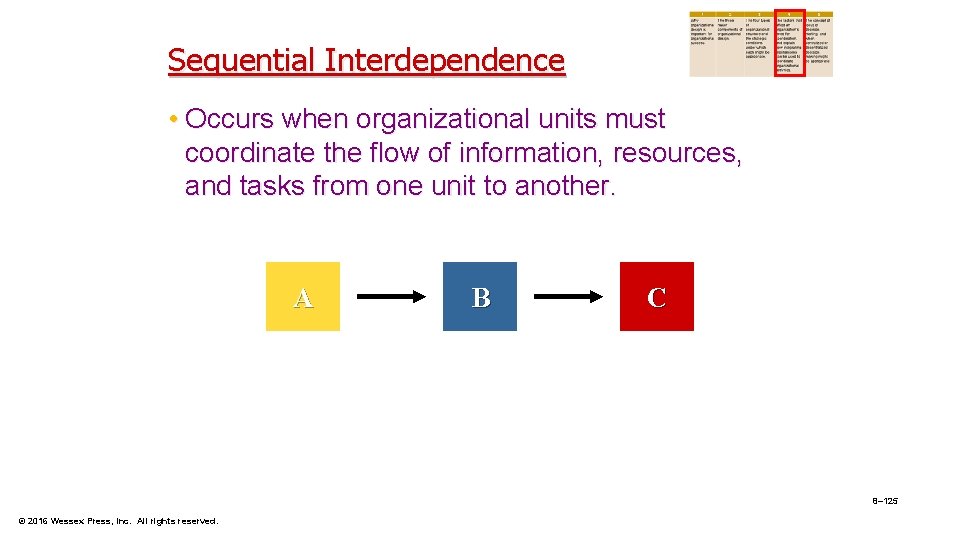
Sequential Interdependence • Occurs when organizational units must coordinate the flow of information, resources, and tasks from one unit to another. A B C 8– 125 © 2016 Wessex Press, Inc. All rights reserved.
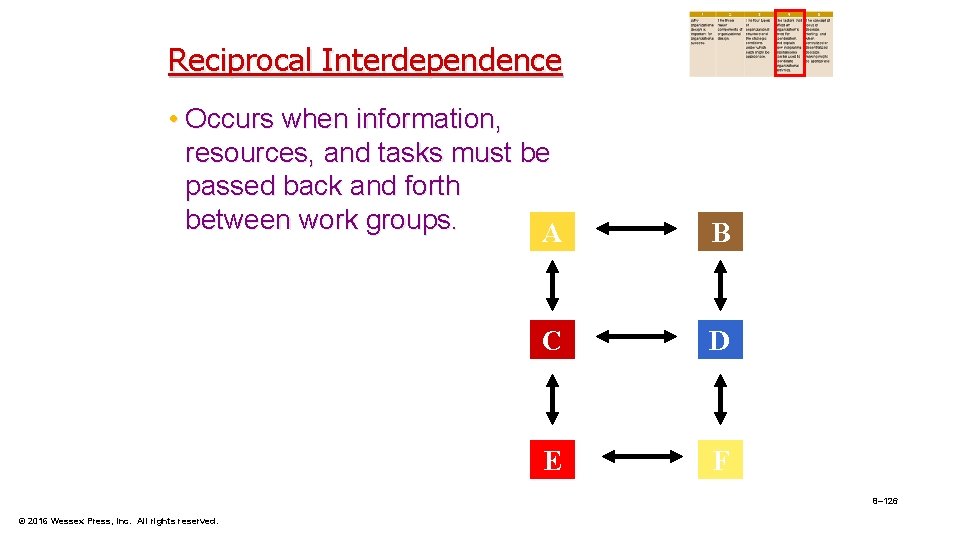
Reciprocal Interdependence • Occurs when information, resources, and tasks must be passed back and forth between work groups. A B C D E F 8– 126 © 2016 Wessex Press, Inc. All rights reserved.
Integrating Mechanisms • Methods for managing the flow of information, resources, and tasks within the organization. • Major categories of integrating mechanisms are: Ø General management systems. Ø Methods of increasing coordination potential. Ø Methods of reducing the need for coordination. 8– 127 © 2016 Wessex Press, Inc. All rights reserved.
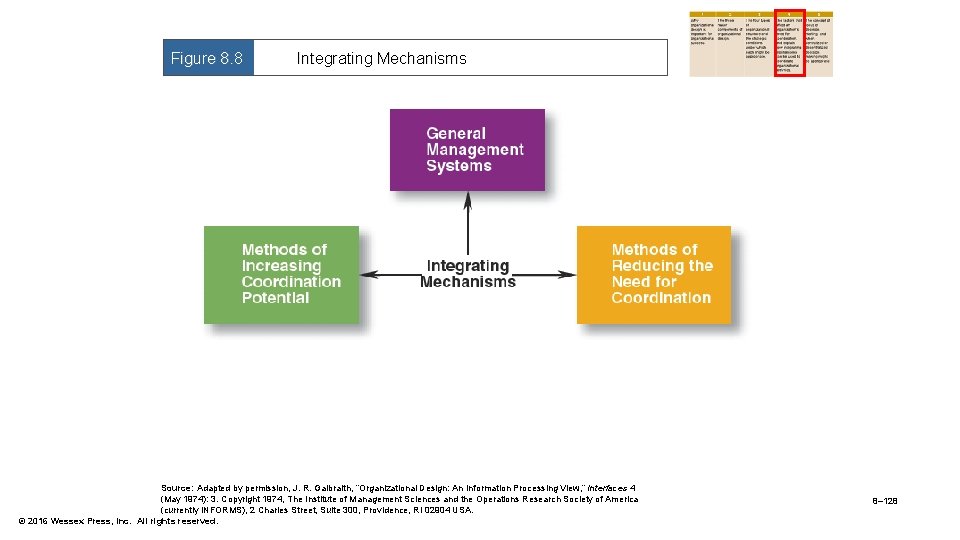
Figure 8. 8 Integrating Mechanisms Source: Adapted by permission, J. R. Galbraith, “Organizational Design: An Information Processing View, ” Interfaces 4 (May 1974): 3. Copyright 1974, The Institute of Management Sciences and the Operations Research Society of America (currently INFORMS), 2 Charles Street, Suite 300, Providence, RI 02904 USA. © 2016 Wessex Press, Inc. All rights reserved. 8– 128
General Management Systems • Some coordination of work units may be achieved through the development of general management systems such as: Ø The managerial hierarchy Ø Rules and procedures Ø Plans and goals • Such mechanisms form the foundation of an organization’s integration system. 8– 129 © 2016 Wessex Press, Inc. All rights reserved.
Increasing Coordination Potential • Two mechanisms for increasing the coordination potential both vertically and horizontally in the organization are information systems and lateral relationships. Ø Information systems facilitate the flow of information up and down the traditional chain of command across organizational units. Ø Lateral relationships exist across work units and serve as mechanisms for exchanging decision-making information. 8– 130 © 2016 Wessex Press, Inc. All rights reserved.
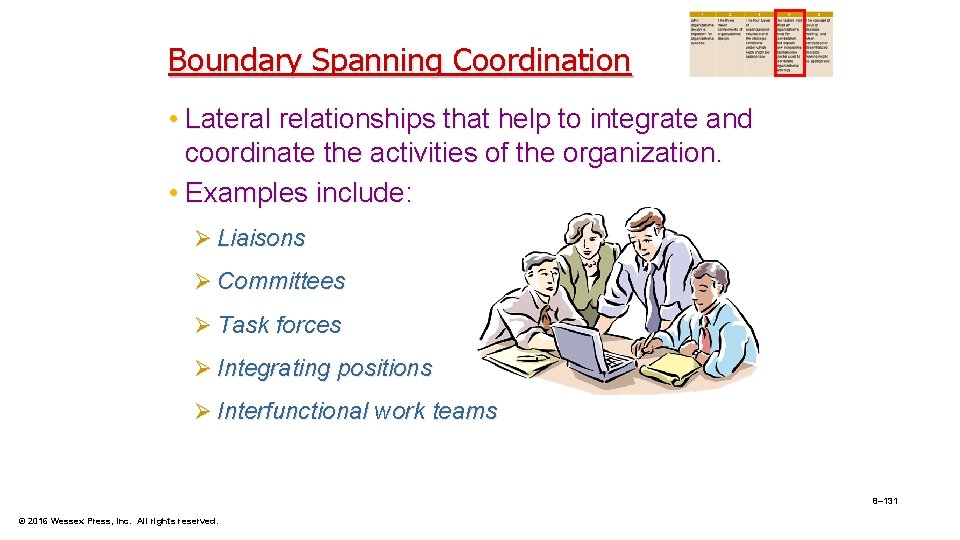
Boundary Spanning Coordination • Lateral relationships that help to integrate and coordinate the activities of the organization. • Examples include: Ø Liaisons Ø Committees Ø Task forces Ø Integrating positions Ø Interfunctional work teams 8– 131 © 2016 Wessex Press, Inc. All rights reserved.
Reducing the Need for Coordination • The organization creates “slack resources” that reduce the interdependence of the work groups. • Actions that reduce the need for coordination: Ø Longer lead times Ø Larger inventories Ø Work units that have only pooled interdependence • As a result, the need for integrating mechanisms is reduced. 8– 132 © 2016 Wessex Press, Inc. All rights reserved.
LEARNING OUTCOMES When you have finished studying this chapter, you should be able to explain: 1 2 Why organizational design is important for organizational success. The three major components of organizational design. 3 The four types of organizational structure and the strategic conditions under which each might be appropriate. 4 5 The factors that affect an organization’s need for coordination, and how integrating mechanisms can be used to coordinate organizational activities. The concept of locus of decision making, and when centralized or decentralized decision making might be appropriate. 8– 133 © 2016 Wessex Press, Inc. All rights reserved.
Locus of Decision Making • The degree to which decision making is centralized versus decentralized. Ø Centralized Decision Making Advantage: gives top-level management maximum control. Disadvantage: limits the organization’s ability to respond quickly and effectively to changes in the environment. Ø Decentralized Decision Making Advantage: rapid and effective response to environmental change because the decision makers are the people closest to the situation. Disadvantage: top-level managers lose some control. 8– 134 © 2016 Wessex Press, Inc. All rights reserved.
The Impact of Environmental Stability • Stable Environments Ø Environments that experience little change. • Turbulent Environments Ø Environments that are characterized by rapid and significant change. • Organizational Design for a Changing Environment Ø An adaptive organization eliminates bureaucracy limiting employee creativity and brings the decision makers closer to the customer. 8– 135 © 2016 Wessex Press, Inc. All rights reserved.
The Impact of Interdependence • The type of interdependence between tasks or work units influences the type of coordination that is appropriate. Ø Reciprocal (highly) interdependent Units can be coordinated with a mechanism or coordinated with centralized decision making. Ø Sequential interdependence Centralized decision making and authority are needed to keep units in alignment with each other. Ø Pooled interdependence Allows for a decentralized approach as long as unit efforts are aligned with the overall goal or mission. 8– 136 © 2016 Wessex Press, Inc. All rights reserved.
The Impact of Organizational Culture • Centralized Organizations Ø The underlying philosophy, or belief, is that authority for decision making should be kept toward the top. • Decentralized Organizations Ø The philosophy is to push it the authority for decision making to lowest possible level. • Either approach can be made to work as long as it is acknowledged, tasks are adapted to the approach, and people are selected for and trained/educated to work with that approach 8– 137 © 2016 Wessex Press, Inc. All rights reserved.
Implications for Leaders • Remember that organizational design provides an important mechanism for achieving the strategic and operational goals of the organization. • Understand the makeup of the forms of organizational structure and under what conditions it would be appropriate to use each. • Understand the potential advantages and disadvantages of the functional, division, matrix, and network structures. • Look for ways to increase the integration potential of the organization or to reduce the need for integration. • Understand the circumstances in which centralized or decentralized decision making would work well and how to use each approach. 8– 138 © 2016 Wessex Press, Inc. All rights reserved.

https: //www. youtube. com/watch? v=Chb 3 Mk 7 w. VVQ https: //www. youtube. com/watch? v=w. O_-Mt. Wej. RM 8– 139 © 2016 Wessex Press, Inc. All rights reserved.
Table 10. 1 Zappos Family Core Values As we grow as a company, it has become more and more important to explicitly define the core values from which we develop our culture, our brand, and our business strategies. These are the 10 core values that we live by: 1. Deliver WOW through Service 2. Embrace and Drive Change 3. Create Fun and a Little Weirdness 4. Be Adventurous, Creative, and Open-Minded 5. Pursue Growth and Learning 6. Build Open and Honest Relationships with Communication 7. Build a Positive Team and Family Spirit 8. Do More with Less 9. Be Passionate and Determined 10. Be Humble 10– 140 © 2016 Wessex Press, Inc. All rights reserved.
Foundations of Organizational Culture • Organizational Culture Ø The shared, emotionally charged beliefs, values, and norms that bind people together and help them make sense of the systems within an organization. • The beliefs, values and norms tell people: Ø “What is to be done. ” Ø “How it is to be done. ” 10– 141 © 2016 Wessex Press, Inc. All rights reserved.
Organizational Culture and Change • In order to survive, organizations and their cultures must continuously evolve and change. Ø Conditions prompting change include: Economic crises Changes in laws or regulations Social developments Global competition Demographic trends Explosive technological changes Ø Cultures change when an organization discovers, invents or develops solutions to problems it faces. 10– 142 © 2016 Wessex Press, Inc. All rights reserved.
Components of Organizational Culture • Substance Ø Consists of shared systems of beliefs, values, expectations, and norms. • Form Ø Consists of the observable ways that members of a culture express ideas. 10– 143 © 2016 Wessex Press, Inc. All rights reserved.
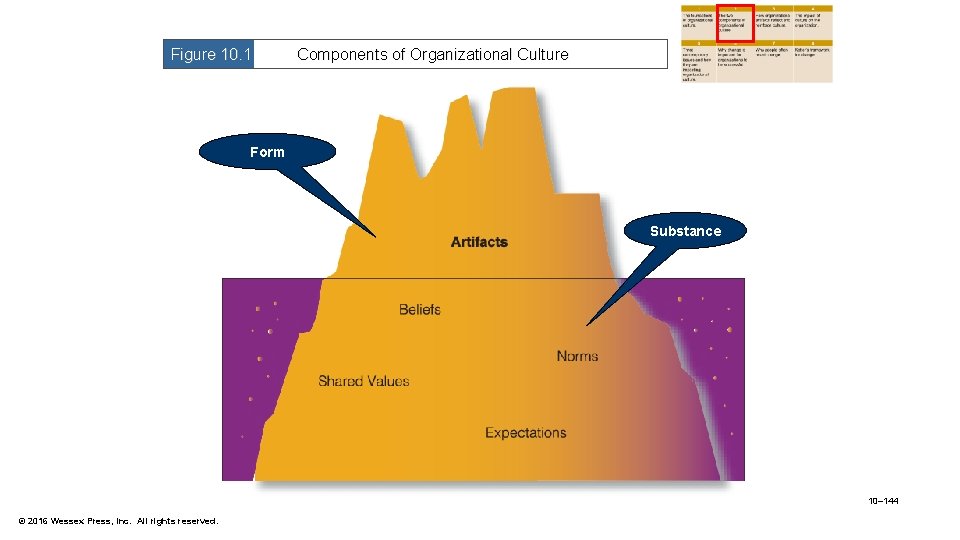
Figure 10. 1 Components of Organizational Culture Form Substance 10– 144 © 2016 Wessex Press, Inc. All rights reserved.
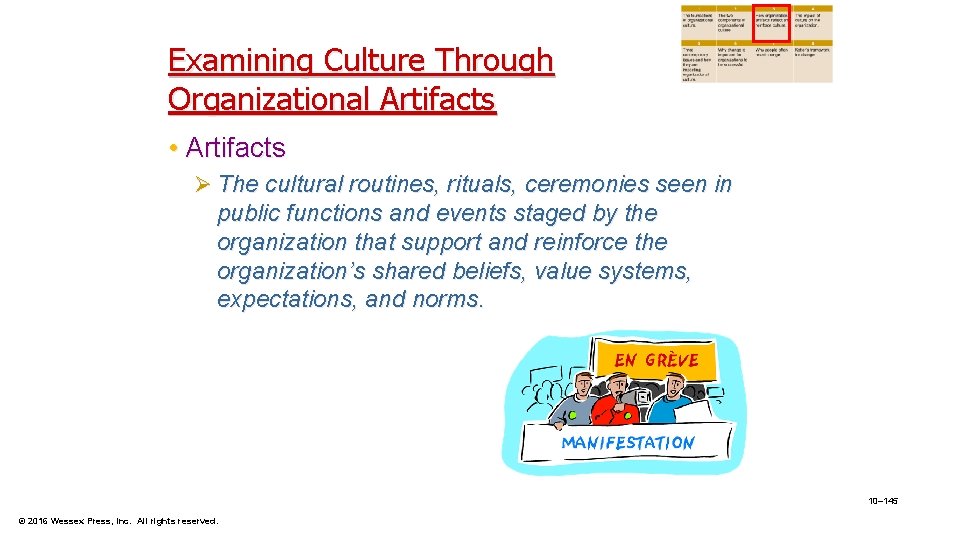
Examining Culture Through Organizational Artifacts • Artifacts Ø The cultural routines, rituals, ceremonies seen in public functions and events staged by the organization that support and reinforce the organization’s shared beliefs, value systems, expectations, and norms. 10– 145 © 2016 Wessex Press, Inc. All rights reserved.
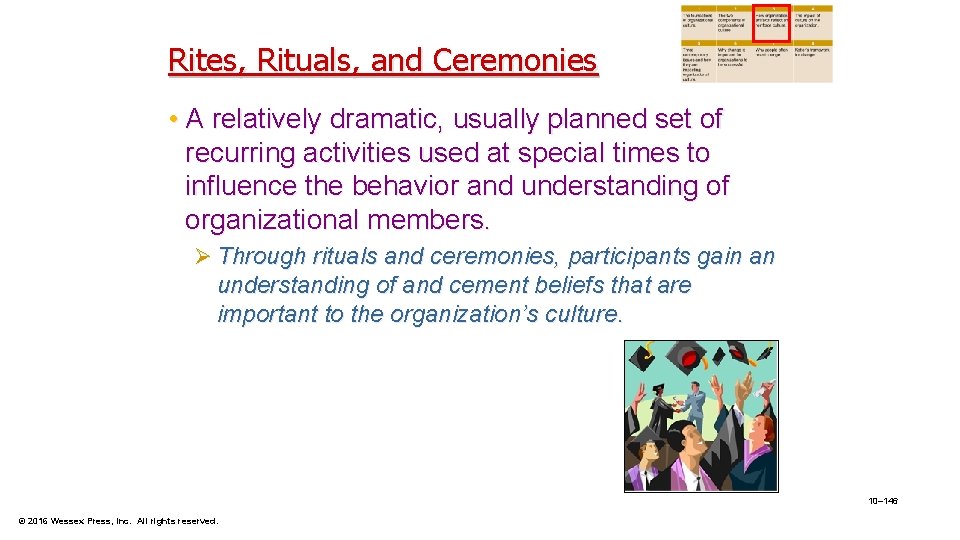
Rites, Rituals, and Ceremonies • A relatively dramatic, usually planned set of recurring activities used at special times to influence the behavior and understanding of organizational members. Ø Through rituals and ceremonies, participants gain an understanding of and cement beliefs that are important to the organization’s culture. 10– 146 © 2016 Wessex Press, Inc. All rights reserved.
Language, Metaphors and Symbols • Language Ø Certain words, phrases, speeches, etc. • Metaphors Ø The use of familiar elements or objects to make behavior or other unfamiliar processes or actions comprehensible. Special terminology Abbreviations Jargon or slang Gestures • Symbols Ø A picture, a shape, or a particular object. 10– 147 © 2016 Wessex Press, Inc. All rights reserved.
Managing Change • Manager’s job can be very complex as change is an ever-present force for today’s organizations. Ø It is important for every manager to recognize the changes occurring in the environment and to help the organization adapt to them in the best way. • Organizational Change Ø A process that leads to new ideas, technology, innovation, and improvement in response to changes in the environment. “Culture drives innovation more than spending on R&D. ” – a study by Booz Allen Hamilton 10– 148 © 2016 Wessex Press, Inc. All rights reserved.
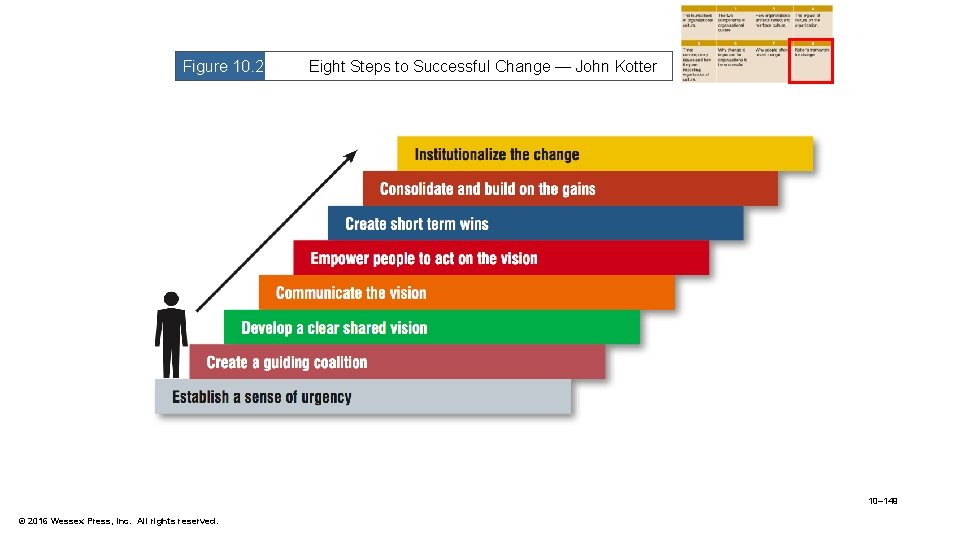
Figure 10. 2 Eight Steps to Successful Change — John Kotter 10– 149 © 2016 Wessex Press, Inc. All rights reserved.
Step 1: Establishing a Sense of Urgency • The manager needs to create the need for change. Ø This involves discussing changes in the market or competitive conditions that call for change. • Burning platform Ø Sharing of negative events or conditions call for change e. g. economic crisis. 10– 150 © 2016 Wessex Press, Inc. All rights reserved.
Step 2: Creating the Guiding Coalition • Create a “Guiding coalition” Ø Set up a team of people who are charged with taking, initiating, and effecting the change. Ø Select those who have an emotional commitment to the change and who have the right skills and talents to effect the change. Ø Select “opinion leaders” - who others admire for their expertise and capabilities make good members of a leadership team. 10– 151 © 2016 Wessex Press, Inc. All rights reserved.
Step 3: Developing a Change Vision • A tool to enable others to see the proposed change’s impact and to understand clearly how the future will be different from the past. • It’s the first task for a guiding coalition to start with. • The vision should be compelling, motivating, realistic, and time specific. 10– 152 © 2016 Wessex Press, Inc. All rights reserved.
Step 4: Communicating the Vision for Buy-In • Effective Communication Ø should be broad and frequent. Ø should go out to every constituent affected by the change. Ø should not be an e-mail, memo, newsletter, or speech — it must be all and more. Ø should be simple, repeatable, and compelling Ø must ensure that communication is two-way and there is open dialogue about the vision for change. Ø Leadership teams must be sure to act in ways that are implied by the change – “Walk the Talk” © 2016 Wessex Press, Inc. All rights reserved. 10– 153
Step 5: Empowering Broad-Based Action • A processes to facilitate change and remove obstacles to change; for example, an incentive and bonus systems to support the change. 10– 154 © 2016 Wessex Press, Inc. All rights reserved.
Step 6: Generating Short-Term Wins • Set up interim goals (within 6– 18 months) that can be achieved and celebrated along the way. • Should be monitored and communicated by the guiding coalition. 10– 155 © 2016 Wessex Press, Inc. All rights reserved.
Step 7: Never Letting Up • Leaders must continue to push the organization toward its ultimate goals until those goals have been achieved. An interim goal is not the destination. 10– 156 © 2016 Wessex Press, Inc. All rights reserved.
Step 8: Incorporating Changes in the Culture • You must be able to prove that the new way is superior to the old. • The success must be visible and well communicated. • You will lose some people in the process. • You must reinforce new norms and values with incentives and rewards—including promotions. • Reinforce the culture with every new employee. 10– 157 © 2016 Wessex Press, Inc. All rights reserved.

- Slides: 158