
PRINCIPLE OF LINEAR IMPULSE AND MOMENTUM Mechanics for
- Slides: 44
PRINCIPLE OF LINEAR IMPULSE AND MOMENTUM Mechanics for Engineers: Dynamics , 13 th SI Edition R. C. Hibbeler and Kai Beng Yap © Pearson Education South Asia Pte Ltd 2013. All rights reserved.
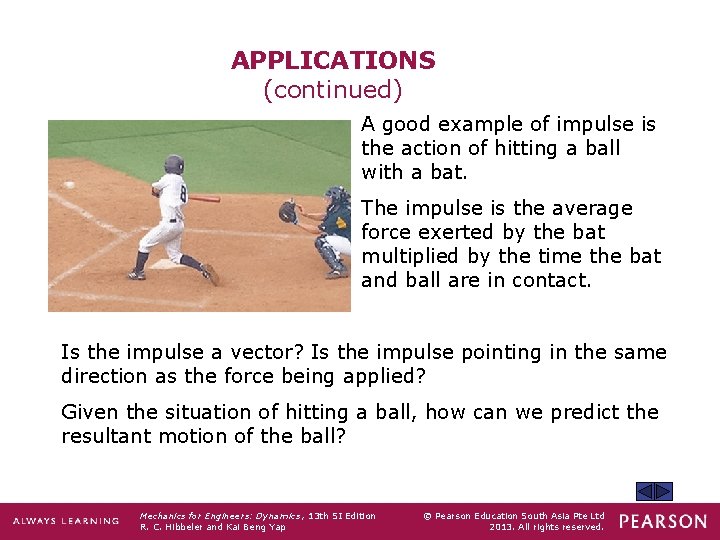
APPLICATIONS (continued) A good example of impulse is the action of hitting a ball with a bat. The impulse is the average force exerted by the bat multiplied by the time the bat and ball are in contact. Is the impulse a vector? Is the impulse pointing in the same direction as the force being applied? Given the situation of hitting a ball, how can we predict the resultant motion of the ball? Mechanics for Engineers: Dynamics , 13 th SI Edition R. C. Hibbeler and Kai Beng Yap © Pearson Education South Asia Pte Ltd 2013. All rights reserved.
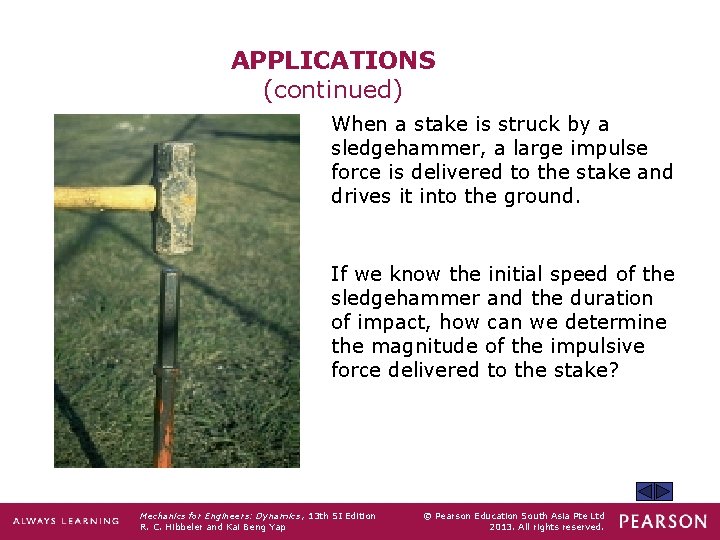
APPLICATIONS (continued) When a stake is struck by a sledgehammer, a large impulse force is delivered to the stake and drives it into the ground. If we know the initial speed of the sledgehammer and the duration of impact, how can we determine the magnitude of the impulsive force delivered to the stake? Mechanics for Engineers: Dynamics , 13 th SI Edition R. C. Hibbeler and Kai Beng Yap © Pearson Education South Asia Pte Ltd 2013. All rights reserved.
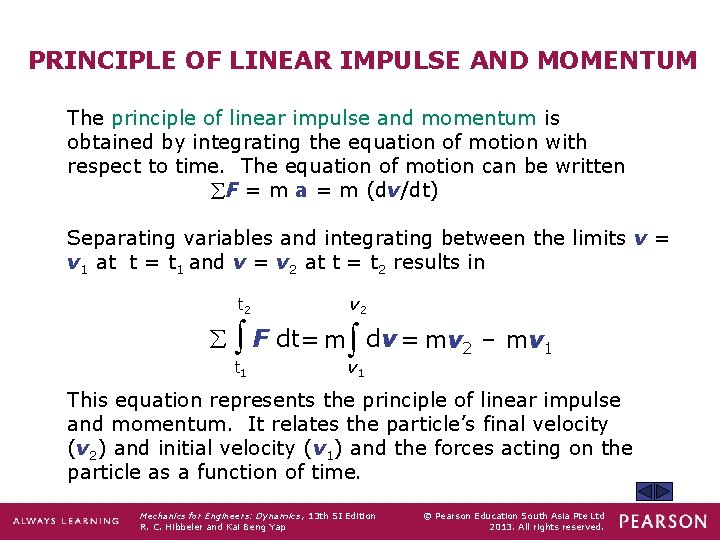
PRINCIPLE OF LINEAR IMPULSE AND MOMENTUM The principle of linear impulse and momentum is obtained by integrating the equation of motion with respect to time. The equation of motion can be written F = m a = m (dv/dt) Separating variables and integrating between the limits v = v 1 at t = t 1 and v = v 2 at t = t 2 results in t 2 v 2 t 1 v 1 F dt= m dv = mv 2 – mv 1 This equation represents the principle of linear impulse and momentum. It relates the particle’s final velocity (v 2) and initial velocity (v 1) and the forces acting on the particle as a function of time. Mechanics for Engineers: Dynamics , 13 th SI Edition R. C. Hibbeler and Kai Beng Yap © Pearson Education South Asia Pte Ltd 2013. All rights reserved.
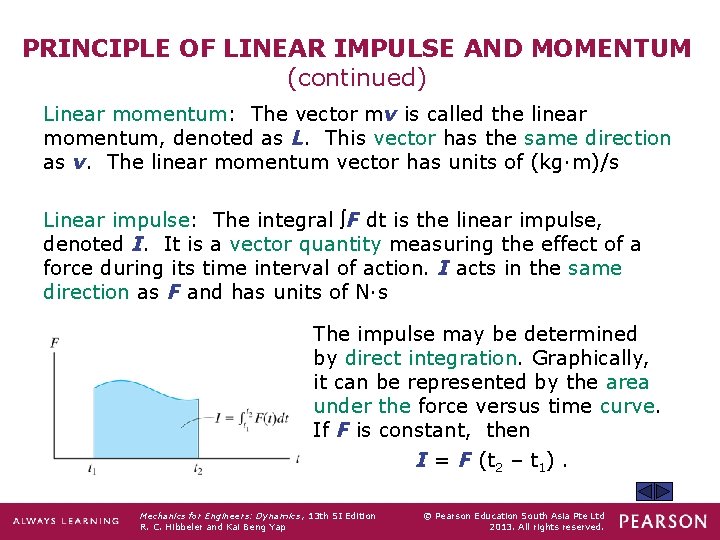
PRINCIPLE OF LINEAR IMPULSE AND MOMENTUM (continued) Linear momentum: The vector mv is called the linear momentum, denoted as L. This vector has the same direction as v. The linear momentum vector has units of (kg·m)/s Linear impulse: The integral F dt is the linear impulse, denoted I. It is a vector quantity measuring the effect of a force during its time interval of action. I acts in the same direction as F and has units of N·s The impulse may be determined by direct integration. Graphically, it can be represented by the area under the force versus time curve. If F is constant, then I = F (t 2 – t 1). Mechanics for Engineers: Dynamics , 13 th SI Edition R. C. Hibbeler and Kai Beng Yap © Pearson Education South Asia Pte Ltd 2013. All rights reserved.
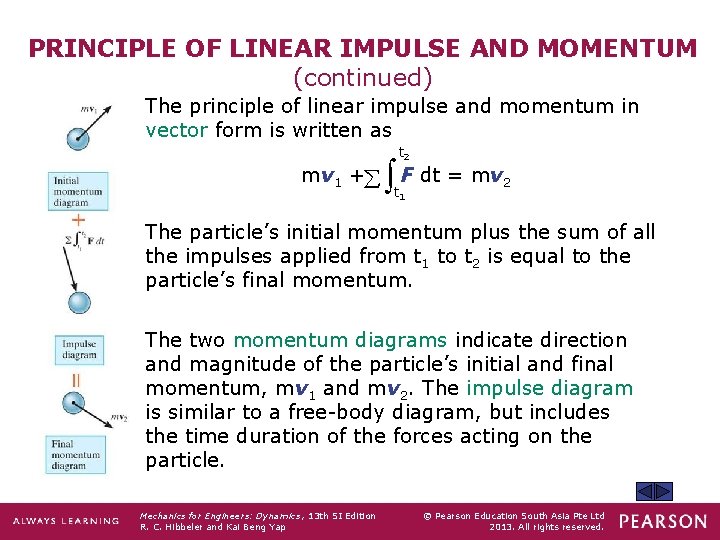
PRINCIPLE OF LINEAR IMPULSE AND MOMENTUM (continued) The principle of linear impulse and momentum in vector form is written as t 2 mv 1 + F dt = mv 2 t 1 The particle’s initial momentum plus the sum of all the impulses applied from t 1 to t 2 is equal to the particle’s final momentum. The two momentum diagrams indicate direction and magnitude of the particle’s initial and final momentum, mv 1 and mv 2. The impulse diagram is similar to a free-body diagram, but includes the time duration of the forces acting on the particle. Mechanics for Engineers: Dynamics , 13 th SI Edition R. C. Hibbeler and Kai Beng Yap © Pearson Education South Asia Pte Ltd 2013. All rights reserved.
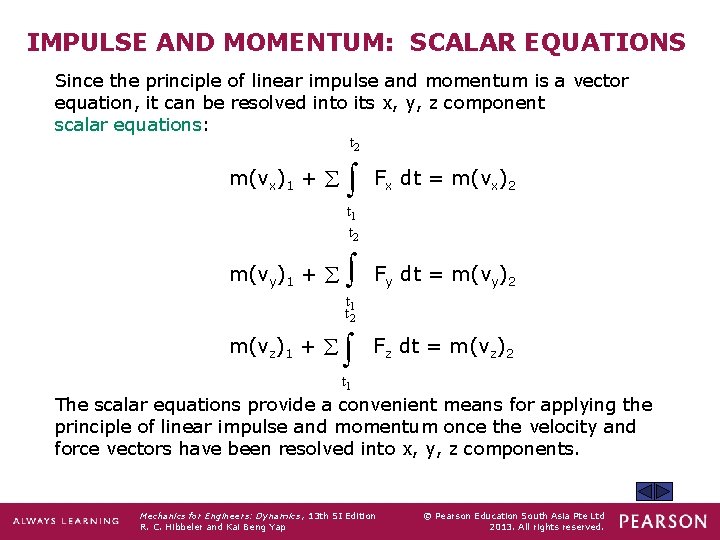
IMPULSE AND MOMENTUM: SCALAR EQUATIONS Since the principle of linear impulse and momentum is a vector equation, it can be resolved into its x, y, z component scalar equations: t 2 m(vx)1 + Fx dt = m(vx)2 Fy dt = m(vy)2 Fz dt = m(vz)2 t 1 t 2 m(vy)1 + t 1 t 2 m(vz)1 + t 1 The scalar equations provide a convenient means for applying the principle of linear impulse and momentum once the velocity and force vectors have been resolved into x, y, z components. Mechanics for Engineers: Dynamics , 13 th SI Edition R. C. Hibbeler and Kai Beng Yap © Pearson Education South Asia Pte Ltd 2013. All rights reserved.
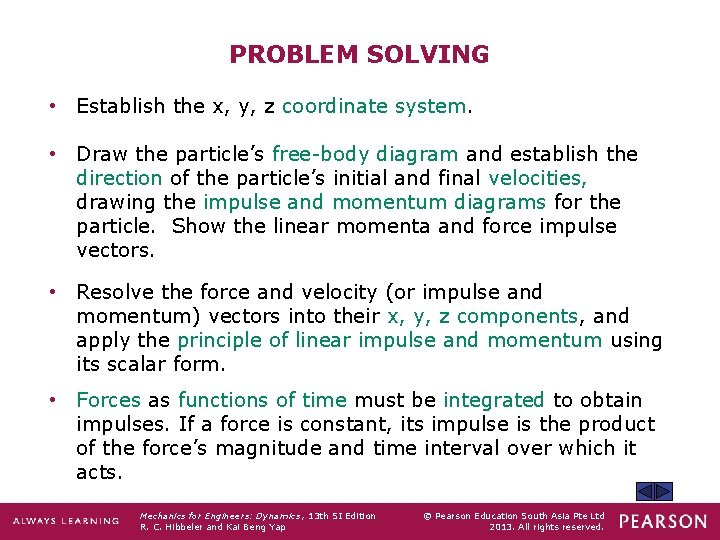
PROBLEM SOLVING • Establish the x, y, z coordinate system. • Draw the particle’s free-body diagram and establish the direction of the particle’s initial and final velocities, drawing the impulse and momentum diagrams for the particle. Show the linear momenta and force impulse vectors. • Resolve the force and velocity (or impulse and momentum) vectors into their x, y, z components, and apply the principle of linear impulse and momentum using its scalar form. • Forces as functions of time must be integrated to obtain impulses. If a force is constant, its impulse is the product of the force’s magnitude and time interval over which it acts. Mechanics for Engineers: Dynamics , 13 th SI Edition R. C. Hibbeler and Kai Beng Yap © Pearson Education South Asia Pte Ltd 2013. All rights reserved.
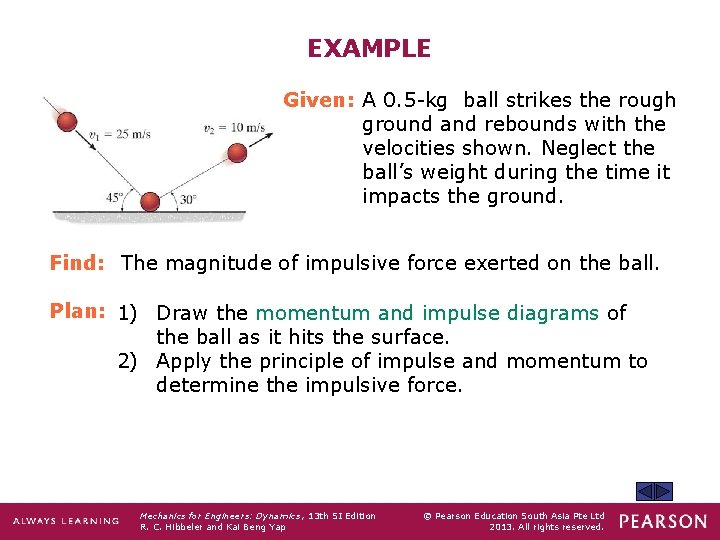
EXAMPLE Given: A 0. 5 -kg ball strikes the rough ground and rebounds with the velocities shown. Neglect the ball’s weight during the time it impacts the ground. Find: The magnitude of impulsive force exerted on the ball. Plan: 1) Draw the momentum and impulse diagrams of the ball as it hits the surface. 2) Apply the principle of impulse and momentum to determine the impulsive force. Mechanics for Engineers: Dynamics , 13 th SI Edition R. C. Hibbeler and Kai Beng Yap © Pearson Education South Asia Pte Ltd 2013. All rights reserved.
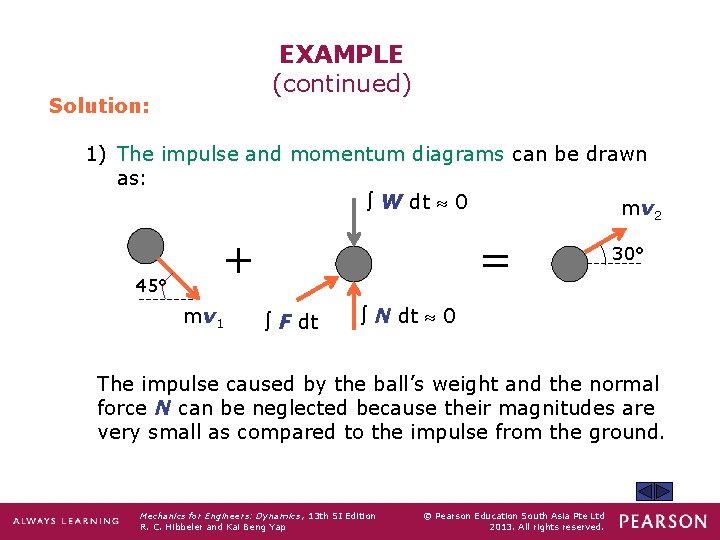
EXAMPLE (continued) Solution: 1) The impulse and momentum diagrams can be drawn as: W dt 0 mv 2 45° = + mv 1 F dt 30° N dt 0 The impulse caused by the ball’s weight and the normal force N can be neglected because their magnitudes are very small as compared to the impulse from the ground. Mechanics for Engineers: Dynamics , 13 th SI Edition R. C. Hibbeler and Kai Beng Yap © Pearson Education South Asia Pte Ltd 2013. All rights reserved.
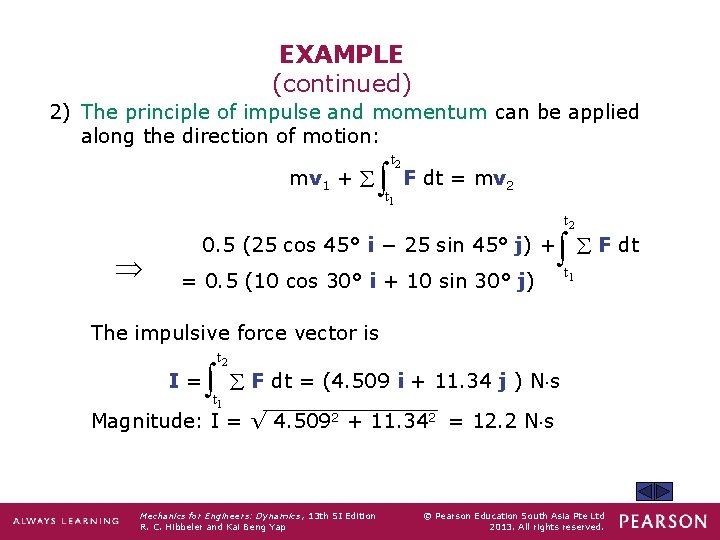
EXAMPLE (continued) 2) The principle of impulse and momentum can be applied along the direction of motion: mv 1 + t t 2 F dt = mv 2 1 t 2 0. 5 (25 cos 45° i − 25 sin 45° j) + = 0. 5 (10 cos 30° i + 10 sin 30° j) t F dt 1 The impulsive force vector is I= t t 2 F dt = (4. 509 i + 11. 34 j ) N s 1 Magnitude: I = √ 4. 5092 + 11. 342 = 12. 2 N s Mechanics for Engineers: Dynamics , 13 th SI Edition R. C. Hibbeler and Kai Beng Yap © Pearson Education South Asia Pte Ltd 2013. All rights reserved.
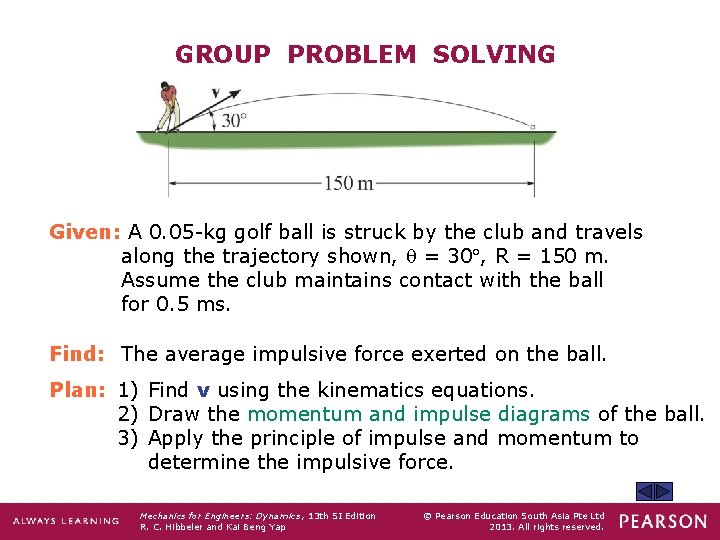
GROUP PROBLEM SOLVING Given: A 0. 05 -kg golf ball is struck by the club and travels along the trajectory shown, = 30 , R = 150 m. Assume the club maintains contact with the ball for 0. 5 ms. Find: The average impulsive force exerted on the ball. Plan: 1) Find v using the kinematics equations. 2) Draw the momentum and impulse diagrams of the ball. 3) Apply the principle of impulse and momentum to determine the impulsive force. Mechanics for Engineers: Dynamics , 13 th SI Edition R. C. Hibbeler and Kai Beng Yap © Pearson Education South Asia Pte Ltd 2013. All rights reserved.
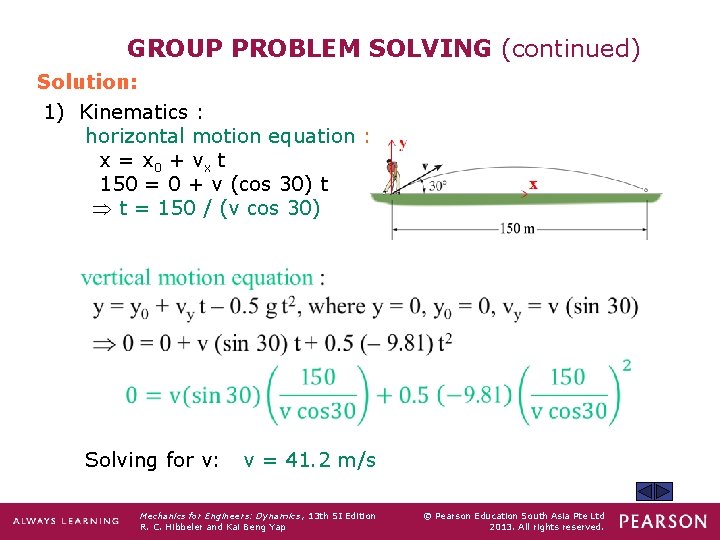
GROUP PROBLEM SOLVING (continued) Solution: 1) Kinematics : horizontal motion equation : x = x 0 + vx t 150 = 0 + v (cos 30) t t = 150 / (v cos 30) Solving for v: v = 41. 2 m/s Mechanics for Engineers: Dynamics , 13 th SI Edition R. C. Hibbeler and Kai Beng Yap © Pearson Education South Asia Pte Ltd 2013. All rights reserved.
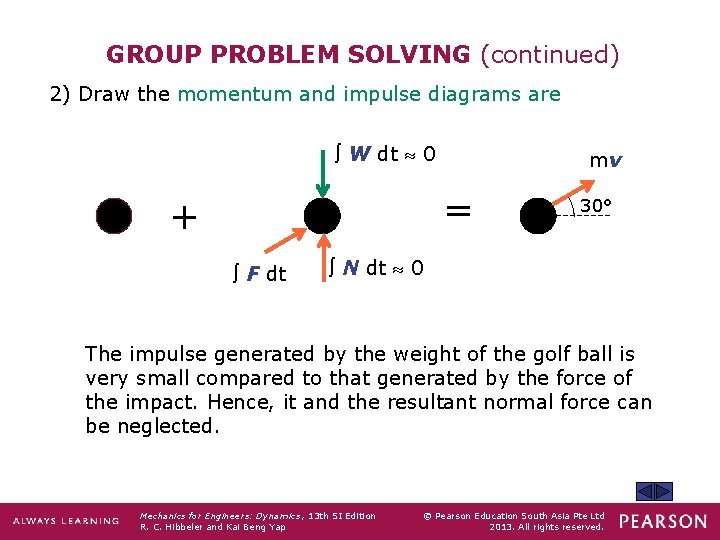
GROUP PROBLEM SOLVING (continued) 2) Draw the momentum and impulse diagrams are W dt 0 mv = + F dt 30° N dt 0 The impulse generated by the weight of the golf ball is very small compared to that generated by the force of the impact. Hence, it and the resultant normal force can be neglected. Mechanics for Engineers: Dynamics , 13 th SI Edition R. C. Hibbeler and Kai Beng Yap © Pearson Education South Asia Pte Ltd 2013. All rights reserved.
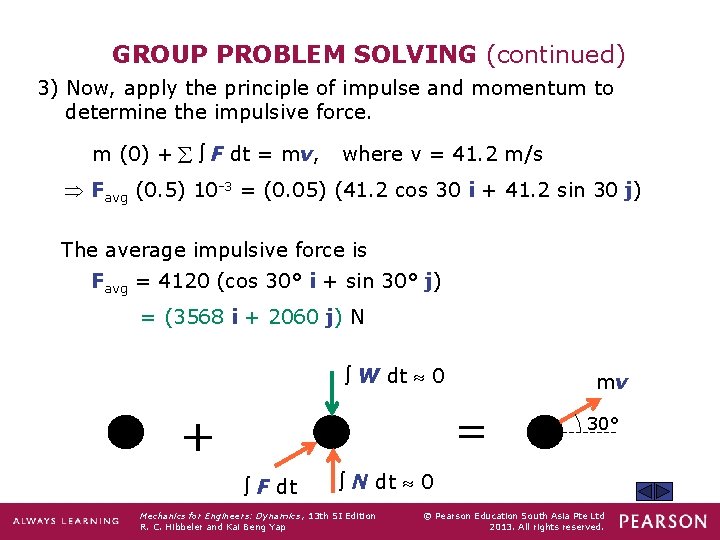
GROUP PROBLEM SOLVING (continued) 3) Now, apply the principle of impulse and momentum to determine the impulsive force. m (0) + F dt = mv, where v = 41. 2 m/s Favg (0. 5) 10 -3 = (0. 05) (41. 2 cos 30 i + 41. 2 sin 30 j) The average impulsive force is Favg = 4120 (cos 30° i + sin 30° j) = (3568 i + 2060 j) N W dt 0 mv = + F dt 30° N dt 0 Mechanics for Engineers: Dynamics , 13 th SI Edition R. C. Hibbeler and Kai Beng Yap © Pearson Education South Asia Pte Ltd 2013. All rights reserved.
PRINCIPLE OF LINEAR IMPULSE AND MOMENTUM AND CONSERVATION OF LINEAR MOMENTUM FOR SYSTEMS OF PARTICLES Mechanics for Engineers: Dynamics , 13 th SI Edition R. C. Hibbeler and Kai Beng Yap © Pearson Education South Asia Pte Ltd 2013. All rights reserved.
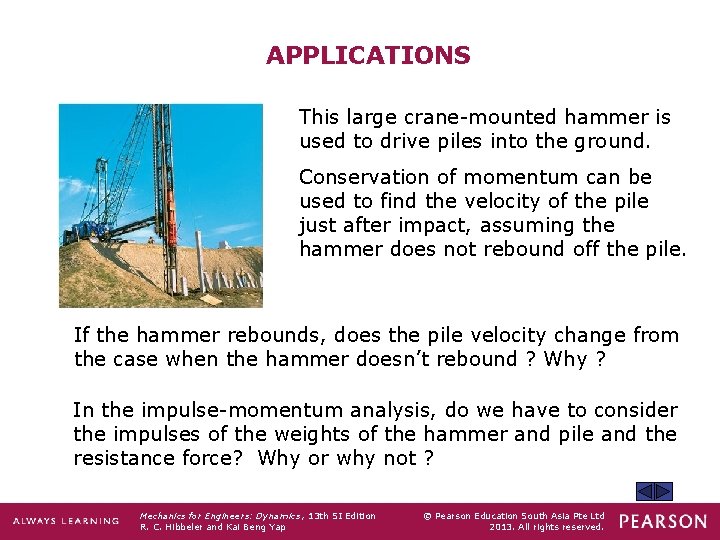
APPLICATIONS This large crane-mounted hammer is used to drive piles into the ground. Conservation of momentum can be used to find the velocity of the pile just after impact, assuming the hammer does not rebound off the pile. If the hammer rebounds, does the pile velocity change from the case when the hammer doesn’t rebound ? Why ? In the impulse-momentum analysis, do we have to consider the impulses of the weights of the hammer and pile and the resistance force? Why or why not ? Mechanics for Engineers: Dynamics , 13 th SI Edition R. C. Hibbeler and Kai Beng Yap © Pearson Education South Asia Pte Ltd 2013. All rights reserved.
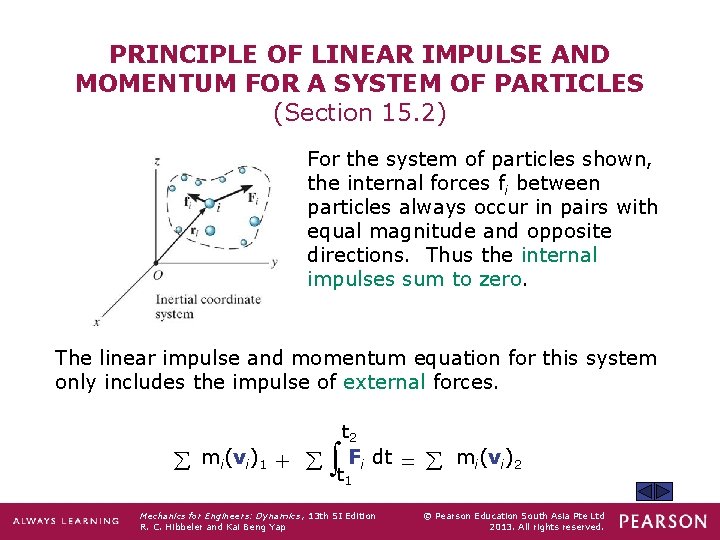
PRINCIPLE OF LINEAR IMPULSE AND MOMENTUM FOR A SYSTEM OF PARTICLES (Section 15. 2) For the system of particles shown, the internal forces fi between particles always occur in pairs with equal magnitude and opposite directions. Thus the internal impulses sum to zero. The linear impulse and momentum equation for this system only includes the impulse of external forces. t 2 mi(vi)1 + Fi dt = mi(vi)2 t 1 Mechanics for Engineers: Dynamics , 13 th SI Edition R. C. Hibbeler and Kai Beng Yap © Pearson Education South Asia Pte Ltd 2013. All rights reserved.
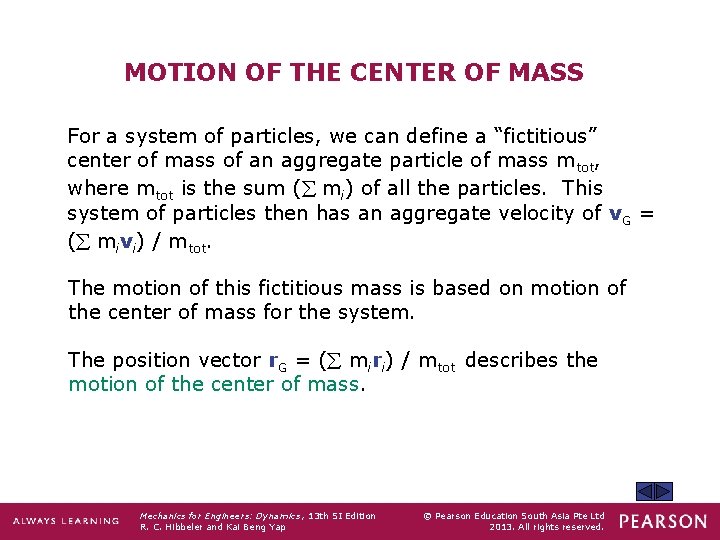
MOTION OF THE CENTER OF MASS For a system of particles, we can define a “fictitious” center of mass of an aggregate particle of mass mtot, where mtot is the sum ( mi) of all the particles. This system of particles then has an aggregate velocity of v. G = ( mivi) / mtot. The motion of this fictitious mass is based on motion of the center of mass for the system. The position vector r. G = ( miri) / mtot describes the motion of the center of mass. Mechanics for Engineers: Dynamics , 13 th SI Edition R. C. Hibbeler and Kai Beng Yap © Pearson Education South Asia Pte Ltd 2013. All rights reserved.
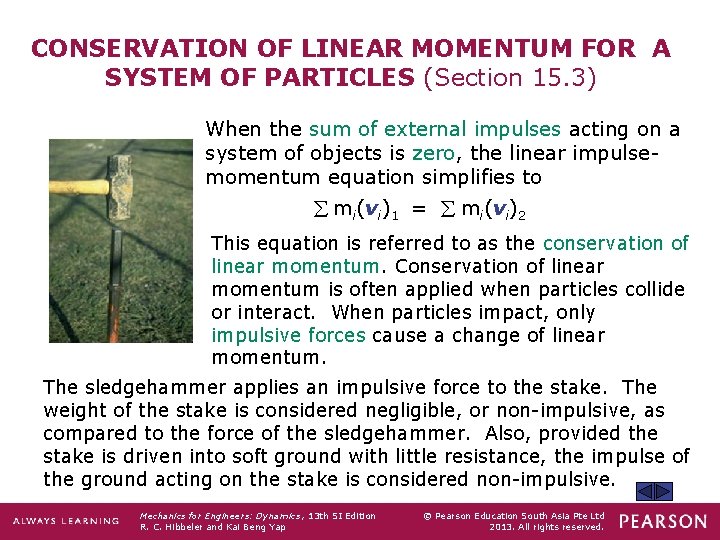
CONSERVATION OF LINEAR MOMENTUM FOR A SYSTEM OF PARTICLES (Section 15. 3) When the sum of external impulses acting on a system of objects is zero, the linear impulsemomentum equation simplifies to mi(vi)1 = mi(vi)2 This equation is referred to as the conservation of linear momentum. Conservation of linear momentum is often applied when particles collide or interact. When particles impact, only impulsive forces cause a change of linear momentum. The sledgehammer applies an impulsive force to the stake. The weight of the stake is considered negligible, or non-impulsive, as compared to the force of the sledgehammer. Also, provided the stake is driven into soft ground with little resistance, the impulse of the ground acting on the stake is considered non-impulsive. Mechanics for Engineers: Dynamics , 13 th SI Edition R. C. Hibbeler and Kai Beng Yap © Pearson Education South Asia Pte Ltd 2013. All rights reserved.
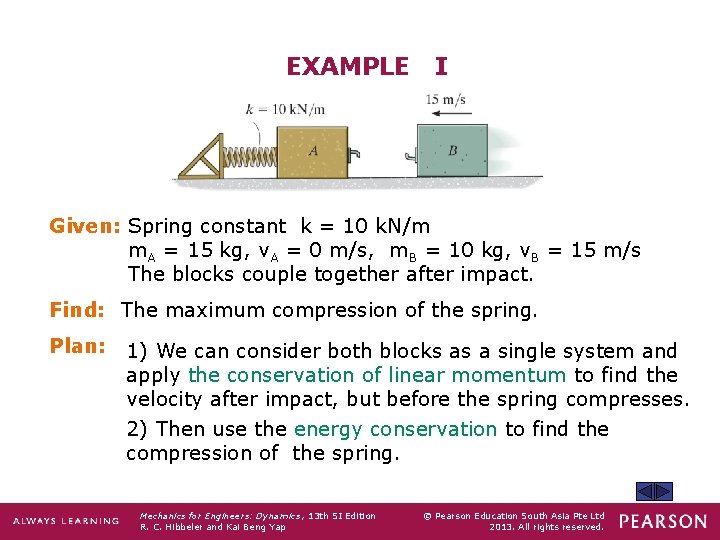
EXAMPLE I Given: Spring constant k = 10 k. N/m m. A = 15 kg, v. A = 0 m/s, m. B = 10 kg, v. B = 15 m/s The blocks couple together after impact. Find: The maximum compression of the spring. Plan: 1) We can consider both blocks as a single system and apply the conservation of linear momentum to find the velocity after impact, but before the spring compresses. 2) Then use the energy conservation to find the compression of the spring. Mechanics for Engineers: Dynamics , 13 th SI Edition R. C. Hibbeler and Kai Beng Yap © Pearson Education South Asia Pte Ltd 2013. All rights reserved.
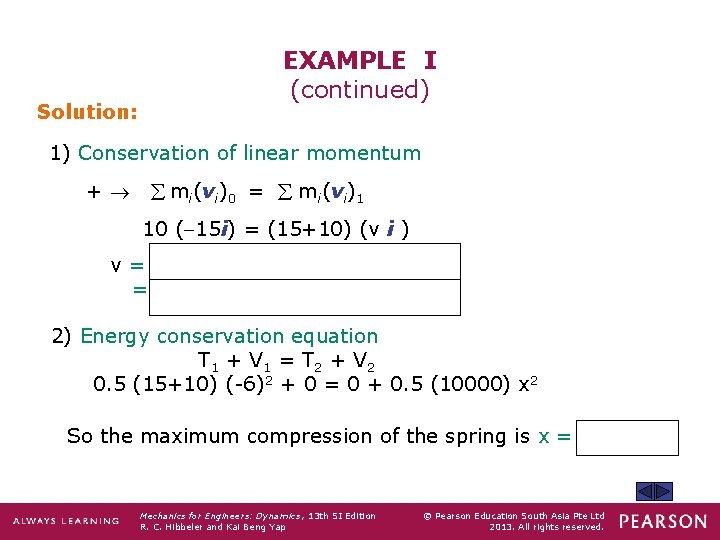
EXAMPLE I (continued) Solution: 1) Conservation of linear momentum + mi(vi)0 = mi(vi)1 10 ( 15 i) = (15+10) (v i ) v = 6 m/s 2) Energy conservation equation T 1 + V 1 = T 2 + V 2 0. 5 (15+10) (-6)2 + 0 = 0 + 0. 5 (10000) x 2 So the maximum compression of the spring is x = 0. 3 m. Mechanics for Engineers: Dynamics , 13 th SI Edition R. C. Hibbeler and Kai Beng Yap © Pearson Education South Asia Pte Ltd 2013. All rights reserved.
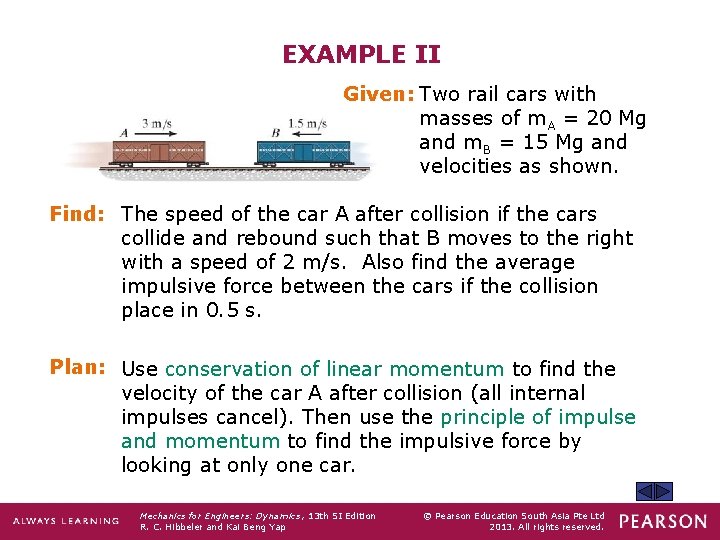
EXAMPLE II Given: Two rail cars with masses of m. A = 20 Mg and m. B = 15 Mg and velocities as shown. Find: The speed of the car A after collision if the cars collide and rebound such that B moves to the right with a speed of 2 m/s. Also find the average impulsive force between the cars if the collision place in 0. 5 s. Plan: Use conservation of linear momentum to find the velocity of the car A after collision (all internal impulses cancel). Then use the principle of impulse and momentum to find the impulsive force by looking at only one car. Mechanics for Engineers: Dynamics , 13 th SI Edition R. C. Hibbeler and Kai Beng Yap © Pearson Education South Asia Pte Ltd 2013. All rights reserved.
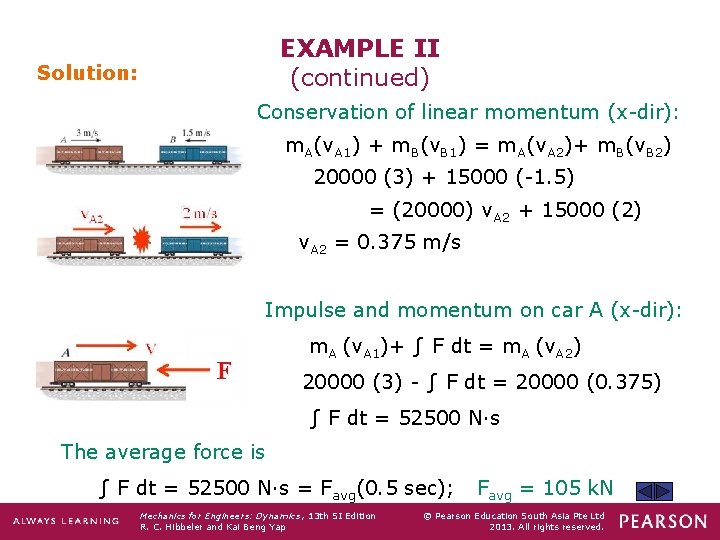
EXAMPLE II (continued) Solution: Conservation of linear momentum (x-dir): m. A(v. A 1) + m. B(v. B 1) = m. A(v. A 2)+ m. B(v. B 2) 20000 (3) + 15000 (-1. 5) = (20000) v. A 2 + 15000 (2) v. A 2 = 0. 375 m/s Impulse and momentum on car A (x-dir): m. A (v. A 1)+ ∫ F dt = m. A (v. A 2) 20000 (3) - ∫ F dt = 20000 (0. 375) ∫ F dt = 52500 N·s The average force is ∫ F dt = 52500 N·s = Favg(0. 5 sec); Mechanics for Engineers: Dynamics , 13 th SI Edition R. C. Hibbeler and Kai Beng Yap Favg = 105 k. N © Pearson Education South Asia Pte Ltd 2013. All rights reserved.
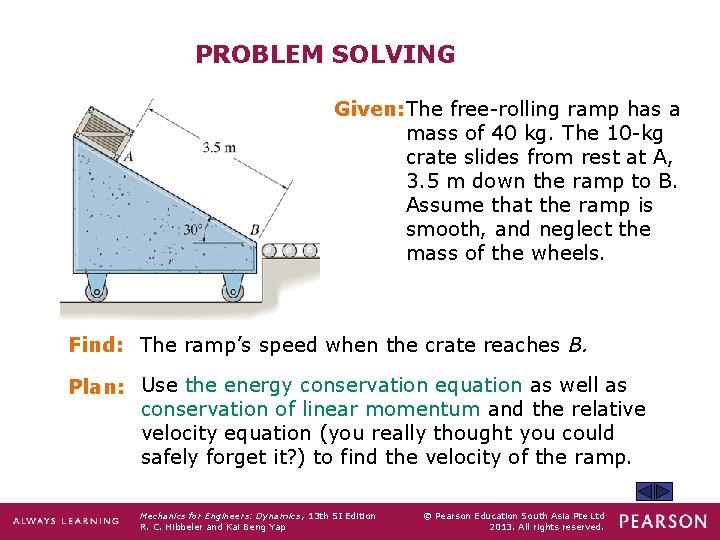
PROBLEM SOLVING Given: The free-rolling ramp has a mass of 40 kg. The 10 -kg crate slides from rest at A, 3. 5 m down the ramp to B. Assume that the ramp is smooth, and neglect the mass of the wheels. Find: The ramp’s speed when the crate reaches B. Plan: Use the energy conservation equation as well as conservation of linear momentum and the relative velocity equation (you really thought you could safely forget it? ) to find the velocity of the ramp. Mechanics for Engineers: Dynamics , 13 th SI Edition R. C. Hibbeler and Kai Beng Yap © Pearson Education South Asia Pte Ltd 2013. All rights reserved.
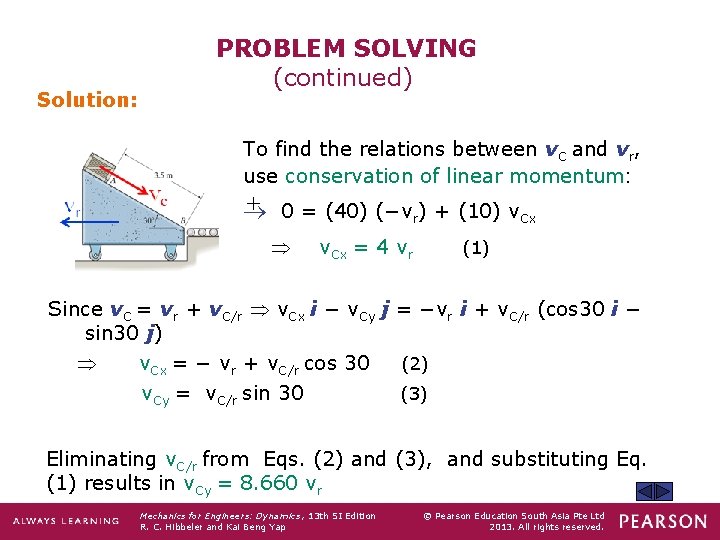
Solution: PROBLEM SOLVING (continued) To find the relations between v. C and vr, use conservation of linear momentum: + 0 = (40) (−vr) + (10) v. Cx = 4 vr (1) Since v. C = vr + v. C/r v. Cx i − v. Cy j = −vr i + v. C/r (cos 30 i − sin 30 j) v. Cx = − vr + v. C/r cos 30 (2) v. Cy = v. C/r sin 30 (3) Eliminating v. C/r from Eqs. (2) and (3), and substituting Eq. (1) results in v. Cy = 8. 660 vr Mechanics for Engineers: Dynamics , 13 th SI Edition R. C. Hibbeler and Kai Beng Yap © Pearson Education South Asia Pte Ltd 2013. All rights reserved.
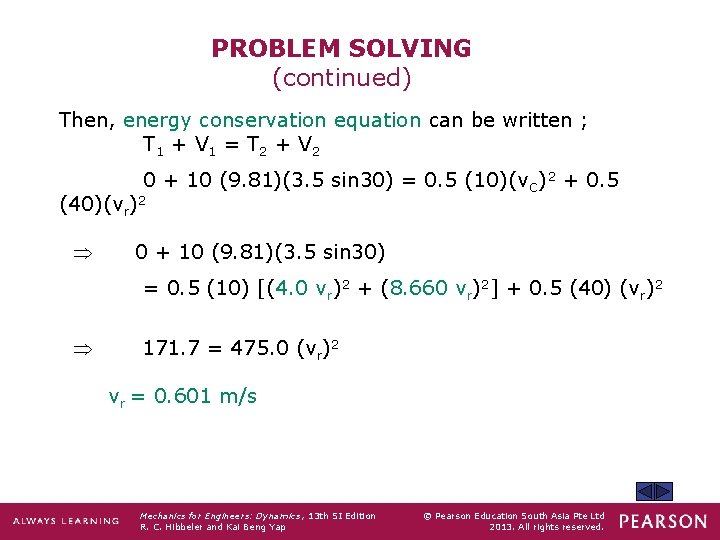
PROBLEM SOLVING (continued) Then, energy conservation equation can be written ; T 1 + V 1 = T 2 + V 2 0 + 10 (9. 81)(3. 5 sin 30) = 0. 5 (10)(v. C)2 + 0. 5 (40)(vr)2 0 + 10 (9. 81)(3. 5 sin 30) = 0. 5 (10) [(4. 0 vr)2 + (8. 660 vr)2] + 0. 5 (40) (vr)2 171. 7 = 475. 0 (vr)2 vr = 0. 601 m/s Mechanics for Engineers: Dynamics , 13 th SI Edition R. C. Hibbeler and Kai Beng Yap © Pearson Education South Asia Pte Ltd 2013. All rights reserved.
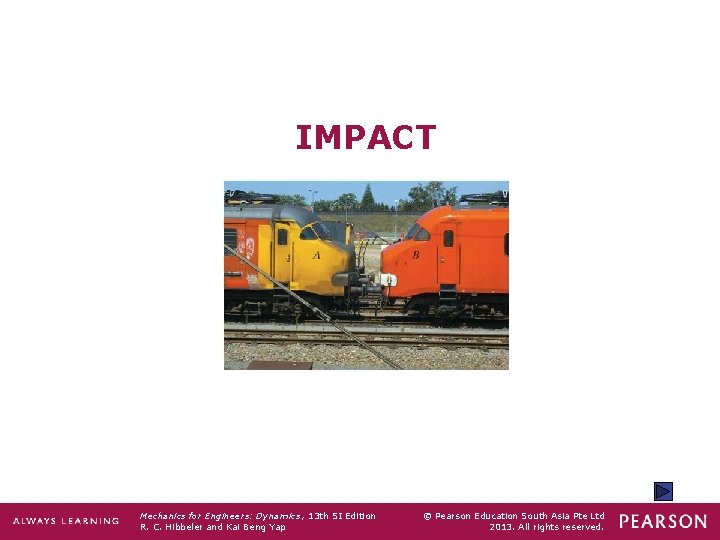
IMPACT Mechanics for Engineers: Dynamics , 13 th SI Edition R. C. Hibbeler and Kai Beng Yap © Pearson Education South Asia Pte Ltd 2013. All rights reserved.
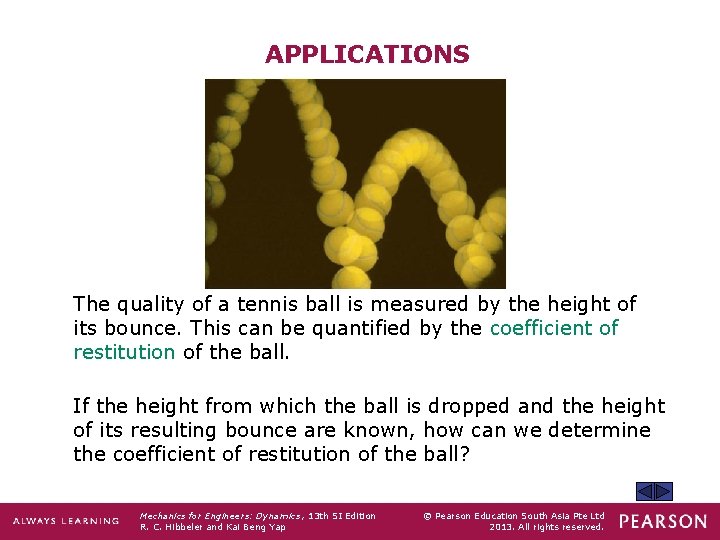
APPLICATIONS The quality of a tennis ball is measured by the height of its bounce. This can be quantified by the coefficient of restitution of the ball. If the height from which the ball is dropped and the height of its resulting bounce are known, how can we determine the coefficient of restitution of the ball? Mechanics for Engineers: Dynamics , 13 th SI Edition R. C. Hibbeler and Kai Beng Yap © Pearson Education South Asia Pte Ltd 2013. All rights reserved.
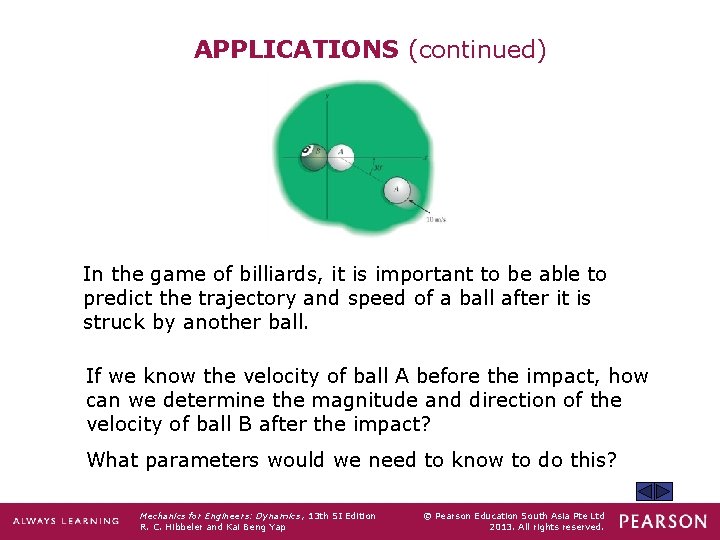
APPLICATIONS (continued) In the game of billiards, it is important to be able to predict the trajectory and speed of a ball after it is struck by another ball. If we know the velocity of ball A before the impact, how can we determine the magnitude and direction of the velocity of ball B after the impact? What parameters would we need to know to do this? Mechanics for Engineers: Dynamics , 13 th SI Edition R. C. Hibbeler and Kai Beng Yap © Pearson Education South Asia Pte Ltd 2013. All rights reserved.
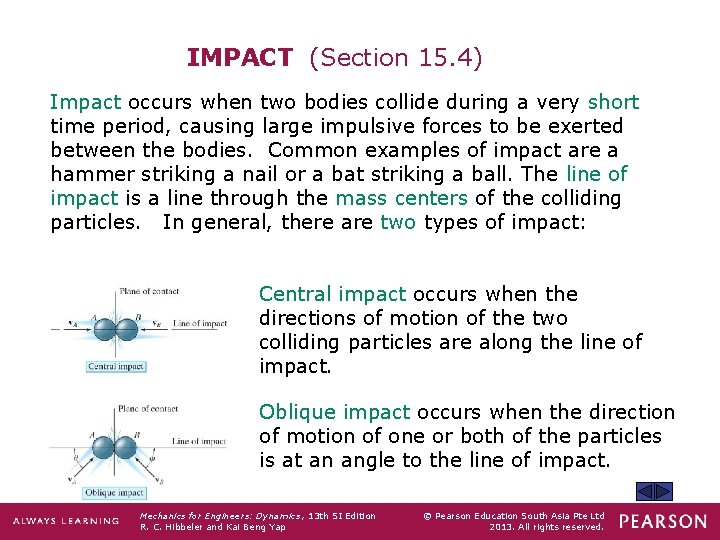
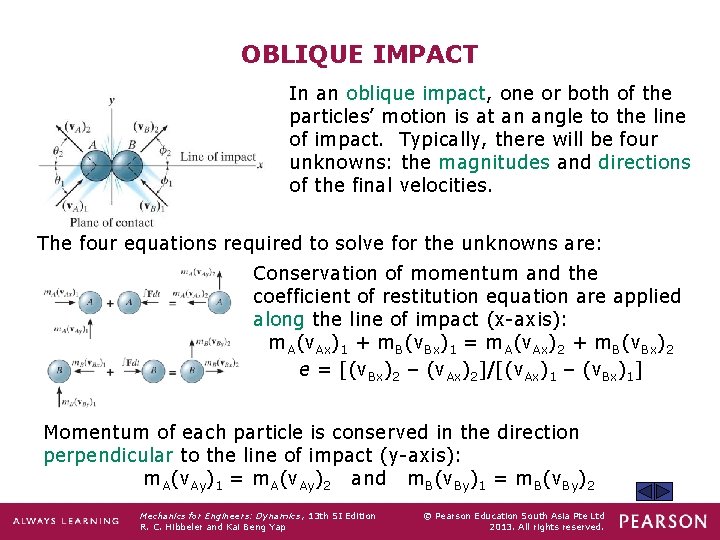
IMPACT (Section 15. 4) Impact occurs when two bodies collide during a very short time period, causing large impulsive forces to be exerted between the bodies. Common examples of impact are a hammer striking a nail or a bat striking a ball. The line of impact is a line through the mass centers of the colliding particles. In general, there are two types of impact: Central impact occurs when the directions of motion of the two colliding particles are along the line of impact. Oblique impact occurs when the direction of motion of one or both of the particles is at an angle to the line of impact. Mechanics for Engineers: Dynamics , 13 th SI Edition R. C. Hibbeler and Kai Beng Yap © Pearson Education South Asia Pte Ltd 2013. All rights reserved.
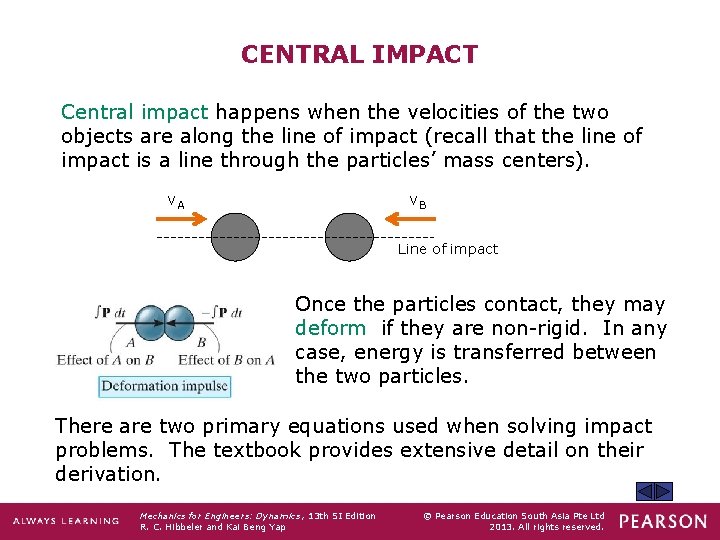
CENTRAL IMPACT Central impact happens when the velocities of the two objects are along the line of impact (recall that the line of impact is a line through the particles’ mass centers). v. A v. B Line of impact Once the particles contact, they may deform if they are non-rigid. In any case, energy is transferred between the two particles. There are two primary equations used when solving impact problems. The textbook provides extensive detail on their derivation. Mechanics for Engineers: Dynamics , 13 th SI Edition R. C. Hibbeler and Kai Beng Yap © Pearson Education South Asia Pte Ltd 2013. All rights reserved.
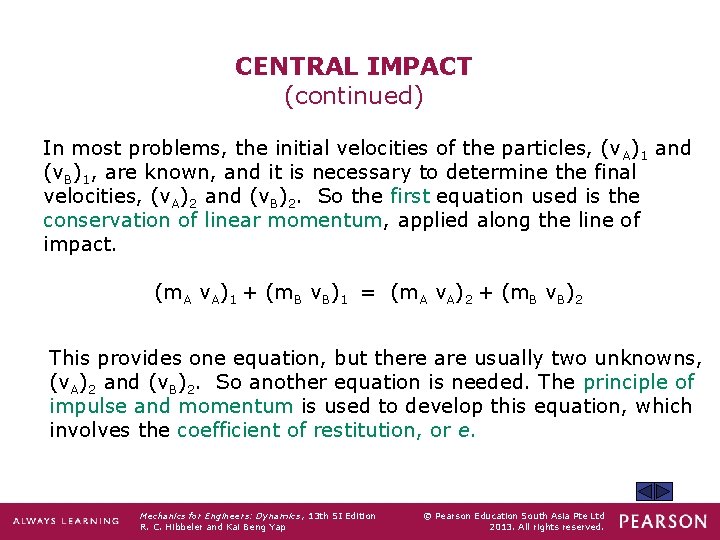
CENTRAL IMPACT (continued) In most problems, the initial velocities of the particles, (v A)1 and (v. B)1, are known, and it is necessary to determine the final velocities, (v. A)2 and (v. B)2. So the first equation used is the conservation of linear momentum, applied along the line of impact. (m. A v. A)1 + (m. B v. B)1 = (m. A v. A)2 + (m. B v. B)2 This provides one equation, but there are usually two unknowns, (v. A)2 and (v. B)2. So another equation is needed. The principle of impulse and momentum is used to develop this equation, which involves the coefficient of restitution, or e. Mechanics for Engineers: Dynamics , 13 th SI Edition R. C. Hibbeler and Kai Beng Yap © Pearson Education South Asia Pte Ltd 2013. All rights reserved.
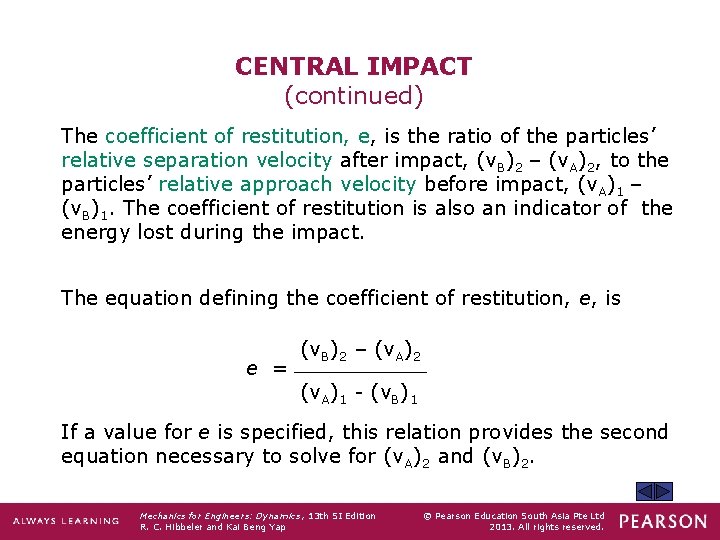
CENTRAL IMPACT (continued) The coefficient of restitution, e, is the ratio of the particles’ relative separation velocity after impact, (v. B)2 – (v. A)2, to the particles’ relative approach velocity before impact, (v. A)1 – (v. B)1. The coefficient of restitution is also an indicator of the energy lost during the impact. The equation defining the coefficient of restitution, e, is e = (v. B)2 – (v. A)2 (v. A)1 - (v. B)1 If a value for e is specified, this relation provides the second equation necessary to solve for (v. A)2 and (v. B)2. Mechanics for Engineers: Dynamics , 13 th SI Edition R. C. Hibbeler and Kai Beng Yap © Pearson Education South Asia Pte Ltd 2013. All rights reserved.
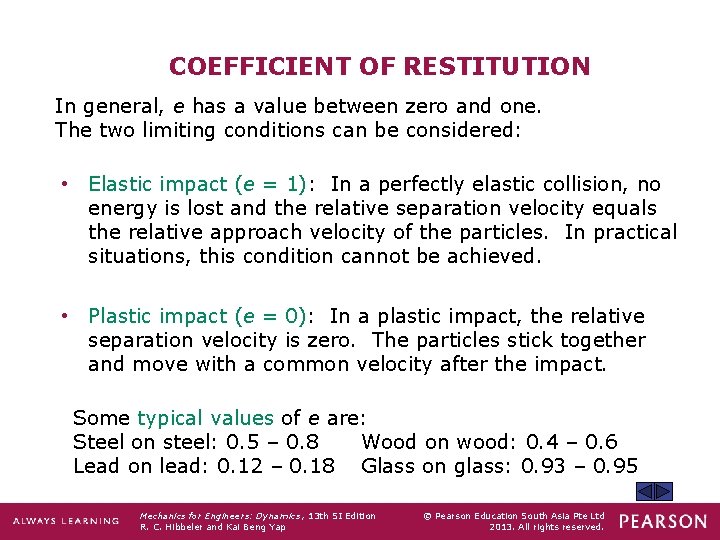
COEFFICIENT OF RESTITUTION In general, e has a value between zero and one. The two limiting conditions can be considered: • Elastic impact (e = 1): In a perfectly elastic collision, no energy is lost and the relative separation velocity equals the relative approach velocity of the particles. In practical situations, this condition cannot be achieved. • Plastic impact (e = 0): In a plastic impact, the relative separation velocity is zero. The particles stick together and move with a common velocity after the impact. Some typical values of e are: Steel on steel: 0. 5 – 0. 8 Wood on wood: 0. 4 – 0. 6 Lead on lead: 0. 12 – 0. 18 Glass on glass: 0. 93 – 0. 95 Mechanics for Engineers: Dynamics , 13 th SI Edition R. C. Hibbeler and Kai Beng Yap © Pearson Education South Asia Pte Ltd 2013. All rights reserved.
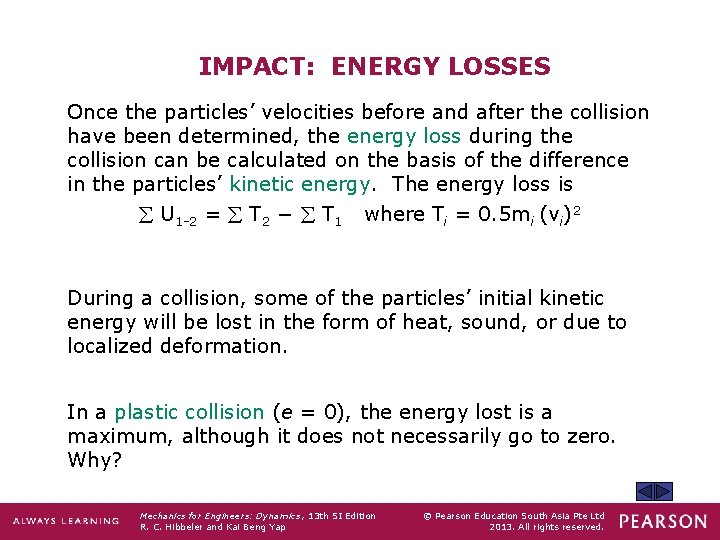
IMPACT: ENERGY LOSSES Once the particles’ velocities before and after the collision have been determined, the energy loss during the collision can be calculated on the basis of the difference in the particles’ kinetic energy. The energy loss is U 1 -2 = T 2 − T 1 where Ti = 0. 5 mi (vi)2 During a collision, some of the particles’ initial kinetic energy will be lost in the form of heat, sound, or due to localized deformation. In a plastic collision (e = 0), the energy lost is a maximum, although it does not necessarily go to zero. Why? Mechanics for Engineers: Dynamics , 13 th SI Edition R. C. Hibbeler and Kai Beng Yap © Pearson Education South Asia Pte Ltd 2013. All rights reserved.
OBLIQUE IMPACT In an oblique impact, one or both of the particles’ motion is at an angle to the line of impact. Typically, there will be four unknowns: the magnitudes and directions of the final velocities. The four equations required to solve for the unknowns are: Conservation of momentum and the coefficient of restitution equation are applied along the line of impact (x-axis): m. A(v. Ax)1 + m. B(v. Bx)1 = m. A(v. Ax)2 + m. B(v. Bx)2 e = [(v. Bx)2 – (v. Ax)2]/[(v. Ax)1 – (v. Bx)1] Momentum of each particle is conserved in the direction perpendicular to the line of impact (y-axis): m. A(v. Ay)1 = m. A(v. Ay)2 and m. B(v. By)1 = m. B(v. By)2 Mechanics for Engineers: Dynamics , 13 th SI Edition R. C. Hibbeler and Kai Beng Yap © Pearson Education South Asia Pte Ltd 2013. All rights reserved.
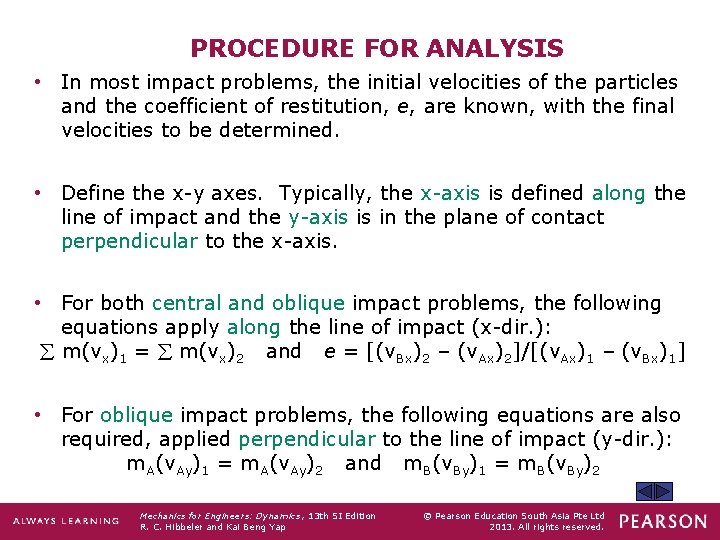
PROCEDURE FOR ANALYSIS • In most impact problems, the initial velocities of the particles and the coefficient of restitution, e, are known, with the final velocities to be determined. • Define the x-y axes. Typically, the x-axis is defined along the line of impact and the y-axis is in the plane of contact perpendicular to the x-axis. • For both central and oblique impact problems, the following equations apply along the line of impact (x-dir. ): m(vx)1 = m(vx)2 and e = [(v. Bx)2 – (v. Ax)2]/[(v. Ax)1 – (v. Bx)1] • For oblique impact problems, the following equations are also required, applied perpendicular to the line of impact (y-dir. ): m. A(v. Ay)1 = m. A(v. Ay)2 and m. B(v. By)1 = m. B(v. By)2 Mechanics for Engineers: Dynamics , 13 th SI Edition R. C. Hibbeler and Kai Beng Yap © Pearson Education South Asia Pte Ltd 2013. All rights reserved.
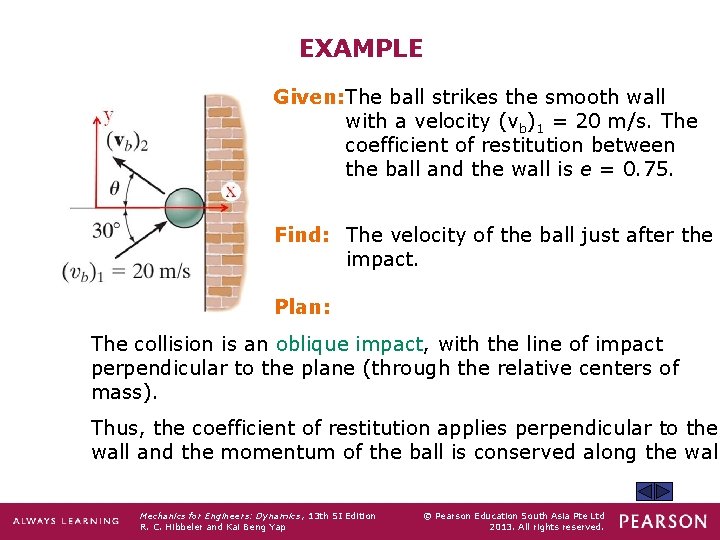
EXAMPLE Given: The ball strikes the smooth wall with a velocity (vb)1 = 20 m/s. The coefficient of restitution between the ball and the wall is e = 0. 75. Find: The velocity of the ball just after the impact. Plan: The collision is an oblique impact, with the line of impact perpendicular to the plane (through the relative centers of mass). Thus, the coefficient of restitution applies perpendicular to the wall and the momentum of the ball is conserved along the wall Mechanics for Engineers: Dynamics , 13 th SI Edition R. C. Hibbeler and Kai Beng Yap © Pearson Education South Asia Pte Ltd 2013. All rights reserved.
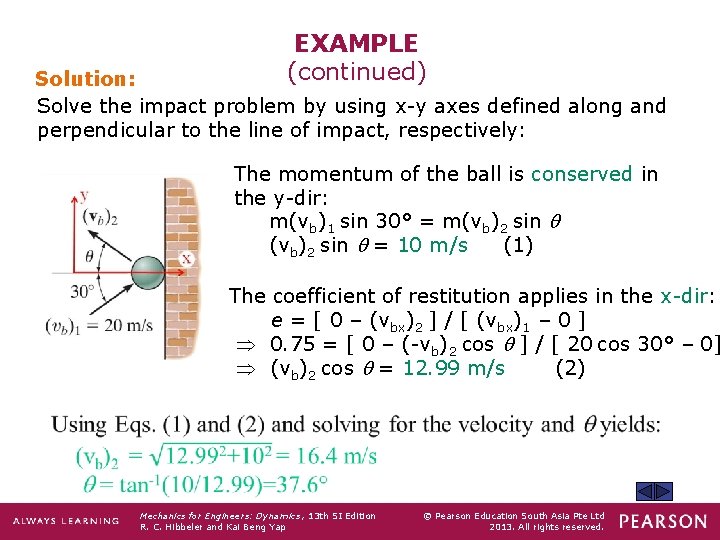
EXAMPLE (continued) Solution: Solve the impact problem by using x-y axes defined along and perpendicular to the line of impact, respectively: The momentum of the ball is conserved in the y-dir: m(vb)1 sin 30° = m(vb)2 sin = 10 m/s (1) The coefficient of restitution applies in the x-dir: e = [ 0 – (vbx)2 ] / [ (vbx)1 – 0 ] 0. 75 = [ 0 – (-vb)2 cos ] / [ 20 cos 30° – 0] (vb)2 cos = 12. 99 m/s (2) Mechanics for Engineers: Dynamics , 13 th SI Edition R. C. Hibbeler and Kai Beng Yap © Pearson Education South Asia Pte Ltd 2013. All rights reserved.
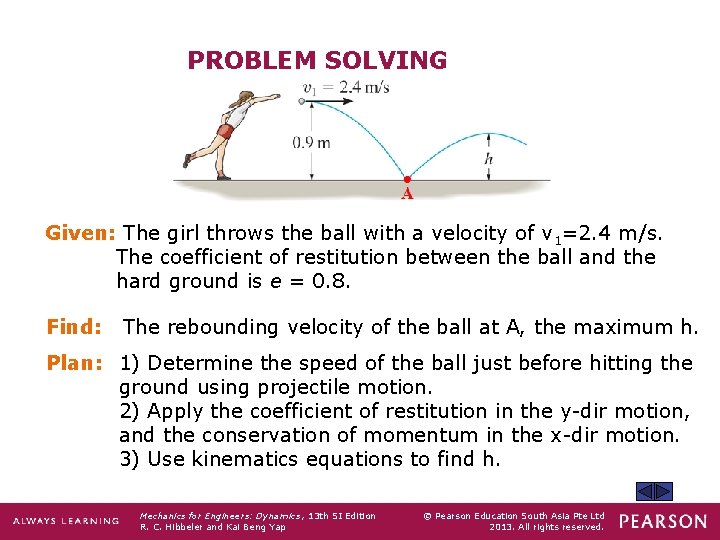
PROBLEM SOLVING Given: The girl throws the ball with a velocity of v 1=2. 4 m/s. The coefficient of restitution between the ball and the hard ground is e = 0. 8. Find: The rebounding velocity of the ball at A, the maximum h. Plan: 1) Determine the speed of the ball just before hitting the ground using projectile motion. 2) Apply the coefficient of restitution in the y-dir motion, and the conservation of momentum in the x-dir motion. 3) Use kinematics equations to find h. Mechanics for Engineers: Dynamics , 13 th SI Edition R. C. Hibbeler and Kai Beng Yap © Pearson Education South Asia Pte Ltd 2013. All rights reserved.
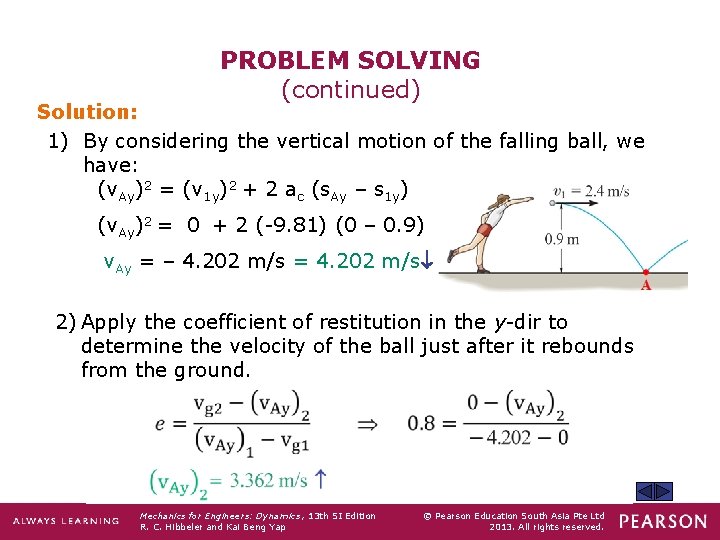
PROBLEM SOLVING (continued) Solution: 1) By considering the vertical motion of the falling ball, we have: (v. Ay)2 = (v 1 y)2 + 2 ac (s. Ay – s 1 y) (v. Ay)2 = 0 + 2 (-9. 81) (0 – 0. 9) v. Ay = – 4. 202 m/s = 4. 202 m/s 2) Apply the coefficient of restitution in the y-dir to determine the velocity of the ball just after it rebounds from the ground. Mechanics for Engineers: Dynamics , 13 th SI Edition R. C. Hibbeler and Kai Beng Yap © Pearson Education South Asia Pte Ltd 2013. All rights reserved.
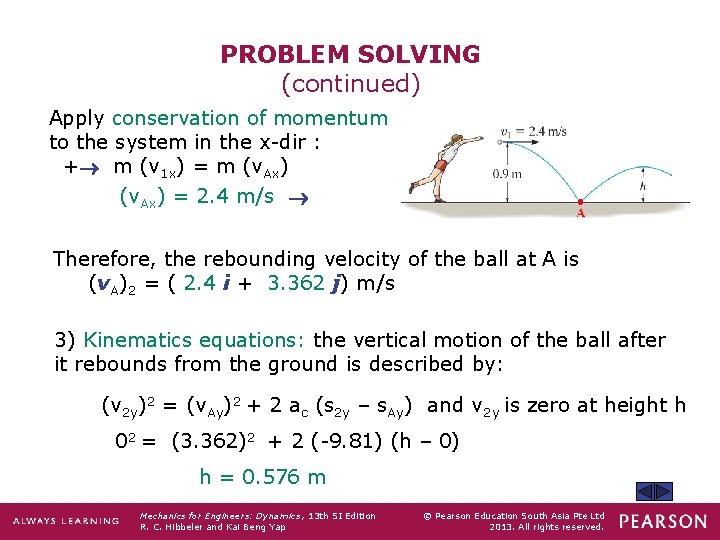
PROBLEM SOLVING (continued) Apply conservation of momentum to the system in the x-dir : + m (v 1 x) = m (v. Ax) = 2. 4 m/s Therefore, the rebounding velocity of the ball at A is (v. A)2 = ( 2. 4 i + 3. 362 j) m/s 3) Kinematics equations: the vertical motion of the ball after it rebounds from the ground is described by: (v 2 y)2 = (v. Ay)2 + 2 ac (s 2 y – s. Ay) and v 2 y is zero at height h 02 = (3. 362)2 + 2 (-9. 81) (h – 0) h = 0. 576 m Mechanics for Engineers: Dynamics , 13 th SI Edition R. C. Hibbeler and Kai Beng Yap © Pearson Education South Asia Pte Ltd 2013. All rights reserved.
Mechanics for Engineers: Dynamics , 13 th SI Edition R. C. Hibbeler and Kai Beng Yap © Pearson Education South Asia Pte Ltd 2013. All rights reserved.