
Principle of Business Statistics Sampling Distributions of Sample
Principle of Business Statistics Sampling Distributions of Sample Statistics: Sample Proportion Readings: Chapter 9 Qiao Yang Shanghai. Tech Lecture 9
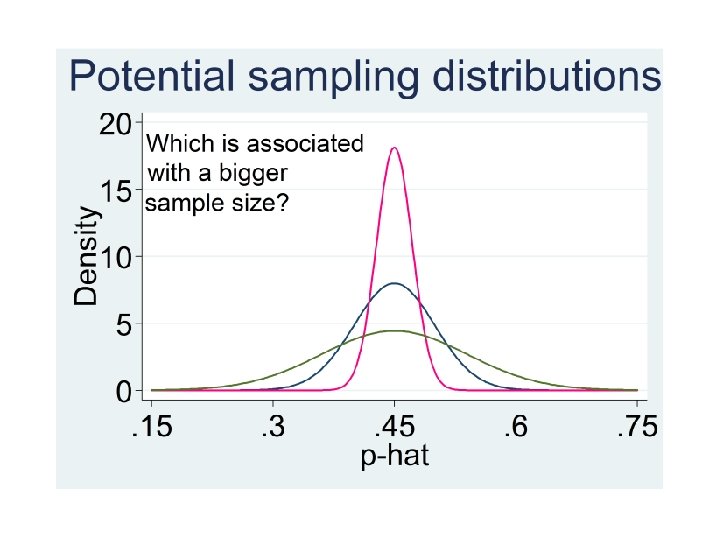
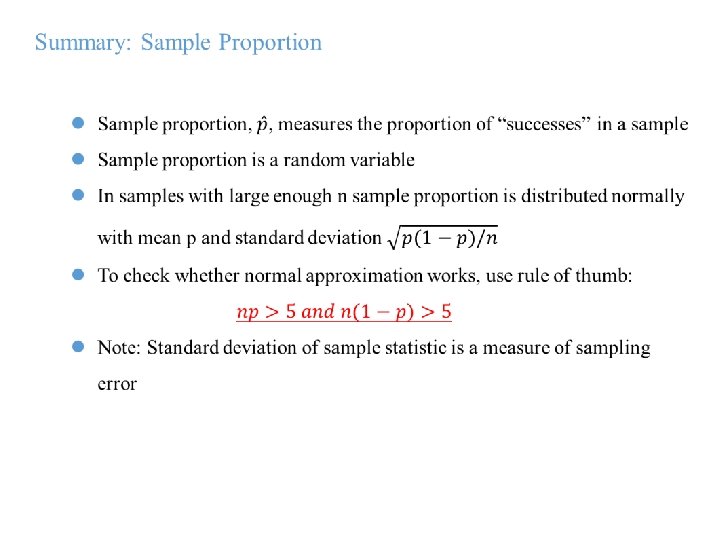
Sampling Distributions Recall: l A sample is a [small] part of a population. l A parameter is a numerical fact about the population of interest. Usually, a parameter cannot be determined exactly, but can only be estimated. l A statistic can be computed from a sample, and used to estimate a parameter. Today: l Sample statistics are random variables. l Sampling distribution is a probability distribution of a sample statistic. l Sampling error, or noise, is the variation of estimates from sample to sample.
How to Find Sampling Distribution ① Analytically (√) Ø Use probability rules Ø Use Laws of Expectation and Variance Ø Use Central Limit Theorem ② Empirically Ø Toss 2 coins many times Ø Record the value of sample statistics Ø Record frequencies of each value and probabilities – probability distribution ③ Simulations Ø Monte-Carlo simulation Ø Boot-strapping
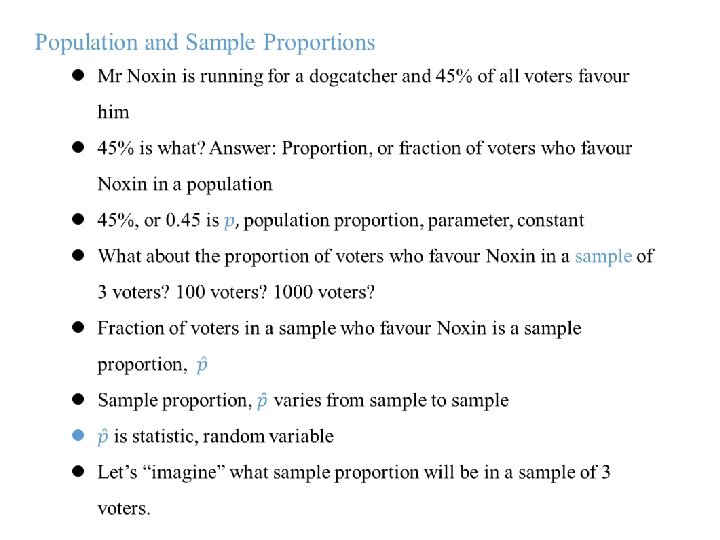
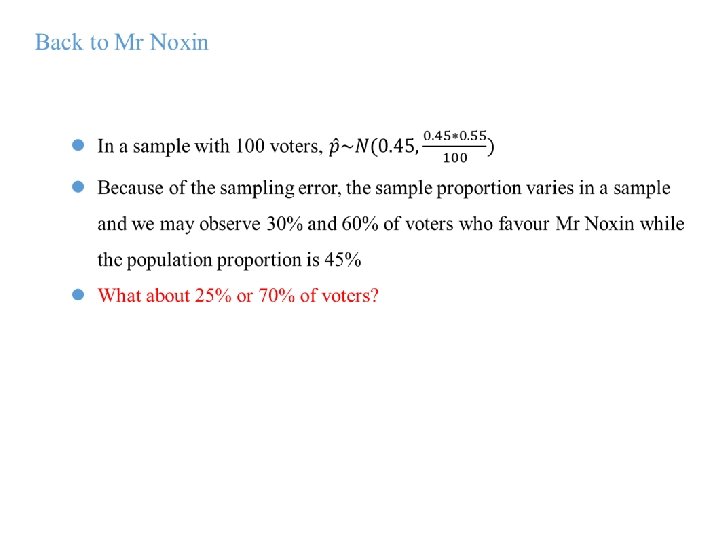
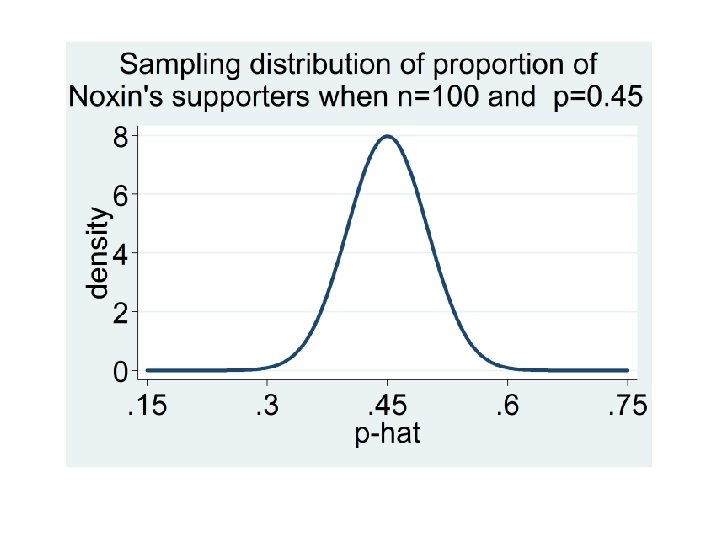
Sample Proportion l Mr Noxin is running for a dogcatcher (such as 业委会) and 45% of all voters favour him. l We polled 100 people on a street and found that 30% of them favour Mr Noxin l We polled another 100 people on a street and found that 60% of them favour Mr. Noxin l Why the difference between two samples? l How we can reconcile 30 and 60 percent with 45 percent who favour Mr Noxin?

- Slides: 15