
Principle Applications of Liquid Chromatography with Mass Spectrometry



- Slides: 40
Principle & Applications of Liquid Chromatography with Mass Spectrometry (LC-MS)
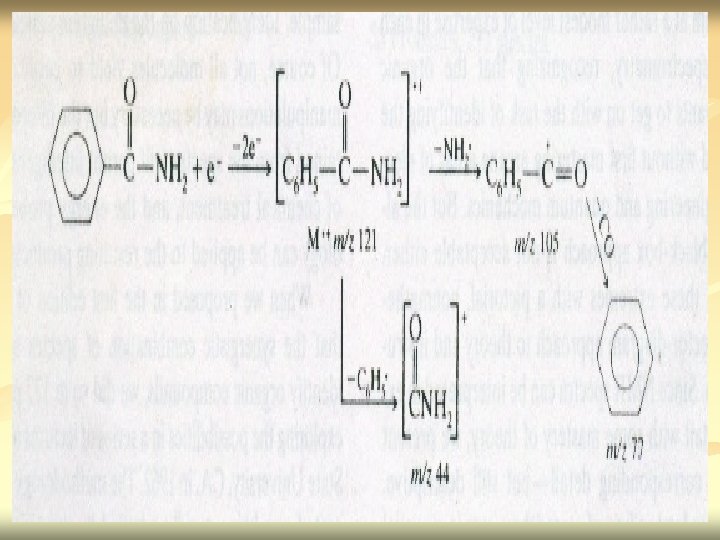
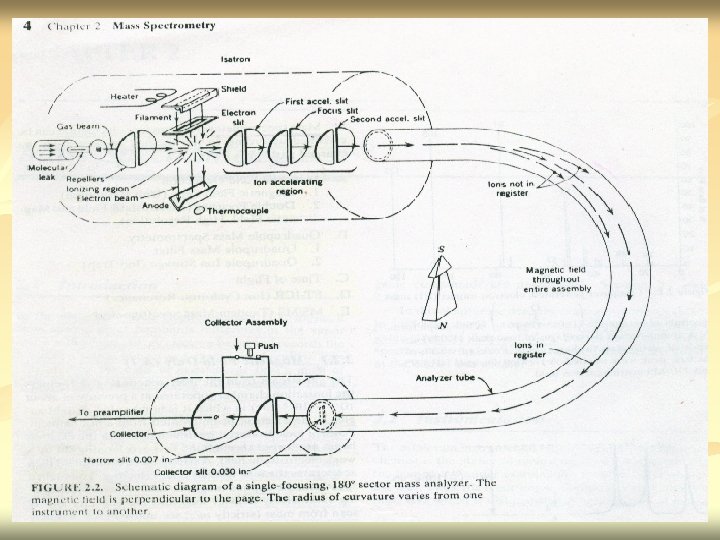
Principle of MS n Bombardment of sample in vapor phase with high energy electron beam to converted into positively charged ion species which are separated on the basis of their mass to charge ratio.
Contents n n n n Introduction Elements of LC-MS Liquid Chromatography Interfaces Mass spectrometry Applications References
Hyphen is a great fun Hyphen is a line which is used to join the words of different design Chromatography and spectroscopy Hyphened to give sensitivity and selectivity GC-MS, LC-MS and GC or LC -MS-MS
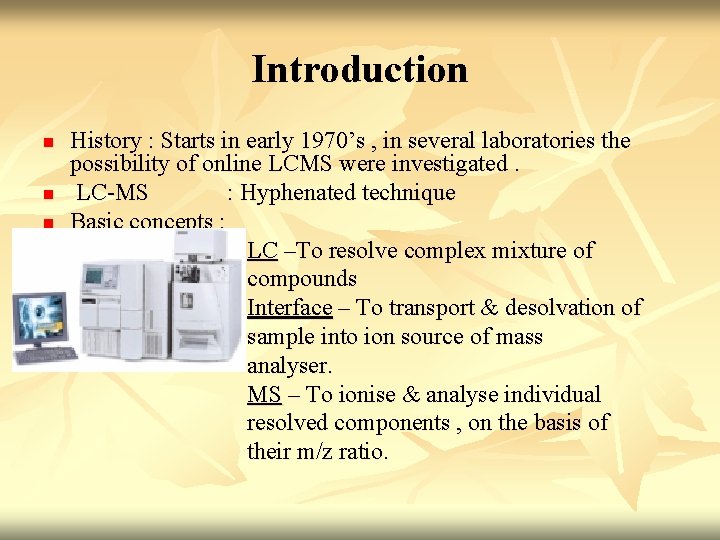
Introduction n History : Starts in early 1970’s , in several laboratories the possibility of online LCMS were investigated. LC-MS : Hyphenated technique Basic concepts : LC –To resolve complex mixture of compounds Interface – To transport & desolvation of sample into ion source of mass analyser. MS – To ionise & analyse individual resolved components , on the basis of their m/z ratio.
Liquid Chromatography n n n Principle – Partitioning of analyte between mobile (liquid & stationary (solid) phase. RPHPLC is most commonly used in LC-MS. Column is heart of LC. Length : 5 – 25 cm ID : 3 – 5 mm Particle size : 3 or 5 micron Material : Silica + long chain hydrocarbon. Liquid flow rate : 0. 1 – 1. 5 ml/min Column efficiency : 40, 000 – 70, 000 plates/meter
Mass Spectroscopy n n n Mass spectrometer produces a beam of ions, separates them according to m/z ratio of ions. The "heart" of the mass spectrometer is an analyzer. Analyzer uses electrical or magnetic fields, or combination of both, to move the ions from the region where they are produced to a detector.
Need of technique n n Drawbacks : HPLC – On its own provide ambiguous confirmation of identity of analyte. MS – Limitation in handling mixture of compounds. LC-MS – Benefited mutually, from high resolution separation capability of LC & high sensitive, structure specific detection capacity of mass.
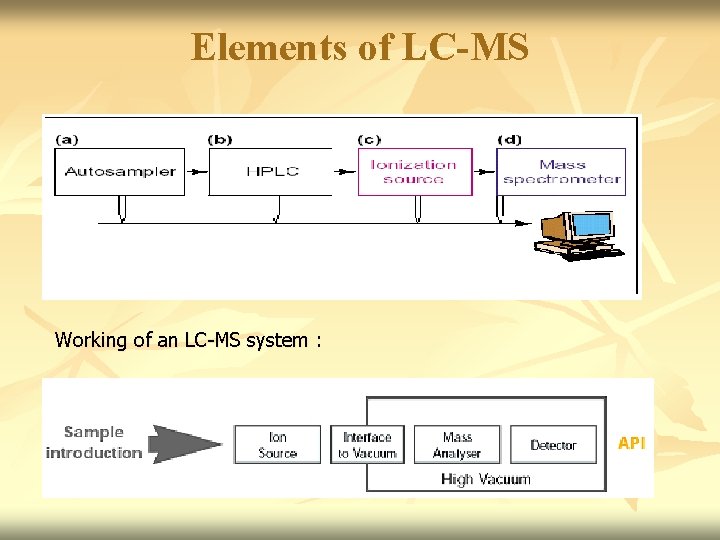
Elements of LC-MS Working of an LC-MS system :
Interfacing problem n n Problem in coupling LC-MS - Enormous mismatch between large solvent volumes from LC & vacuum requirement of MS So for solving this problem interface is used. Problem while interfacing Ø Necessity to remove solvent. Ø Difficulty in vaporising nonvolatile solvent. Ø Degradation of thermally labile compound.
Interfaces Used in LC-MS n n n n Moving belt Thermospray interface Particle beam interface Atmospheric pressure ionisation (API) - with ESI - with APCI Capillary inlet Continuous flow – fast atom bombardment Direct liquid introduction
Moving belt interface n n Important reason for it’s success is compatibility with wide range of chromatographic conditions ; also EI, CI & FAB methods employed easily. Limitations : 1) Complex mechanical device 2) Renewal of belt & belt memory are troublesome.
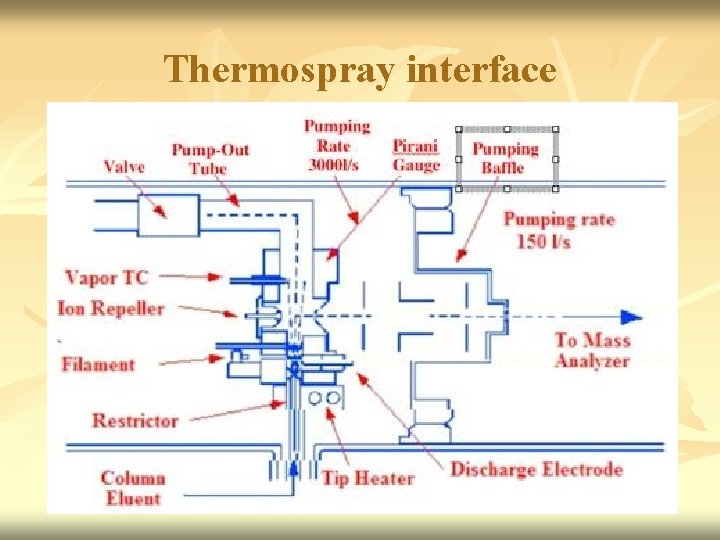
Thermospray interface
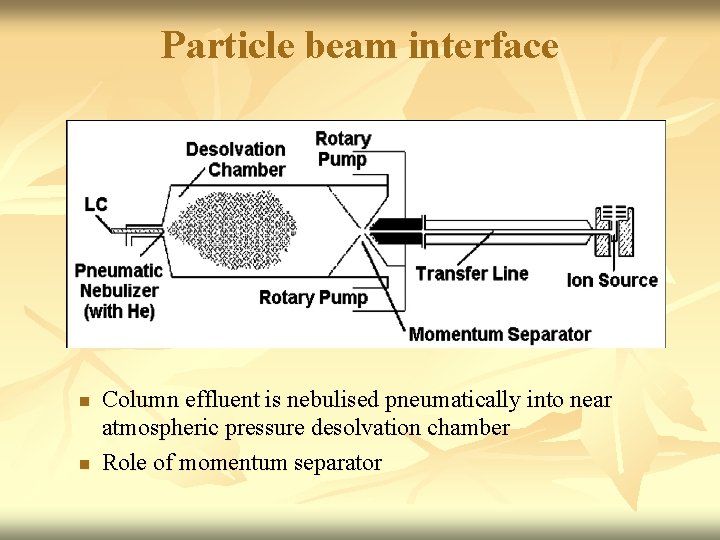
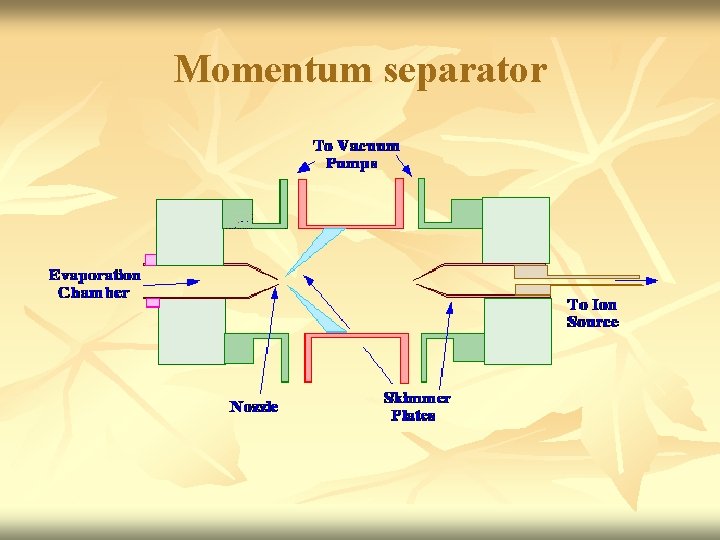
Particle beam interface n n Column effluent is nebulised pneumatically into near atmospheric pressure desolvation chamber Role of momentum separator
Momentum separator
Electrospray Ionisation n Unique feature – Desolvation & ionization process occur together in the ion source at atmospheric pressure. Nebulisation is done by using strong electric potential difference of 3 kv & N 2 flow. Nebulisation occur at only flow rate of below 10 microlitre/min.
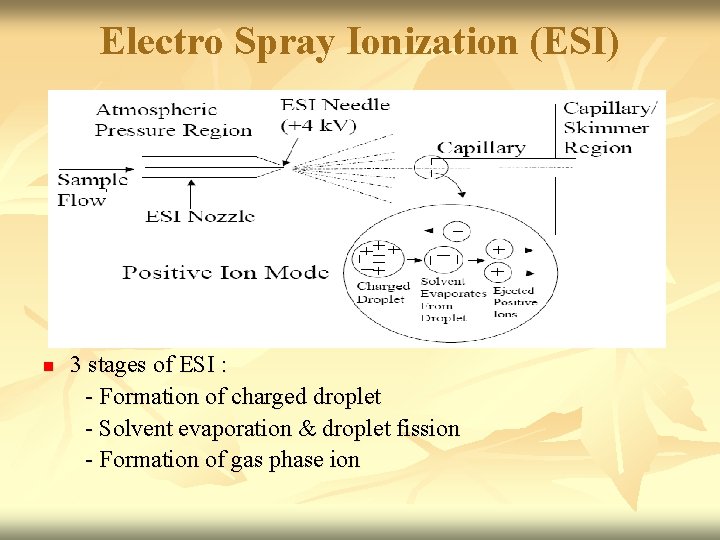
Electro Spray Ionization (ESI) n 3 stages of ESI : - Formation of charged droplet - Solvent evaporation & droplet fission - Formation of gas phase ion
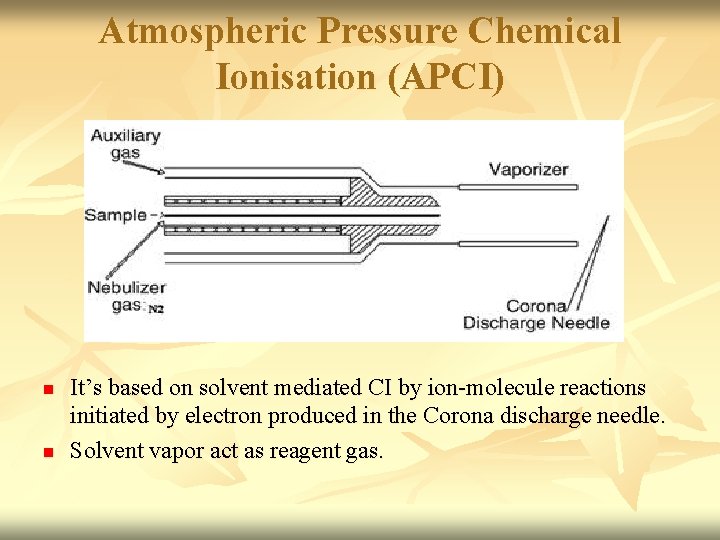
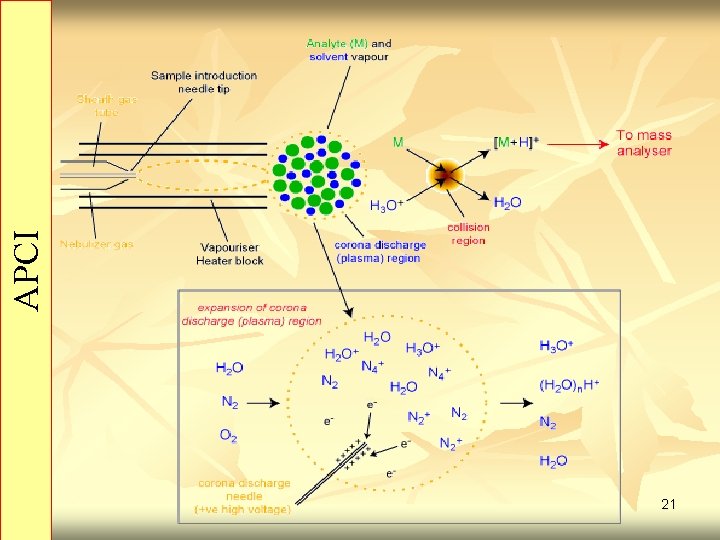
Atmospheric Pressure Chemical Ionisation (APCI) n n It’s based on solvent mediated CI by ion-molecule reactions initiated by electron produced in the Corona discharge needle. Solvent vapor act as reagent gas.
21 APCI
Mass Analyser n n n Linear quadrupole mass analyser Quadrupole – ion trap mass analyser Time of flight Quadrupole - time of flight FT –ICR - MS
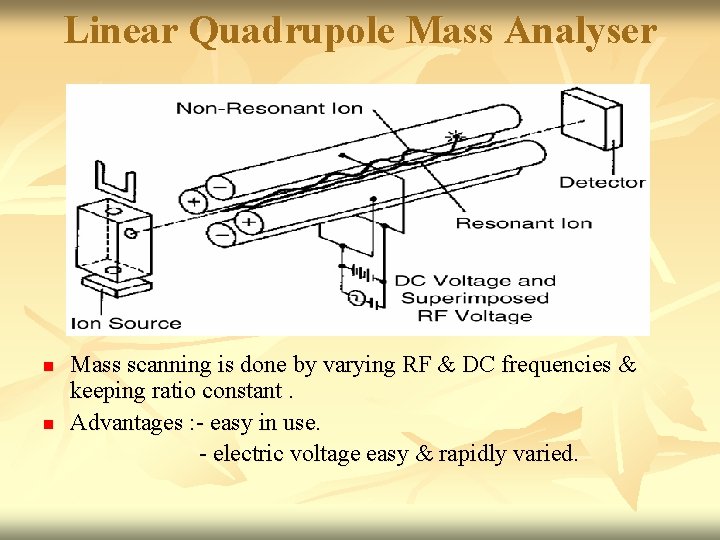
Linear Quadrupole Mass Analyser n n Mass scanning is done by varying RF & DC frequencies & keeping ratio constant. Advantages : - easy in use. - electric voltage easy & rapidly varied.
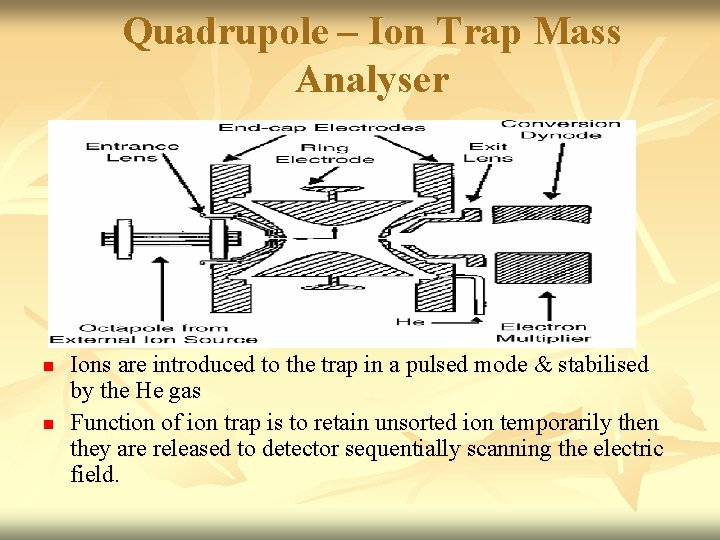
Quadrupole – Ion Trap Mass Analyser n n Ions are introduced to the trap in a pulsed mode & stabilised by the He gas Function of ion trap is to retain unsorted ion temporarily then they are released to detector sequentially scanning the electric field.
Applications n n n n n Quantitative bioanalysis Clinical application – TDM Pharmacokinetic study Drug metabolism Proteomics Analysis of pestisides Drug discovery & drug develpoment Analysis of steroids Food safety analysis Stability testing & impurity profiling
Quantitative Bioanalysis n n Methods for quantitative measurement of a drug, drug metabolites or chemicals in biological fluids. Determination of : Ø Resperine (by ESI or APCI ) Ø Risperidone & 9 -OH Risperidone ( by ESI ) Ø Lovastatin , Simvaststin.
Clinical Application - TDM n n n The ability to accurately measure drug levels in whole blood is vital for effective quantification of drugs. With the help of MS-MS its easy to distinguish parent drug molecule from metabolites by use of molecular mass. Determination of : Ø Sirolimus , Tacrilimus Ø Amphetamines (by LC-APCI-MS) Ø LSD & Cocaine (by LC-ESI-MS)
Pharmacokinetic Studies n n n These studies tell us how quickly a drug will be cleared from the hepatic blood flow, and organs of the body. This is done by detection of the drug in the body matrices such as blood & urine. With the help of MS-MS we can program the detector to select out certain ions to fragment. eg. Cefixime, Adefovir, Zolmitriptan
Drug Metabolism Easier to characterize metabolites (previously difficult task) n Its done by comparing directly the spectra of the drug with those of it’s metabolites. n Common biotransformation (eg. oxidaton, reduction, hydrolysis etc. ) detected from molecular mass of metabolite. n eg. Zolpidem (by ESI ) Quercetin (by ESI) n
Proteomics n n Its the large-scale study of protein, particularly their structures and functions. Important technique : Ø peptide mass fingerprinting(by nano ESI-MS) Ø Peptide sequence analysis – this is not possible by MS, needs MS-MS. Ø accurate mass, affinity or sequence tags(by FT-ICR-MS)
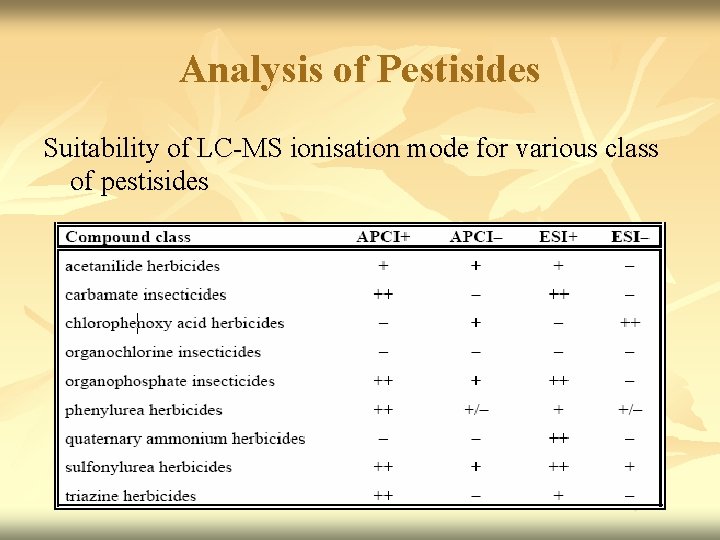
Analysis of Pestisides Suitability of LC-MS ionisation mode for various class of pestisides
Drug Discovery & Drug Development n n n Drug development steps : drug discovery, preclinical development , manufacturing. LC-MS needed in every step, It help in checking proper progress in the synthesis of new chemical entity.
Analysis of Steroids n Doping analysis in sports Ø Detection of Stanozolol , methandrostenolone in equine & human urine by LC-ESI-MS. Ø Detection of testosterone by LC-ESI-MS in Human athletes.
Food Safety Analysis n n LC-MS imp in quantification & confirmation of identity of food contaminants (eg. Sea food) LC-MS of antibiotic & antibacterial compound:
Stability Testing & Impurity Profiling n n In stability testing : to determine the identity, chemical structure of the API and quantification levels as well as presence of degradants, excipients and impurities. eg. determination of degradants in -. Trimethoprim - Artesunate In impurity profiling : detection of minor components in presence of major components. eg. In identification of Polar impurity in mosapride
LC/MS in Clinical Labs n Neonatal screening n n Therapeutic drug monitoring n n Specialist triple quard application To replace immuno assays Drugs of abuse
LC/MS in the Environmental Field n Water n n n Food n n Identification and quantization of pollutants Pesticides, antibiotics chemical contaminants antibiotics natural toxins Animal feeds n contaminants, illegal substances
LC/MS in Other Industries n Organometallics n n Detergents n n structure Quality Control, competitors products Polymers n molecular weight, structure
References Frank Settle. Handbook of Instrumental Techniques for Analytical Chemistry 1 st ed. 647 -659. n Willard, Merritt, Dean, Settle. Instrumental Methods of Analysis. 7 th ed. 618 -620. n Skoog, Holler, Nieman. Principles of Instrumental Analysis, 5 th ed. 1992; 501 -511: 528 -531: 738 -739. n Christian Garry. Analytical Chemistry. 6 th ed. 608 -610 n Wilfried M. A. Niessen. Liquid Chromatography – Mass Spectroscopy. 3 rd ed. 80 -120 , 164 - 180. n J. Flarakos*, W. Luoa, M. Aman, D. Svinarov, Quantification of risperidone and 9 -hydroxyrisperidone in plasmaand saliva from adult and pediatric patients by liquidchromatography–mass spectrometry. Journal of Chromatography A, 1026 (2004) 175– 183 n
References n n n N. Lindeg°ardh a, b*, A. M. Dondorp a, b, P. Singhasivanon a, Validation and application of a liquid chromatographic–mass spectrometric method for determination of artesunate in pharmaceutical samples. Journal of Pharmaceutical and Biomedical Analysis 45 (2007) 149– 153. www. pubmedcentral. nih. gov www. sciencedirect. com www. agilent. com/chem www. waters. com www. interscience. wiley. com