
Principle 9 Grow Leaders Who Thoroughly Understand the

- Slides: 24
Principle 9 Grow Leaders Who Thoroughly Understand the Work, Live the Philosophy, and Teach It to Others
Non Toyota Leaders Vs. Toyota Leaders l l l l Non Toyota leaders were hired from outside to turn around ailing companies. They brought in a group of their own handpicked outside lieutenants to help in the turnaround. They also reorganized and brought their own philosophy and approach to transform the company. None of these leaders naturally progressed through promotions to become presidents and CEO’s at these companies. Whereas, Fujio Cho grew up in Toyota and was a student of Taiichi Ohno. Cho and Ohno provided a theoretical basis for TPS and the Toyota Way Principles in order to tech them throughout the company. Cho moved into the position naturally and built on the momentum that had been ongoing for decades. At Toyota the new president or CEO does not need to come in and take charge to move the company in a radically new direction to put his imprint on the company.
The Principle – Growing Your Leaders Rather than Purchasing Them l l l l The concept of eliminating muri (unevenness) at work at the executive level. Throughout Toyota’s history, key leaders have been found within the company, at the right time, to shape the next step in Toyota’s evolution. Despite major differences in personal style, neither of these leaders deviated from the basic philosophies of the Toyota Way. The Toyoda family has always been there, carefully grooming and selecting the new leaders. Critical element of the Toyota culture is genchi genbutsu, which means deeply observing the actual situation in details, leaders must demonstrate this ability and understand how work gets done at a shop floor level within Toyota expects its leaders to teach their subordinates the Toyota Way, which means they must understand live the philosophy. The efforts leaders make to support the culture year after year so it can create the environment for a learning organisation. The characteristics of Toyota leadership, particularly the drive to meet seemingly impossible targets and the requirements to understand the work by getting your hands dirty, evolved from the leadership of company founders
The Principle – Growing Your Leaders Rather than Purchasing Them l l l l Mentoring More stress on – the – job experience than brilliant theoretical insights. Engaging people towards goals The practice of genchi genbutsu The absolute core of the philosophy is that the culture must support the people doing the work. Commitment of Management towards quality Very clear two priorities – Quality first, Safety first. Extra effort, Extra caring. Customer first philosophy.
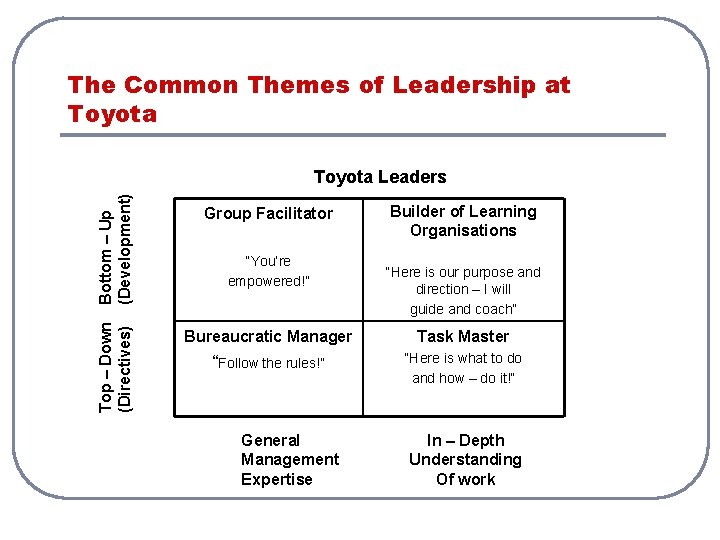
The Common Themes of Leadership at Toyota Top – Down (Directives) Bottom – Up (Development) Toyota Leaders Group Facilitator “You’re empowered!” Builder of Learning Organisations “Here is our purpose and direction – I will guide and coach” Bureaucratic Manager Task Master “Follow the rules!” “Here is what to do and how – do it!” General Management Expertise In – Depth Understanding Of work
The Common Themes of Leadership at Toyota l l l Toyota leaders are passionate about involving people who are doing value – added work in improving the process. “In – depth understanding of the work” in addition to general management expertise. Toyota leaders by having a combination of in depth understanding of the work and the ability to develop, mentor, and lead people, are respected for their technical knowledge as well as followed for their leadership abilities. Toyota leaders seldom give orders. The leader often lead and mentor through questioning Questions will be asked about the situation, and the person’s strategy for action.
Common traits of the great leaders in Toyota’s history. l Focused on a long – term purpose for Toyota as a value added contributor to society. l Never deviated from the percepts of the Toyota way DNA and lived and modeled themselves around this for all to see. l Worked their way up doing the detailed work and continued to go to the gemba – the actual place where the real added – value work is done. l Saw problems as opportunities to train and coach their people.
“Before we build cars, we build people” l l Ø Ø Ø The leader’s goal at Toyota is to develop people so they are strong contributors who can think and follow the TW at all levels in the organisation. The leader’s real challenge is having the long term vision of knowing – what to do, the knowledge of how to do it, and the ability to develop people so they can understand do their job excellently.
“Payoff” l The payoff for this dedication is more profound and lasting to company competitiveness and longevity than l Using a leader merely to solve immediate financial problems, make the correct decision for a given situation, or provide new short term solution to bail a company out of a bad situation.
Principle – 14 Become a Learning Organisation Through Relentless Reflection (Hansei) And Continuous Improvement (Kaizen)
Learning Organisation l l Adaptation, innovation, and flexibility become have become necessary ingredients for survival and hallmarks of successful business. To sustain such organisational behaviour one essential attributes is required: The ability to learn
Learning Organisation – Peter Senge “Where people continually expand their capacity to create the results they truly desire, where new and expansive patterns of thinking are nurtured, where collective aspiration is set free, and where people are continually learning how to learn together”.
Learning Organisation l l Senge focuses on “new pattern of thinking” and learning to learn. A learning organisation does not only adopt and develop new business or technical skills; it puts in place a second level of learning – how to learn new skills, knowledge, and capabilities.
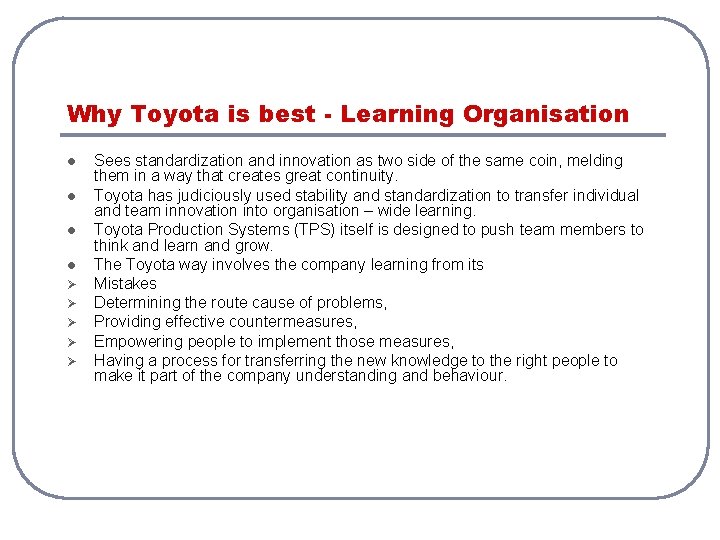
Why Toyota is best - Learning Organisation l l Ø Ø Ø Sees standardization and innovation as two side of the same coin, melding them in a way that creates great continuity. Toyota has judiciously used stability and standardization to transfer individual and team innovation into organisation – wide learning. Toyota Production Systems (TPS) itself is designed to push team members to think and learn and grow. The Toyota way involves the company learning from its Mistakes Determining the route cause of problems, Providing effective countermeasures, Empowering people to implement those measures, Having a process for transferring the new knowledge to the right people to make it part of the company understanding and behaviour.
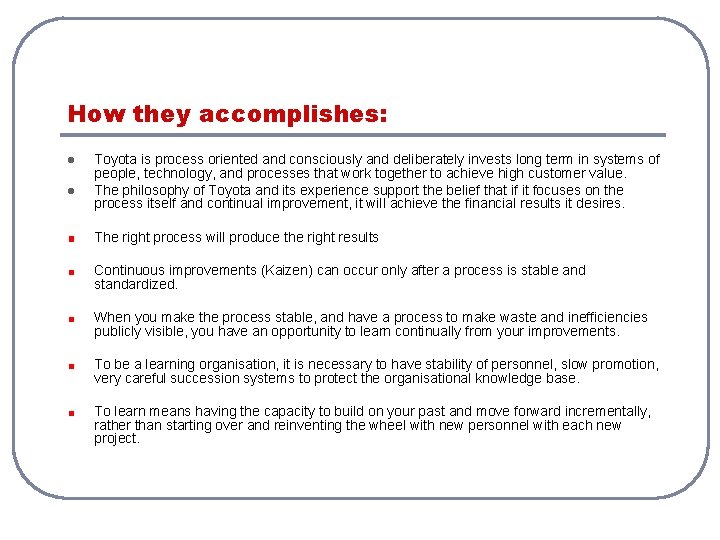
How they accomplishes: l l Toyota is process oriented and consciously and deliberately invests long term in systems of people, technology, and processes that work together to achieve high customer value. The philosophy of Toyota and its experience support the belief that if it focuses on the process itself and continual improvement, it will achieve the financial results it desires. The right process will produce the right results Continuous improvements (Kaizen) can occur only after a process is stable and standardized. When you make the process stable, and have a process to make waste and inefficiencies publicly visible, you have an opportunity to learn continually from your improvements. To be a learning organisation, it is necessary to have stability of personnel, slow promotion, very careful succession systems to protect the organisational knowledge base. To learn means having the capacity to build on your past and move forward incrementally, rather than starting over and reinventing the wheel with new personnel with each new project.
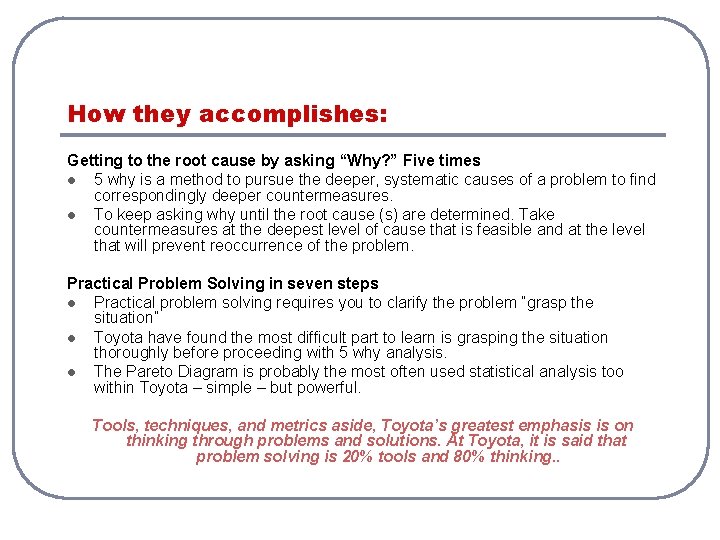
How they accomplishes: Getting to the root cause by asking “Why? ” Five times l 5 why is a method to pursue the deeper, systematic causes of a problem to find correspondingly deeper countermeasures. l To keep asking why until the root cause (s) are determined. Take countermeasures at the deepest level of cause that is feasible and at the level that will prevent reoccurrence of the problem. Practical Problem Solving in seven steps l Practical problem solving requires you to clarify the problem “grasp the situation” l Toyota have found the most difficult part to learn is grasping the situation thoroughly before proceeding with 5 why analysis. l The Pareto Diagram is probably the most often used statistical analysis too within Toyota – simple – but powerful. Tools, techniques, and metrics aside, Toyota’s greatest emphasis is on thinking through problems and solutions. At Toyota, it is said that problem solving is 20% tools and 80% thinking. .
How they accomplishes: Hansei: Responsibility , Self – Reflection, and Organisational Learning. Teamwork never overshadows individual accountability at Toyota. Individual accountability is not about blame & punishment, but about learning and growing.
Hansei: l l A key to learning & growing, not only within Toyota but in Japanese culture, is hansei, which roughly means “reflection” it is an integral ingredient in Toyota’s organisational learning. Without hansei it is impossible to do Kaizen. In Japanese hansei, when you do something wrong, at first you must feel really, really sad. Then you must create a future plan to solve that problem and you must sincerely believe you will never make this type of mistake again. Hansei is a mindset, an attitude. Hansei and Kaizen go hand in hand. . There is another term called Hansei – Kai (reflection meeting) Hansei is not simply a philosophical belief system at Toyota, but a practical tool for improvement.
Process vs. Results Orientation: The Role of Metrics: l 1. 2. 3. Toyota measures processes everywhere on the factory floor, but prefers simple metrics and does not use many of them at plant level. There at least 3 types of measures at Toyota: Global performance measures – how is company doing? (Financial, quality, safety measures) Operational performance measures – how is the plant or department doing? Stretch improvement metrics – how is the business unit or work group doing? Global metrics, developing standards is not a high priority at Toyota. They do it as simple as possible. More important to them are the metrics driving problem solving and supporting their process orientation.
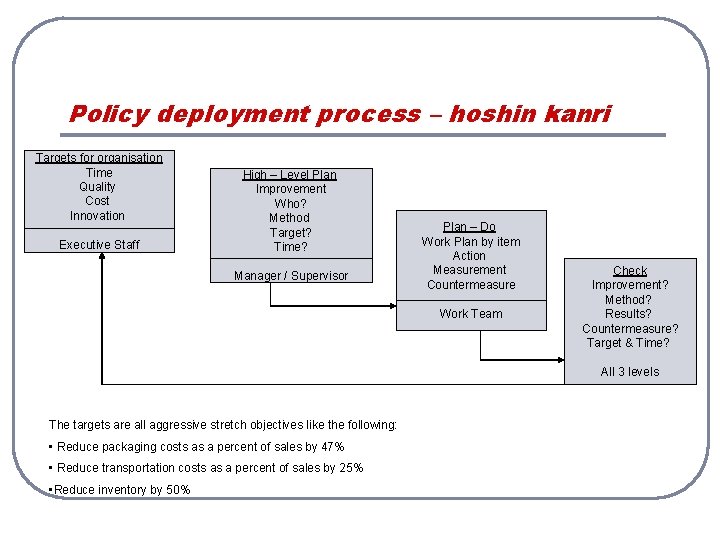
Hoshin Kanri – Directing and Motivating Organisational learning: l l l Toyota managers have become masterful at setting challenging goals jointly with their subordinates and are passionate about measurement and feedback. Hoshin Kanri – policy deployment is Toyota’s process of cascading objectives from the top of the company down to the work group level. Aggressive goals starts at the executive levels and then each level in turn develops measurable objectives for the year, designed to support the executive level.
Policy deployment process – hoshin kanri Targets for organisation Time Quality Cost Innovation Executive Staff High – Level Plan Improvement Who? Method Target? Time? Manager / Supervisor Plan – Do Work Plan by item Action Measurement Countermeasure Work Team Check Improvement? Method? Results? Countermeasure? Target & Time? All 3 levels The targets are all aggressive stretch objectives like the following: • Reduce packaging costs as a percent of sales by 47% • Reduce transportation costs as a percent of sales by 25% • Reduce inventory by 50%
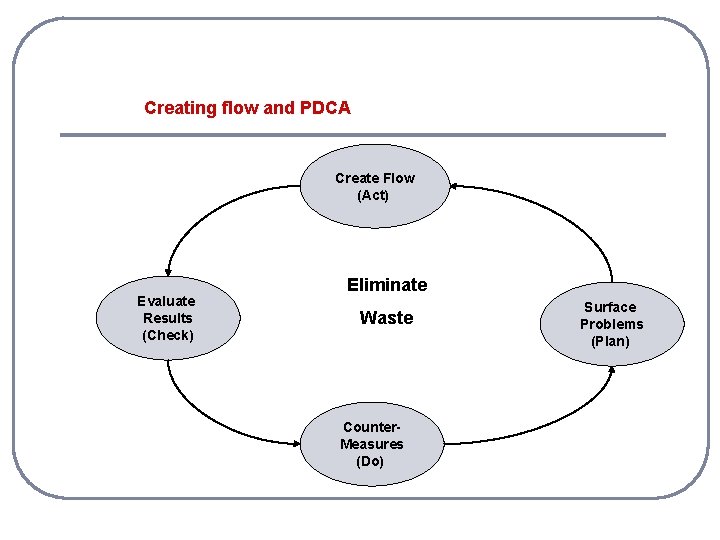
Creating a Learning Organisation is a Long Term Journey l l l Moving people from firefighting and short term fixes to long term improvements by adapting Toyota principle 14: Become a learning organisation through relentless reflection (hansei) and continuous improvement (Kaizen) is an on going process at Toyota Production System itself embodies the learning cycle of Plan Do Check Act (PDCA) The cycle relates to creating flow, surfacing problems, creating countermeasures, and evaluating results.
Creating flow and PDCA Create Flow (Act) Evaluate Results (Check) Eliminate Waste Counter. Measures (Do) Surface Problems (Plan)
13 Tips for transitioning to a lean enterprise: • Start with action in the technical systems: follow quickly with cultural change • Learn by doing first and training second • Start with value stream pilots to demonstrate lean as a system and provide a “go see” model • Use value stream mapping to develop future state visions and help “learn to see” • Use Kaizen workshops to teach and make rapid changes. • Organize around value streams. • Make it mandatory • Be opportunistic in identifying opportunities for big financial impacts • Realign metrics with a value stream perspective • Build on your company’s roots to develop your own way • Hire or develop lean leaders and develop a succession system • Use experts for teaching and getting quick results.