
Principal Mining Hazard Roads and Other Vehicles Operating





- Slides: 37
Principal Mining Hazard : Roads and Other Vehicles Operating Areas April 2017
The Mining and Quarrying Occupational Health and Safety Committee Promoting Work Health and Safety in the Workplace This workplace industry safety presentation is developed and fully funded by the Mining and Quarrying Occupational Health and Safety Committee (MAQOHSC). ISBN 978 -1 -925361 -46 -9 2
Disclaimer 3 § IMPORTANT: The information in this presentation is of a general nature, and should not be relied upon as individual professional advice. If necessary, legal advice should be obtained from a legal practitioner with expertise in the field of Work Health and Safety law (SA). § Although every effort has been made to ensure that the information in this presentation is complete, current and accurate, the Mining and Quarrying Occupational Health and Safety Committee, any agent, author, contributor or the South Australian Government, does not guarantee that it is so, and the Committee accepts no responsibility for any loss, damage or personal injury that may result from the use of any material which is not complete, current and accurate. § Users should always verify historical material by making and relying upon their own separate inquiries prior to making any important decisions or taking any action on the basis of this information.
Creative Commons This creative commons licence allows you to copy, communicate and or adapt our work for non-commercial purposes only, as long as you attribute the work to Mining and Quarrying Occupational Health and Safety Committee and abide by all the other licence terms therein. 4
What is a Principal Mining Hazard? Regulation 612 of the Work Health and Safety Regulations 2012 (SA), defines a Principal Mining Hazard (PMH) as any: § activity, process, procedure § plant, structure, substance § situation § other circumstance relating to the carrying out of mining operations that has a reasonable potential to result in multiple deaths in a single incident or a series of recurring incidents. Additionally, Regulation 612 identifies ‘roads and other vehicle operating areas’ as a principal mining hazard. 5
Identification and Assessment of PMHs Regulation 627 states, a mine operator must identify all principal mining hazards at the mine and conduct a risk assessment that: § involves a comprehensive and systematic investigation and analysis of all aspects of risk with the PMH § uses appropriate investigation and analysis methods § considers the PMH individually and its interaction with other PMHs and hazards at the mine, and develops control measures. In assessing a PMH, consideration must be given to the additional criteria outlined in Schedule 19 of the Work Health and Safety Regulations 2012 (SA). 6
Consultation Work Health and Safety legislation states, a mine operator must also consult with all personnel working at the mine / quarry and give them opportunity to contribute in the: § identification and assessment of principal mining hazards § development of principal mining hazard management plans (PMHMPs). Consultation shall also take place with: § the health and safety committee and elected health and safety representatives (HSRs). Note: Where a committee and HSRs are not in place, the workforce can be consulted via toolbox meetings. 7
Schedule 19 - Additional Criteria Under Schedule 19 of the Work Health and Safety Regulations 2012 (SA), the following matters must be considered in developing the control measures to manage the risks associated with roads and other vehicle operating areas: 8 § Mobile plant characteristics, including stopping distances, manoeuvrability, operating speeds, driver position, driver line of sight and remote controlled mobile plant § The effect on road conditions of expected environmental conditions during operating periods, including time of day, weather, temperature and visibility § The impact of road design and characteristics, including grade, camber, surface, radius of curves and intersections § The impact of mine design, including banks and steep drops adjacent to vehicle operating areas
Schedule 19 - Additional Criteria Continued… 9 § The volume and speed of traffic and the potential for interactions between mobile plant with different operating characteristics, including heavy and light vehicles § The potential for interactions between mobile plant and pedestrians, including consideration of park up areas and driver access § The potential for interaction between mining mobile plant and public traffic § The potential for interaction between mobile plant and fixed structures, including overhead and underground power lines, tunnel walls and roofs.
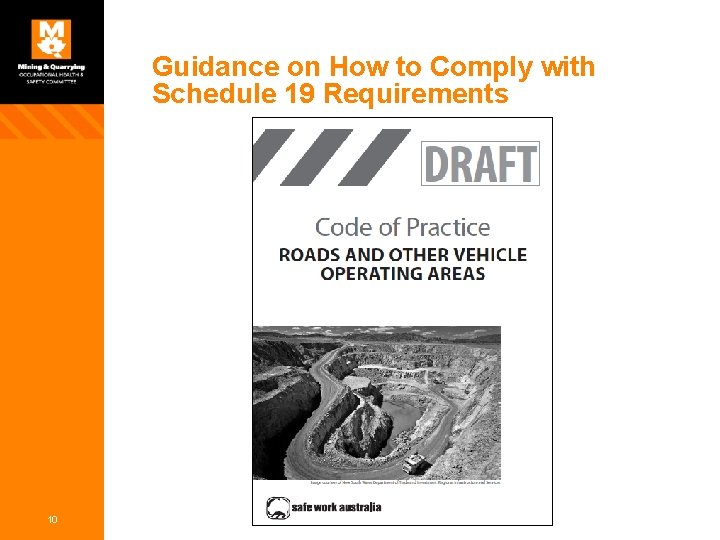
Guidance on How to Comply with Schedule 19 Requirements 10
Guidance on How to Comply with Schedule 19 Requirements The Draft Code of Practice for Roads and other Operating Areas from Safe Work Australia looks at the following areas: § Design § § § § § 11 Construction and Maintenance Separation and Segregation of Vehicles and Pedestrians Restricted Access Exclusion Zones Vehicle Selection Communications Lighting Traffic Rules Signage Training Inspections and Monitoring.
Design Identifies the following areas to consider: 12 § Terrain and geotechnical considerations § Prevailing weather and environmental conditions § Primary and secondary roads design, construction and maintenance § Road widths and gradients § Road curvature – vertical and horizontal § Sight and stopping distance § Road surface, drainage and edge protection § Intersections § Parking areas § Overhead powerlines and structures § Dumps and pads § Workshops and fixed plant areas § Runaway vehicle provisions.
Construction and Maintenance Identifies the following areas to consider: 13 § Strength of the in-situ material used on roadways and surfaces § Wearing course or sheeting - choosing a material that will provide adequate wear and friction in the environment it is exposed to § Inspection and maintenance of its surface and drainage § Dust control - method of watering.
Separation and Segregation of Vehicles and Pedestrians Identifies the following areas to consider: 14 § Interaction with mobile equipment and pedestrians § Interaction with light and heavy mobile equipment § Unauthorised access to operational areas including loading areas, dumps and stockpiles, workshops and plant areas and designated parking areas within these zones § Communication rules between mobile equipment / mobile equipment and mobile equipment / pedestrians § Use of engineering controls for collision avoidance.
Restricted Access / Exclusion Zones Identifies the following areas to consider: 15 § ROM - run of mine, what material is being produced § Stockpiles and waste dumps § Drill pads § Blast pads § Haul roads § Workshops and plant areas § Stopes or unventilated areas.
High Wall Drop Zones Identifies the following areas to consider: 16 § Haul roads located alongside high walls § Wall stability, weathing and effects of water over time § Rock falls, open joints, water damage, or overhangs § Unstable material § Restricted areas.
Remotely Operated Mobile Equipment Locations Identifies the following areas to consider: 17 § Selection and maintenance of the remotely controlled equipment § Training and assessment of the operators § Establishment of procedures and standard work instructions § Restricted access to equipment operating areas § Communication requirements § Separation of operators and remote control equipment whilst it is operating in remote locations.
Vehicle Selection Identifies the following areas to consider: 18 § Existing or planned road layout and conditions on site § Selected vehicles operate within their design specifications and capabilities § Drivers / operators competencies.
Communications Identifies the following areas to consider: 19 § Communication systems § Other persons operating on roads § Communicate with each other and reporting hazards or other issues § Induction and refresher training § Radio communications policies and rules § Consistent signage § Managing changed conditions.
Lighting Identifies the following areas to consider: 20 § Nature and type of activities being undertaken § Types of vehicles involved § Speed the vehicles will be travelling § When or where pedestrians will be encountered § Suitable lighting on vehicles such as background lighting to avoid long shadows § Use of lighting towers in operating areas § Provision of lighting in areas where pedestrians are present.
Traffic Rules Identifies the following areas to consider: 21 § Site road layout, operating speeds and traffic flows § Right of way and signage § Vehicle operating requirements § Overtaking, parking and breakdown procedures § Radio communications § Restricted area requirements, for example, dumps, stockpiles, park bays, overhead powerlines and obstructions § Equipment separation distances and pedestrians.
Signage Identifies the following areas to consider: 22 § Traffic sign visibility § Easy to understand § Positioned so that people have sufficient time to identify, read and react to the sign § Consistent with signage used on public roads § Maintained to ensure that they remain visible at all times and are still relevant.
Training Identifies the following areas to consider: 23 § Induction training which includes site traffic and road rules § Specific equipment operator training § Training in road construction and maintenance.
Inspections and Monitoring Identifies the following areas to consider: 24 § Establishing system of regular inspection and monitoring § Review of effectiveness of training provided § Pre-start inspections of equipment by operators § Regular routine equipment maintenance § Workplace inspections and monitoring of compliance by supervisors § Regular inspection and maintenance of roads, signage and traffic controls.
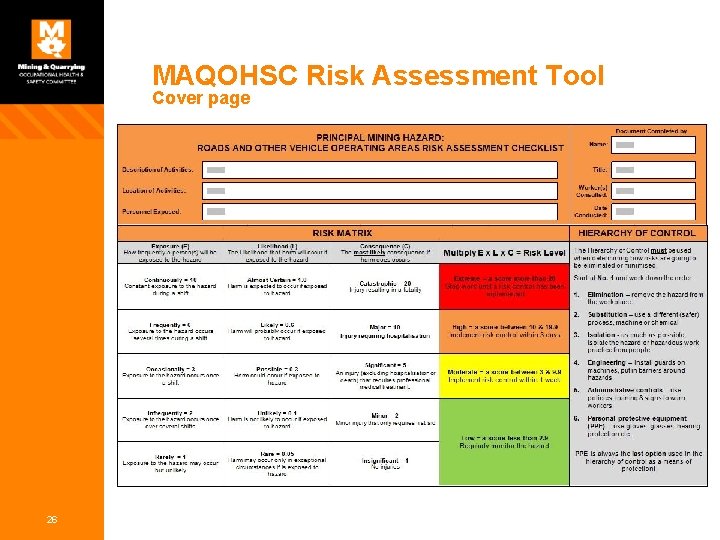
MAQOHSC PMH Risk Assessment Tool MAQOHSC has developed a specific risk assessment checklist tool to assist industry in managing principal mining hazards for roads and other vehicle operating areas. The tool is based on the requirements and criteria from the Draft Code of Practice - Roads and Other Operating Areas issued by Safe. Work Australia. The tool: 25 § Covers all the elements of the Draft Code of Practice and provides a comprehensive series of questions to identify hazards and to assess risks § Contains a risk matrix and hierarchy of control § Captures the level of risk before and after controls have been implemented § Provides an area to document the findings on hazards and associated risks § Provides an area to document principal mining hazard control measures.
MAQOHSC Risk Assessment Tool Cover page 26
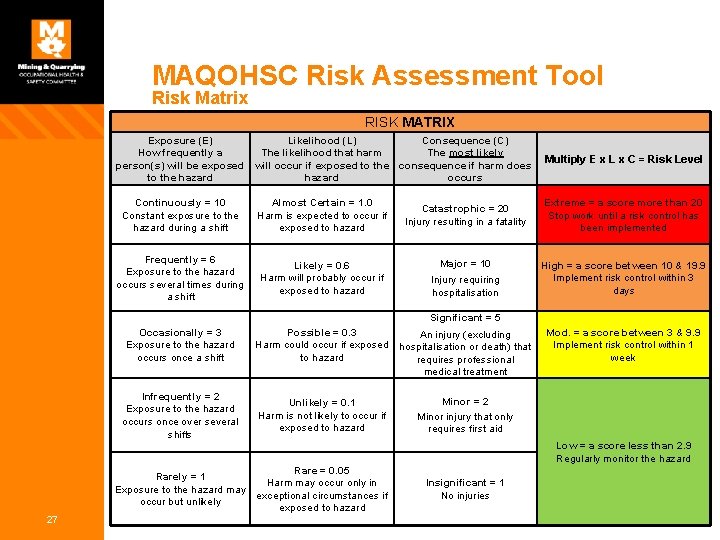
MAQOHSC Risk Assessment Tool Risk Matrix RISK MATRIX Exposure (E) Likelihood (L) Consequence (C) How frequently a The likelihood that harm The most likely Multiply E x L x C = Risk Level person(s) will be exposed will occur if exposed to the consequence if harm does to the hazard occurs Continuously = 10 Constant exposure to the hazard during a shift Almost Certain = 1. 0 Harm is expected to occur if exposed to hazard Frequently = 6 Exposure to the hazard occurs several times during a shift Likely = 0. 6 Harm will probably occur if exposed to hazard Occasionally = 3 Exposure to the hazard occurs once a shift Infrequently = 2 Exposure to the hazard occurs once over several shifts Catastrophic = 20 Injury resulting in a fatality Major = 10 Injury requiring hospitalisation Significant = 5 Possible = 0. 3 An injury (excluding Harm could occur if exposed hospitalisation or death) that to hazard requires professional medical treatment Unlikely = 0. 1 Harm is not likely to occur if exposed to hazard Extreme = a score more than 20 Stop work until a risk control has been implemented High = a score between 10 & 19. 9 Implement risk control within 3 days Mod. = a score between 3 & 9. 9 Implement risk control within 1 week Minor = 2 Minor injury that only requires first aid Low = a score less than 2. 9 Regularly monitor the hazard Rare = 0. 05 Rarely = 1 Harm may occur only in Exposure to the hazard may exceptional circumstances if occur but unlikely exposed to hazard 27 Insignificant = 1 No injuries
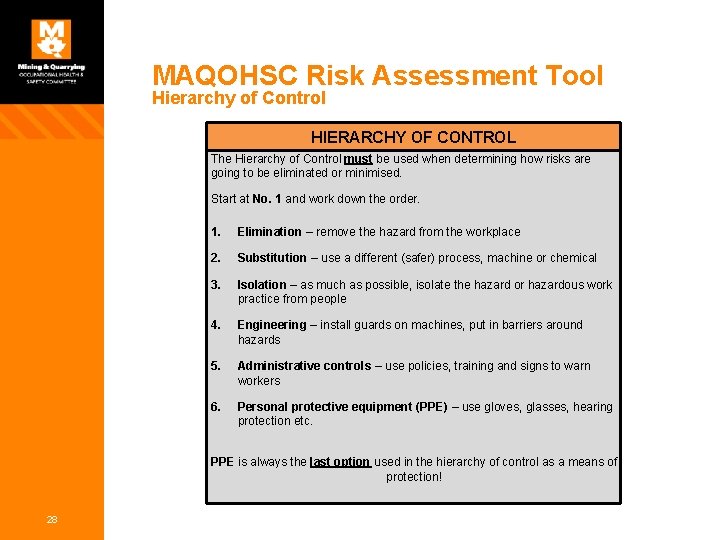
MAQOHSC Risk Assessment Tool Hierarchy of Control HIERARCHY OF CONTROL The Hierarchy of Control must be used when determining how risks are going to be eliminated or minimised. Start at No. 1 and work down the order. 1. Elimination – remove the hazard from the workplace 2. Substitution – use a different (safer) process, machine or chemical 3. Isolation – as much as possible, isolate the hazard or hazardous work practice from people 4. Engineering – install guards on machines, put in barriers around hazards 5. Administrative controls – use policies, training and signs to warn workers 6. Personal protective equipment (PPE) – use gloves, glasses, hearing protection etc. PPE is always the last option used in the hierarchy of control as a means of protection! 28
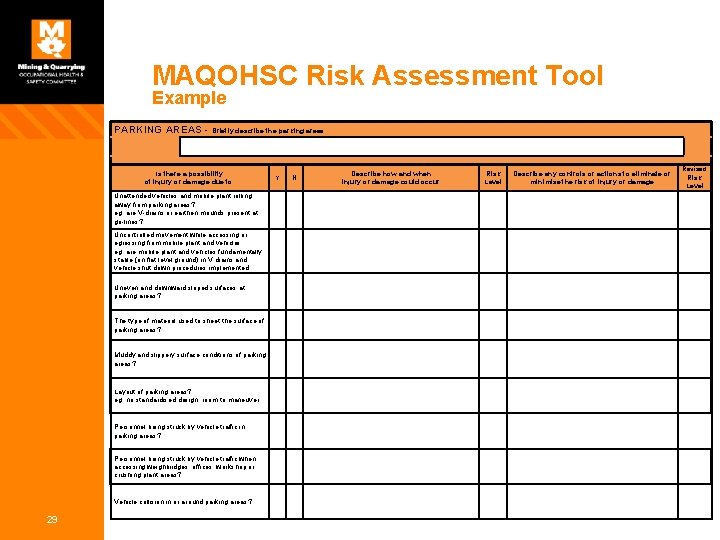
MAQOHSC Risk Assessment Tool Example PARKING AREAS - Briefly describe the parking areas Is there a possibility of injury or damage due to: Describe how and when injury or damage could occur N Risk Level Describe any controls or actions to eliminate or minimise the risk of injury or damage Revised Risk Level Unattended vehicles and mobile plant rolling away from parking areas? eg, are V-drains or earthen mounds present at go-lines? Uncontrolled movement while accessing or egressing from mobile plant and vehicles. eg, are mobile plant and vehicles fundamentally stable (on flat level ground) in V drains and vehicle shut down procedures implemented. Uneven and downward sloped surfaces at parking areas? The type of material used to sheet the surface of parking areas? Muddy and slippery surface conditions of parking areas? Layout of parking areas? eg, no standardised design, room to maneuver. Personnel being struck by vehicle traffic in parking areas? Personnel being struck by vehicle traffic when accessing weighbridges, offices, workshop or crushing plant areas? Vehicle collision in or around parking areas? 29 Y
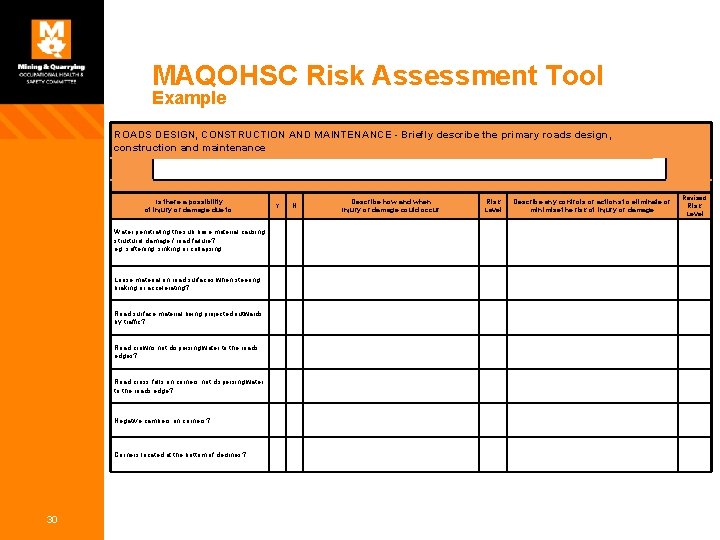
MAQOHSC Risk Assessment Tool Example ROADS DESIGN, CONSTRUCTION AND MAINTENANCE - Briefly describe the primary roads design, construction and maintenance Is there a possibility of injury or damage due to: 30 Y Describe how and when Injury or damage could occur N Risk Level Describe any controls or actions to eliminate or minimise the risk of injury or damage Revised Risk Level Water penetrating the sub base material causing structural damage / road failure? eg, softening, sinking or collapsing. Loose material on road surfaces when steering, braking or accelerating? Road surface material being projected outwards by traffic? Road crowns not dispersing water to the roads edges? Road cross falls on corners not dispersing water to the roads edge? Negative cambers on corners? Corners located at the bottom of declines?
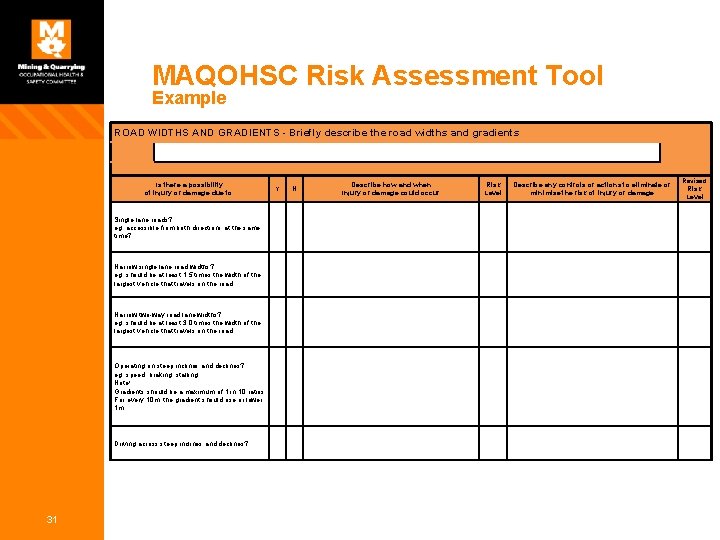
MAQOHSC Risk Assessment Tool Example ROAD WIDTHS AND GRADIENTS - Briefly describe the road widths and gradients Is there a possibility of injury or damage due to: 31 Y Describe how and when Injury or damage could occur N Risk Level Describe any controls or actions to eliminate or minimise the risk of injury or damage Revised Risk Level Single lane roads? eg, accessible from both directions at the same time? Narrow single lane road widths? eg, should be at least 1. 5 times the width of the largest vehicle that travels on the road. Narrow two-way road lane widths? eg, should be at least 3. 0 times the width of the largest vehicle that travels on the road. Operating on steep inclines and declines? eg, speed, braking, stalling Note! Gradients should be a maximum of 1 in 10 ratios. For every 10 m, the gradient should rise or lower 1 m. Driving across steep inclines and declines?
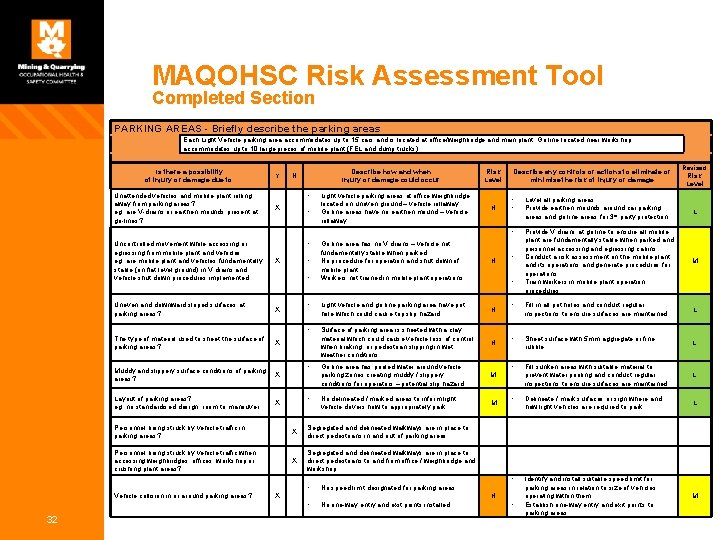
MAQOHSC Risk Assessment Tool Completed Section PARKING AREAS - Briefly describe the parking areas Each Light Vehicle parking area accommodates up to 15 cars and is located at office/weighbridge and main plant, Go line located near workshop accommodates up to 10 large pieces of mobile plant (FEL and dump trucks) Is there a possibility of injury or damage due to: Unattended vehicles and mobile plant rolling away from parking areas? eg, are V-drains or earthen mounds present at go-lines? Describe how and when Injury or damage could occur N • X • • Uncontrolled movement while accessing or egressing from mobile plant and vehicles. eg, are mobile plant and vehicles fundamentally stable (on flat level ground) in V drains and vehicle shut down procedures implemented. X Uneven and downward sloped surfaces at parking areas? X The type of material used to sheet the surface of parking areas? X Muddy and slippery surface conditions of parking areas? X Layout of parking areas? eg, no standardised design, room to manouver X • • Light vehicle parking areas at office weighbridge located on uneven ground – vehicle rollaway Go line areas have no earthen mound – vehicle rollaway Go line area has no V drains – vehicle not fundamentally stable when parked No procedure for operation and shut down of mobile plant Workers not trained in mobile plant operations Risk Level H H Light vehicle and go line parking area have pot hole which could cause trip slip hazard • Surface of parking area is sheeted with a clay material which could cause vehicle loss of control when braking or pedestrian slipping in wet weather conditions H Go line area has pooled water around vehicle parking zones creating muddy / slippery conditions for operators – potential slip hazard M No delineated / marked areas to inform light vehicle drivers how to appropriately park M • • X Segregated and delineated walkways are in place to direct pedestrians in and out of parking areas Personnel being struck by vehicle traffic when accessing weighbridges, offices, workshop or crushing plant areas? X Segregated and delineated walkways are in place to direct pedestrians to and from office / weighbridge and workshop • No speed limit designated for parking areas • No one-way entry and exit points installed X Describe any controls or actions to eliminate or minimise the risk of injury or damage H Revised Risk Level • • Level all parking areas Provide earthen mounds around car parking areas and go line areas for 3 rd party protection • Provide V drains at go line to ensure all mobile plant are fundamentally stable when parked and personnel accessing and egressing cabins Conduct a risk assessment on the mobile plant and its operations and generate procedures for operations Train workers in mobile plant operation procedures M • Fill in all pot holes and conduct regular inspections to ensure surfaces are maintained L • Sheet surface with 5 mm aggregate or fine rubble L • Fill sunken areas with suitable material to prevent water pooling and conduct regular inspections to ensure surfaces are maintained L • • • Personnel being struck by vehicle traffic in parking areas? Vehicle collision in or around parking areas? 32 Y L • Delineate / mark surfaces or sign where and how light vehicles are required to park L • Identify and install suitable speed limit for parking areas in relation to size of vehicles operating within them Establish one-way entry and exit points to parking areas M H •
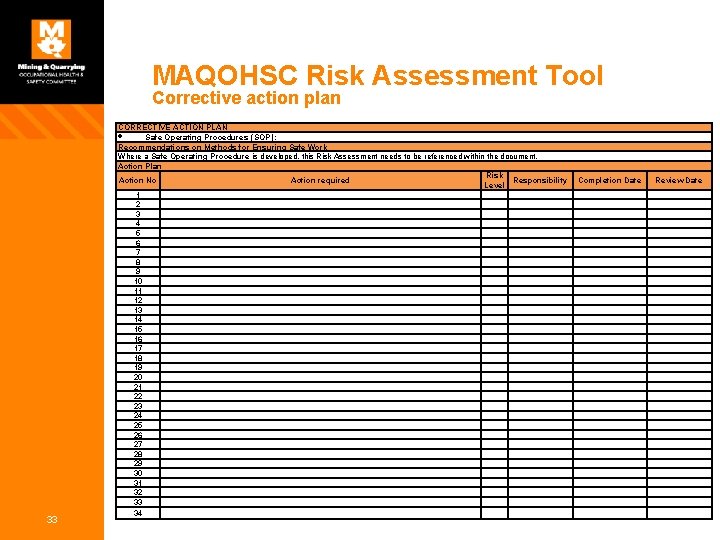
MAQOHSC Risk Assessment Tool Corrective action plan 33 CORRECTIVE ACTION PLAN Safe Operating Procedures (SOP): Recommendations on Methods for Ensuring Safe Work Where a Safe Operating Procedure is developed, this Risk Assessment needs to be referenced within the document. Action Plan Risk Action No Action required Responsibility Level 1 2 3 4 5 6 7 8 9 10 11 12 13 14 15 16 17 18 19 20 21 22 23 24 25 26 27 28 29 30 31 32 33 34 Completion Date Review Date
Preparation of Principal Mining Hazard Management Plans A Principal Mining Hazard Management Plan (PMHMP) must: 34 § Provide for the management of all aspects of risk control in relation to the relevant principal mining hazard § Be set out and expressed in a way that is readily accessible and understandable to all persons who use it.
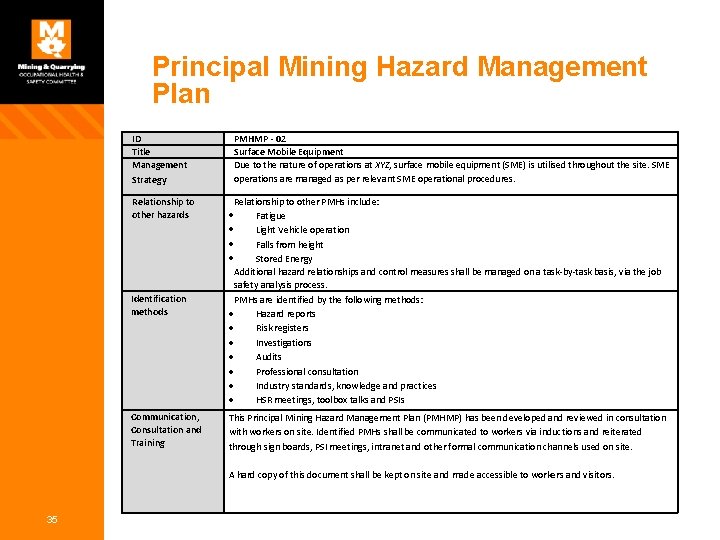
Principal Mining Hazard Management Plan ID Title Management Strategy Relationship to other hazards Identification methods Communication, Consultation and Training 35 PMHMP - 02 Surface Mobile Equipment Due to the nature of operations at XYZ, surface mobile equipment (SME) is utilised throughout the site. SME operations are managed as per relevant SME operational procedures. Relationship to other PMHs include: Fatigue Light Vehicle operation Falls from height Stored Energy Additional hazard relationships and control measures shall be managed on a task-by-task basis, via the job safety analysis process. PMHs are identified by the following methods: Hazard reports Risk registers Investigations Audits Professional consultation Industry standards, knowledge and practices HSR meetings, toolbox talks and PSIs This Principal Mining Hazard Management Plan (PMHMP) has been developed and reviewed in consultation with workers on site. Identified PMHs shall be communicated to workers via inductions and reiterated through sign boards, PSI meetings, intranet and other formal communication channels used on site. A hard copy of this document shall be kept on site and made accessible to workers and visitors.
Review of Principal Mining Hazard Management Plans The mine operator of a mine / quarry must ensure that any Management Plan developed for a Principal Mining Hazard: 36 § Is reviewed on a regular basis § As necessary, revised if a risk control measure specified in the plan is revised under Regulation 38 or Regulation 618 of the Work Health and Safety Regulations 2012 (SA).
Further Assistance MAQOHSC Work Health and Safety Specialists are available to provide further on-site support and assistance on all Work Health and Safety matters. MAQOHSC Work Health and Safety Specialists can be contacted via our online support request form available on our website at www. maqohsc. sa. gov. au or email maqohsc@sa. gov. au. Work Health and Safety Legislation, Codes of Practice, fact sheets, Health and Safety Representatives (HSR) information and guides can be found at the following websites: Safe. Work SA – www. safework. sa. gov. au or call 1300 365 255 Safe Work Australia – www. safeworkaustralia. gov. au or call 1300 551 832 37