
Princess Sumaya University for Technology Computing Sciences Research

- Slides: 18
Princess Sumaya University for Technology Computing Sciences Research Center Comparative study of word embeddings models and their usage in Arabic language applications Dima Suleiman Prof. Arafat Awajan 29 -11 -2018
About the Presenter • Dima Suleiman • Education: – Ph. D. Computer Science, Deep Learning, NLP (2015 -) – MSc. Computer Science (2002 -2004) – BSc. Computer Science(1998 -2002) • Contact: – Dima. suleiman@ju. edu. jo – Dimah_1999@yahoo. com PSUT © 2017 Computing Sciences Research Center 2
Agenda Ø Introduction Ø Overview of word embeddings models o Word 2 vec Model o Global Vectors for Word Representation(Glove) Model Ø Word embeddings uses in Arabic NLP Ø Evaluation and pre-trained word embeddings Ø Discussions and Conclusion Computing Sciences Research Center 3
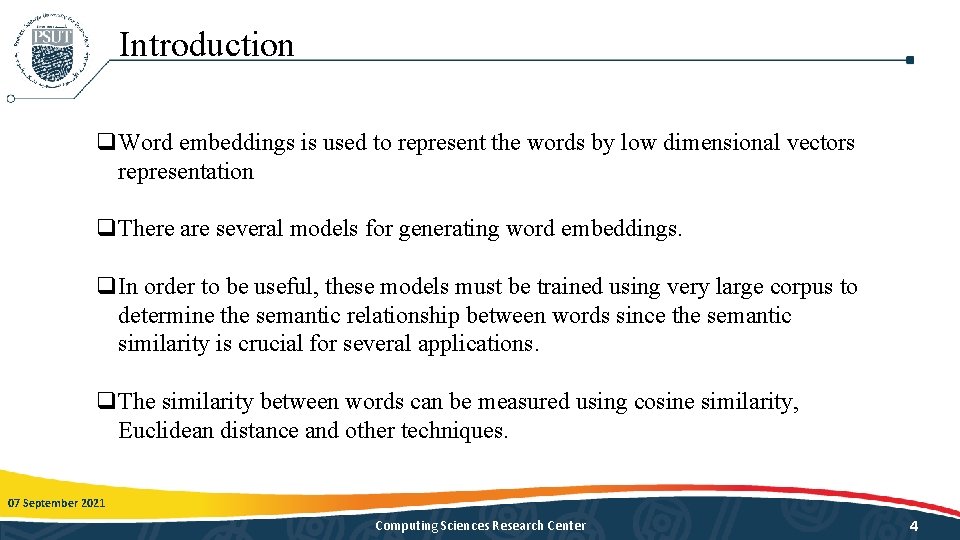
Introduction q. Word embeddings is used to represent the words by low dimensional vectors representation q. There are several models for generating word embeddings. q. In order to be useful, these models must be trained using very large corpus to determine the semantic relationship between words since the semantic similarity is crucial for several applications. q. The similarity between words can be measured using cosine similarity, Euclidean distance and other techniques. 07 September 2021 Computing Sciences Research Center 4
Overview of word embeddings models q Word 2 vec consists of two approaches: Ø Continuous Bag-of-Words Model (CBOW) Ø Continuous Skip-gram Model (Skip-gram) q Global Vectors for Word Representation(Glove) Model 07 September 2021 Computing Sciences Research Center 5
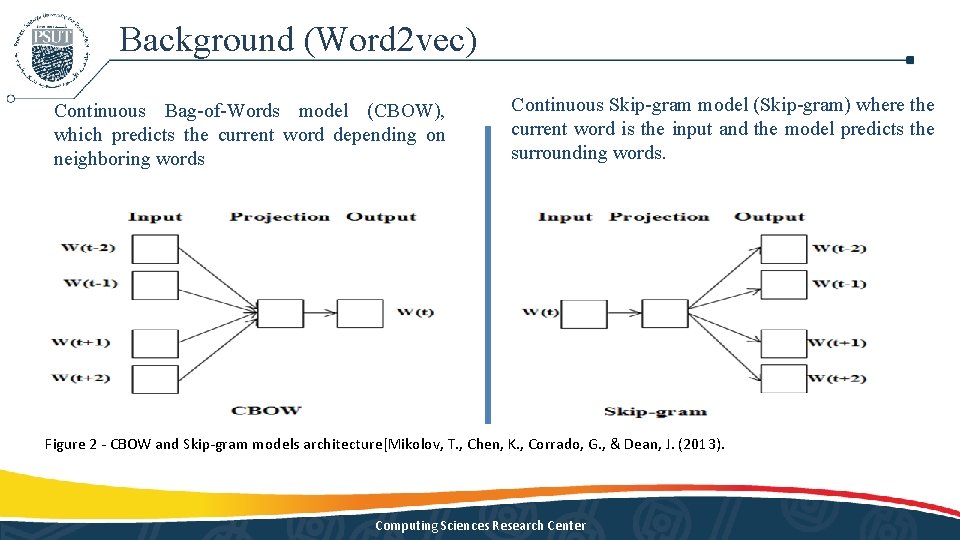
Background (Word 2 vec) Continuous Bag-of-Words model (CBOW), which predicts the current word depending on neighboring words Continuous Skip-gram model (Skip-gram) where the current word is the input and the model predicts the surrounding words. Figure 2 - CBOW and Skip-gram models architecture[Mikolov, T. , Chen, K. , Corrado, G. , & Dean, J. (2013). Computing Sciences Research Center 6
Which model is better? Computing Sciences Research Center
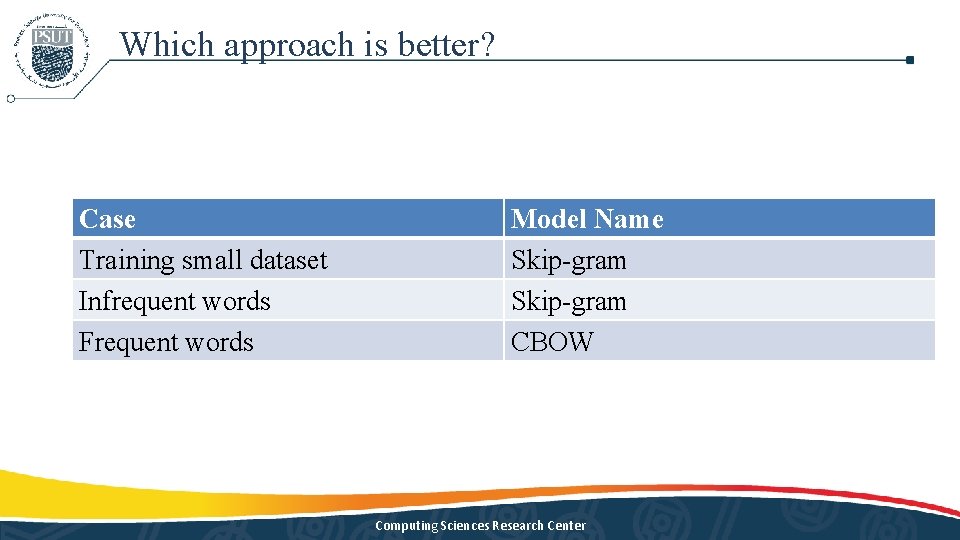
Which approach is better? Case Training small dataset Infrequent words Frequent words Model Name Skip-gram CBOW Computing Sciences Research Center
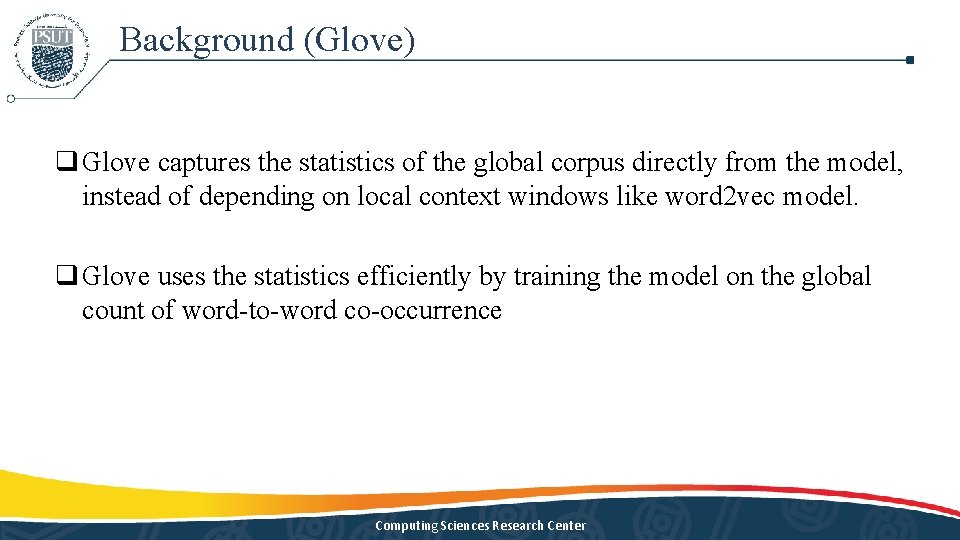
Background (Glove) q Glove captures the statistics of the global corpus directly from the model, instead of depending on local context windows like word 2 vec model. q Glove uses the statistics efficiently by training the model on the global count of word-to-word co-occurrence Computing Sciences Research Center
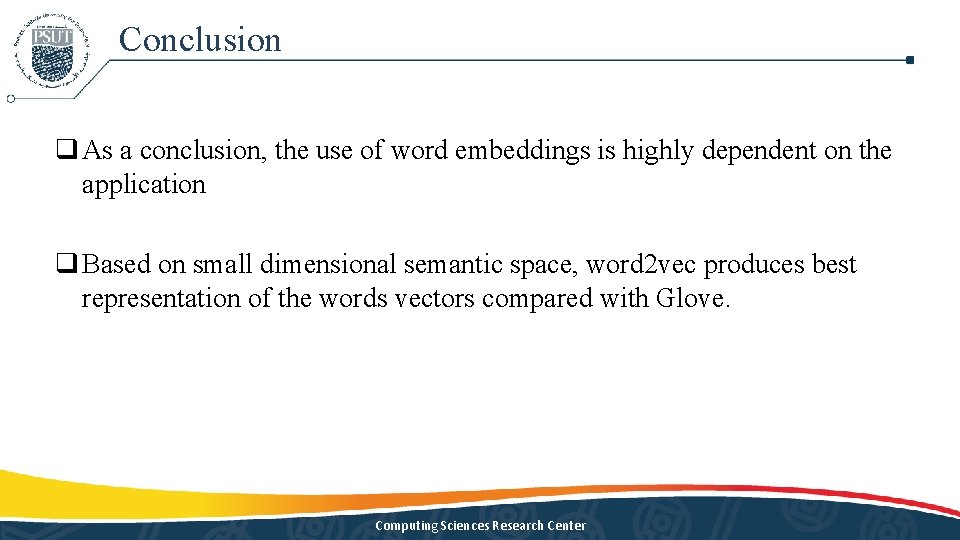
Conclusion q As a conclusion, the use of word embeddings is highly dependent on the application q Based on small dimensional semantic space, word 2 vec produces best representation of the words vectors compared with Glove. Computing Sciences Research Center
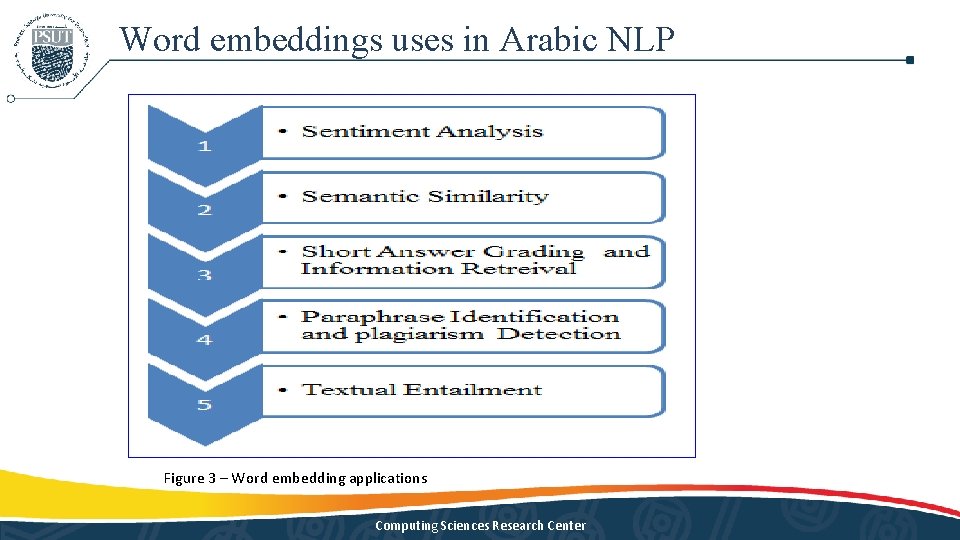
Word embeddings uses in Arabic NLP Figure 3 – Word embedding applications Computing Sciences Research Center
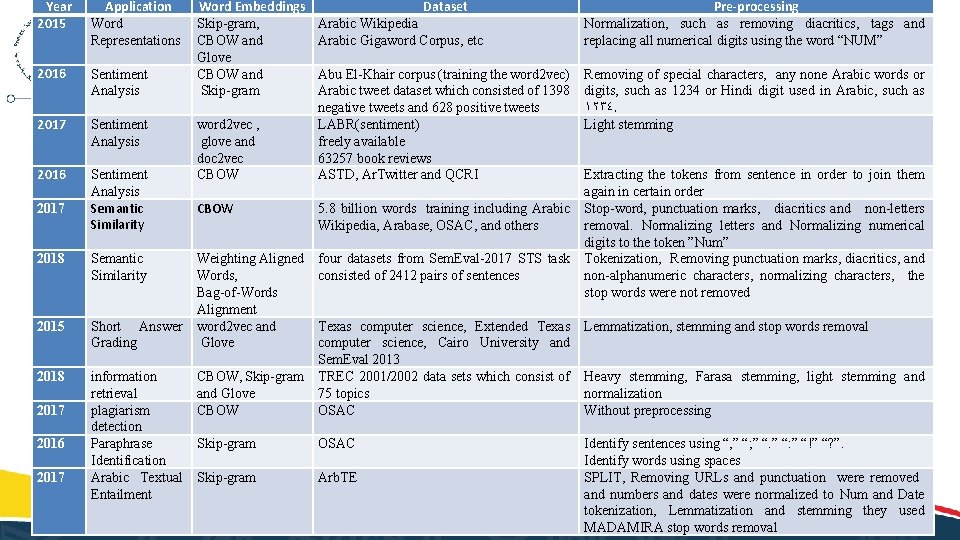
Year 2015 Application Word Representations 2016 Sentiment Analysis 2017 Sentiment Analysis 2016 Sentiment Analysis Semantic Similarity 2017 2018 Semantic Similarity 2015 Short Answer Grading 2018 information retrieval plagiarism detection Paraphrase Identification Arabic Textual Entailment 2017 2016 2017 Word Embeddings Skip-gram, CBOW and Glove CBOW and Skip-gram word 2 vec , glove and doc 2 vec CBOW Dataset Arabic Wikipedia Arabic Gigaword Corpus, etc Abu El-Khair corpus (training the word 2 vec) Arabic tweet dataset which consisted of 1398 negative tweets and 628 positive tweets LABR(sentiment) freely available 63257 book reviews ASTD, Ar. Twitter and QCRI CBOW 5. 8 billion words training including Arabic Wikipedia, Arabase, OSAC, and others Weighting Aligned Words, Bag-of-Words Alignment word 2 vec and Glove four datasets from Sem. Eval-2017 STS task consisted of 2412 pairs of sentences CBOW, Skip-gram and Glove CBOW Texas computer science, Extended Texas computer science, Cairo University and Sem. Eval 2013 TREC 2001/2002 data sets which consist of 75 topics OSAC Skip-gram Arb. TE Pre-processing Normalization, such as removing diacritics, tags and replacing all numerical digits using the word “NUM” Removing of special characters, any none Arabic words or digits, such as 1234 or Hindi digit used in Arabic, such as ١٢٣٤. Light stemming Extracting the tokens from sentence in order to join them again in certain order Stop-word, punctuation marks, diacritics and non-letters removal. Normalizing letters and Normalizing numerical digits to the token ”Num” Tokenization, Removing punctuation marks, diacritics, and non-alphanumeric characters, normalizing characters, the stop words were not removed Lemmatization, stemming and stop words removal Heavy stemming, Farasa stemming, light stemming and normalization Without preprocessing Identify sentences using “, ” “; ” “: ” “!” “? ”. Identify words using spaces SPLIT, Removing URLs and punctuation were removed and numbers and dates were normalized to Num and Date tokenization, Lemmatization and stemming they used Computing Sciences Research Center. MADAMIRA stop words removal
Evaluation of word embeddings q There are two evaluation ways of space vectors representation including: 1. Intrinsic: The semantic and syntactic similarity of words was evaluated using semantic and syntactic benchmark dataset which was used to evaluate the models quality 2. Extrinsic. The word embeddings were evaluated through using it in NLP applications Computing Sciences Research Center
Pre-trained word embeddings q According to the importance of using word embeddings in several NLP applications pre-trained Arabic word embeddings models was proposed and called Ara. Vec. q Ara. Vec is an open source project of pre-trained Arabic distributed words embeddings that enables Arabic researchers to use free and powerful model in their researches. Computing Sciences Research Center
Pre-trained word embeddings q Ara. Vec was published in 2017 q Ara. Vec trained using CBOW and Skip-gram approaches of word 2 vec. q Tweets, article of Arabic Wikipedia and World Wide Web pages with total number of tokens more than 3, 300, 000 were used for training. q The datasets collected were normalize and non-Arabic content filtering was applied. Computing Sciences Research Center
Discussions and Conclusion q Word embeddings were used in various Arabic NLP applications. q Training of the word embeddings model was conducted in large Arabic dataset such as OSAC, Sem. Eval-2017, LABR, Arb. TE, Abu El-Khair corpus, where most of them are freely available. q Some of researchers collected their own dataset from Twitter, Wikipedia and World Wide Web pages. Computing Sciences Research Center
Discussions and Conclusion q Several data preprocessing were applied on the dataset, where the most common preprocessing are: Ø Normalization. Ø Lemmatization. Ø Stemming. Ø Removing of stop words, diacritics, tags, URLs and punctuation marks. Ø Normalizing the numbers and dates by replacing them with Num and Date tokens. Computing Sciences Research Center
Thank You Princess Sumaya University for Technology Computing Sciences Research Center