
PRIMT A PickRevise Framework for Interactive Machine Translation


- Slides: 23
PRIMT: A Pick-Revise Framework for Interactive Machine Translation Shanbo Cheng, Shujian Huang, Huadong Chen, Xinyu Dai and Jiajun Chen Nanjing University By Jiawei Ling
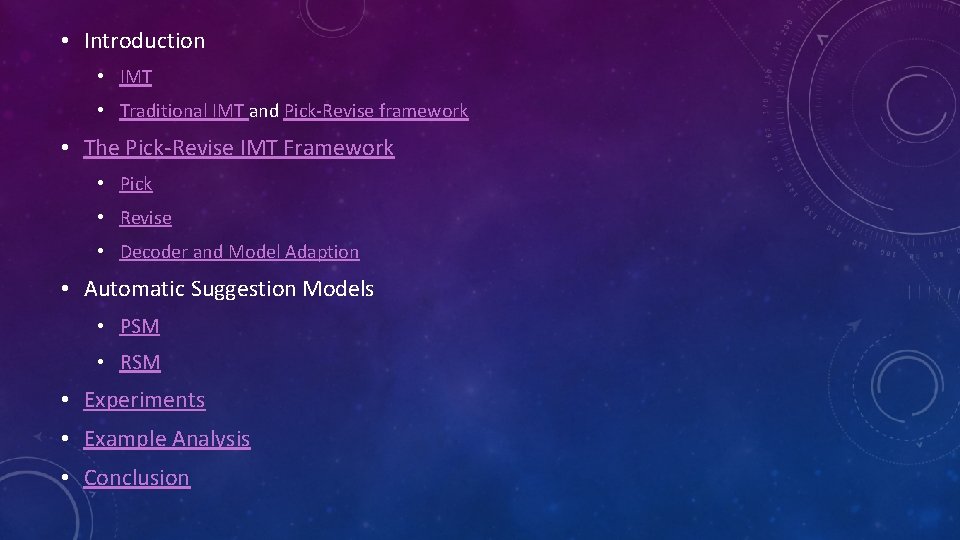
• Introduction • IMT • Traditional IMT and Pick-Revise framework • The Pick-Revise IMT Framework • Pick • Revise • Decoder and Model Adaption • Automatic Suggestion Models • PSM • RSM • Experiments • Example Analysis • Conclusion
IMT • Human translators usually have to modify the results generated by a machine translation (MT) system which needs a lot of modifications, and is timeconsuming. • To speed up the process, interactive machine translation (IMT) is proposed which instantly update the translation result after every human action. • Because the translation quality could be improved after every update, IMT is expected to generate high quality translations with less human actions.
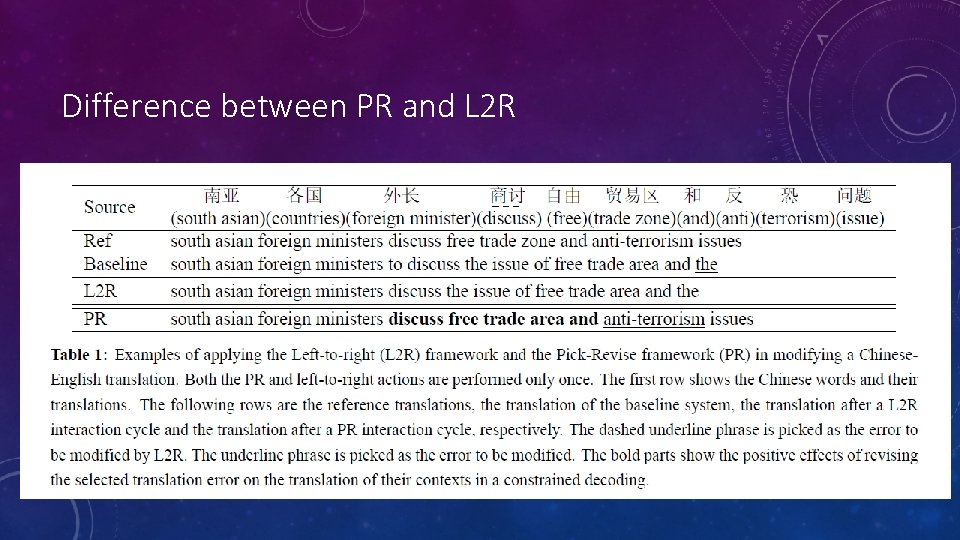
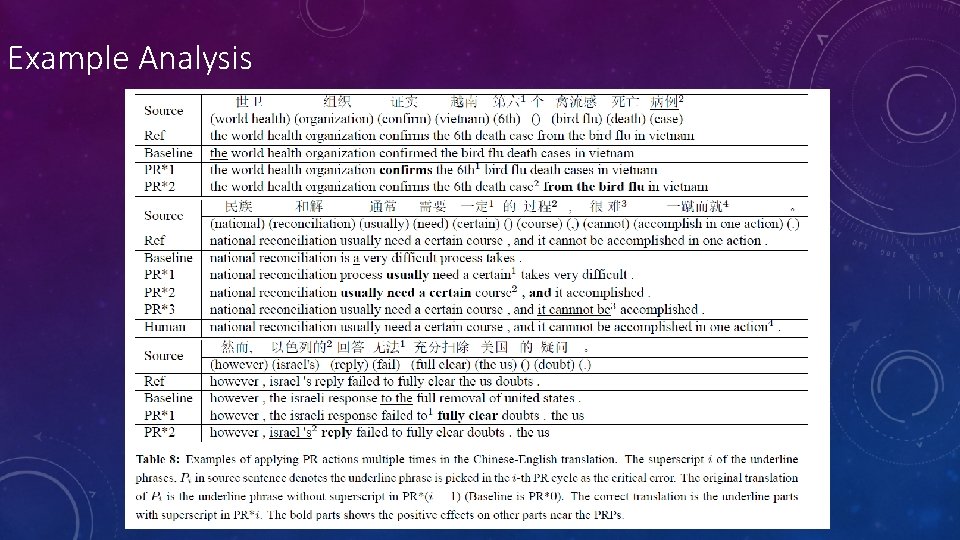
Traditional IMT • Typical IMT systems usually use a left-to-right sentence completing framework in which the users process the translation from the beginning of the sentence and interact with the system at the left-most error. • It is difficult to modify critical translation errors at the end of a sentence. • Critical translation errors are those errors that has large impact on the translation of other words or phrases, which are often caused by the inherent difficulty of translating source phrases.
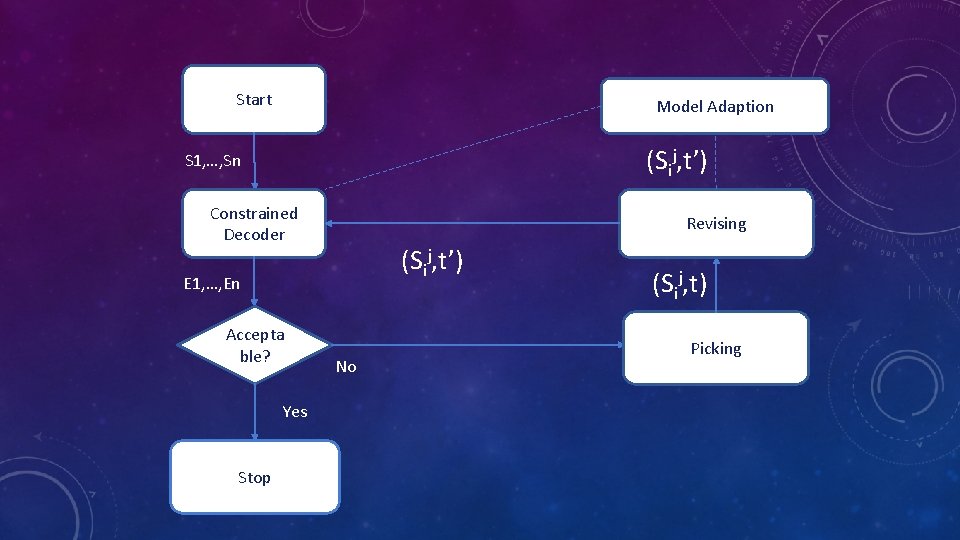
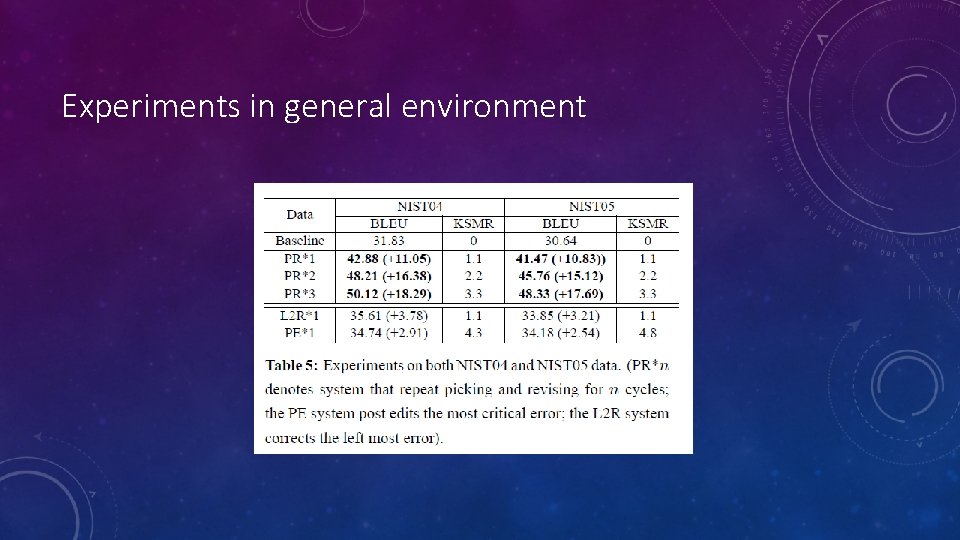
Introduction to Pick-Revise Framework • Pick: a wrongly-translated phrase is selected from the whole sentence. • Revise: the correct translation is selected from the translation table (or manually added) to replace the original one. • Our system then re-translates the sentence and searches for the best translation using previous modifications as constraints. • we propose two automatic suggestion models that could predict the wronglytranslated phrases and select the revised translation.
Difference between PR and L 2 R
Start Model Adaption (Sij, t’) S 1, …, Sn Constrained Decoder Revising (Sij, t’) E 1, …, En Accepta ble? Yes Stop No (Sij, t) Picking
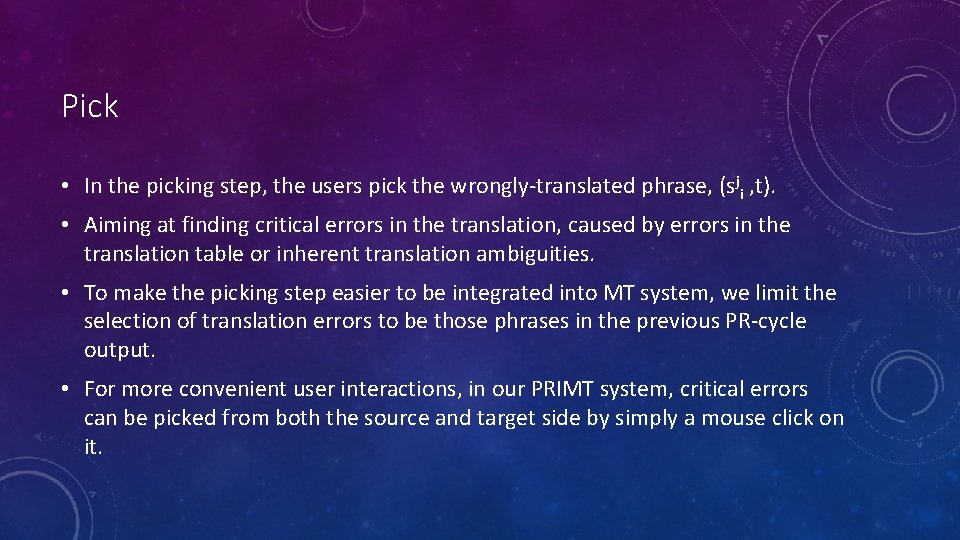
Pick • In the picking step, the users pick the wrongly-translated phrase, (sji , t). • Aiming at finding critical errors in the translation, caused by errors in the translation table or inherent translation ambiguities. • To make the picking step easier to be integrated into MT system, we limit the selection of translation errors to be those phrases in the previous PR-cycle output. • For more convenient user interactions, in our PRIMT system, critical errors can be picked from both the source and target side by simply a mouse click on it.
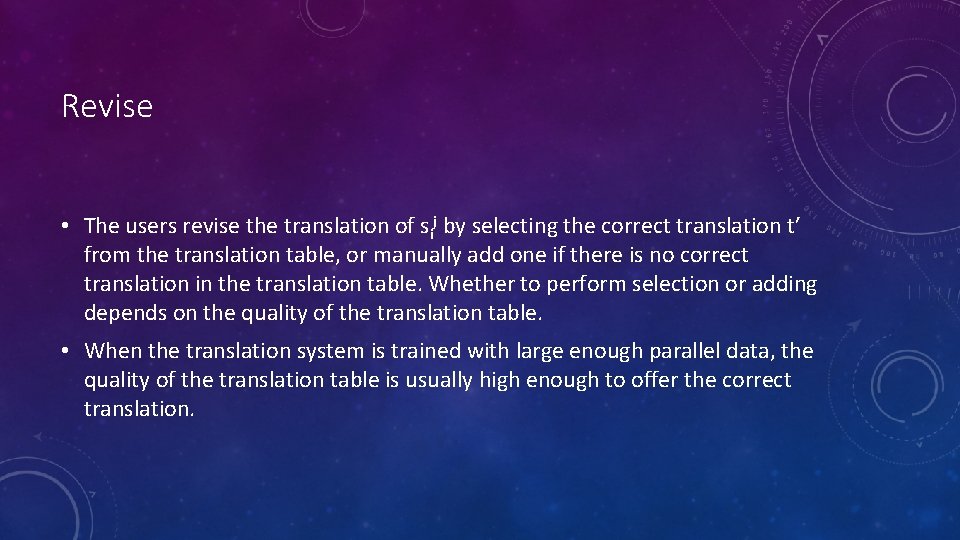
Revise • The users revise the translation of sij by selecting the correct translation t′ from the translation table, or manually add one if there is no correct translation in the translation table. Whether to perform selection or adding depends on the quality of the translation table. • When the translation system is trained with large enough parallel data, the quality of the translation table is usually high enough to offer the correct translation.
Decoder and Model Adaption • We use a constrained decoder to search for the best translation with the previous PRPs as constraints. • It makes an extra comparison between each translation option and previous PR pairs, which ignores all the phrases that overlap with the source side of a pick-revise pair (PRP). • It makes the search space much smaller than standard decoding.
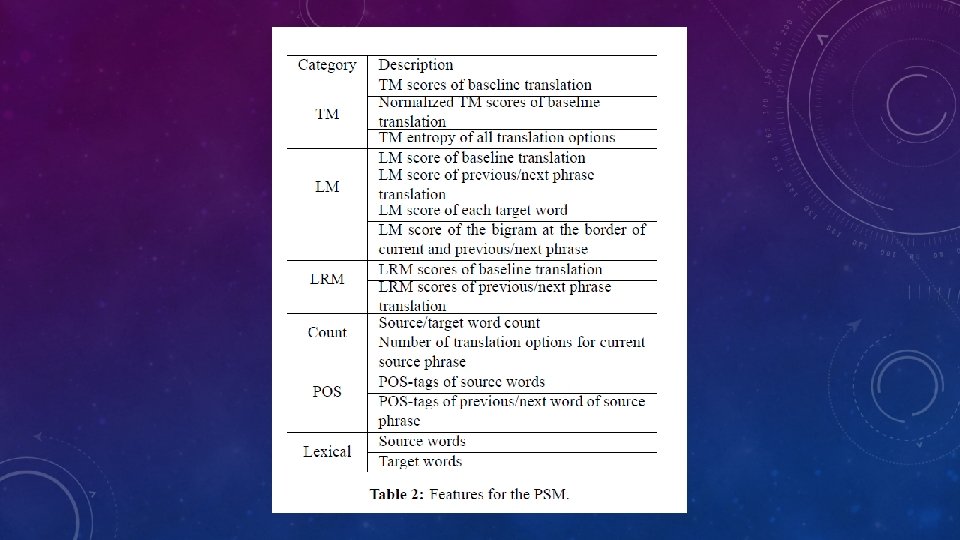
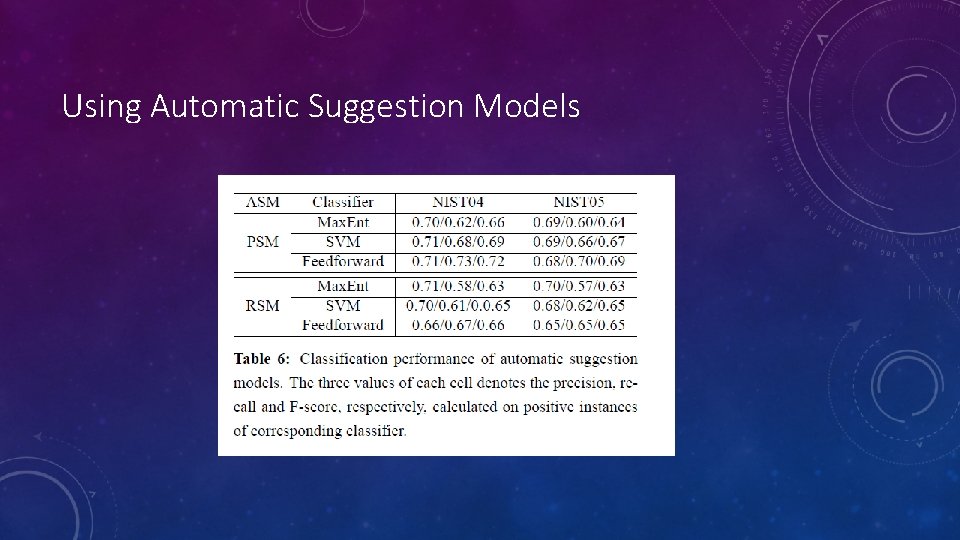
The Picking Suggestion Model (PSM) • The goal of PSM is to automatically recognize those phrases that might be wrongly-translated, and suggest users to pick these phrases. • Within all the phrases of a source sentence, we need to separate the wronglytranslated phrases and correctly-translated phrases. • We use the translation quality gain after the revising action as a measurement.
The Picking Suggestion Model (PSM) • determine whether the phrase is difficult-to-translate. • determine whether the current translation option is correct.
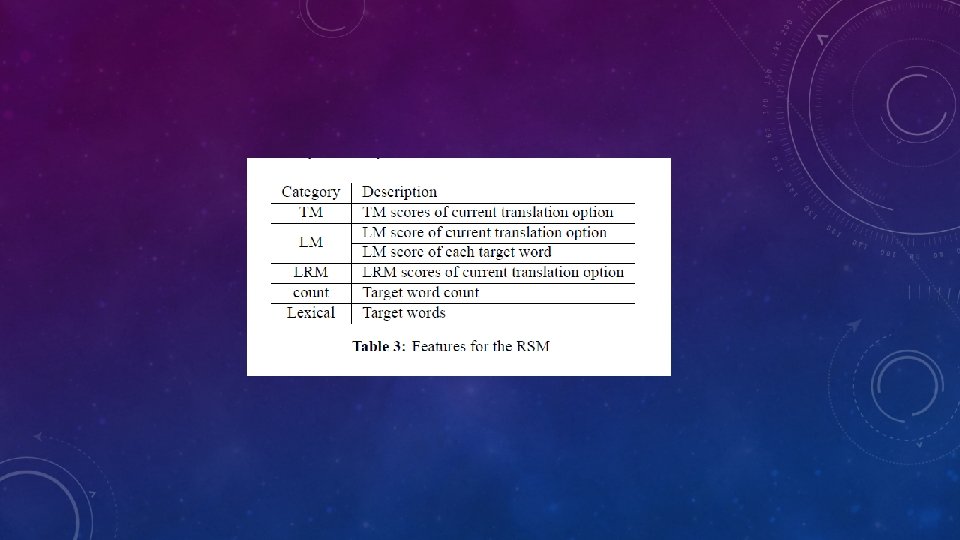
The Revising Suggestion Model (RSM) • The goal of RSM is to predict the correct translation and suggest users to replace the wrong translation with the predicted one. • We use two criteria to distinguish correct translation options from wrong translation options: • The correct translation option should be a substring of the references. • The correct translation option should be consistent with pretrained word alignment on the translated sentence pair. • With the above criteria, we select all correct translation options as positive instances for the revising step, and randomly sample the same number of wrong translation options to be negative instances.
The Revising Suggestion Model (RSM) • For translations of a given source phrase, there is no need to compare their source-side information because these translation options share the same source phrase and context. • Features mainly focus on estimating the translation quality of a given translation option.
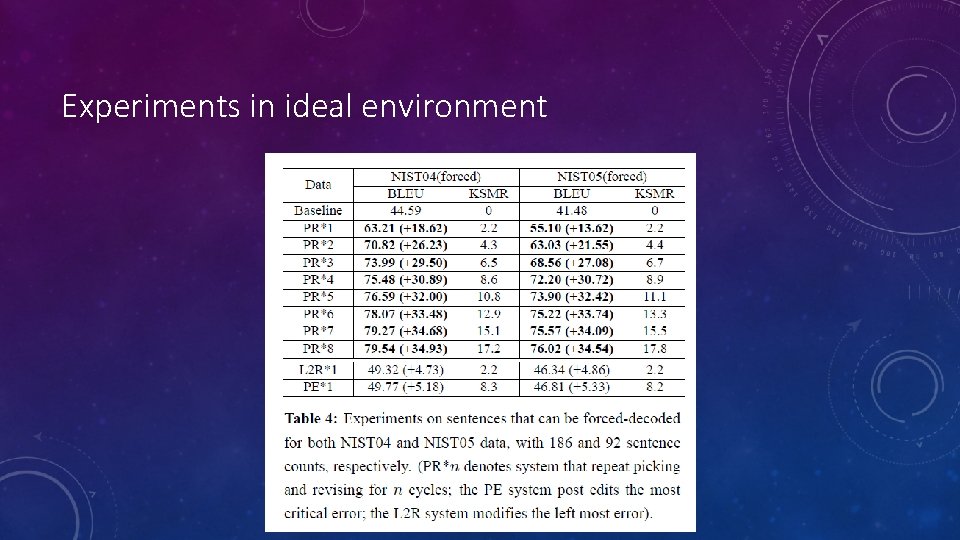
Experiments in ideal environment
Experiments in general environment
Using Automatic Suggestion Models
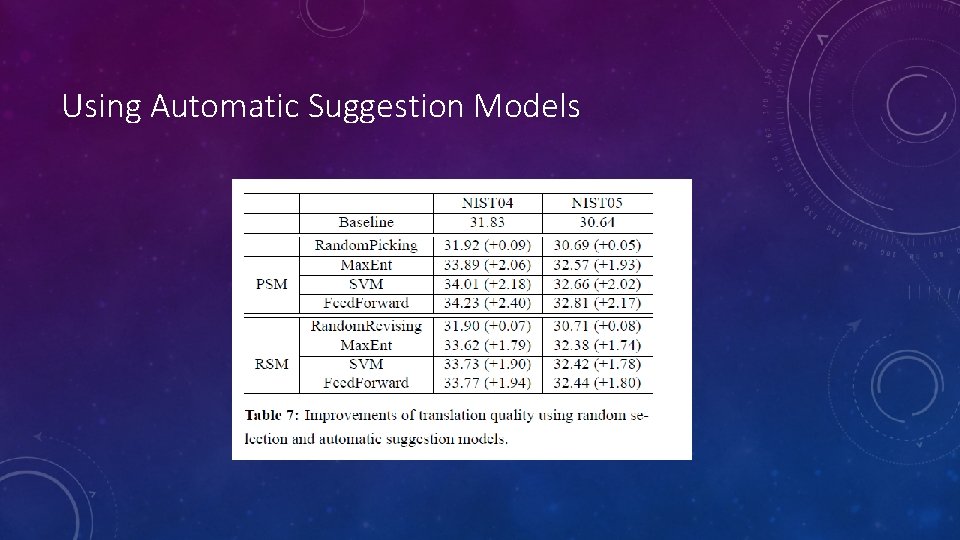
Using Automatic Suggestion Models
Example Analysis
Conclusion • By correcting the critical error instead of the left most one, our framework could improve the translation quality in a quicker and more efficient way. • By using automatic suggestion models, we could reduce human interaction to a single type, either picking or revising. • The performance of current framework is still related to the underlying MT system. Further improvement could be achieved by supporting other type of interactions, such as reordering operations, or building the system with stronger statistical models.
• Q&A • Thank you~