
Primitive Theatre Humans have a basic need to

Primitive Theatre
Humans have a basic need to imitate (that is how we acquire most of our learning) Imitation is the basis of all theatre One definition of theatre is a person or persons imitating the actions and words of others for the benefit of others (actors, plays, audience)
We know very little about how primitive theatre evolved This is because of lack of records (no writing!) The only ideas we have are drawn from artifacts and drawings in caves
One theory Members of a tribe went to hunt (which had to be successful in order to provide food for survival) The rest of the tribe stayed behind to protect the campsite When the hunters returned, they were asked something like “Did it go well? ” The hunters may have responded “Let us show you!” They would then re-enact the hunt Some would be the animals, wearing skins as costumes Others portrayed the hunters Imitated the animals, told a story to the tribe, while wearing “costumes”
Greek Theatre 550 BC – 220 BC
Four Qualities of Greek Drama 1. *Performed for special occasions (festivals) Athens had four festivals worshipping Dionysus -- (Bacchus in Latin, Roman) god of wine, fertility, rebirth The son of Zeus [a god] and Semele [a mortal], reared by satyrs, killed, dismembered, and resurrected (was actually reborn) --
2. *Competitive -- prizes awarded Actors and playwrights competed --Oedipus apparently didn't win (was 2 nd) -- 430 B. C. 3. *Choral -- singing seems to have been an important part a chorus of men (varied in size form 3 to 50) -many think the choral song -- dithyramb-- was the beginnings of Greek drama (but origins are unclear)
4. *Closely associated with religion - stories based on myth or history
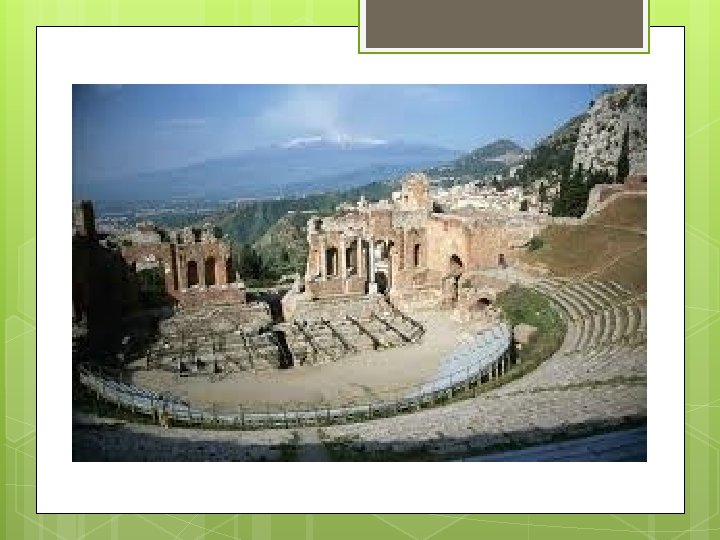
The Greek Tragedy Structure of Greek Tragedy: Late point of attack Violence and death offstage (Sophocles' Ajax is an exception) Frequent use of messengers to relate information Usually continuous time of action (except Aeschylus's Eumenides) Usually single place (except Ajax) Stories based on myth or history, but varied interpretations of events Focus is on psychological and ethical attributes of characters, rather than physical and sociological.
The three Greek Tragedians
Aeschylus His are the oldest surviving plays - began competing 449 B. C. at Dionysus Theatre. Most of his plays were part of trilogies; the only extant Greek trilogy is The Orestia.
Characteristics of Aeschylus’ Plays characters have limited number of traits, but clear and direct emphasizes forces beyond human control evolution of justice, impersonal power of state eventually replacing personal revenge chain of private guilt and punishment all reconciled at end
Sophocles: (496 -406 B. C. ) Won 24 contests, never lower than 2 nd; believed to have introduced the 3 rd actor; fixed the chorus at 15 (had been 50)
Characteristics of Sophocles' plays: emphasis on individual characters reduced role of chorus complex characters, psychologically well-motivated characters subjected to crisis leading to suffering and selfrecognition - including a higher law above man exposition carefully motivated scenes suspenseful and climactic action clear and logical poetry clear and beautiful few elaborate visual effects theme emphasized: the choices of people
Euripides (480 -406 B. C. ) Very popular in later Greek times, little appreciated during his life sometimes known as "the father of melodrama"
Characteristics of Euripides' plays: dealt with subjects usually considered unsuited to the stage which questioned traditional values (Medea loving her stepson, Medea murdering her children) dramatic method often unclear -not always clearly causally related episodes, with many reversals, deus ex machina endings many practices were to become popular: using minor myths or severely altered major ones less poetic language, realistic characterizations and dialog
- Slides: 18