
Primitive Mammals in an Egg or Pouch l
![Web References 1] www. wikipedia. org/wiki/cynodont 2] www. bobpickett. org/evolution_of_mammals. htm 3] http//palaeo. gly.](https://slidetodoc.com/presentation_image_h/9cc339cdbb35276006059737aae50317/image-20.jpg "Web References 1] www. wikipedia. org/wiki/cynodont 2] www. bobpickett. org/evolution_of_mammals. htm 3] http//palaeo. gly.")
- Slides: 21
Primitive Mammals: in an Egg or Pouch l l l Dane Mc. Donald 2413521 Dr. Knight Available at http: //planet. uwc. ac. za/nisl/Eco_people/Presentations/
The Origin of mammals q In some way reptiles can be considered as the ancestors of mammals. q These reptiles, however, had little in common with modern reptiles. q Fossil evidence indicates that a split occurred between the early reptilian ancestors of mammals and the evolutionary line that gave rise to today’s living reptiles. § This occurred approximately 300 mya in the Carbiniferous period, which was the time of the great swamp forests. q At this time many of the characteristics of modern reptiles had not yet evolved, and hence were not present in the reptilian ancestors of mammals. q In conclusion, today’s reptiles can therefore not be considered as the “evolutionary stage” preceding mammals.
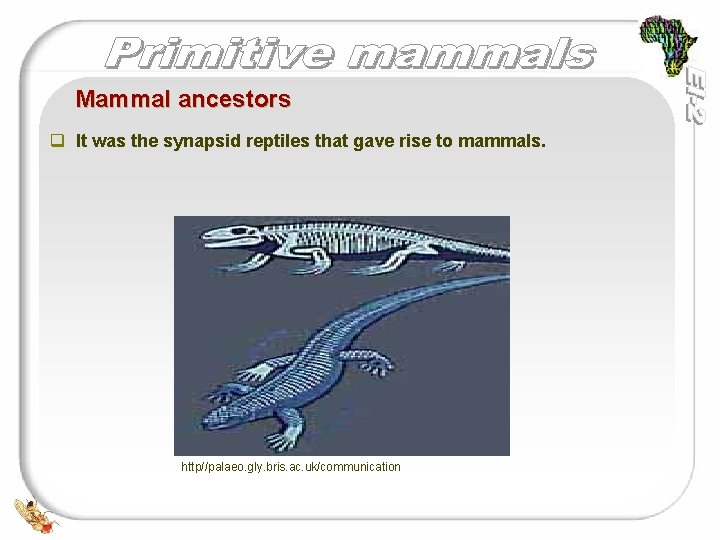
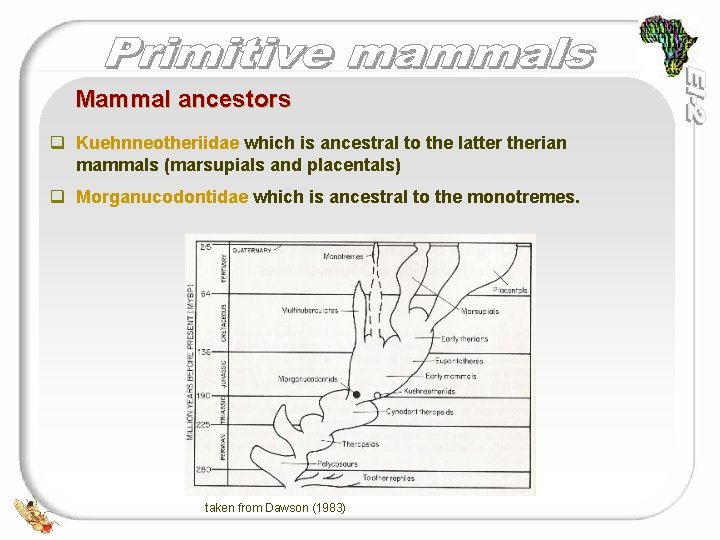
Mammal ancestors q It was the synapsid reptiles that gave rise to mammals. http//palaeo. gly. bris. ac. uk/communication
Mammal ancestors q The history of these animals can be divided into a series of evolutionary branches. Three major radiations occurred: § Carboniferous and Permian pelycosaurs § Permian and Triassic noncynodont therapsids § Cynodont therapsids q All mammals are descended from the latter group which shows distinct mammal- like structure. q At the end of the Triassic (190 mya) there was a split in the cynodont lineage q The result was two lineages that represent-day mammals:
Mammal ancestors q Kuehnneotheriidae which is ancestral to the latter therian mammals (marsupials and placentals) q Morganucodontidae which is ancestral to the monotremes. taken from Dawson (1983)
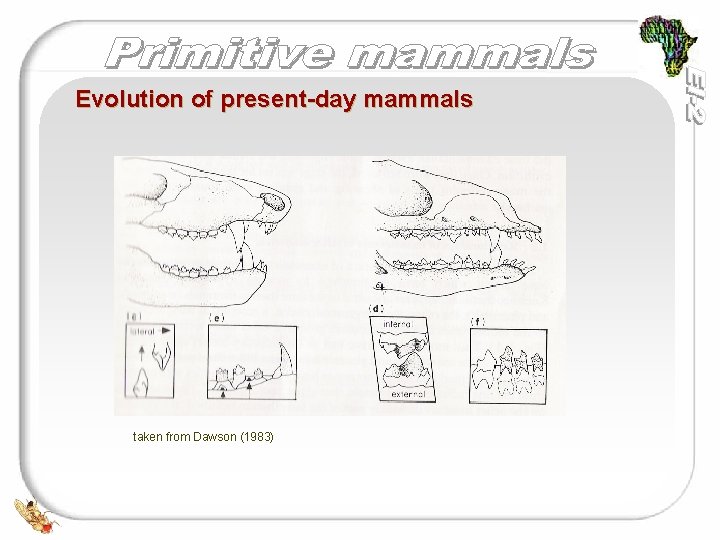
Evolution of present-day mammals q During the Jurassic (200 mya) the dinosaurs dominated the earth. Hence early mammals were confined to a nocturnal lifestyle or protected habitats to survive competition or predation. q This period of “dormancy” resulted in major innovations that opened up a large new adaptive zone. q Being nocturnal resulted in the following developments: § Relatively large eyes § More acute hearing § Developed vocal cords § Pronounced whiskers q Another important feature that evolved in early mammals were new jaw attachments and modified teeth.
Evolution of present-day mammals taken from Dawson (1983)
Evolution of present-day mammals q Food could now be chewed more effectively. q This rather small modification had a cascade of impacts on mammalian development: “More efficient mastication of food→ faster digestion → rapid delivery of energy to the body, hence it was possible to accommodate greater metabolic requirements such as those associated with maintenance of a high body temperature and increased activity. ”(www. bobpickett. org/evolution_of_mammals. htm) q All these factors combined to give mammals a greater awareness of the environment and survival advantages. q There was also a demand for constant fine-tuning of the integration of brain and bodily equipment. q Hence there was the opportunity for increased evolution of reproductive strategies, maternal behaviour, parental care, communication between individuals and learning
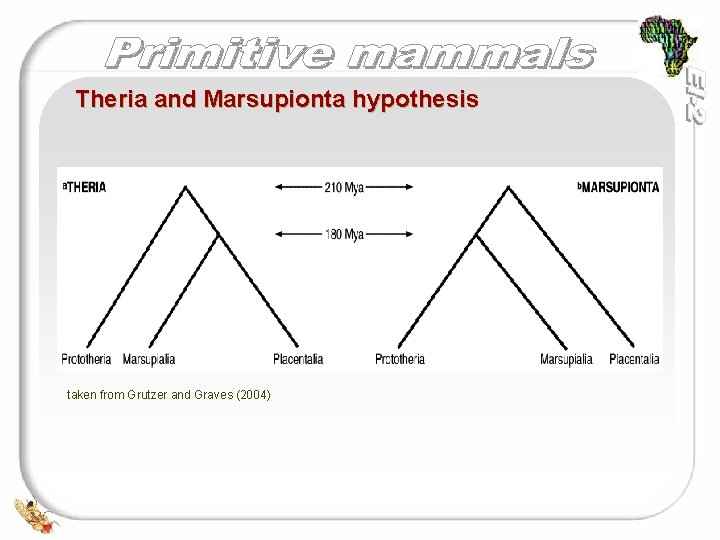
Theria and Marsupionta hypothesis q Theses are the two hypothesis that attempt to explain the emergence and positions of the extant mammals ( i. e. monotremes, marsupials, placentals) q Theria hypothesis states that monotremes are the oldest branch of the mammalian tree and are placed outside the Theria (marsupials and placentals). § There is increasing fossil evidence to support this hypothesis. q The Marsupionta hypothesis suggests that monotremes and marsupials should be aligned as sister groups within the mammalian subclass marsupionta § Most of the characters used in this hypothesis are considered ancestral or their interpretation is controversial.
Theria and Marsupionta hypothesis taken from Grutzer and Graves (2004)
Monotremes vs Marsupials q Monotremes are isolated from the other mammals by a key physiological difference: their defecatory, urinary and reproductive systems all open into a single duct called the cloaca. q In contrast to this characteristically reptilian feature, other mammal females have separate openings for reproduction, defecation, and urination: the anus, vagina and urethra. q Marsupials, on the other hand, differ from placental mammals in their reproductive traits q Hence reproductive traits and strategies can be used to compare and contrast the extant primitive mammals ( i. e. monotremes and marsupials. )
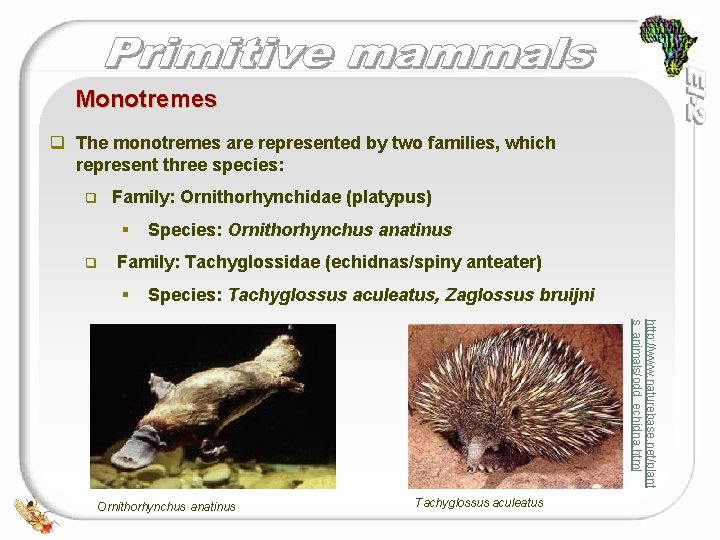
Monotremes q The monotremes are represented by two families, which represent three species: q Family: Ornithorhynchidae (platypus) § q Species: Ornithorhynchus anatinus Family: Tachyglossidae (echidnas/spiny anteater) § Species: Tachyglossus aculeatus, Zaglossus bruijni http: //www. naturebase. net/plant s_animals/odd_echidna. html Ornithorhynchus anatinus Tachyglossus aculeatus
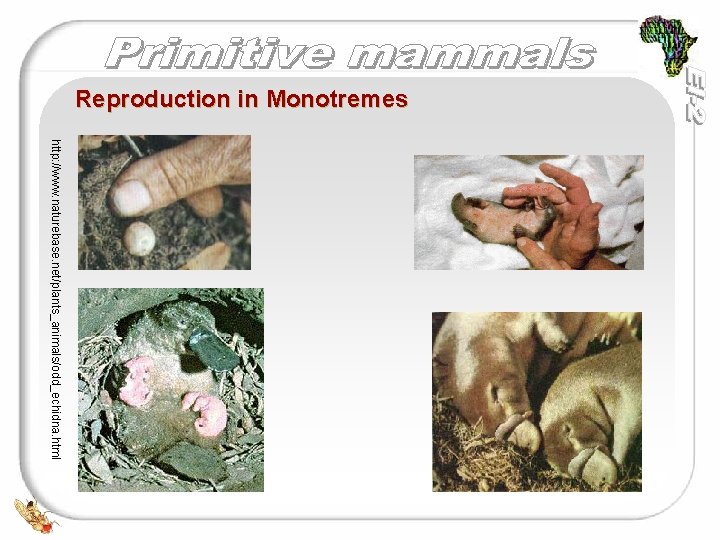
Reproduction in Monotremes q Monotremes are the only extant group of egg-laying mammals q Do monotremes follow a DISTINCTLY reptilian pattern? q NO, reproduction in monotremes differ from the basic patterns in both reptiles and mammals. q Eggs are retained for some time in the mother who actively provides the eggs with nutrients q Literature suggests a combination between oviparity and ovoviviparity. § Oviparity: laying of eggs as in reptiles § Ovoviviparity: the embryo derives nutrients from the egg, but hatching takes place within the female tract and birth takes place thereafter. q Monotremes are seasonal breeders and the season typically lasts between 1 -3 mths between July and October.
Reproduction in Monotremes http: //www. naturebase. net/plants_animals/odd_echidna. html
Reproduction in Monotremes q During copulation, males use spurs on their feet to hold females (and hence execute ground-shattering positions!!) q The female usually lays 1 -3 small eggs that are covered by a leathery shell. q The eggs are incubated for about 12 days and hatch outside the mother “The newly hatched young are vulnerable, blind, and are fed by the mother’s milk. ” q The young sucks up milk as it oozes out of a gland onto the abdominal surface. q Babies only leave the burrow after approximately 17 wks of age.
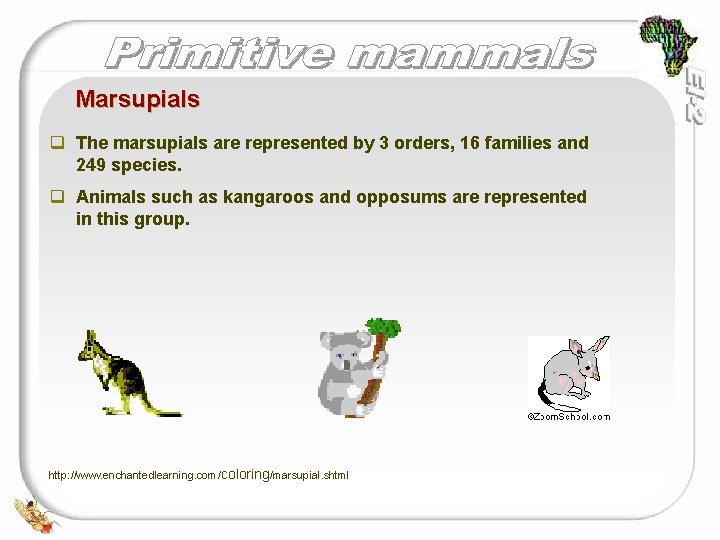
Marsupials q The marsupials are represented by 3 orders, 16 families and 249 species. q Animals such as kangaroos and opposums are represented in this group. http: //www. enchantedlearning. com/coloring/marsupial. shtml
Reproduction in Marsupials q Marsupials are viviparous ( i. e. they give birth to live young). q Females typically have a pouch or marsupium in which their young are reared during infancy. q Marsupials have a short gestation period and spend only 12 -13 days in the reproductive tract. q The reproductive tract has two primary functions: § Reception and transport of spermatozoa to the egg for fertilization. § Production of egg coats and shells and provision of nourishment for the developing embryo. q The female has two vaginas that lead to different compartments within the uterus but open externally through a single orifice. q Males usually have a corresponding two-pronged penis, which only passes sperm.
Reproduction in Marsupials q The pregnant female develops a yolk sack in her womb which delivers nutrients to the embryo. q The young are born in an underdeveloped state after about 4 -5 wks. q Despite their incredibly small size, they are able to crawl into a pouch on the mother’s abdomen and attach to the teat after birth. q Marsupial young are nurtured in the pouch until they reach a level of development that is similar to that of young placentals.
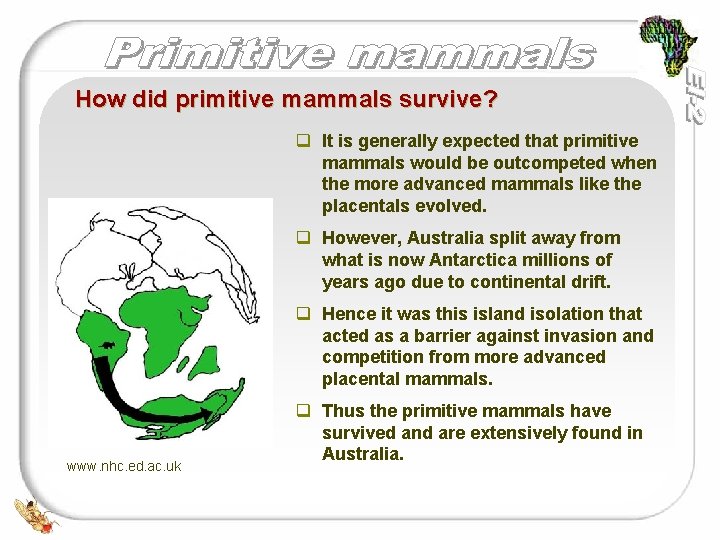
How did primitive mammals survive? q It is generally expected that primitive mammals would be outcompeted when the more advanced mammals like the placentals evolved. q However, Australia split away from what is now Antarctica millions of years ago due to continental drift. q Hence it was this island isolation that acted as a barrier against invasion and competition from more advanced placental mammals. www. nhc. ed. ac. uk q Thus the primitive mammals have survived and are extensively found in Australia.
Web References 1] www. wikipedia. org/wiki/cynodont 2] www. bobpickett. org/evolution_of_mammals. htm 3] http//palaeo. gly. bris. ac. uk/communicatio 4] http: //en. wikipedia. org/wiki/Monotremes 5] http: //en. wikipedia. org/wiki/Marsupials 6] http//animaldiversity. ummz. edu/site/accounts 7] http//www. nhc. edu. ac. uk/index. php? page 8] http: //en. wikipedia. org/wiki/Platypus 9] http: //www. naturebase. net/plants_animals/odd_echidna. html 10] Not available
Literature q q Dawson, TJ (1983) Monotremes and Marsupials: the other mammals. Edward Arnold Ltd, London. ISBN 0 -7131 -2853 -4 Kemp, TS (1982) Mammal-like Reptiles and the Origin of Mammals. Academic Press, London. ISBN 0 -12 -404120 -5