
PRIMES 3 The GPP process in practice Presented
![PRIMES [3] The GPP process in practice Presented by (Insert own logo)](https://slidetodoc.com/presentation_image_h/24bea09d01fbd2e2b5f3989734fd412d/image-1.jpg "PRIMES [3] The GPP process in practice Presented by (Insert own logo)")
![Technical specifications Practical test examples [Product] produced/provided using energy-efficient machines; Supplier of [product] must](https://slidetodoc.com/presentation_image_h/24bea09d01fbd2e2b5f3989734fd412d/image-12.jpg "Technical specifications Practical test examples [Product] produced/provided using energy-efficient machines; Supplier of [product] must")
- Slides: 29
PRIMES [3] The GPP process in practice Presented by (Insert own logo)
Overview 1) Procurement process 2) Tender criteria 3) Verification / means of proof
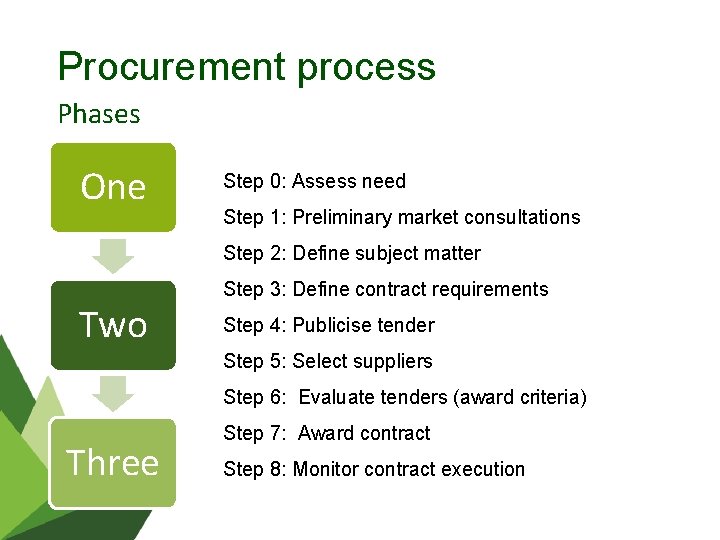
Procurement process Phases One Step 0: Assess need Step 1: Preliminary market consultations Step 2: Define subject matter Two Step 3: Define contract requirements Step 4: Publicise tender Step 5: Select suppliers Step 6: Evaluate tenders (award criteria) Three Step 7: Award contract Step 8: Monitor contract execution
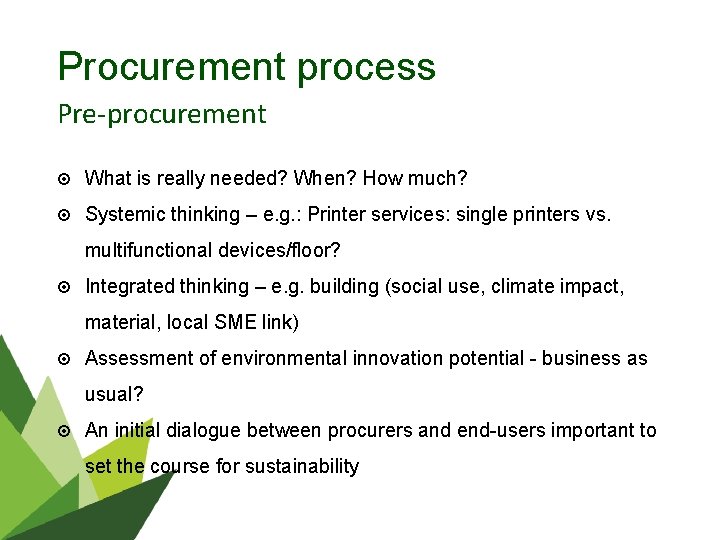
Procurement process Pre-procurement What is really needed? When? How much? Systemic thinking – e. g. : Printer services: single printers vs. multifunctional devices/floor? Integrated thinking – e. g. building (social use, climate impact, material, local SME link) Assessment of environmental innovation potential - business as usual? An initial dialogue between procurers and end-users important to set the course for sustainability
© Image courtesy jscreationzs of Free. Digital. Photos. net Procurement process Preliminary market consultations Early market engagement can be important in view to preparing the procurement and informing economic operators of their procurement plans and requirements. Examples: seek or accept advice from independent experts or authorities or from market participants (interviews, workshops etc. ). Early market engagement should not distort competition or violate the principles of non-discrimination and transparency.
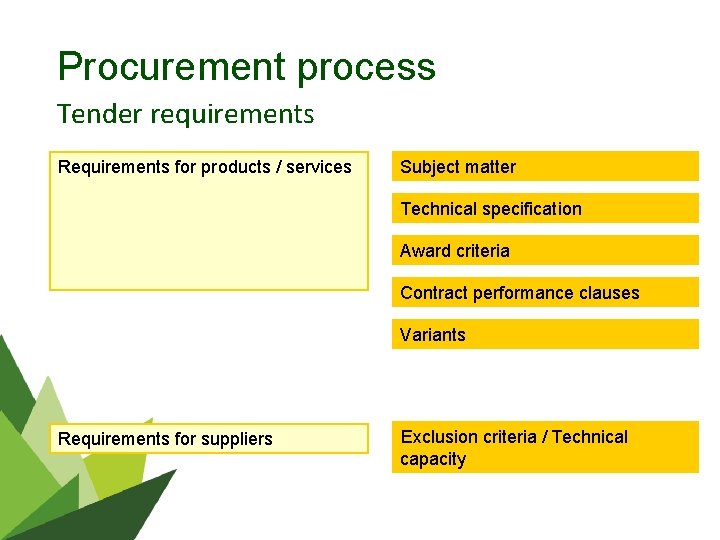
Procurement process Tender requirements Requirements for products / services Subject matter Technical specification Award criteria Contract performance clauses Variants Requirements for suppliers Exclusion criteria / Technical capacity
Overview 1) Procurement process 2) Tender criteria 3) Verification / means of proof 4) Monitoring
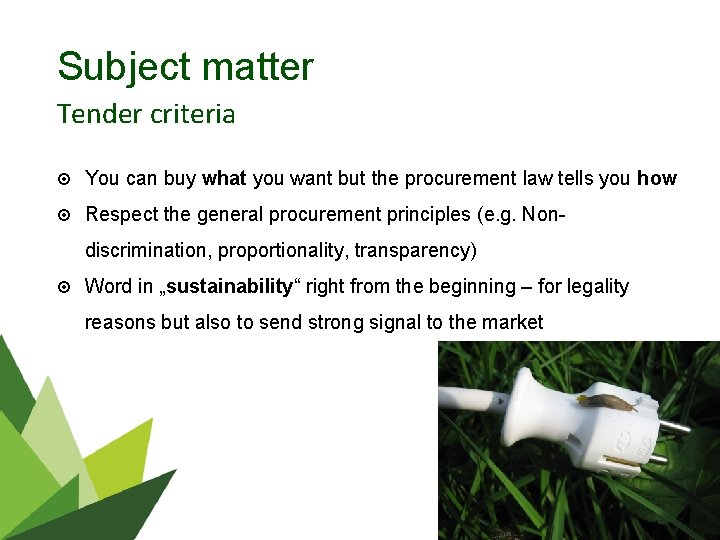
Subject matter Tender criteria You can buy what you want but the procurement law tells you how Respect the general procurement principles (e. g. Nondiscrimination, proportionality, transparency) Word in „sustainability“ right from the beginning – for legality reasons but also to send strong signal to the market
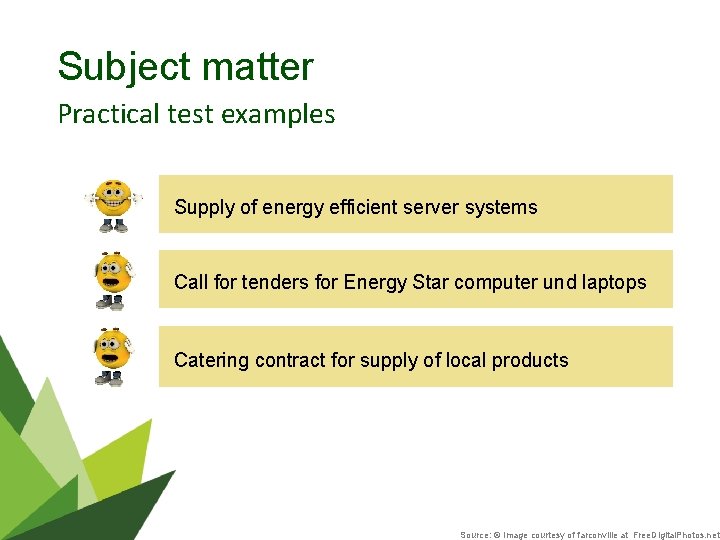
Subject matter Practical test examples Supply of energy efficient server systems Call for tenders for Energy Star computer und laptops Catering contract for supply of local products Source: © Image courtesy of farconville at Free. Digital. Photos. net
Technical specifications (I) Tender criteria They define the technical or functional characteristics required of a material, product or supply, so that it fulfils the use for which it is intended by the contracting authority, for instance: - Quality levels, environmental and climate performance levels; - Design for all requirements (including accessibility for disabled persons) and conformity assessment; - Performance, use of the product, safety or dimensions, including requirements relevant to the product as regards the name under which the product is sold - testing and test methods, packaging, marking and labelling, user instructions;
Technical specifications (II) Tender criteria Use technical specifications for: Improved environmental performance Use of certain specified materials Factors related to production process/methods, provision or trading; - Even where such factors do not form part of the material substance of the product (e. g. no use of toxic chemicals or using energy-efficient machines) - When referring to production processes/methods or a specific process for another stage of the life-cycle these must be linked to the subject-matter of the contract and proportionate to its value and its objectives. "
Technical specifications Practical test examples [Product] produced/provided using energy-efficient machines; Supplier of [product] must have low emission fleet Supplier must have organic food policy (E. g. Energy-efficient catering contract) Source: © Image courtesy of farconville at Free. Digital. Photos. net
Selection process (I) Tender criteria Selection criteria focus on an economic operator’s suitability and technical skills to perform the contract they are tendering for. Questions: - - Does the company have the capacity and competence executing environmental contracts? Does the company employ or have access to personnel with the required educational and professional qualifications and experience to deal with the environmental elements of the contract? Does the company own or have access to the necessary technical equipment for environmental protection? Does the company have the means to ensure the quality of the environmental aspects of the contract (e. g. access to relevant technical bodies and measures)?
Selection process (II) Tender criteria Procurers can ask bidders: - to be enrolled in one of the professional or trade registers kept in their Member State of establishment - to possess a particular authorisation or to be members of a particular organisation in order to be able to perform in their country of origin the service concerned The minimum yearly turnover that economic operators are required to have shall not exceed two times the estimated contract value - Where a contract is divided into lots this Article shall apply in relation to each individual lot.
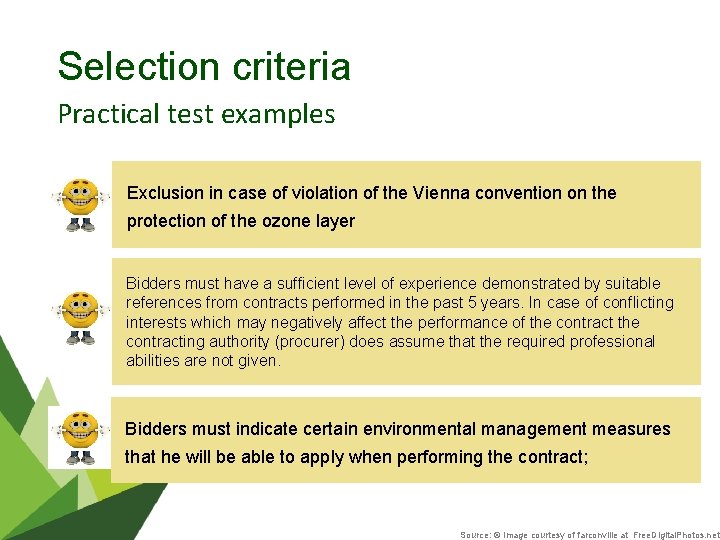
Selection criteria Practical test examples Exclusion in case of violation of the Vienna convention on the protection of the ozone layer Bidders must have a sufficient level of experience demonstrated by suitable references from contracts performed in the past 5 years. In case of conflicting interests which may negatively affect the performance of the contracting authority (procurer) does assume that the required professional abilities are not given. Bidders must indicate certain environmental management measures that he will be able to apply when performing the contract; Source: © Image courtesy of farconville at Free. Digital. Photos. net
Use of eco-labels (I) Tender criteria The new rules allow public purchasers to refer to a specific label or eco-label when laying down the environmental characteristics of the works, goods or services they wish to purchase. If an enterprise has been unable to obtain the label on time, equivalent labels or other means of proof must be accepted by public purchasers. Where some label requirements do not refer to the subject matter contracting authorities shall not require the label as such but may define the technical specifications
Use of ecolabels (II) Tender criteria Concerned label must be linked to the specific works, goods or services to be purchased, i. e. they must characterise them. Labels cannot relate to the enterprise itself or its policy in general. - In this case, reference can only be made to the specific requirements of the label which are linked to the purchased works, goods or services; Transparent procedure - Participation of independent bodies must be ensured (all relevant stakeholders, such as government bodies, consumers, manufacturers, distributors and non-governmental organisations; ) Based on objective and non-discriminatory criteria and available to all interested parties;
Award criteria (I) Tender criteria Use technical specifications for: The new procurement directives encourage procurers to award the contract to the ‘most economically advantageous’ advantageous tender (MEAT) – instead of going for the cheapest offer Contracting authorities can award: quality, price, technical merit, aesthetic and functional characteristics, environmental characteristics, characteristics running costs, cost-effectiveness, after-sales service and technical assistance, delivery date and delivery period or period of completion etc.
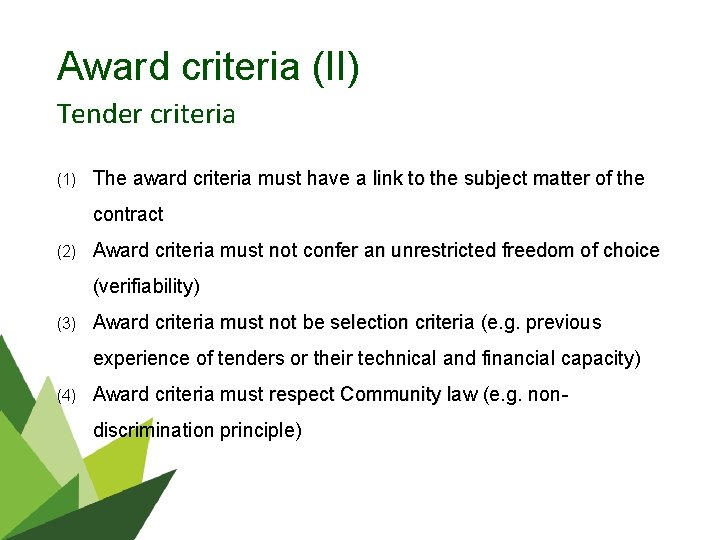
Award criteria (II) Tender criteria (1) The award criteria must have a link to the subject matter of the contract (2) Award criteria must not confer an unrestricted freedom of choice (verifiability) (3) Award criteria must not be selection criteria (e. g. previous experience of tenders or their technical and financial capacity) (4) Award criteria must respect Community law (e. g. nondiscrimination principle)
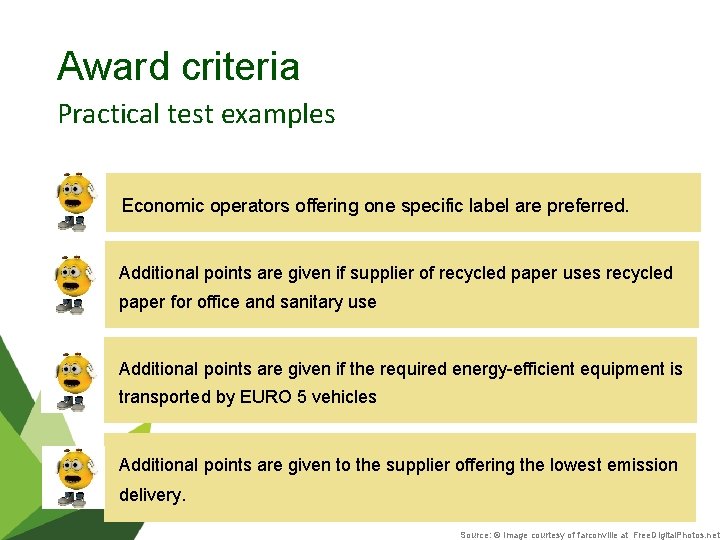
Award criteria Practical test examples Economic operators offering one specific label are preferred. Additional points are given if supplier of recycled paper uses recycled paper for office and sanitary use Additional points are given if the required energy-efficient equipment is transported by EURO 5 vehicles Additional points are given to the supplier offering the lowest emission delivery. Source: © Image courtesy of farconville at Free. Digital. Photos. net
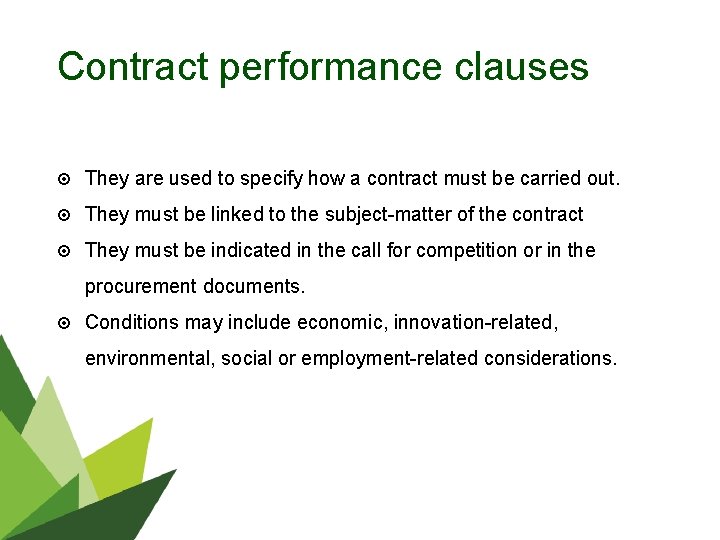
Contract performance clauses They are used to specify how a contract must be carried out. They must be linked to the subject-matter of the contract They must be indicated in the call for competition or in the procurement documents. Conditions may include economic, innovation-related, environmental, social or employment-related considerations.
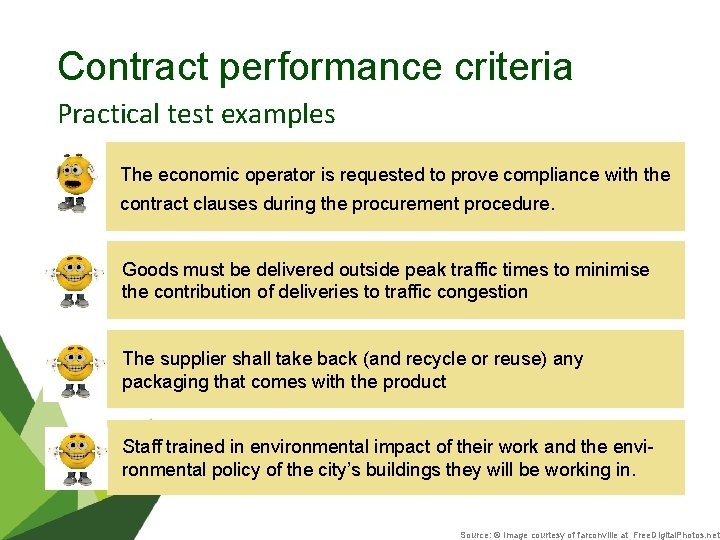
Contract performance criteria Practical test examples The economic operator is requested to prove compliance with the contract clauses during the procurement procedure. Goods must be delivered outside peak traffic times to minimise the contribution of deliveries to traffic congestion The supplier shall take back (and recycle or reuse) any packaging that comes with the product Staff trained in environmental impact of their work and the environmental policy of the city’s buildings they will be working in. Source: © Image courtesy of farconville at Free. Digital. Photos. net
Overview 1) Procurement process 2) Tender criteria 3) Verification / means of proof 4) Monitoring
Verification methods Means of proof Labels can be required as means of proof in technical specifications, award criteria or contract performance conditions provided they are (see also previous slides): - linked to the subject matter - appropriate to define characteristics of works, supplies or services - based on objectively verifiable and non-discriminatory criteria; - established in an open and transparent procedure - accessible to all interested parties; - set by a third party over which the economic operator applying for the label cannot exercise a decisive influence.
Verification methods Proofing equivalence To prove equivalence, it is possible to require tenderers to provide third-party verified evidence. - However, other appropriate means of proof such as a technical dossier of the manufacturer should also be allowed where the economic operator concerned has no access to such certificates or test reports, or no possibility of obtaining them within the relevant time limits, provided that the economic operator concerned thereby proves that the works, supplies or services meet the requirements or criteria set out in the technical specifications, the award criteria or the contract performance conditions.
Verification Methods Art. 60 of the Procurement Directive refers to means of proof for selection criteria and Annex XII provides a list When requiring certain environmental management systems or standards, contracting authorities shall refer to EMAS or equivalent
Overview 1) Procurement process 2) Tender criteria 3) Verification / means of proof 4) Monitoring
Monitoring Procurement process Assessing progress requires an effective monitoring system to be in place, such as a record of green tenders; Monitoring should also include information about the environmental impact of purchasing decisions made. Several EU Member States are working on schemes to monitor national GPP implementation; A regular qualitative review of GPP activities is advisable (barriers, corrective actions, improvements, future targets)
Monitoring Procurement process Having environmental contract clauses is only effective if compliance with these clauses is properly monitored. Different forms of contract compliance monitoring can be applied: The supplier may be requested to supply evidence of compliance The contracting authority may carry out spot checks A third party may be contracted to monitor compliance Appropriate penalties for non-compliance or bonuses for good performance should be included within the contract.