
Primer Ch 8 Sentencing of Organization Federal Sentencing

- Slides: 24
Primer Ch. 8 - Sentencing of Organization Federal Sentencing Guidelines
Key Terms • "Offense" means the offense of conviction and all relevant conduct under § 1 B 1. 3 (Relevant Conduct) unless a different meaning is specified or is otherwise clear from the context. • "High-level personnel of the organization" means individuals who have substantial control over the organization or who have a substantial role in the making of policy within the organization. • "Substantial authority personnel" means individuals who within the scope of their authority exercise a substantial measure of discretion in acting on behalf of an organization.
Key Terms • "Agent" means any individual, including a director, an officer, an employee, or an independent contractor, authorized to act on behalf of the organization. • An individual "condoned" an offense if the individual knew of the offense and did not take reasonable steps to prevent or terminate the offense. • "Similar misconduct" means prior conduct that is similar in nature to the conduct underlying the instant offense, without regard to whether or not such conduct violated the same statutory provision.
Key Terms • "Prior criminal adjudication" means conviction by trial, plea of guilty (including an Alfordplea), or plea of nolo contendere. • "Pecuniary gain" is derived from 18 U. S. C. § 3571(d) and means the additional before-tax profit to the defendant resulting from the relevant conduct of the offense. Gain can result from either additional revenue or cost savings. • "Pecuniary loss" is derived from 18 U. S. C. § 3571(d) and is equivalent to the term "loss" as used in Chapter Two (Offense Conduct). • An individual was "willfully ignorant of the offense" if the individual did not investigate the possible occurrence of unlawful conduct despite knowledge of circumstances that would lead a reasonable person to investigate whether unlawful conduct had occurred.
§ 8 B 2. 1. Effective Compliance and Ethics Program • “Effective compliance and ethics program” – • Exercise due diligence to prevent and detect criminal conduct • Promote organizational culture that promotes ethical conduct and commitment with the law • Standards and procedures to prevent and detect criminal conduct • ”Governing authority” = Compliance Committee shall be knowledgeable about content and operations of compliance and ethics program and oversight • Compliance Officer – “high level” personnel – ensure organization has an effective compliance program • Specific individual(s) within the organization shall be delegated day-to-day operational responsibility for the compliance and ethics program
§ 8 B 2. 1. Effective Compliance and Ethics Program • “Effective compliance and ethics program” – • Not to include an individuals that has engage in illegal activities – Exclusion checks • Communicate periodically and in a practical manner its standards and procedures, and other aspects of the compliance and ethics program – Education and training • To ensure that the organization's compliance and ethics program is followed, including monitoring and auditing to detect criminal conduct • to evaluate periodically the effectiveness of the organization's compliance and ethics program • to have and publicize a system, which may include mechanisms that allow for anonymity or confidentiality reporting without fear of retaliation
§ 8 B 2. 1. Effective Compliance and Ethics Program • “Effective compliance and ethics program” – • The organization's compliance and ethics program shall be promoted and enforced consistently throughout the organization • Appropriate disciplinary measures for engaging in criminal conduct and for failing to take reasonable steps to prevent or detect criminal conduct. • Respond appropriately to the criminal conduct and to prevent further similar criminal conduct, including making any necessary modifications to the organization's compliance and ethics program. • Periodically assess the risk of criminal conduct and shall take appropriate steps to design, implement, or modify each requirement set forth in subsection (b) to reduce the risk of criminal conduct identified through this process.
§ 8 B 2. 1. Effective Compliance and Ethics Program • Key Commentaries/Notes • Each of the compliance elements shall be met with certain factors as excepts: • Applicable industry practice and standards • Size of organization • Similar misconduct
§ 8 B 2. 1. Effective Compliance and Ethics Program • Key Commentaries/Notes • Applicable industry practice and standards • An organization's failure to incorporate and follow applicable industry practice or the standards called for by any applicable governmental regulation weighs against a finding of an effective compliance and ethics program.
§ 8 B 2. 1. Effective Compliance and Ethics Program • Key Commentaries/Notes • Size of organization • Large Organizations. —A large organization generally shall devote more formal operations and greater resources in meeting the requirements of this guideline than shall a small organization. • Small Organizations. —In meeting the requirements of this guideline, small organizations shall demonstrate the same degree of commitment to ethical conduct and compliance with the law as large organizations. However, a small organiza¬tion may meet the requirements of this guideline with less formality and fewer resources than would be expected of large organizations
§ 8 B 2. 1. Effective Compliance and Ethics Program • Key Commentaries/Notes • Similar misconduct • Recurrence of similar misconduct creates doubt regarding whether the organization took reasonable steps to meet the requirements of this guideline
§ 8 B 2. 1. Effective Compliance and Ethics Program • Key Commentaries/Notes • Response to criminal conduct: • Take reasonable steps to remedy the harm done – restitution to victims • Respond appropriately = self – reporting and cooperation with authorities • Prevention similar conduct in the future – assessing compliance and ethics program and make modification.
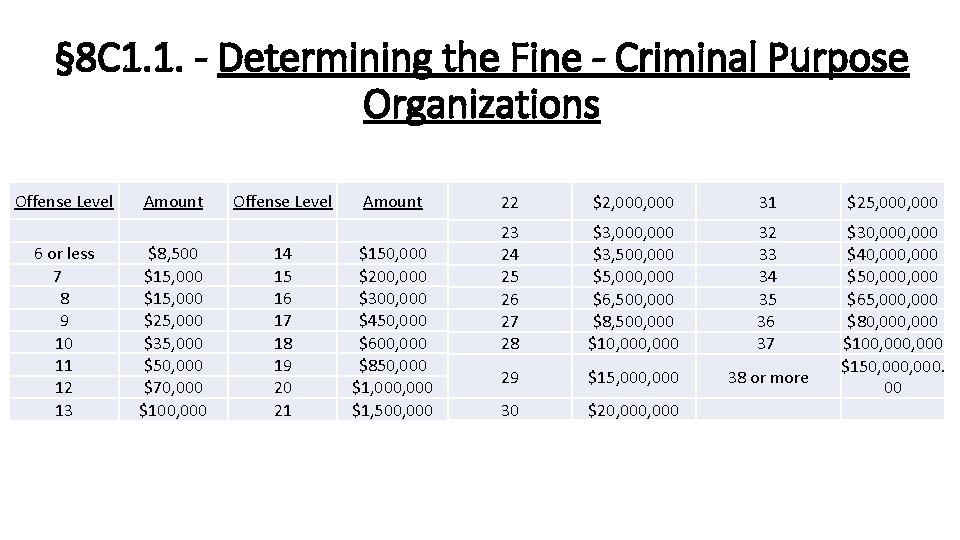
§ 8 C 1. 1. - Determining the Fine - Criminal Purpose Organizations Offense Level 6 or less 7 8 9 10 11 12 13 Amount $8, 500 $15, 000 $25, 000 $35, 000 $50, 000 $70, 000 $100, 000 Offense Level 14 15 16 17 18 19 20 21 Amount $150, 000 $200, 000 $300, 000 $450, 000 $600, 000 $850, 000 $1, 500, 000 22 $2, 000 31 $25, 000 23 24 25 26 27 28 $3, 000 $3, 500, 000 $5, 000 $6, 500, 000 $8, 500, 000 $10, 000 32 33 34 35 36 37 29 $15, 000 38 or more $30, 000 $40, 000 $50, 000 $65, 000 $80, 000 $100, 000 $150, 000. 00 30 $20, 000
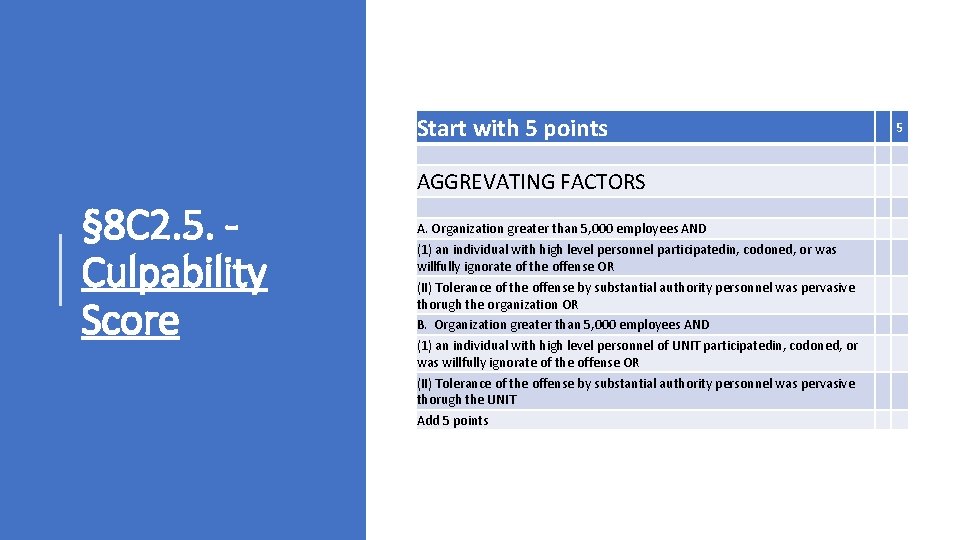
Start with 5 points AGGREVATING FACTORS § 8 C 2. 5. Culpability Score A. Organization greater than 5, 000 employees AND (1) an individual with high level personnel participatedin, codoned, or was willfully ignorate of the offense OR (II) Tolerance of the offense by substantial authority personnel was pervasive thorugh the organization OR B. Organization greater than 5, 000 employees AND (1) an individual with high level personnel of UNIT participatedin, codoned, or was willfully ignorate of the offense OR (II) Tolerance of the offense by substantial authority personnel was pervasive thorugh the UNIT Add 5 points 5
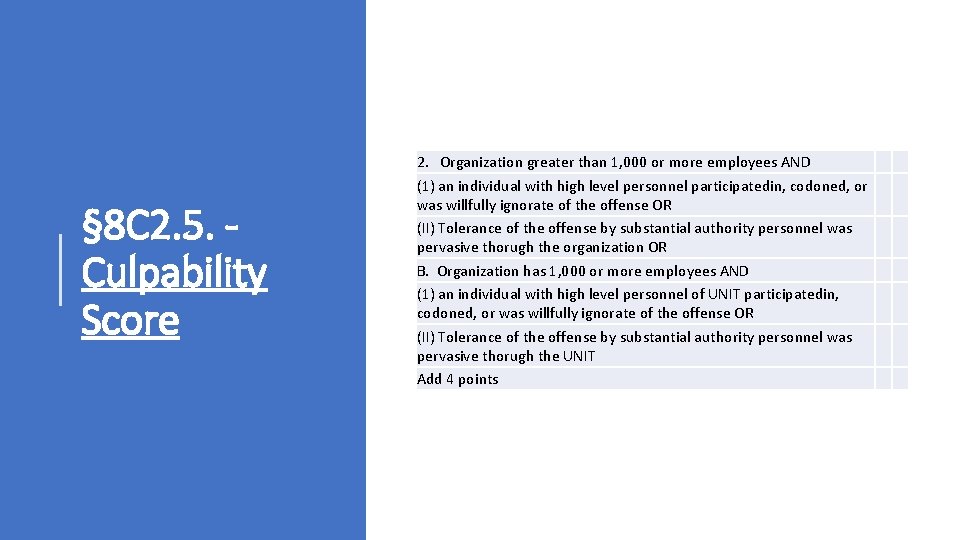
§ 8 C 2. 5. Culpability Score 2. Organization greater than 1, 000 or more employees AND (1) an individual with high level personnel participatedin, codoned, or was willfully ignorate of the offense OR (II) Tolerance of the offense by substantial authority personnel was pervasive thorugh the organization OR B. Organization has 1, 000 or more employees AND (1) an individual with high level personnel of UNIT participatedin, codoned, or was willfully ignorate of the offense OR (II) Tolerance of the offense by substantial authority personnel was pervasive thorugh the UNIT Add 4 points
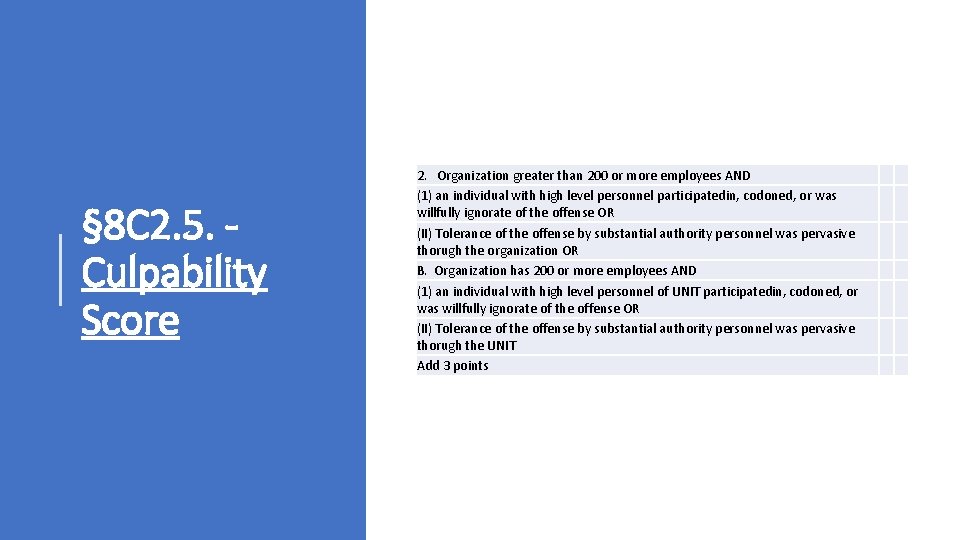
§ 8 C 2. 5. Culpability Score 2. Organization greater than 200 or more employees AND (1) an individual with high level personnel participatedin, codoned, or was willfully ignorate of the offense OR (II) Tolerance of the offense by substantial authority personnel was pervasive thorugh the organization OR B. Organization has 200 or more employees AND (1) an individual with high level personnel of UNIT participatedin, codoned, or was willfully ignorate of the offense OR (II) Tolerance of the offense by substantial authority personnel was pervasive thorugh the UNIT Add 3 points
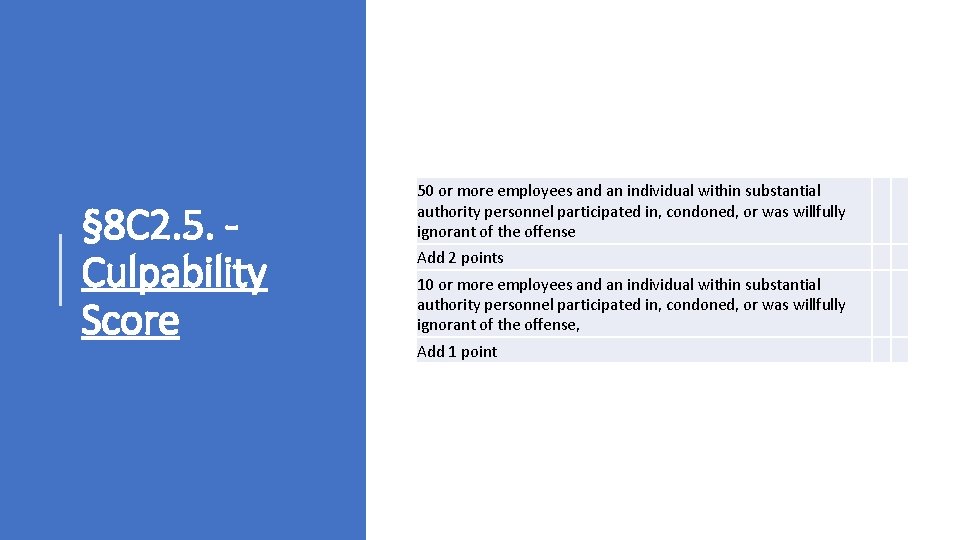
§ 8 C 2. 5. Culpability Score 50 or more employees and an individual within substantial authority personnel participated in, condoned, or was willfully ignorant of the offense Add 2 points 10 or more employees and an individual within substantial authority personnel participated in, condoned, or was willfully ignorant of the offense, Add 1 point
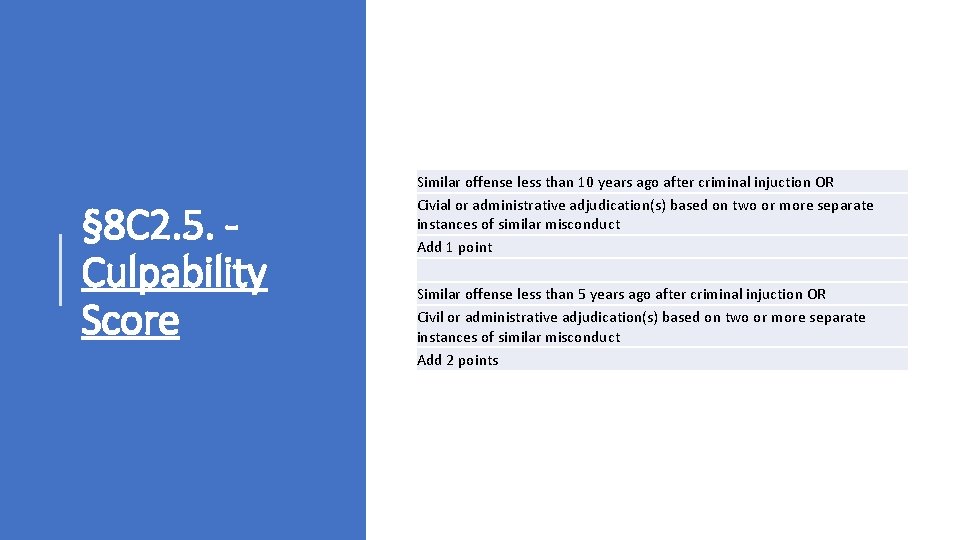
§ 8 C 2. 5. Culpability Score Similar offense less than 10 years ago after criminal injuction OR Civial or administrative adjudication(s) based on two or more separate instances of similar misconduct Add 1 point Similar offense less than 5 years ago after criminal injuction OR Civil or administrative adjudication(s) based on two or more separate instances of similar misconduct Add 2 points
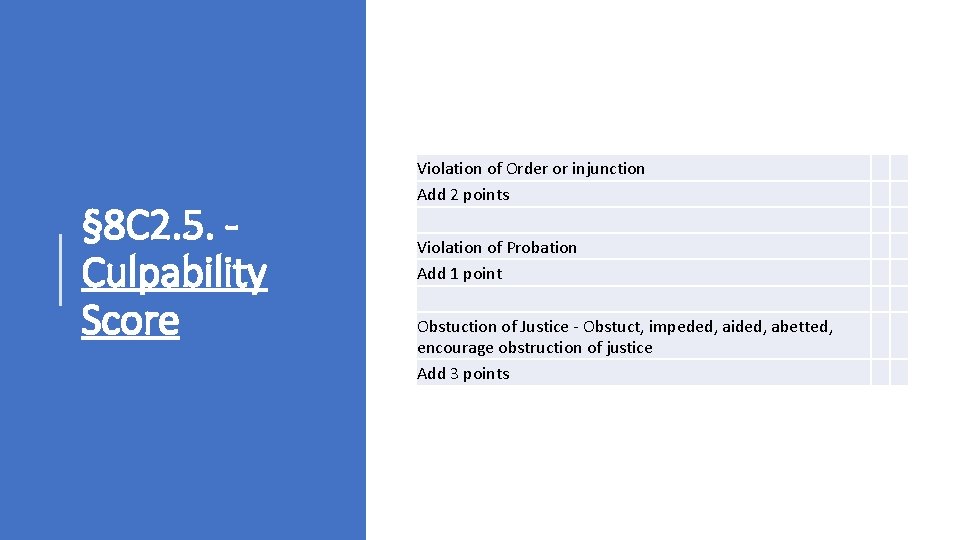
§ 8 C 2. 5. Culpability Score Violation of Order or injunction Add 2 points Violation of Probation Add 1 point Obstuction of Justice - Obstuct, impeded, aided, abetted, encourage obstruction of justice Add 3 points
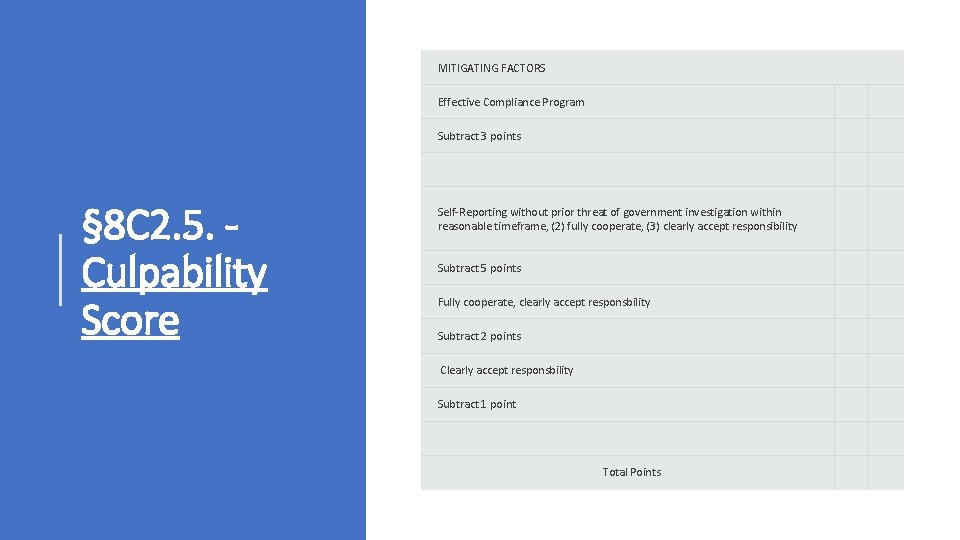
MITIGATING FACTORS Effective Compliance Program Subtract 3 points § 8 C 2. 5. Culpability Score Self-Reporting without prior threat of government investigation within reasonable timeframe, (2) fully cooperate, (3) clearly accept responsibility Subtract 5 points Fully cooperate, clearly accept responsbility Subtract 2 points Clearly accept responsbility Subtract 1 point Total Points
§ 8 C 2. 6. Minimum and Maximum Multipliers
§ 8 C 2. 7. Guideline Fine Range ― Organizations The minimum of the guideline fine range is determined by multiplying the base fine determined under § 8 C 2. 4 (Base Fine) by the applicable minimum multiplier determined under § 8 C 2. 6 (Minimum and Maximum Multipliers). The maximum of the guideline fine range is determined by multiplying the base fine determined under § 8 C 2. 4 (Base Fine) by the applicable maximum multiplier determined under § 8 C 2. 6 (Minimum and Maximum Multipliers).
Departures of Fines • Cause of a downward departures • Substantial assistances in investigation or prosecution of another organization that has committed an offense • The timeliness of the organization’s assistance • The nature and extent of the organization’s assistance • Public Entity • Member or Beneficiaries of the Organization as Victims • Remedial Costs that GREATLY Exceed Gain)
Departures of Fines • Cause of an upward departure • Offense results in death or bodily injury or foreseeable risk of such • Threat to National Security • Threat to the Environment • Threat to Market • Official corruption/Bribery • Not having a compliance and ethics program when required to do so