
Primer Benchmarking Research Administration Using Benchmark Data to
Primer: Benchmarking Research Administration Using Benchmark Data to Improve Performance
Agenda § Introduction § Institutional Internal Benchmarking § Institutional External Benchmarking 2

Introduction
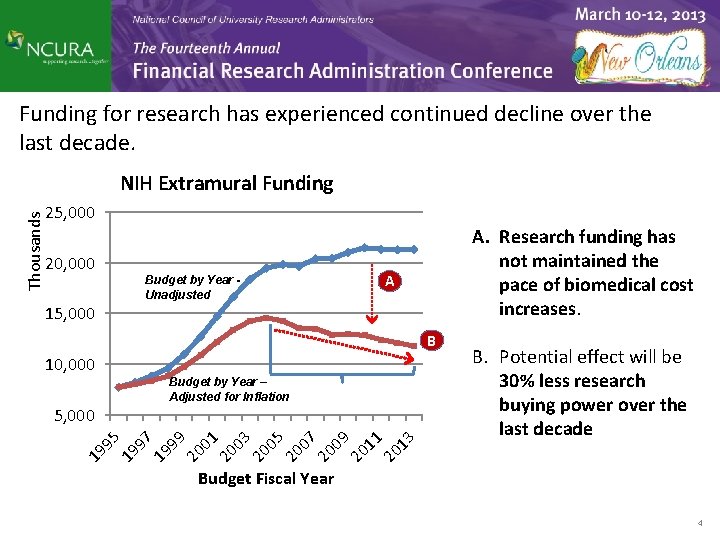
Funding for research has experienced continued decline over the last decade. 25, 000 20, 000 Budget by Year Unadjusted A. Research funding has not maintained the pace of biomedical cost increases. A 15, 000 B 10, 000 Budget by Year – Adjusted for Inflation 03 20 05 20 07 20 09 20 11 20 13 B. Potential effect will be 30% less research buying power over the last decade 20 01 20 99 19 97 19 95 5, 000 19 Thousands NIH Extramural Funding Budget Fiscal Year 4
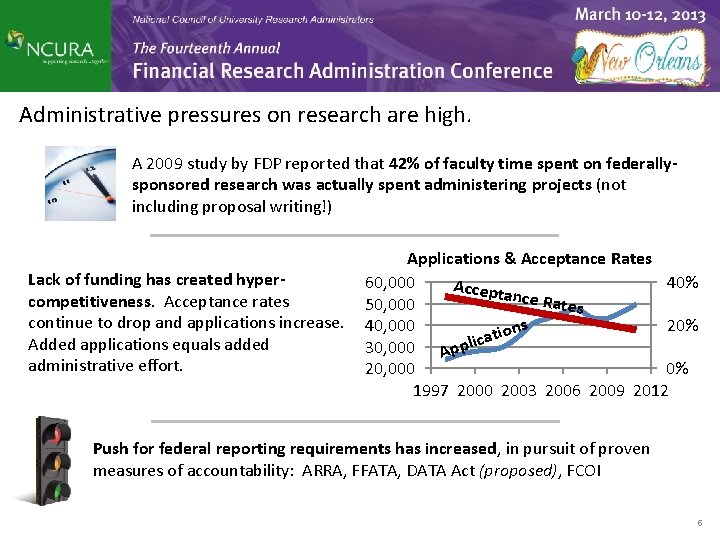
Administrative pressures on research are high. A 2009 study by FDP reported that 42% of faculty time spent on federallysponsored research was actually spent administering projects (not including proposal writing!) Applications & Acceptance Rates Lack of funding has created hyper 60, 000 40% Accepta n c e Rates competitiveness. Acceptance rates 50, 000 continue to drop and applications increase. 40, 000 20% ns o i t a Added applications equals added 30, 000 Applic administrative effort. 20, 000 0% 1997 2000 2003 2006 2009 2012 Push for federal reporting requirements has increased, in pursuit of proven measures of accountability: ARRA, FFATA, DATA Act (proposed), FCOI 5
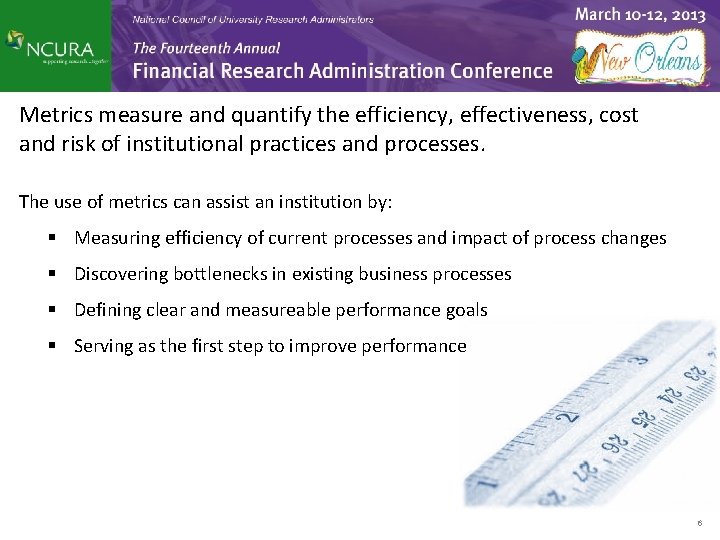
Metrics measure and quantify the efficiency, effectiveness, cost and risk of institutional practices and processes. The use of metrics can assist an institution by: § Measuring efficiency of current processes and impact of process changes § Discovering bottlenecks in existing business processes § Defining clear and measureable performance goals § Serving as the first step to improve performance 6

Why benchmark? A. Justify current or desired operational levels, e. g. “Is this reasonable? ” B. Identify opportunities to deliver research more effectively or efficiently. “Why are other institutions more successful? ” C. Measure and compare performance against a group of standard peers as well as aspirational peers – “Can we be the cutting edge? ” B A C 7
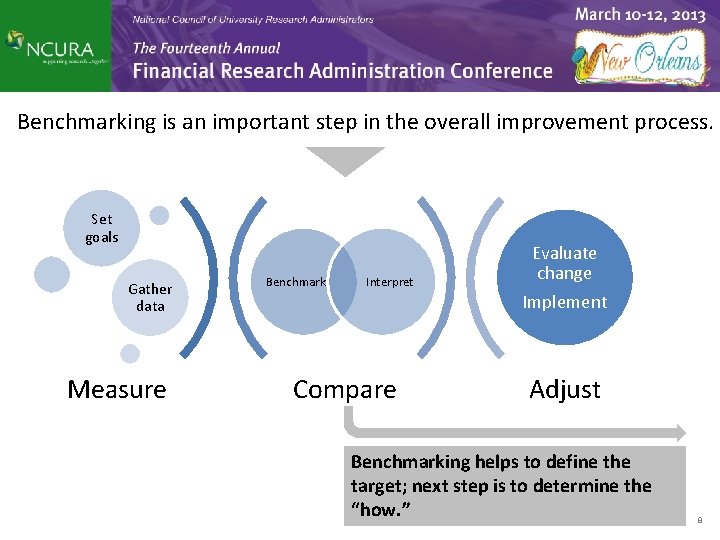
Benchmarking is an important step in the overall improvement process. Set goals Gather data Measure Benchmark Interpret Evaluate change Implement Compare Adjust Benchmarking helps to define the target; next step is to determine the “how. ” 8
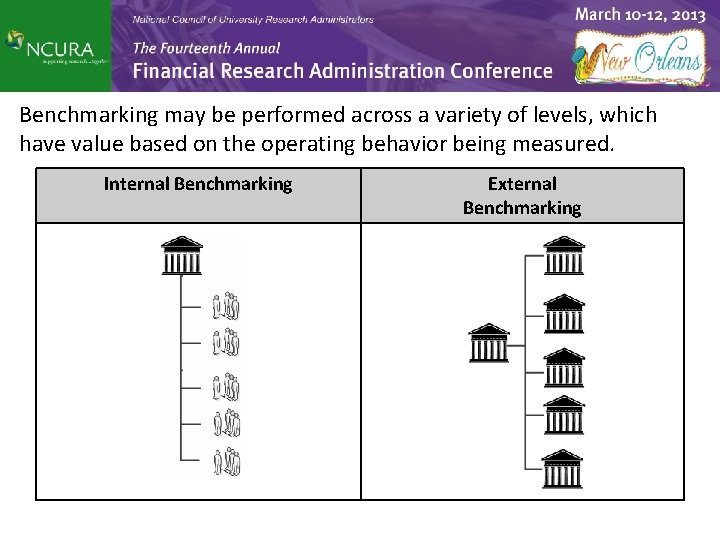
Benchmarking may be performed across a variety of levels, which have value based on the operating behavior being measured. Internal Benchmarking External Benchmarking
Institutional Internal Benchmarking
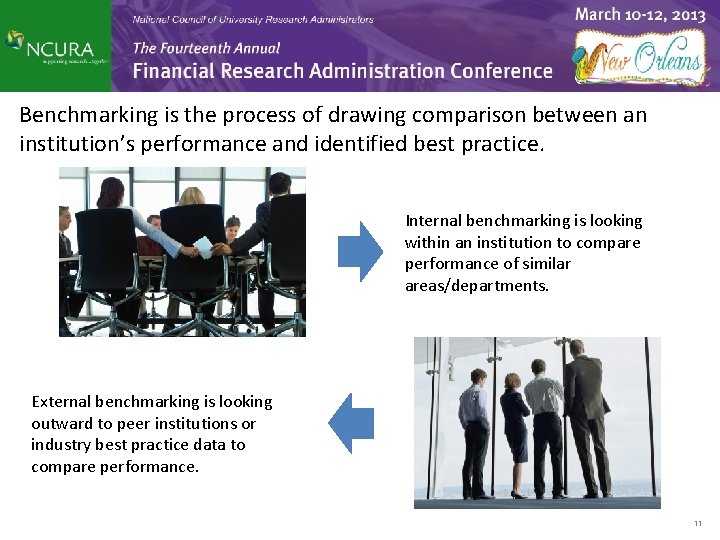
Benchmarking is the process of drawing comparison between an institution’s performance and identified best practice. Internal benchmarking is looking within an institution to compare performance of similar areas/departments. External benchmarking is looking outward to peer institutions or industry best practice data to compare performance. 11
Benefits to internal benchmarking: § Much easier to accomplish than external benchmarking § More buy-in from departments on need for improvement (maximizes apples to apples comparisons) § Fosters collaboration and idea-sharing across departments § Can reinforce institutional service level expectations and performance standards 12
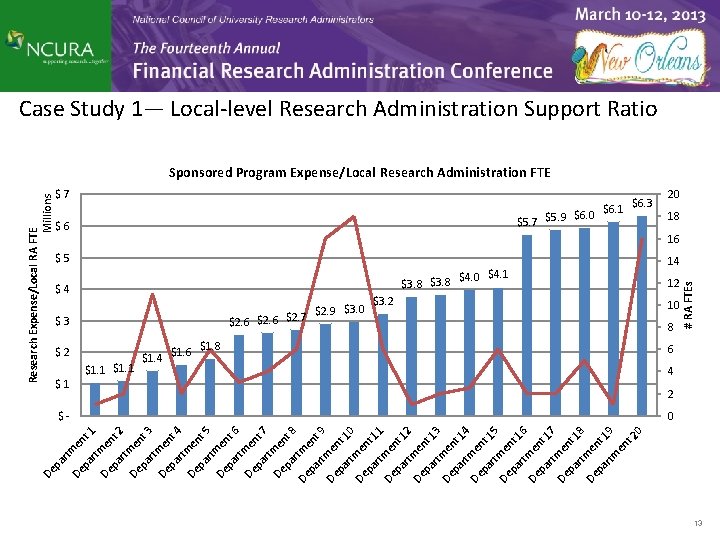
t De men pa t rtm 1 De e pa nt 2 rt De men pa t rtm 3 De e pa nt 4 rt De men pa t rtm 5 De e pa nt 6 rt De men pa t rtm 7 De e pa nt 8 r De tm pa ent 9 rt De men pa t rtm 10 De e pa nt 1 rt 1 De men pa t rtm 12 De e pa nt 1 rt 3 De men pa t rtm 14 De e pa nt 1 rt 5 De men pa t rtm 16 De e pa nt 1 rt 7 De men pa t rtm 18 De e pa nt 1 rtm 9 en t 2 0 ar De p Research Expense/Local RA FTE Millions $ 7 $ 6 $ 1 $6. 3 $6. 0 $5. 7 $5. 9 $ 5 $ 4 $4. 0 $4. 1 $3. 8 $ 3 $2. 9 $3. 0 $2. 6 $2. 7 $ 2 $1. 1 $1. 4 $3. 2 $1. 6 $1. 8 $ 12 10 8 # RA FTEs Case Study 1— Local-level Research Administration Support Ratio Sponsored Program Expense/Local Research Administration FTE 20 18 16 14 6 4 2 0 13
Using internal benchmarking to monitor compliance: § Better understand compliance area at an institutional level § Monitor specific compliance issues within departments § Identify and prevent waste § Identify departments/units with overall high risk profile § Self-assess/monitor department performance 14
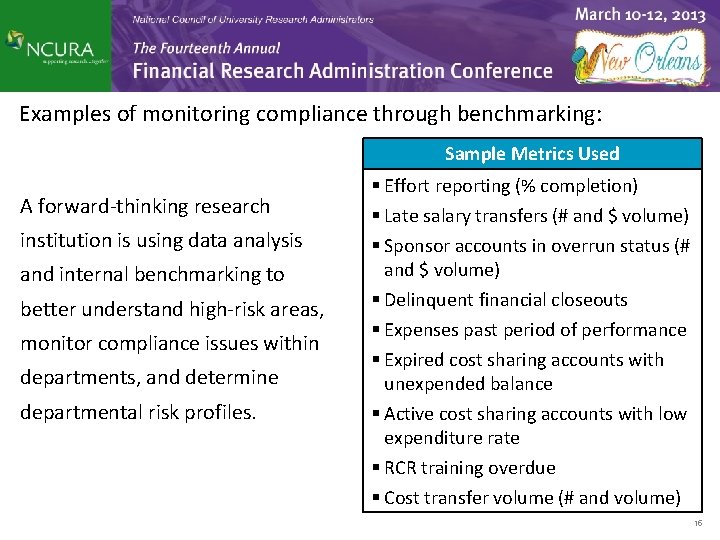
Examples of monitoring compliance through benchmarking: Sample Metrics Used A forward-thinking research institution is using data analysis and internal benchmarking to better understand high-risk areas, monitor compliance issues within departments, and determine departmental risk profiles. § Effort reporting (% completion) § Late salary transfers (# and $ volume) § Sponsor accounts in overrun status (# and $ volume) § Delinquent financial closeouts § Expenses past period of performance § Expired cost sharing accounts with unexpended balance § Active cost sharing accounts with low expenditure rate § RCR training overdue § Cost transfer volume (# and volume) 15
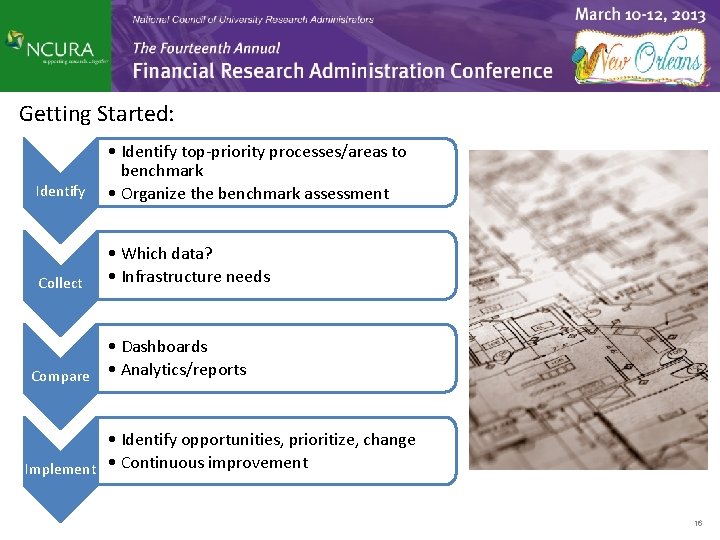
Getting Started: Identify • Identify top-priority processes/areas to benchmark • Organize the benchmark assessment Collect • Which data? • Infrastructure needs • Dashboards Compare • Analytics/reports • Identify opportunities, prioritize, change Implement • Continuous improvement 16
Institutional External Benchmarking
In order to draw a comparison between institutional performance and best practice – an institution must first determine what best practice is. External benchmarking can be industry wide - reaching farther than internal benchmarking. An outward view of peer institutions’ performance can identify industry best practice data for comparison. External benchmarking provides broader, industry-wide perspective, presenting a unique opportunity for an institution to measure and target improved performance in research administration. 18
There are unique benefits specific to externally benchmarking research administration in higher education. § Benefits: § Broader perspective for a reality-based “best practice” § Similar comparison basis § Core research administration processes § Difficulty of sponsored project environment § Willingness to share the play book 19
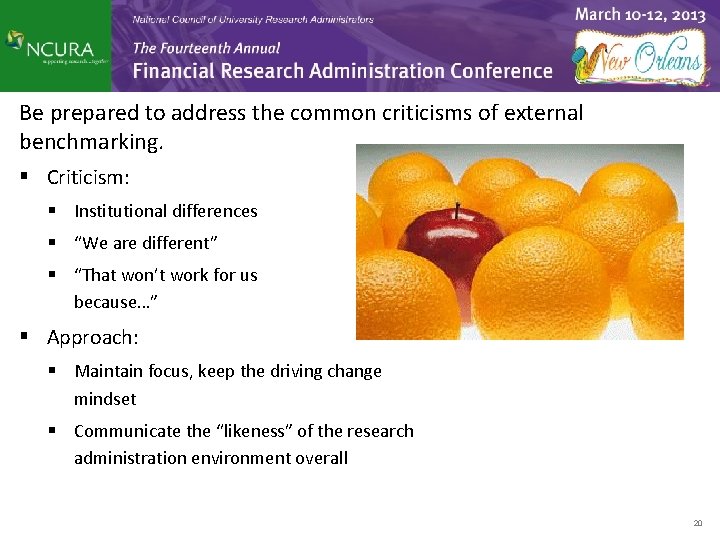
Be prepared to address the common criticisms of external benchmarking. § Criticism: § Institutional differences § “We are different” § “That won’t work for us because…” § Approach: § Maintain focus, keep the driving change mindset § Communicate the “likeness” of the research administration environment overall 20
Using benchmarking to attain balanced efficiency. § Recalibrate your institution’s efficiency standards • • • Recognize what is possible Set goals to achieve increased performance expectations Challenge and enable process owners and performers § Achieve Balance • • Cost-Benefit Considerations Average vs. Above Average vs. Top Tier § Find new solutions for existing problems • • Gain insight into peer institutions to bring fresh ideas to your institution Define new performance metrics • Identify options for innovative supporting organizational structures 21
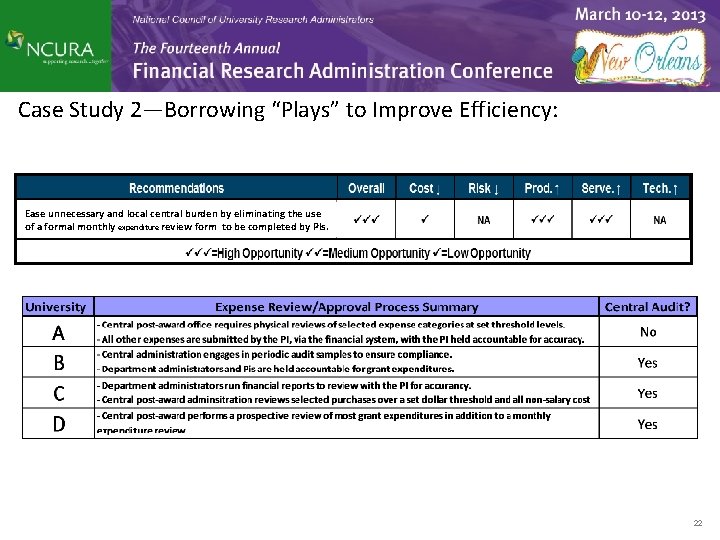
Case Study 2—Borrowing “Plays” to Improve Efficiency: Ease unnecessary and local central burden by eliminating the use of a formal monthly expenditure review form to be completed by PIs. 22
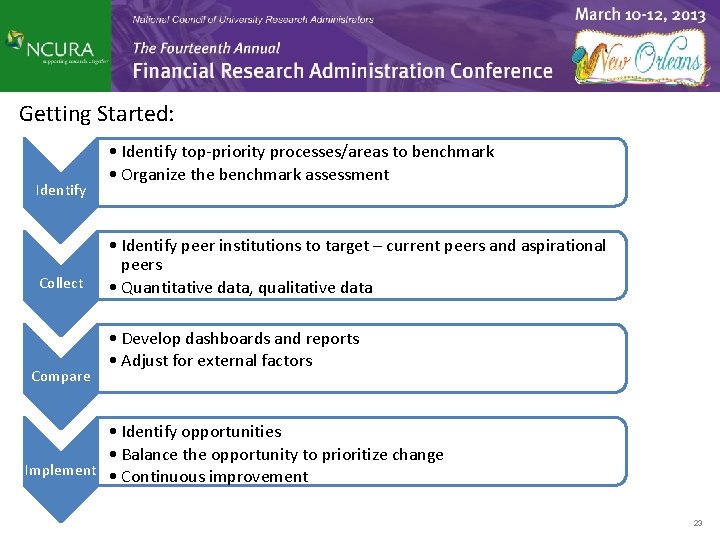
Getting Started: Identify Collect Compare • Identify top-priority processes/areas to benchmark • Organize the benchmark assessment • Identify peer institutions to target – current peers and aspirational peers • Quantitative data, qualitative data • Develop dashboards and reports • Adjust for external factors • Identify opportunities • Balance the opportunity to prioritize change Implement • Continuous improvement 23
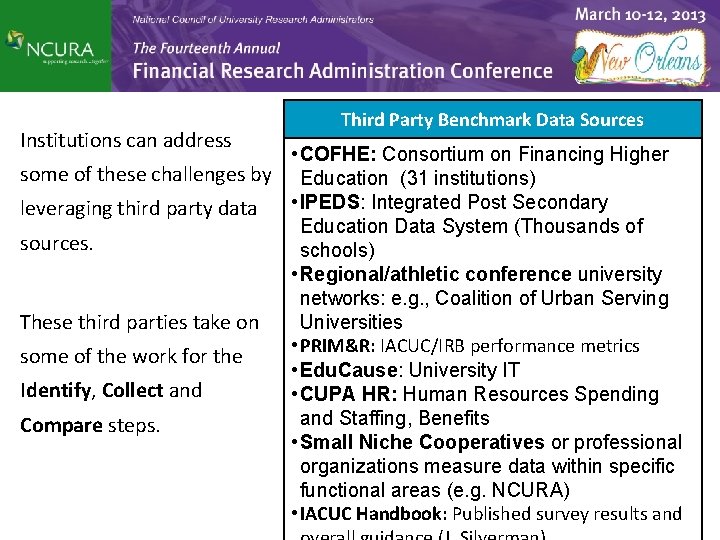
Institutions can address Third Party Benchmark Data Sources • COFHE: Consortium on Financing Higher some of these challenges by Education (31 institutions) leveraging third party data • IPEDS: Integrated Post Secondary Education Data System (Thousands of sources. schools) • Regional/athletic conference university networks: e. g. , Coalition of Urban Serving These third parties take on Universities • PRIM&R: IACUC/IRB performance metrics some of the work for the • Edu. Cause: University IT Identify, Collect and • CUPA HR: Human Resources Spending and Staffing, Benefits Compare steps. • Small Niche Cooperatives or professional organizations measure data within specific functional areas (e. g. NCURA) • IACUC Handbook: Published survey results and 24
Selected Findings From Recent Research Administration Benchmarking Efforts
RADIUS Benchmarking Survey In cooperation with several trusted industry partners, Huron Education is pleased to offer the RADIUS Benchmarking Survey, a comprehensive, education and research benchmarking source focused on spending, staffing and performance efficiency across several survey modules: § Sponsored Projects and Research Administration § Budgeting § Human Resources § Information Technology § Facilities § Procurement § Etc. 26
RADIUS Benchmarking Survey The following slides present some of the information and insights we have gained through our benchmarking experiences, including RADIUS. For information, please visit: https: //huronbenchmarkingsurvey. huronconsultinggroup. com/ 27
RADIUS Benchmarking Survey Data to be presented during FRA Concurrent Session. 28
- Slides: 28