
PRIME ECG Mapping The Science and the Practice





- Slides: 30
PRIME ECG Mapping: The Science and the Practice Brian O’Neil MD, FACEP Professor, Emergency Medicine, Wayne State University, Research Director, William Beaumont Hospital
When You are Trying to Get a Clear Idea of Something Be Sure to Get the Full View
It’s All About Resolution VS PONG KONG
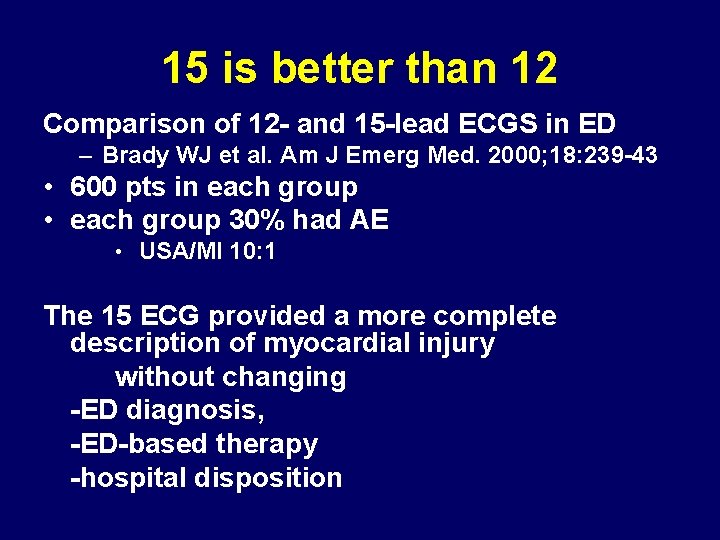
15 is better than 12 Comparison of 12 - and 15 -lead ECGS in ED – Brady WJ et al. Am J Emerg Med. 2000; 18: 239 -43 • 600 pts in each group • each group 30% had AE • USA/MI 10: 1 The 15 ECG provided a more complete description of myocardial injury without changing -ED diagnosis, -ED-based therapy -hospital disposition
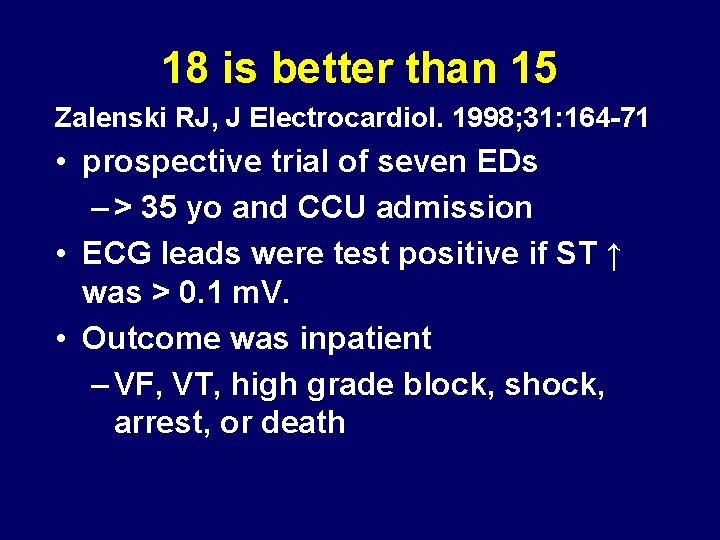
18 is better than 15 Zalenski RJ, J Electrocardiol. 1998; 31: 164 -71 • prospective trial of seven EDs – > 35 yo and CCU admission • ECG leads were test positive if ST ↑ was > 0. 1 m. V. • Outcome was inpatient – VF, VT, high grade block, shock, arrest, or death
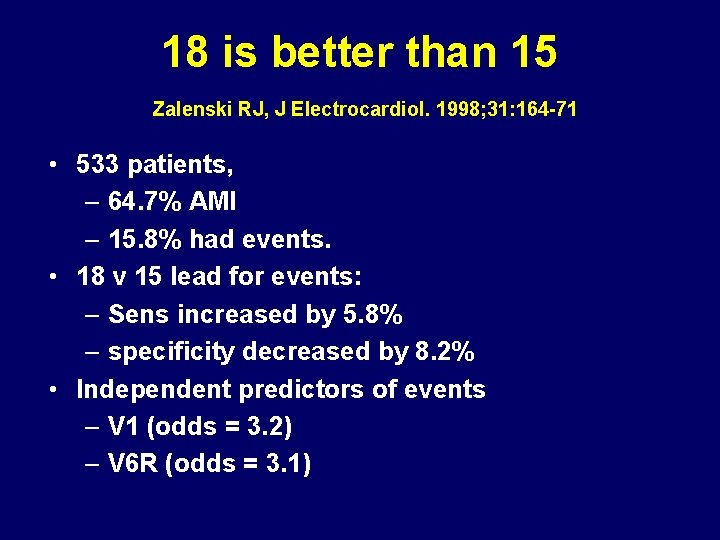
18 is better than 15 Zalenski RJ, J Electrocardiol. 1998; 31: 164 -71 • 533 patients, – 64. 7% AMI – 15. 8% had events. • 18 v 15 lead for events: – Sens increased by 5. 8% – specificity decreased by 8. 2% • Independent predictors of events – V 1 (odds = 3. 2) – V 6 R (odds = 3. 1)
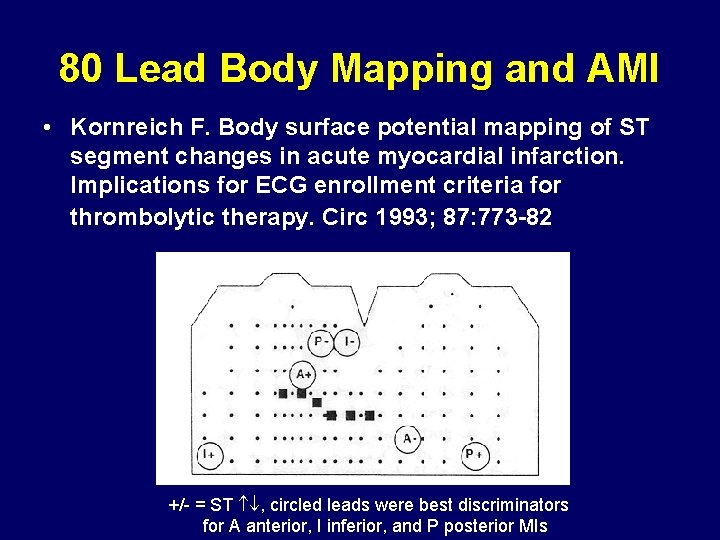
80 Lead Body Mapping and AMI • Kornreich F. Body surface potential mapping of ST segment changes in acute myocardial infarction. Implications for ECG enrollment criteria for thrombolytic therapy. Circ 1993; 87: 773 -82 +/- = ST , circled leads were best discriminators for A anterior, I inferior, and P posterior MIs
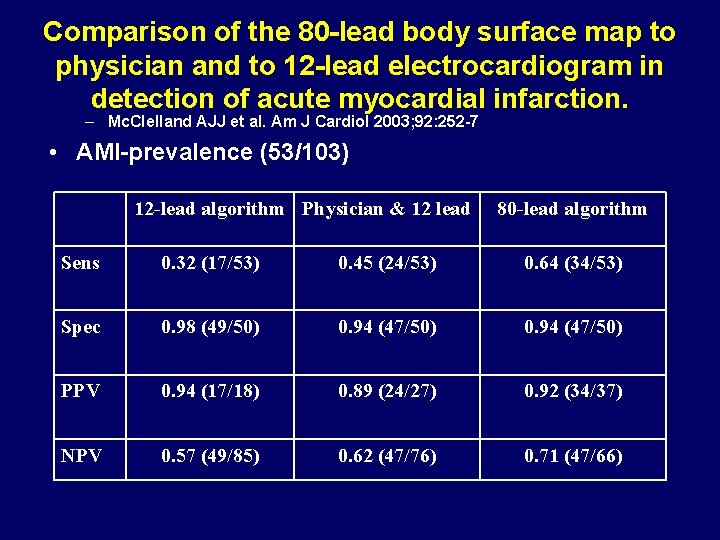
Comparison of the 80 -lead body surface map to physician and to 12 -lead electrocardiogram in detection of acute myocardial infarction. – Mc. Clelland AJJ et al. Am J Cardiol 2003; 92: 252 -7 • AMI-prevalence (53/103) 12 -lead algorithm Physician & 12 lead 80 -lead algorithm Sens 0. 32 (17/53) 0. 45 (24/53) 0. 64 (34/53) Spec 0. 98 (49/50) 0. 94 (47/50) PPV 0. 94 (17/18) 0. 89 (24/27) 0. 92 (34/37) NPV 0. 57 (49/85) 0. 62 (47/76) 0. 71 (47/66)
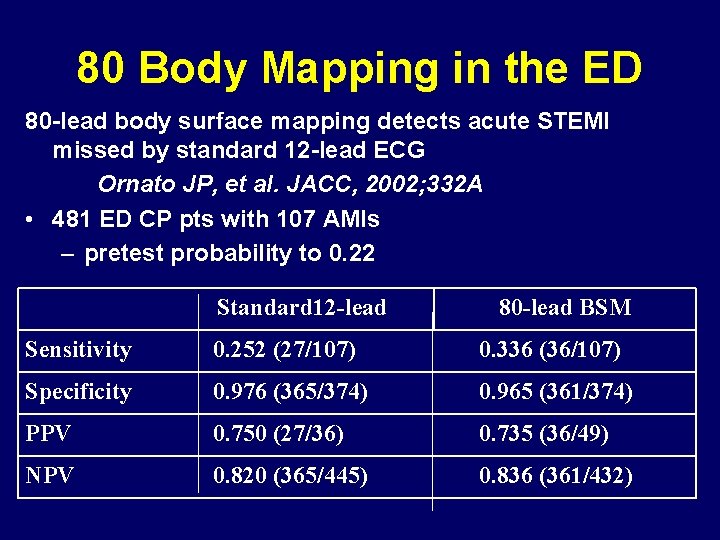
80 Body Mapping in the ED 80 -lead body surface mapping detects acute STEMI missed by standard 12 -lead ECG Ornato JP, et al. JACC, 2002; 332 A • 481 ED CP pts with 107 AMIs – pretest probability to 0. 22 Standard 12 -lead 80 -lead BSM Sensitivity 0. 252 (27/107) 0. 336 (36/107) Specificity 0. 976 (365/374) 0. 965 (361/374) PPV 0. 750 (27/36) 0. 735 (36/49) NPV 0. 820 (365/445) 0. 836 (361/432)
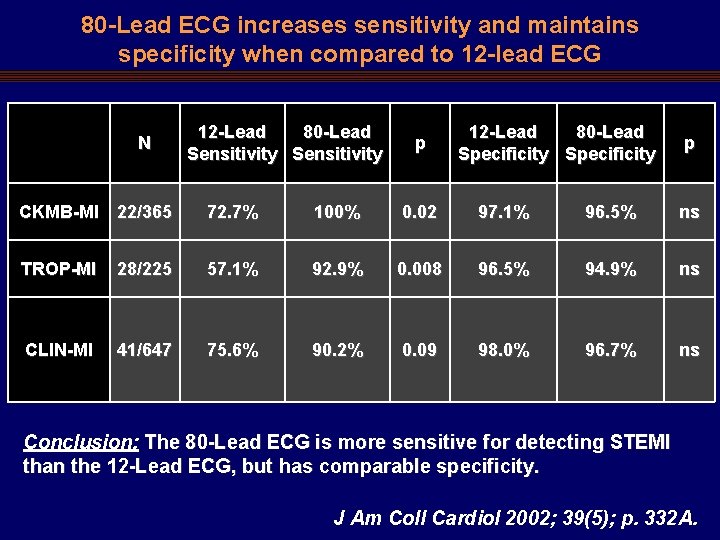
80 -Lead ECG increases sensitivity and maintains specificity when compared to 12 -lead ECG N 12 -Lead 80 -Lead Sensitivity p 12 -Lead 80 -Lead Specificity p CKMB-MI 22/365 72. 7% 100% 0. 02 97. 1% 96. 5% ns TROP-MI 28/225 57. 1% 92. 9% 0. 008 96. 5% 94. 9% ns CLIN-MI 41/647 75. 6% 90. 2% 0. 09 98. 0% 96. 7% ns Conclusion: The 80 -Lead ECG is more sensitive for detecting STEMI than the 12 -Lead ECG, but has comparable specificity. J Am Coll Cardiol 2002; 39(5); p. 332 A.
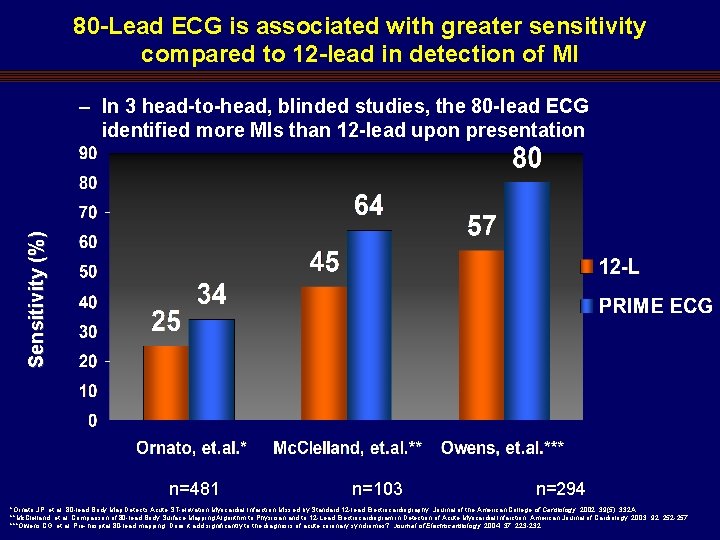
80 -Lead ECG is associated with greater sensitivity compared to 12 -lead in detection of MI Sensitivity (%) – In 3 head-to-head, blinded studies, the 80 -lead ECG identified more MIs than 12 -lead upon presentation n=481 n=103 n=294 *Ornato JP, et al; 80 -lead Body Map Detects Acute ST-elevation Myocardial Infarction Missed by Standard 12 -lead Electrocardiography, Journal of the American College of Cardiology, 2002; 39(5): 332 A **Mc. Clelland, et al; Comparison of 80 -lead Body Surface Mapping Algorithm to Physician and to 12 -Lead Electrocardiogram in Detection of Acute Myocardial Infarction, American Journal of Cardiology, 2003; 92: 252 -257 ***Owens CG, et al; Pre-hospital 80 -lead mapping: Does it add significantly to the diagnosis of acute coronary syndromes? , Journal of Electrocardiology, 2004; 37: 223 -232
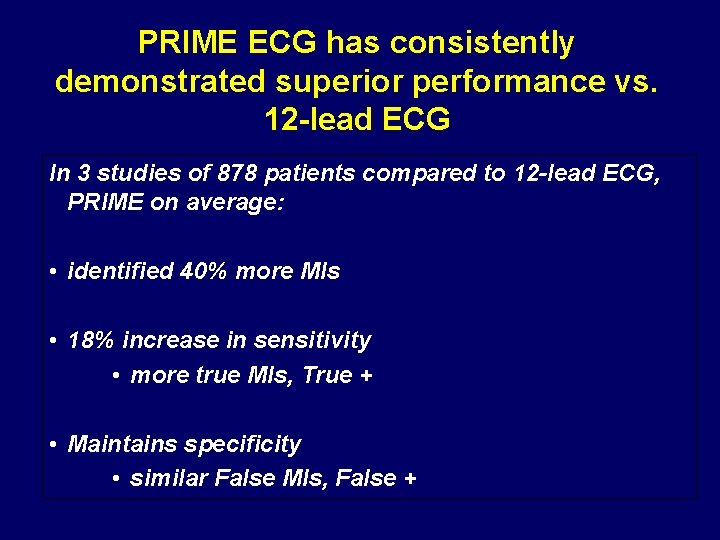
PRIME ECG has consistently demonstrated superior performance vs. 12 -lead ECG In 3 studies of 878 patients compared to 12 -lead ECG, PRIME on average: • identified 40% more MIs • 18% increase in sensitivity • more true MIs, True + • Maintains specificity • similar False MIs, False +
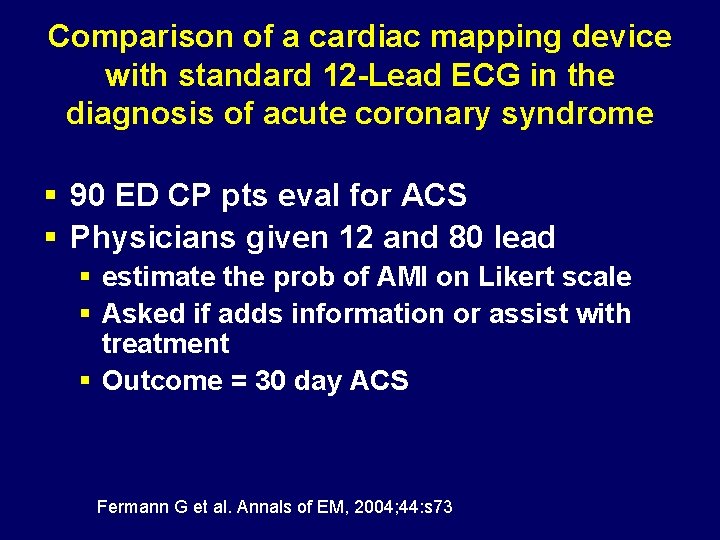
Comparison of a cardiac mapping device with standard 12 -Lead ECG in the diagnosis of acute coronary syndrome § 90 ED CP pts eval for ACS § Physicians given 12 and 80 lead § estimate the prob of AMI on Likert scale § Asked if adds information or assist with treatment § Outcome = 30 day ACS Fermann G et al. Annals of EM, 2004; 44: s 73
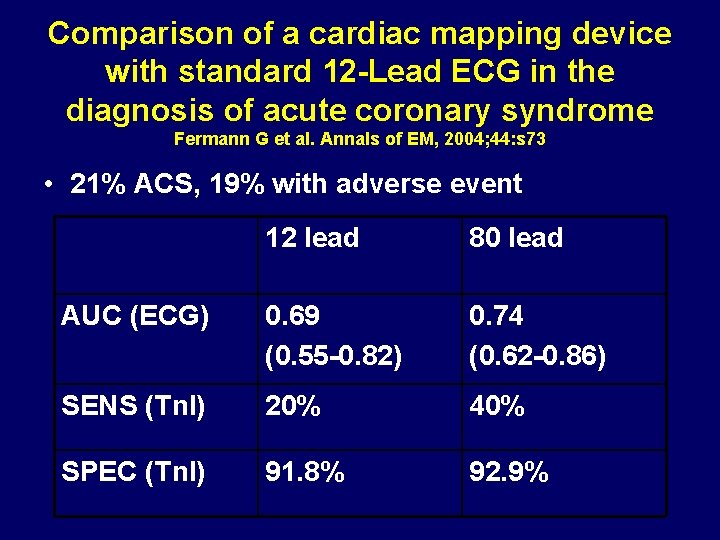
Comparison of a cardiac mapping device with standard 12 -Lead ECG in the diagnosis of acute coronary syndrome Fermann G et al. Annals of EM, 2004; 44: s 73 • 21% ACS, 19% with adverse event 12 lead 80 lead AUC (ECG) 0. 69 (0. 55 -0. 82) 0. 74 (0. 62 -0. 86) SENS (Tn. I) 20% 40% SPEC (Tn. I) 91. 8% 92. 9%
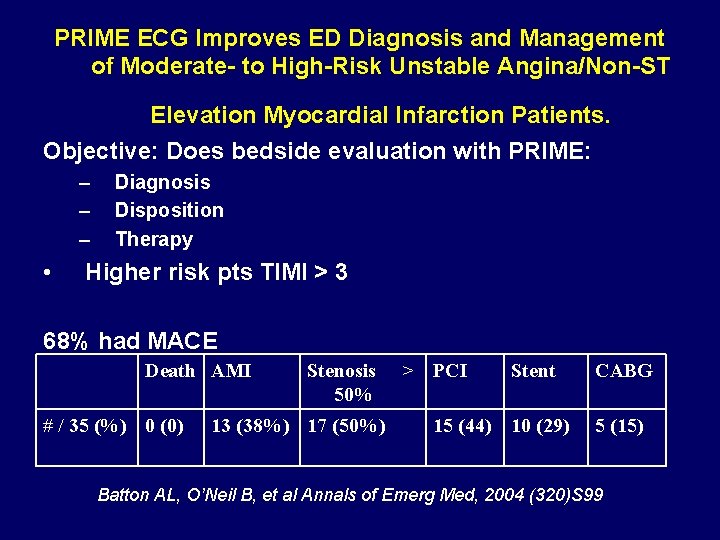
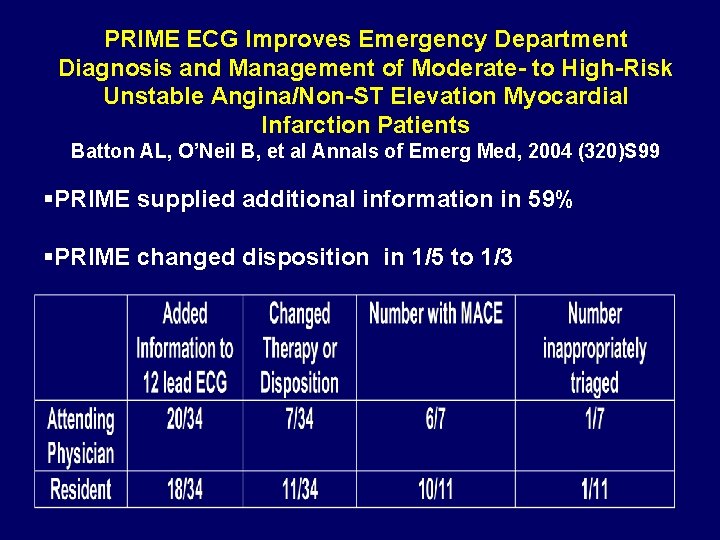
PRIME ECG Improves ED Diagnosis and Management of Moderate- to High-Risk Unstable Angina/Non-ST Elevation Myocardial Infarction Patients. Objective: Does bedside evaluation with PRIME: – – – • Diagnosis Disposition Therapy Higher risk pts TIMI > 3 68% had MACE Death AMI # / 35 (%) 0 (0) Stenosis 50% 13 (38%) 17 (50%) > PCI Stent 15 (44) 10 (29) CABG 5 (15) Batton AL, O’Neil B, et al Annals of Emerg Med, 2004 (320)S 99
PRIME ECG Improves Emergency Department Diagnosis and Management of Moderate- to High-Risk Unstable Angina/Non-ST Elevation Myocardial Infarction Patients Batton AL, O’Neil B, et al Annals of Emerg Med, 2004 (320)S 99 §PRIME supplied additional information in 59% §PRIME changed disposition in 1/5 to 1/3
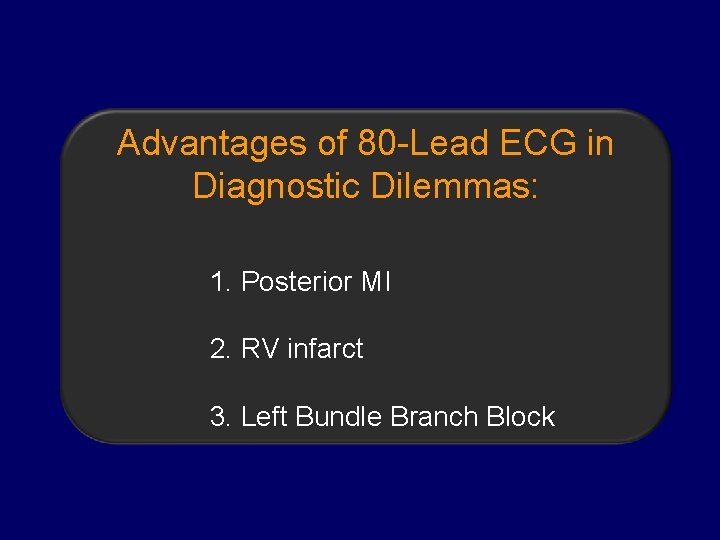
Advantages of 80 -Lead ECG in Diagnostic Dilemmas: 1. Posterior MI 2. RV infarct 3. Left Bundle Branch Block
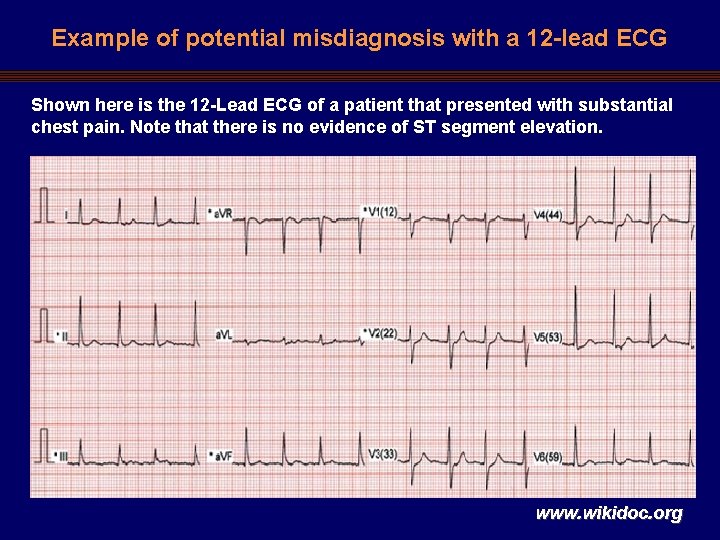
Example of potential misdiagnosis with a 12 -lead ECG Shown here is the 12 -Lead ECG of a patient that presented with substantial chest pain. Note that there is no evidence of ST segment elevation. www. wikidoc. org
Leads 68, 69 & 72 meet criteria for STEMI Anterior Posterior 3+ contiguous leads; >. 5 mm ST elevation, with reciprocal depression (seen in V 3/V 4 area) 80 -lead Single-Beat Display with pop-up window. [In this example, a series of sequential beats can be observed by placing a cursor over any beat (shows instantly in the pop-up window). ] [Actual screen shot for same patient. ]
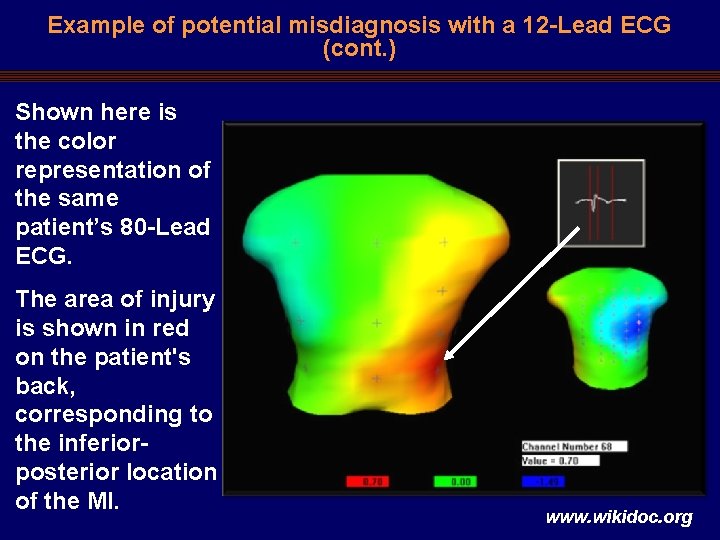
Example of potential misdiagnosis with a 12 -Lead ECG (cont. ) Shown here is the color representation of the same patient’s 80 -Lead ECG. The area of injury is shown in red on the patient's back, corresponding to the inferiorposterior location of the MI. www. wikidoc. org
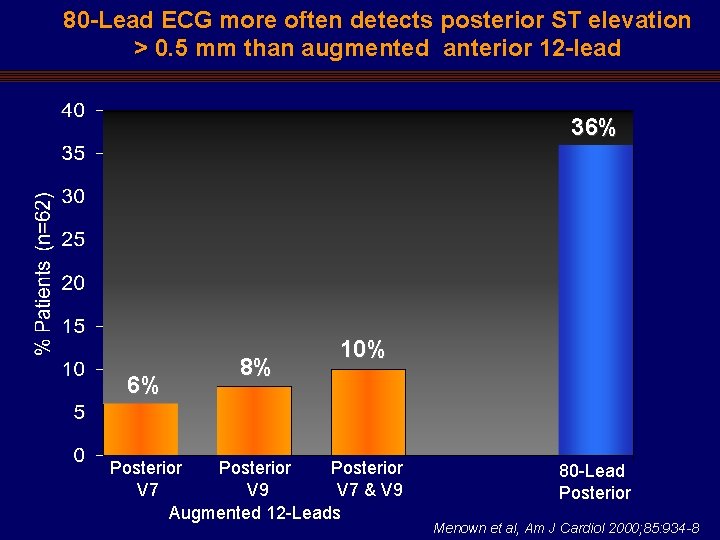
80 -Lead ECG more often detects posterior ST elevation > 0. 5 mm than augmented anterior 12 -lead 36% 6% 8% 10% Posterior V 7 V 9 V 7 & V 9 Augmented 12 -Leads 80 -Lead Posterior Menown et al, Am J Cardiol 2000; 85: 934 -8
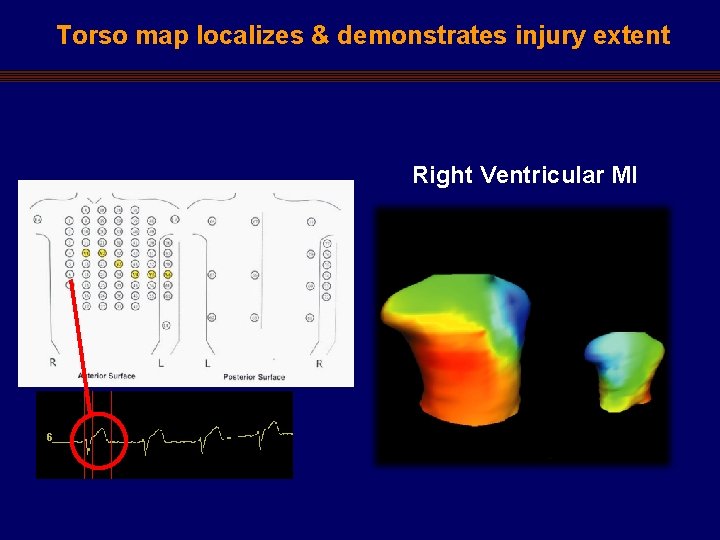
Torso map localizes & demonstrates injury extent Right Ventricular MI
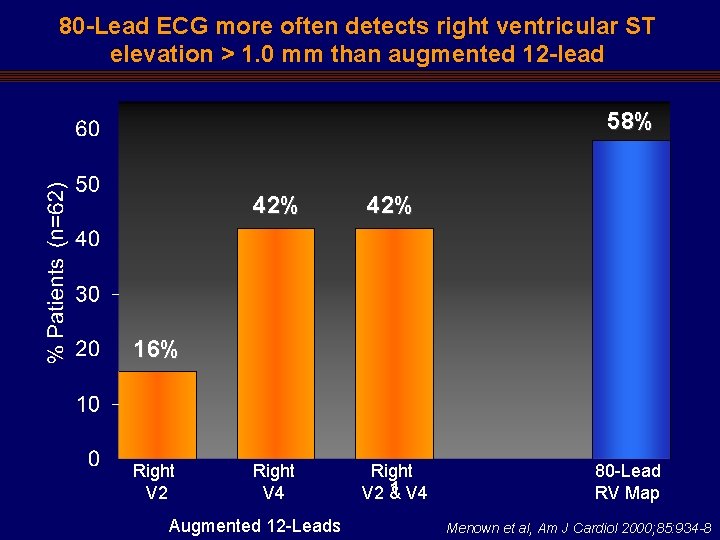
80 -Lead ECG more often detects right ventricular ST elevation > 1. 0 mm than augmented 12 -lead 58% 42% Right V 4 Right V 2 & V 4 16% Right V 2 Augmented 12 -Leads 80 -Lead RV Map Menown et al, Am J Cardiol 2000; 85: 934 -8
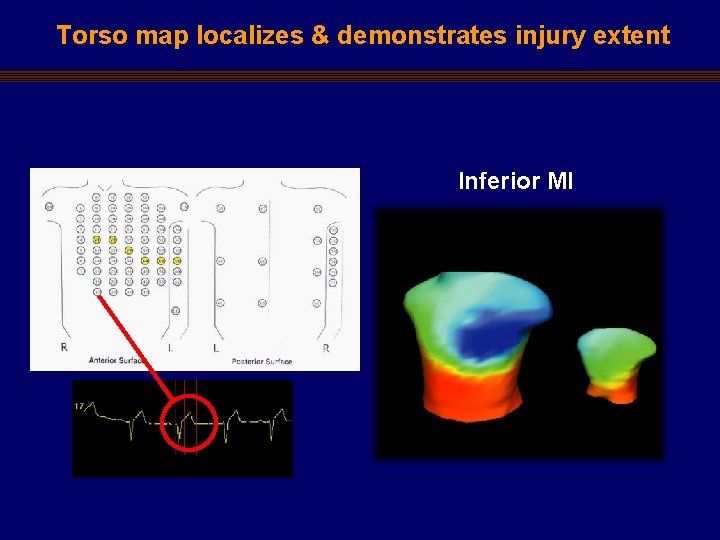
Torso map localizes & demonstrates injury extent Inferior MI
Advantages of 80 -Lead ECG in Diagnostic Dilemmas: Left Bundle Branch Block
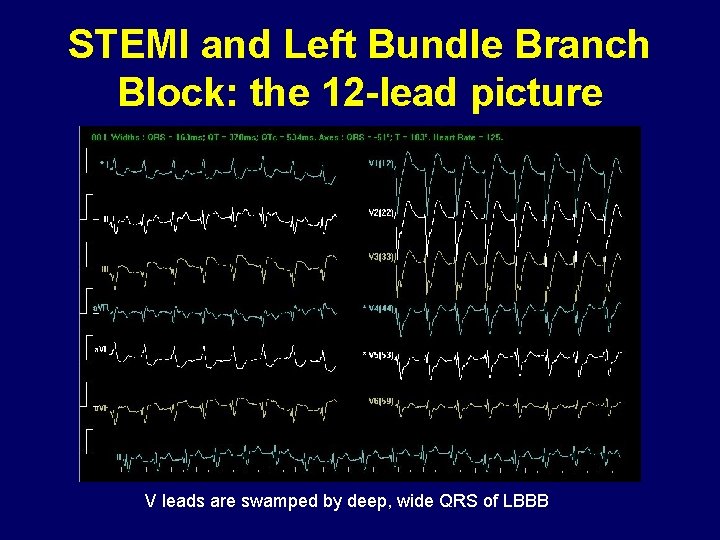
STEMI and Left Bundle Branch Block: the 12 -lead picture V leads are swamped by deep, wide QRS of LBBB
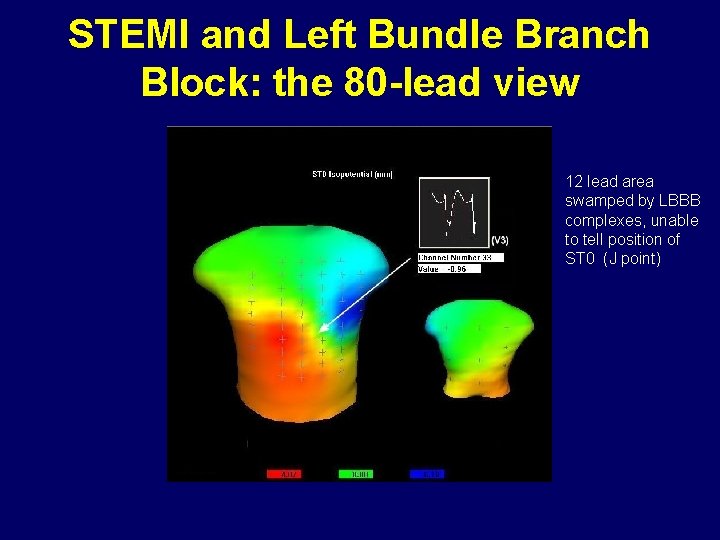
STEMI and Left Bundle Branch Block: the 80 -lead view 12 lead area swamped by LBBB complexes, unable to tell position of ST 0 (J point)
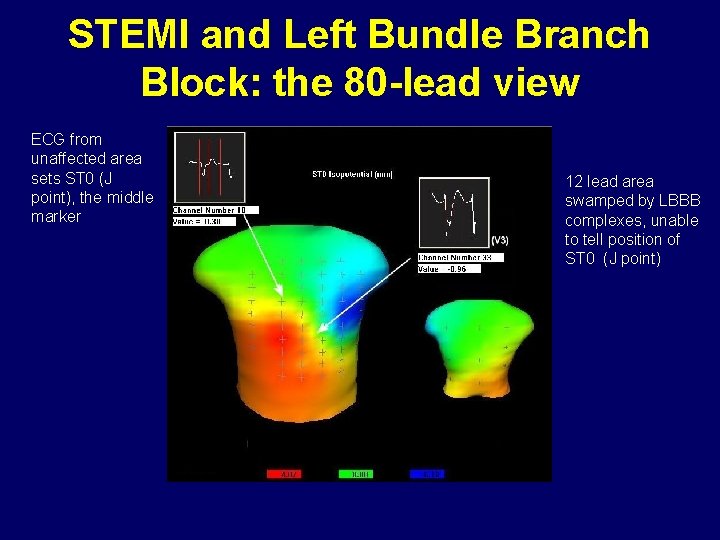
STEMI and Left Bundle Branch Block: the 80 -lead view ECG from unaffected area sets ST 0 (J point), the middle marker 12 lead area swamped by LBBB complexes, unable to tell position of ST 0 (J point)
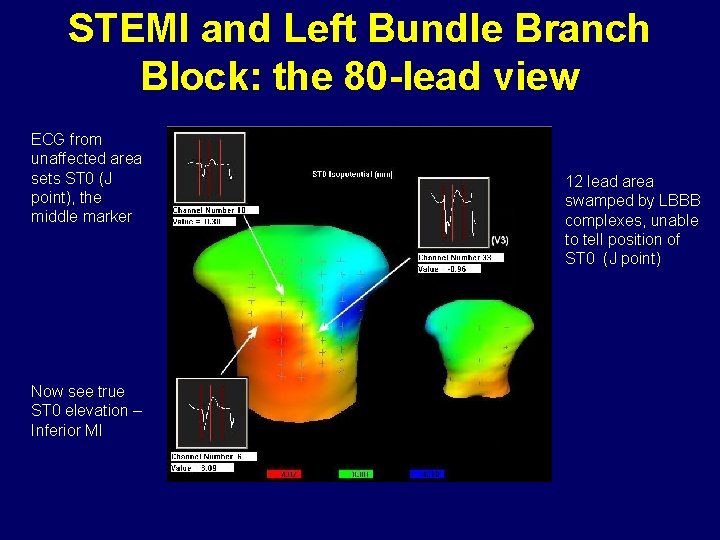
STEMI and Left Bundle Branch Block: the 80 -lead view ECG from unaffected area sets ST 0 (J point), the middle marker Now see true ST 0 elevation – Inferior MI 12 lead area swamped by LBBB complexes, unable to tell position of ST 0 (J point)
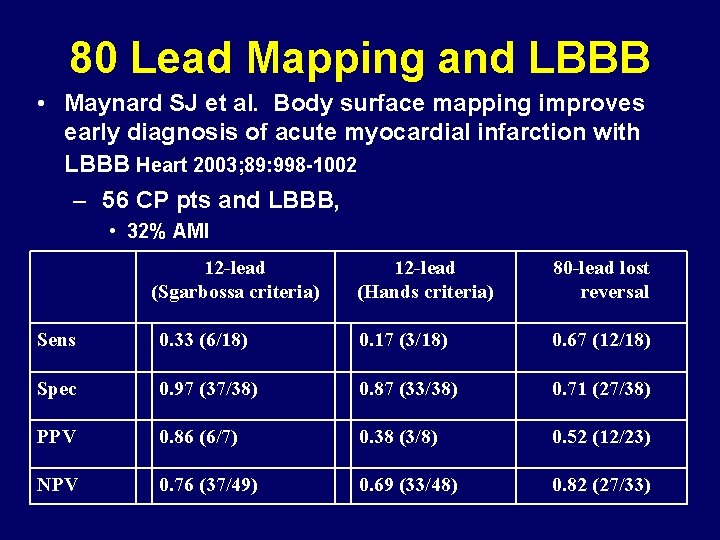
80 Lead Mapping and LBBB • Maynard SJ et al. Body surface mapping improves early diagnosis of acute myocardial infarction with LBBB Heart 2003; 89: 998 -1002 – 56 CP pts and LBBB, • 32% AMI 12 -lead (Sgarbossa criteria) 12 -lead (Hands criteria) 80 -lead lost reversal Sens 0. 33 (6/18) 0. 17 (3/18) 0. 67 (12/18) Spec 0. 97 (37/38) 0. 87 (33/38) 0. 71 (27/38) PPV 0. 86 (6/7) 0. 38 (3/8) 0. 52 (12/23) NPV 0. 76 (37/49) 0. 69 (33/48) 0. 82 (27/33)