
PRIMAVERA High resolution climate modelling what are the







- Slides: 41
PRIMAVERA: High resolution climate modelling – what are the requirements from ECVs? Malcolm Roberts, Met Office Hadley Centre Pier Luigi Vidale, NCAS-Climate, University of Reading Rein Haarsma, KNMI With thanks to many other contributors, including: A. Shelly, P. Hyder, T. Johns, N. Rayner, C. Birch M. -E. Demory, R. Schiemann T. Koenick, P. Doblas-Reyes, O. Bellprat, C. Prodhomme CCI-CMUG meeting, Norrköping, May 2015
Talk outline • Overview of H 2020 PRIMAVERA and CMIP 6 High. Res. MIP • Examples of science questions • Requirements of ECVs – Examples of how ECVs are or could be used • Some initial Met Office work with CCI SST
Malcolm Roberts, Met Office (coordinator) Pier Luigi Vidale, Univ. of Reading (scientific coordinator) PRocess-based climate s. IMulation: Ad. Vances in high resolution modelling and European climate Risk Assessment Goal: • to deliver novel, advanced and well-evaluated high-resolution global climate models (GCMs), capable of simulating and projecting regional climate with unprecedented fidelity, out to 2050. To deliver: • innovative climate science and a new generation of European advanced GCMs. • improve understanding of the drivers of variability and change in European climate, including extremes, which continue to be characterised by high uncertainty • new climate information that is tailored, actionable and strengthens societal risk management decisions with sector-specific end-users • new insights into climate processes using eddy-resolving ocean and explicit convection atmosphere models To run for 4 years from Nov 2015 including 19 partners across Europe, funded by the Horizon 2020 call SC 5 -1 -2014 - Advanced Earth System Models proj. badc. rl. ac. uk/primavera Core integrations in PRIMAVERA will form much of the European contribution to CMIP 6 High. Res. MIP http: //www. wcrp-climate. org/index. php/modelling-wgcm-mip-catalogue/429 -wgcm-hiresmip
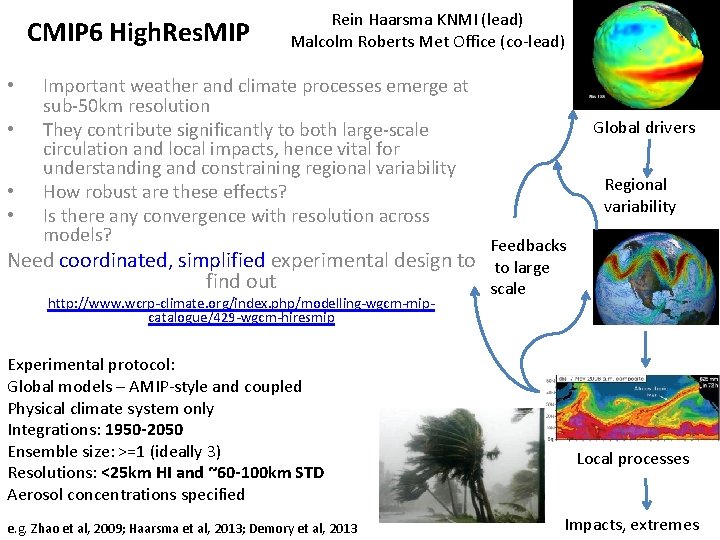
CMIP 6 High. Res. MIP • • Rein Haarsma KNMI (lead) Malcolm Roberts Met Office (co-lead) Important weather and climate processes emerge at sub-50 km resolution They contribute significantly to both large-scale circulation and local impacts, hence vital for understanding and constraining regional variability How robust are these effects? Is there any convergence with resolution across models? Need coordinated, simplified experimental design to find out http: //www. wcrp-climate. org/index. php/modelling-wgcm-mipcatalogue/429 -wgcm-hiresmip Experimental protocol: Global models – AMIP-style and coupled Physical climate system only Integrations: 1950 -2050 Ensemble size: >=1 (ideally 3) Resolutions: <25 km HI and ~60 -100 km STD Aerosol concentrations specified e. g. Zhao et al, 2009; Haarsma et al, 2013; Demory et al, 2013 Global drivers Regional variability Feedbacks to large scale Local processes Impacts, extremes
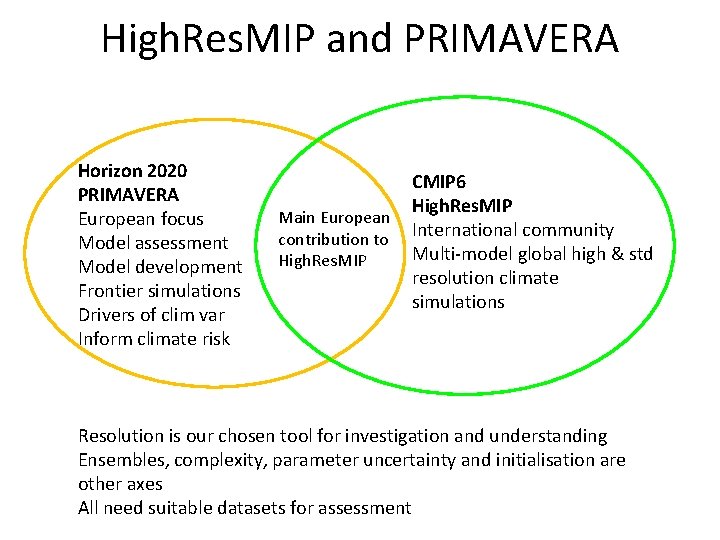
High. Res. MIP and PRIMAVERA Horizon 2020 PRIMAVERA European focus Model assessment Model development Frontier simulations Drivers of clim var Inform climate risk Main European contribution to High. Res. MIP CMIP 6 High. Res. MIP International community Multi-model global high & std resolution climate simulations Resolution is our chosen tool for investigation and understanding Ensembles, complexity, parameter uncertainty and initialisation are other axes All need suitable datasets for assessment
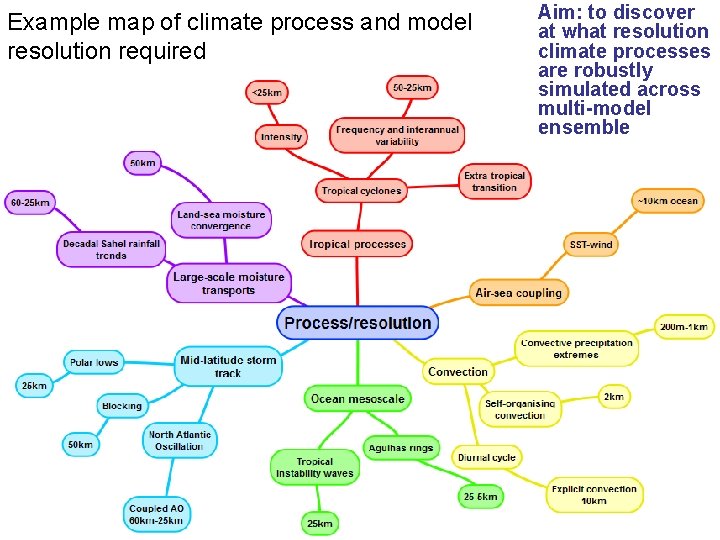
Example map of climate process and model resolution required Aim: to discover at what resolution climate processes are. Joint robustly Weather and Climate Research Programme simulated across multi-model ensemble A partnership in climate research
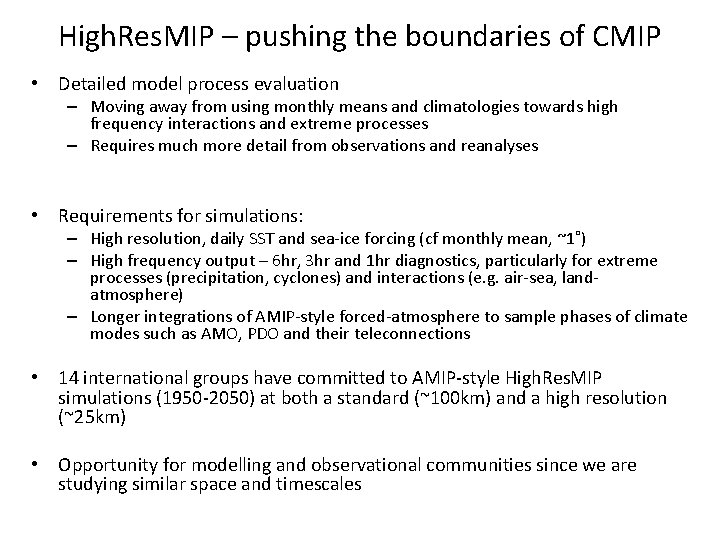
High. Res. MIP – pushing the boundaries of CMIP • Detailed model process evaluation – Moving away from using monthly means and climatologies towards high frequency interactions and extreme processes – Requires much more detail from observations and reanalyses • Requirements for simulations: – High resolution, daily SST and sea-ice forcing (cf monthly mean, ~1˚) – High frequency output – 6 hr, 3 hr and 1 hr diagnostics, particularly for extreme processes (precipitation, cyclones) and interactions (e. g. air-sea, landatmosphere) – Longer integrations of AMIP-style forced-atmosphere to sample phases of climate modes such as AMO, PDO and their teleconnections • 14 international groups have committed to AMIP-style High. Res. MIP simulations (1950 -2050) at both a standard (~100 km) and a high resolution (~25 km) • Opportunity for modelling and observational communities since we are studying similar space and timescales
European High. Res. MIP resolutions (as part of PRIMAVERA) • Concentrate on horizontal resolution – keep vertical resolution the same • Global atmosphere resolutions: range from 150 km to 6 km • Global ocean resolutions: from 1˚ to 1/12˚
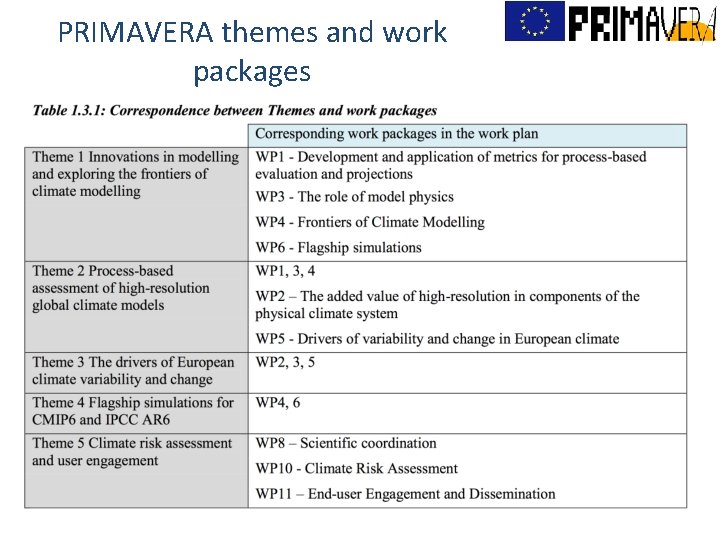
PRIMAVERA themes and work packages
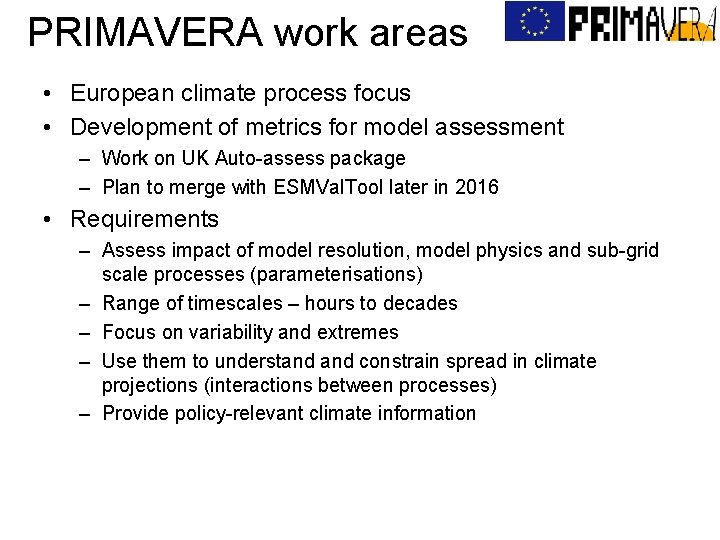
PRIMAVERA work areas • European climate process focus • Development of metrics for model assessment – Work on UK Auto-assess package – Plan to merge with ESMVal. Tool later in 2016 • Requirements – Assess impact of model resolution, model physics and sub-grid scale processes (parameterisations) – Range of timescales – hours to decades – Focus on variability and extremes – Use them to understand constrain spread in climate projections (interactions between processes) – Provide policy-relevant climate information
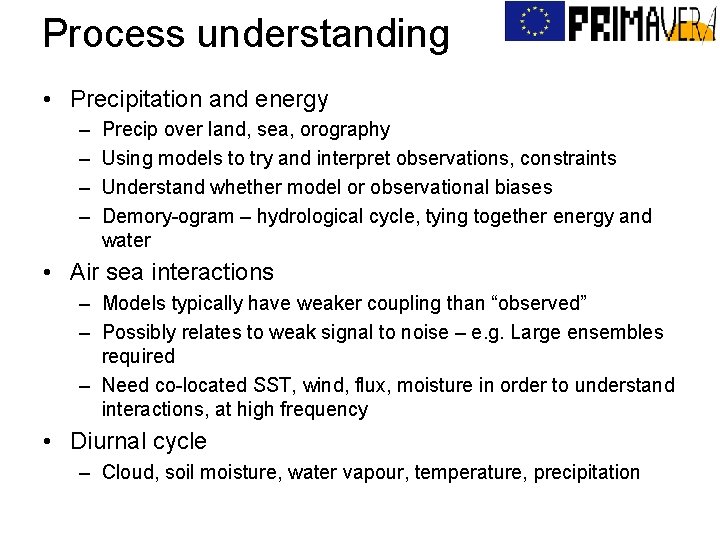
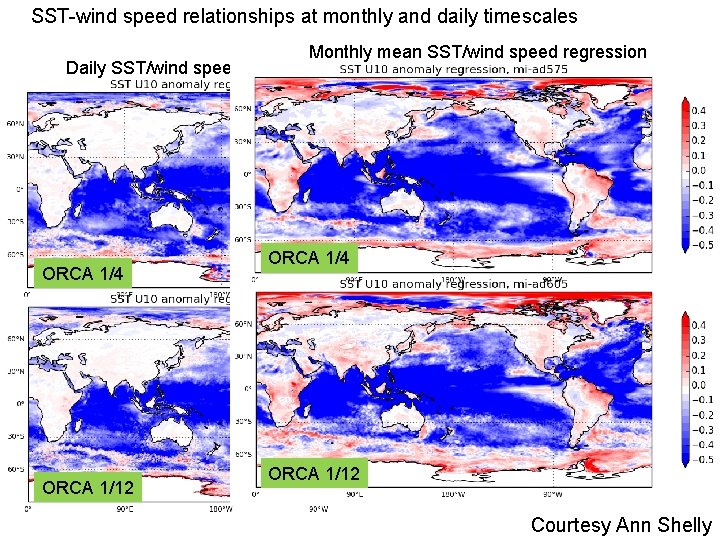
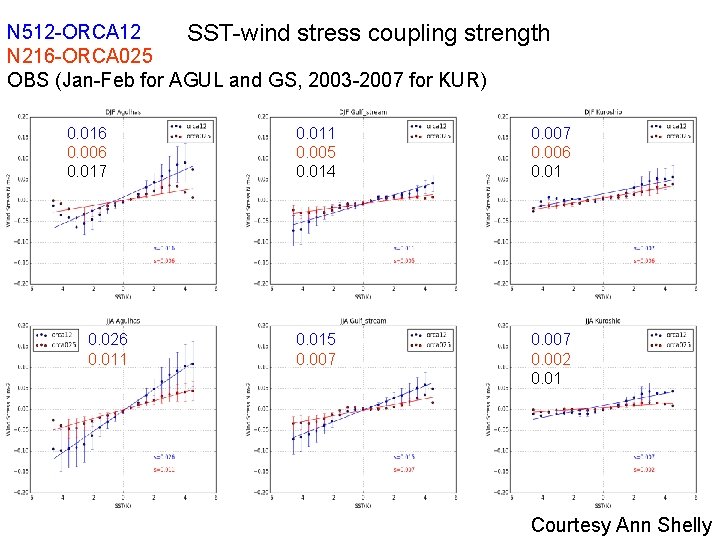
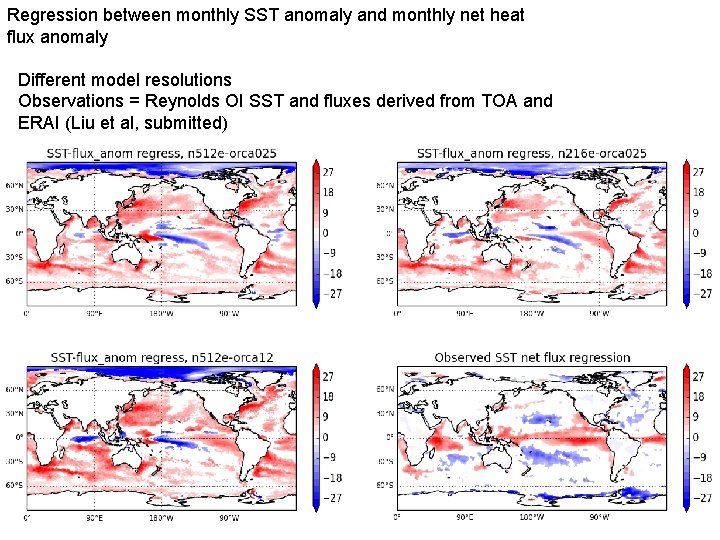
Process understanding • Precipitation and energy – – Precip over land, sea, orography Using models to try and interpret observations, constraints Understand whether model or observational biases Demory-ogram – hydrological cycle, tying together energy and water • Air sea interactions – Models typically have weaker coupling than “observed” – Possibly relates to weak signal to noise – e. g. Large ensembles required – Need co-located SST, wind, flux, moisture in order to understand interactions, at high frequency • Diurnal cycle – Cloud, soil moisture, water vapour, temperature, precipitation
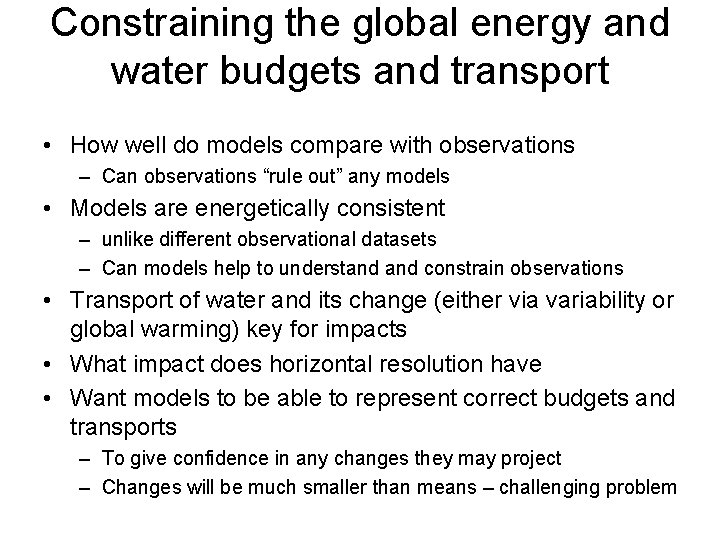
Constraining the global energy and water budgets and transport • How well do models compare with observations – Can observations “rule out” any models • Models are energetically consistent – unlike different observational datasets – Can models help to understand constrain observations • Transport of water and its change (either via variability or global warming) key for impacts • What impact does horizontal resolution have • Want models to be able to represent correct budgets and transports – To give confidence in any changes they may project – Changes will be much smaller than means – challenging problem
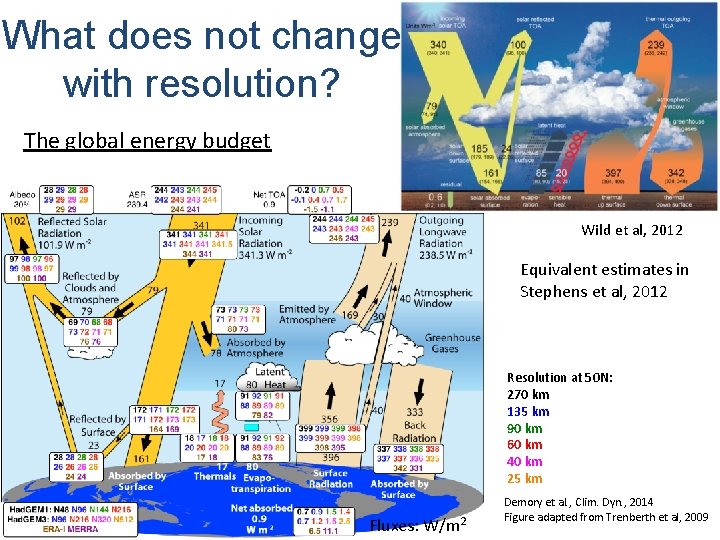
What does not change with resolution? The global energy budget Wild et al, 2012 Equivalent estimates in Stephens et al, 2012 Resolution at 50 N: 270 km 135 km 90 km 60 km 40 km 25 km Fluxes: W/m 2 Demory et al. , Clim. Dyn. , 2014 Figure adapted from Trenberth et al, 2009
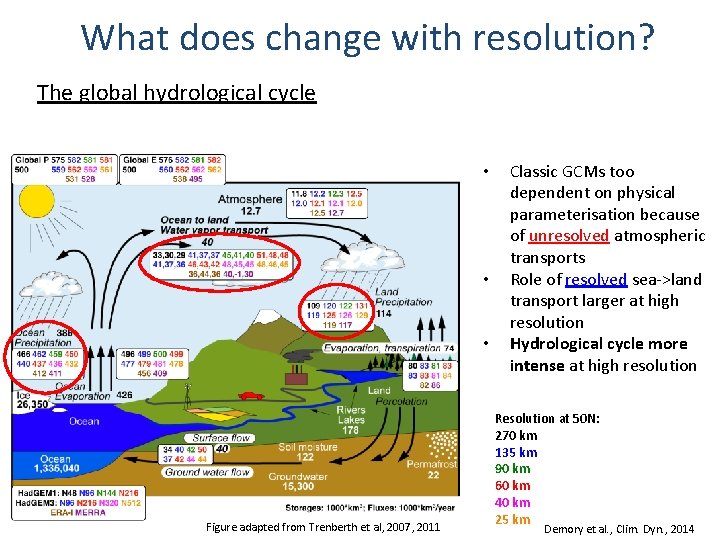
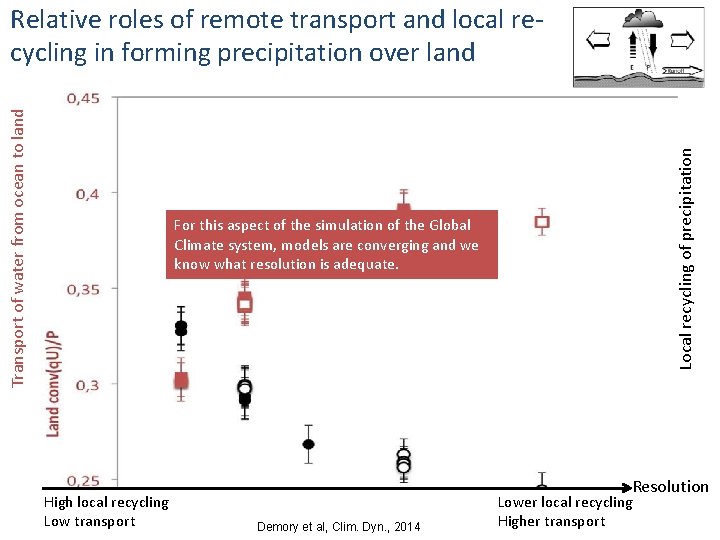
What does change with resolution? The global hydrological cycle • • • Figure adapted from Trenberth et al, 2007, 2011 Classic GCMs too dependent on physical parameterisation because of unresolved atmospheric transports Role of resolved sea->land transport larger at high resolution Hydrological cycle more intense at high resolution Resolution at 50 N: 270 km 135 km 90 km 60 km 40 km 25 km Demory et al. , Clim. Dyn. , 2014
Local recycling of precipitation Transport of water from ocean to land Relative roles of remote transport and local recycling in forming precipitation over land For this aspect of the simulation of the Global Climate system, models are converging and we know what resolution is adequate. High local recycling Low transport Resolution Demory et al, Clim. Dyn. , 2014 Lower local recycling Higher transport
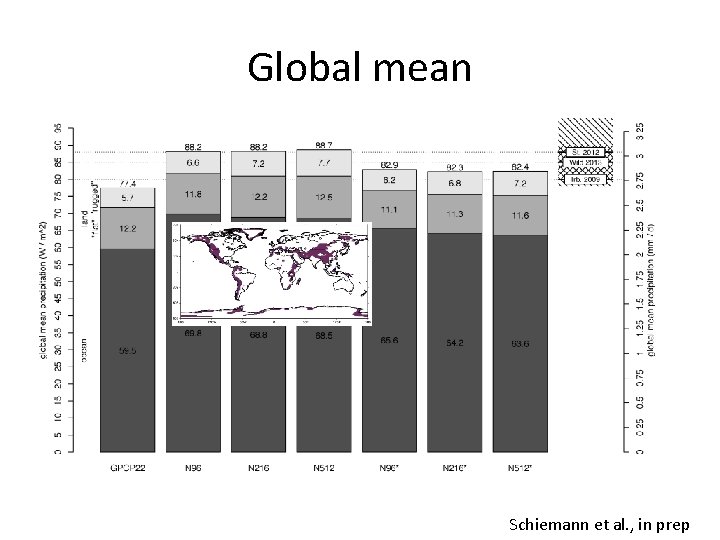
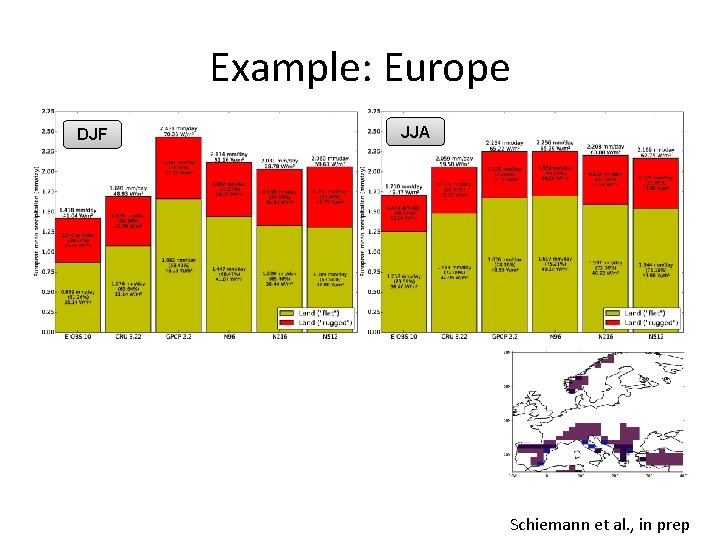
Understanding causes of hydrological changes with model resolution • ocean-to-land water transport and global land precipitation has been shown to increase with AGCM resolution (Demory et al. , 2014) 1. What is the role of better resolved orography at higher model resolution? 2. How well is the amount of land precipitation (spatial averages over large areas) constrained by observations?
Global mean Schiemann et al. , in prep
Example: Europe DJF JJA Schiemann et al. , in prep
Air-sea interactions
SST-wind speed relationships at monthly and daily timescales Monthly mean SST/wind speed regression Daily SST/wind speed regression ORCA 1/4 ORCA 1/12 Courtesy Ann Shelly
N 512 -ORCA 12 SST-wind stress coupling strength N 216 -ORCA 025 OBS (Jan-Feb for AGUL and GS, 2003 -2007 for KUR) 0. 016 0. 006 0. 017 0. 026 0. 011 0. 005 0. 014 0. 007 0. 006 0. 015 0. 007 0. 002 0. 01 Courtesy Ann Shelly
Regression between monthly SST anomaly and monthly net heat flux anomaly Different model resolutions Observations = Reynolds OI SST and fluxes derived from TOA and ERAI (Liu et al, submitted)
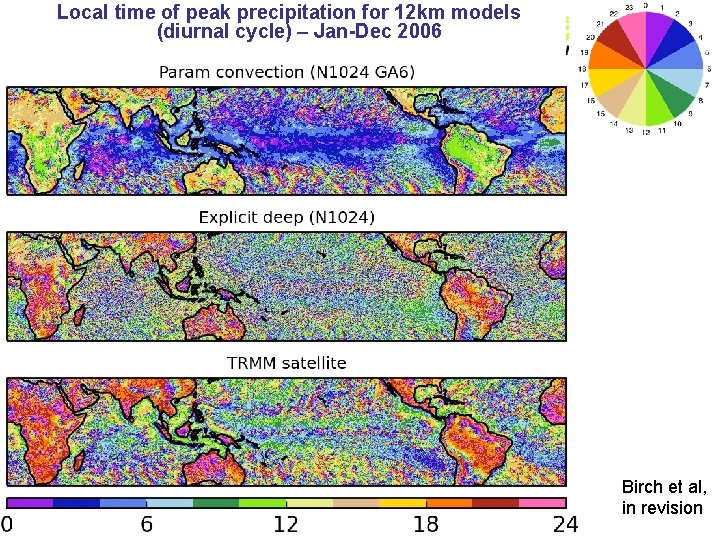
Local time of peak precipitation for 12 km models (diurnal cycle) – Jan-Dec 2006 Joint Weather and Climate Research Programme A partnership in climate research Birch et al, in revision
ECV properties • • • Global coverage Long time period, homogeneous datasets Gridded, quality controlled, familiar data formats Quantified uncertainties Easily searchable, downloadable Co-location of related quantities for understanding processes • Availability of multiple observations of same ECV for comparison, understanding uncertainty
Precipitation and orography • 3 hr precipitation for diurnal cycle • Rainfall over steep orography – reduced biases Ocean • Sub-daily SST product to assess diurnal cycle • In-situ heat fluxes over ocean – Including temperature, humidity, wind in order to validate turbulent fluxes and parameterisations in models
Clouds and aerosols • Cloud properties – big differences in observational estimates – Droplet number – Effective size • Ice water path • Lightning – Satellites detect light – mainly cloud to cloud – Radio detect mainly cloud to ground – Models simulate both – how to assess • Differentiation between cloud regimes/different cloud layers • Estimates of vertical velocity would be amazing to look at convective up and downdrafts
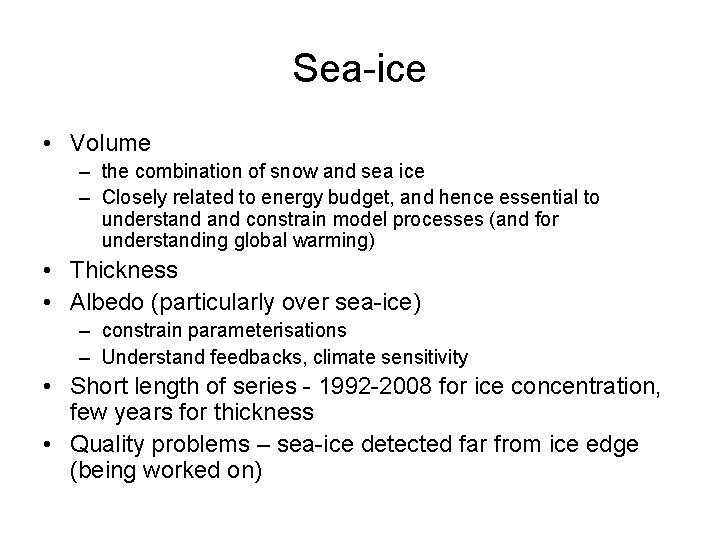
Sea-ice • Volume – the combination of snow and sea ice – Closely related to energy budget, and hence essential to understand constrain model processes (and for understanding global warming) • Thickness • Albedo (particularly over sea-ice) – constrain parameterisations – Understand feedbacks, climate sensitivity • Short length of series - 1992 -2008 for ice concentration, few years for thickness • Quality problems – sea-ice detected far from ice edge (being worked on)
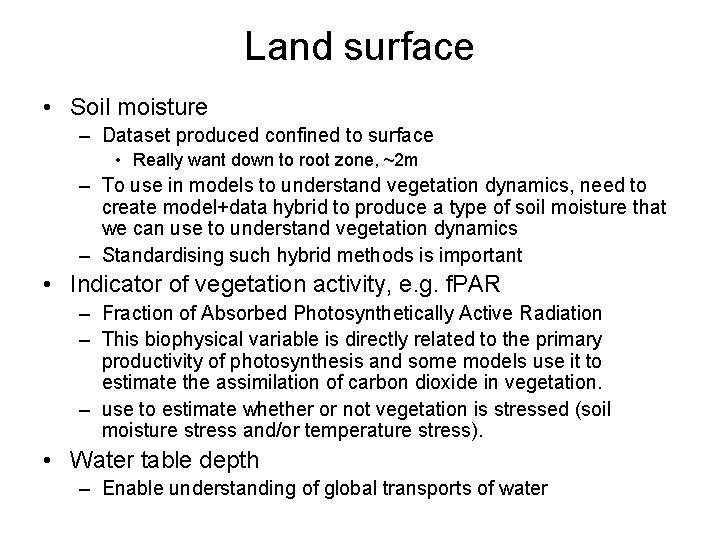
Land surface • Soil moisture – Dataset produced confined to surface • Really want down to root zone, ~2 m – To use in models to understand vegetation dynamics, need to create model+data hybrid to produce a type of soil moisture that we can use to understand vegetation dynamics – Standardising such hybrid methods is important • Indicator of vegetation activity, e. g. f. PAR – Fraction of Absorbed Photosynthetically Active Radiation – This biophysical variable is directly related to the primary productivity of photosynthesis and some models use it to estimate the assimilation of carbon dioxide in vegetation. – use to estimate whether or not vegetation is stressed (soil moisture stress and/or temperature stress). • Water table depth – Enable understanding of global transports of water
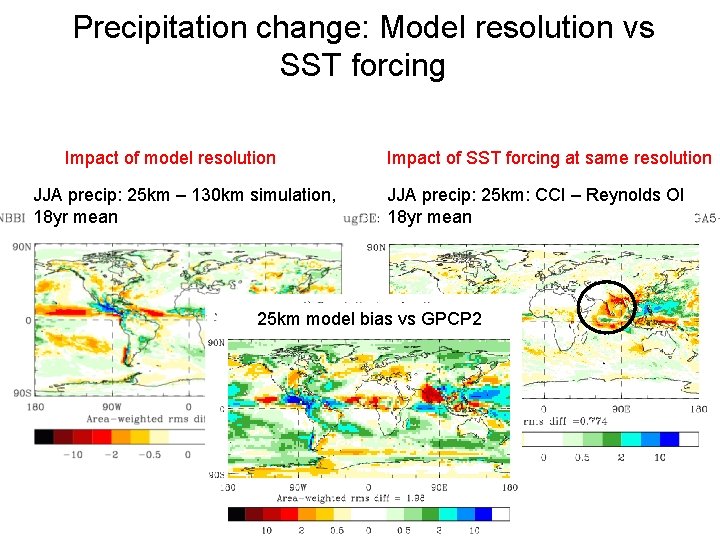
Initial Met Office work using CCI SST • Several 25 km integrations complete using CCI SST and sea-ice as driving data (together with 130 km simulations for comparison) • To compare with standard model development integrations using Reynolds OI
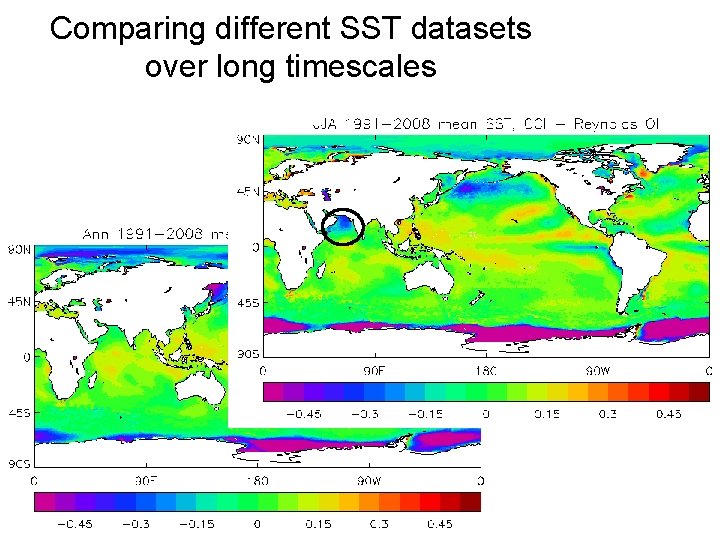
Comparing different SST datasets over long timescales
Precipitation change: Model resolution vs SST forcing Impact of model resolution JJA precip: 25 km – 130 km simulation, 18 yr mean Impact of SST forcing at same resolution JJA precip: 25 km: CCI – Reynolds OI 18 yr mean 25 km model bias vs GPCP 2
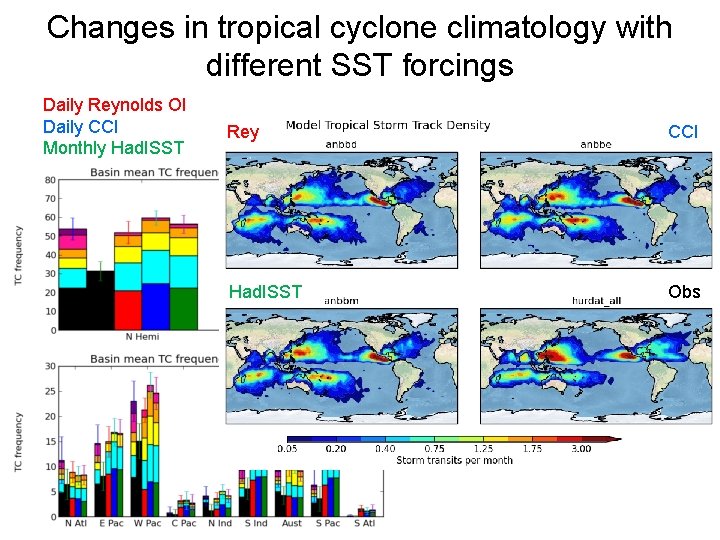
Changes in tropical cyclone climatology with different SST forcings Daily Reynolds OI Daily CCI Monthly Had. ISST Rey CCI Had. ISST Obs
Future plans • Testing and understanding impact of using different forcing datasets on model simulations – Differences between ECVs is much smaller than coupled model biases – However can still have a significant effect on other quantities of interest • Understanding relative impact of – Uncertainty in ECVs (running ensembles of models with different forcing/including uncertainty) – Quantifying impact of these uncertainties on response of relevant climate variables and processes • Make use of CCI datasets in PRIMAVERA work packages – Metrics – Model development and assessment – both core and frontier simulations
Q&A
UPSCALE: UK on PRACE - weather resolving Simulations of Climate for glob. AL Environmental risk PI: P. L. Vidale, NCAS-Climate, Reading Joint Weather and Climate Research Programme A partnershipdependence in climate research AIM: To increase understanding of climate processes and their resolution • Forced atmosphere-land integrations, 1985 -2011, 3 -5 ensemble members/resolution • SST and sea-ice forcing from OSTIA 1/20° daily data • CMIP 5 -defined forcings including historic aerosol emissions • Timeslice future climate for 2100 with ΔSST from Had. GEM 2 -ES using RCP 8. 5, 3 ensemble members/resolution • Using PRACE HPC grant of 144 M core hours on HLRS Stuttgart CRAY XE 6 • 400 TB data produced • Demory et al (2013), Mizielinski et al (2014), Allan et al 2014, Roberts et al 2015, Vidale et al (in prep), Bush et al (in revision), Vellinga et al (in revision) 500 1500 orography (m) UPSCALE: Had. GEM 3 -A GA 3. 0 (85 levels, top@85 km) Essentially the same physics/dynamics parameters used throughout model hierarchy 5 members 3 members 5 members N 96 (135 km) N 216 (60 km) N 512 (25 km) Resolution increase
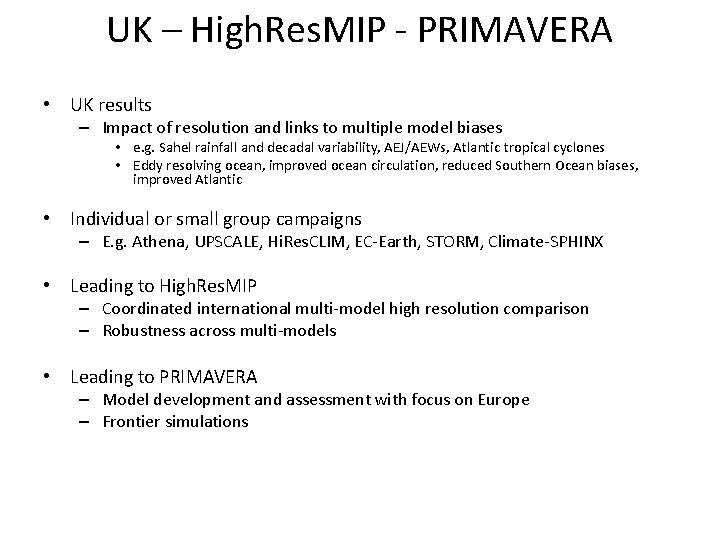
UK – High. Res. MIP - PRIMAVERA • UK results – Impact of resolution and links to multiple model biases • e. g. Sahel rainfall and decadal variability, AEJ/AEWs, Atlantic tropical cyclones • Eddy resolving ocean, improved ocean circulation, reduced Southern Ocean biases, improved Atlantic • Individual or small group campaigns – E. g. Athena, UPSCALE, Hi. Res. CLIM, EC-Earth, STORM, Climate-SPHINX • Leading to High. Res. MIP – Coordinated international multi-model high resolution comparison – Robustness across multi-models • Leading to PRIMAVERA – Model development and assessment with focus on Europe – Frontier simulations
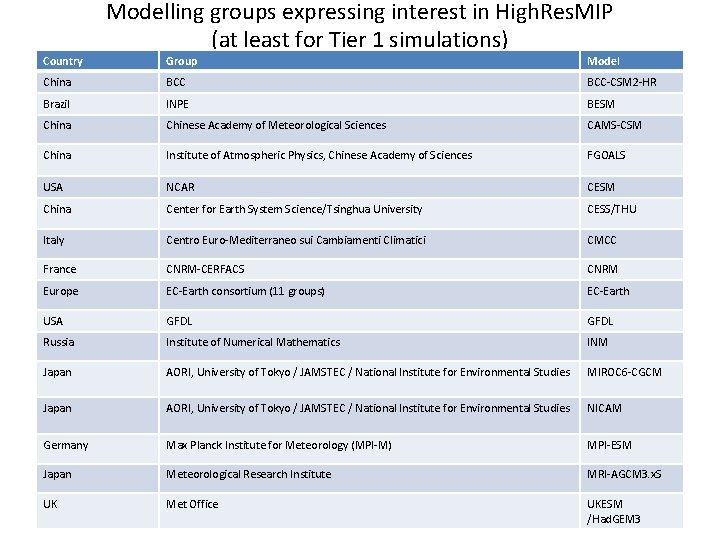
Country Modelling groups expressing interest in High. Res. MIP (at least for Tier 1 simulations) Group Model China BCC-CSM 2 -HR Brazil INPE BESM China Chinese Academy of Meteorological Sciences CAMS-CSM China Institute of Atmospheric Physics, Chinese Academy of Sciences FGOALS USA NCAR CESM China Center for Earth System Science/Tsinghua University CESS/THU Italy Centro Euro-Mediterraneo sui Cambiamenti Climatici CMCC France CNRM-CERFACS CNRM Europe EC-Earth consortium (11 groups) EC-Earth USA GFDL Russia Institute of Numerical Mathematics INM Japan AORI, University of Tokyo / JAMSTEC / National Institute for Environmental Studies MIROC 6 -CGCM Japan AORI, University of Tokyo / JAMSTEC / National Institute for Environmental Studies NICAM Germany Max Planck Institute for Meteorology (MPI-M) MPI-ESM Japan Meteorological Research Institute MRI-AGCM 3. x. S UK Met Office UKESM /Had. GEM 3
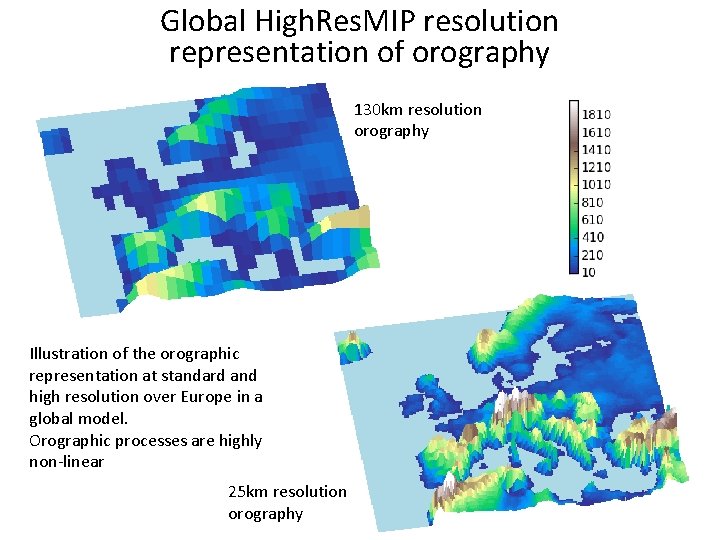
Global High. Res. MIP resolution representation of orography 130 km resolution orography Illustration of the orographic representation at standard and high resolution over Europe in a global model. Orographic processes are highly non-linear 25 km resolution orography
High resolution climate modelling multi-resolution and multi-model robustness • Need a traceable resolution hierarchy with no tuning between resolutions • UPSCALE – tropical cyclones, moisture transports, tropical precipitation • explicit convection – diurnal cycle, land-atmosphere interaction, precipitation intensity • ORCA 12 – mean state, air-sea interaction • Towards multi-model – robust changes with resolution alone (no resolution-specific tuning) • Give examples of these from UK group, what answers and questions there and how multi-model can help to address these CMIP 5/IPCC AR 5 questions
Met. UM global atmosphere/coupled model climate configurations in use Atmosphere/land Glo. Sea 5 N 144 N 96 UPSCALE N 216 N 512 60 km 25 km N 768 90 km 17 km UK-ESM 1 for CMIP 6? 130 km N 1024 ORCA 025 12 km 0. 25° ORCA 12 1° 0. 08° Explicit convection Charisma project Project to assess impact of global explicit convection Essentially the same physics/dynamics parameters used throughout model hierarchy Ocean/sea-ice CMIP 3&CMIP 5 resolution GA = Global Atmosphere GC = Global Coupled