
Primary Succession Renewal of Life A popular destination



- Slides: 17
Primary Succession
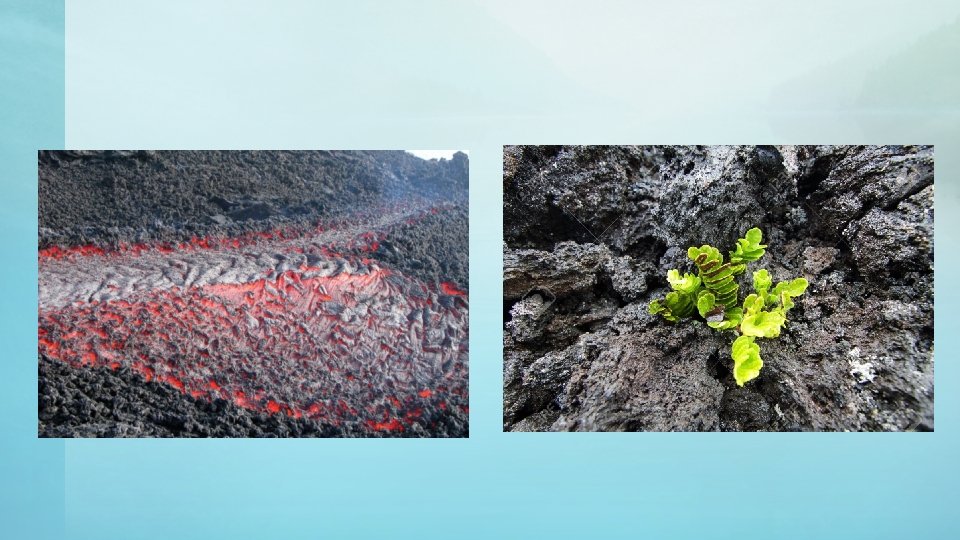
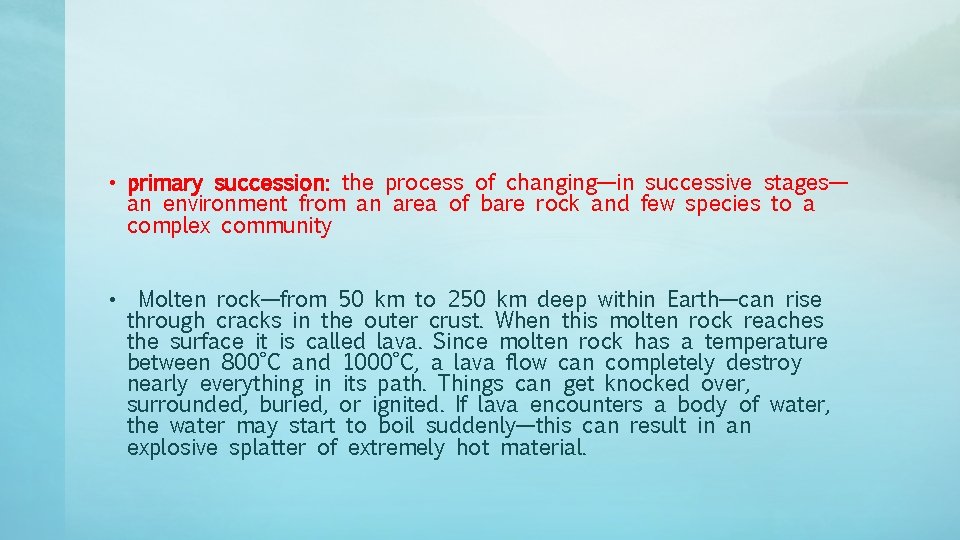
Renewal of Life • A popular destination for people visiting the Hawaiian Islands is Volcanoes National Park. The park features two active volcanoes, Mauna Loa and Kilauea, that regularly erupt. The eruptions are rarely violent, and the lava produced flows slowly. This allows tourists to get close to this 1000°C molasses-like fluid. As molten rock reaches the Pacific Ocean shore, it transfers its thermal energy upon contacting the water. This produces steam and new rock. Each year, with the continual eruption of these volcanoes, Hawaii’s Big Island gets bigger. New rock formed from solidified lava is exposed to seeds and spores of simple, tough plants, such as ferns. These seeds and spores are carried to the new rock by wind, insects, or on the feet and bodies of birds. The germination of seeds and spores on the new rock demonstrates that the process of primary succession has begun.
• primary succession: the process of changing—in successive stages— an environment from an area of bare rock and few species to a complex community • Molten rock—from 50 km to 250 km deep within Earth—can rise through cracks in the outer crust. When this molten rock reaches the surface it is called lava. Since molten rock has a temperature between 800°C and 1000°C, a lava flow can completely destroy nearly everything in its path. Things can get knocked over, surrounded, buried, or ignited. If lava encounters a body of water, the water may start to boil suddenly—this can result in an explosive splatter of extremely hot material.
• https: //www. youtube. com/watch? v=l. Dx. Ohfi. Fsuc • https: //www. youtube. com/watch? v=vrv 2 GT 1 d. YT 0
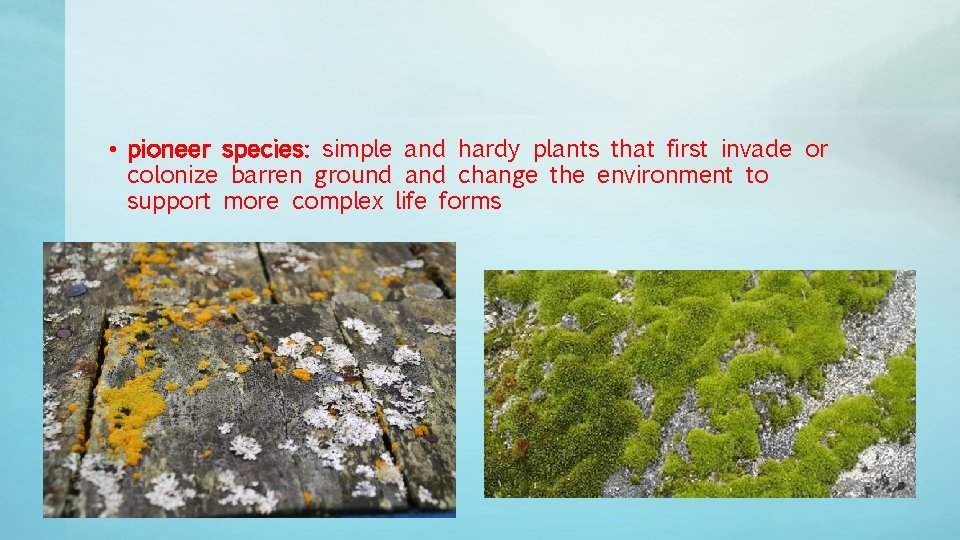
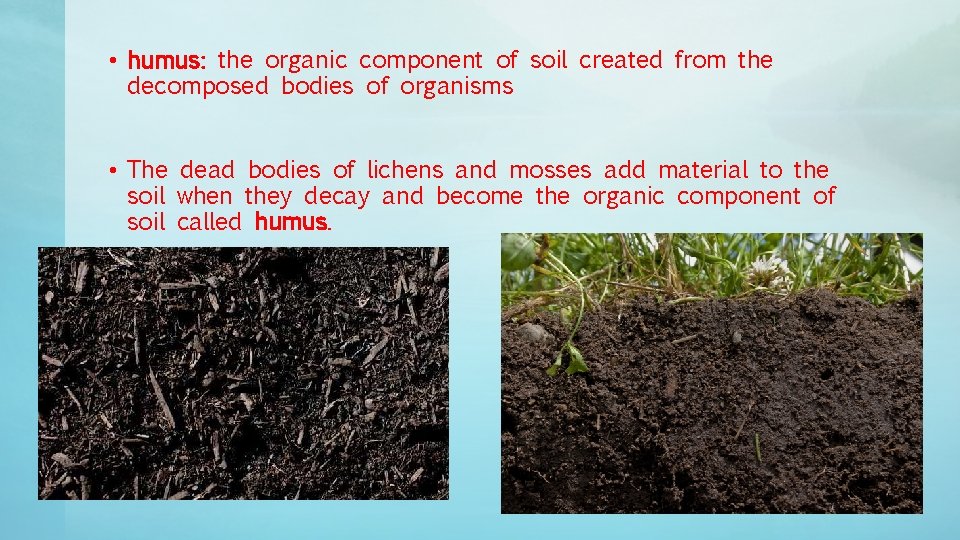
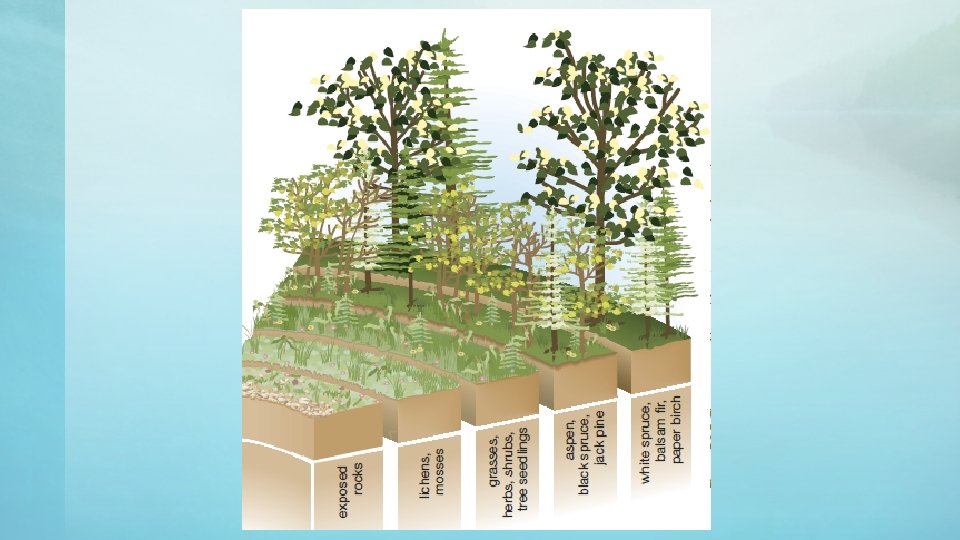
Succession Begins • Primary succession occurs in places where soil has been removed or where it never existed. Examples include bare land—such as cooled lava, sand dunes, and mountain slopes. Primary succession is a slow process because few plants are able to grow on bare rock without soil, with little water, or without protection from the sun and wind. Tough plants first invade or colonize this new territory. Lichens growing on these rocks exposed by a retreating glacier or ferns that can grow on lava rock are called pioneer species. • Pioneer species—ferns, lichens, mosses, and some bacteria, etc. —pave the way for more complex organisms as their life processes change the original habitat.
• pioneer species: simple and hardy plants that first invade or colonize barren ground and change the environment to support more complex life forms
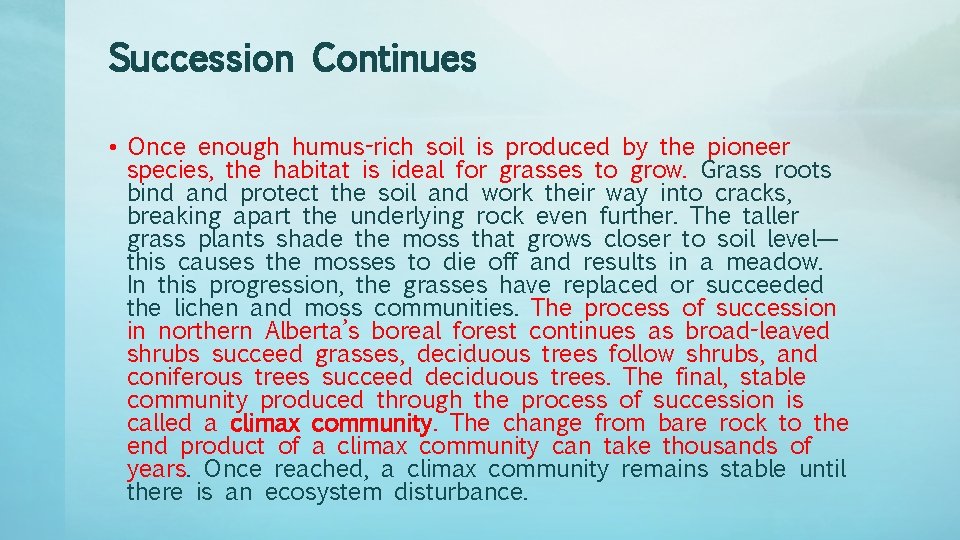
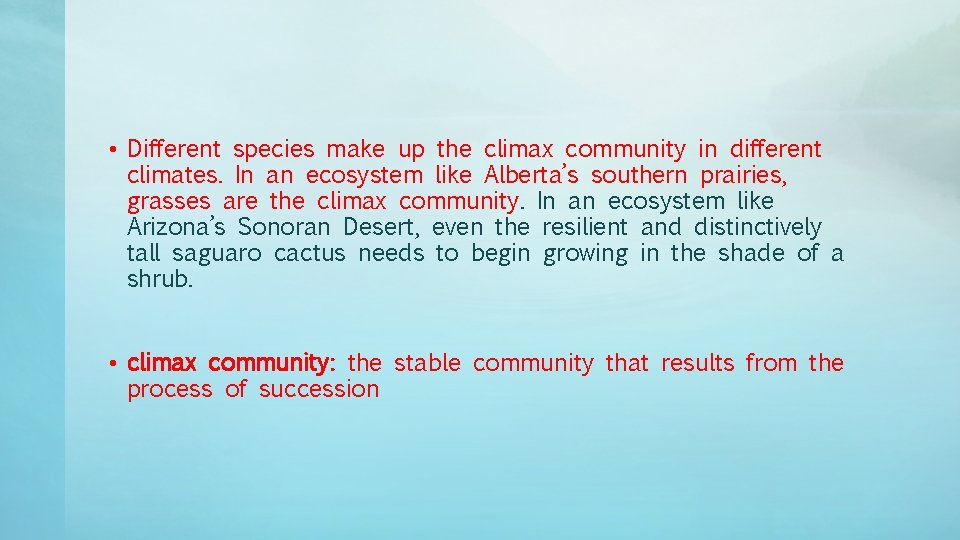
• humus: the organic component of soil created from the decomposed bodies of organisms • The dead bodies of lichens and mosses add material to the soil when they decay and become the organic component of soil called humus.
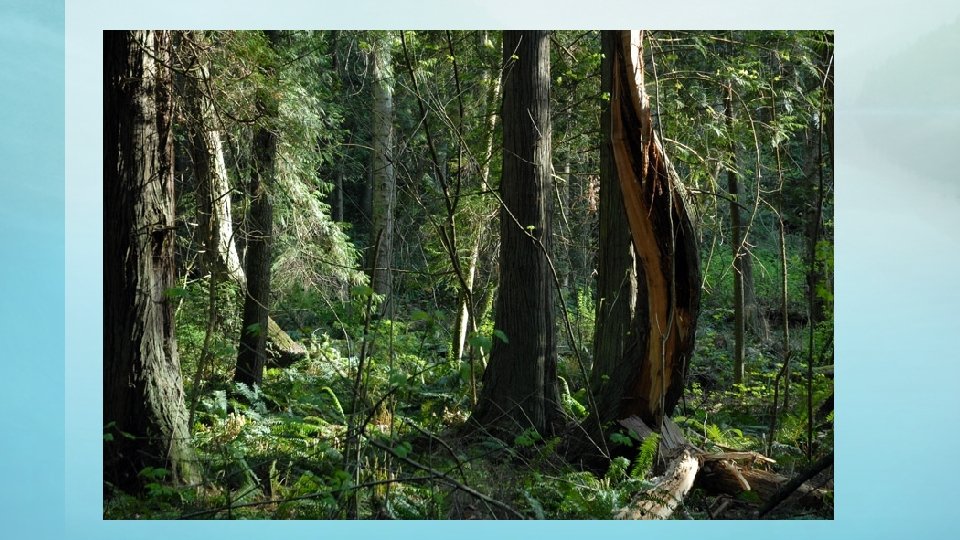
Succession Continues • Once enough humus-rich soil is produced by the pioneer species, the habitat is ideal for grasses to grow. Grass roots bind and protect the soil and work their way into cracks, breaking apart the underlying rock even further. The taller grass plants shade the moss that grows closer to soil level— this causes the mosses to die off and results in a meadow. In this progression, the grasses have replaced or succeeded the lichen and moss communities. The process of succession in northern Alberta’s boreal forest continues as broad-leaved shrubs succeed grasses, deciduous trees follow shrubs, and coniferous trees succeed deciduous trees. The final, stable community produced through the process of succession is called a climax community. The change from bare rock to the end product of a climax community can take thousands of years. Once reached, a climax community remains stable until there is an ecosystem disturbance.
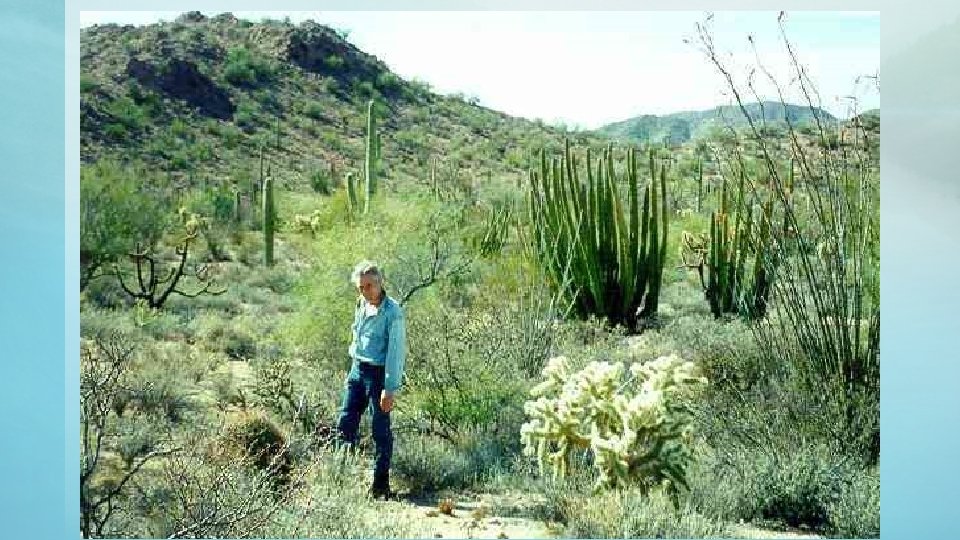
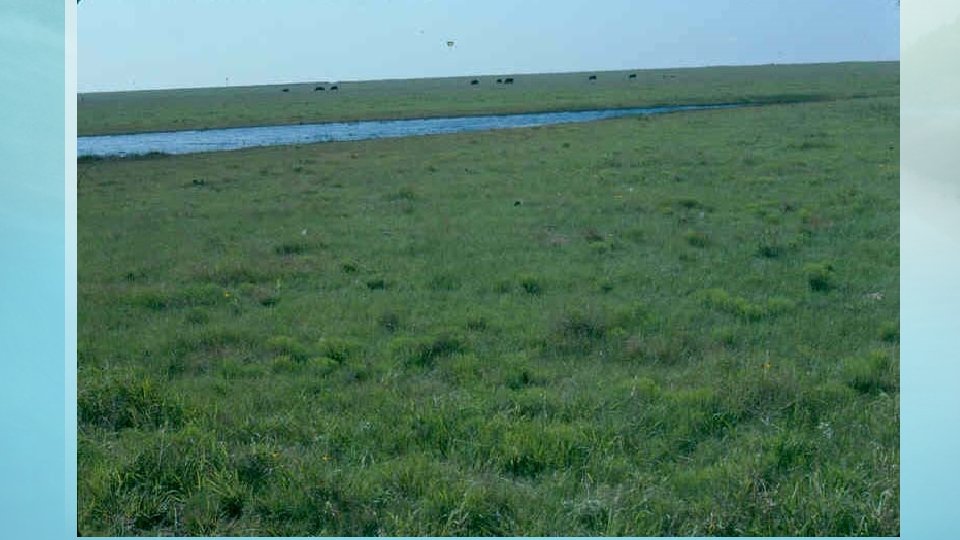
• Different species make up the climax community in different climates. In an ecosystem like Alberta’s southern prairies, grasses are the climax community. In an ecosystem like Arizona’s Sonoran Desert, even the resilient and distinctively tall saguaro cactus needs to begin growing in the shade of a shrub. • climax community: the stable community that results from the process of succession
Researching Primary Succession on Mars • Pg. 473 • Investigate primary succession on Mars!
Knowledge • 1. Why do you think scientists chose the term pioneer species for certain organisms? What characteristics do these pioneer plant species possess that allow them to be categorized as pioneer species? • 2. List the benefits that a pioneer species would experience. • 3. Place the following stages in the correct order in which they would be observed during primary succession: deciduous trees, bare rock, grasses, lichens, deep humus-rich soil, coniferous trees, mosses, shrubs, thin soil.
Booklet Break