
Primary steps in plant breeding Develop a Vision
Primary steps in plant breeding ü Develop a Vision ü Find or Create Variability (Techniques) ü Apply Selection Pressure ü Evaluate and Select (Screen) ü Commercialize
General Breeding Procedure I. Producing initial variation (crossing of diverse material) II. Development, testing, and selection of potential cultivar III. Testing experimental varieties selection and multiplication of the best and
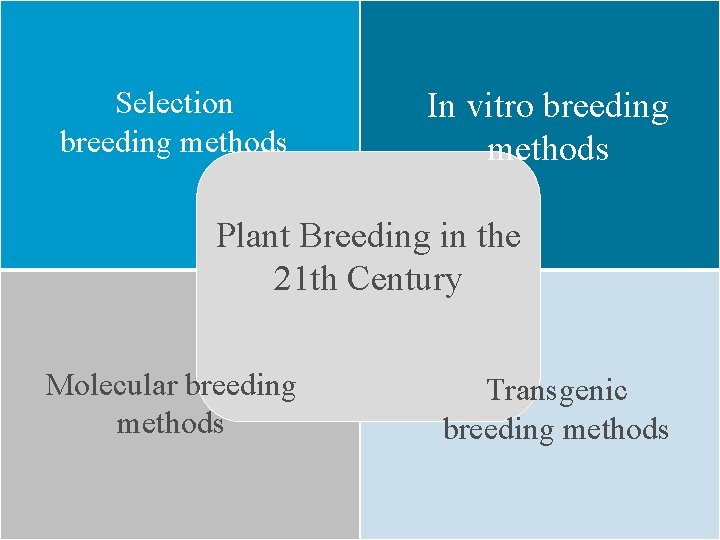
Selection breeding methods In vitro breeding methods Plant Breeding in the 21 th Century Molecular breeding methods Transgenic breeding methods
Conventional breeding methods § Selection § Hybridization § Mutagenesis § Polyploidy § Heterosis
Selection breeding methods The oldest method for plant improvement § Mass selection § Bulk breeding method § Single-seed descent § Pedigree breeding
In vitro breeding 1. Somaclonal variation 2. Haploid and double breeding 3. In vitro selection 4. Somatic Hybridization 5. Micro-propagation
Transgenic breeding 1. Gene construct methods 2. Transformation methods 3. Screening methods 4. Evaluation methods
Molecular breeding 1. Marker techniques 2. Quantitative trait loci 3. Marker assisted breeding methods
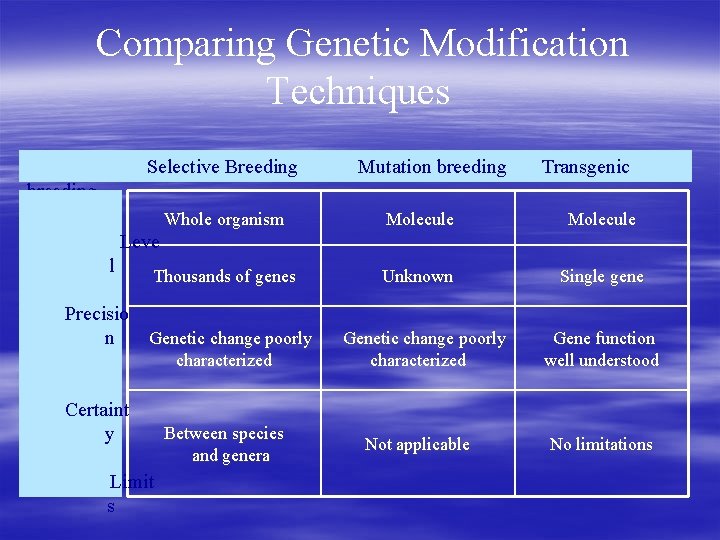
Comparing Genetic Modification Techniques Selective Breeding Mutation breeding Transgenic breeding Whole organism Molecule Thousands of genes Unknown Single gene Leve l Precisio Genetic change poorly n characterized Certaint y Limit s Between species and genera Genetic change poorly characterized Not applicable Gene function well understood No limitations
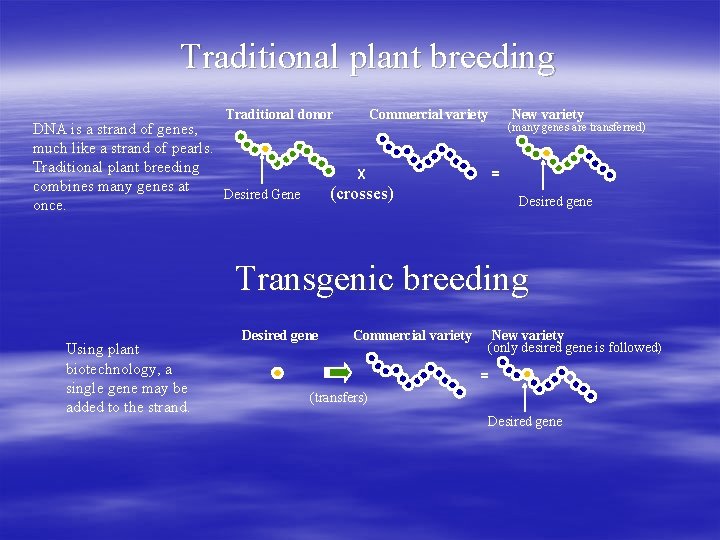
Traditional plant breeding Commercial variety Traditional donor DNA is a strand of genes, much like a strand of pearls. Traditional plant breeding combines many genes at Desired Gene once. New variety (many genes are transferred) = X (crosses) Desired gene Transgenic breeding Using plant biotechnology, a single gene may be added to the strand. Desired gene Commercial variety New variety (only desired gene is followed) = (transfers) Desired gene
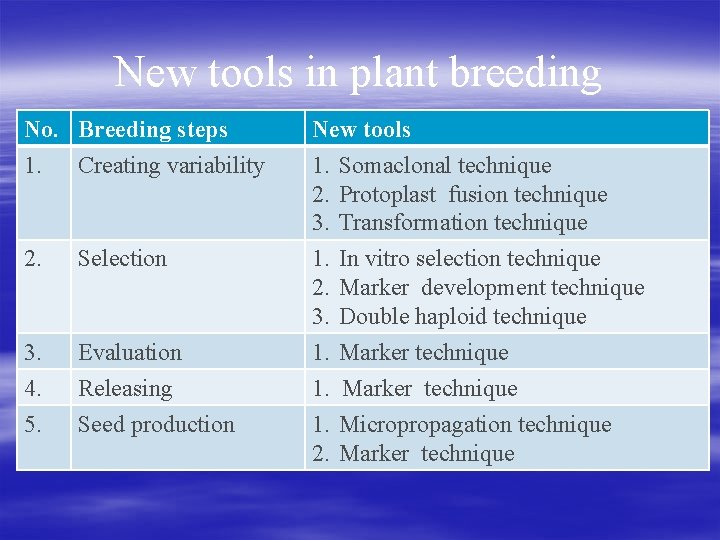
New tools in plant breeding No. Breeding steps 1. Creating variability New tools 1. Somaclonal technique 2. Protoplast fusion technique 3. Transformation technique 2. Selection 3. Evaluation 4. 5. Releasing Seed production 1. 2. 3. 1. 1. 1. 2. In vitro selection technique Marker development technique Double haploid technique Marker technique Micropropagation technique Marker technique
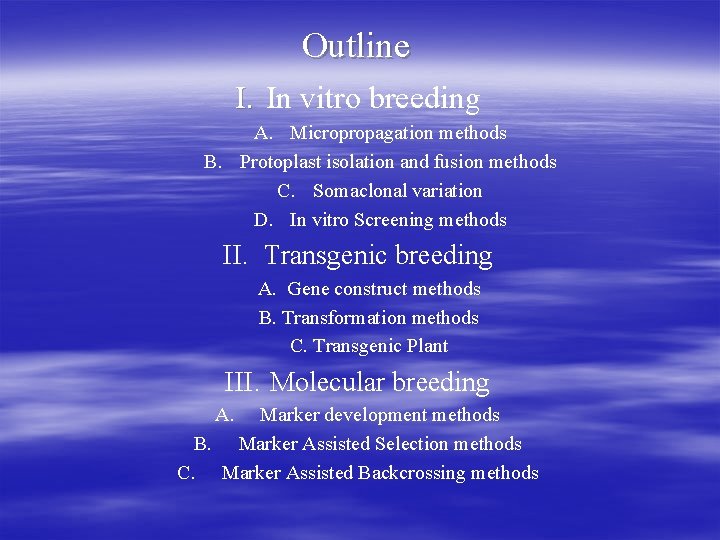
Outline I. In vitro breeding A. Micropropagation methods B. Protoplast isolation and fusion methods C. Somaclonal variation D. In vitro Screening methods II. Transgenic breeding A. Gene construct methods B. Transformation methods C. Transgenic Plant III. Molecular breeding A. Marker development methods B. Marker Assisted Selection methods C. Marker Assisted Backcrossing methods
Seminar Topics a. Organogenesis b. Embryogenesis c. Protoplast isolation and fusion methods d. In vitro fertilization e. Induction of somaclonal variation f. In vitro screening methods g. Vector construction method h. Transformation methods i. Marker based Southern Blot and sequencing techniques j. Marker based PCR techniques k. Marker Assisted Selection methods

"Never think for a minute that we are going to build permanent peace in this world on empty stomachs and human misery. " Norman Borlaug Nobel Peace Prize Laureate
- Slides: 14