
Primary Sources of Information OBJECTIVES Identify the appropriate
Primary Sources of Information

OBJECTIVES Identify the appropriate source of information define primary and secondary source of information differentiate interview, observation, and survey from each other create tools to acquire information from primary sources cite the source of information.
Carousel Brainstorming Primary Sources of Information Interview Observation Survey Intellectual Honesty Intellectual Interdependence

Definition of Primary Sources of Information sources wherein the person who wrote or the person who gave information is part of the incident or a witness of the incident or event
What types of projects or activities benefit from primary research? When you are working on a local problem that may not have been addressed before and little research is there to back it up When you are writing about a specific group of people or a specific person When you are working on a topic that is relatively new or original and few publications exist on the subject

Observation When to use: If you are studying a local group or a small group or a representative of a bigger group Nature: careful observation and recording of behavior and attitude of a group of people/ individual
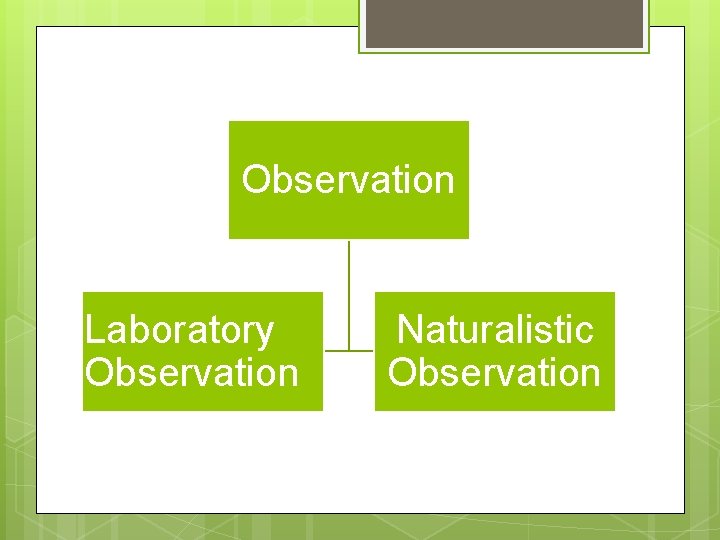
Observation Laboratory Observation Naturalistic Observation
For observations to be effective, take note of the following: What are you looking for? Who are you observing? When and where will you observe? How will the observation be done? In what form will the observation be recorded?
If you will be observed, how would you react? What is one of the disadvantages of observation?
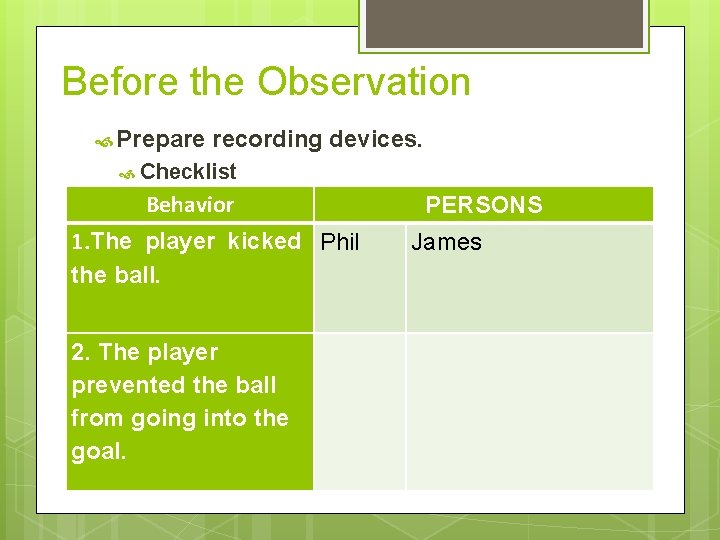
Before the Observation Prepare recording devices. Checklist Behavior 1. The player kicked Phil the ball. 2. The player prevented the ball from going into the goal. PERSONS James

Rating Scale Behavior 1. The player kicked the ball. 2. The player prevented the ball from going into the goal. Excellent Very Good Satisfactory Passin g
2. Prepare instruments. 2. 1 stopwatch 2. 2 mechanical counters 2. 3 audio 2. 4 videotape recordings 2. 5 notebook/computer

DURING AN OBSERVATION 1. Separate the facts from interpretation of the facts. Not: He is tall. But: His height is 5 feet 6 inches. 2. Be objective. Recognize and eliminate bias.

AFTER THE OBSERVATION Record the observations carefully and expertly.

INTERVIEW When to use: If the topic needs the expertise of an individual or the firsthand information from a witness Nature: According to De Vito (1991), an interview is “a particular form of interpersonal communication involving two persons interacting largely through a question-and-answer format to achieve specific goals” (p. 201).
Preparing for an Information. Seeking Interview: 1. Determine the purpose of the interview. 2. Choose the informant. 3. Obtain the informant’s cooperation. 3. 1 Determine the right place and time for the interview. 3. 2 Be sure to test everything that you will use before the interview. Test your recorder and its battery if you are going to use one.
4. Learn about the informant and the interview topic. 5. Choose the interview format. Structured Non- Structured Guided
6. Prepare the interview plan.

Sample Interview Plan Date: ______ Interviewer: Richelle A. Steigerwald Interviewee: Miss Tess Aguilar Background Information: Guidance Counselor of Grade Seven students in Saint Pedro Poveda College Purpose of Interview: To learn different ways students can spend more time with their parents
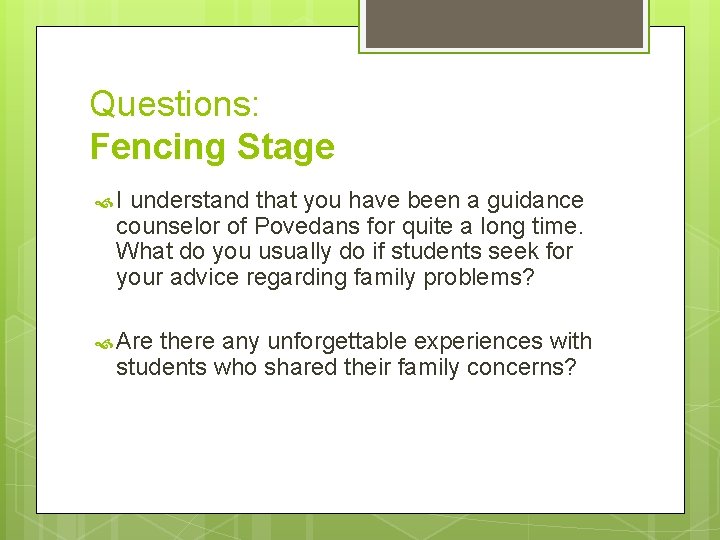
Questions: Fencing Stage I understand that you have been a guidance counselor of Povedans for quite a long time. What do you usually do if students seek for your advice regarding family problems? Are there any unforgettable experiences with students who shared their family concerns?
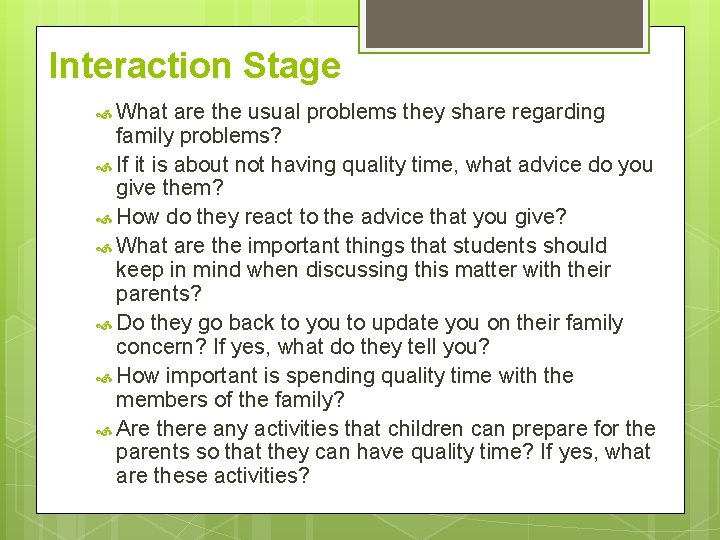
Interaction Stage What are the usual problems they share regarding family problems? If it is about not having quality time, what advice do you give them? How do they react to the advice that you give? What are the important things that students should keep in mind when discussing this matter with their parents? Do they go back to you to update you on their family concern? If yes, what do they tell you? How important is spending quality time with the members of the family? Are there any activities that children can prepare for the parents so that they can have quality time? If yes, what are these activities?
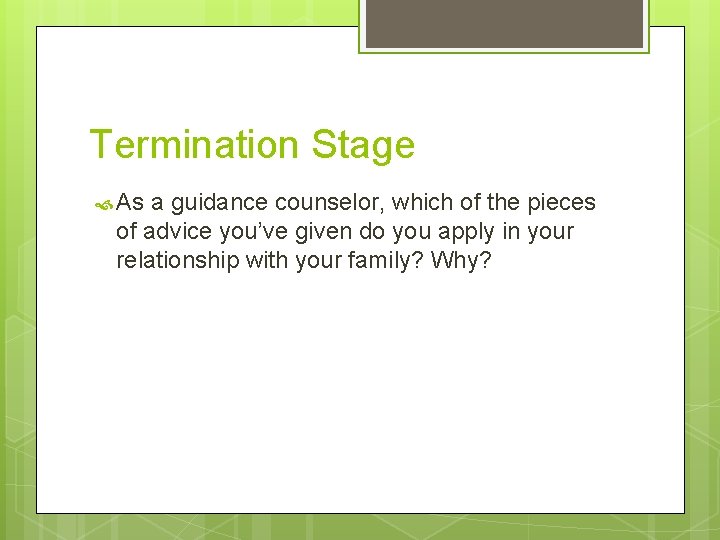
Termination Stage As a guidance counselor, which of the pieces of advice you’ve given do you apply in your relationship with your family? Why?
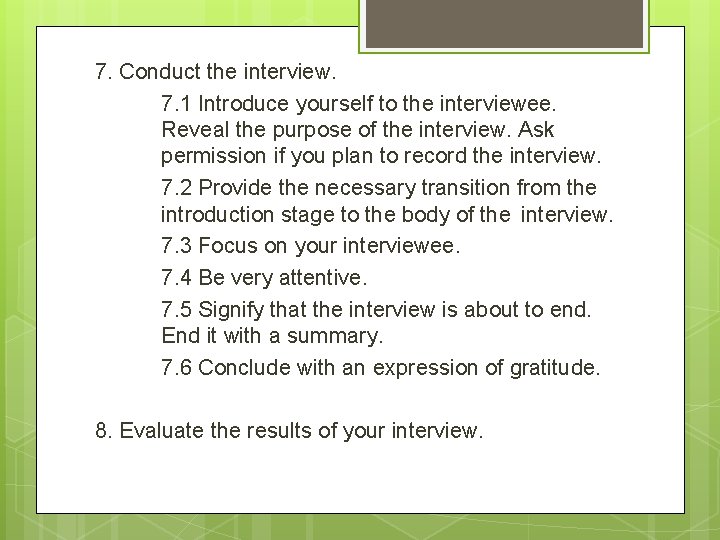
7. Conduct the interview. 7. 1 Introduce yourself to the interviewee. Reveal the purpose of the interview. Ask permission if you plan to record the interview. 7. 2 Provide the necessary transition from the introduction stage to the body of the interview. 7. 3 Focus on your interviewee. 7. 4 Be very attentive. 7. 5 Signify that the interview is about to end. End it with a summary. 7. 6 Conclude with an expression of gratitude. 8. Evaluate the results of your interview.
Surveys & Questionnaires: A process of gathering specific information from people in a systematic way with a set series of questions. Survey questions usually have pre-specified or short responses. When to use: This research method is most useful when you are doing a research on a larger number of people.
Guidelines 1. Start with a greeting message indicating your name and the purpose of the questionnaire. Also, indicate that the information will be kept confidential. 2. Prepare the questions. 2. 1 Use questions with fixed answer categories. 2. 2 The answer categories must cover all imaginable possibilities. Always include “others pls. specify” as one of the options. 2. 3 Give instructions explicitly. Whether you want a single answer or multiple answers, say it explicitly.
2. 4 Pre-number the answer categories. 2. 5 Do not split answer categories across pages. 2. 6 Place the easier to answer questions beginning of the survey. 2. 7 Questions that are related to each should be grouped together. two at the other 3. Thank the person who answered your questionnaire.
Other guidelines 1. Know what you want to know. 2. Make sure that the written question can stand by itself. 3. Avoid using words that have subjective meaning and words that can be misinterpreted. (always, rarely) 4 Avoid the double-barreled question.
- Slides: 28