
PRIMARY SEARCH AND FIRE ATTACK Engine Company Operations
- Slides: 31
PRIMARY SEARCH AND FIRE ATTACK Engine Company Operations
PRIMARY SEARCH AND FIRE ATTACK • • • Addresses the practical application to support the initial IAP in Blue Card Command. Quickly puts firefighters in close proximity to unprotected citizens by using Engine company personnel to search egress and travel areas. Uses standard terminology. Commits enough resources to accomplish the objective, while not overcommitting resources to repetitive job assignments. Allows Truck companies to quickly access areas of the structure most severely affected by the products of combustion, ie bedrooms, via VEIS.
REFERENCES � The Nozzle Forward Aaron Fields Seattle FD � Primary Search- Making the Grab Gary Lane Rogue Fire � Modern. Fire. Behavior. com
CLAMP SLIDE FIRE ATTACK “Hit and Move” “Take and Make space”
CLAMP SLIDE � • • Objectives Understand fire behavior in enclosed structures. Understand function of the four hand line positions Understand proper body positioning, nozzle technique and stream application. Discuss common terminology
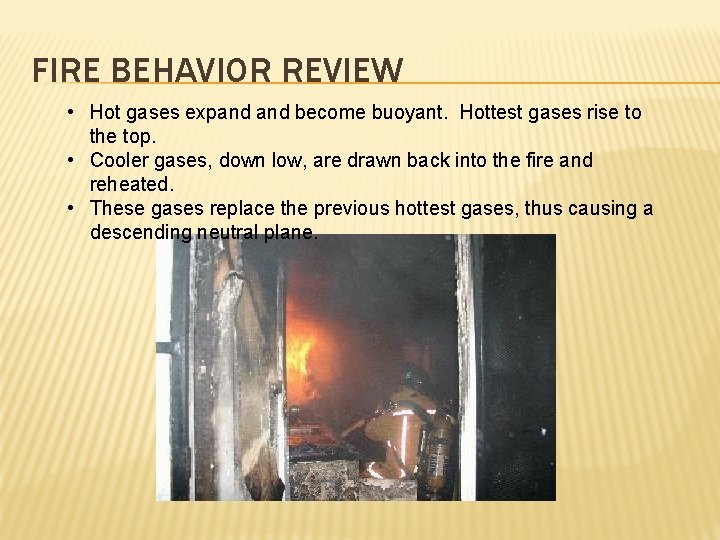
FIRE BEHAVIOR REVIEW • Hot gases expand become buoyant. Hottest gases rise to the top. • Cooler gases, down low, are drawn back into the fire and reheated. • These gases replace the previous hottest gases, thus causing a descending neutral plane.
FIRE BEHAVIOR REVIEW • Face piece failure occurs at around 500 degrees F. • Knowing this, we should work to maintain an environment below these numbers. • Ventilation limited fires are causing super-heated, super-rich environments that are only waiting for ventilation to occur. The front door is a ventilation opening. • If we are keeping the atmosphere safe for the respiratory compromised, then, by definition, we are making it better for ourselves.
FIRE BEHAVIOR � Fire conditions change at room changes. � For �A example: fully involved bedroom will extend into the hallway causing the hallway to be in the growth stage. � The growth stage hallway will extend into the living room, lessening in severity due to the amount of space, causing it to be in the incipient stage.
UNDERSTAND PROPER NOZZLE TECHNIQUE AND STREAM APPLICATION The Clamp “You can’t fight fire, and fire hose, at the same time. ” -Aaron Fields • Used at the initial stage of fire attack by firefighters while the line is being charged. • Once it is determined that the fire is ventilation limited, firefighters must be able to “control the weather” once the front door is opened. • This position allows for one firefighter to control the nozzle, and allows the ground to absorb the nozzle reaction.
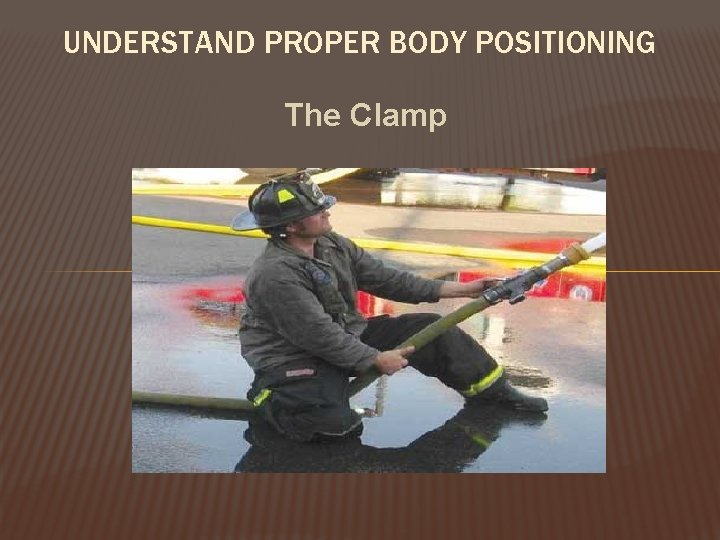
UNDERSTAND PROPER BODY POSITIONING The Clamp
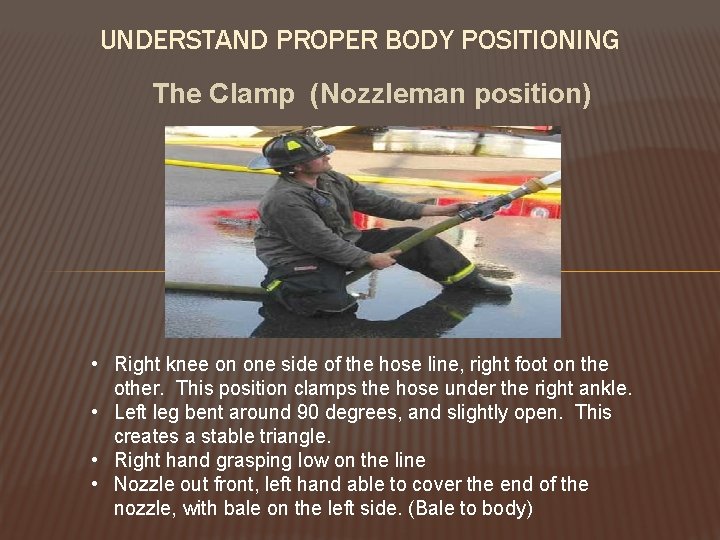
UNDERSTAND PROPER BODY POSITIONING The Clamp (Nozzleman position) • Right knee on one side of the hose line, right foot on the other. This position clamps the hose under the right ankle. • Left leg bent around 90 degrees, and slightly open. This creates a stable triangle. • Right hand grasping low on the line • Nozzle out front, left hand able to cover the end of the nozzle, with bale on the left side. (Bale to body)
THE CLAMP SLIDE Benefits • • • Allows for quick, efficient hose line stretches with minimal staffing Keeps the nozzle aimed at the fuel at all times. Allows for quicker transition from advancing to flowing water Allows for the skeleton and large muscle groups to bare the strain of the hose line. Allows the nozzle man the ability to focus on the fire fight. Adaptable to all lengths and diameters of hose line. Allows for the nozzle man to search hallways, egress points, while advancing hose. Can be used from both the left and right side of the hose line. When to use? • “If high heat or you can’t see your feet”
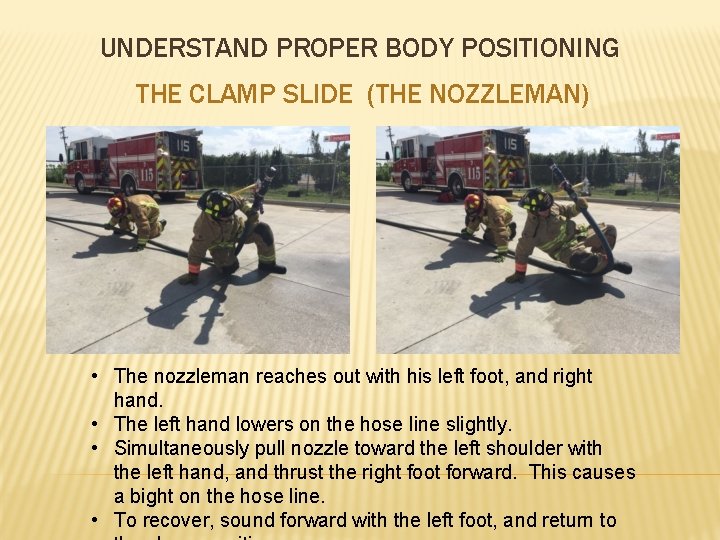
UNDERSTAND PROPER BODY POSITIONING THE CLAMP SLIDE (THE NOZZLEMAN) • The nozzleman reaches out with his left foot, and right hand. • The left hand lowers on the hose line slightly. • Simultaneously pull nozzle toward the left shoulder with the left hand, and thrust the right foot forward. This causes a bight on the hose line. • To recover, sound forward with the left foot, and return to
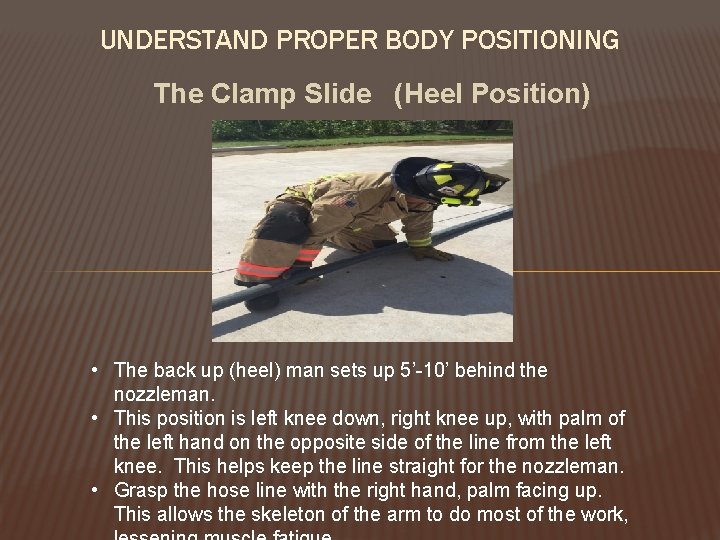
UNDERSTAND PROPER BODY POSITIONING The Clamp Slide (Heel Position) • The back up (heel) man sets up 5’-10’ behind the nozzleman. • This position is left knee down, right knee up, with palm of the left hand on the opposite side of the line from the left knee. This helps keep the line straight for the nozzleman. • Grasp the hose line with the right hand, palm facing up. This allows the skeleton of the arm to do most of the work,
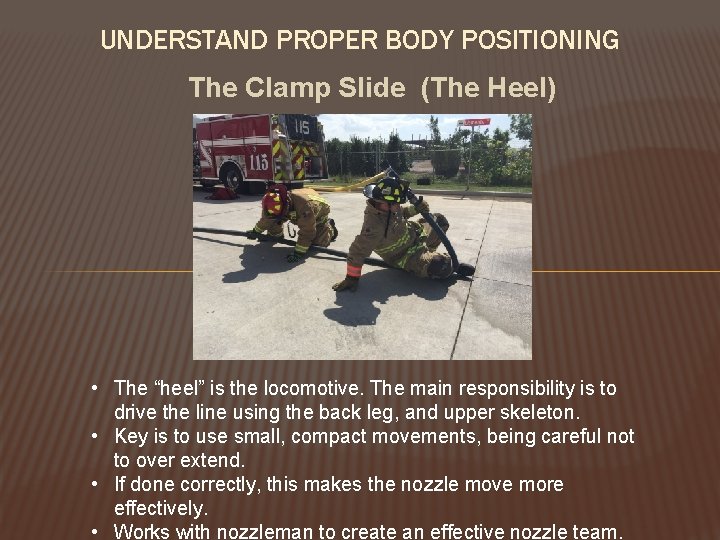
UNDERSTAND PROPER BODY POSITIONING The Clamp Slide (The Heel) • The “heel” is the locomotive. The main responsibility is to drive the line using the back leg, and upper skeleton. • Key is to use small, compact movements, being careful not to over extend. • If done correctly, this makes the nozzle move more effectively. • Works with nozzleman to create an effective nozzle team.
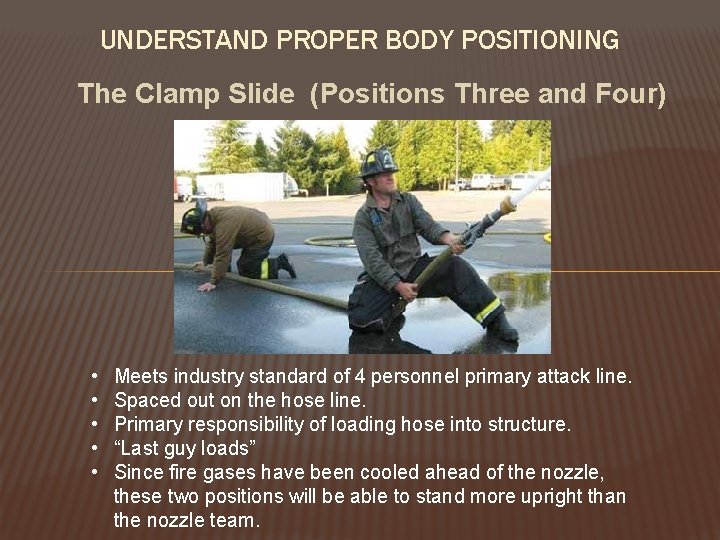
UNDERSTAND PROPER BODY POSITIONING The Clamp Slide (Positions Three and Four) • • • Meets industry standard of 4 personnel primary attack line. Spaced out on the hose line. Primary responsibility of loading hose into structure. “Last guy loads” Since fire gases have been cooled ahead of the nozzle, these two positions will be able to stand more upright than the nozzle team.
“LOADING” HOSE Benefits • • Uses large muscle groups, legs, to drive hose to the next turn. In contrast to “dropping” personnel at current pinch points using small muscle groups, arms, to pull hose around corners. Prevents “hooking” furniture and other obstacles with hose line, because line is driven with the legs downward, toward the floor.
“LOADING” HOSE Three types of turns • 90 Degree • T- Hallway • 180 Degree (Mostly found in stair cases)
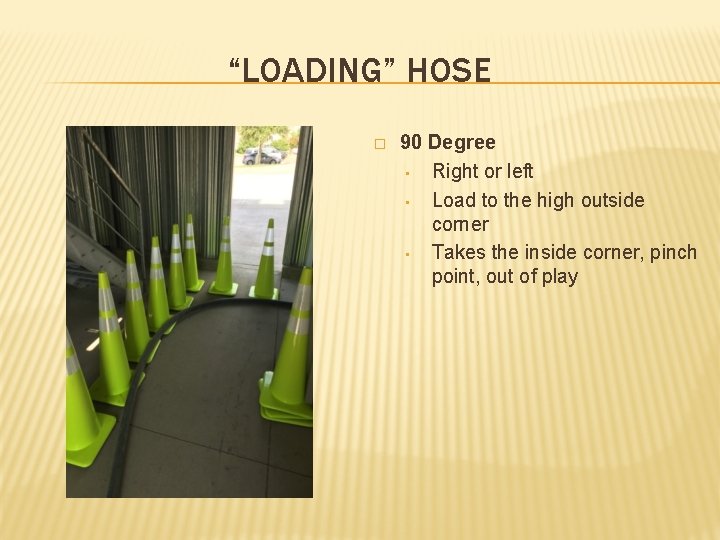
“LOADING” HOSE � 90 Degree • Right or left • Load to the high outside corner • Takes the inside corner, pinch point, out of play
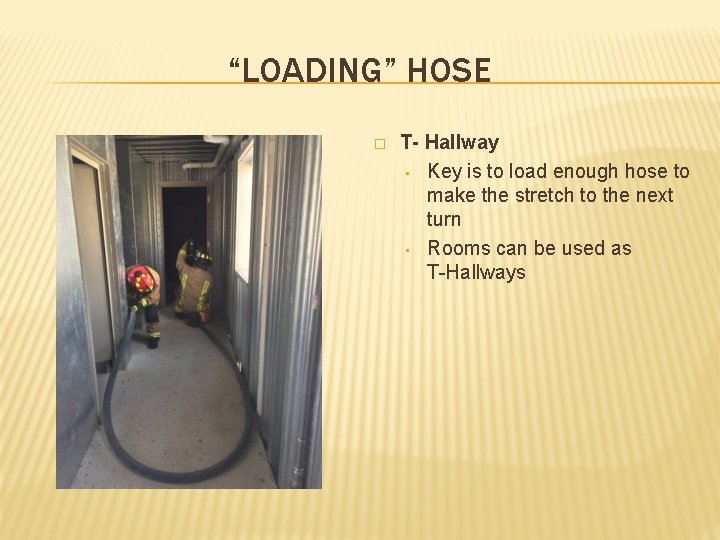
“LOADING” HOSE � T- Hallway • Key is to load enough hose to make the stretch to the next turn • Rooms can be used as T-Hallways
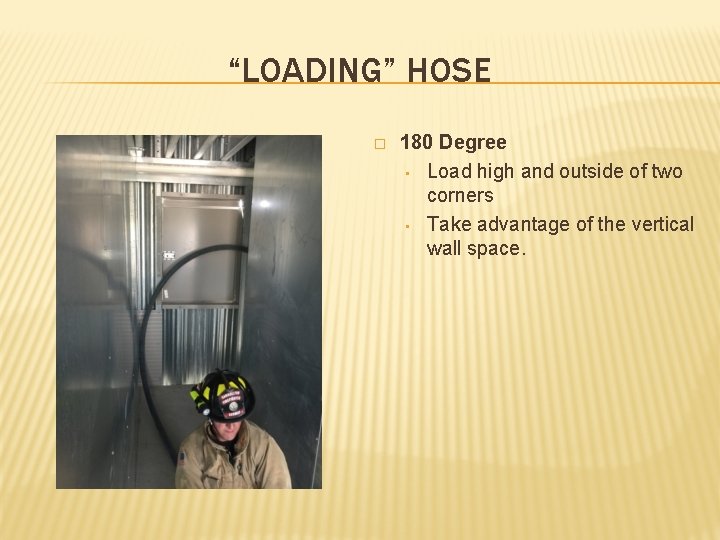
“LOADING” HOSE � 180 Degree • Load high and outside of two corners • Take advantage of the vertical wall space.
NOZZLE AND STREAM 3 Targets • Smoke • Contents • Fire 3 Goals • Cooling • Return • Lift
NOZZLE AND STREAM 3 TARGETS • Smoke • Applying water into the smoke will reduce temperatures and prevent actions such as ventilation induced flashover, and vent point ignition. • This is will temporarily disturb thermal balance. This is cooling. • As gases are cooled by the steam conversion, the remaining water will return to the floor, further cooling the lesser heated gases. This is “return” or “fallout”. • As the line remains open, the cooling has allowed for the shrinking of hot gases, causing “Lift” • This “makes space”, survivable space, for victims.
NOZZLE AND STREAM 3 TARGETS • Contents • • Walls, furniture, carpet This allows the box to absorb heat, thus preventing flashover
NOZZLE AND STREAM 3 TARGETS • Fire • • • When the fire room can be identified, water can be applied in-directly. Bounced off doors, walls, and ceilings. As the attack continues and the closer we get to the fire room, a more direct attack can be used.
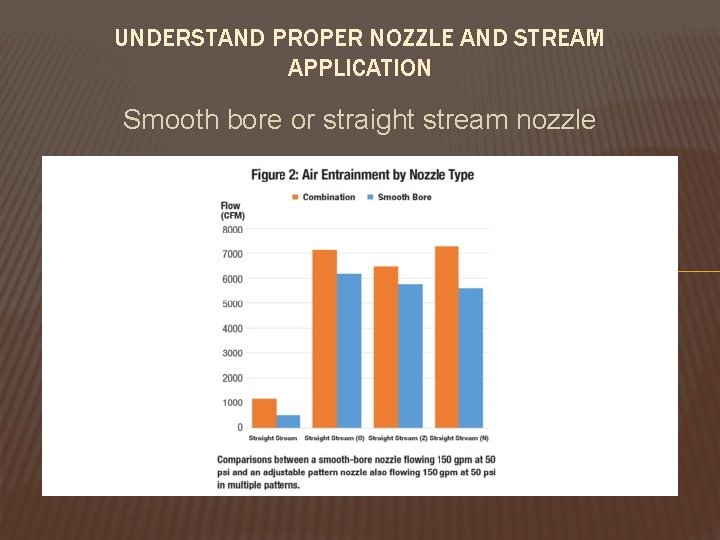
NOZZLE AND STREAMS Smooth bore or straight stream nozzle • • • Allows for controlling the amount of air that is entrained into the hose stream. When applying water into smoke, use a slow back and forth movement. This entrains little air, preventing over pressurization of the space. When applying to the contents, use an “n” or upside down “U”. This entrains more air, but begins to push fire gases back towards fire area. When cooling, return, and lift are noticed, use an “O” pattern. This will entrain more air causing fire gases to withdrawal toward the fire room. It will also replace the hot water on the floor, that absorbed heat from the smoke, with cooler water. When these results are achieved, the nozzle is shut down, and advanced using the clamp slide technique
UNDERSTAND PROPER NOZZLE AND STREAM APPLICATION Smooth bore or straight stream nozzle
COMMON TERMINOLOGY • • Action, Intention, Distance • “Forward, Right turn, 10 feet” “Bump up” • Command given from the nozzle team to members down the line to move up to the next possible friction point.
WHAT ABOUT THE SEARCH?
PRIMARY SEARCH WITH A HAND LINE
PRIMARY SEARCH � � Nozzleman is able to search while advancing hand line, the “Move” All other positions take advantage of the pauses, the “Hit” phase. � While the Nozzleman is flowing water down range, Heel man gets low, below neutral plane, and uses TIC, if available, for location of the fire, layout of the structure, and life. � Heel man can also control doors to isolate. � Positions 3 and 4 can work as a two man team to search open rooms, i. e. living rooms, kitchens, and bedrooms along the ingress paths.