
Primary Science in a Box This leaflet has

Primary Science in a Box! This leaflet has a range of science activities suitable to be done by children at home. Science equipment is provided, with other objects readily available at home. All activities must be carried out with adult supervision. Contents 1. 2. 3. 4. 5. A funny sort of electricity. . . p 2 Balancing Butterflies………………p 4 All about Liquids…………………. p 6 Unique You!. . . . . p 8 Getting Colourful………………. . p 10 Health & Safety – PLEASE READ…………. p 12 ‘This is a Reaching Wider funded project’ 'Mae Ymestyn yn Ehangach yn ariannu'r project hwn' 1
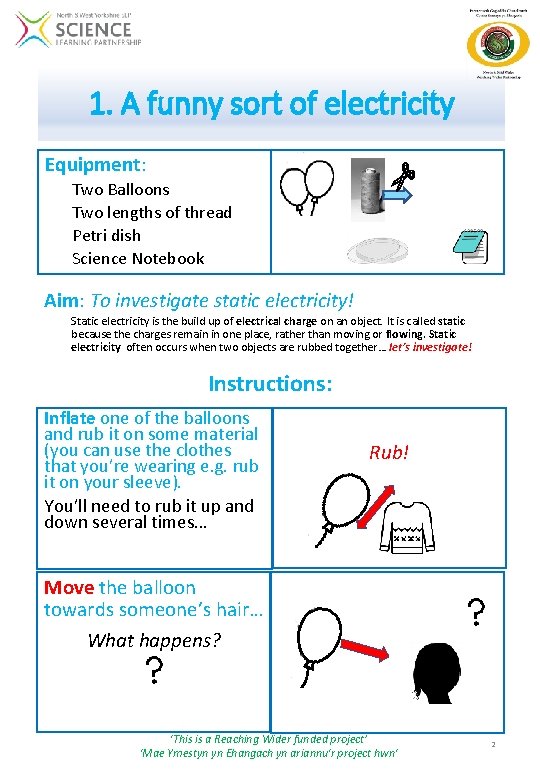
1. A funny sort of electricity Equipment: Two Balloons Two lengths of thread Petri dish Science Notebook Aim: To investigate static electricity! Static electricity is the build up of electrical charge on an object. It is called static because the charges remain in one place, rather than moving or flowing. Static electricity often occurs when two objects are rubbed together… let’s investigate! Instructions: Inflate one of the balloons and rub it on some material (you can use the clothes that you’re wearing e. g. rub it on your sleeve). You’ll need to rub it up and down several times… Rub! Move the balloon towards someone’s hair… What happens? ‘This is a Reaching Wider funded project’ 'Mae Ymestyn yn Ehangach yn ariannu'r project hwn' 2
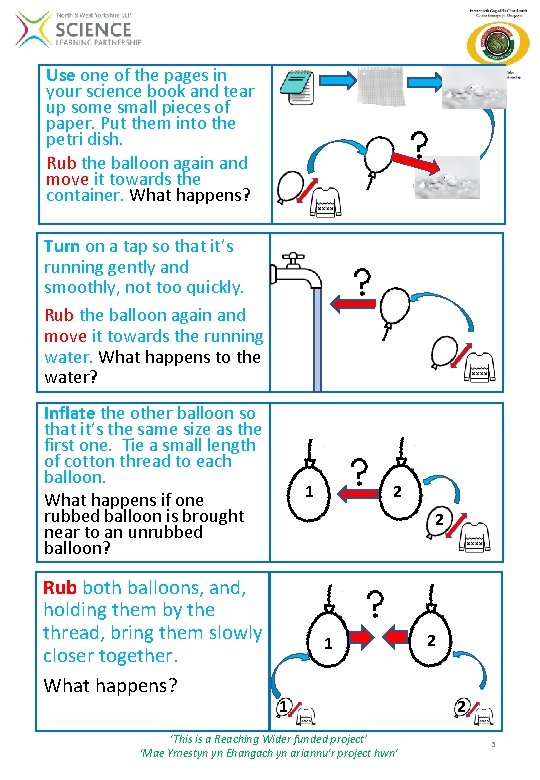
Use one of the pages in your science book and tear up some small pieces of paper. Put them into the petri dish. Rub the balloon again and move it towards the container. What happens? Turn on a tap so that it’s running gently and smoothly, not too quickly. Rub the balloon again and move it towards the running water. What happens to the water? Inflate the other balloon so that it’s the same size as the first one. Tie a small length of cotton thread to each balloon. What happens if one rubbed balloon is brought near to an unrubbed balloon? Rub both balloons, and, holding them by the thread, bring them slowly closer together. What happens? 1 2 2 1 1 ‘This is a Reaching Wider funded project’ 'Mae Ymestyn yn Ehangach yn ariannu'r project hwn' 2 2 3
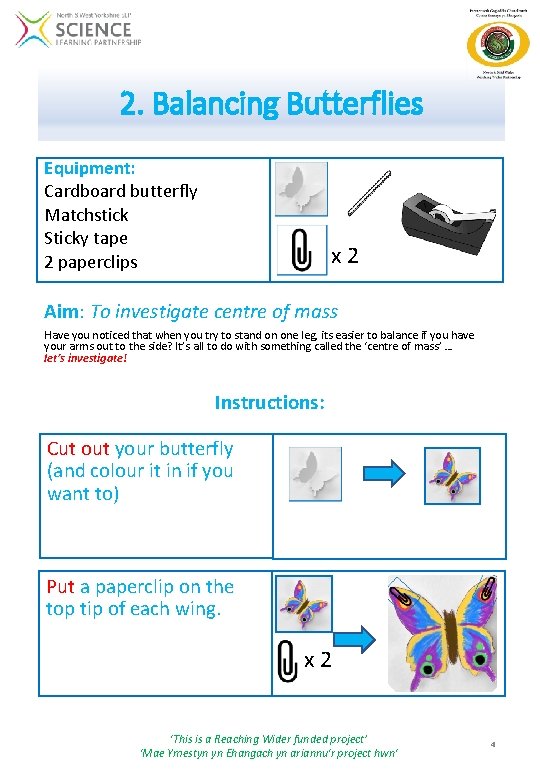
2. Balancing Butterflies Equipment: Cardboard butterfly Matchstick Sticky tape 2 paperclips x 2 Aim: To investigate centre of mass Have you noticed that when you try to stand on one leg, its easier to balance if you have your arms out to the side? It’s all to do with something called the ‘centre of mass’ … let’s investigate! Instructions: Cut out your butterfly (and colour it in if you want to) Put a paperclip on the top tip of each wing. x 2 ‘This is a Reaching Wider funded project’ 'Mae Ymestyn yn Ehangach yn ariannu'r project hwn' 4
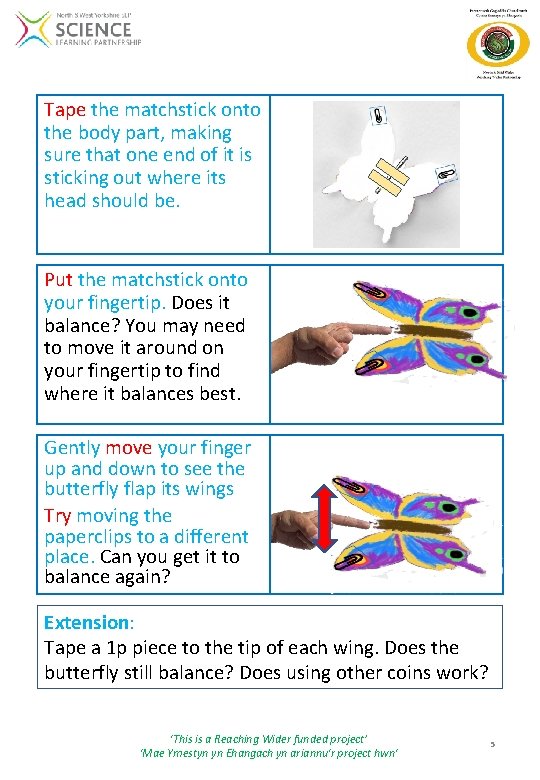
Tape the matchstick onto the body part, making sure that one end of it is sticking out where its head should be. Put the matchstick onto your fingertip. Does it balance? You may need to move it around on your fingertip to find where it balances best. Gently move your finger up and down to see the butterfly flap its wings Try moving the paperclips to a different place. Can you get it to balance again? Extension: Tape a 1 p piece to the tip of each wing. Does the butterfly still balance? Does using other coins work? ‘This is a Reaching Wider funded project’ 'Mae Ymestyn yn Ehangach yn ariannu'r project hwn' 5

3. All about liquids Equipment: Dimple tray Pipettes p. H indicator paper Pencil & Science notebook Aim: To investigate the p. H of different liquids Liquids have something called a p. H value – which tell us how acidic or alkaline they are. Acids include lemon juice and vinegar – they taste sour and are bad for your teeth as they dissolve the outer layer (enamel). This is why you must clean your teeth properly. Soap and other cleaning products are alkalis and can make your skin feel slippery. Very strong acids and alkalis are dangerous – we say they are corrosive. We can use a special type of paper, called indicator paper, which changes colour to tell us the p. H of a liquid. Let’s investigate! Instructions: Find examples of liquids you want to test – e. g. milk, fizzy drink, water, shampoo, ‘This is a Reaching Wider funded project’ 'Mae Ymestyn yn Ehangach yn ariannu'r project hwn' 6
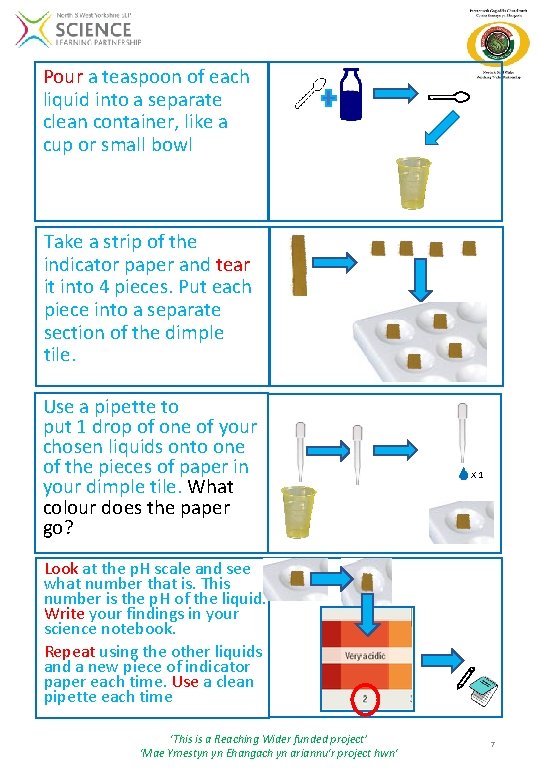
Pour a teaspoon of each liquid into a separate clean container, like a cup or small bowl Take a strip of the indicator paper and tear it into 4 pieces. Put each piece into a separate section of the dimple tile. Use a pipette to put 1 drop of one of your chosen liquids onto one of the pieces of paper in your dimple tile. What colour does the paper go? X 1 Look at the p. H scale and see what number that is. This number is the p. H of the liquid. Write your findings in your science notebook. Repeat using the other liquids and a new piece of indicator paper each time. Use a clean pipette each time ‘This is a Reaching Wider funded project’ 'Mae Ymestyn yn Ehangach yn ariannu'r project hwn' 7
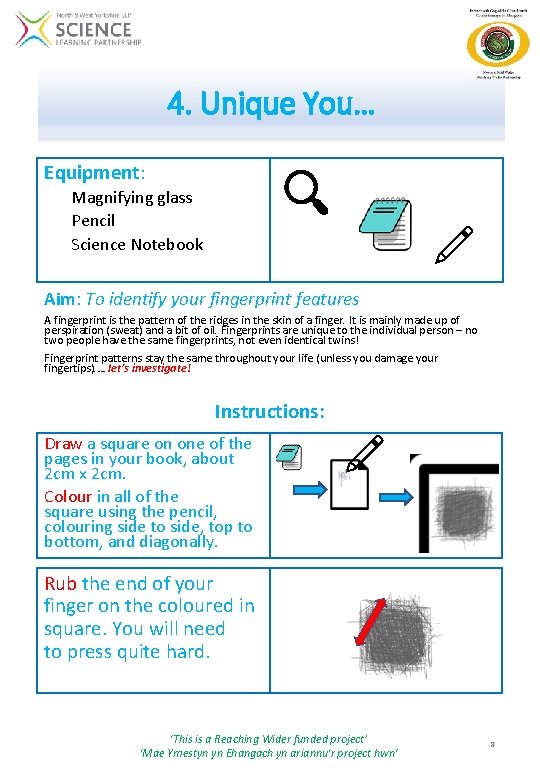
4. Unique You… Equipment: Magnifying glass Pencil Science Notebook Aim: To identify your fingerprint features A fingerprint is the pattern of the ridges in the skin of a finger. It is mainly made up of perspiration (sweat) and a bit of oil. Fingerprints are unique to the individual person – no two people have the same fingerprints, not even identical twins! Fingerprint patterns stay the same throughout your life (unless you damage your fingertips). … let’s investigate! Instructions: Draw a square on one of the pages in your book, about 2 cm x 2 cm. Colour in all of the square using the pencil, colouring side to side, top to bottom, and diagonally. Rub the end of your finger on the coloured in square. You will need to press quite hard. ‘This is a Reaching Wider funded project’ 'Mae Ymestyn yn Ehangach yn ariannu'r project hwn' 8
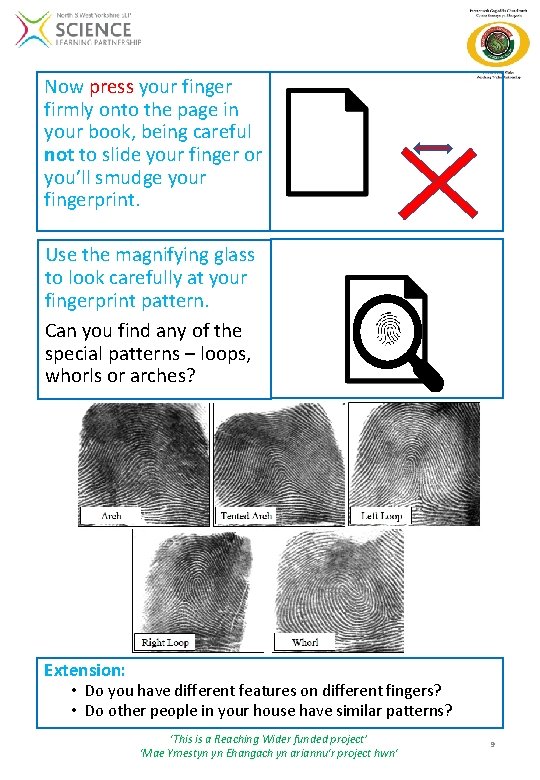
Now press your finger firmly onto the page in your book, being careful not to slide your finger or you’ll smudge your fingerprint. Use the magnifying glass to look carefully at your fingerprint pattern. Can you find any of the special patterns – loops, whorls or arches? Extension: • Do you have different features on different fingers? • Do other people in your house have similar patterns? ‘This is a Reaching Wider funded project’ 'Mae Ymestyn yn Ehangach yn ariannu'r project hwn' 9
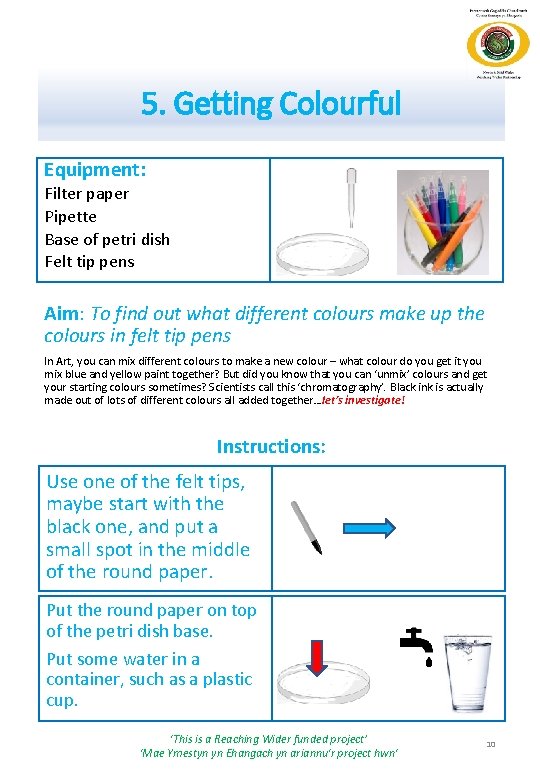
5. Getting Colourful Equipment: Filter paper Pipette Base of petri dish Felt tip pens Aim: To find out what different colours make up the colours in felt tip pens In Art, you can mix different colours to make a new colour – what colour do you get it you mix blue and yellow paint together? But did you know that you can ‘unmix’ colours and get your starting colours sometimes? Scientists call this ‘chromatography’. Black ink is actually made out of lots of different colours all added together…let’s investigate! Instructions: Use one of the felt tips, maybe start with the black one, and put a small spot in the middle of the round paper. Put the round paper on top of the petri dish base. Put some water in a container, such as a plastic cup. ‘This is a Reaching Wider funded project’ 'Mae Ymestyn yn Ehangach yn ariannu'r project hwn' 10
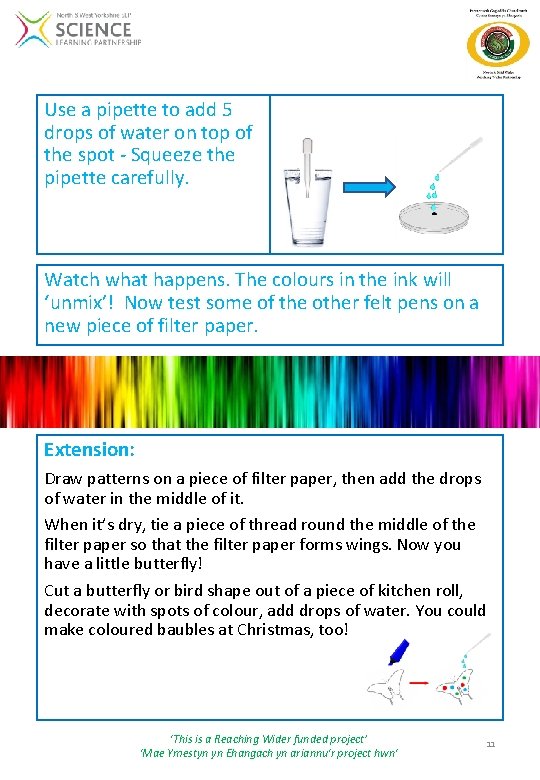
Use a pipette to add 5 drops of water on top of the spot - Squeeze the pipette carefully. Watch what happens. The colours in the ink will ‘unmix’! Now test some of the other felt pens on a new piece of filter paper. Extension: Draw patterns on a piece of filter paper, then add the drops of water in the middle of it. When it’s dry, tie a piece of thread round the middle of the filter paper so that the filter paper forms wings. Now you have a little butterfly! Cut a butterfly or bird shape out of a piece of kitchen roll, decorate with spots of colour, add drops of water. You could make coloured baubles at Christmas, too! ‘This is a Reaching Wider funded project’ 'Mae Ymestyn yn Ehangach yn ariannu'r project hwn' 11
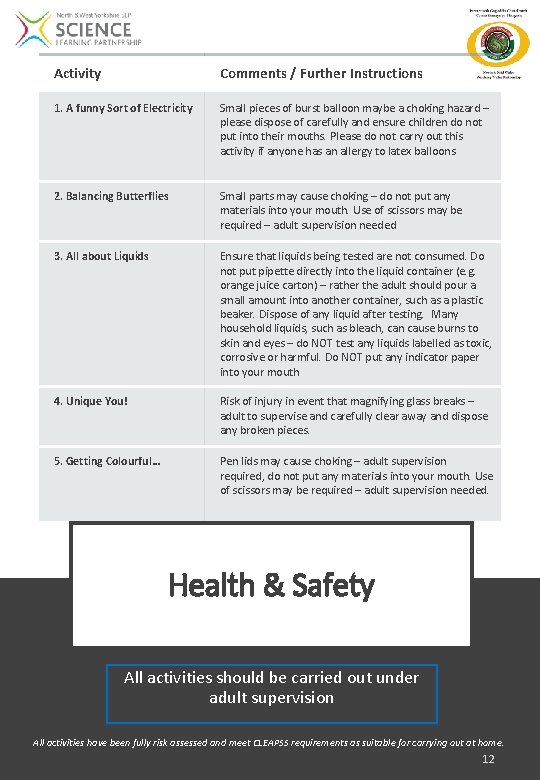
Activity Comments / Further Instructions 1. A funny Sort of Electricity Small pieces of burst balloon maybe a choking hazard – please dispose of carefully and ensure children do not put into their mouths. Please do not carry out this activity if anyone has an allergy to latex balloons 2. Balancing Butterflies Small parts may cause choking – do not put any materials into your mouth. Use of scissors may be required – adult supervision needed 3. All about Liquids Ensure that liquids being tested are not consumed. Do not put pipette directly into the liquid container (e. g. orange juice carton) – rather the adult should pour a small amount into another container, such as a plastic beaker. Dispose of any liquid after testing. Many household liquids, such as bleach, can cause burns to skin and eyes – do NOT test any liquids labelled as toxic, corrosive or harmful. Do NOT put any indicator paper into your mouth 4. Unique You! Risk of injury in event that magnifying glass breaks – adult to supervise and carefully clear away and dispose any broken pieces. 5. Getting Colourful… Pen lids may cause choking – adult supervision required, do not put any materials into your mouth. Use of scissors may be required – adult supervision needed. Health & Safety All activities should be carried out under adult supervision ‘This is a Reaching Wider funded project’ All activities have been fully risk assessed and meet CLEAPSS requirements as suitable for carrying out at home. 'Mae Ymestyn yn Ehangach yn ariannu'r project hwn' 12
- Slides: 12