
Primary migration of oil through selfpropagating fractures S
- Slides: 1
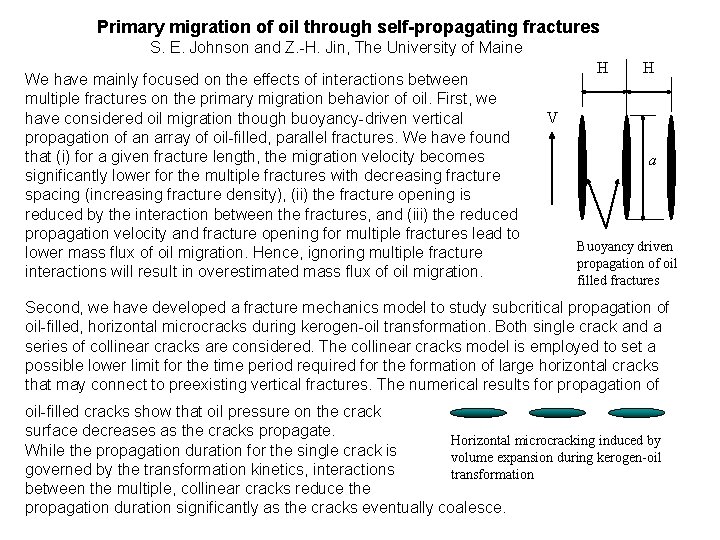
Primary migration of oil through self-propagating fractures S. E. Johnson and Z. -H. Jin, The University of Maine We have mainly focused on the effects of interactions between multiple fractures on the primary migration behavior of oil. First, we have considered oil migration though buoyancy-driven vertical propagation of an array of oil-filled, parallel fractures. We have found that (i) for a given fracture length, the migration velocity becomes significantly lower for the multiple fractures with decreasing fracture spacing (increasing fracture density), (ii) the fracture opening is reduced by the interaction between the fractures, and (iii) the reduced propagation velocity and fracture opening for multiple fractures lead to lower mass flux of oil migration. Hence, ignoring multiple fracture interactions will result in overestimated mass flux of oil migration. H H V a Buoyancy driven propagation of oil filled fractures Second, we have developed a fracture mechanics model to study subcritical propagation of oil-filled, horizontal microcracks during kerogen-oil transformation. Both single crack and a series of collinear cracks are considered. The collinear cracks model is employed to set a possible lower limit for the time period required for the formation of large horizontal cracks that may connect to preexisting vertical fractures. The numerical results for propagation of oil-filled cracks show that oil pressure on the crack surface decreases as the cracks propagate. Horizontal microcracking induced by While the propagation duration for the single crack is volume expansion during kerogen-oil governed by the transformation kinetics, interactions transformation between the multiple, collinear cracks reduce the propagation duration significantly as the cracks eventually coalesce.