
Primary Geography Subject knowledge Development 2019 20 Geography
Primary Geography Subject knowledge Development 2019 -20
Geography programmes of study: key stages 1 and 2 National curriculum in England Purpose of study A high-quality geography education should inspire in pupils a curiosity and fascination about the world and its people that will remain with them for the rest of their lives. Teaching should equip pupils with knowledge about diverse places, people, resources and natural and human environments, together with a deep understanding of the Earth’s key physical and human processes. As pupils progress, their growing knowledge about the world should help them to deepen their understanding of the interaction between physical and human processes, and of the formation and use of landscapes and environments. Geographical knowledge, understanding and skills provide the frameworks and approaches that explain how the Earth’s features at different scales are shaped, interconnected and change over time. Theory / Information
Aims of the Geography NC Theory / Information The national curriculum for geography aims to ensure that all pupils: • develop contextual knowledge of the location of globally significant places – both terrestrial and marine – including their defining physical and human characteristics and how these provide a geographical context for understanding the actions of processes • understand the processes that give rise to key physical and human geographical features of the world, how these are interdependent and how they bring about spatial variation and change over time • are competent in the geographical skills needed to: Ø collect, analyse and communicate with a range of data gathered through experiences of fieldwork that deepen their understanding of geographical Processes Ø interpret a range of sources of geographical information, including maps, diagrams, globes, aerial photographs and Geographical Information Systems (GIS) Ø communicate geographical information in a variety of ways, including through maps, numerical and quantitative skills and writing at length.
Subject Content: KS 1 Pupils should develop knowledge about the world, the United Kingdom and their locality. They should understand basic subject-specific vocabulary relating to human and physical geography and begin to use geographical skills, including firsthand observation, to enhance their locational awareness. Pupils should be taught to: Locational knowledge • name and locate the world’s seven continents and five oceans • name, locate and identify characteristics of the four countries and capital cities of the United Kingdom and its surrounding seas Place knowledge • understand geographical similarities and differences through studying the human and physical geography of a small area of the United Kingdom, and of a small area in a contrasting non-European country Theory / Information

Subject Content: KS 1 Human and physical geography • identify seasonal and daily weather patterns in the United Kingdom and the location of hot and cold areas of the world in relation to the Equator and the North and South Poles • use basic geographical vocabulary to refer to: Ø key physical features, including: beach, cliff, coast, forest, hill, mountain, sea, ocean, river, soil, valley, vegetation, season and weather Ø key human features, including: city, town, village, factory, farm, house, office, port, harbour and shop Geographical skills and fieldwork • use world maps, atlases and globes to identify the United Kingdom and its countries, as well as the countries, continents and oceans studied at this key stage • use simple compass directions (North, South, East and West) and locational and directional language [for example, near and far; left and right], to describe the location of features and routes on a map • use aerial photographs and plan perspectives to recognise landmarks and basic human and physical features; devise a simple map; and use and construct basic symbols in a key • use simple fieldwork and observational skills to study the geography of their school and its grounds and the key human and physical features of its surrounding environment. Theory / Information
Subject Content: KS 2 Pupils should extend their knowledge and understanding beyond the local area to include the United Kingdom and Europe, North and South America. This will include the location and characteristics of a range of the world’s most significant human and physical features. They should develop their use of geographical knowledge, understanding and skills to enhance their locational and place knowledge. Pupils should be taught to: Locational knowledge • locate the world’s countries, using maps to focus on Europe (including the location of Russia) and North and South America, concentrating on their environmental regions, key physical and human characteristics, countries, and major cities • name and locate counties and cities of the United Kingdom, geographical regions and their identifying human and physical characteristics, key topographical features (including hills, mountains, coasts and rivers), and land-use patterns; and understand how some of these aspects have changed over time • identify the position and significance of latitude, longitude, Equator, Northern Hemisphere, Southern Hemisphere, the Tropics of Cancer and Capricorn, Arctic and Antarctic Circle, the Prime/Greenwich Meridian and time zones (including day and night) Place knowledge • understand geographical similarities and differences through the study of human and physical geography of a region of the United Kingdom, a region in a European country, and a region within North or South America Theory / Information
Subject Content: KS 2 Human and physical geography • describe and understand key aspects of: Ø physical geography, including: climate zones, biomes and vegetation belts, rivers, mountains, volcanoes and earthquakes, and the water cycle Ø human geography, including: types of settlement and land use, economic activity including trade links, and the distribution of natural resources including energy, food, minerals and water Geographical skills and fieldwork • use maps, atlases, globes and digital/computer mapping to locate countries and describe features studied • use the eight points of a compass, four and six-figure grid references, symbols and key (including the use of Ordnance Survey maps) to build their knowledge of the United Kingdom and the wider world • use fieldwork to observe, measure, record and present the human and physical features in the local area using a range of methods, including sketch maps, plans and graphs, and digital technologies. Theory / Information
Top tips for teaching Geography: Make it fun: Search out a fun and active geography curriculum with a variety of activities and games. Why not learn alongside your children. Games, puzzles, cooking, and even drill type games involving map labelling can make geography come alive. Involve history: Geography is important because of its relationship to history. Seeing the big picture of why a place was important in a history event can solidify the learning and require less work to learn. For example, did you know that without the work of the Romans in developing roads? How might this have impacted history? As the saying goes, "Location, location. “ Include food: There's truly nothing more fun that eating local food. You likely can't travel the world to taste the variety of cuisine, but you can certainly whip it up in a basic kitchen. A geography curriculum that includes recipe suggestions to take you around the world is a great way to learn geography. You're not likely to forget a Kentucky Hot Brown or Hoosier Chili. Become a geography foodie! Theory / Information
Top tips for teaching Geography: Enquiry based approaches: Where pupils become the investigators of a geographical issue. With this approach, they start to own their geographical education. Use personal geographies: When starting a topic, use the pupil’s own personal geographies – they will love to talk about the places they know or have been to, so when looking at tourism – ask them where they have been on holiday. Or, if looking at water supply issues – ask them to total up the amount of water they use in a day. This makes the geography relevant to them. Using hooks: A carefully selected photograph, map, graph video clip, written quote or even a poem can be a great hook into a topic. Pupils are inspired to ask their own questions and gain a sense of ownership over topic. If this is well chosen, it can inspire the whole scheme of work. Meaningful fieldwork: There are ways to complete fieldwork without excessive cost, planning and cover. Consider your local environments, e. g. where are the water sources in our local area? How do we get from school to the local shop or post office? Pose a question which links to the pupils investigating for themselves or coming up with ideas to answer the questions. Theory / Information
Geography in practice: Theory / Information https: //www. youtube. com/watch? v=0 v 722 IRc. Xuk
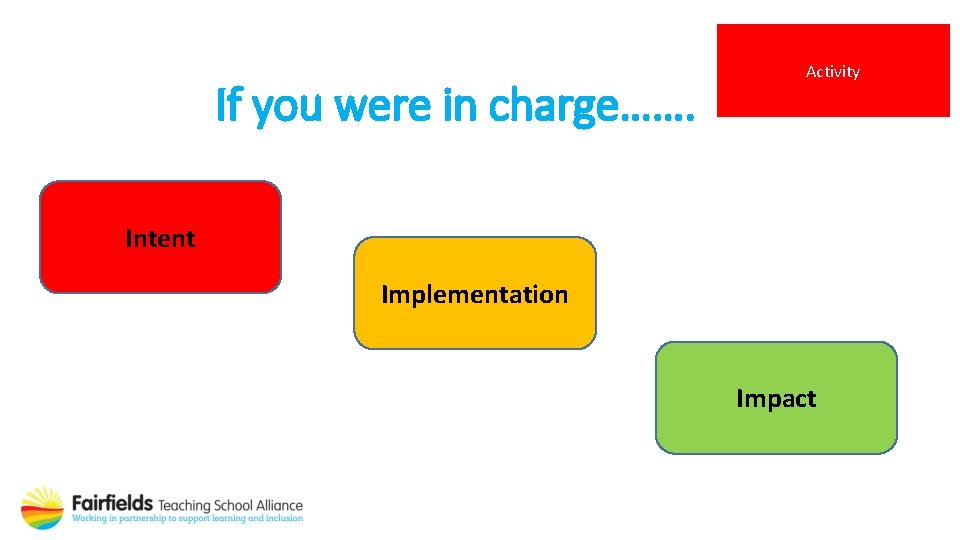
If you were in charge……. Activity Intent Implementation Impact
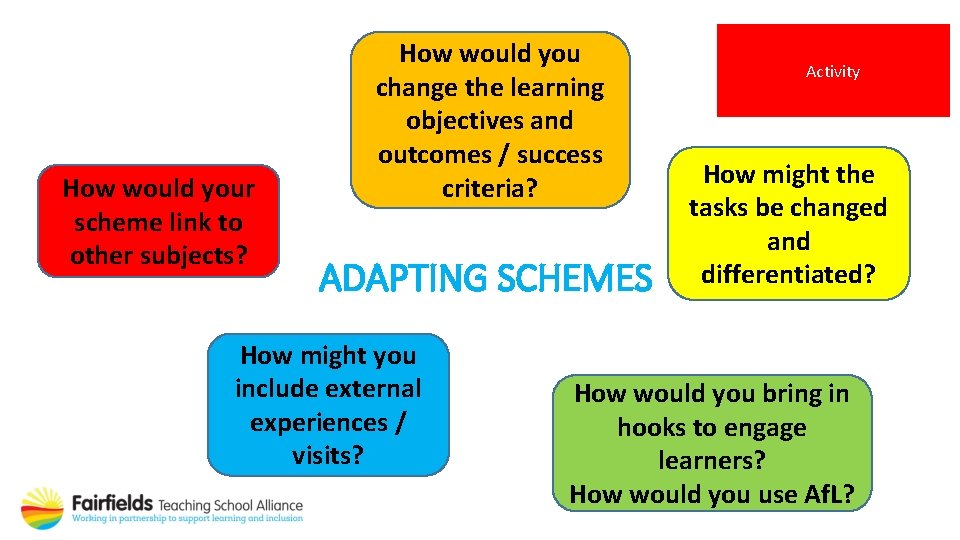
How would your scheme link to other subjects? How would you change the learning objectives and outcomes / success criteria? ADAPTING SCHEMES How might you include external experiences / visits? Activity How might the tasks be changed and differentiated? How would you bring in hooks to engage learners? How would you use Af. L?
- Slides: 12