
Primary Dentition Review Development and Eruption All 20



- Slides: 17
Primary Dentition Review
Development and Eruption • All 20 primaries begin calcifying 4 -6 months in utero (2 nd trimester) • Crown completion in all primaries within first year after birth • Eruption occurs from 6 months to 2 years • Mixed dentition from age 6 to 12 • Age 4 -5 yrs, primate spaces develop due to growth of maxilla and mandible
Eruption Sequence • Mandibular teeth erupt prior to their maxillary counterparts • Sequence: – – – Centrals Laterals 1 st molars Canines 2 nd molars
Exfoliation sequence: 1. Preceeds the eruption sequence of the permanent dentition. 2. Root resorption begins one year prior to exfoliation 3. All primary second molars are lost about the same time
Unique Characteristics of Primary Teeth
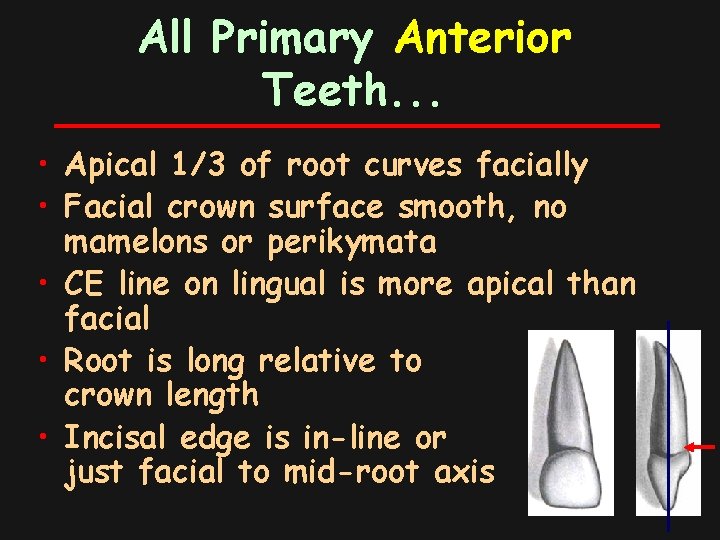
All Primary Anterior Teeth. . . • Apical 1/3 of root curves facially • Facial crown surface smooth, no mamelons or perikymata • CE line on lingual is more apical than facial • Root is long relative to crown length • Incisal edge is in-line or just facial to mid-root axis
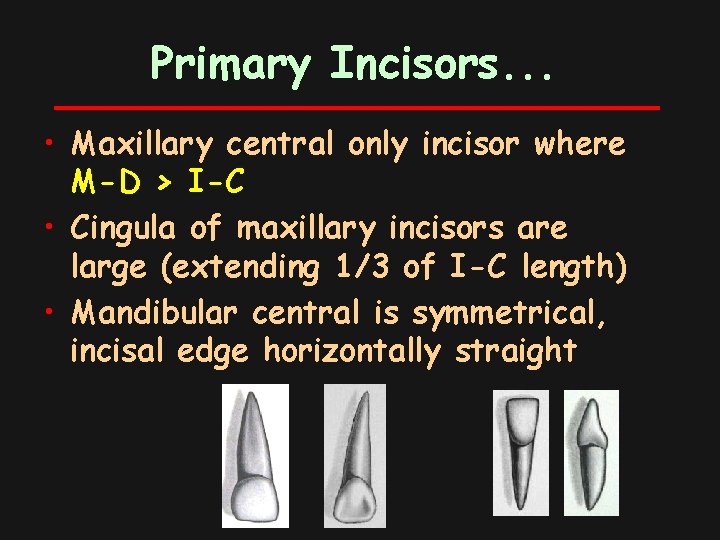
Primary Incisors. . . • Maxillary central only incisor where M-D > I-C • Cingula of maxillary incisors are large (extending 1/3 of I-C length) • Mandibular central is symmetrical, incisal edge horizontally straight
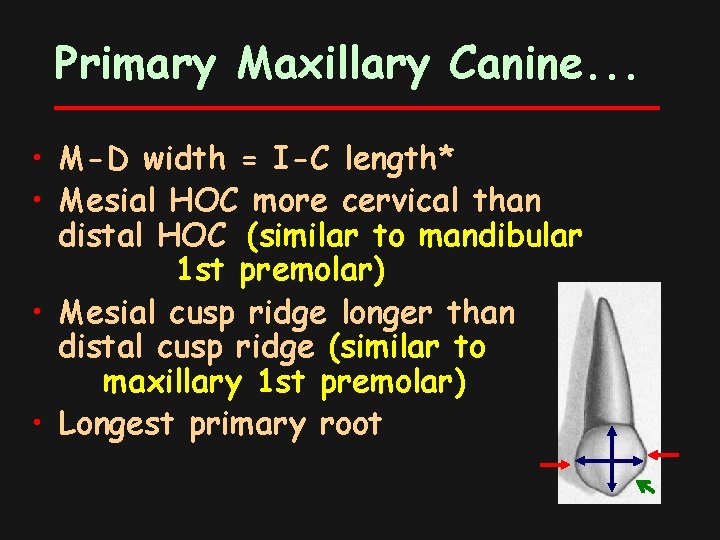
Primary Maxillary Canine. . . • M-D width = I-C length* • Mesial HOC more cervical than distal HOC (similar to mandibular 1 st premolar) • Mesial cusp ridge longer than distal cusp ridge (similar to maxillary 1 st premolar) • Longest primary root
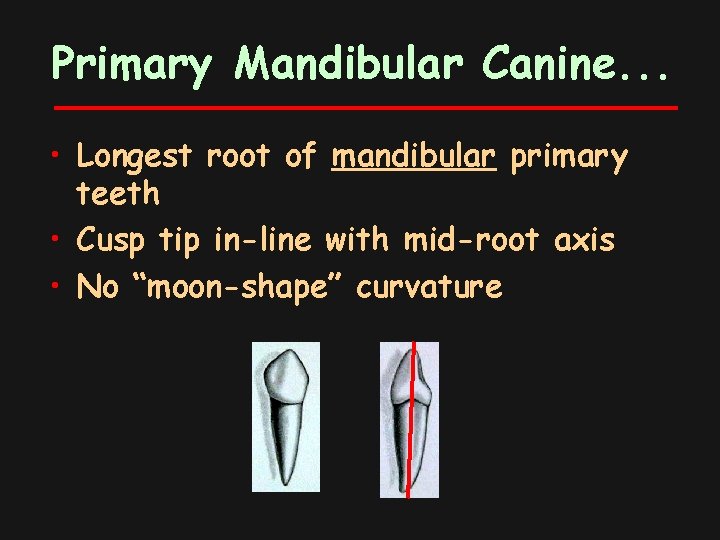
Primary Mandibular Canine. . . • Longest root of mandibular primary teeth • Cusp tip in-line with mid-root axis • No “moon-shape” curvature
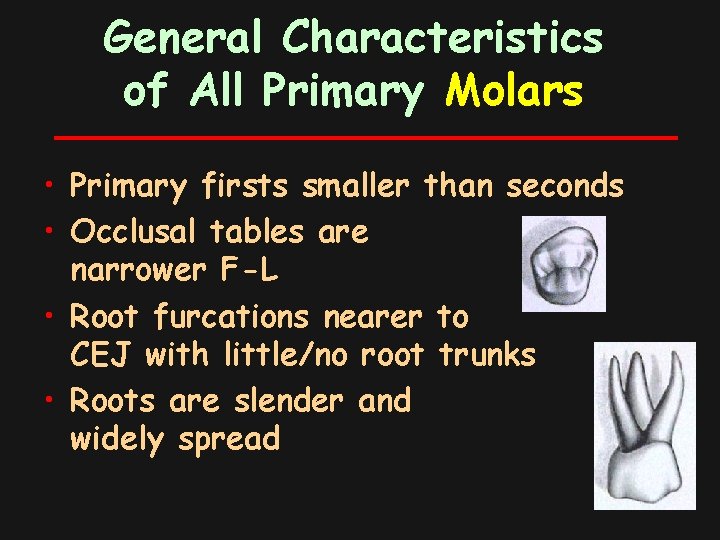
General Characteristics of All Primary Molars • Primary firsts smaller than seconds • Occlusal tables are narrower F-L • Root furcations nearer to CEJ with little/no root trunks • Roots are slender and widely spread
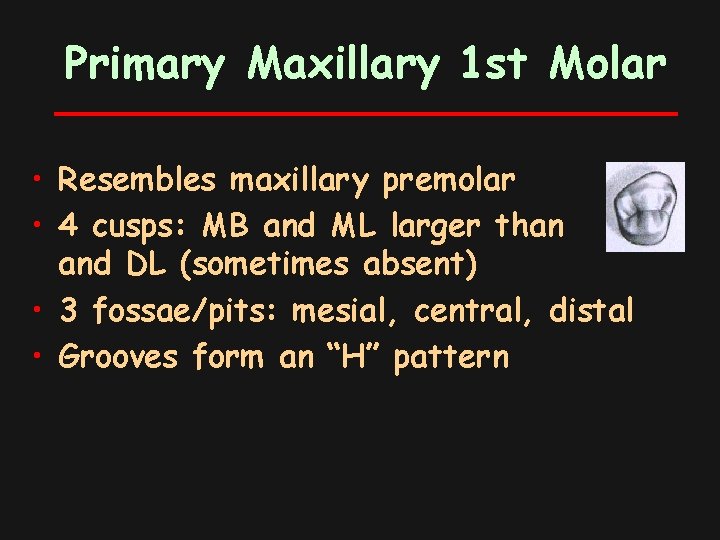
Primary Maxillary 1 st Molar • Resembles maxillary premolar • 4 cusps: MB and ML larger than DB and DL (sometimes absent) • 3 fossae/pits: mesial, central, distal • Grooves form an “H” pattern
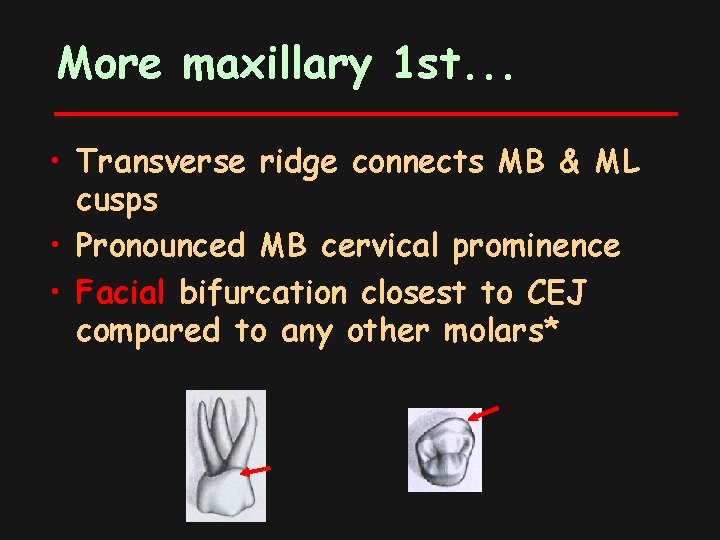
More maxillary 1 st. . . • Transverse ridge connects MB & ML cusps • Pronounced MB cervical prominence • Facial bifurcation closest to CEJ compared to any other molars*
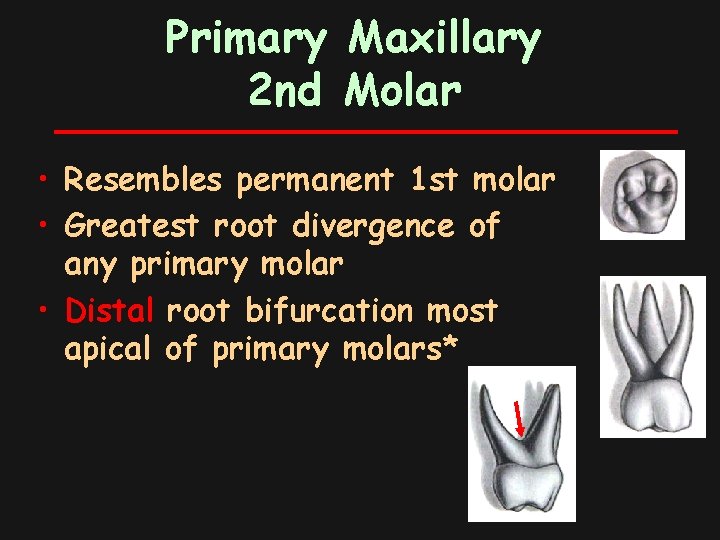
Primary Maxillary 2 nd Molar • Resembles permanent 1 st molar • Greatest root divergence of any primary molar • Distal root bifurcation most apical of primary molars*
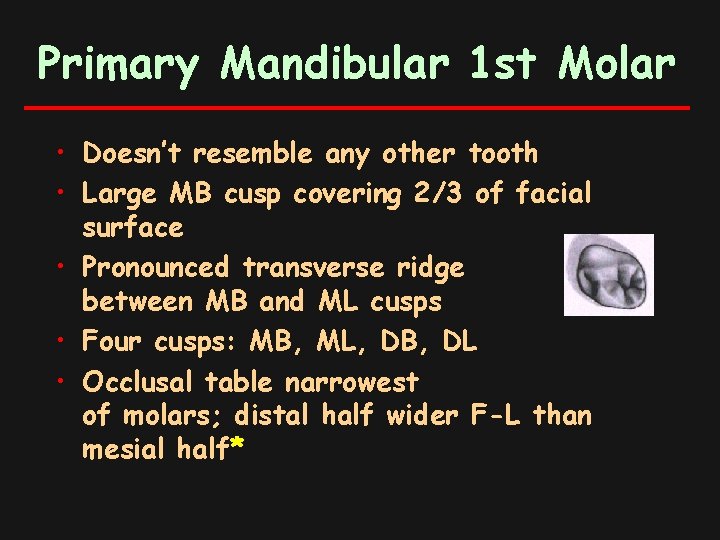
Primary Mandibular 1 st Molar • Doesn’t resemble any other tooth • Large MB cusp covering 2/3 of facial surface • Pronounced transverse ridge between MB and ML cusps • Four cusps: MB, ML, DB, DL • Occlusal table narrowest of molars; distal half wider F-L than mesial half*
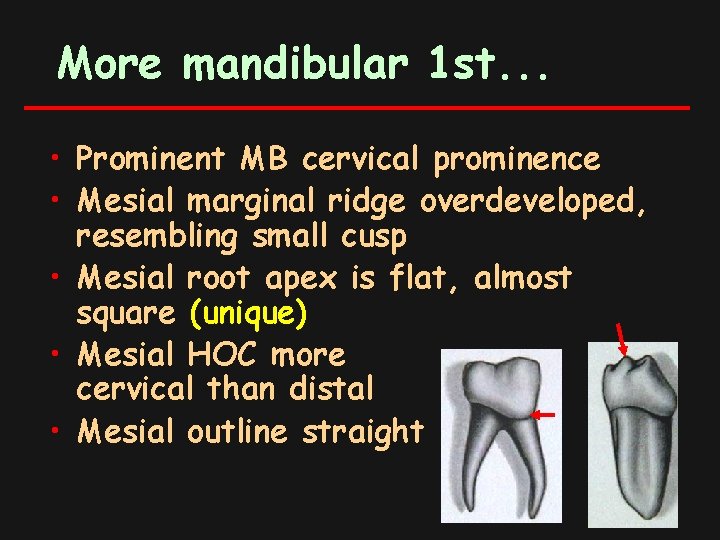
More mandibular 1 st. . . • Prominent MB cervical prominence • Mesial marginal ridge overdeveloped, resembling small cusp • Mesial root apex is flat, almost square (unique) • Mesial HOC more cervical than distal • Mesial outline straight
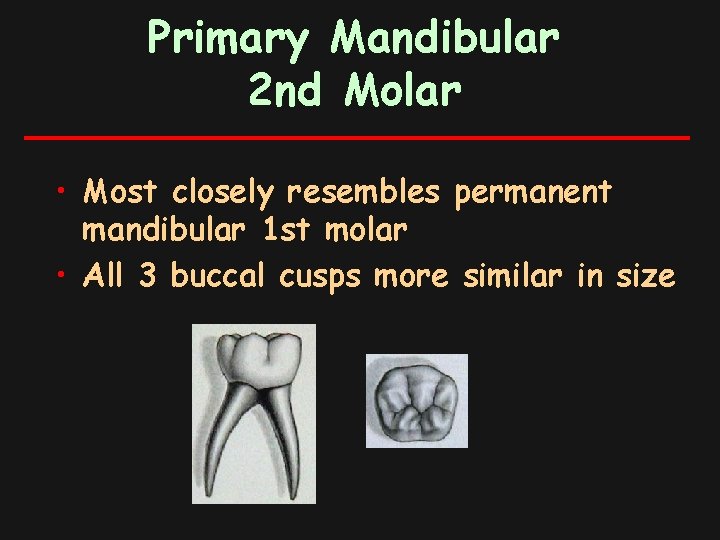
Primary Mandibular 2 nd Molar • Most closely resembles permanent mandibular 1 st molar • All 3 buccal cusps more similar in size
All the Best on Your Exams