
Primary Creative Arts Dance in the K6 Classroom
- Slides: 14
Primary Creative Arts Dance in the K-6 Classroom Deirdre Russell-Bowie
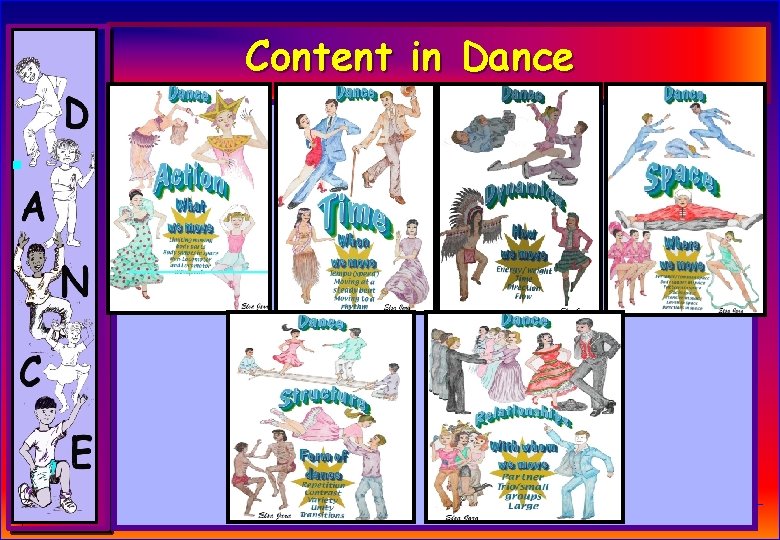
Dance § Action • What we move § Time • When we move § Dynamics • How we move § Space • Where we move § Relationships • With whom we move § Structure • How dance is organised
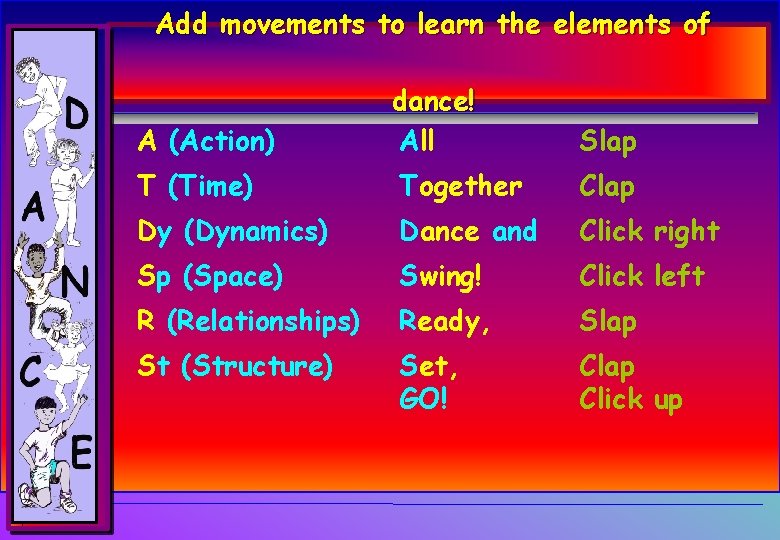
Add movements to learn the elements of A (Action) dance! All Slap T (Time) Together Clap Dy (Dynamics) Dance and Click right Sp (Space) Swing! Click left R (Relationships) Ready, Slap St (Structure) Set, GO! Clap Click up
Elements of Dance § What are the six elements of dance? • A • T • D • Sp • R • St
Dance Contexts § Teacher-directed dances § Students’ compositions § Cultural and historical dances
Planning for Dance Lessons • Indicators • Introduction • Warm up ü Are specific to activities in program ü Used to evaluate effectiveness of lessons; ü link to assessment pointers ü Relates to KNOWN (experiences, curriculum areas) ü Catch children’s imagination and attention ü Sets rules, rewards and routines ü Focus attention on lesson content ü Physically warms the body up to prevent injury ü Links Intro to exploration and development of lesson ü Introduces children to dance elements in lesson
Planning for Dance Lessons • Exploration and development of dance ideas • Appreciation/Sharing dances ü Children improvise, explore, try out different moves ü Select movements to form into sections of dance ü Children practise, clarify, refine dance ü Children should observe, describe, analyse, interpret and evaluate peers’ and their own dances ü Use the language of dance ü Encouraged to give reasons for their views ü Performance for an audience (from 1 - 100+!) • • Closure Clear start and finish Clarity of movement and phrasing Group working together well, focussed, communicates ü Cool down / discussion, if appropriate
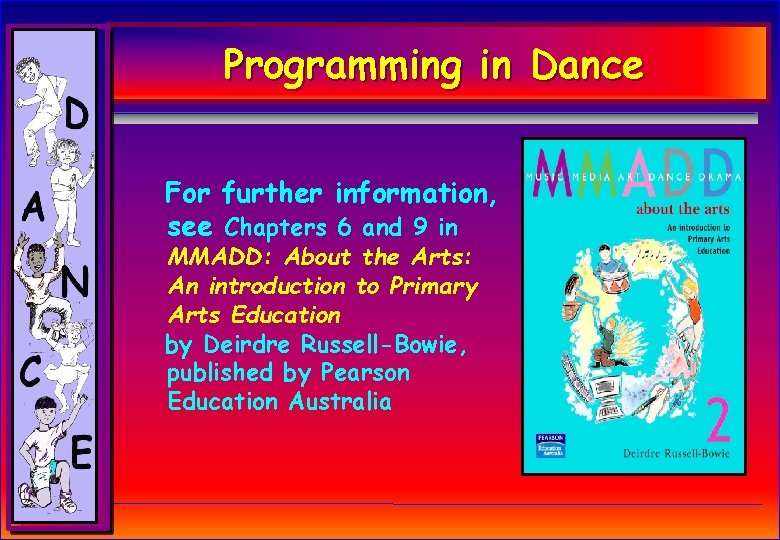
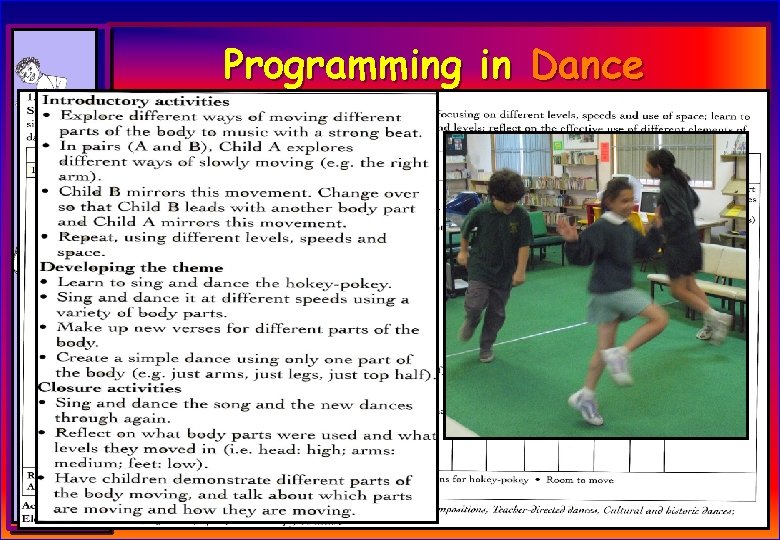
Programming in Dance For further information, see Chapters 6 and 9 in MMADD: About the Arts: An introduction to Primary Arts Education by Deirdre Russell-Bowie, published by Pearson Education Australia
Content in Dance § 101293: Dance Lecture
Programming in Dance MMADD page 298; 101293: Dance Lecture
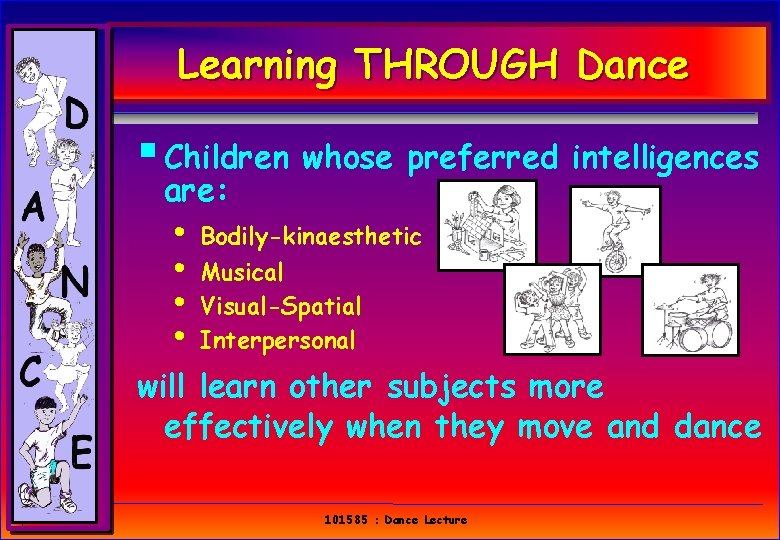
Learning THROUGH Dance § Children whose preferred intelligences are: • • Bodily-kinaesthetic Musical Visual-Spatial Interpersonal will learn other subjects more effectively when they move and dance 101585 : Dance Lecture
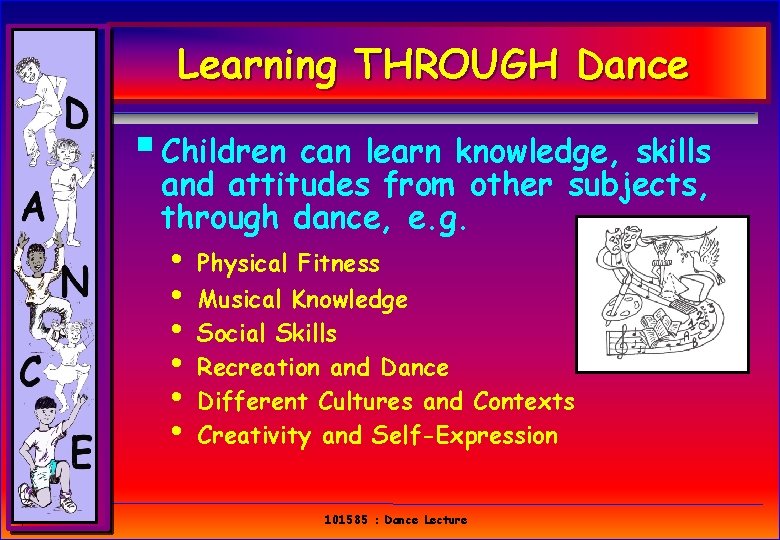
Learning THROUGH Dance § Children can learn knowledge, skills and attitudes from other subjects, through dance, e. g. • • • Physical Fitness Musical Knowledge Social Skills Recreation and Dance Different Cultures and Contexts Creativity and Self-Expression 101585 : Dance Lecture
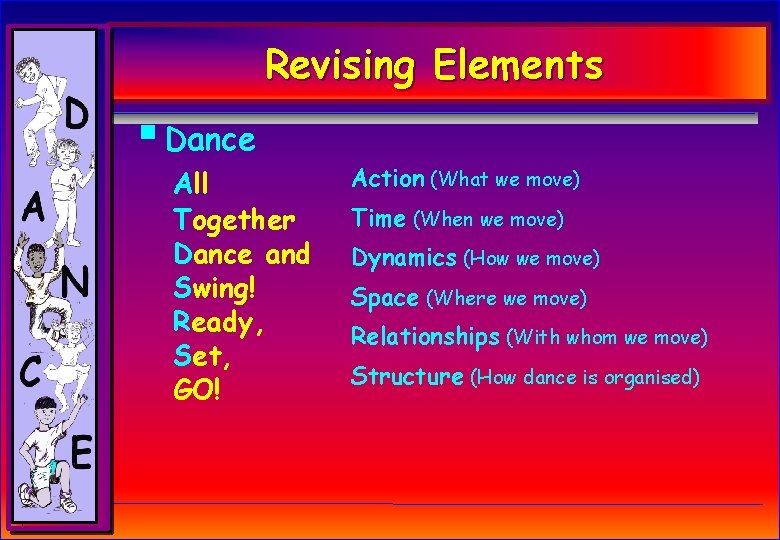
Revising Elements § Dance All Together Dance and Swing! Ready, Set, GO! Action (What we move) Time (When we move) Dynamics (How we move) Space (Where we move) Relationships (With whom we move) Structure (How dance is organised)
Dance is a poem of which each movement is a word! Mata Hari