
Primary CosmicRay Energy Spectrum Around The Knee Energy

- Slides: 27
Primary Cosmic-Ray Energy Spectrum Around The Knee Energy Region Measured By The Tibet Hybrid Experiment Physics at the End of the Galactic Cosmic Ray Spectrum, Aspen, 26 April, 2005 Masato Takita ICRR, Univ. of Tokyo For The Tibet ASg Collaboration
The Tibet ASg Collaboration M. Amenomori(1), S. Ayabe(2), S. W. Cui(3), Danzengluobu(4), L. K. Ding(3), X. H. Ding(4), C. F. Feng(5), Z. Y. Feng(6), X. Y. Gao(7), Q. X. Geng(7), H. W. Guo(4), H. H. He(3), M. He(5), K. Hibino(8), N. Hotta(9), Haibing Hu(4), H. B. Hu(3), J. Huang(10), Q. Huang(6), H. Y. Jia(6), F. Kajino(11), K. Kasahara(12), Y. Katayose(13), C. Kato(14), K. Kawata(10), Labaciren(4), G. M. Le(15), J. Y. Li(5), H. Lu(3), S. L. Lu(3), X. R. Meng(4), K. Mizutani(2), J. Mu(7), K. Munakata(14), A. Nagai(16), H. Nanjo(1), M. Nishizawa(17), M. Ohnishi(10), I. Ohta(9), H. Onuma(2), T. Ouchi(8), S. Ozawa(10), J. R. Ren(3), T. Saito(18), M. Sakata(11), T. Sasaki(8), M. Shibata(13), A. Shiomi(10), T. Shirai(8), H. Sugimoto(19), M. Takita(10), Y. H. Tan(3), N. Tateyama(8) , S. Torii(8), H. Tsuchiya(10), S. Udo(10), T. Utsugi(8), B. S. Wang(3), H. Wang(3), X. Wang(2), Y. G. Wang(5), H. R. Wu(3), L. Xue(5), Y. Yamamoto(11), C. T. Yan(3), X. C. Yang(7), S. Yasue(14), Z. H. Ye(15), G. C. Yu(6), A. F. Yuan(4), T. Yuda(10), H. M. Zhang(3), J. L. Zhang(3), N. J. Zhang(5), X. Y. Zhang(5), Y. Zhang(3), Zhaxisangzhu(4), X. X. Zhou(6) (1) Dept. of Phys. , Hirosaki Univ. , Hirosaki, Japan, (3) IHEP, CAS, Beijing, China, (2) Dept. of Phys. , Saitama Univ. , Saitama, Japan, (4) Dept. of Math. and Phys. , Tibet Univ. , Lhasa, China, (5) Dept. of Phys. , Shandong Univ. , Jinan, China, (6) Inst. of Modern Phys. , SW Jiaotong Univ. , Chengdu, China, (7) Dept. of Phys. , Yunnan Univ. , Kunming, China, (8) Faculty of Eng. , Kanagawa Univ. , Yokohama, Japan, (9) Faculty of Ed. , Utsunomiya Univ. , Utsunomiya, Japan, (11) Dept. of Phys. , Konan Univ. , Kobe, Japan, (12) Faculty of Systems Eng. , Shibaura Inst. of Technology, Saitama, Japan, (13) Dept. of Phys. , Yokohama Natl. Univ. , Yokohama, Japan, (15) CSSAR, CAS, Beijing, China, (17) NII, Tokyo, Japan, (10) ICRR, Univ. of Tokyo, Kashiwa, Japan, (14) Dept. of Phys. , Shinshu Univ. , Matsumoto, Japan, (16) Adv. Media Network Center, Utsunomiya Univ. , Utsunomiya, Japan, (18) Tokyo Metropolitan Coll. of Aeronautical Eng. , Tokyo, Japan, (19) Shonan Inst. of Technology, Fujisawa, Japan
Outline i) Research purpose ii) Tibet hybrid experiment iii) Monte Carlo simulation iv) Selection of proton-induced events by ANN (artificial neural network) v) Results and discussions iv) Summary
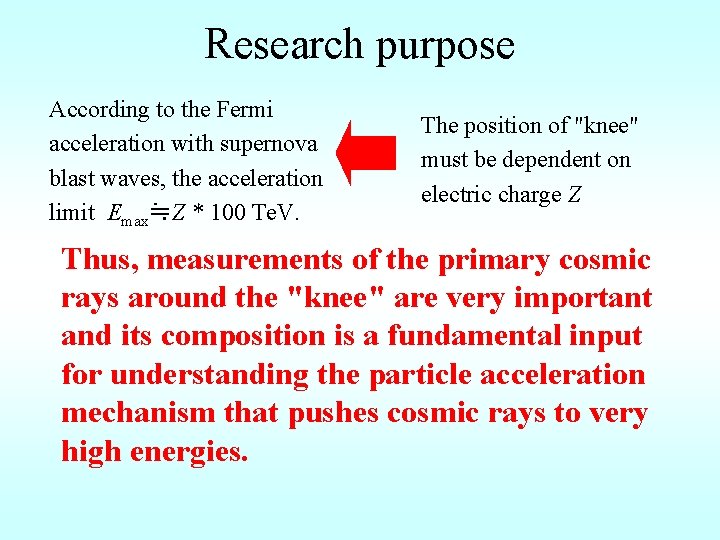
Research purpose According to the Fermi acceleration with supernova blast waves, the acceleration limit Emax≒Z * 100 Te. V. The position of "knee" must be dependent on electric charge Z Thus, measurements of the primary cosmic rays around the "knee" are very important and its composition is a fundamental input for understanding the particle acceleration mechanism that pushes cosmic rays to very high energies.
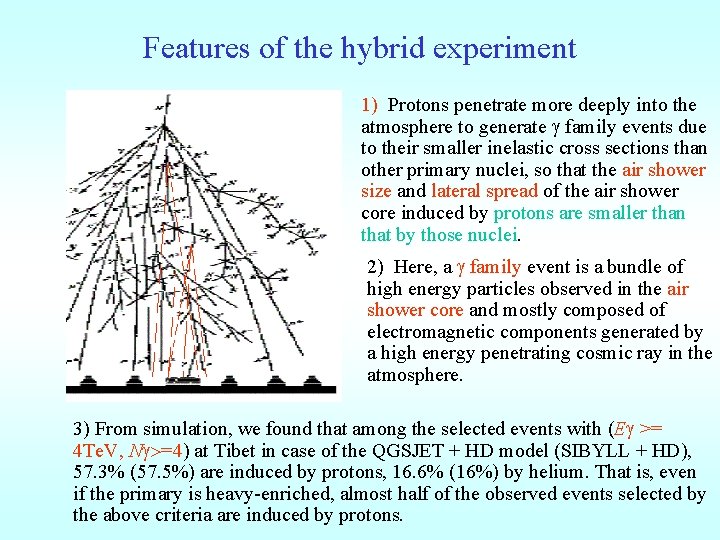
Features of the hybrid experiment 1) Protons penetrate more deeply into the atmosphere to generate g family events due to their smaller inelastic cross sections than other primary nuclei, so that the air shower size and lateral spread of the air shower core induced by protons are smaller than that by those nuclei. 2) Here, a g family event is a bundle of high energy particles observed in the air shower core and mostly composed of electromagnetic components generated by a high energy penetrating cosmic ray in the atmosphere. 3) From simulation, we found that among the selected events with (Eg >= 4 Te. V, Ng>=4) at Tibet in case of the QGSJET + HD model (SIBYLL + HD), 57. 3% (57. 5%) are induced by protons, 16. 6% (16%) by helium. That is, even if the primary is heavy-enriched, almost half of the observed events selected by the above criteria are induced by protons.
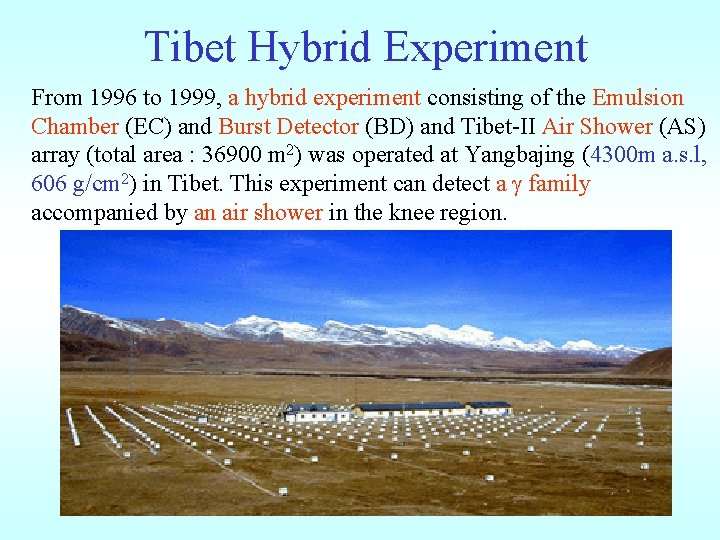
Tibet Hybrid Experiment From 1996 to 1999, a hybrid experiment consisting of the Emulsion Chamber (EC) and Burst Detector (BD) and Tibet-II Air Shower (AS) array (total area : 36900 m 2) was operated at Yangbajing (4300 m a. s. l, 606 g/cm 2) in Tibet. This experiment can detect a g family accompanied by an air shower in the knee region.
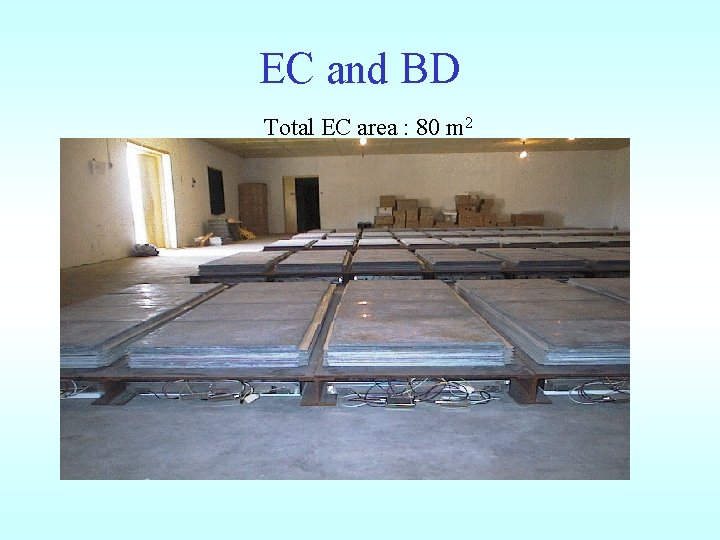
EC and BD Total EC area : 80 m 2
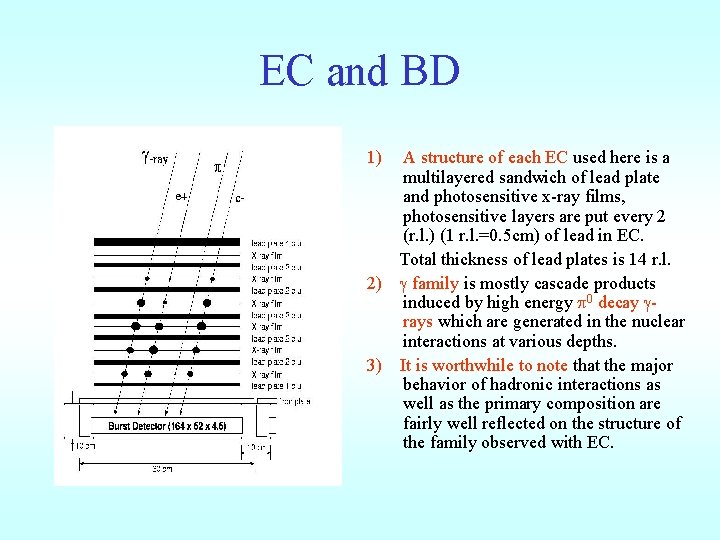
EC and BD 1) A structure of each EC used here is a multilayered sandwich of lead plate and photosensitive x-ray films, photosensitive layers are put every 2 (r. l. ) (1 r. l. =0. 5 cm) of lead in EC. Total thickness of lead plates is 14 r. l. 2) g family is mostly cascade products induced by high energy p 0 decay grays which are generated in the nuclear interactions at various depths. 3) It is worthwhile to note that the major behavior of hadronic interactions as well as the primary composition are fairly well reflected on the structure of the family observed with EC.
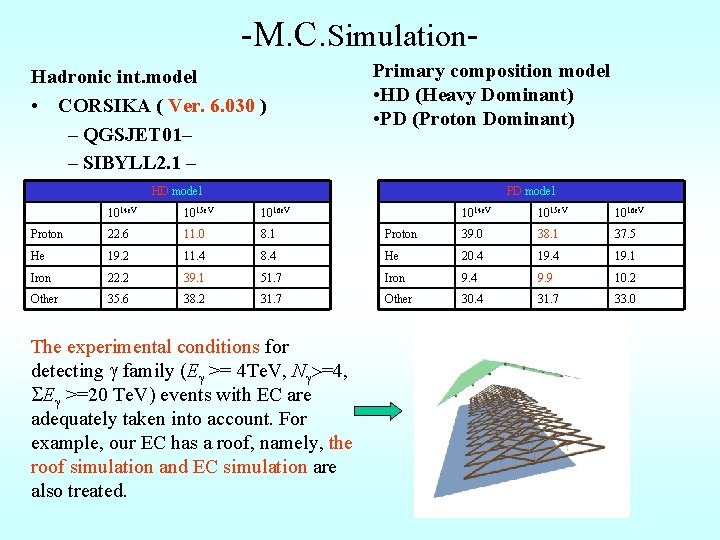
-M. C. Simulation. Hadronic int. model • CORSIKA ( Ver. 6. 030 ) – QGSJET 01– – SIBYLL 2. 1 – Primary composition model • HD (Heavy Dominant) • PD (Proton Dominant) HD model PD model 1014 e. V 1015 e. V 1016 e. V Proton 22. 6 11. 0 8. 1 Proton 39. 0 38. 1 37. 5 He 19. 2 11. 4 8. 4 He 20. 4 19. 1 Iron 22. 2 39. 1 51. 7 Iron 9. 4 9. 9 10. 2 Other 35. 6 38. 2 31. 7 Other 30. 4 31. 7 33. 0 The experimental conditions for detecting g family (Eg >= 4 Te. V, Ng>=4, SEg >=20 Te. V) events with EC are adequately taken into account. For example, our EC has a roof, namely, the roof simulation and EC simulation are also treated.
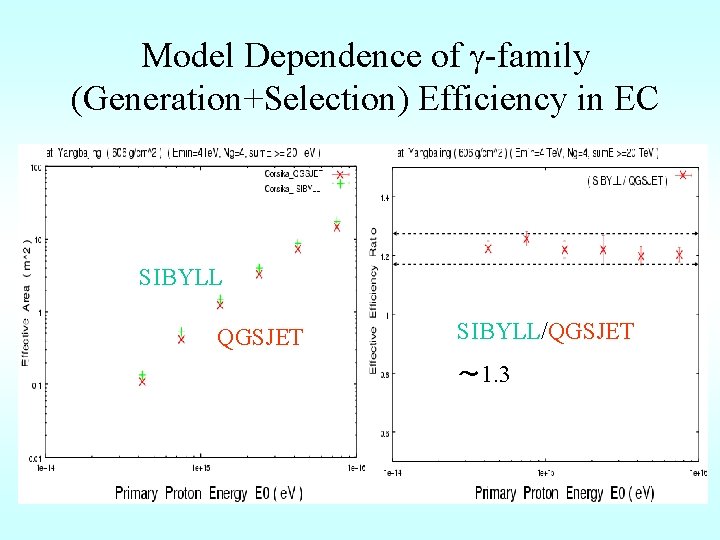
Model Dependence of g-family (Generation+Selection) Efficiency in EC SIBYLL QGSJET SIBYLL/QGSJET ~1. 3 ~ 1. 3
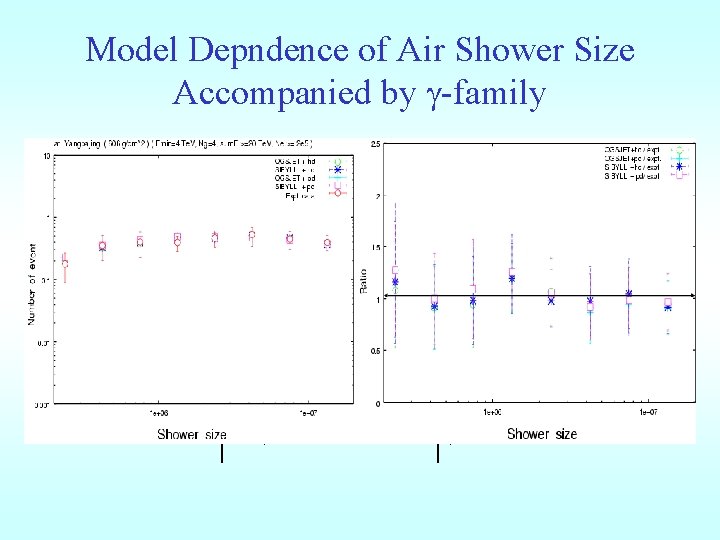
Model Depndence of Air Shower Size Accompanied by g-family
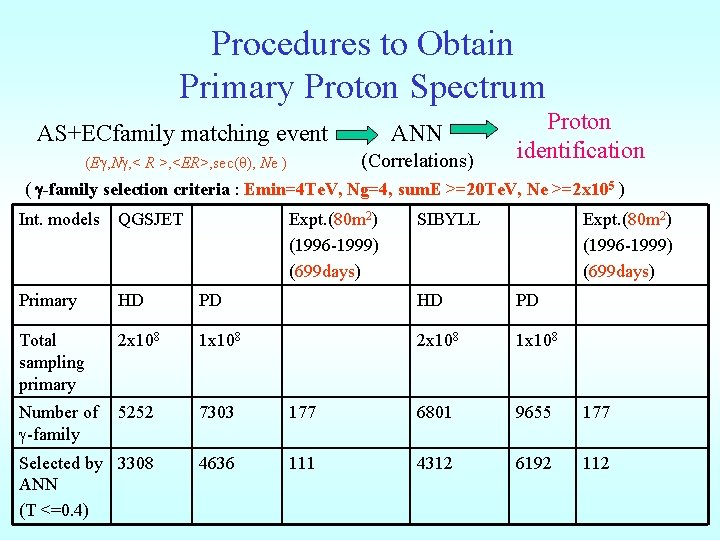
Procedures to Obtain Primary Proton Spectrum AS+ECfamily matching event ANN (Eg, Ng, < R >, <ER>, sec(θ), Ne ) (Correlations) Proton identification ( g-family selection criteria : Emin=4 Te. V, Ng=4, sum. E >=20 Te. V, Ne >=2 x 10⁵ ) Int. models QGSJET Expt. (80 m 2) (1996 -1999) (699 days) SIBYLL Expt. (80 m 2) (1996 -1999) (699 days) Primary HD PD Total sampling primary 2 x 10⁸ 1 x 10⁸ Number of g-family 5252 7303 177 6801 9655 177 Selected by 3308 ANN (T <=0. 4) 4636 111 4312 6192 112
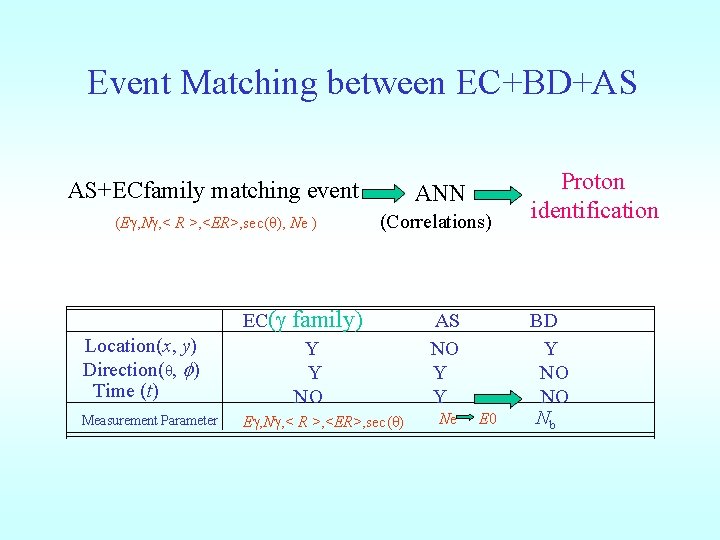
Event Matching between EC+BD+AS AS+ECfamily matching event ANN (Eg, Ng, < R >, <ER>, sec(θ), Ne ) (Correlations) EC(g Location(x, y) Direction(θ, f) Time (t) Measurement Parameter family) Y Y NO Eg, Ng, < R >, <ER>, sec(θ) AS NO Y Y Ne E 0 Proton identification BD Y NO NO Nb
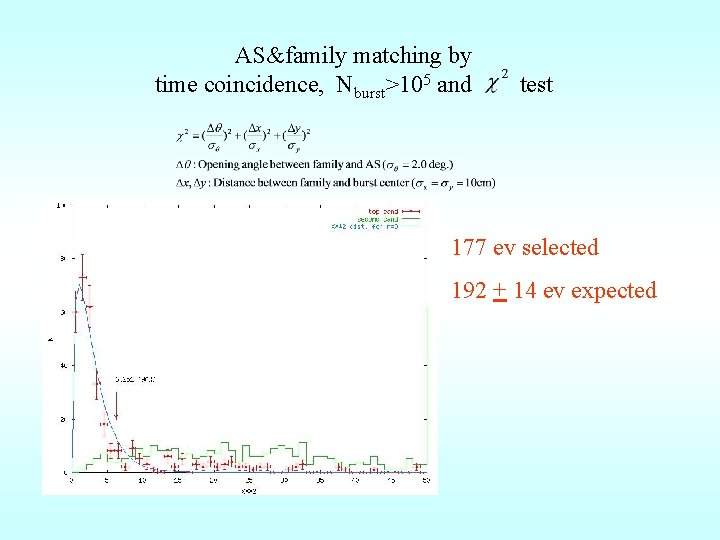
AS&family matching by time coincidence, Nburst>105 and test 177 ev selected 192 + 14 ev expected
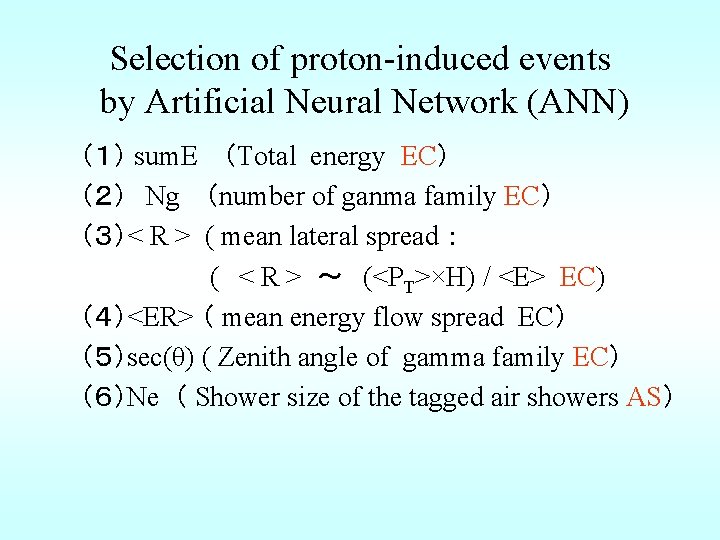
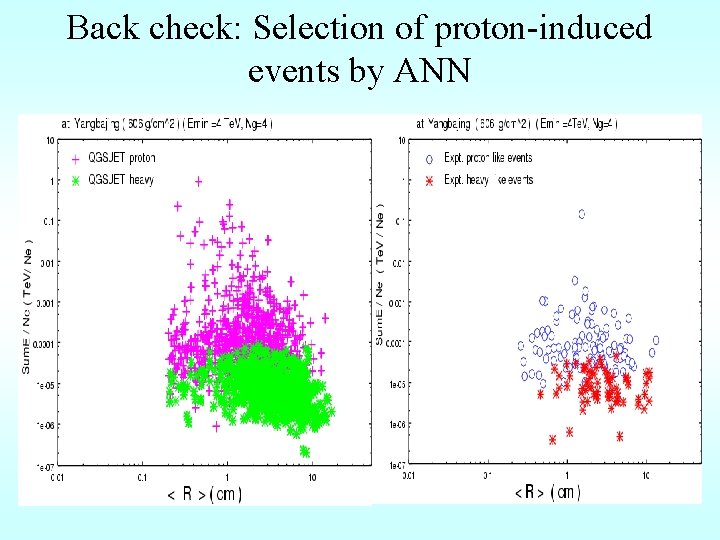
Selection of proton-induced events by Artificial Neural Network (ANN) (1) sum. E (Total energy EC) (2) Ng (number of ganma family EC) (3)< R > ( mean lateral spread : ( < R > ~ (<PT>×H) / <E> EC) (4)<ER> ( mean energy flow spread EC) (5)sec(θ) ( Zenith angle of gamma family EC) (6)Ne ( Shower size of the tagged air showers AS)
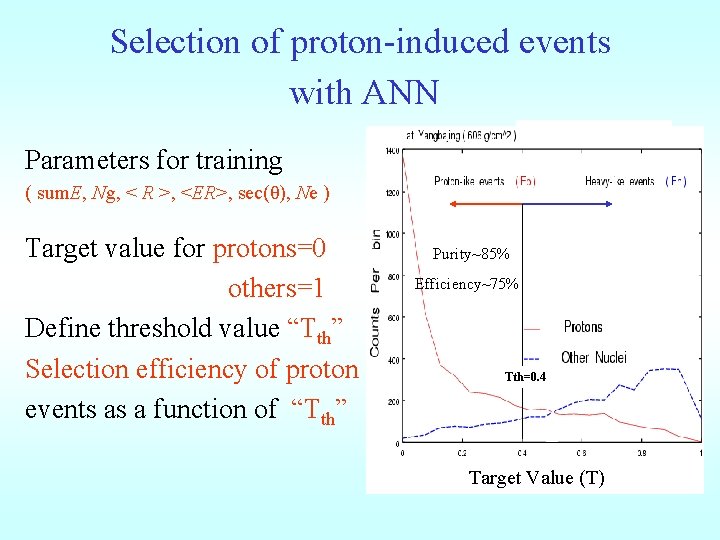
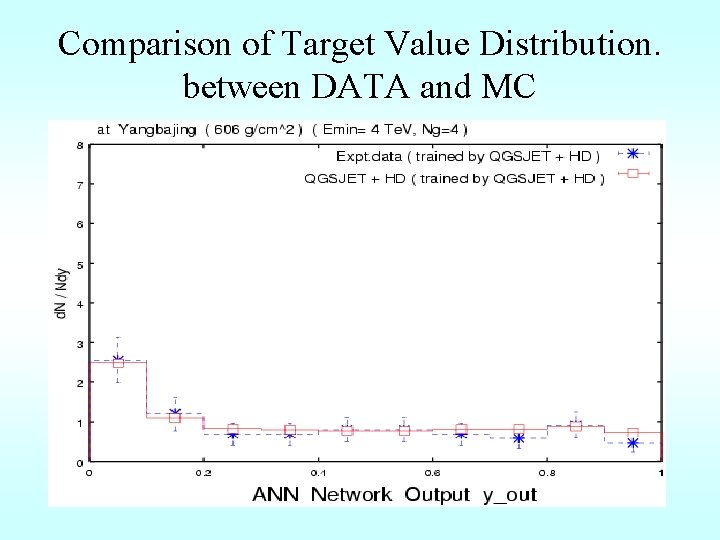
Selection of proton-induced events with ANN Parameters for training ( sum. E, Ng, < R >, <ER>, sec(θ), Ne ) Target value for protons=0 others=1 Define threshold value “Tth” Selection efficiency of proton events as a function of “Tth” Purity~85% Efficiency~75% Tth=0. 4 Target Value (T)
Comparison of Target Value Distribution. between DATA and MC
Back check: Selection of proton-induced events by ANN
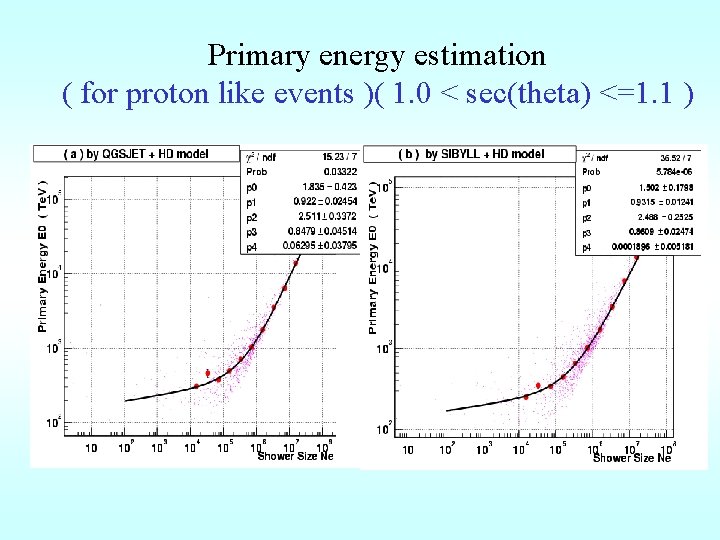
Primary energy estimation ( for proton like events )( 1. 0 < sec(theta) <=1. 1 )
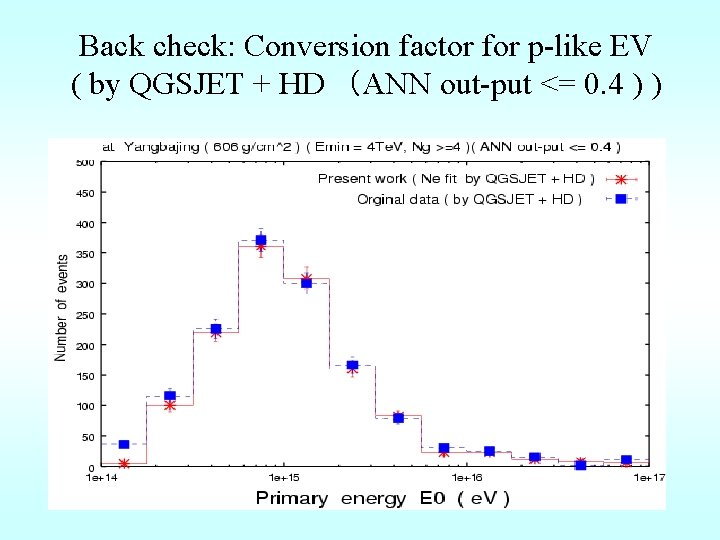
Back check: Conversion factor for p-like EV ( by QGSJET + HD (ANN out-put <= 0. 4 ) )
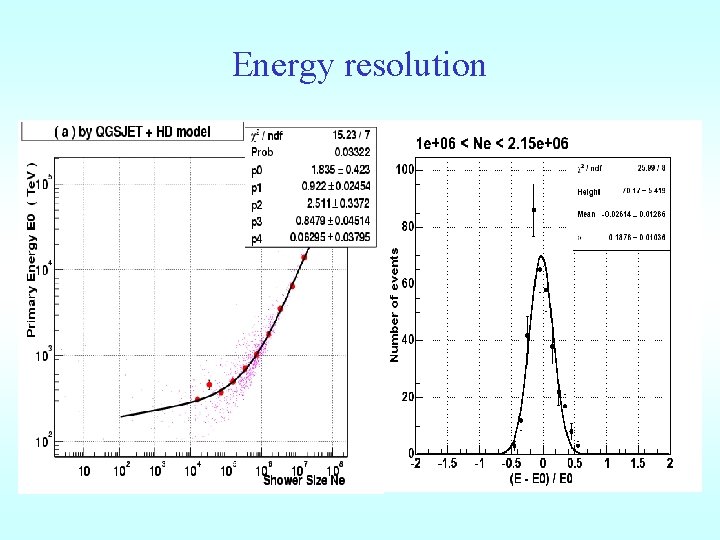
Energy resolution
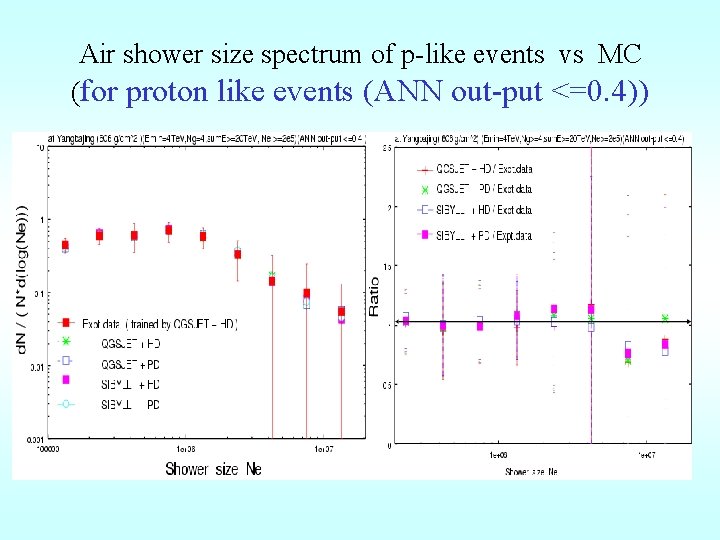
Air shower size spectrum of p-like events vs MC (for proton like events (ANN out-put <=0. 4))
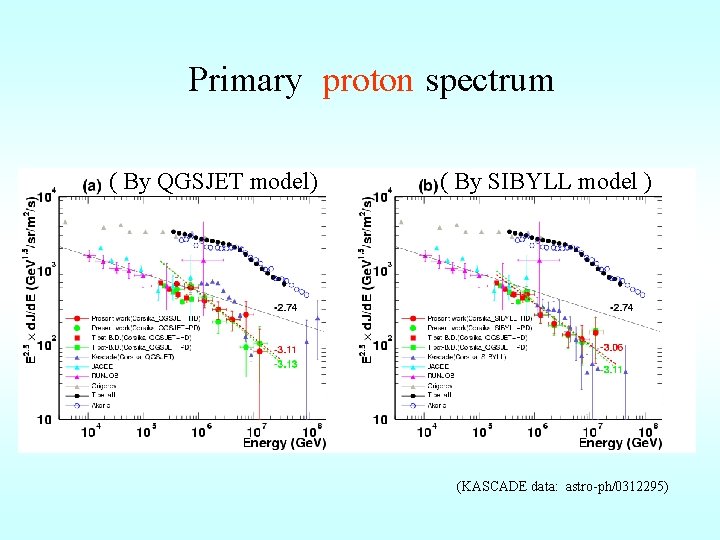
Primary proton spectrum ( By QGSJET model) All ( By SIBYLL model ) Preliminary Proton KASCADE (P) Present Results (KASCADE data: astro-ph/0312295)
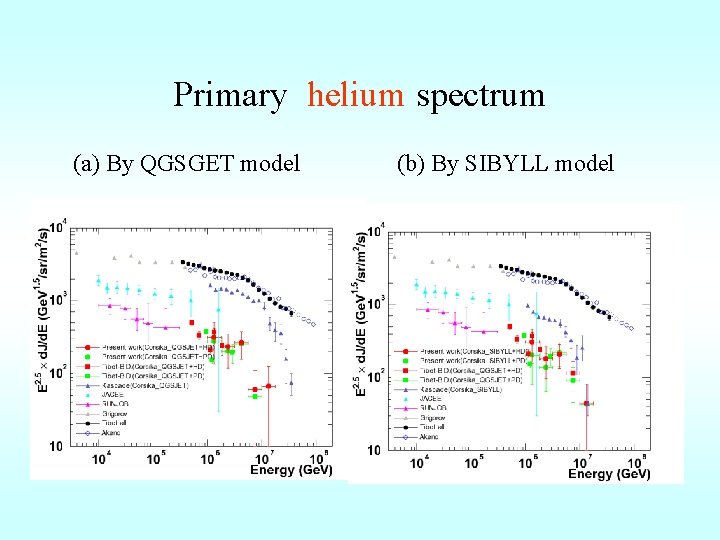
Primary helium spectrum (a) By QGSGET model (b) By SIBYLL model
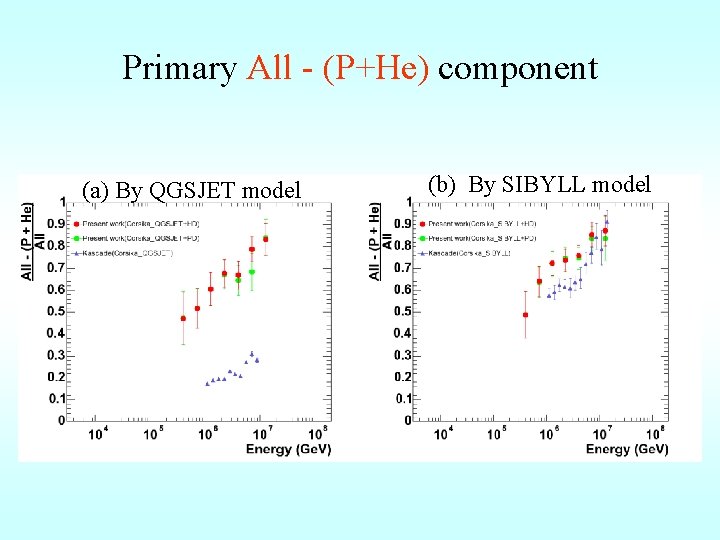
Primary All - (P+He) component (a) By QGSJET model (b) By SIBYLL model Tibet KASCADE
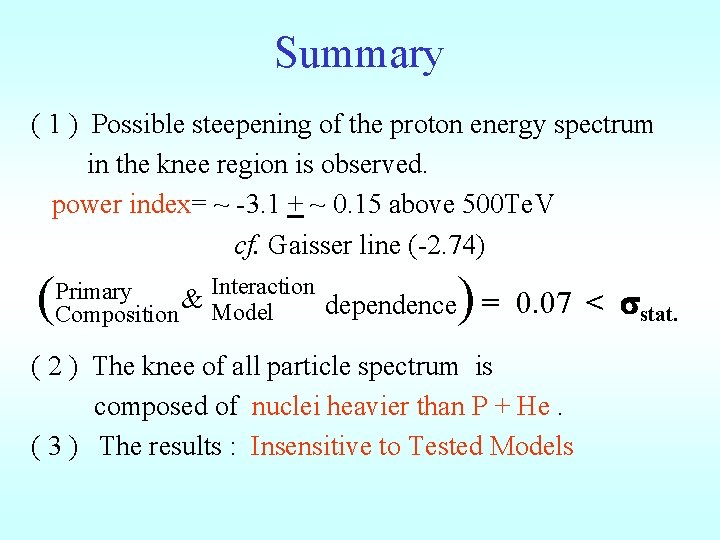
Summary ( 1 ) Possible steepening of the proton energy spectrum in the knee region is observed. power index= ~ -3. 1 + ~ 0. 15 above 500 Te. V cf. Gaisser line (-2. 74) ( Interaction Primary & dependence Composition Model ) = 0. 07 < s ( 2 ) The knee of all particle spectrum is composed of nuclei heavier than P + He. ( 3 ) The results : Insensitive to Tested Models stat.
END