
Primary Care The Art and Science of Advanced

- Slides: 28
Primary Care: The Art and Science of Advanced Practice Nursing, 4 th Edition Chapter 22 The Business of Advanced Practice Copyright © 2015 F. A. Davis Company
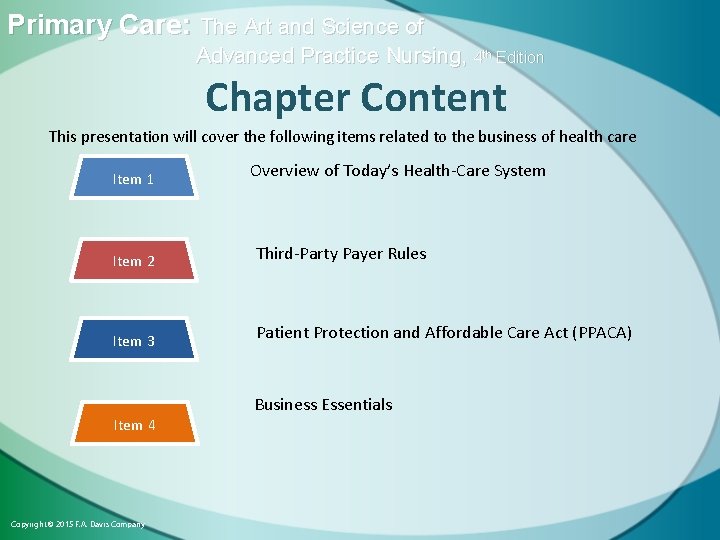
Primary Care: The Art and Science of Advanced Practice Nursing, 4 th Edition Chapter Content This presentation will cover the following items related to the business of health care Item 1 Overview of Today’s Health-Care System Item 2 Third-Party Payer Rules Item 3 Patient Protection and Affordable Care Act (PPACA) Item 4 Copyright © 2015 F. A. Davis Company Business Essentials
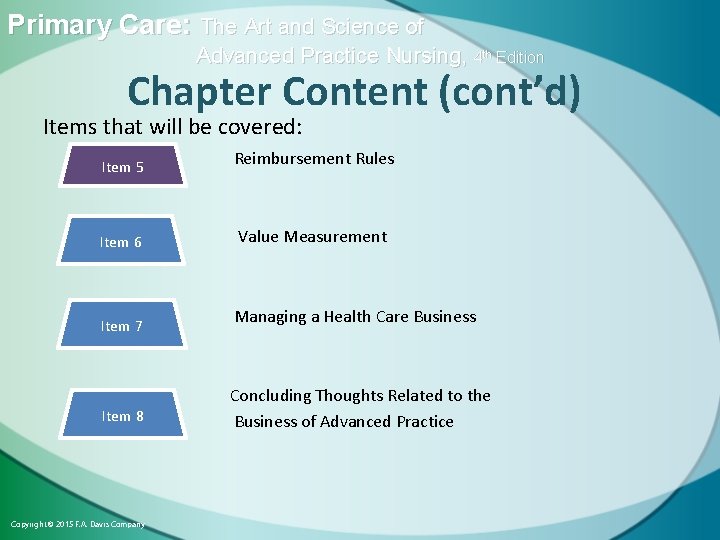
Primary Care: The Art and Science of Advanced Practice Nursing, 4 th Edition Chapter Content (cont’d) Items that will be covered: Item 5 Reimbursement Rules Item 6 Value Measurement Item 7 Item 8 Copyright © 2015 F. A. Davis Company Managing a Health Care Business Concluding Thoughts Related to the Business of Advanced Practice
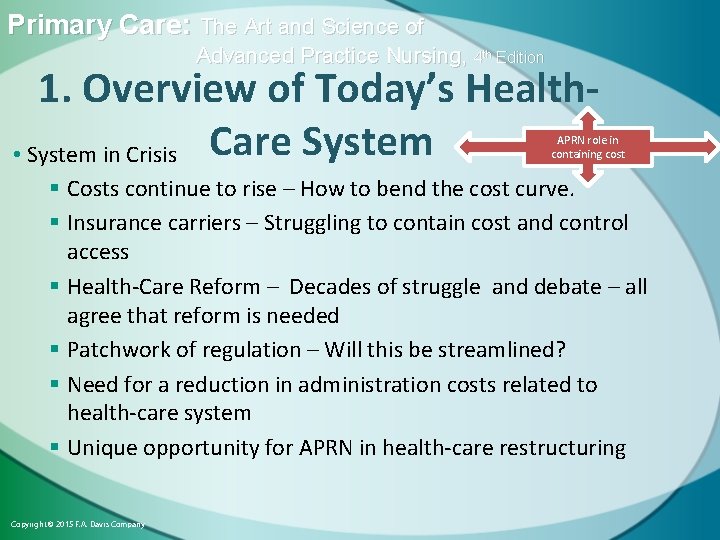
Primary Care: The Art and Science of Advanced Practice Nursing, 4 th Edition 1. Overview of Today’s Health • System in Crisis Care System APRN role in containing cost § Costs continue to rise – How to bend the cost curve. § Insurance carriers – Struggling to contain cost and control access § Health-Care Reform – Decades of struggle and debate – all agree that reform is needed § Patchwork of regulation – Will this be streamlined? § Need for a reduction in administration costs related to health-care system § Unique opportunity for APRN in health-care restructuring Copyright © 2015 F. A. Davis Company
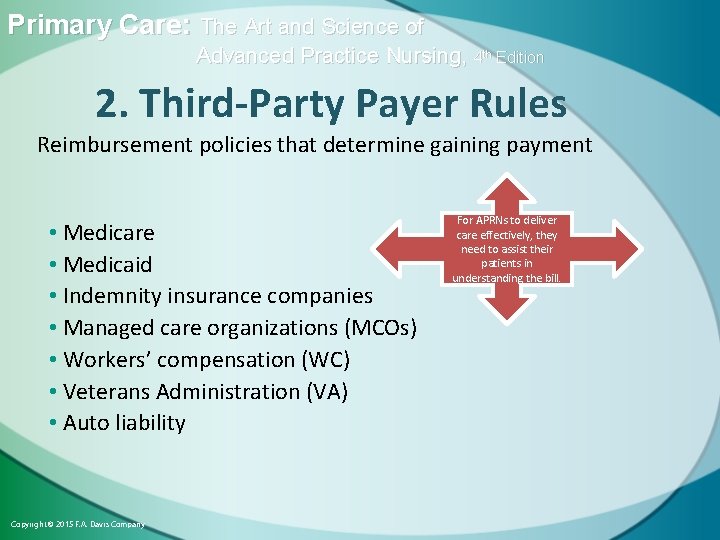
Primary Care: The Art and Science of Advanced Practice Nursing, 4 th Edition 2. Third-Party Payer Rules Reimbursement policies that determine gaining payment • Medicare • Medicaid • Indemnity insurance companies • Managed care organizations (MCOs) • Workers’ compensation (WC) • Veterans Administration (VA) • Auto liability Copyright © 2015 F. A. Davis Company For APRNs to deliver care effectively, they need to assist their patients in understanding the bill.
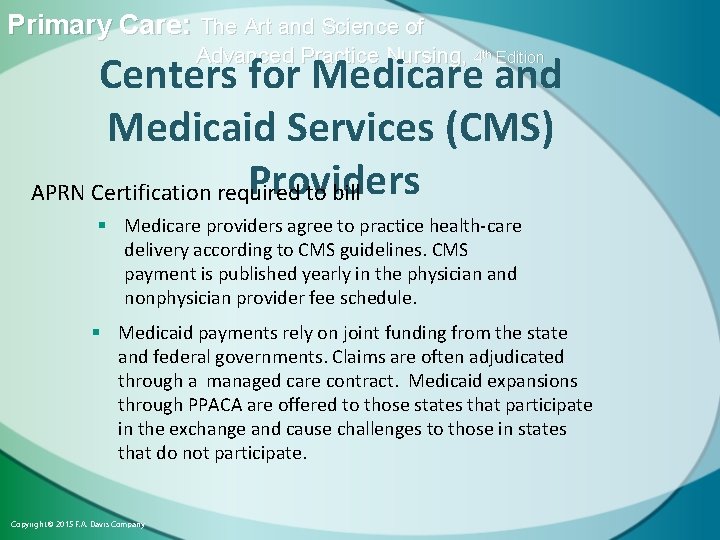
Primary Care: The Art and Science of Advanced Practice Nursing, 4 th Edition Centers for Medicare and Medicaid Services (CMS) Providers APRN Certification required to bill § Medicare providers agree to practice health-care delivery according to CMS guidelines. CMS payment is published yearly in the physician and nonphysician provider fee schedule. § Medicaid payments rely on joint funding from the state and federal governments. Claims are often adjudicated through a managed care contract. Medicaid expansions through PPACA are offered to those states that participate in the exchange and cause challenges to those in states that do not participate. Copyright © 2015 F. A. Davis Company
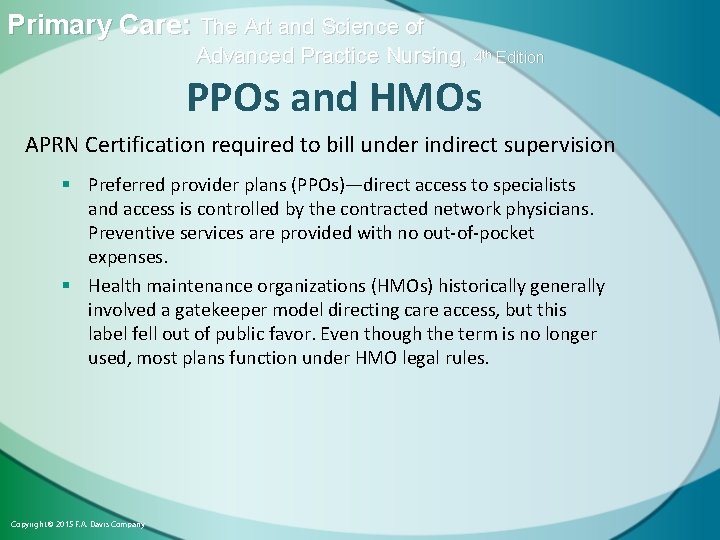
Primary Care: The Art and Science of Advanced Practice Nursing, 4 th Edition PPOs and HMOs APRN Certification required to bill under indirect supervision § Preferred provider plans (PPOs)—direct access to specialists and access is controlled by the contracted network physicians. Preventive services are provided with no out-of-pocket expenses. § Health maintenance organizations (HMOs) historically generally involved a gatekeeper model directing care access, but this label fell out of public favor. Even though the term is no longer used, most plans function under HMO legal rules. Copyright © 2015 F. A. Davis Company
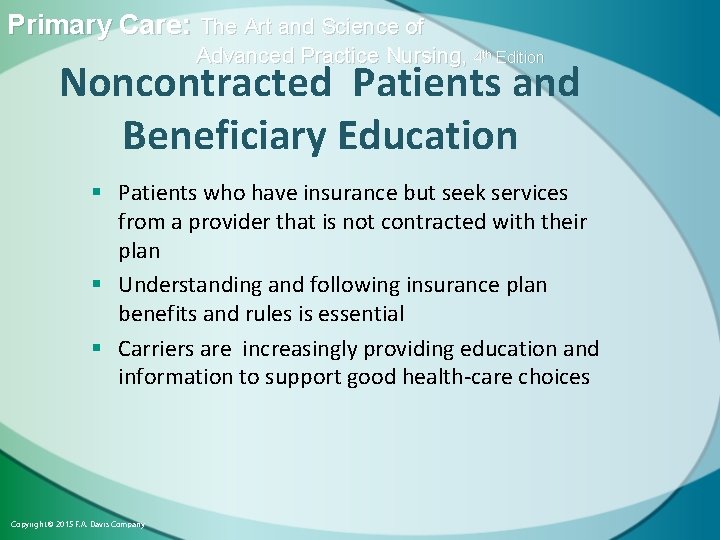
Primary Care: The Art and Science of Advanced Practice Nursing, 4 th Edition Noncontracted Patients and Beneficiary Education § Patients who have insurance but seek services from a provider that is not contracted with their plan § Understanding and following insurance plan benefits and rules is essential § Carriers are increasingly providing education and information to support good health-care choices Copyright © 2015 F. A. Davis Company
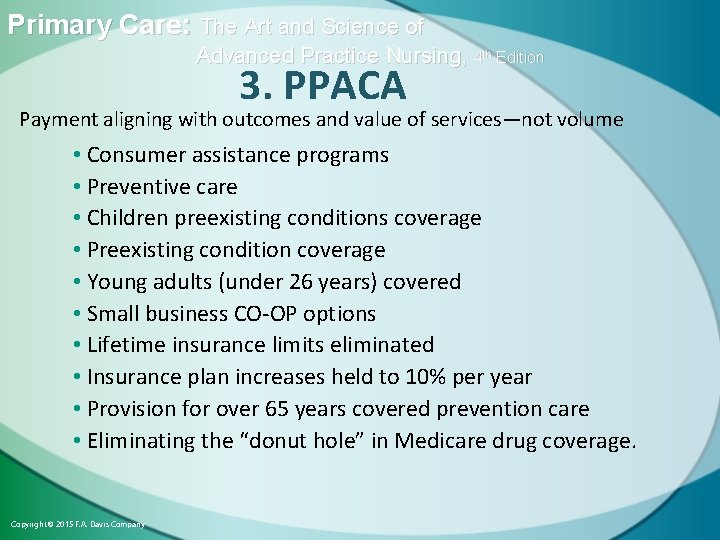
Primary Care: The Art and Science of Advanced Practice Nursing, 4 th Edition 3. PPACA Payment aligning with outcomes and value of services—not volume • Consumer assistance programs • Preventive care • Children preexisting conditions coverage • Preexisting condition coverage • Young adults (under 26 years) covered • Small business CO-OP options • Lifetime insurance limits eliminated • Insurance plan increases held to 10% per year • Provision for over 65 years covered prevention care • Eliminating the “donut hole” in Medicare drug coverage. Copyright © 2015 F. A. Davis Company
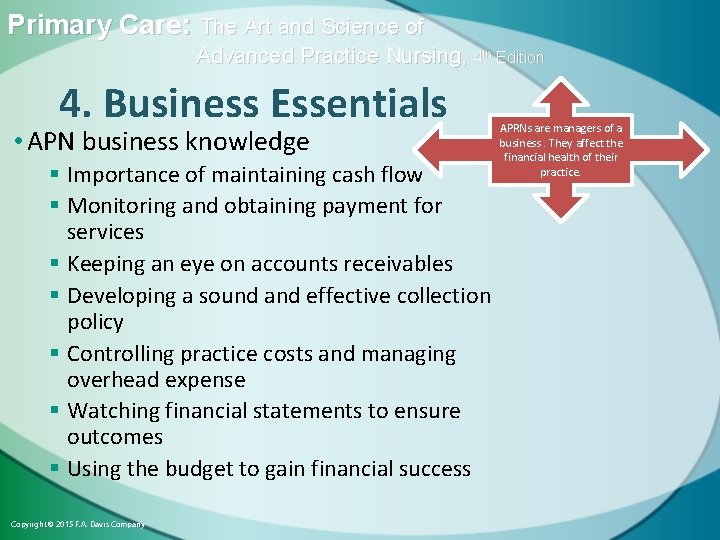
Primary Care: The Art and Science of Advanced Practice Nursing, 4 th Edition 4. Business Essentials • APN business knowledge § Importance of maintaining cash flow § Monitoring and obtaining payment for services § Keeping an eye on accounts receivables § Developing a sound and effective collection policy § Controlling practice costs and managing overhead expense § Watching financial statements to ensure outcomes § Using the budget to gain financial success Copyright © 2015 F. A. Davis Company APRNs are managers of a business. They affect the financial health of their practice.
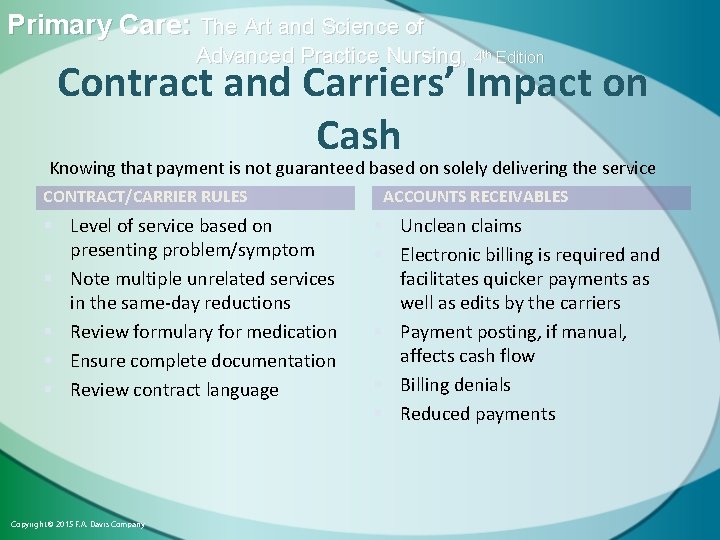
Primary Care: The Art and Science of Advanced Practice Nursing, 4 th Edition Contract and Carriers’ Impact on Cash Knowing that payment is not guaranteed based on solely delivering the service CONTRACT/CARRIER RULES § Level of service based on presenting problem/symptom § Note multiple unrelated services in the same-day reductions § Review formulary for medication § Ensure complete documentation § Review contract language Copyright © 2015 F. A. Davis Company ACCOUNTS RECEIVABLES § Unclean claims § Electronic billing is required and facilitates quicker payments as well as edits by the carriers § Payment posting, if manual, affects cash flow § Billing denials § Reduced payments
Primary Care: The Art and Science of Advanced Practice Nursing, 4 th Edition Setting Fees and Collection Policies § Carriers pay the lesser of fees or charges. § Collecting patient co-pay and deductible before services enhances the ability to gain payment, supports enhanced patient understanding of payment responsibilities, and decreases administrative costs. Copyright © 2015 F. A. Davis Company
Primary Care: The Art and Science of Advanced Practice Nursing, 4 th Edition 5. Reimbursement Rules Knowledge of the rules enhances optimum payment § § § CPT Coding Rules CPT Unlisted Codes CPT Modifiers and Add-On Codes “Incident to” Collaboration (agreements with physician) CPT Level II Codes ICD-9 -CM transition to ICD-10 -CM Codes Medicare Physician and Nonphysician Practitioner Fee Schedule ACOs Evaluation and management (E&M) documentation Electronic medical record (EMR) Copyright © 2015 F. A. Davis Company
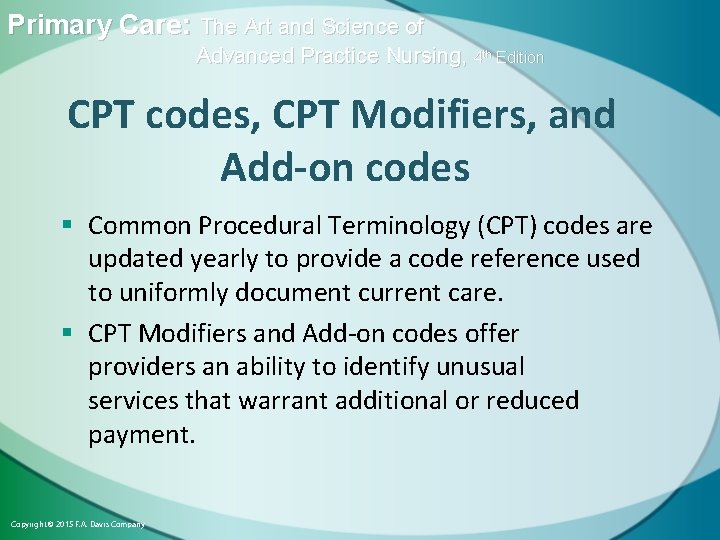
Primary Care: The Art and Science of Advanced Practice Nursing, 4 th Edition CPT codes, CPT Modifiers, and Add-on codes § Common Procedural Terminology (CPT) codes are updated yearly to provide a code reference used to uniformly document current care. § CPT Modifiers and Add-on codes offer providers an ability to identify unusual services that warrant additional or reduced payment. Copyright © 2015 F. A. Davis Company
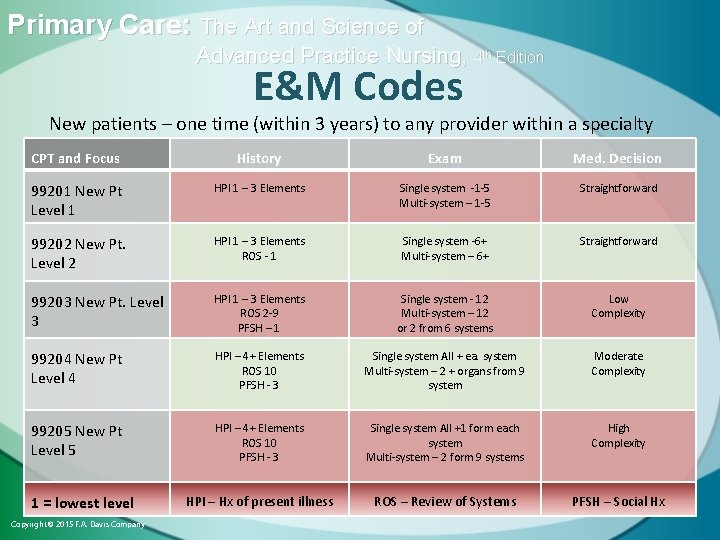
Primary Care: The Art and Science of Advanced Practice Nursing, 4 th Edition E&M Codes New patients – one time (within 3 years) to any provider within a specialty CPT and Focus History Exam Med. Decision 99201 New Pt Level 1 HPI 1 – 3 Elements Single system -1 -5 Multi-system – 1 -5 Straightforward 99202 New Pt. Level 2 HPI 1 – 3 Elements ROS - 1 Single system -6+ Multi-system – 6+ Straightforward 99203 New Pt. Level 3 HPI 1 – 3 Elements ROS 2 -9 PFSH – 1 Single system - 12 Multi-system – 12 or 2 from 6 systems Low Complexity 99204 New Pt Level 4 HPI – 4+ Elements ROS 10 PFSH - 3 Single system All + ea. system Multi-system – 2 + organs from 9 system Moderate Complexity 99205 New Pt Level 5 HPI – 4+ Elements ROS 10 PFSH - 3 Single system All +1 form each system Multi-system – 2 form 9 systems High Complexity HPI – Hx of present illness ROS – Review of Systems PFSH – Social Hx 1 = lowest level Copyright © 2015 F. A. Davis Company
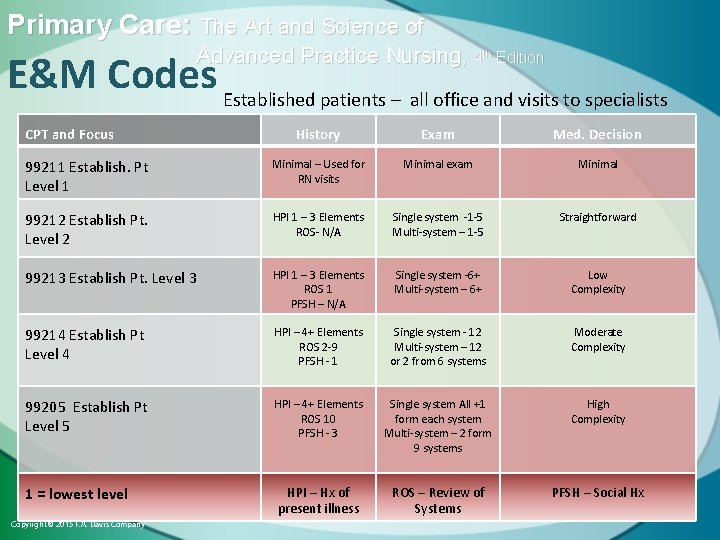
Primary Care: The Art and Science of Advanced Practice Nursing, 4 th Edition E&M Codes Established patients – all office and visits to specialists CPT and Focus History Exam Med. Decision 99211 Establish. Pt Level 1 Minimal – Used for RN visits Minimal exam Minimal 99212 Establish Pt. Level 2 HPI 1 – 3 Elements ROS- N/A Single system -1 -5 Multi-system – 1 -5 Straightforward 99213 Establish Pt. Level 3 HPI 1 – 3 Elements ROS 1 PFSH – N/A Single system -6+ Multi-system – 6+ Low Complexity 99214 Establish Pt Level 4 HPI – 4+ Elements ROS 2 -9 PFSH - 1 Single system - 12 Multi-system – 12 or 2 from 6 systems Moderate Complexity 99205 Establish Pt Level 5 HPI – 4+ Elements ROS 10 PFSH - 3 Single system All +1 form each system Multi-system – 2 form 9 systems High Complexity 1 = lowest level HPI – Hx of present illness ROS – Review of Systems PFSH – Social Hx Copyright © 2015 F. A. Davis Company
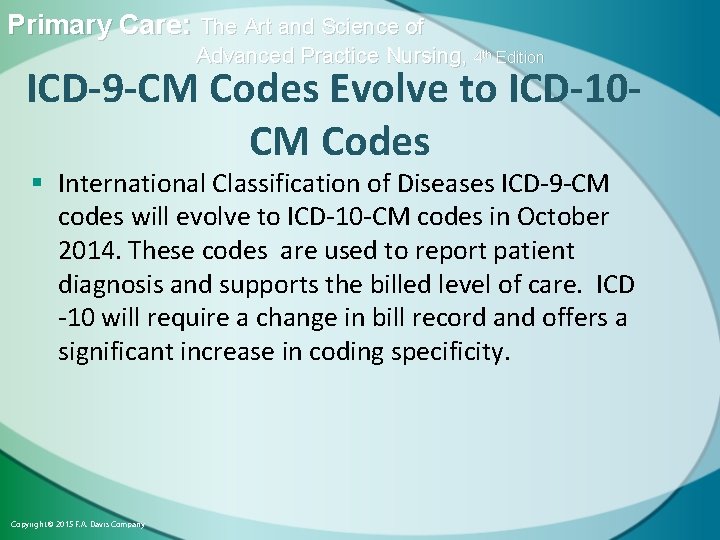
Primary Care: The Art and Science of Advanced Practice Nursing, 4 th Edition ICD-9 -CM Codes Evolve to ICD-10 CM Codes § International Classification of Diseases ICD-9 -CM codes will evolve to ICD-10 -CM codes in October 2014. These codes are used to report patient diagnosis and supports the billed level of care. ICD -10 will require a change in bill record and offers a significant increase in coding specificity. Copyright © 2015 F. A. Davis Company
Primary Care: The Art and Science of Advanced Practice Nursing, 4 th Edition Electronic Medical Record § Mandated for providers by 2014, and President Obama’s stimulus package contains a $20 billion investment to make e-records happen. § Benefits: 1. Longitudinal patient care record 2. Track care to all delivery centers, including the patient’s home 3. Emphasis shifts to care across the continuum vs. each episode 4. Allows for a universal patient identification. 5. Will allow ACOs to develop bundled coding communication. Copyright © 2015 F. A. Davis Company
Primary Care: The Art and Science of Advanced Practice Nursing, 4 th Edition Discussion or Dialogue Question Do you think today’s APRNs are prepared with the business skills needed for independent practice in this changing health-care delivery model? Copyright © 2015 F. A. Davis Company
Primary Care: The Art and Science of Advanced Practice Nursing, 4 th Edition 6. Value Measurement Challenge to gather data that demonstrate the quality of services § § § § § Compliance plan HIPAA Risk management HEDIS reporting Safety and performance improvement initiatives Pay for performance (P 4 P) Provider comparison Web sites Value-based purchasing (VBP) National Committee for Quality Assurance (NCQA) Medicare Physician Quality Reporting System (PQRS) Copyright © 2015 F. A. Davis Company
Primary Care: The Art and Science of Advanced Practice Nursing, 4 th Edition Compliance Plans and Risk Management Important components of all health-care businesses § Compliance plans prevent episodes of fraud and abuse. § Risk management is an extension of performance improvement. Risk management prevents undesirable events from happening and minimizes the financial impact of litigation claims. Copyright © 2015 F. A. Davis Company
Primary Care: The Art and Science of Advanced Practice Nursing, 4 th Edition HIPAA and Performance Improvement Important component of all health-care businesses § HIPAA – Health Insurance Portability and Accountability Act of 1996 Title I and Title II § Performance Improvement – APRNs are valued for their ability to identify familiar patterns and to use intuition and keen assessment when options for interventions are needed. Copyright © 2015 F. A. Davis Company
Primary Care: The Art and Science of Advanced Practice Nursing, 4 th Edition Pay for Performance (P 4 P) Important component of all health-care businesses § Pay for Performance (P 4 P) – As the title implies, payments are based on outcomes versus volume. Reduced payments were first implemented by CMS in 2007 for hospital-acquired conditions and in 2010 involved reducing payments for patients readmitted within 30 days of discharge. Managed care plans quickly followed CMS by implementing their own carrier-specific P 4 P criteria. Copyright © 2015 F. A. Davis Company
Primary Care: The Art and Science of Advanced Practice Nursing, 4 th Edition Quality Reporting § The consumer call for safe and effective care has created a variety of outcome measurement Web sites and reporting criteria (e. g. , the Health-plan Employer Data and Information Set [HEDIS]) that monitor current health-care issues and the outcomes of care. Copyright © 2015 F. A. Davis Company
Primary Care: The Art and Science of Advanced Practice Nursing, 4 th Edition 7. Managing a Health-Care Business • APRN business knowledge § Negotiating salary § Establishing employee benefits § Gaining hospital privileges § Reviewing practice insurance § Developing a strategic plan § Establishing a marketing plan Copyright © 2015 F. A. Davis Company APRNs are managers of a business. They affect the financial health of their practice.
Primary Care: The Art and Science of Advanced Practice Nursing, 4 th Edition Planning for Health-Care Change § Policy advocacy and planning for each health-care change will make the difference between marginal sustainability and success. The provider who plans for health-care change will be positioned for success. Copyright © 2015 F. A. Davis Company
Primary Care: The Art and Science of Advanced Practice Nursing, 4 th Edition 9. Concluding Thoughts Health-Care Reform and Implications for APRNs § How will the nation cope with a surge of newly insured patients? § With a shortage of primary-care physicians, how will the industry resolve the workforce issues? § How will the growth of those 65 years and older affect health care? § How can APRNs move toward practicing to their full scope of practice? § Can the profession expand NPs’ knowledge of the financial and economic factors challenging health-care delivery? § Will NPs be able to imbed data collection in their daily functions and use this information to improve efficiency and care? § Will tomorrow’s practitioners embrace innovation and process change in order to create a viable health-care system? Copyright © 2015 F. A. Davis Company Opportunity for the APRN role to evolve —and to ensure high-quality care at reasonable cost
Primary Care: The Art and Science of Advanced Practice Nursing, 4 th Edition Questions for Discussion and Dialogue § PPACA has increased the number of insured citizens. What do you think are the opportunities for APRNs? § How should APRN leaders educationally prepare tomorrow’s APRN students to meet the needs of the upcoming health-care industry changes? § What are the business strengths and values that APRNs uniquely bring to the U. S. health-care system? Copyright © 2015 F. A. Davis Company Opportunity for the APRN role to evolve— and to ensure highquality care at reasonable cost