
Primary Care Hypertension Pathway Elevated Adult BP Assessment
Primary Care Hypertension Pathway

Elevated Adult BP Assessment Hypertension not Diagnosed Hypertension Diagnosed Review at least 5 yearly Assessing CVD risk and end-organ damage Target BP Management Review Annually

Stage 1 HTN (Under 80 years old) Stage 2 HTN (Any age) Stage 1 hypertension - Clinic blood pressure is 140/90 mm. Hg or higher and subsequent ambulatory blood pressure monitoring (ABPM) daytime average or home blood pressure monitoring (HBPM) average blood pressure is 135/85 mm. Hg or higher. Stage 2 hypertension - Clinic blood pressure is 160/100 mm. Hg or higher and subsequent ABPM daytime average or HBPM average blood pressure is 150/95 mm. Hg or higher. If target organ damage present or 10 year CVD risk >20% or DM or CKD/CVD Offer Antihypertensive Treatment Severe hypertension - Clinic systolic blood pressure is 180 mm. Hg or higher or clinic diastolic blood pressure is 110 mm. Hg or higher. Refer the person to specialist care the same day if they have: Consider Specialist Review If <40 Years Old Lifestyle Intervention – One Life Suffolk Patient Education and Interventions to Support Adherence to Treatment Annual Review NB: Be mindful of Qo. F targets and attainment Accelerated hypertension, that is, blood pressure usually higher than 180/110 mm. Hg with signs of papilloedema and/or retinal haemorrhage or 220 -120 mm. Hg without or Suspected phaeochromocytoma (labile or postural hypotension, headache, palpitations, pallor and diaphoresis). Consider the need for specialist investigations in people with signs and symptoms suggesting a secondary cause of hypertension. Consider the possibility of Conn’s (Primary Aldosteronism - PA) Consider case detection of PA in patient groups with relatively high prevalence of PA. These include patients with stage 2, stage 3, or drug resistant hypertension; hypertension and spontaneous or diuretic-induced hypokalaemia; hypertension with adrenal incidentaloma; or hypertension and a family history of early onset hypertension or cerebrovascular accident at a young age (<40 years). Case detection for all hypertensive first-degree relatives of patients with PA is also recommended. The plasma aldosterone – renin ratio (ARR) is the recommended screening tool.

Stage 1 hypertension - Clinic blood pressure is 140/90 mm. Hg or higher and subsequent ambulatory blood pressure monitoring (ABPM) daytime average or home blood pressure monitoring (HBPM) average blood pressure is 135/85 mm. Hg or higher. Stage 2 hypertension - Clinic blood pressure is 160/100 mm. Hg or higher and subsequent ABPM daytime average or HBPM average blood pressure is 150/95 mm. Hg or higher. Severe hypertension - Clinic systolic blood pressure is 180 mm. Hg or higher or clinic diastolic blood pressure is 110 mm. Hg or higher. Refer the person to specialist care the same day if they have: Accelerated hypertension, that is, blood pressure usually higher than 180/110 mm. Hg with signs of papilloedema and/or retinal haemorrhage or 220/120 mm. Hg without or Suspected phaeochromocytoma (labile or postural hypotension, headache, palpitations, pallor and diaphoresis). Consider the need for specialist investigations in people with signs and symptoms suggesting a secondary cause of hypertension.
Diagnosis • If the clinic blood pressure is 140/90 mm. Hg or higher, offer ABPM to confirm the diagnosis of hypertension. • If a person is unable to tolerate ABPM, HBPM is a suitable alternative to confirm the diagnosis of hypertension. • If the person has severe hypertension, consider starting antihypertensive drug treatment immediately, without waiting for the results of ABPM or HBPM. • While waiting for confirmation of a diagnosis of hypertension, carry out investigations for target organ damage (such as left ventricular hypertrophy, chronic kidney disease and hypertensive retinopathy) and a formal assessment of cardiovascular risk using a cardiovascular risk assessment tool. • When using ABPM to confirm a diagnosis of hypertension, ensure that at least two measurements per hour are taken during the person's usual waking hours (for example, between 08: 00 and 22: 00). Use the average value of at least 14 measurements taken during the person's usual waking hours to confirm a diagnosis of hypertension.

HBPM • When using HBPM to confirm a diagnosis of hypertension, ensure that: • For each blood pressure recording, two consecutive measurements are taken, at least 1 minute apart and with the person seated and • Blood pressure is recorded twice daily, ideally in the morning and evening and • Blood pressure recording continues for at least 4 days, ideally for 7 days. • Discard the measurements taken on the first day and use the average value of all the remaining measurements to confirm a diagnosis of hypertension.

Assessing Cardiovascular Risk and End. Organ Damage • For all people with hypertension: • Test for the presence of protein in the urine by sending a urine sample for estimation of the albumin: creatinine ratio and test for haematuria using a reagent strip • Take a blood sample to measure plasma glucose, electrolytes, creatinine, e. GFR, serum total cholesterol and HDL cholesterol • Consider Renal USS if e. GFR <60 and/or presence of albuminuria/proteinuria. Seek Nephrology opinion if persistent proteinuria despite good BP control • Examine the fundi for the presence of hypertensive retinopathy • Arrange for a 12 -lead electrocardiograph to be performed
Under 40’s • For people aged under 40 years with stage 1 hypertension and no evidence of target organ damage, cardiovascular disease, renal disease or diabetes, consider seeking specialist evaluation of secondary causes of hypertension and a more detailed assessment of potential target organ damage. This is because 10 -year cardiovascular risk assessments can underestimate the lifetime risk of cardiovascular events in these people.
Lifestyle Advice • • Lifestyle advice should be offered initially and then periodically to people undergoing assessment or treatment for hypertension. Ascertain people's diet and exercise patterns because a healthy diet and regular exercise can reduce blood pressure. Offer appropriate guidance and written or audiovisual materials to promote lifestyle changes – Consider One. Life Suffolk Relaxation therapies can reduce blood pressure and people may wish to pursue these as part of their treatment. However, routine provision by primary care teams is not currently recommended. Ascertain people's alcohol consumption and encourage a reduced intake if they drink excessively, because this can reduce blood pressure and has broader health benefits. Discourage excessive consumption of coffee and other caffeine-rich products. Encourage people to keep their dietary sodium intake low, either by reducing or substituting sodium salt, as this can reduce blood pressure. Offer advice and help to smokers to stop smoking. A common aspect of studies for motivating lifestyle change is the use of group working. Inform people about local initiatives by, for example, healthcare teams or patient organisations that provide support and promote healthy lifestyle change.
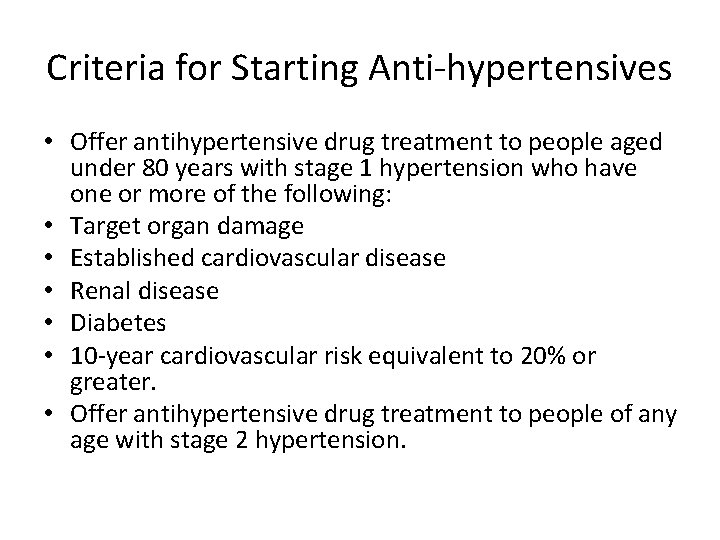
Criteria for Starting Anti-hypertensives • Offer antihypertensive drug treatment to people aged under 80 years with stage 1 hypertension who have one or more of the following: • Target organ damage • Established cardiovascular disease • Renal disease • Diabetes • 10 -year cardiovascular risk equivalent to 20% or greater. • Offer antihypertensive drug treatment to people of any age with stage 2 hypertension.

Targets Long Term Condition Target Primary Hypertension ≤ 140/90 (≤ 135/85 HBPM) ≤ 150/90 if aged over 80 years old CVD ≤ 140/90 Diabetes ≤ 140/80 ≤ 130/80 if eye, kidney or cerebrovascular complications CKD 120 - 139/≤ 90 120 – 129/≤ 80 if ACR >70
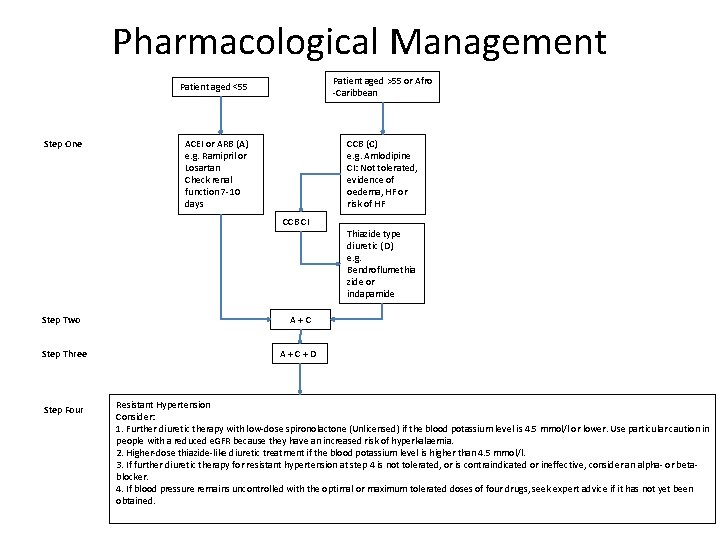
Pharmacological Management Patient aged >55 or Afro -Caribbean Patient aged <55 Step One ACEI or ARB (A) e. g. Ramipril or Losartan Check renal function 7 -10 days CCB (C) e. g. Amlodipine CI: Not tolerated, evidence of oedema, HF or risk of HF CCB CI Step Two Step Three Step Four Thiazide type diuretic (D) e. g. Bendroflumethia zide or indapamide A + C + D Resistant Hypertension Consider: 1. Further diuretic therapy with low-dose spironolactone (Unlicensed) if the blood potassium level is 4. 5 mmol/l or lower. Use particular caution in people with a reduced e. GFR because they have an increased risk of hyperkalaemia. 2. Higher-dose thiazide-like diuretic treatment if the blood potassium level is higher than 4. 5 mmol/l. 3. If further diuretic therapy for resistant hypertension at step 4 is not tolerated, or is contraindicated or ineffective, consider an alpha- or betablocker. 4. If blood pressure remains uncontrolled with the optimal or maximum tolerated doses of four drugs, seek expert advice if it has not yet been obtained.
- Slides: 12