
Primary and Secondary Sources Objective I will describe

Primary and Secondary Sources Objective: I will describe the differences between primary and secondary sources by answering specific questions and giving specific details. 1

Primary and Secondary Sources § Primary Source § A document or physical object that was created during the time period being studied. § A first hand account of an event or time period. § When are primary sources created? § They are created at the time of an event, or soon after something has happened. § Examples of primary sources; § Interviews, photographs, art, maps, video and film, sound recordings, newspapers, magazines, and published first-hand stories. 2

Primary and Secondary Sources § Secondary sources § Second-hand account of a historical event. § Analyzes and interprets primary sources. § When are secondary sources created? § Secondary sources are created after the event; sometimes a long time after something happened. § Secondary sources are sometimes biased (give additional opinions) on a past event. § They often have many copies, found in libraries, schools, or homes. § Examples of secondary sources; § History textbooks, biographies, movies of historical events, art, and published stories. 3
Primary and Secondary Sources § How do you determine what a source is? § Ask yourself the 5 W’s! § What? § What is the primary source? § Is it a photo? § If so, is it in black and white or color? § Is it a letter? § If so, is it typed, or handwritten? § Who? § Who wrote the letter, took the photo or painted the painting? § Can you be sure it was really that person who made it? 4
Primary and Secondary Sources § When? § When was the primary source created? § Soon after the event, or years later? § Where? § Can you tell where the primary source was created? § Why? § Does the primary source tell a story? § Does the primary source tell you why it was created? 5
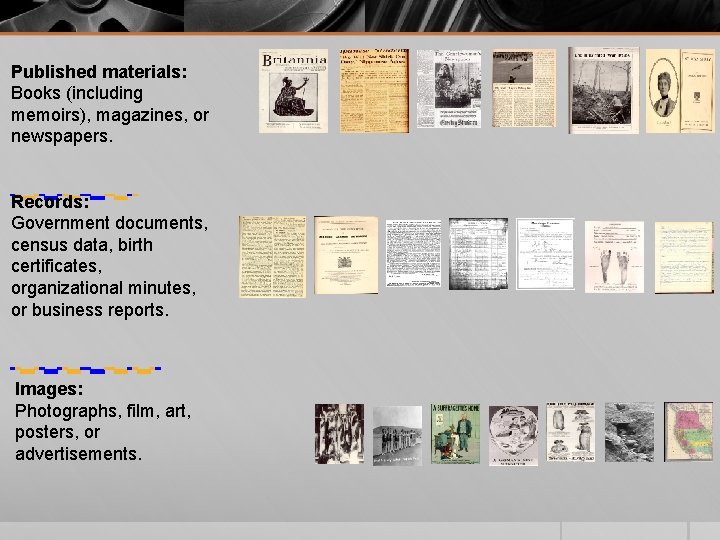
Published materials: Books (including memoirs), magazines, or newspapers. Records: Government documents, census data, birth certificates, organizational minutes, or business reports. Images: Photographs, film, art, posters, or advertisements.
Practice 1. Draw 2 columns on the next full sheet of notebook paper, label the left side Primary Sources and the right side Secondary Sources. 2. Place the sources in the correct column. 3. You may work with your group and use your notes. 7

Primary Sources Secondary Sources: 1. social studies book 2. public television documentary 3. biography 4. Photograph 5. birth certificate 6. census records 7. college diploma 8. Letter 9. geography textbook 10. newspaper article 11. diary 12. journal 13. map 14. Encyclopedia 15. original piece of artwork 8
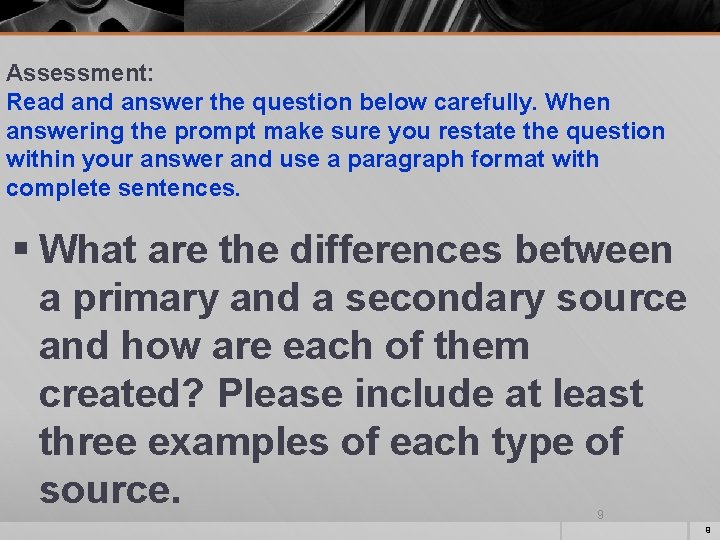
Assessment: Read answer the question below carefully. When answering the prompt make sure you restate the question within your answer and use a paragraph format with complete sentences. § What are the differences between a primary and a secondary source and how are each of them created? Please include at least three examples of each type of source. 9 9
- Slides: 9