
PRICING Mr Calkins Spring 2008 PRICING o o
- Slides: 46
PRICING Mr. Calkins Spring 2008
PRICING o o o WHAT IS PRICE? The Role of Product Value Various Forms of Price Importance of Price
Role of Product Value The key to pricing is understanding the value of buyers place on a product. Value is a matter of anticipated satisfaction. If consumers believe they will get a great deal of satisfaction from a product, they will place a high value on it. They will also be willing to pay a high price for it.
Various Forms of Price is involved in every marketing exchange regardless of whether the term price is used. The fee you pay a dentist to clean your teeth, the amount you pay for a new pair of shoes, and other charges such as bridge tolls & bus fares are all prices. Rent is the monthly price of an apartment, Interest is the price of a loan etc.
Importance of Price is an important factor in the success or failure of a business because it helps establish and maintain a firm’s image, competitive edge and profits.
PRICING o o o FACTORS AFFECTING PRICE Supply and Demand Consumers Channel Members Competition Costs and Expenses Government Regulations
Supply and Demand **The basic theories of supply and demand affect price: Consumers buy less when the price is higher Consumers buy more when the price is lower. **Suppliers may not be willing/able to produce as many items at a lower price as they can at a higher price. **Subsequently a price must be chosen that satisfies supply and demand.
Consumers Consumer perceptions about price and consumer purchasing habits also play a role in price planning. **When the purchase is dependent on price, we say the demand is elastic. In essence, buyers are sensitive to price changes. If a price is lowered, consumers will purchase more of the item, and vice versa.
Channel Members All along the channel of distribution, each channel member plays a part in setting the price of an item. All members are concerned with generating sales, making a profit and maintaining a certain image.
Competition When a company knows that the target market is price conscious, a lower price will be effective. When the target market is not price conscious, non-price competition may be used to influence consumers. In price competition, marketers change prices to reflect potential earnings
Costs & Expenses o Sales, costs and expenses determine a firms profits. Businesses constantly monitor and project sales to minimize expenses.
Government Regulations § PRICE FIXING § PRICE DISCRIMINATION § RESALE PRICE MAINTENANCE § MINIMUM PRICE LAWS § UNIT PRICING § PRICE ADVERTISING
PRICE FIXING o This occurs when competitors agree on certain price ranges within which they can control the market. The federal law concerned with act of “price fixing” is the Sherman Antitrust Act of 1890.
Price Discrimination o IS WHEN A FIRM CHARGES DIFFERENT PRICES TO DIFFERENT CUSTOMERS UNDER SIMILAR CIRCUMSTANCES.
CLAYTON ACT 1936 o DEFINES DISCRIMINATION, STATING THAT IT CREATES UNFAIR COMPETITION.
ROBINSON-PATMAN ACT o Was passed to strengthen provision in the Clayton act in that it prohibits sellers from offering one customer one price and another customer another price selling the same product in similar circumstances.
PRICE DISCRIMINATION IS ALLOWABLE UNDER FOLLOWING: PRODUCT ARE PHYSICALLY DIFFERENT NONCOMPETING BUYERS ARE INVOLVED PRICES DON’T AFFECT COMPETITION COSTS JUSTIFY DIFFERENCES IN PRICES PRODUCTIONS COSTS GO UP PRICES CHANGE TO MEET SUPPLIERS BID
RESALE PRICE MAINTENANCE o WAS PREVALENT IN THE 1970’S , MANUFACTURERS WOULD SET RETAIL PRICE OF AN ITEM AND FORCE RETAILERS TO SELL THE ITEM AT THAT PRICE. THE MANUFACTURER COULD PUNISH THE RETAILER BY WITHOLDING DELIVERIES OF THE PRODUCT IF THEY DIDN’T CONFORM OR GIVE(CREATE) DISCOUNTS.
MINIMUM PRICE LAWS o Many states implement minimum price laws also known as unfair sales laws which supposedly prevent retailers from selling goods below their costs plus a percentage for expense/profits.
LOSS LEADER o IS AN ITEM THAT IS PRICED AT COST TO DRAW CUSTOMERS. RETAILERS SELECT HIGHLY POPULAR, WELL ADVERTISED PRODUCTS IN THE HOPE INCREASING STORE TRAFFIC LEADS TO SALES OF OTHER ITMES IN THE STORE. (Although prohibited under minimum price laws rarely enforced because they benefit the customer.
UNIT PRICING o SO THAT CONSUMERS CAN COMPARE SIMILAR GOODS THAT ARE PACKAGED IN DIFFERENT SIZES. THIS ALLOWS THE CONSUMER TO COMPARE PRICES RELATIVE TO STANDARD UNIT OR MEASURE.
PRICE ADVERTISING WITH F. T. C GUIDELINES o A COMPANY MAY NOT ADVERTISE A PRICE REDUCTION UNLESS THE ORIGINAL PRICE WAS OFFERED TO THE PUBLIC ON A REGULAR BASIS FOR A REASONABLE AND RECENT PERIOD OF TIME
PRICE ADVERTISING WITH F. T. C GUIDELINES o A COMPANY MAY NOT SAY THAT ITS PRICES ARE LOWER THAN ITS COMPETITOR’S WITHOUT PROOF OF SUCH COMPARISON BASED ON A LARGE NUMBER OF ITEMS
PRICE ADVERTISING WITH F. T. C GUIDELINES o A COMPANY MAY NOT ADVERTISE A PRICE REDUCTION UNLESS THE ORIGINAL PRICE WAS OFFERED TO THE PUBLIC ON A REGULAR BASIS FOR A REASONABLE AND RECENT PERIOD OF TIME
PRICE ADVERTISING WITH F. T. C GUIDELINES o A PREMARKED OR LIST PRICE CANNOT BE USED AS THE REFERENCE POINT FOR A NEW SALE PRICE UNLESS THE ITEM HAS ACTUALLY BEEN SOLD AT THAT PRICE.
PRICE ADVERTISING AND FEDERAL TRADE GUIDELINES o BAIT & SWITCH ADVERTISING IS ILLEGAL. IN BAIT & SWITCH ADVERTISING, A FIRM ADVERTISES AL LOW PRICE FOR AN ITEM IT HAS NO INTENTION OF SELLING. CUSTOMER COMES IN AND ASKS FOR SAID ITEM SALESPEOPLE SWITCH THE CUSTOMER TO A HIGHER PRICED ITEM SAYING THAT IT IS OUT OF STOCK OR POOR QUALITY.
GOALS OF PRICING o o o SHARE OF THE MARKET RETURN ON INVESTMENT MEETING COMPETITION
Share of the Market In addition to market share, which is reported as a percentage, marketers are interested in their relative standing in relation to their competitors, or their market position. To monitor market position, a firm must keep track of the changing size of the market and the growth of its competitors.
BAIT AND SWITCH o BAIT & SWITCH ADVERTISING IS ILLEGAL. IN BAIT & SWITCH ADVERTISING, A FIRM ADVERTISES AL LOW PRICE FOR AN ITEM IT HAS NO INTENTION OF SELLING. CUSTOMER COMES IN AND ASKS FOR SAID ITEM SALESPEOPLE SWITCH THE CUSTOMER TO A HIGHER PRICED ITEM SAYING THAT IT IS OUT OF STOCK OR POOR QUALITY.
Return on Investment Marketers who are concerned about accusations of earning unreasonably high profits may set a goal of achieving a specific return on investment based levels. Government-controlled monopolies, such as utility companies, frequently use this pricing goal to limit their profits, which are scrutinized by the government to protect customers from rate-gouging.
Meeting Competition Some marketers set their pricing goal simply to meet their competition. In so doing, they either follow the industry leader or calculate the average price and then position their product close to that figure. Two products priced in this manner are automobiles and soft drinks. Competing products in both these categories tend to be very similar and thus may be priced closely to one another.
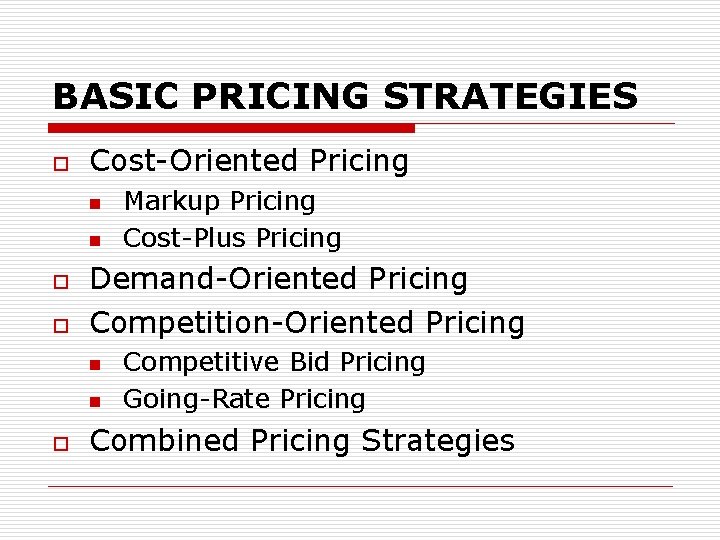
BASIC PRICING STRATEGIES o Cost-Oriented Pricing n n o o Demand-Oriented Pricing Competition-Oriented Pricing n n o Markup Pricing Cost-Plus Pricing Competitive Bid Pricing Going-Rate Pricing Combined Pricing Strategies
Cost-Oriented Pricing In cost-oriented pricing, marketers first calculate the costs of acquiring or making the product and their expenses of doing business. Then they add their projected profit margin to these figures to arrive at a price.
Cost-Oriented Pricing Method 1: Markup Pricing is used primarily by wholesalers and retailers who are involved in acquiring goods for resale. A markup is the difference between the price of an item and its cost. If the business is to be successful, the markup on its products must be high enough to cover the expense of running the business and must include the intended profit
Cost-Oriented Pricing Method 2: Cost-Plus Pricing in this type of pricing all cost and expenses are calculated and then the desired profit is added to arrive at a price. Very similar to markup pricing, cost-plus pricing is used primarily by manufacturers and service companies.
Demand-Oriented Pricing Marketers who use demandoriented pricing attempt to determine what present consumers are willing to pay for given goods and services. The key to using this method of pricing is the consumer’s perceived value of the item. The price set must be in line with this perception.
Competition-Oriented Pricing Marketers who study their competitors to determine the prices of their products are using competitionoriented pricing. These marketers may elect to take one of three actions after learning their competitors’ prices: price above the competition, price below the competition, or price in line with the competition.
Competition-Oriented Pricing Method 1: Competitive Bid Pricing Determining the price for a product on the basis of bids submitted by competitors to a company or government agency is called competitive bid pricing. Most government agencies are required by law to request bids based on certain specifications so they can select the company that offers the lowest price on the desired product.
Competition-Oriented Pricing Method 2: Going-Rate Pricing Almost all firms engage in some form of going-rate pricing, which involves studying the competition’s prices to be sure one’s own prices are in line. Going-rate pricing is especially important in businesses where the competing products are similar.
Combined Pricing Strategies Even though the three basic pricing strategies just described were introduced as separate options, in reality most marketers use all three to determine prices.
INFLUENCES OF WHOLESALERS AND RETAILERS In addition to using the foregoing strategies to arrive at a price, manufacturers may also consider the prices they will charge wholesalers and retailers for their products. This means working backward from the final retail price or forward from costs and expenses to the final retail price.
PRICING AND PRODUCT LIFE CYCLE Products move through four stages: Ø Ø o o Introduction Growth Maturity Decline When products are no longer profitable to the company, they may be dropped form the line. Pricing plays an important role in this sequence of events. NEW PRODUCT INTRODUCTION OTHER PRODUCT STAGES
New Product Introduction Depending on the philosophy of the business and market conditions, one of two pricing methods may be used when a new product is introducedskimming pricing (a pricing policy that sets a very high price for a new product to capitalize on the high demand for it during its introductory period) and penetration pricing (setting the initial price very low).
Other Stages Pricing during subsequent periods in a product’s life cycle will be determined on the basis of which pricing method was originally used- skimming or penetration. During the growth stage, sales increase rapidly and total costs per unit decrease because volume absorbs fixed costs. The main goal of marketers is to keep the products in this stage as long as possible.