
Pricing In Retailing Chapter 17 Dr Pointers Notes
- Slides: 31
Pricing In Retailing Chapter 17 Dr. Pointer’s Notes
Overview n n Pricing is the value that is placed on something. That something is usually goods and service Products must be priced in a way that both achieves profits and satisfies customers
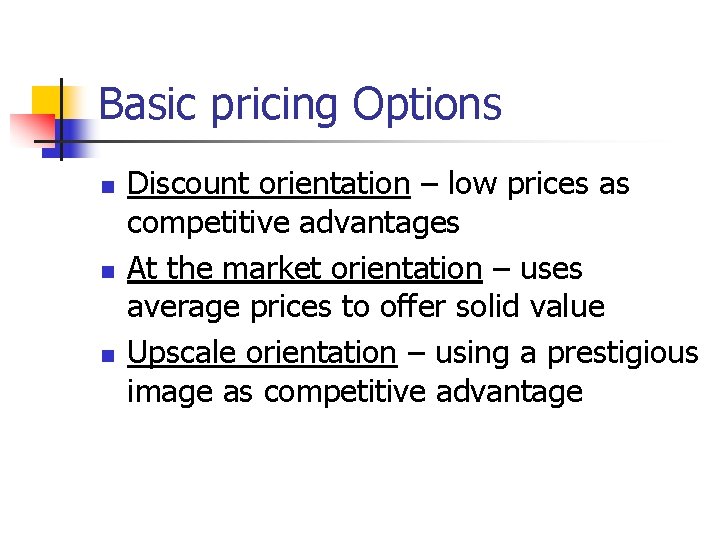
Basic pricing Options n n n Discount orientation – low prices as competitive advantages At the market orientation – uses average prices to offer solid value Upscale orientation – using a prestigious image as competitive advantage
External Factors Affecting Retail Pricing n n Consumers Governmental issues Manufacturers/wholesalers/suppliers Current and potential competitors
Consumer Factors n n n Price elasticity of demand – Measures sensitivity of consumers to price changes. A small change in prices results in a big change is quantity – very elastic Change in prices does not result in significant change in quantity it is inelastic. Elasticity = ∆ Q/ ∆P
Consumer_2 Price sensitivity varies by market segment based on market orientation 1. Economic Consumers 2. Status-oriented consumers 3. Assortment oriented consumers 4. Personalizing consumers 5. Convenience oriented consumers n
Government Issues n n Horizontal pricing fixing – parties within the same level in channel agree to set prices Vertical price fixing – when manufacturers or wholesalers seek to control the retail prices of their products Price discrimination –occurs when retailers sell same product at different prices to different consumers under same conditions. Robinson- Patman act bars price discrimination
Justifiable reasons to price discriminate n n n Products are physically different Retailers paying different prices are not competitors Competition is not injured Price differences are due to differences in costs Market conditions change
Government issues n n Minimum price laws- can not sell certain items for less than costs Predatory pricing- seeks to reduce competition by pricing products very low Loss leaders - price products below costs to attract more store traffic Unit pricing- must provide total price and price per a certain unit such as price per oz. or price per lb
Government issues n n Item price removal – some states ban this Price advertising – cannot advertising a price reduction unless it has actually been done Price matching- legal in many states Bait and switching – illegal practice of advertising a low price but then try to switch customers to another product when they enter the store or say the product is not available.
Manuf, wholesalers and Other Suppliers n n n May have conflicts between manuf, wholesalers regarding the pricing of merchandise Private label is increasing – selling against the brand Gray market goods are sold by retailers and not liked by manufacturers
Competition and retail Pricing n n Market pricing- many retailers are in market and consumers have many to chose from which makes prices of products very similar Administered pricing- seeks to attract consumers based on uniqueness of offering rather than price
Factors Affecting Retail Price Strategy n n n Price objectives Broad price policy Price strategy Implementation of strategy Price adjustments
Pricing objectives n n Sales or market share – market penetration strategy – seek big revenues by reducing prices Profit objectives – market skimming strategy. Sets premium prices and attracts customers who are less price senstitive. Objective is recovery of cash quicker.
Examples of Specific pricing Objectives (Fig. 17 -5) n n n Maintain a proper image Clear seasonal inventory Provide good customer service Encourage repeat business Match competitors prices Increase shopper traffic
Broad Price Policy n n n Broad price policy a retailer generates an integrated price plan with short and long run perspective Price policy is integrated with target market, retail image, and other elements of retail mix Example of policy: no competitors will have lower prices
Price Strategy n n n Demand Oriented –price set based on consumers desire Cost Oriented – costs are calculated and profits are added to set price Competition oriented – prices set to match competition
Demand Oriented n n n Use demand to estimate what consumers are willing to pay Price- quality association – higher price the higher the quality Prestige pricing – higher the price the better, consumers preferences
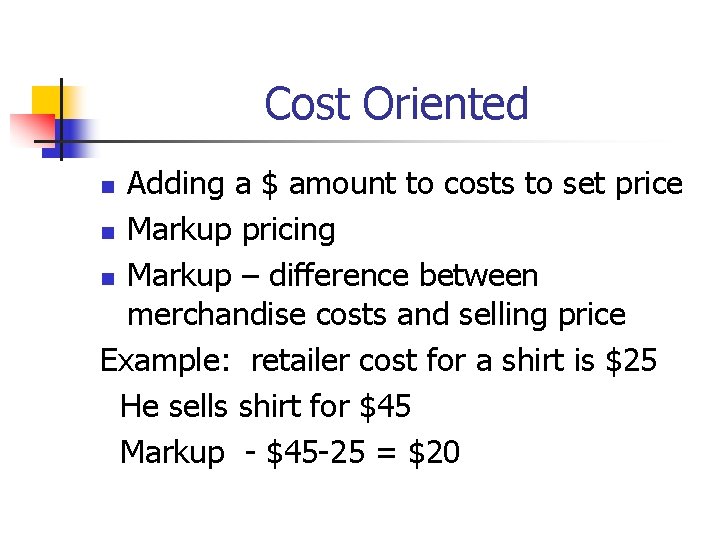
Cost Oriented Adding a $ amount to costs to set price n Markup pricing n Markup – difference between merchandise costs and selling price Example: retailer cost for a shirt is $25 He sells shirt for $45 Markup - $45 -25 = $20 n
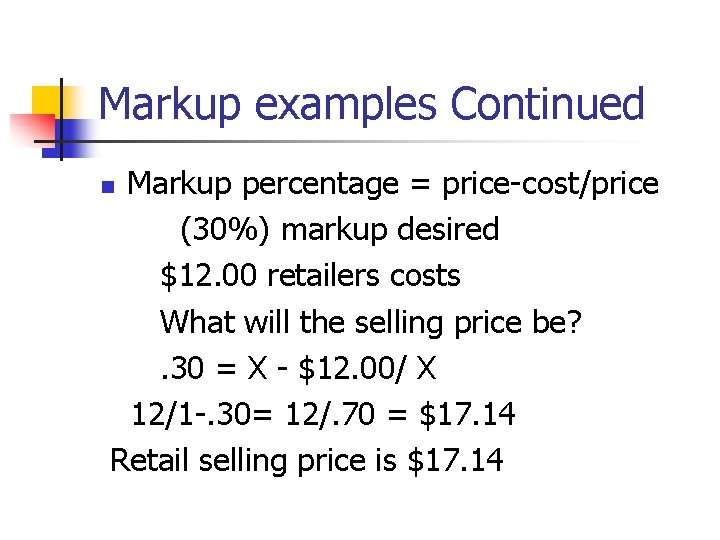
Markup examples Continued Markup percentage = price-cost/price (30%) markup desired $12. 00 retailers costs What will the selling price be? . 30 = X - $12. 00/ X 12/1 -. 30= 12/. 70 = $17. 14 Retail selling price is $17. 14 n
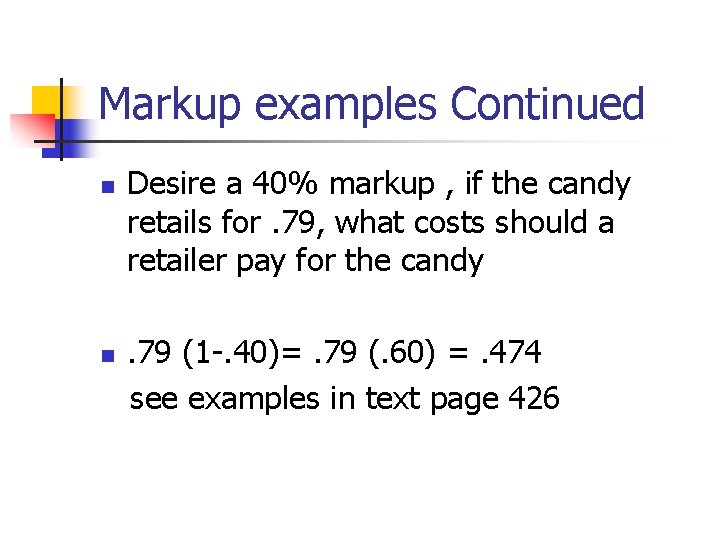
Markup examples Continued n n Desire a 40% markup , if the candy retails for. 79, what costs should a retailer pay for the candy. 79 (1 -. 40)=. 79 (. 60) =. 474 see examples in text page 426
Markup n n Initial markup Maintained markups Variable markup policy Direct product profitability
Competition oriented pricing n Use competitions prices ONLY as a guide can price above, below or at same level as competition
Integrated approaches to pricing strategy Must consider many factors such as 1. if price reduces will revenues increase greatly 2. Will a given price, allow a traditional markup to be attained 3. Can above market prices lead to superior image n
Implementation of Price Strategy n 1. 2. 3. 4. Customary and variable pricing Customary pricing –sets price at one level and seek to keep them at these levels Everyday low pricing (EDLP) sell goods at consistently low prices Variable pricing – change prices as costs vary Yield management pricing – determines price that yields the greatest profits for a given period.
Implementation of Price Strategy n 1. 2. 3. One price policy and flexible pricing One price policy – charge all customers the same price Flexible pricing – let consumers bargain over prices Contingency pricing -
Implementation of Price Strategy n Odd pricing- set prices below even dollar amt, . 49. 99. 1. 99, 99. 99 Leader pricing selling selected items at reduced price to build store traffic n Multiple –unit – 2 for. 79 bundled pricing combines several products n Price lining- sell products at a limited price range. n
Price Adjustments n n Price adjustments let retailer use price as an adaptive mechanism 1. markdowns 2. additional markups 3. employee discount Markdowns are taken because of competition, seasonality, demand patterns, merchandise costs and pilferage.
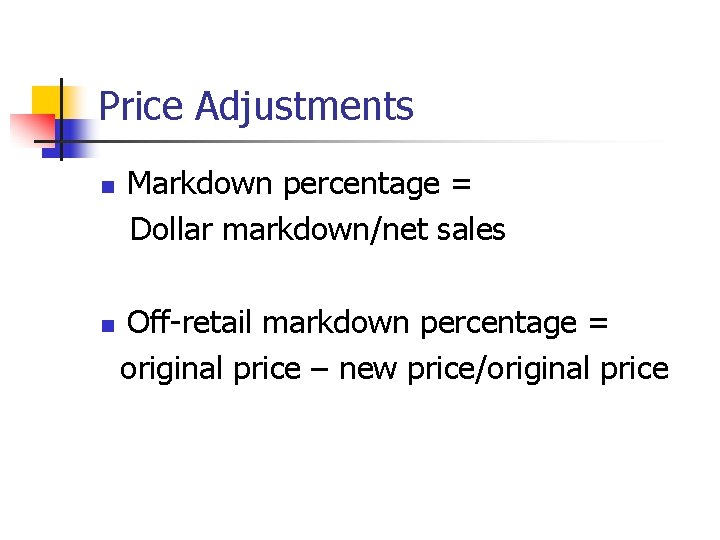
Price Adjustments n n Markdown percentage = Dollar markdown/net sales Off-retail markdown percentage = original price – new price/original price
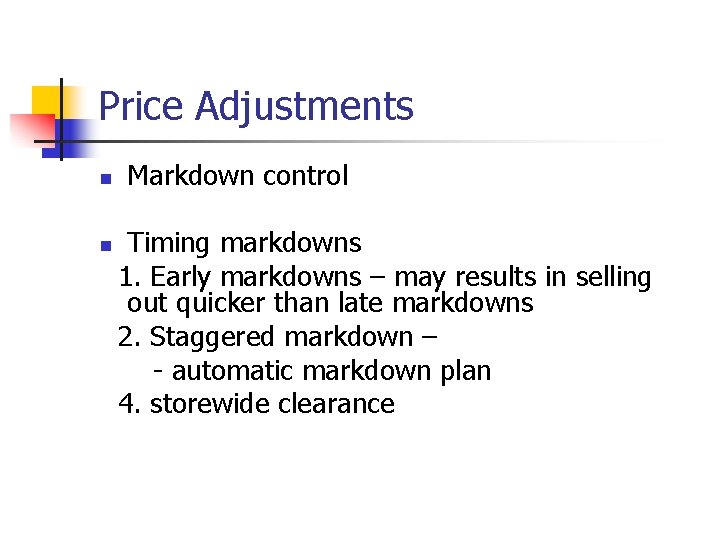
Price Adjustments n n Markdown control Timing markdowns 1. Early markdowns – may results in selling out quicker than late markdowns 2. Staggered markdown – - automatic markdown plan 4. storewide clearance
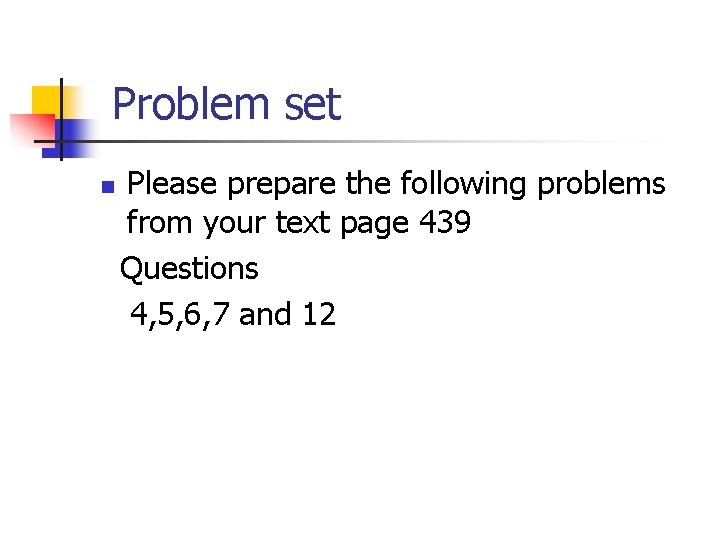
Problem set n Please prepare the following problems from your text page 439 Questions 4, 5, 6, 7 and 12