
Pricing Considerations and Approaches Chapter 10 1 Objectives

Pricing Considerations and Approaches Chapter 10 1
Objectives w Understand the internal factors affecting a firm’s pricing decisions. w Understand the external factors affecting pricing decisions, including the impact of consumer perceptions of price and value. w Be able to contrast the three general approaches to setting prices.

What is Price? Price Has Many Names w w w Rent Fee Rate Commission Assessment w w w Tuition Fare Toll Premium Retainer • Bribe • Salary • Wage • Interest • Tax
Definition w Price n The amount of money charged for a product or service, or the sum of the values that consumers exchange for the benefits of having or using the product or service.
What is Price? w Prices set by negotiation w Fixed price policies: 19 th century w Dynamic pricing: charging different prices depending on individual customers and situations.
What is Price? w Price and the Marketing Mix: n n Only element to generate revenues Most flexible element w Common Pricing Mistakes: price reduction, too cost oriented, not revised enough to reflect market changes, does not take into account the rest of marketing mix.

Factors Affecting Price Decisions External Factors Internal Factors Marketing Objectives Marketing Mix Strategy Costs Organizational considerations Pricing Decisions Nature of the market and demand Competition Other environmental factors (economy, resellers, government)
Factors to Consider When Setting Price Internal Factors w Marketing objectives w Marketing mix strategies w Costs w Organizational considerations w Market positioning influences pricing strategy w Other pricing objectives: n Survival: too much capacity, heavy competition; low price n Current profit maximization n Market share leadership n Product quality leadership
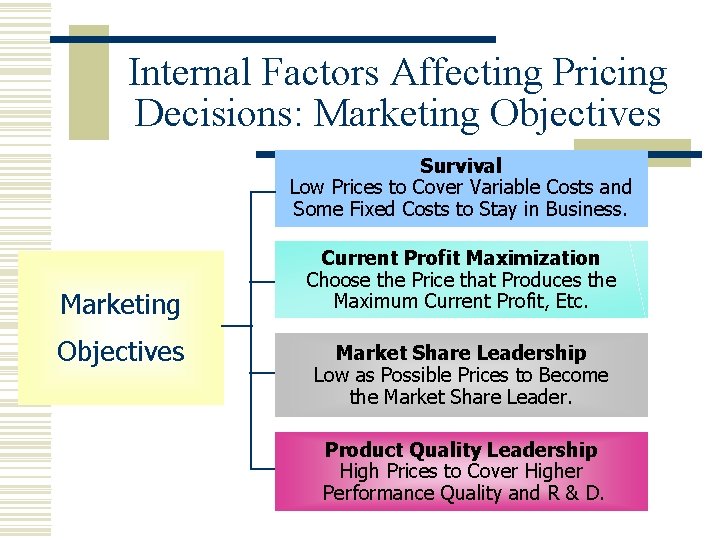
Internal Factors Affecting Pricing Decisions: Marketing Objectives Survival Low Prices to Cover Variable Costs and Some Fixed Costs to Stay in Business. Marketing Objectives Current Profit Maximization Choose the Price that Produces the Maximum Current Profit, Etc. Market Share Leadership Low as Possible Prices to Become the Market Share Leader. Product Quality Leadership High Prices to Cover Higher Performance Quality and R & D.
Factors to Consider When Setting Price Internal Factors w Marketing objectives w Marketing mix strategies w Costs w Organizational considerations w Pricing must be carefully coordinated with the other marketing mix elements w Target costing (pricing that starts with ideal selling price, then targets cost that will ensure that the price is met) is often used to support product positioning strategies based on price w Nonprice positioning (differentiate offer) can also be used
Factors to Consider When Setting Price Internal Factors w Marketing objectives w Marketing mix strategies w Costs w Organizational considerations w Types of costs: n Variable n Fixed n Total costs w How costs vary at different production levels will influence price setting w Experience (learning) curve effects on price

Costs Considerations Cost Per Unit at Different Levels of Production Period 4 SRAC 4, 000 3 2, 000 1, 000 Cost per unit 2 3, 000 1 Quantity Produced per Day LRAC
Factors to Consider When Setting Price Internal Factors w Marketing objectives w Marketing mix strategies w Costs w Organizational considerations w Who sets the price? n n Small companies: CEO or top management Large companies: Divisional or product line managers w Price negotiation is common in industrial settings
Factors to Consider When Setting Price External Factors w Nature of market and demand w Competitors’ costs, prices, and offers w Other environmental elements w Types of markets n n Pure competition Monopolistic competition Oligopolistic competition Pure monopoly
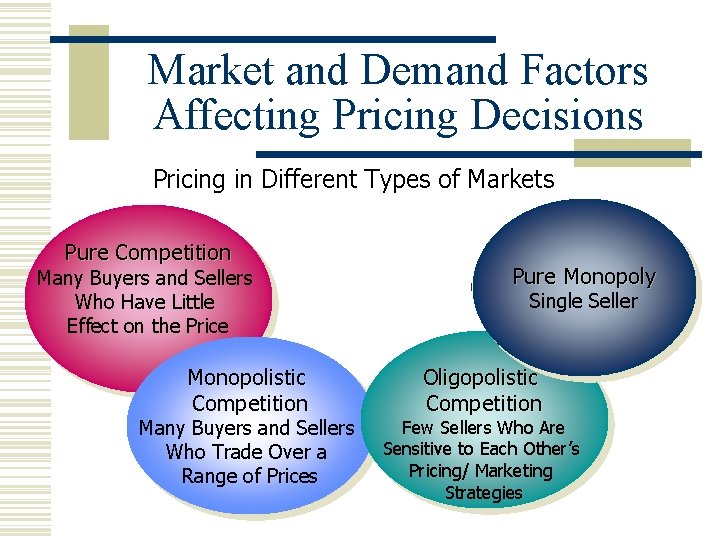
Market and Demand Factors Affecting Pricing Decisions Pricing in Different Types of Markets Pure Competition Many Buyers and Sellers Who Have Little Effect on the Price Monopolistic Competition Many Buyers and Sellers Who Trade Over a Range of Prices Pure Monopoly Single Seller Oligopolistic Competition Few Sellers Who Are Sensitive to Each Other’s Pricing/ Marketing Strategies

Factors to Consider When Setting Price External Factors w Nature of market and demand w Competitors’ costs, prices, and offers w Other environmental elements w Price-demand relationship n n Demand curve Price elasticity of demand l Unique, high in quality, prestige, substitute products are hard to find.
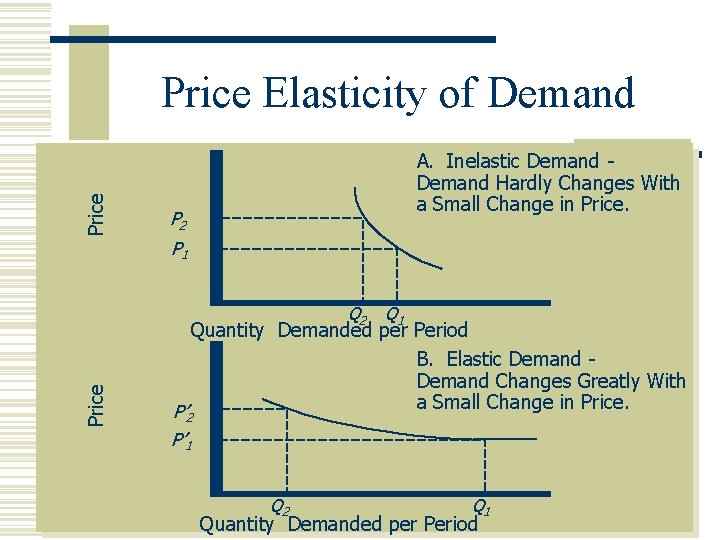
Price Elasticity of Demand A. Inelastic Demand Hardly Changes With a Small Change in Price. P 2 P 1 Price Q 2 Q 1 Quantity Demanded per Period P’ 2 P’ 1 B. Elastic Demand Changes Greatly With a Small Change in Price. Q 2 Q 1 Quantity Demanded per Period
Factors to Consider When Setting Price External Factors w Nature of market and demand w Competitors’ costs, prices, and offers w Other environmental elements w Consider competitors’ costs, prices, and possible reactions when developing a pricing strategy
Factors to Consider When Setting Price External Factors w Nature of market and demand w Competitors’ costs, prices, and offers w Other environmental elements w Economic conditions n n Affect production costs Affect buyer perceptions of price and value w Reseller reactions to prices must be considered w Government may restrict or limit pricing options
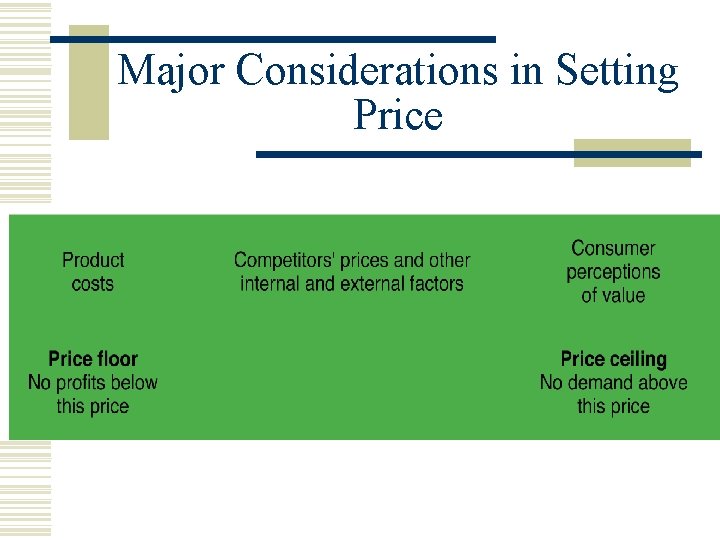
Major Considerations in Setting Price
General Pricing Approaches w Cost-Based Pricing: Cost-Plus Pricing n n n Adding a standard markup to cost Ignores demand competition Popular pricing technique because: l l l It simplifies the pricing process Price competition may be minimized It is perceived as more fair to both buyers and sellers
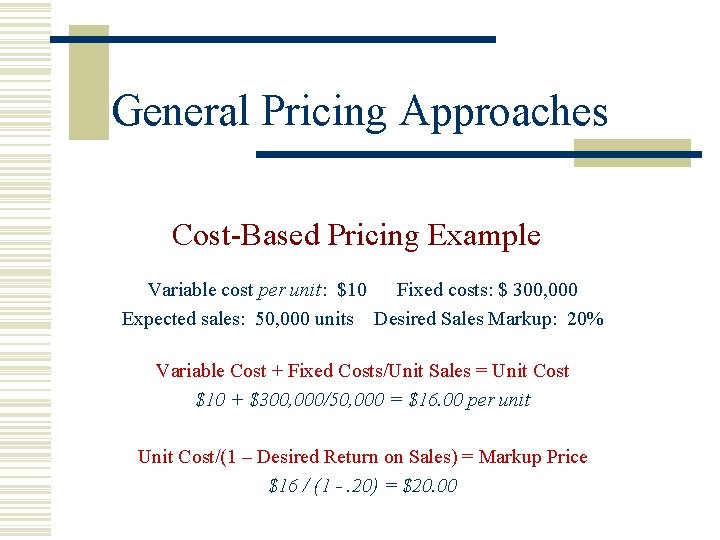
General Pricing Approaches Cost-Based Pricing Example Variable cost per unit: $10 Fixed costs: $ 300, 000 Expected sales: 50, 000 units Desired Sales Markup: 20% Variable Cost + Fixed Costs/Unit Sales = Unit Cost $10 + $300, 000/50, 000 = $16. 00 per unit Unit Cost/(1 – Desired Return on Sales) = Markup Price $16 / (1 -. 20) = $20. 00
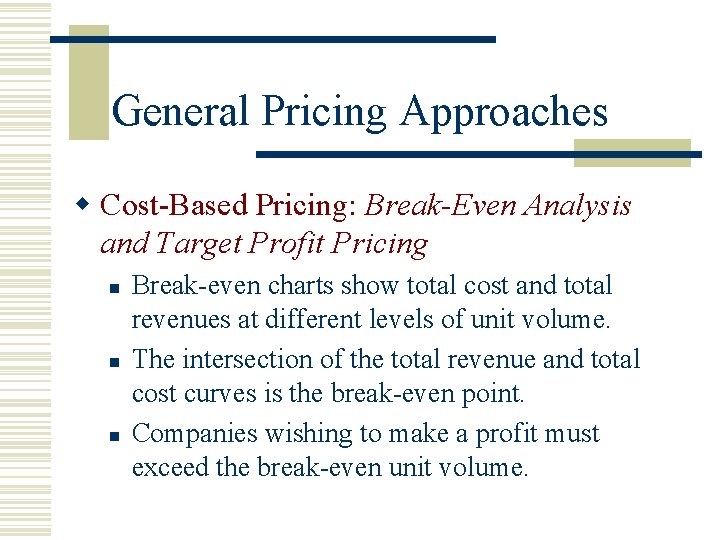
General Pricing Approaches w Cost-Based Pricing: Break-Even Analysis and Target Profit Pricing n n n Break-even charts show total cost and total revenues at different levels of unit volume. The intersection of the total revenue and total cost curves is the break-even point. Companies wishing to make a profit must exceed the break-even unit volume.
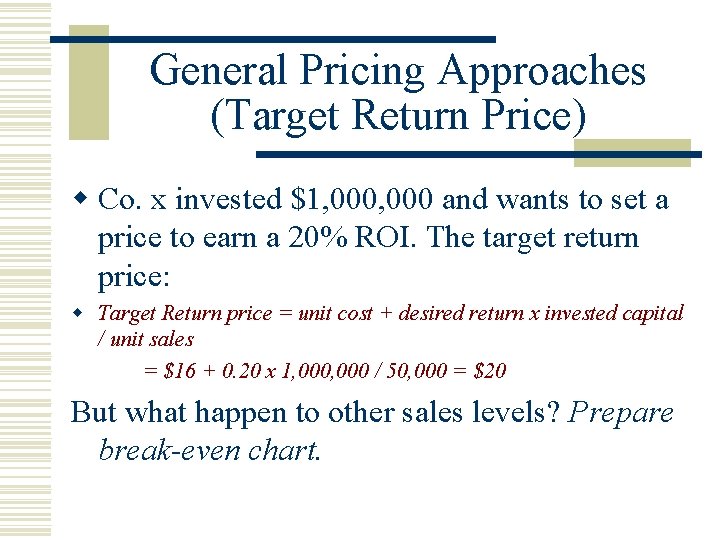
General Pricing Approaches (Target Return Price) w Co. x invested $1, 000 and wants to set a price to earn a 20% ROI. The target return price: w Target Return price = unit cost + desired return x invested capital / unit sales = $16 + 0. 20 x 1, 000 / 50, 000 = $20 But what happen to other sales levels? Prepare break-even chart.
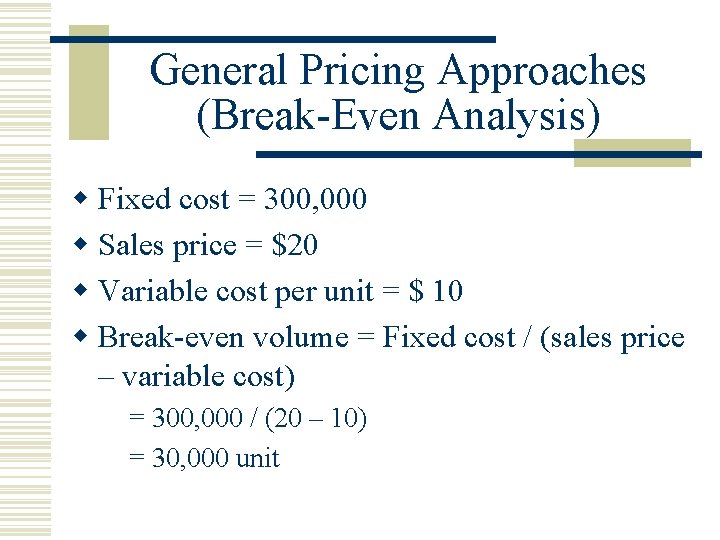
General Pricing Approaches (Break-Even Analysis) w Fixed cost = 300, 000 w Sales price = $20 w Variable cost per unit = $ 10 w Break-even volume = Fixed cost / (sales price – variable cost) = 300, 000 / (20 – 10) = 30, 000 unit
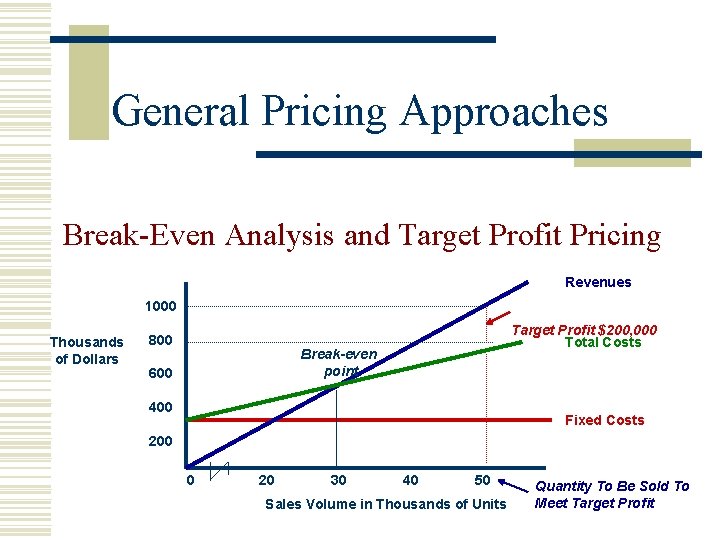
General Pricing Approaches Break-Even Analysis and Target Profit Pricing Revenues 1000 Thousands of Dollars 800 Target Profit $200, 000 Total Costs Break-even point 600 400 Fixed Costs 200 0 20 30 40 50 Sales Volume in Thousands of Units Quantity To Be Sold To Meet Target Profit
General Pricing Approaches w Value-Based Pricing: n n Uses buyers’ perceptions of value rather than seller’s costs to set price. Measuring perceived value can be difficult.
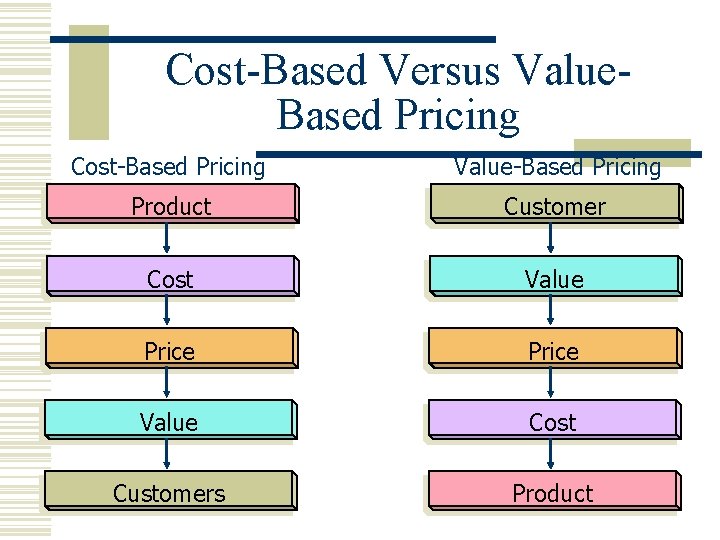
Cost-Based Versus Value. Based Pricing Cost-Based Pricing Value-Based Pricing Product Customer Cost Value Price Value Cost Customers Product
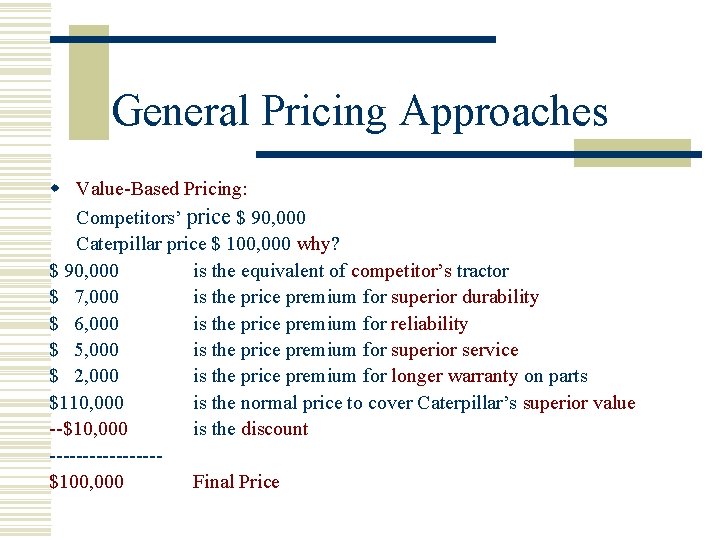
General Pricing Approaches w Value-Based Pricing: Competitors’ price $ 90, 000 Caterpillar price $ 100, 000 why? $ 90, 000 is the equivalent of competitor’s tractor $ 7, 000 is the price premium for superior durability $ 6, 000 is the price premium for reliability $ 5, 000 is the price premium for superior service $ 2, 000 is the price premium for longer warranty on parts $110, 000 is the normal price to cover Caterpillar’s superior value --$10, 000 is the discount --------$100, 000 Final Price
General Pricing Approaches w Competition-Based Pricing: n n Also called going-rate pricing May price at the same level, above, or below the competition
- Slides: 30