
Pricing and Profitability Analysis 18 18 1 Basic
Pricing and Profitability Analysis 18 18 -1
Basic Pricing Concepts 1 • Price Elasticity of Demand • • Measured as the percentage change in quantity divided by the percentage change in price If demand is relatively elastic, a small percent change in price will lead to a greater percent change in quantity demanded (the opposite is true for inelastic demand) 18 -2
Basic Pricing Concepts 1 • Market Structure and Price • • Perfect competition – many buyers and sellers, no one of which is large enough to influence the market Monopolistic competition – has both the characteristics of both monopoly and perfect competition Oligopoly – few sellers Monopoly – barriers to entry are so high that there is only one firm in the market 18 -3
Cost and Pricing Policies 2 Two Approaches to Pricing 1. Cost-based Pricing: prices are established using ‘cost’ plus markup 2. Target Pricing: prices are influenced by market conditions 18 -4
Cost and Pricing Policies 2 Cost Plus Pricing Markup is a percentage applied to base cost; it includes desired profit and any costs not included in the base cost. Markup on COGS = (Selling and administrative expenses + Operating Income)/COGS Markup on DM = (Direct Labor + Overhead + Selling and administrative expense + Operating Income)/ Direct Materials See Cornerstone 18 -1 18 -5
Cost and Pricing Policies 2 • Target Costing • • Sets the cost of a product or service based on the price that customers are willing to pay Involves more upfront work than cost based pricing. If the cost-plus pricing turns out to be higher than what customers will accept, additional work or lost opportunity will result 18 -6
Cost and Pricing Policies 2 • Other Pricing Policies • • • Penetration pricing: the pricing of a new product at a low initial price to build market share quickly • Not like predatory pricing because it is not meant to destroy competition Price skimming: a higher price is charged when a product or service is first introduced Price gouging: occurs when firms with market power price products ‘too high’ 18 -7

The Legal System and Pricing 3 Basic principle behind pricing regulation is that competition is good and should be encouraged. Predatory pricing: the practice of setting prices below cost for the purpose of injuring competitors and eliminating competition. Predatory pricing on the international market is called dumping 18 -8
The Legal System and Pricing 3 • Price discrimination: refers to the charging of different prices to different customers for essentially the same product. • Robinson-Patman Act 1936 passed to outlaw price discrimination. It allows discrimination under certain circumstances: • If the competitive situation demands it • If costs can justify the lower price 18 -9
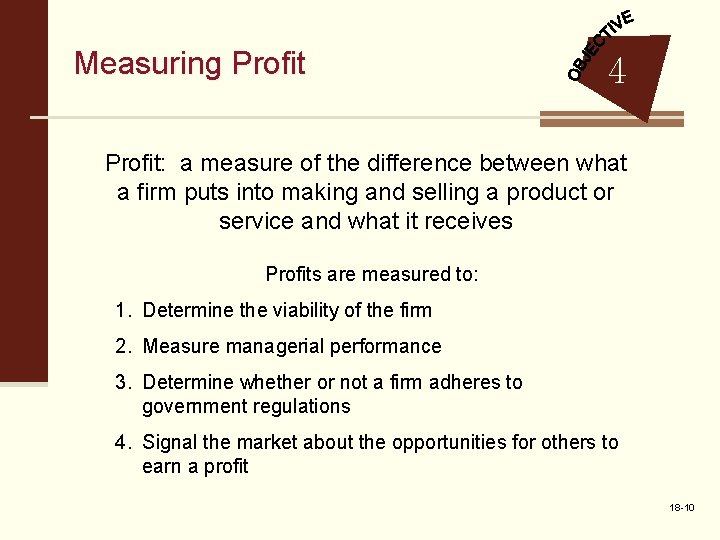
Measuring Profit 4 Profit: a measure of the difference between what a firm puts into making and selling a product or service and what it receives Profits are measured to: 1. Determine the viability of the firm 2. Measure managerial performance 3. Determine whether or not a firm adheres to government regulations 4. Signal the market about the opportunities for others to earn a profit 18 -10
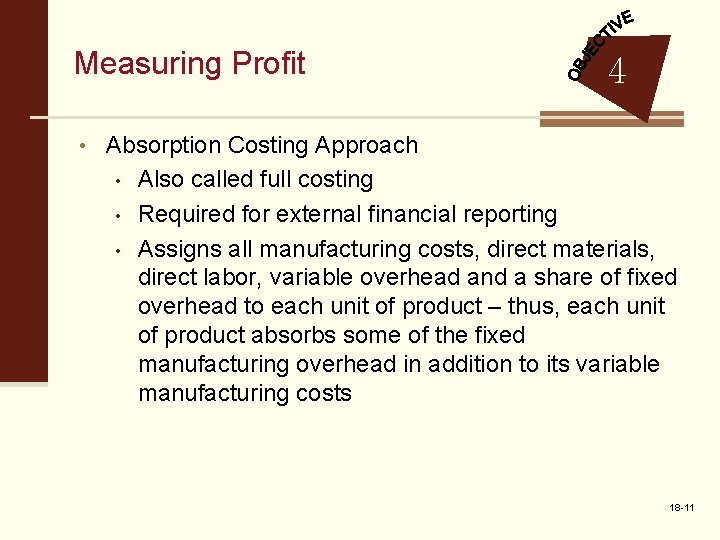
Measuring Profit 4 • Absorption Costing Approach • • • Also called full costing Required for external financial reporting Assigns all manufacturing costs, direct materials, direct labor, variable overhead and a share of fixed overhead to each unit of product – thus, each unit of product absorbs some of the fixed manufacturing overhead in addition to its variable manufacturing costs 18 -11
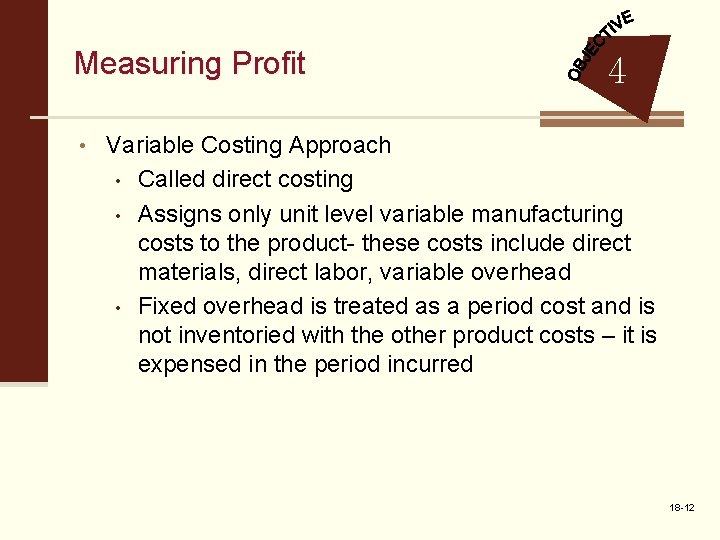
Measuring Profit 4 • Variable Costing Approach • • • Called direct costing Assigns only unit level variable manufacturing costs to the product- these costs include direct materials, direct labor, variable overhead Fixed overhead is treated as a period cost and is not inventoried with the other product costs – it is expensed in the period incurred 18 -12

Analysis of Profit Related Variances 6 Sales Mix Variance = [(Product 1 actual units – Product 1 budgeted units) X (Product 1 budgeted unit contribution margin – Budgeted average unit contribution margin] + [(Product 2 actual units – Product 2 budgeted units) X (Product 2 budgeted unit contribution margin – Budgeted average unit contribution margin] 18 -13
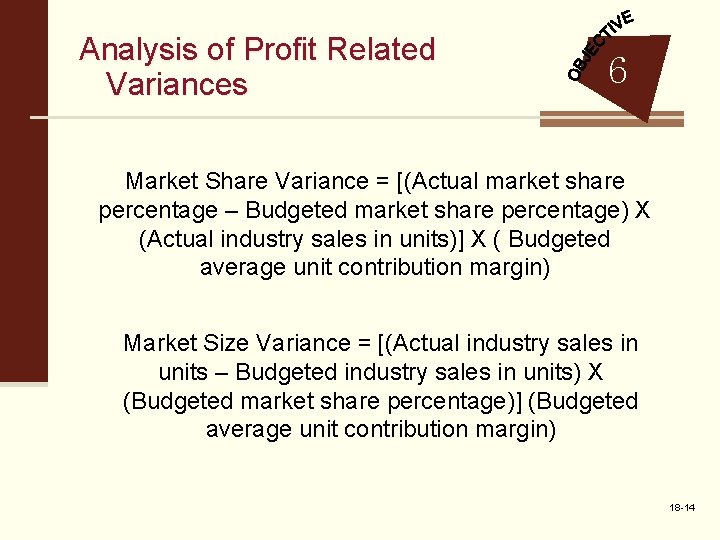
Analysis of Profit Related Variances 6 Market Share Variance = [(Actual market share percentage – Budgeted market share percentage) X (Actual industry sales in units)] X ( Budgeted average unit contribution margin) Market Size Variance = [(Actual industry sales in units – Budgeted industry sales in units) X (Budgeted market share percentage)] (Budgeted average unit contribution margin) 18 -14
- Slides: 14