
Pricing and Liberalisation Pricing in a Liberalised Energy
Pricing and Liberalisation Pricing in a Liberalised Energy Market Guido Pepermans Economics Department and Energy Institute K. U. Leuven ENERGY INSTITUTE KATHOLIEKE UNIVERSITEIT LEUVEN
Structure of the Talk l The liberalisation process l The general principles of pricing l Stranded costs l Cross-subsidies l Transmission pricing ENERGY INSTITUTE KATHOLIEKE UNIVERSITEIT LEUVEN

The Liberalisation Idea BEFORE LIBERALISATION AFTER LIBERALISATION One vertically integrated company Generation Gen. Co Distribution Company Regulated Transmission Grid Company Transmission Distribution Gen. Co Customer ENERGY INSTITUTE KATHOLIEKE UNIVERSITEIT LEUVEN
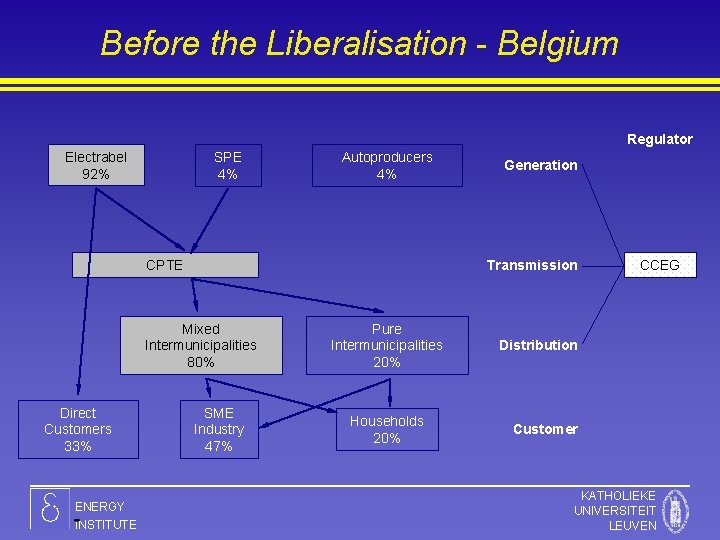
Before the Liberalisation - Belgium Regulator Electrabel 92% SPE 4% Autoproducers 4% Transmission CPTE Mixed Intermunicipalities 80% Direct Customers 33% ENERGY INSTITUTE Generation SME Industry 47% Pure Intermunicipalities 20% Households 20% CCEG Distribution Customer KATHOLIEKE UNIVERSITEIT LEUVEN
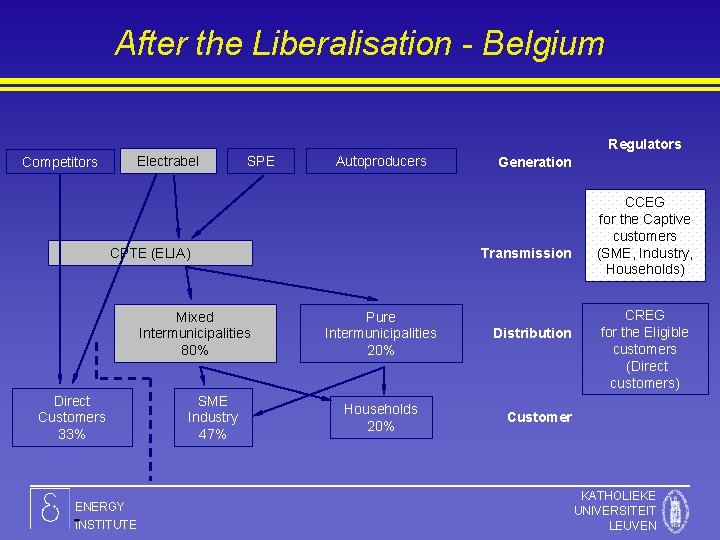
After the Liberalisation - Belgium Regulators Electrabel Competitors SPE Autoproducers CPTE (ELIA) Mixed Intermunicipalities 80% Direct Customers 33% ENERGY INSTITUTE SME Industry 47% Generation Transmission Pure Intermunicipalities 20% Households 20% Distribution CCEG for the Captive customers (SME, Industry, Households) CREG for the Eligible customers (Direct customers) Customer KATHOLIEKE UNIVERSITEIT LEUVEN
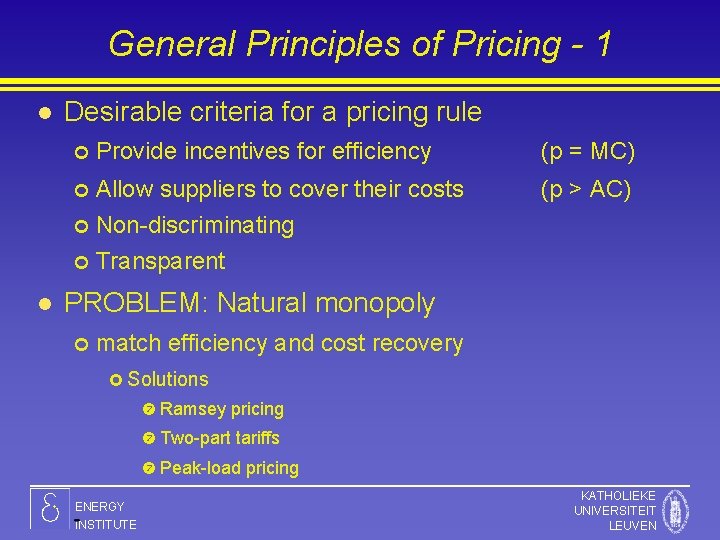
General Principles of Pricing - 1 l Desirable criteria for a pricing rule ¢ Provide incentives for efficiency (p = MC) ¢ Allow suppliers to cover their costs (p > AC) Non-discriminating ¢ Transparent ¢ l PROBLEM: Natural monopoly ¢ match efficiency and cost recovery £ Solutions Ramsey pricing Two-part tariffs Peak-load pricing ENERGY INSTITUTE KATHOLIEKE UNIVERSITEIT LEUVEN
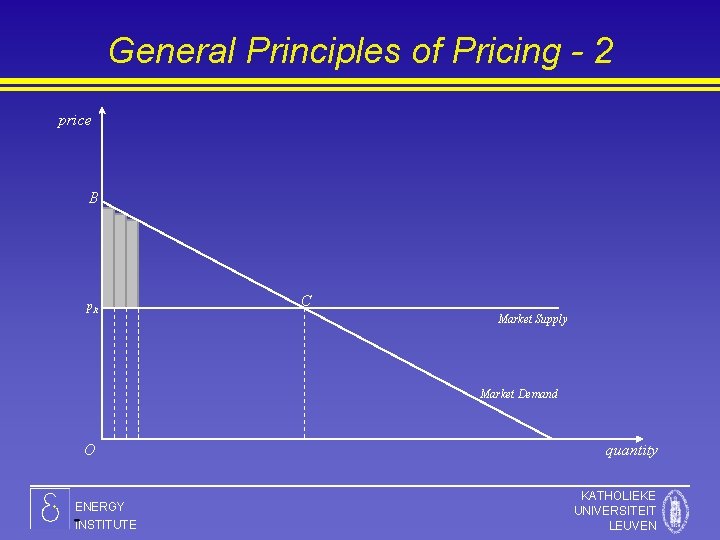
General Principles of Pricing - 2 price B p. R C Market Supply Market Demand O ENERGY INSTITUTE quantity KATHOLIEKE UNIVERSITEIT LEUVEN
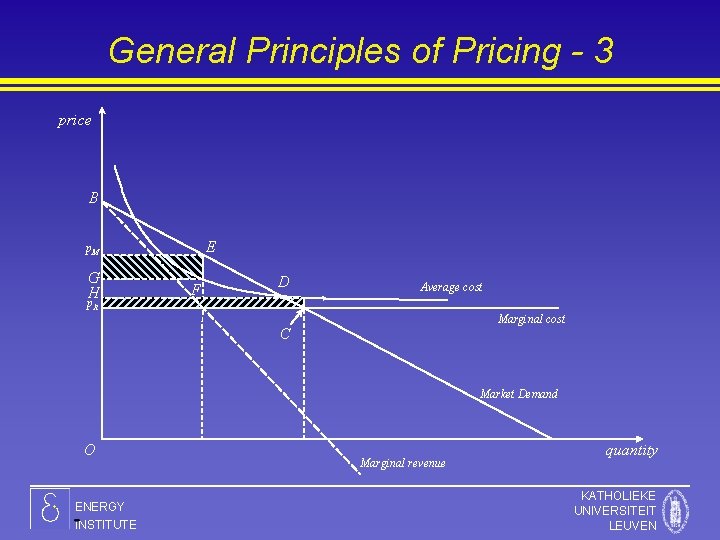
General Principles of Pricing - 3 price B E p. M G H p. R F D Average cost Marginal cost C Market Demand O ENERGY INSTITUTE Marginal revenue quantity KATHOLIEKE UNIVERSITEIT LEUVEN
Stranded Costs - 1 l Problem ¢ What to do with past investments? £ Were ‘guaranteed’ to be recoverable through price increases £ In an open market, this ‘guarantee’ falls away ¢ l Problem mainly for private monopolists Definition is important ¢ As recovery of stranded costs is foreseen in the European Directive ENERGY INSTITUTE KATHOLIEKE UNIVERSITEIT LEUVEN
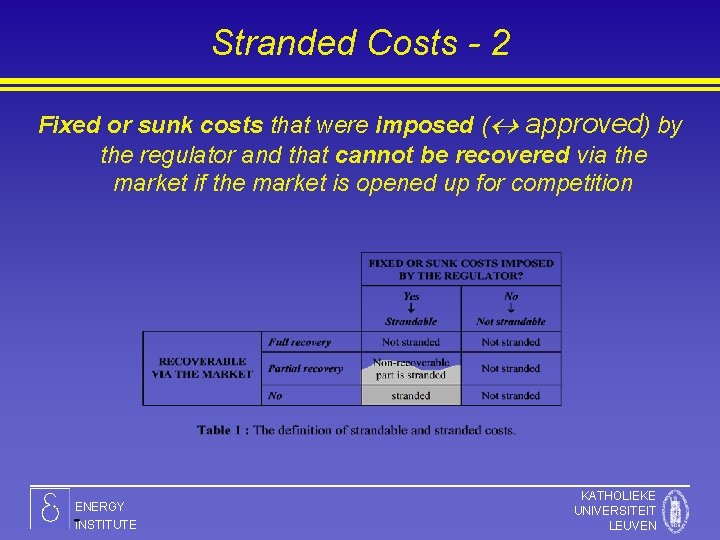
Stranded Costs - 2 Fixed or sunk costs that were imposed ( approved) by the regulator and that cannot be recovered via the market if the market is opened up for competition ENERGY INSTITUTE KATHOLIEKE UNIVERSITEIT LEUVEN
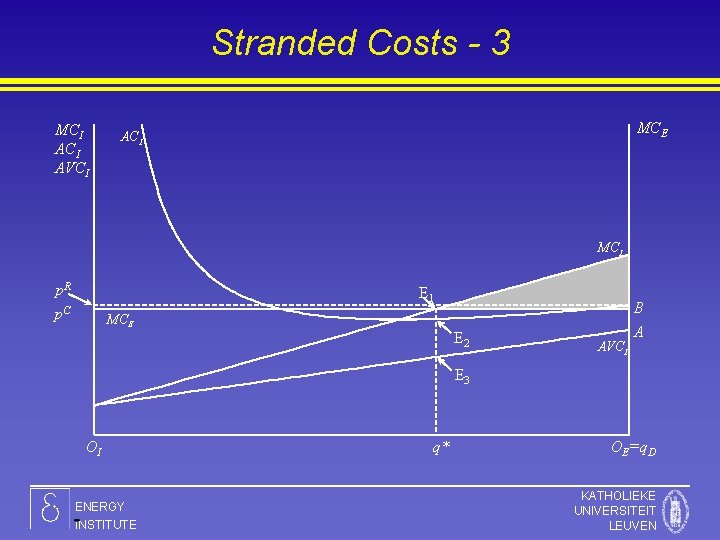
Stranded Costs - 3 MCI AVCI MCE ACI MCI p. R p. C E 1 MCE E 2 AVCI B A E 3 OI ENERGY INSTITUTE q* OE=q. D KATHOLIEKE UNIVERSITEIT LEUVEN
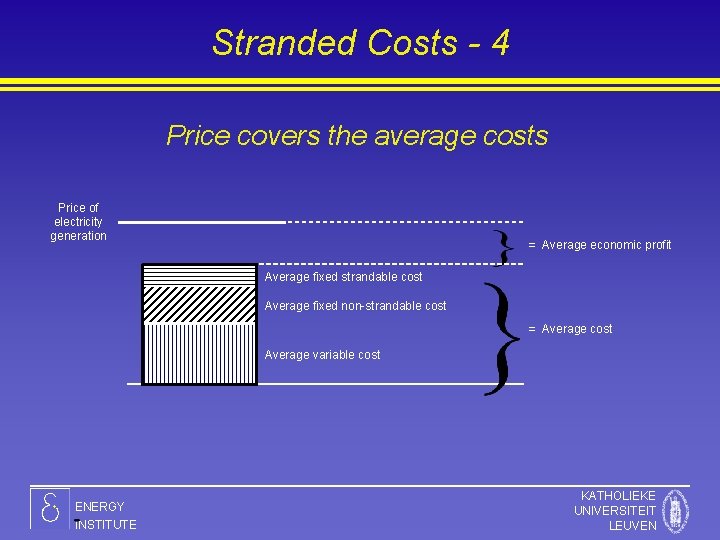
Stranded Costs - 4 Price covers the average costs Price of electricity generation = Average economic profit Average fixed strandable cost Average fixed non-strandable cost = Average cost Average variable cost ENERGY INSTITUTE KATHOLIEKE UNIVERSITEIT LEUVEN
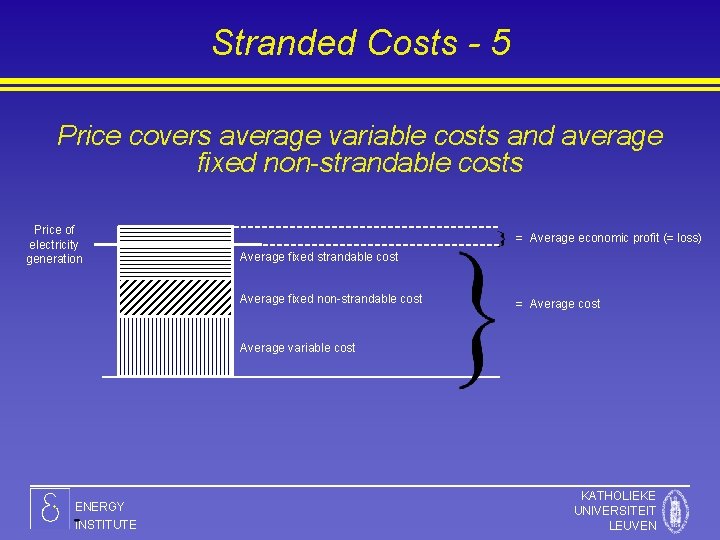
Stranded Costs - 5 Price covers average variable costs and average fixed non-strandable costs Price of electricity generation = Average economic profit (= loss) Average fixed strandable cost Average fixed non-strandable cost = Average cost Average variable cost ENERGY INSTITUTE KATHOLIEKE UNIVERSITEIT LEUVEN
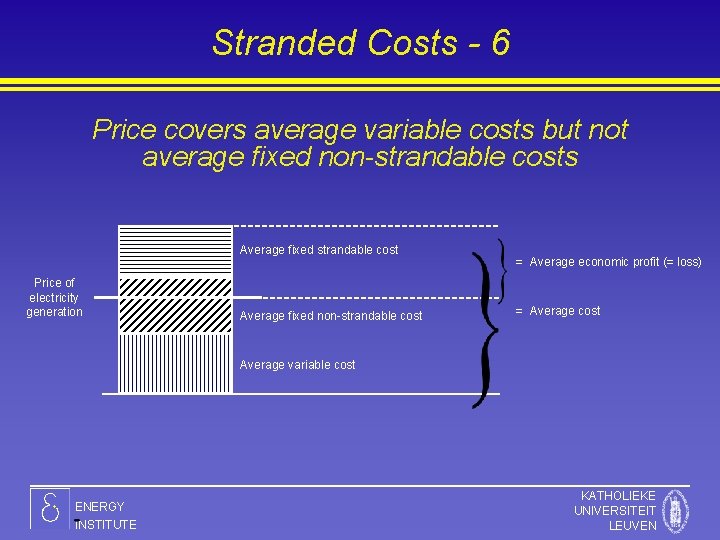
Stranded Costs - 6 Price covers average variable costs but not average fixed non-strandable costs Average fixed strandable cost Price of electricity generation Average fixed non-strandable cost = Average economic profit (= loss) = Average cost Average variable cost ENERGY INSTITUTE KATHOLIEKE UNIVERSITEIT LEUVEN
Stranded Costs - 7 l Conclusion ¢ From the point of view of efficiency £ Stranded ¢ cost recovery is not necessary If recovery is allowed £ It should be competitively neutral £ An upper limit on allowable recovery Size of the strandable cost ENERGY INSTITUTE KATHOLIEKE UNIVERSITEIT LEUVEN
Cross-subsidies - 1 l General pricing principles Should reflect marginal costs ¢ Should allow to recover total costs ¢ l Misunderstandings Uniform pricing may imply cross-subsidies ¢ Price differentiation does not necessarily indicate cross -subsidies ¢ ENERGY INSTITUTE KATHOLIEKE UNIVERSITEIT LEUVEN
Cross-subsidies - 2 l Definition of cross-subsidy-free prices ¢ For all customers £ Price is below the average stand-alone cost The cost of self-providing the good or the service An upper bound on cross-subsidy free prices £ Price not lower than the average incremental cost A lower bound on cross-subsidy-free prices l Why is there a problem? ¢ Wrong incentives ¢ Distributive considerations ENERGY INSTITUTE KATHOLIEKE UNIVERSITEIT LEUVEN
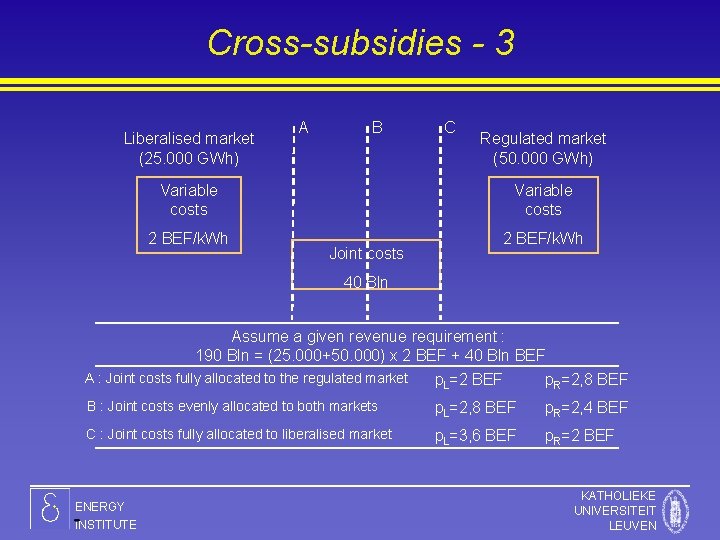
Cross-subsidies - 3 Liberalised market (25. 000 GWh) A B C Regulated market (50. 000 GWh) Variable costs 2 BEF/k. Wh Variable costs Joint costs 2 BEF/k. Wh 40 Bln Assume a given revenue requirement : 190 Bln = (25. 000+50. 000) x 2 BEF + 40 Bln BEF A : Joint costs fully allocated to the regulated market p. L=2 BEF p. R=2, 8 BEF B : Joint costs evenly allocated to both markets p. L=2, 8 BEF p. R=2, 4 BEF C : Joint costs fully allocated to liberalised market p. L=3, 6 BEF p. R=2 BEF ENERGY INSTITUTE KATHOLIEKE UNIVERSITEIT LEUVEN
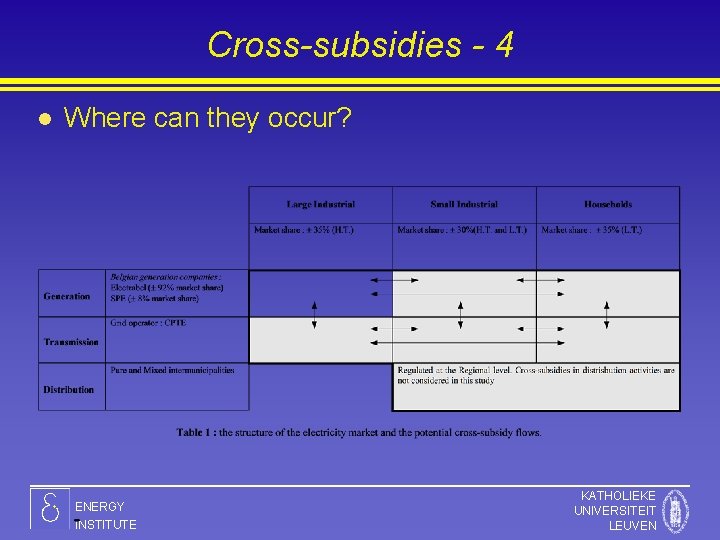
Cross-subsidies - 4 l Where can they occur? ENERGY INSTITUTE KATHOLIEKE UNIVERSITEIT LEUVEN
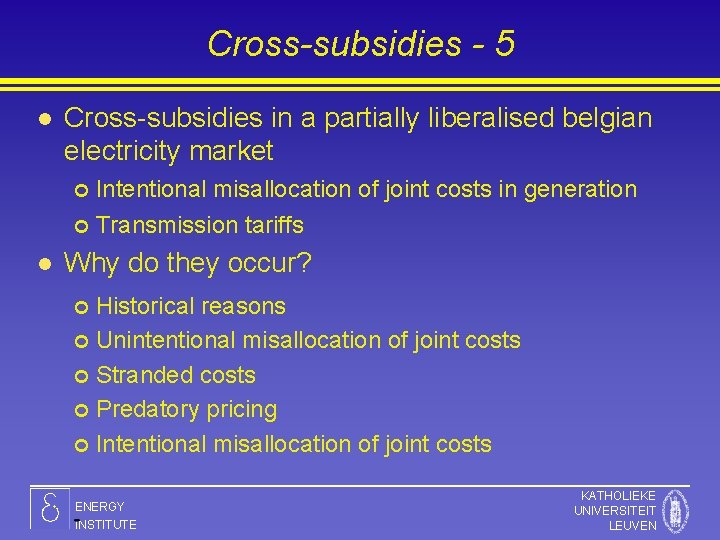
Cross-subsidies - 5 l Cross-subsidies in a partially liberalised belgian electricity market Intentional misallocation of joint costs in generation ¢ Transmission tariffs ¢ l Why do they occur? Historical reasons ¢ Unintentional misallocation of joint costs ¢ Stranded costs ¢ Predatory pricing ¢ Intentional misallocation of joint costs ¢ ENERGY INSTITUTE KATHOLIEKE UNIVERSITEIT LEUVEN
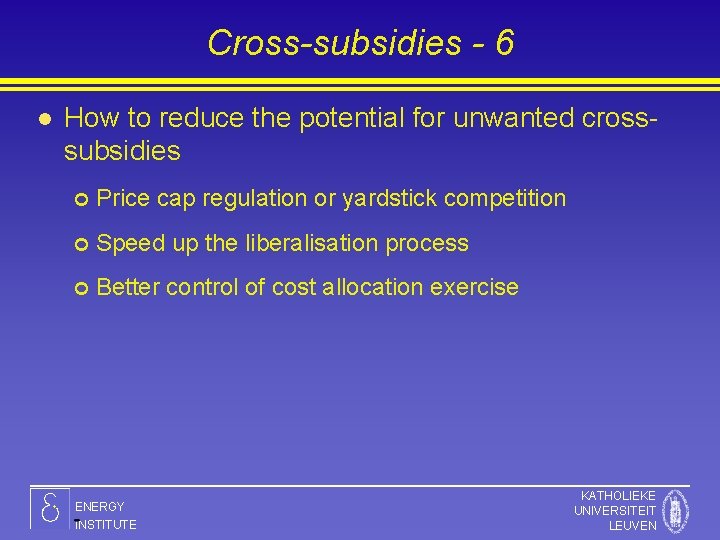
Cross-subsidies - 6 l How to reduce the potential for unwanted crosssubsidies ¢ Price cap regulation or yardstick competition ¢ Speed up the liberalisation process ¢ Better control of cost allocation exercise ENERGY INSTITUTE KATHOLIEKE UNIVERSITEIT LEUVEN
Transmission Pricing - 1 l What makes transmission pricing of electricity difficult? Fixed transmission capacity ¢ Cost recovery ¢ Some physical laws apply to electricity transport ¢ £ Law ¢ of least resistance Belgium is part of a European network in which it cannot control flows £ Dutch l import from France via Belgium or via Germany? Transmission costs and capacity limits will play an important role in the competitive process ENERGY INSTITUTE KATHOLIEKE UNIVERSITEIT LEUVEN
Transmission Pricing - 2 l Alternative pricing systems for transmission £ Cost coverage £ Incentives for optimal siting of generation and consumption £ Incentives for efficient operation, investment and cost minimisation by the transmission company ¢ Postage stamp £ Fixed fee per MWh Simple cost recovery No incentives for correct siting of generation and consumption No incentives for cost minimisation of system operator ENERGY INSTITUTE KATHOLIEKE UNIVERSITEIT LEUVEN
Transmission Pricing - 3 ¢ Distance related tariff £ Fee proportional to distance Cost recovery easy No perfect incentive for siting generation and consumption No incentives for cost minimisation of system operator ¢ Marginal cost pricing Cost recovery not guaranteed Good siting incentives if also future tariffs are announced Better incentives for cost minimisation ENERGY INSTITUTE KATHOLIEKE UNIVERSITEIT LEUVEN
Transmission Pricing - 4 l A proposal for Belgium (Energy Institute) ¢ Mixture postage stamp and marginal cost pricing £ Postage stamp Individualised costs Non-individualised costs - Costs not directly linked to actions of generators and consumers £ Congestion correction for some sites (discount or extra margin) £ Incentive for overall cost efficiency based on yardstick competition ENERGY INSTITUTE KATHOLIEKE UNIVERSITEIT LEUVEN
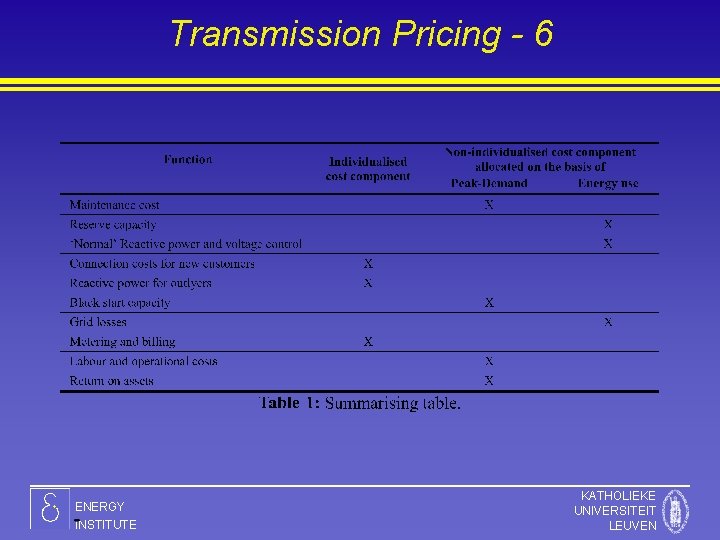
Transmission Pricing - 5 l The fixed component ¢ Covers £ Individualised costs Reactive power for outlyers, connection costs, metering and billing £ Non-individualised costs Allocation based on last year’s - Peak demand: grid maintenance, black start capacity, personnel and operating costs and return on investment - Energy use: reserve capacity, reactive power and voltage control and grid losses Avoid cross-subsidies ENERGY INSTITUTE KATHOLIEKE UNIVERSITEIT LEUVEN
Transmission Pricing - 6 ENERGY INSTITUTE KATHOLIEKE UNIVERSITEIT LEUVEN
Transmission Pricing - 7 l Incentives for optimal grid use and siting ¢ A grid quality charge (GQC) £ Based on typical and critical load flows of previous year £ Nodes are evaluated w. r. t. Congestion, loss, stability and reliability problems Nodes causing extra problems get a surplus charge Nodes relieving problems get a negative charge £ Overall the net revenue from the GQC for the system operator is zero Avoid incentives to create congestion ENERGY INSTITUTE KATHOLIEKE UNIVERSITEIT LEUVEN
Transmission Pricing - 8 l Incentives for efficient grid operation and investment ¢ SO is rewarded or penalised for delivering good or bad quality (measured by overall system reliability) £ Benchmarking Compare with neighbouring countries £ Investing improves quality of the service Avoid over-investment Make the SO the residual claimant for a share of grid investment ENERGY INSTITUTE KATHOLIEKE UNIVERSITEIT LEUVEN
- Slides: 29