
Price elasticity of demand Demand elasticity is measured


![[ii]. Infinite Elasticity Price S 1 [i]. Zero Elasticity S 2 p 1 Price](https://slidetodoc.com/presentation_image_h2/f222afa6b6c31b9d0074c926979db921/image-31.jpg "[ii]. Infinite Elasticity Price S 1 [i]. Zero Elasticity S 2 p 1 Price")
- Slides: 40
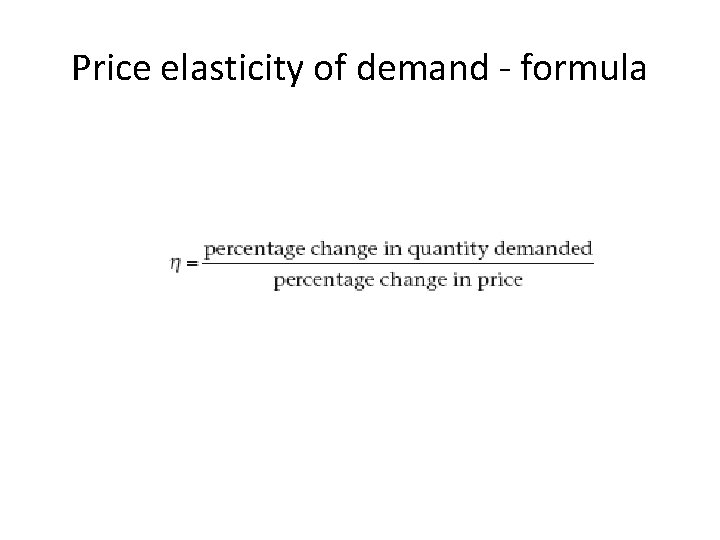
Price elasticity of demand • Demand elasticity is measured by a ratio: the percentage change in quantity demanded divided by the percentage change in price that brought it about. • For normal, negatively sloped demand curves, elasticity is negative, but the relative size of two elasticities is usually assessed by comparing their absolute values.
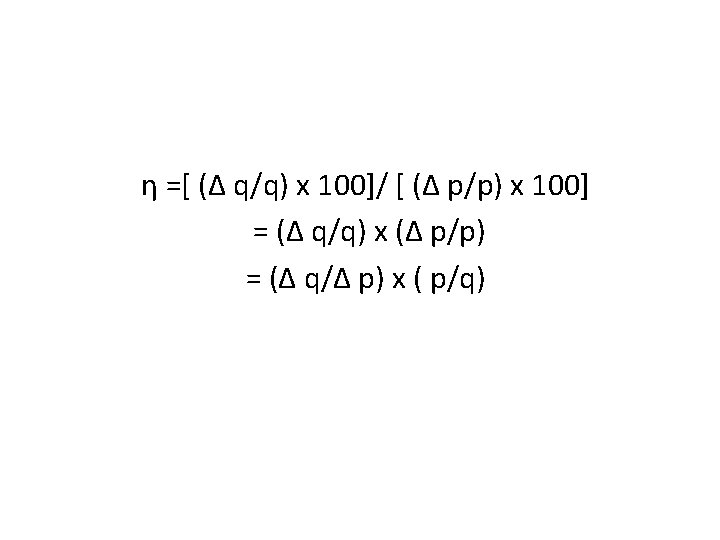
Price elasticity of demand - formula
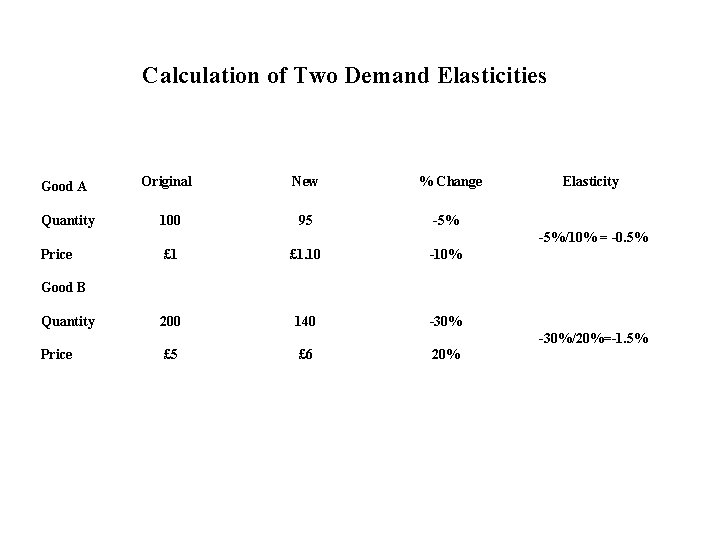
Calculation of Two Demand Elasticities Good A Original New Quantity 100 95 % Change Elasticity -5%/10% = -0. 5% Price £ 1. 10 -10% 200 140 -30% Good B Quantity -30%/20%=-1. 5% Price £ 5 £ 6 20%
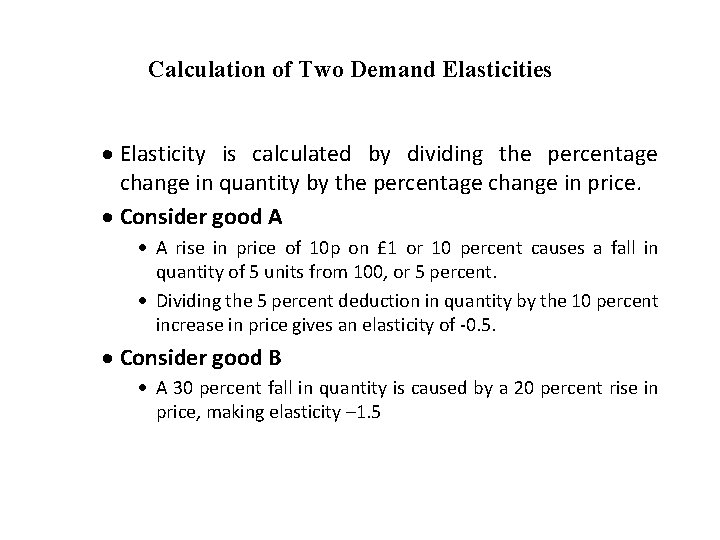
Calculation of Two Demand Elasticities · Elasticity is calculated by dividing the percentage change in quantity by the percentage change in price. · Consider good A · A rise in price of 10 p on £ 1 or 10 percent causes a fall in quantity of 5 units from 100, or 5 percent. · Dividing the 5 percent deduction in quantity by the 10 percent increase in price gives an elasticity of -0. 5. · Consider good B · A 30 percent fall in quantity is caused by a 20 percent rise in price, making elasticity – 1. 5
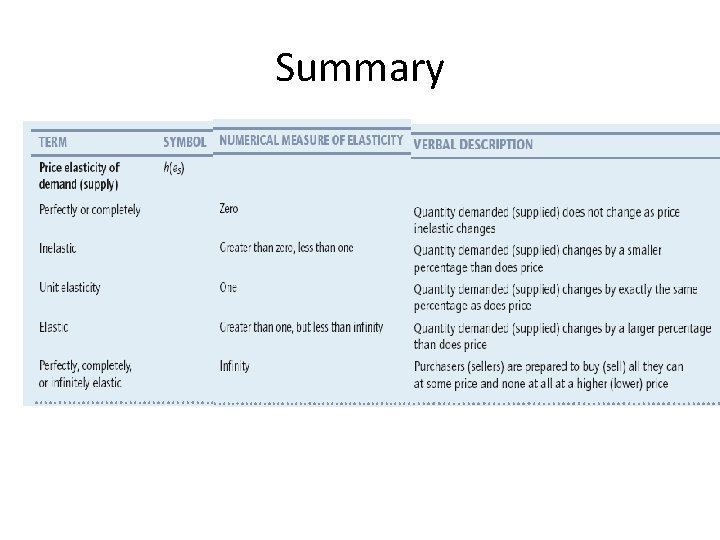
Interpreting price elasticity • The value of price elasticity of demand ranges from zero to minus infinity. • In this section, however, we concentrate on absolute values, and so ask by how much the absolute value exceeds zero. • Elasticity is zero if quantity demanded is unchanged when price changes, namely when quantity demanded does not respond to a price change.
• As long as there is some positive response of quantity demanded to a change in price, the absolute value of elasticity will exceed zero. The greater the response, the larger the elasticity. • Demand is said to be ‘elastic’
• Whenever this value is less than one, however, the percentage change in quantity is less than the percentage change in price and demand is said to be inelastic.
• When elasticity is equal to one, the two percentage changes are then equal to each other. • This is called unit elasticity.
Summary
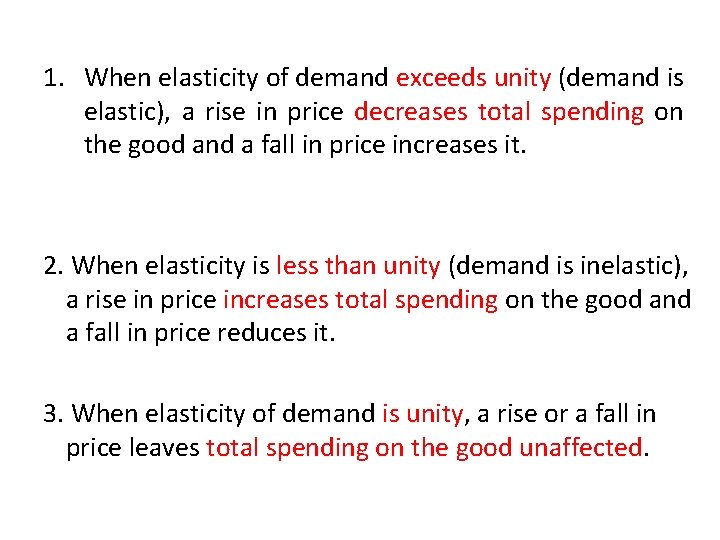
1. When elasticity of demand exceeds unity (demand is elastic), a rise in price decreases total spending on the good and a fall in price increases it. 2. When elasticity is less than unity (demand is inelastic), a rise in price increases total spending on the good and a fall in price reduces it. 3. When elasticity of demand is unity, a rise or a fall in price leaves total spending on the good unaffected.
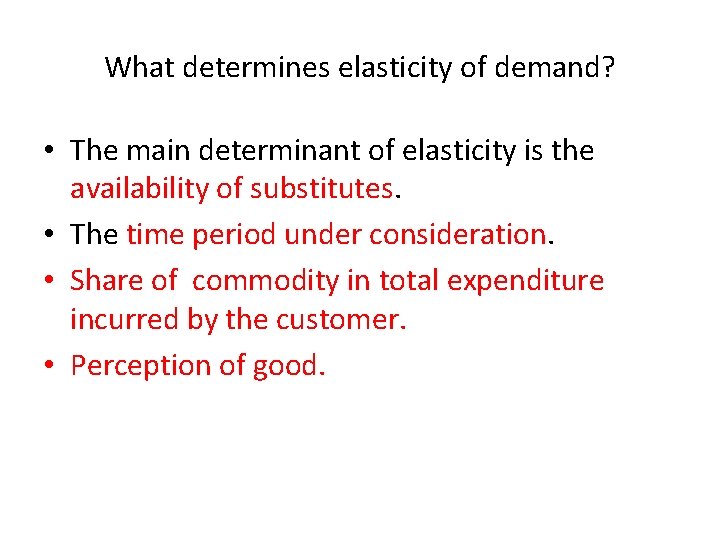
What determines elasticity of demand? • The main determinant of elasticity is the availability of substitutes. • The time period under consideration. • Share of commodity in total expenditure incurred by the customer. • Perception of good.
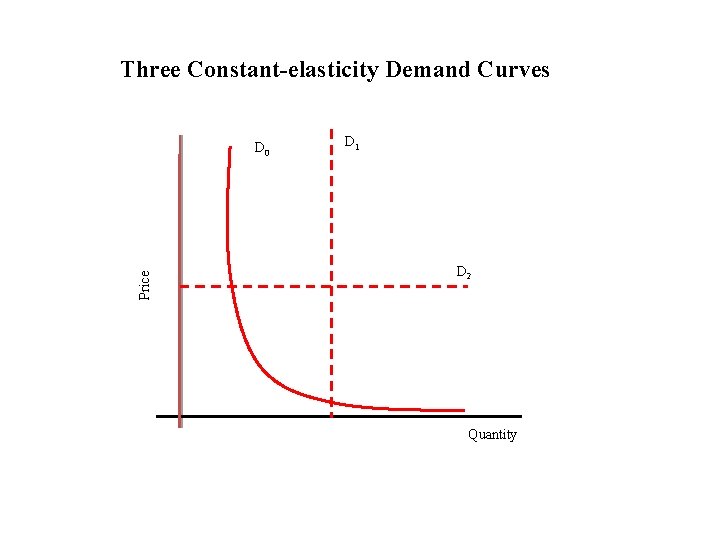
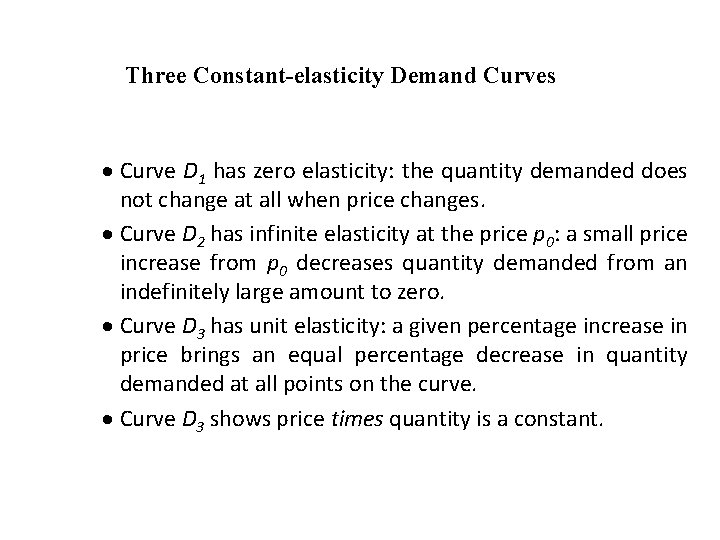
Three Constant-elasticity Demand Curves Price D 0 D 1 D 2 Quantity
Three Constant-elasticity Demand Curves · Curve D 1 has zero elasticity: the quantity demanded does not change at all when price changes. · Curve D 2 has infinite elasticity at the price p 0: a small price increase from p 0 decreases quantity demanded from an indefinitely large amount to zero. · Curve D 3 has unit elasticity: a given percentage increase in price brings an equal percentage decrease in quantity demanded at all points on the curve. · Curve D 3 shows price times quantity is a constant.
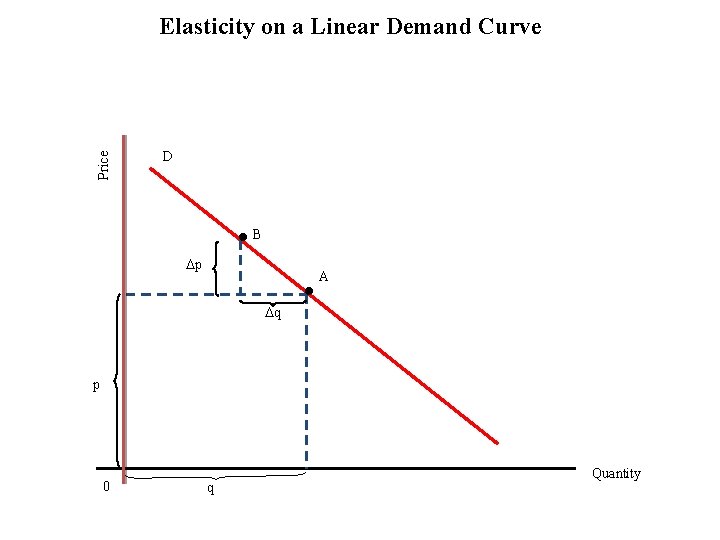
Price Elasticity on a Linear Demand Curve D B p A q p 0 q Quantity
Elasticity on a Linear Demand Curve · Starting at point A and moving to point B, the ratio p/ q is the slope of the line. · Its reciprocal q/ p is the first term in the percentage definition of elasticity. · The second term in the definition is p/q, which is the ratio of the coordinates of point A. · Since the slope p/ q is constant, it is clear that the elasticity along the curve varies with the ratio p/q. · This ratio is zero where the curve intersects the quantity axis and ‘infinity’ where it intersects the price axis.
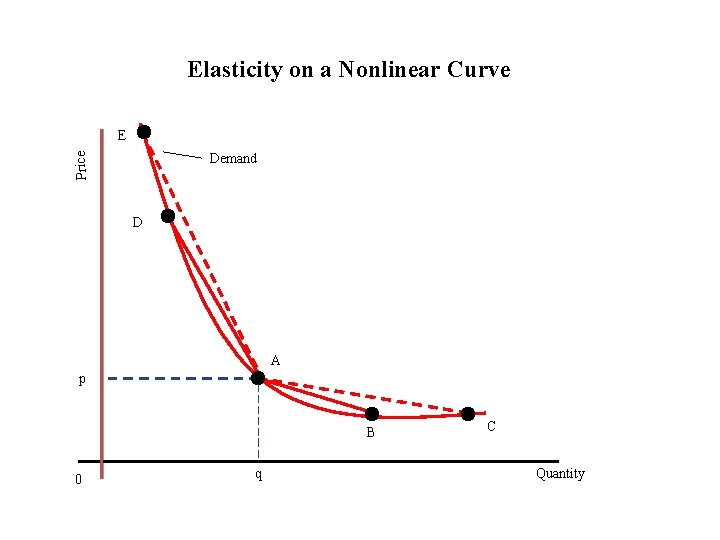
Elasticity on a Nonlinear Curve E Price Demand D A p B 0 q C Quantity
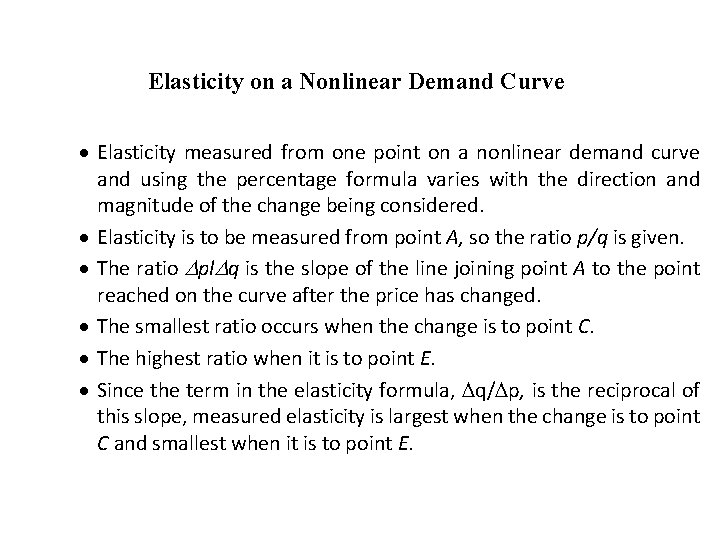
Elasticity on a Nonlinear Demand Curve · Elasticity measured from one point on a nonlinear demand curve and using the percentage formula varies with the direction and magnitude of the change being considered. · Elasticity is to be measured from point A, so the ratio p/q is given. · The ratio pl q is the slope of the line joining point A to the point reached on the curve after the price has changed. · The smallest ratio occurs when the change is to point C. · The highest ratio when it is to point E. · Since the term in the elasticity formula, q/ p, is the reciprocal of this slope, measured elasticity is largest when the change is to point C and smallest when it is to point E.
Elasticity by the Exact Method Price D a p q b” b’ Quantity 0
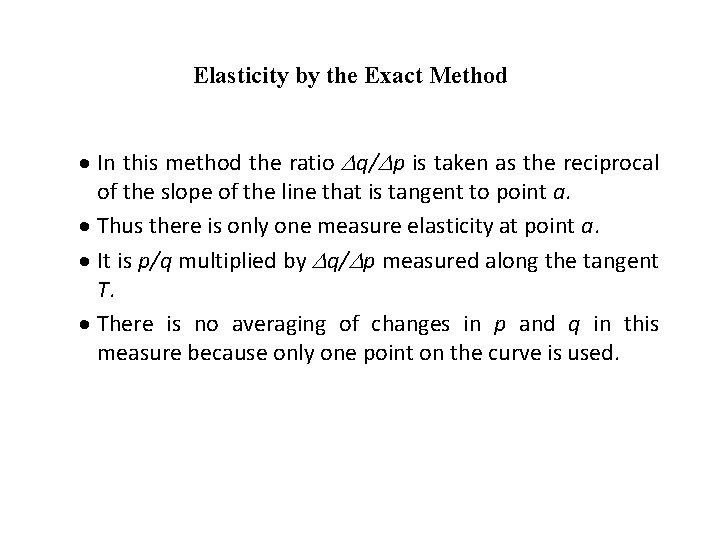
Elasticity by the Exact Method · In this method the ratio q/ p is taken as the reciprocal of the slope of the line that is tangent to point a. · Thus there is only one measure elasticity at point a. · It is p/q multiplied by q/ p measured along the tangent T. · There is no averaging of changes in p and q in this measure because only one point on the curve is used.
Short-run and Long-run Demand Curves E 2 p 2 E’ 2 E 1 E’ 1 Price p 1 E 0 p 0 Dl Ds 2 q’ 2 q 1 Ds 1 q’ 1 q 0 Dso Quantity
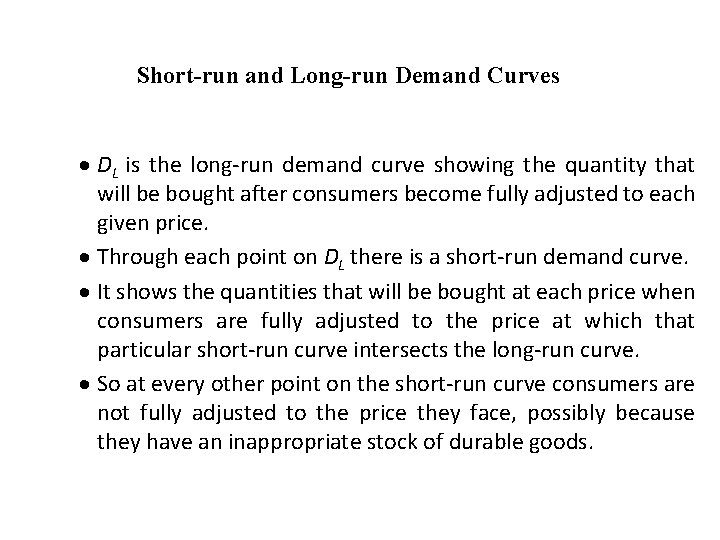
Short-run and Long-run Demand Curves · DL is the long-run demand curve showing the quantity that will be bought after consumers become fully adjusted to each given price. · Through each point on DL there is a short-run demand curve. · It shows the quantities that will be bought at each price when consumers are fully adjusted to the price at which that particular short-run curve intersects the long-run curve. · So at every other point on the short-run curve consumers are not fully adjusted to the price they face, possibly because they have an inappropriate stock of durable goods.
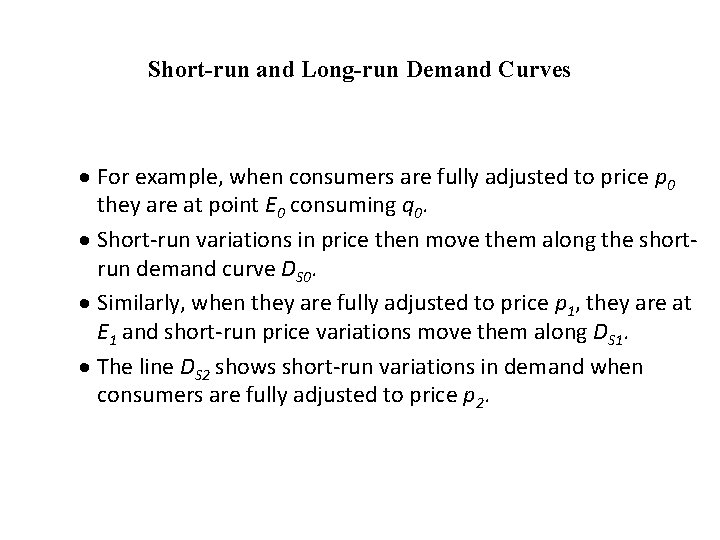
Short-run and Long-run Demand Curves · For example, when consumers are fully adjusted to price p 0 they are at point E 0 consuming q 0. · Short-run variations in price then move them along the shortrun demand curve DS 0. · Similarly, when they are fully adjusted to price p 1, they are at E 1 and short-run price variations move them along DS 1. · The line DS 2 shows short-run variations in demand when consumers are fully adjusted to price p 2.
Quantity The Relation Between Quantity Demanded and Income 0 Income
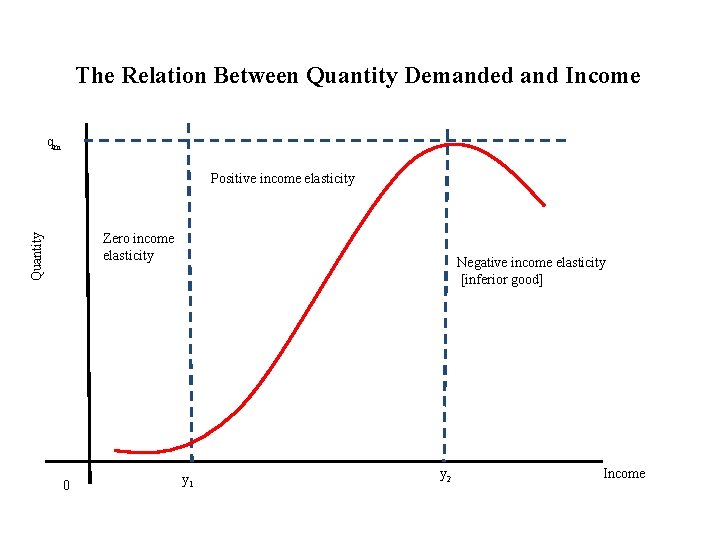
The Relation Between Quantity Demanded and Income qm Quantity Zero income elasticity 0 y 1 Income y 2
The Relation Between Quantity Demanded and Income qm Positive income elasticity Quantity Zero income elasticity 0 y 1 Income y 2
The Relation Between Quantity Demanded and Income qm Positive income elasticity Quantity Zero income elasticity 0 Negative income elasticity [inferior good] y 1 y 2 Income
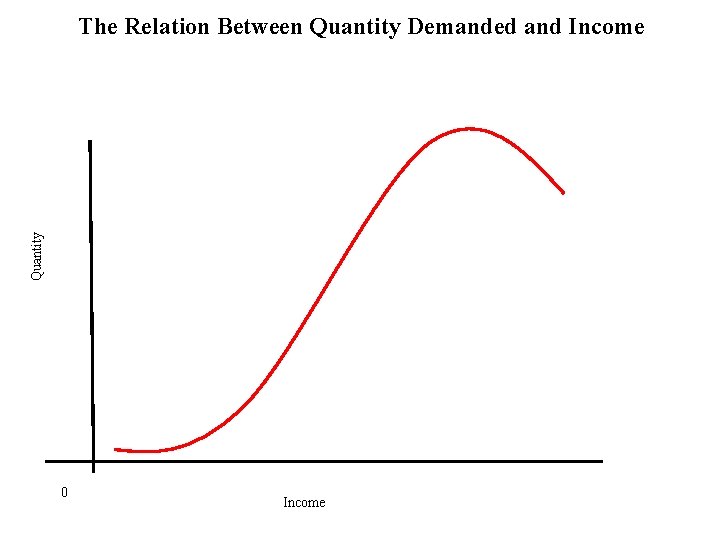
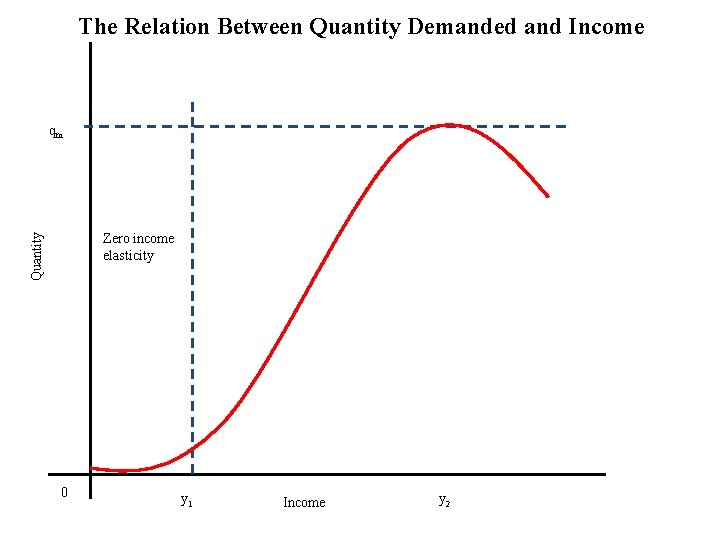
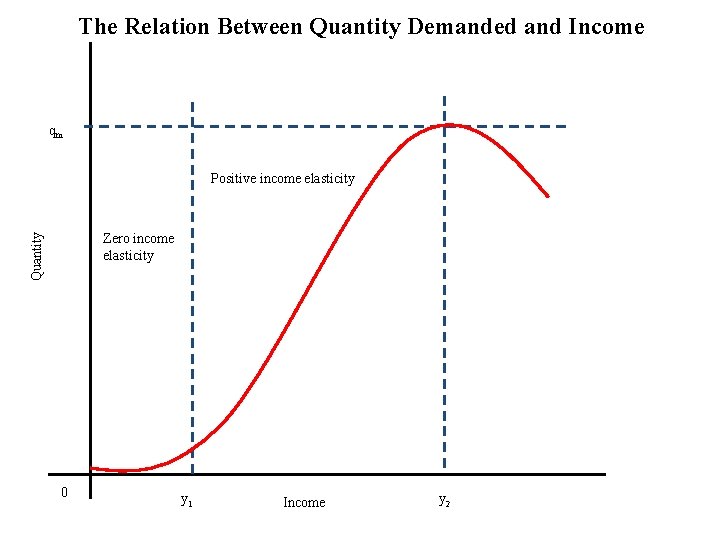
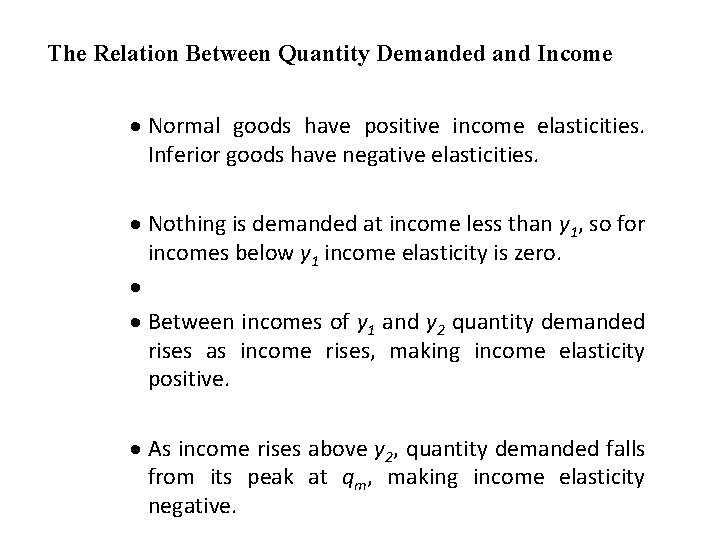
The Relation Between Quantity Demanded and Income · Normal goods have positive income elasticities. Inferior goods have negative elasticities. · Nothing is demanded at income less than y 1, so for incomes below y 1 income elasticity is zero. · · Between incomes of y 1 and y 2 quantity demanded rises as income rises, making income elasticity positive. · As income rises above y 2, quantity demanded falls from its peak at qm, making income elasticity negative.
Supply elasticity • We have seen that elasticity of demand measures the response of quantity demanded to changes in any of the variables that affect it. • Similarly, elasticity of supply measures the response of quantity supplied to changes in any of the variables that influence it.
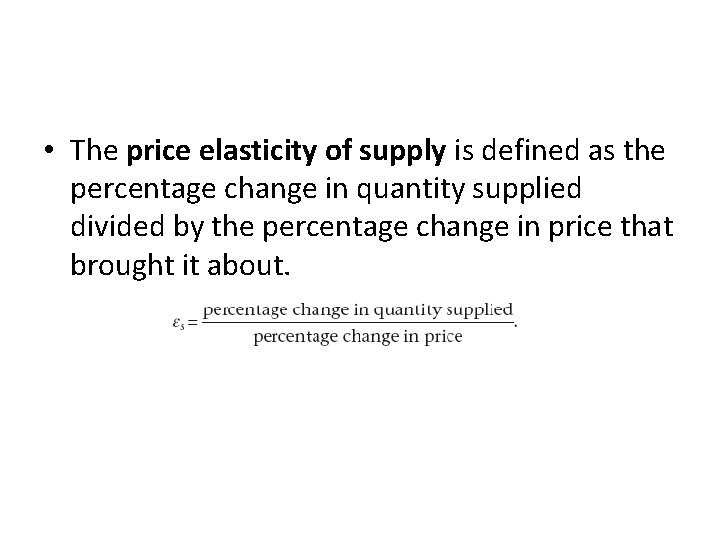
• The price elasticity of supply is defined as the percentage change in quantity supplied divided by the percentage change in price that brought it about.
[ii]. Infinite Elasticity Price S 1 [i]. Zero Elasticity S 2 p 1 Price Three Constant-elasticity Supply Curves q 1 Quantity S 3 Quantity p q [iii]. Unit Elasticity p Quantity
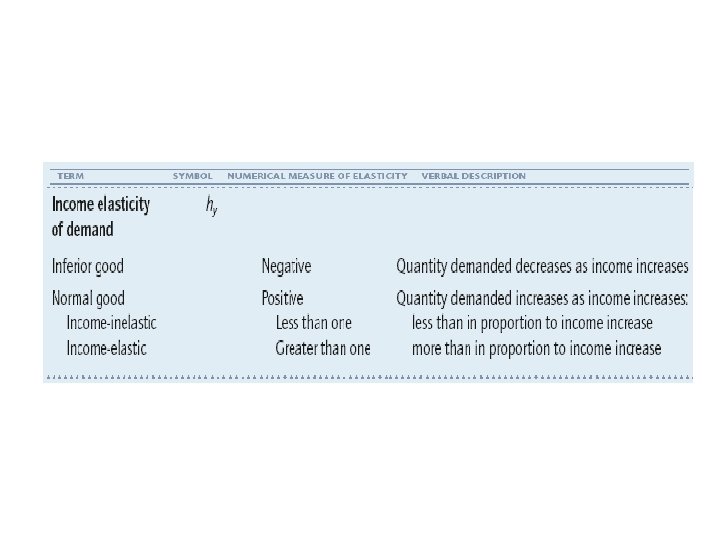
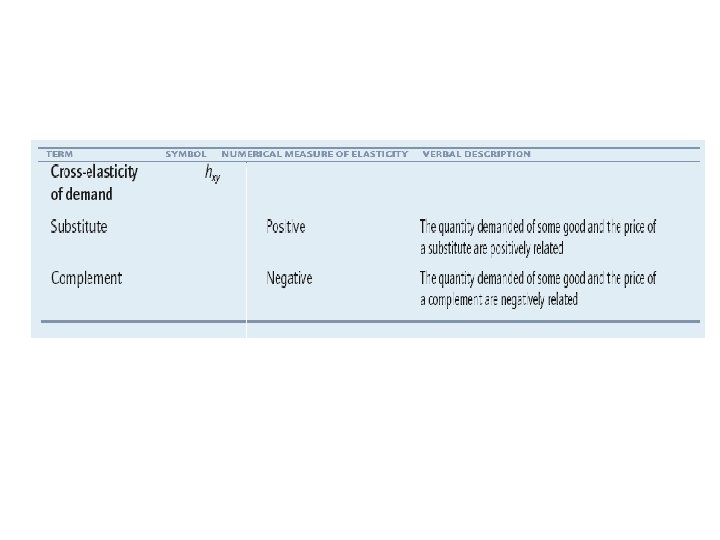
Other demand elasticities • The concept of demand elasticity can be broadened to measure the response to changes in any of the variables that influence demand. – Income elasticity of demand – Cross elasticity of demand
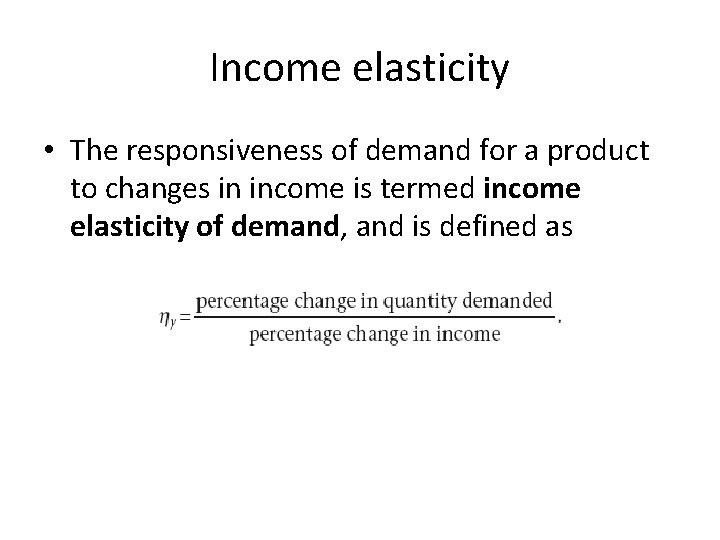
Income elasticity • The responsiveness of demand for a product to changes in income is termed income elasticity of demand, and is defined as
• If the resulting percentage change in quantity demanded is larger than the percentage increase in income, hy will exceed unity. • The product’s demand is then said to be incomeelastic. If the percentage change in quantity demanded is smaller than the percentage change in income, hy will be less than unity. • The product’s demand is then said to be incomeinelastic.
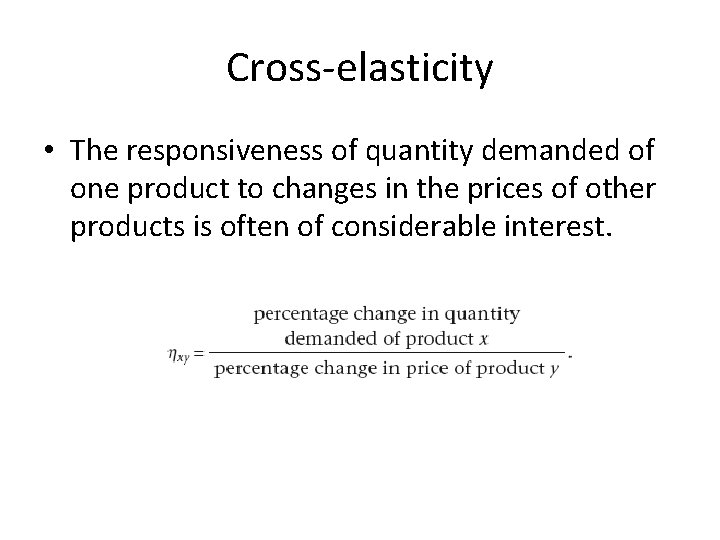
Cross-elasticity • The responsiveness of quantity demanded of one product to changes in the prices of other products is often of considerable interest.
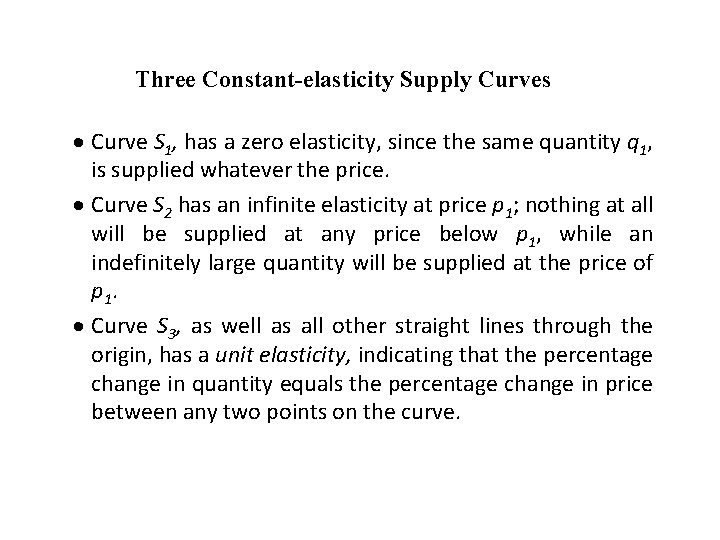
Three Constant-elasticity Supply Curves · Curve S 1, has a zero elasticity, since the same quantity q 1, is supplied whatever the price. · Curve S 2 has an infinite elasticity at price p 1; nothing at all will be supplied at any price below p 1, while an indefinitely large quantity will be supplied at the price of p 1. · Curve S 3, as well as all other straight lines through the origin, has a unit elasticity, indicating that the percentage change in quantity equals the percentage change in price between any two points on the curve.
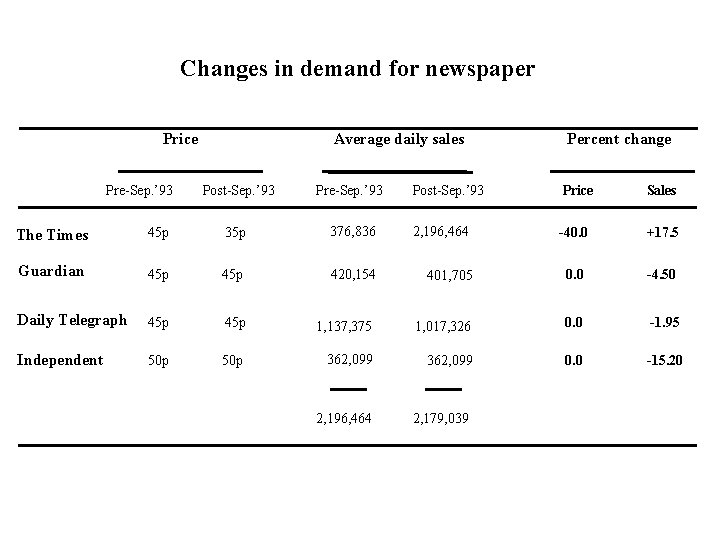
Changes in demand for newspaper Price Pre-Sep. ’ 93 Average daily sales Post-Sep. ’ 93 Pre-Sep. ’ 93 Percent change Post-Sep. ’ 93 Price Sales -40. 0 +17. 5 The Times 45 p 376, 836 2, 196, 464 Guardian 45 p 420, 154 401, 705 0. 0 -4. 50 Daily Telegraph 45 p 1, 137, 375 1, 017, 326 0. 0 -1. 95 Independent 50 p 362, 099 0. 0 -15. 20 2, 196, 464 2, 179, 039
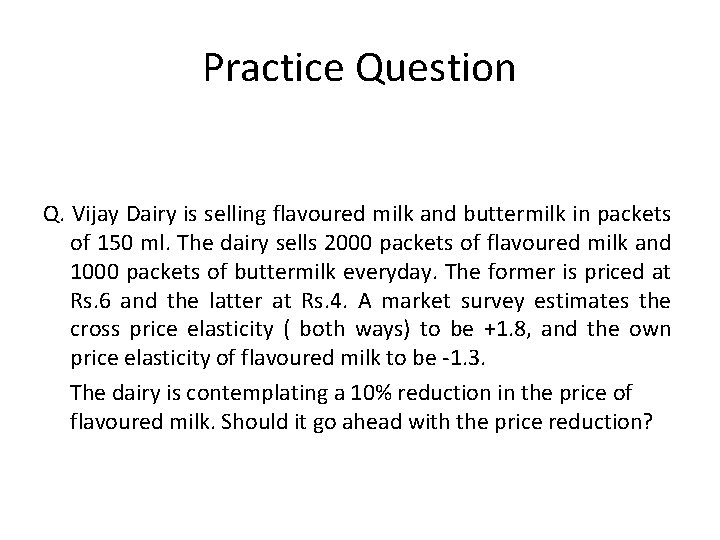
Practice Question Q. Vijay Dairy is selling flavoured milk and buttermilk in packets of 150 ml. The dairy sells 2000 packets of flavoured milk and 1000 packets of buttermilk everyday. The former is priced at Rs. 6 and the latter at Rs. 4. A market survey estimates the cross price elasticity ( both ways) to be +1. 8, and the own price elasticity of flavoured milk to be -1. 3. The dairy is contemplating a 10% reduction in the price of flavoured milk. Should it go ahead with the price reduction?