
PRICE COLLECTION IN UNSTABLE MARKET CONDITIONS Miroslav Jankovic
PRICE COLLECTION IN UNSTABLE MARKET CONDITIONS Miroslav Jankovic (Statistical Office of Serbia and Montenegro) Dragi Stojiljkovic Tatjana Stanojevic-Miladinovic (Statistical Office of the Republic of Serbia) Joint UNECE/ILO Meeting on Consumer Price Indices Geneva, 10 -12 May 2006
INTRODUCTION n National level: Serbia and Montenegro (Statistical Office of Serbia and Montenegro) n Republican level: Serbia (Statistical Office of the Republic of Serbia) Montenegro (Statistical Office of the Republic of Montenegro – MONSTAT) n Lower levels: Central Serbia, Vojvodina, Belgrade
INTRODUCTION Retail price indices in Serbia and Montenegro: n 1954 (data produced and published) n 1962 (methodology published) n Methods are the same for all levels n In accordance with international standards
INTRODUCTION The case of retail price indices in the Republic of Serbia: n Chronology of market conditions (19902005) n Price collection n Calculation n Further development
UNSTABLE MARKET CONDITIONS In the period 1990 – 2005 market conditions in Serbia were frequently changed n The price statisticians had to react in the quickest possible way n
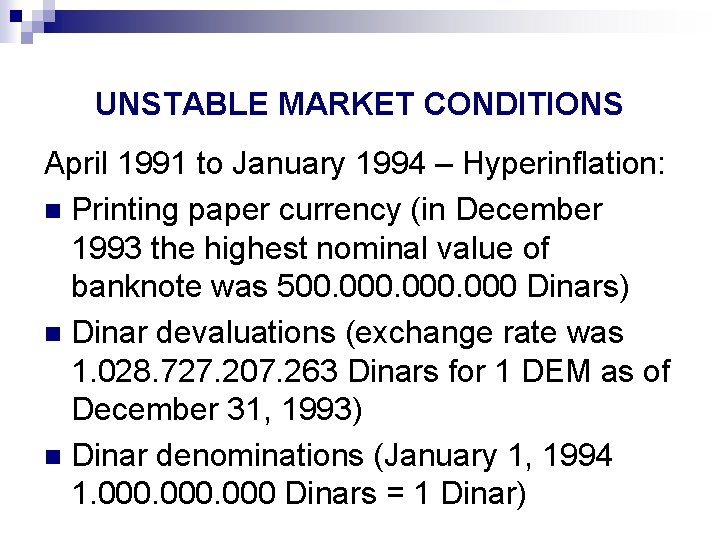
UNSTABLE MARKET CONDITIONS April 1991 to January 1994 – Hyperinflation: n Printing paper currency (in December 1993 the highest nominal value of banknote was 500. 000 Dinars) n Dinar devaluations (exchange rate was 1. 028. 727. 207. 263 Dinars for 1 DEM as of December 31, 1993) n Dinar denominations (January 1, 1994 1. 000 Dinars = 1 Dinar)
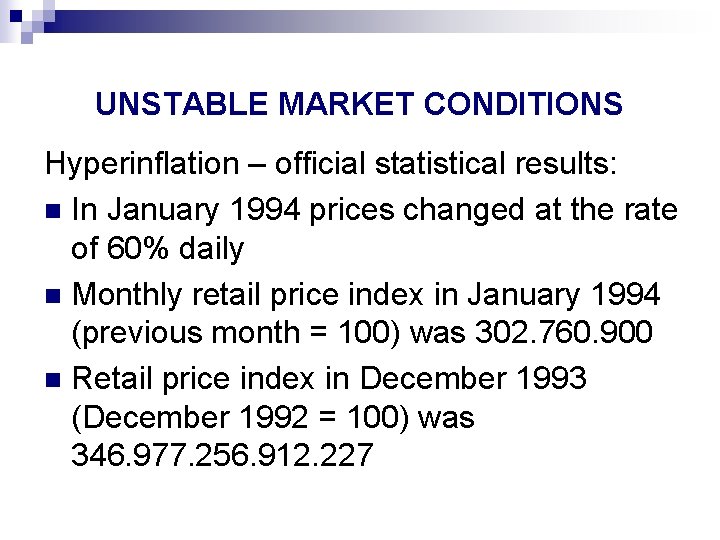
UNSTABLE MARKET CONDITIONS Hyperinflation – official statistical results: n In January 1994 prices changed at the rate of 60% daily n Monthly retail price index in January 1994 (previous month = 100) was 302. 760. 900 n Retail price index in December 1993 (December 1992 = 100) was 346. 977. 256. 912. 227
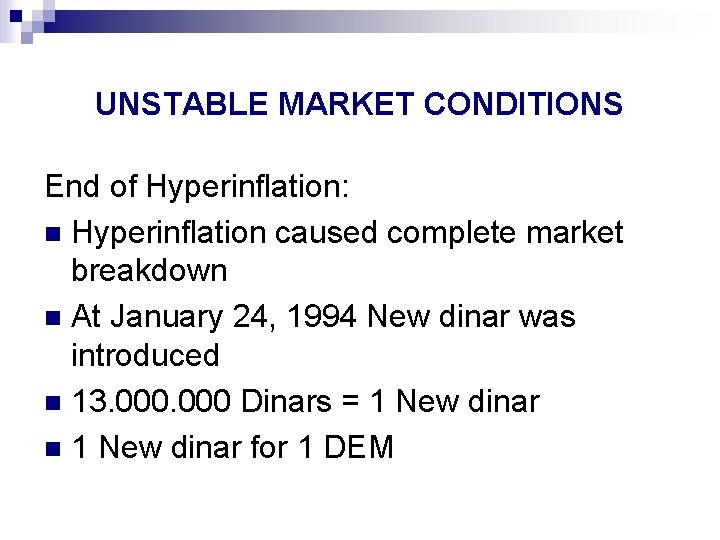
UNSTABLE MARKET CONDITIONS End of Hyperinflation: n Hyperinflation caused complete market breakdown n At January 24, 1994 New dinar was introduced n 13. 000 Dinars = 1 New dinar n 1 New dinar for 1 DEM
UNSTABLE MARKET CONDITIONS 1995 to 2000: n Breakdown of the huge trade systems n Large number of small shops (with limited and changeable goods assortment) appeared n Significant share of turnover was relocated into underground and illegal economy n Bigger sample needed to ensure reliable price indices
UNSTABLE MARKET CONDITIONS 2001 to 2005: n Foreign investments and privatization n The chains of big supermarkets were established in main towns n Small shops almost completely diminished n Problem of missing prices and quality harmonization
BASIC ELEMENTS National retail price indices: n Retail price index - used as national inflation measure and deflator of output and assets value n Consumer price index (Cost of living index) - used for salaries (wages), pensions and other social benefits revaluation
BASIC ELEMENTS Coverage: Prices collected in 15 towns in Serbia n List of products: about 500 products (definitions detailed enough and general enough) n Classifications: national classifications of goods and services by origin and purpose (different from COICOP) n
BASIC ELEMENTS Weights: n Structure of retail turnover of goods and services (for retail price index) n Structure of household consumption (for consumer price index)
PRICE COLLECTION Main principles: n Products being bought most often and price dynamics is representative for the whole group of products n Shops that reflect consumers’ habits n Price collectors are full-time employees in regional offices
PRICE COLLECTION Selection of shops – recording places (with the highest turnover, where prices represent the average of prices in town) n Selection of products (most sold, present for a longer period of time) n Substitution of shops and products (closing of a shop, deficit of a product) n
PRICE COLLECTION Time/period of prices recording: n Manufactured non-food goods (from 3 rd to 10 th each month) n Manufactured food goods (from 11 th to 12 th) n Services (from 16 th to 18 th) n Agricultural goods (in the first and the third week of each month)
PRICE COLLECTION Documentation of prices recording n Prices recording procedures (auxiliary papers, data base, sending to Price department) n Validation and control of recorded prices n
DATA PROCESSING Average prices: n Average monthly prices (for a town, territory, the Republic of Serbia) n Average annual prices (simple arithmetic mean of average monthly prices except for seasonal agricultural goods)
DATA PROCESSING Indices calculation: n Individual indices (for products) n Aggregated indices (for groups and total) n Annual indices
DISSEMINATION Following indices are published: n Current month in relation to: average of previous year, previous month, same month of the previous year and December of the previous year n Period from the beginning of the year in relation to: average of previous year and same period of the previous year
OTHER METHODOLOGICAL ISSUES Treatment of seasonal products n Adjusting of price changes to quality changes: - minor change of a product - significant change - when price change is not harmonized with quality change n
FURTHER DEVELOPMENT Analysis and updating of the product list n Introducing COICOP classification n Computing seasonal products prices n Analysis of various formula effects n Excluding the influence of quality change on price change n Introducing hand held computers in data collecting n
CONCLUSION Quality of retail price indices is the priority task of official statistics n Data collection improved by creating new instruction for price recording and intensifying the training of price collectors n General intention to produce and publish new CPI in accordance with EU standards and COICOP classification starting from January 2007 n
PRICE COLLECTION IN UNSTABLE MARKET CONDITIONS Miroslav Jankovic (Statistical Office of Serbia and Montenegro) Dragi Stojiljkovic Tatjana Stanojevic-Miladinovic (Statistical Office of the Republic of Serbia) Joint UNECE/ILO Meeting on Consumer Price Indices Geneva, 10 -12 May 2006
- Slides: 24