
PRF By The Numbers 2018 The Progeria Research
PRF By The Numbers © 2018 The Progeria Research Foundation. All Rights Reserved. Produced by Leslie B. Gordon, MD, Ph. D; Medical Director Please Do Not Reproduce Children’s Photographs Without Express Permission From PRF December, 2018
Table of Contents � Introduction and Collaborations 3 - 10 � Overview Data 11 - 19 � International Progeria Registry 20 - 23 � PRF Diagnostics Program 24 - 27 � PRF Cell & Tissue Bank 28 - 37 � PRF Medical & Research Database 38 - 42 � Weighing – In Program 43 - 46 � Clinical Trials 47 - 55 � PRF Grants Program 56 - 61 � Scientific Meetings and Workshops 62 - 65 � Publications 66 - 67 © 2018 The Progeria Research Foundation. All Rights Reserved.
PRF By The Numbers: A Data Sharing Tool Ø PRF By The Numbers is a data sharing tool originating from The Progeria Research Foundation’s programs and services. Ø We translate information collected within our programs and services, and develop charts and graphs which track our progress from year to year. Ø This allows you to assess where we’ve been, and the improvements we’ve made for children with Progeria. © 2018 The Progeria Research Foundation. All Rights Reserved.
Why Sharing Data Is Essential Ø According to the National Institutes of Health: “data sharing is essential for expedited translation of research results into knowledge, products, and procedures to improve human health. ” http: //grants. nih. gov/grants/guide/notice-files/NOT-OD-03 -032. html Ø In other words, everyone benefits by knowing and learning as much as possible about Progeria - the scientific and medical communities, the public, and the children. © 2018 The Progeria Research Foundation. All Rights Reserved.
PRF By The Numbers…Here’s How It Works Ø We take raw data collected through our programs and services, remove any personal information to protect the participant, and present it to you in a format that is engaging and informative. Ø PRF programs and services include: The PRF International Registry The PRF Diagnostics Program The PRF Cell & Tissue Bank The PRF Medical & Research Database PRF Research Grants Scientific Workshops Clinical Trial Funding and Participation © 2018 The Progeria Research Foundation. All Rights Reserved.
Our Target Audience Ø PRF By The Numbers is intended for a broad array of users Families and children with Progeria The general public and nonscientists of all ages Scientists Physicians The media Ø This means that different types of slides will be of interest depending on who is looking at the information. We have designed this slide set so that you can pull out what is most important to you. Ø We love suggestions - if you don’t see some facts and figures here that you think would be informative, please let us know at info@progeriaresearch. org © 2018 The Progeria Research Foundation. All Rights Reserved.
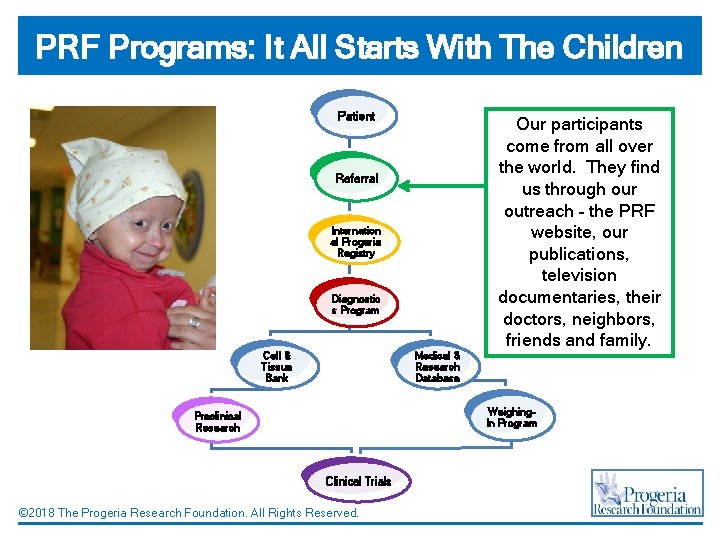
PRF Programs: It All Starts With The Children Patient Referral Internation al Progeria Registry Diagnostic s Program Medical & Research Database Cell & Tissue Bank Our participants come from all over the world. They find us through our outreach – the PRF website, our publications, television documentaries, their doctors, neighbors, friends and family. Weighing. In Program Preclinical Research Clinical Trials © 2018 The Progeria Research Foundation. All Rights Reserved.
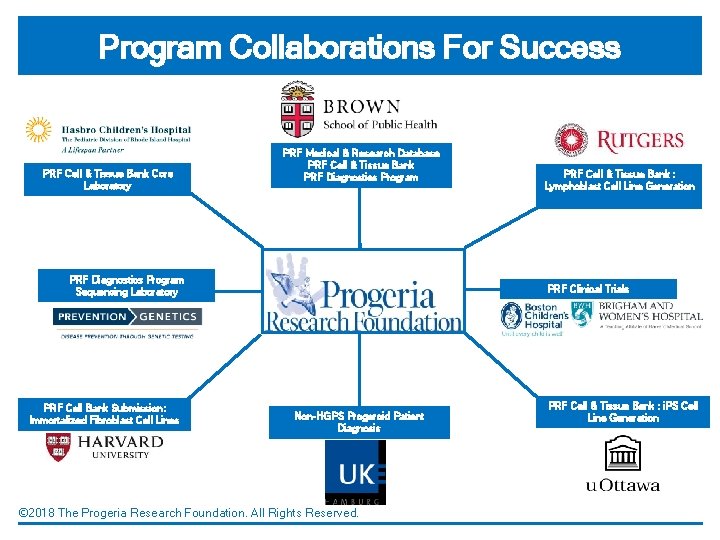
Program Collaborations For Success PRF Cell & Tissue Bank Core Laboratory PRF Medical & Research Database PRF Cell & Tissue Bank PRF Diagnostics Program Sequencing Laboratory PRF Cell Bank Submission: Immortalized Fibroblast Cell Lines PRF Cell & Tissue Bank : Lymphoblast Cell Line Generation PRF Clinical Trials Non-HGPS Progeroid Patient Diagnosis © 2018 The Progeria Research Foundation. All Rights Reserved. PRF Cell & Tissue Bank : i. PS Cell Line Generation
Our Program Collaborators Our collaborating institutions are crucial to our ability to help children with Progeria. We are extremely grateful for these ongoing partnerships: Brown University Location of The PRF Medical & Research Database Program IRB approval Hasbro Children’s Hospital Location of The PRF Cell & Tissue Bank Program IRB approval Prevention. Genetics CLIA*-approved genetic sequence testing Rutgers University Cell and DNA Repository CLIA*-approved lymphoblast generation and distribution University of Ottawa Induced Pluripotent Stem Cell (i. PSC) CLIA*-approved generation and distribution *http: //www. fda. gov/Medical. Devices/Device. Regulationand. Guidance/IVDRegulatory. Assistance/ucm 124105. html © 2018 The Progeria Research Foundation. All Rights Reserved.
Our Clinical Trial Collaborators Our collaborating institutions are crucial to our ability to help children with Progeria Harvard University – Associated Hospitals: Boston Children’s Hospital Brigham and Women’s Hospital Dana Farber Cancer Institute NIH – funded Clinical and Translational Study Unit at Boston Children’s Hospital © 2018 The Progeria Research Foundation. All Rights Reserved.
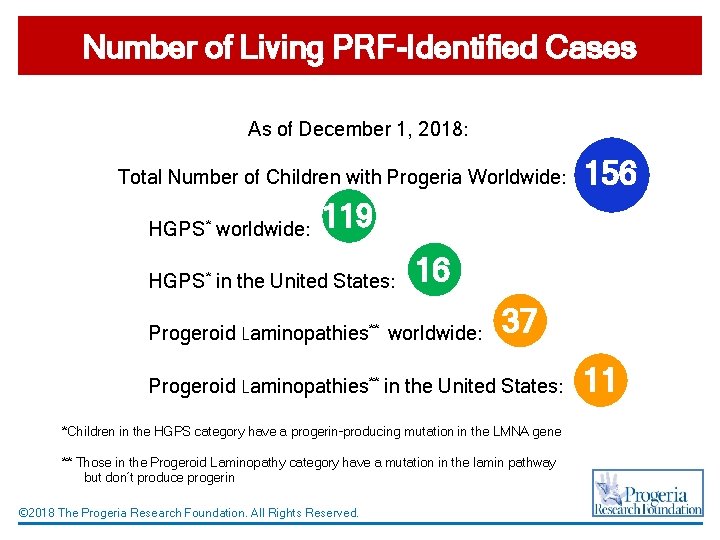
Number of Living PRF-Identified Cases As of December 1, 2018: Total Number of Children with Progeria Worldwide: HGPS* worldwide: 156 119 HGPS* in the United States: 16 Progeroid Laminopathies** worldwide: 37 Progeroid Laminopathies** in the United States: *Children in the HGPS category have a progerin-producing mutation in the LMNA gene ** Those in the Progeroid Laminopathy category have a mutation in the lamin pathway but don’t produce progerin © 2018 The Progeria Research Foundation. All Rights Reserved. 11
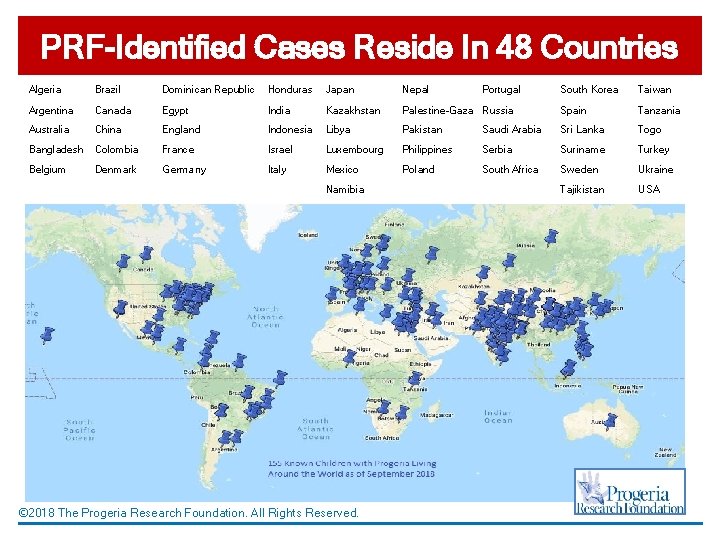
PRF-Identified Cases Reside In 48 Countries Algeria Brazil Dominican Republic Honduras Japan Nepal Argentina Canada Egypt India Kazakhstan Australia China England Indonesia Bangladesh Colombia France Belgium Germany Denmark Portugal South Korea Taiwan Palestine-Gaza Russia Spain Tanzania Libya Pakistan Saudi Arabia Sri Lanka Togo Israel Luxembourg Philippines Serbia Suriname Turkey Italy Mexico Poland South Africa Sweden Ukraine Tajikistan USA Namibia Children Living Around the World with Progeria As of May 1, 2018 © 2018 The Progeria Research Foundation. All Rights Reserved.
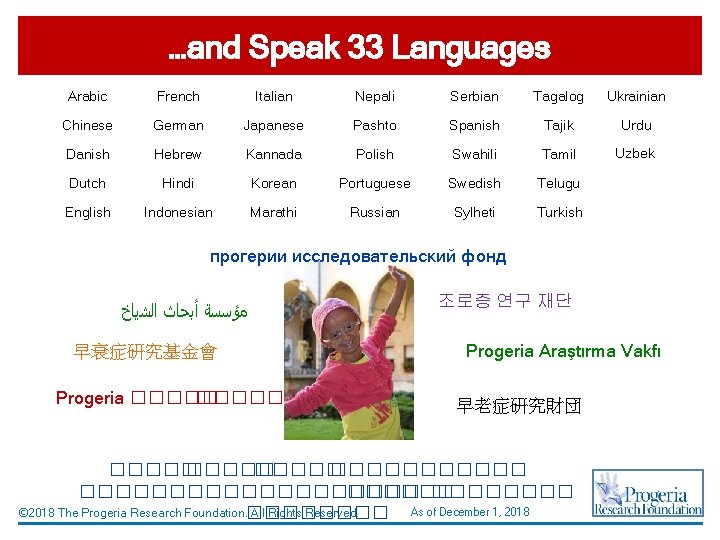
…and Speak 33 Languages Arabic French Italian Nepali Serbian Tagalog Ukrainian Chinese German Japanese Pashto Spanish Tajik Urdu Danish Hebrew Kannada Polish Swahili Tamil Uzbek Dutch Hindi Korean Portuguese Swedish Telugu English Indonesian Marathi Russian Sylheti Turkish прогерии исследовательский фонд ﻣﺆﺴﺴﺔ ﺃﺒﺤﺎﺙ ﺍﻟﺸﻴﺎﺥ 早衰症研究基金會 Progeria �������� 조로증 연구 재단 Progeria Araştırma Vakfı 早老症研究財団 ������������������� As of December 1, 2018 © 2018 The Progeria Research Foundation. ���� All Rights Reserved.
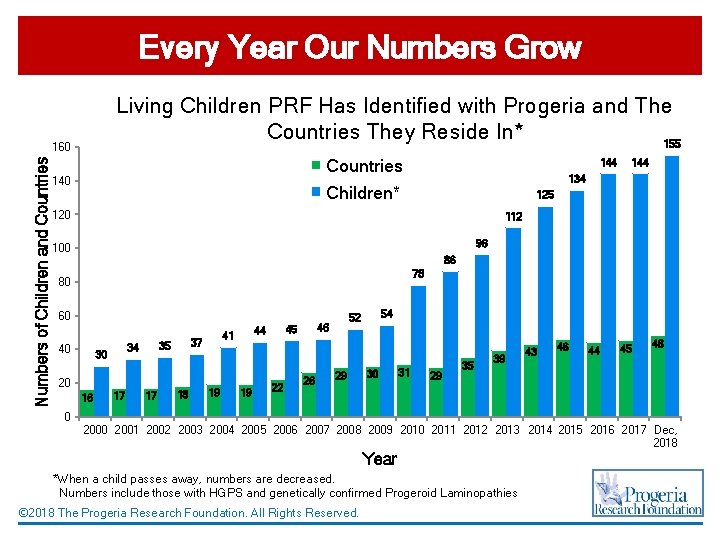
Numbers of Children and Countries Every Year Our Numbers Grow Living Children PRF Has Identified with Progeria and The Countries They Reside In* 155 160 Countries Children* 140 144 134 125 120 112 96 100 86 78 80 60 40 35 34 30 20 16 17 17 18 19 45 44 41 37 19 22 26 54 52 46 29 30 31 29 35 39 43 46 44 45 48 0 2001 2002 2003 2004 2005 2006 2007 2008 2009 2010 2011 2012 2013 2014 2015 2016 2017 Dec, 2018 Year *When a child passes away, numbers are decreased. Numbers include those with HGPS and genetically confirmed Progeroid Laminopathies © 2018 The Progeria Research Foundation. All Rights Reserved.
Tracking Children with Progeria Through Prevalence Ø How does PRF estimate how many children we are searching for, and in what countries? We use population prevalence. Ø Prevalence is the proportion of children with Progeria per total population. © 2018 The Progeria Research Foundation. All Rights Reserved.
How Prevalence Is Estimated Ø At PRF, we use a formula based on the number of children we’ve identified in the US. We then expand that out to the world population. Ø We do this because we have the most complete reporting for the US and since Progeria has no gender, ethnic, or other biases, we assume that the prevalence in the US is the same prevalence in other countries. Ø PRF estimates prevalence for years when the official US census provides a reliable population number. © 2018 The Progeria Research Foundation. All Rights Reserved.
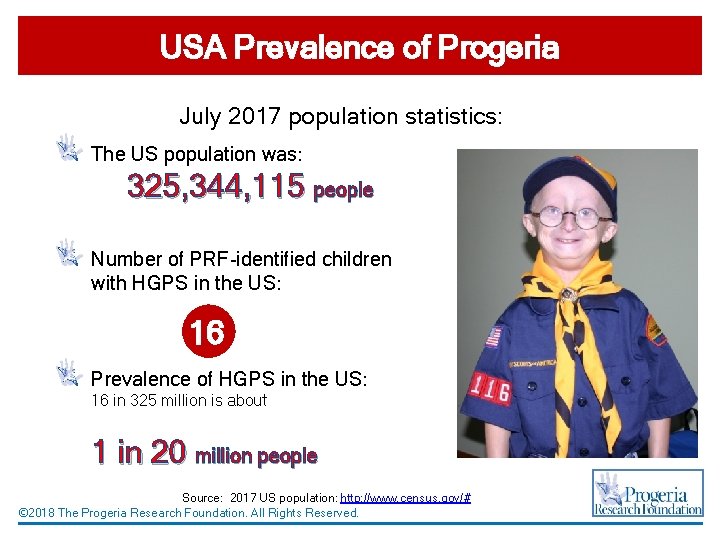
USA Prevalence of Progeria July 2017 population statistics: The US population was: 325, 344, 115 people Number of PRF-identified children with HGPS in the US: 16 Prevalence of HGPS in the US: 16 in 325 million is about 1 in 20 million people Source: 2017 US population: http: //www. census. gov/# © 2018 The Progeria Research Foundation. All Rights Reserved.
Prevalence and World Population of Progeria Given the world population as of July 2017 there are between 350 and 400 children living with Progeria worldwide. PRF strives to find every child with Progeria because in order to help every child, we must find every child © 2018 The Progeria Research Foundation. All Rights Reserved.
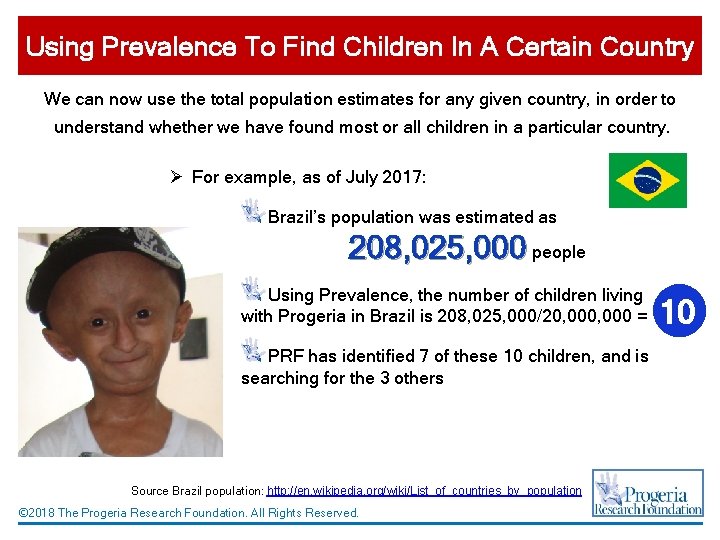
Using Prevalence To Find Children In A Certain Country We can now use the total population estimates for any given country, in order to understand whether we have found most or all children in a particular country. Ø For example, as of July 2017: Brazil’s population was estimated as 208, 025, 000 people Using Prevalence, the number of children living with Progeria in Brazil is 208, 025, 000/20, 000 = PRF has identified 7 of these 10 children, and is searching for the 3 others Source Brazil population: http: //en. wikipedia. org/wiki/List_of_countries_by_population © 2018 The Progeria Research Foundation. All Rights Reserved. 10
International Progeria Registry* Program Goals: Ø Patient identification Ø Outreach to patient families and their physicians Ø A springboard for program enrollment Registry forms available at www. progeriaresearch. org/patient_registry *PRF International Registry includes those with genetically confirmed or clinically suspected Progeria, as well as those with other possible progeroid syndromes © 2018 The Progeria Research Foundation. All Rights Reserved.
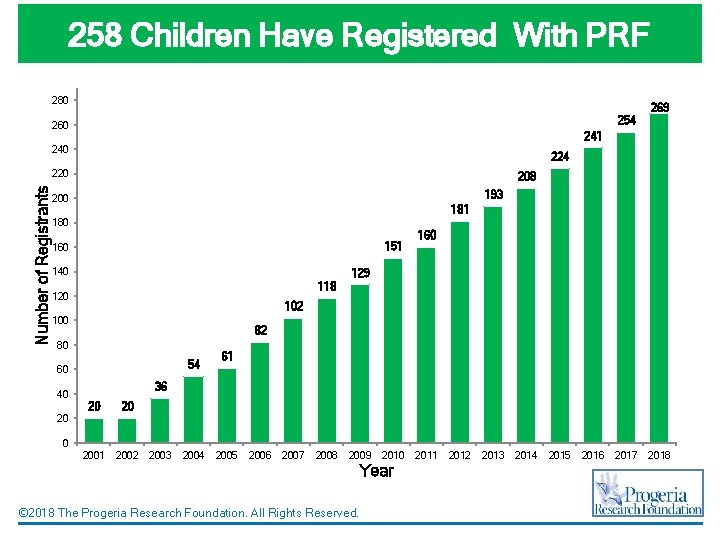
258 Children Have Registered With PRF 280 254 260 241 240 224 220 Number of Registrants 269 208 193 200 181 180 151 160 140 160 129 118 120 102 100 82 80 54 60 61 36 40 20 20 2001 2002 20 0 2003 2004 2005 2006 2007 2008 2009 2010 Year © 2018 The Progeria Research Foundation. All Rights Reserved. 2011 2012 2013 2014 2015 2016 2017 2018
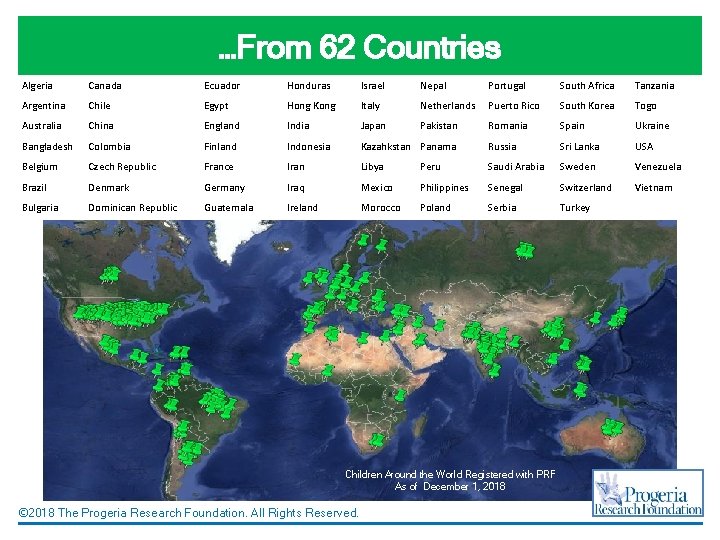
…From 62 Countries Algeria Canada Ecuador Honduras Israel Nepal Portugal South Africa Tanzania Argentina Chile Egypt Hong Kong Italy Netherlands Puerto Rico South Korea Togo Australia China England India Japan Pakistan Romania Spain Ukraine Bangladesh Colombia Finland Indonesia Kazahkstan Panama Russia Sri Lanka USA Belgium Czech Republic France Iran Libya Peru Saudi Arabia Sweden Venezuela Brazil Denmark Germany Iraq Mexico Philippines Senegal Switzerland Vietnam Bulgaria Dominican Republic Guatemala Ireland Morocco Poland Serbia Turkey Children Around the World Registered with PRF As of December 1, 2018 © 2018 The Progeria Research Foundation. All Rights Reserved.
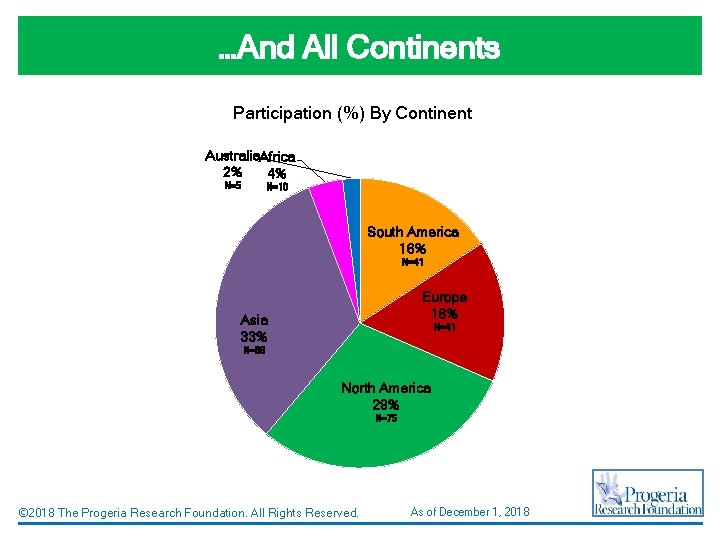
…And All Continents Participation (%) By Continent Australia. Africa 2% 4% N=5 N=10 South America 16% N=41 Europe 16% Asia 33% N=41 N=86 North America 29% N=75 © 2018 The Progeria Research Foundation. All Rights Reserved. As of December 1, 2018
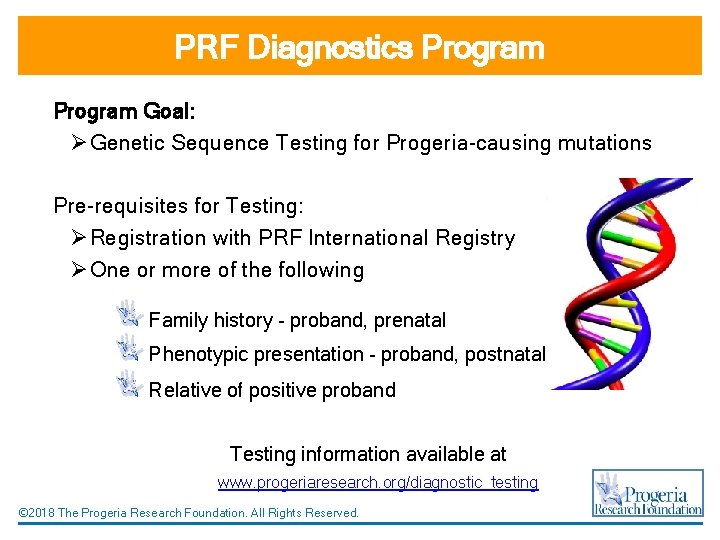
PRF Diagnostics Program Goal: Ø Genetic Sequence Testing for Progeria-causing mutations Pre-requisites for Testing: Ø Registration with PRF International Registry Ø One or more of the following Family history - proband, prenatal Phenotypic presentation - proband, postnatal Relative of positive proband Testing information available at www. progeriaresearch. org/diagnostic_testing © 2018 The Progeria Research Foundation. All Rights Reserved.
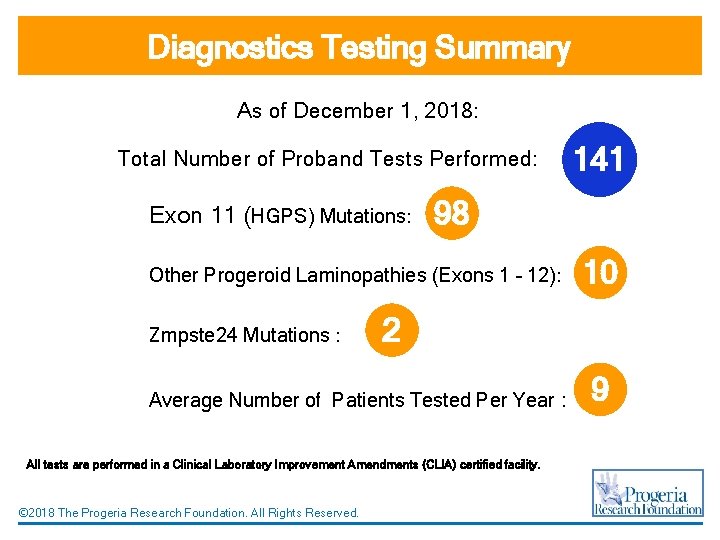
Diagnostics Testing Summary As of December 1, 2018: Total Number of Proband Tests Performed: Exon 11 (HGPS) Mutations: 98 Other Progeroid Laminopathies (Exons 1 – 12): Zmpste 24 Mutations : 10 2 Average Number of Patients Tested Per Year : All tests are performed in a Clinical Laboratory Improvement Amendments (CLIA) certified facility. © 2018 The Progeria Research Foundation. All Rights Reserved. 141 9
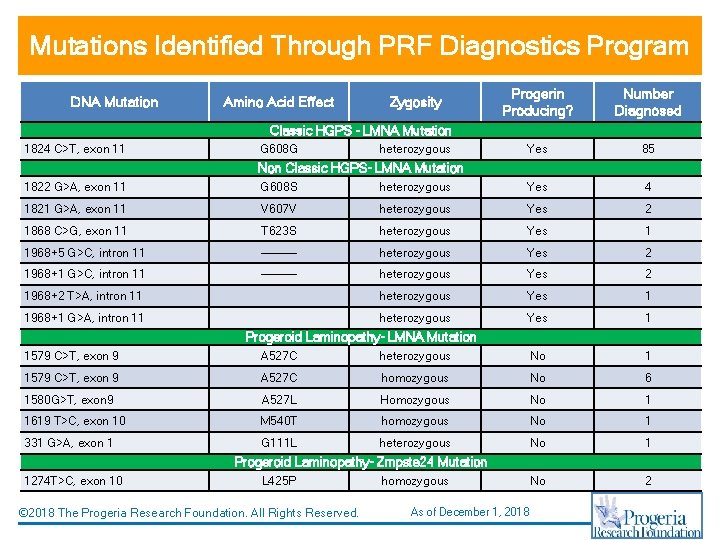
Mutations Identified Through PRF Diagnostics Program DNA Mutation Amino Acid Effect Zygosity Progerin Producing? Number Diagnosed Yes 85 Classic HGPS – LMNA Mutation 1824 C>T, exon 11 G 608 G heterozygous Non Classic HGPS– LMNA Mutation 1822 G>A, exon 11 G 608 S heterozygous Yes 4 1821 G>A, exon 11 V 607 V heterozygous Yes 2 1868 C>G, exon 11 T 623 S heterozygous Yes 1 1968+5 G>C, intron 11 ----- heterozygous Yes 2 1968+1 G>C, intron 11 ----- heterozygous Yes 2 1968+2 T>A, intron 11 heterozygous Yes 1 1968+1 G>A, intron 11 heterozygous Yes 1 Progeroid Laminopathy– LMNA Mutation 1579 C>T, exon 9 A 527 C heterozygous No 1 1579 C>T, exon 9 A 527 C homozygous No 6 1580 G>T, exon 9 A 527 L Homozygous No 1 1619 T>C, exon 10 M 540 T homozygous No 1 331 G>A, exon 1 G 111 L heterozygous No 1 No 2 Progeroid Laminopathy– Zmpste 24 Mutation 1274 T>C, exon 10 L 425 P © 2018 The Progeria Research Foundation. All Rights Reserved. homozygous As of December 1, 2018
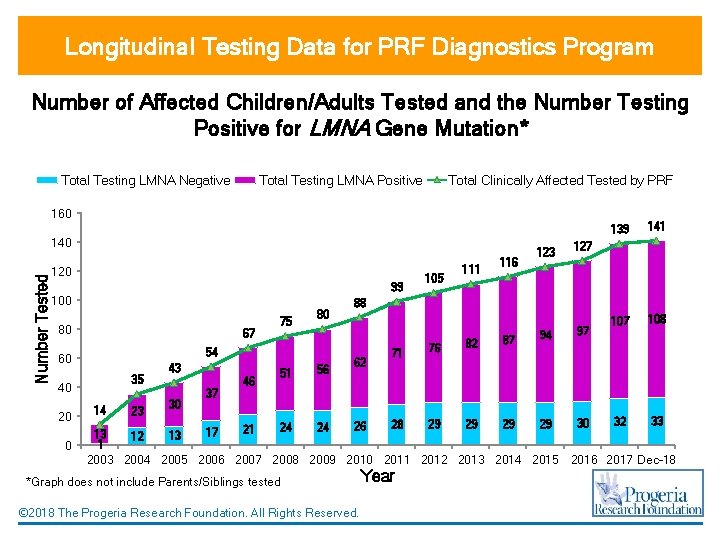
Longitudinal Testing Data for PRF Diagnostics Program Number of Affected Children/Adults Tested and the Number Testing Positive for LMNA Gene Mutation* Total Testing LMNA Negative Total Testing LMNA Positive Total Clinically Affected Tested by PRF 160 Number Tested 140 120 99 100 80 67 54 60 35 40 20 0 75 80 14 13 1 23 12 43 30 13 37 17 46 21 51 56 24 24 105 111 116 123 139 141 107 108 32 33 127 88 62 26 71 76 82 28 29 29 87 94 97 29 29 30 2003 2004 2005 2006 2007 2008 2009 2010 2011 2012 2013 2014 2015 2016 2017 Dec-18 *Graph does not include Parents/Siblings tested © 2018 The Progeria Research Foundation. All Rights Reserved. Year
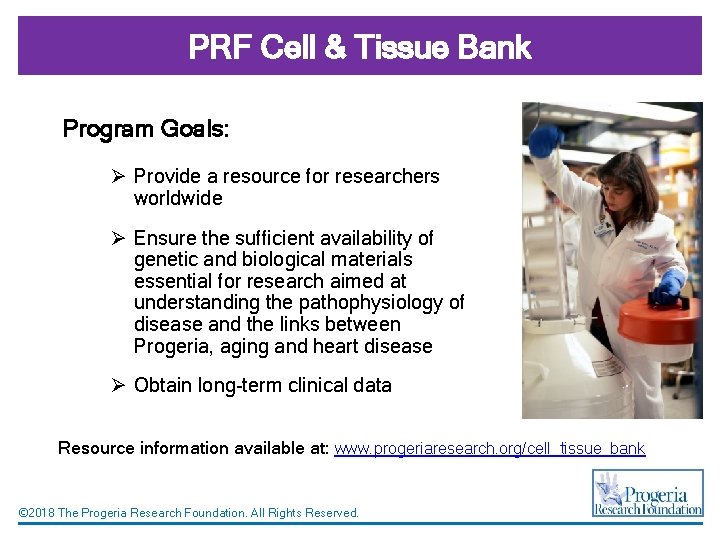
PRF Cell & Tissue Bank Program Goals: Ø Provide a resource for researchers worldwide Ø Ensure the sufficient availability of genetic and biological materials essential for research aimed at understanding the pathophysiology of disease and the links between Progeria, aging and heart disease Ø Obtain long-term clinical data Resource information available at: www. progeriaresearch. org/cell_tissue_bank © 2018 The Progeria Research Foundation. All Rights Reserved.
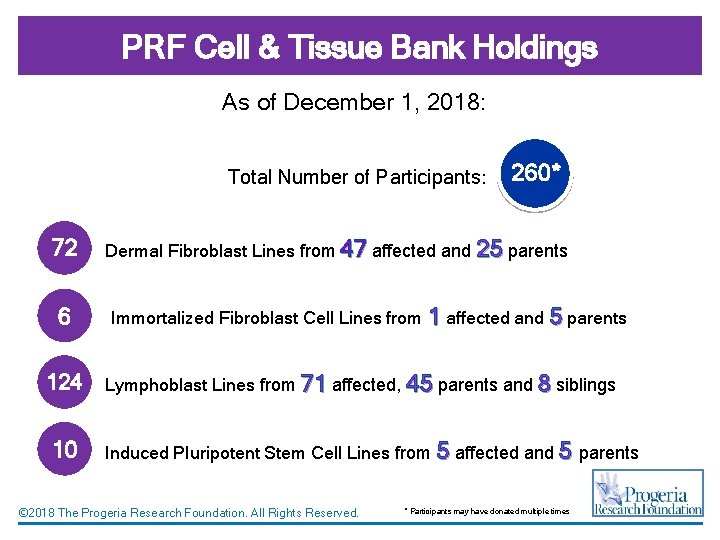
PRF Cell & Tissue Bank Holdings As of December 1, 2018: Total Number of Participants: 72 6 260* Dermal Fibroblast Lines from 47 affected and 25 parents Immortalized Fibroblast Cell Lines from 1 affected and 5 parents 124 Lymphoblast Lines from 71 affected, 45 parents and 8 siblings 10 Induced Pluripotent Stem Cell Lines from 5 affected and 5 parents © 2018 The Progeria Research Foundation. All Rights Reserved. * Participants may have donated multiple times
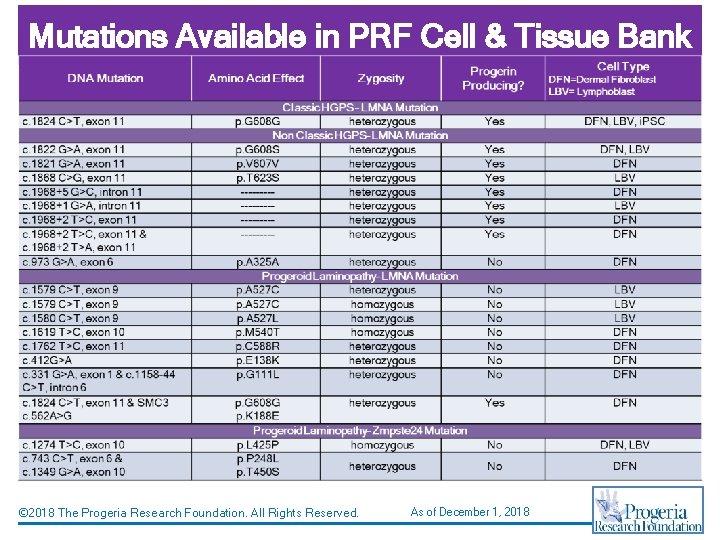
Mutations Available in PRF Cell & Tissue Bank © 2018 The Progeria Research Foundation. All Rights Reserved. As of December 1, 2018
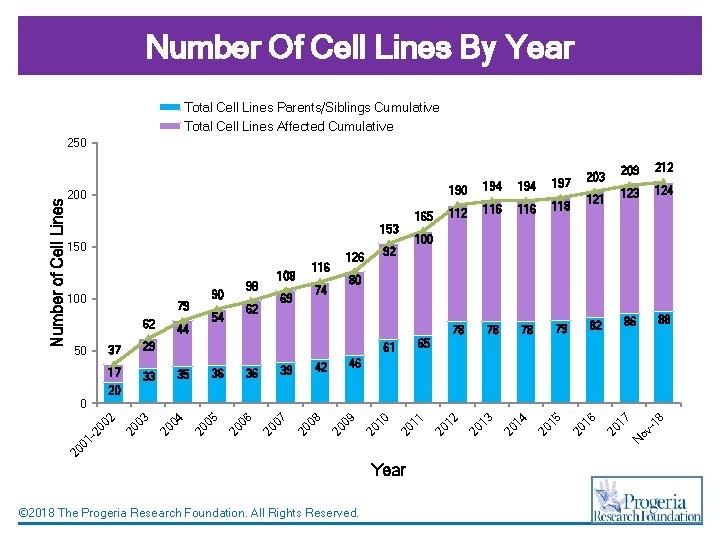
Number Of Cell Lines By Year Total Cell Lines Parents/Siblings Cumulative Total Cell Lines Affected Cumulative 200 165 153 150 100 79 62 37 50 17 44 90 54 98 62 108 69 116 74 126 33 36 36 39 42 194 112 116 118 78 79 121 209 212 123 124 86 88 100 92 61 35 194 197 190 203 80 29 82 65 46 ov - 18 7 20 1 6 20 1 5 20 1 4 20 1 3 20 1 2 N Year © 2018 The Progeria Research Foundation. All Rights Reserved. 20 1 1 20 1 0 20 1 9 20 0 8 20 0 7 20 0 6 20 0 5 20 0 4 20 01 -2 00 2 0 3 20 20 0 Number of Cell Lines 250
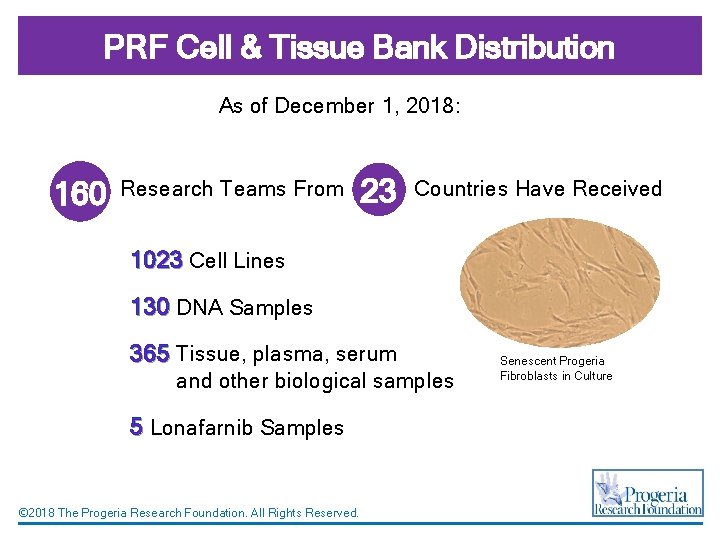
PRF Cell & Tissue Bank Distribution As of December 1, 2018: 160 Research Teams From 23 Countries Have Received 1023 Cell Lines 130 DNA Samples 365 Tissue, plasma, serum and other biological samples 5 Lonafarnib Samples © 2018 The Progeria Research Foundation. All Rights Reserved. Senescent Progeria Fibroblasts in Culture
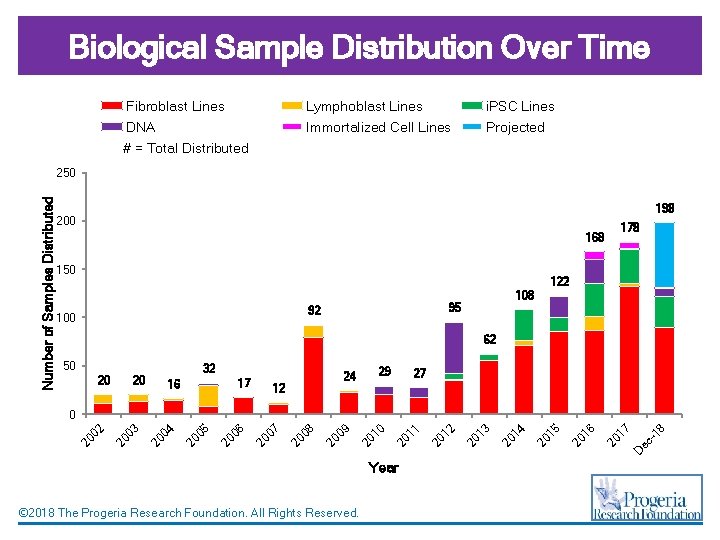
Biological Sample Distribution Over Time Fibroblast Lines Lymphoblast Lines i. PSC Lines DNA Immortalized Cell Lines Projected # = Total Distributed Number of Samples Distributed 250 198 200 168 150 178 122 108 95 92 100 62 50 20 20 32 17 16 29 24 12 27 ec - 18 7 D 20 1 6 20 1 5 20 1 4 20 1 3 20 1 2 20 1 1 20 1 0 20 1 9 20 0 8 20 0 7 20 0 6 20 0 5 20 0 4 20 0 3 20 0 2 0 Year © 2018 The Progeria Research Foundation. All Rights Reserved.
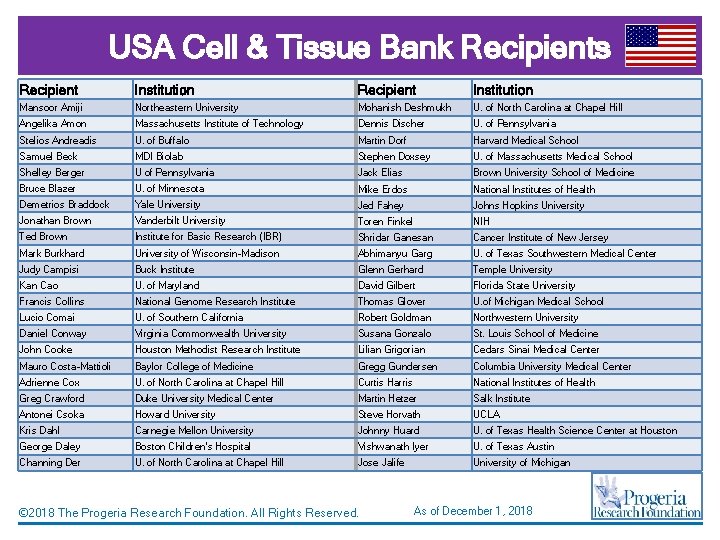
USA Cell & Tissue Bank Recipients Recipient Institution Mansoor Amiji Northeastern University Mohanish Deshmukh U. of North Carolina at Chapel Hill Angelika Amon Massachusetts Institute of Technology Dennis Discher U. of Pennsylvania Stelios Andreadis U. of Buffalo Martin Dorf Harvard Medical School Samuel Beck MDI Biolab Stephen Doxsey U. of Massachusetts Medical School Shelley Berger U of Pennsylvania Jack Elias Brown University School of Medicine Bruce Blazer U. of Minnesota Mike Erdos National Institutes of Health Demetrios Braddock Yale University Jed Fahey Johns Hopkins University Jonathan Brown Vanderbilt University Toren Finkel NIH Ted Brown Institute for Basic Research (IBR) Shridar Ganesan Cancer Institute of New Jersey Mark Burkhard University of Wisconsin-Madison Abhimanyu Garg U. of Texas Southwestern Medical Center Judy Campisi Buck Institute Glenn Gerhard Temple University Kan Cao U. of Maryland David Gilbert Florida State University Francis Collins National Genome Research Institute Thomas Glover U. of Michigan Medical School Lucio Comai U. of Southern California Robert Goldman Northwestern University Daniel Conway Virginia Commonwealth University Susana Gonzalo St. Louis School of Medicine John Cooke Houston Methodist Research Institute Lilian Grigorian Cedars Sinai Medical Center Mauro Costa-Mattioli Baylor College of Medicine Gregg Gundersen Columbia University Medical Center Adrienne Cox U. of North Carolina at Chapel Hill Curtis Harris National Institutes of Health Greg Crawford Duke University Medical Center Martin Hetzer Salk Institute Antonei Csoka Howard University Steve Horvath UCLA Kris Dahl Carnegie Mellon University Johnny Huard U. of Texas Health Science Center at Houston George Daley Boston Children's Hospital Vishwanath Iyer U. of Texas Austin Channing Der U. of North Carolina at Chapel Hill Jose Jalife University of Michigan © 2018 The Progeria Research Foundation. All Rights Reserved. As of December 1, 2018
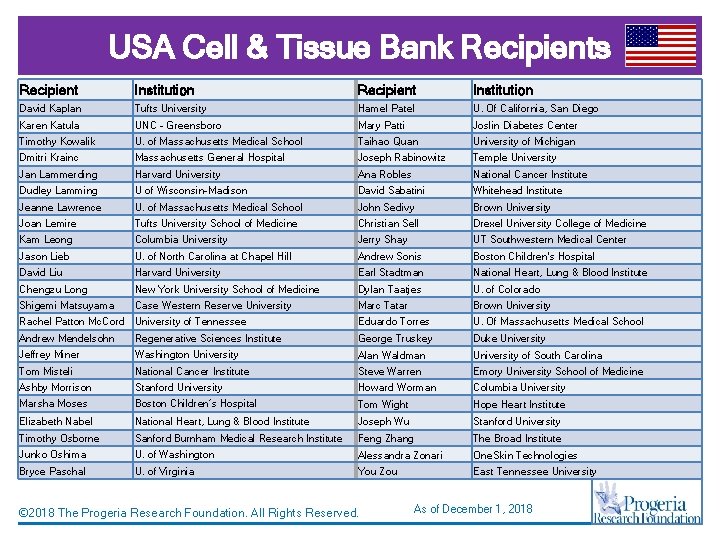
USA Cell & Tissue Bank Recipients Recipient Institution David Kaplan Tufts University Hamel Patel U. Of California, San Diego Karen Katula UNC - Greensboro Mary Patti Joslin Diabetes Center Timothy Kowalik U. of Massachusetts Medical School Taihao Quan University of Michigan Dmitri Krainc Massachusetts General Hospital Joseph Rabinowitz Temple University Jan Lammerding Harvard University Ana Robles National Cancer Institute Dudley Lamming U of Wisconsin-Madison David Sabatini Whitehead Institute Jeanne Lawrence U. of Massachusetts Medical School John Sedivy Brown University Joan Lemire Tufts University School of Medicine Christian Sell Drexel University College of Medicine Kam Leong Columbia University Jerry Shay UT Southwestern Medical Center Jason Lieb U. of North Carolina at Chapel Hill Andrew Sonis Boston Children's Hospital David Liu Harvard University Earl Stadtman National Heart, Lung & Blood Institute Chengzu Long New York University School of Medicine Dylan Taatjes U. of Colorado Shigemi Matsuyama Case Western Reserve University Marc Tatar Brown University Rachel Patton Mc. Cord University of Tennessee Eduardo Torres U. Of Massachusetts Medical School Andrew Mendelsohn Regenerative Sciences Institute George Truskey Duke University Jeffrey Miner Washington University Alan Waldman University of South Carolina Tom Misteli National Cancer Institute Steve Warren Emory University School of Medicine Ashby Morrison Stanford University Howard Worman Columbia University Marsha Moses Boston Children’s Hospital Tom Wight Hope Heart Institute Elizabeth Nabel National Heart, Lung & Blood Institute Joseph Wu Stanford University Timothy Osborne Sanford Burnham Medical Research Institute Feng Zhang The Broad Institute Junko Oshima U. of Washington Alessandra Zonari One. Skin Technologies Bryce Paschal U. of Virginia You Zou East Tennessee University © 2018 The Progeria Research Foundation. All Rights Reserved. As of December 1, 2018
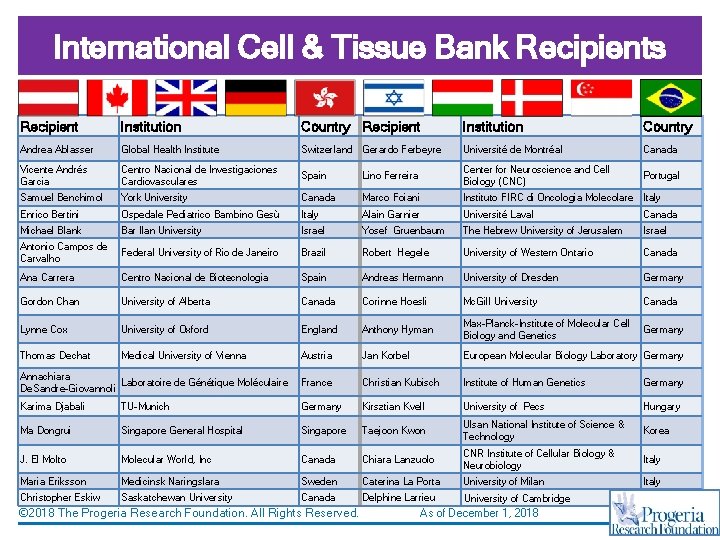
International Cell & Tissue Bank Recipients Recipient Institution Country Andrea Ablasser Global Health Institute Switzerland Gerardo Ferbeyre Université de Montréal Canada Vicente Andrés Garcia Centro Nacional de Investigaciones Cardiovasculares Spain Lino Ferreira Center for Neuroscience and Cell Biology (CNC) Portugal Samuel Benchimol York University Canada Marco Foiani Instituto FIRC di Oncologia Molecolare Italy Enrico Bertini Ospedale Pediatrico Bambino Gesù Italy Alain Garnier Université Laval Canada Michael Blank Bar Ilan University Israel Yosef Gruenbaum The Hebrew University of Jerusalem Israel Antonio Campos de Carvalho Federal University of Rio de Janeiro Brazil Robert Hegele University of Western Ontario Canada Ana Carrera Centro Nacional de Biotecnologia Spain Andreas Hermann University of Dresden Germany Gordon Chan University of Alberta Canada Corinne Hoesli Mc. Gill University Canada Lynne Cox University of Oxford England Anthony Hyman Max-Planck-Institute of Molecular Cell Biology and Genetics Germany Thomas Dechat Medical University of Vienna Austria Jan Korbel European Molecular Biology Laboratory Germany Annachiara Laboratoire de Génétique Moléculaire De. Sandre-Giovannoli France Christian Kubisch Institute of Human Genetics Germany Karima Djabali TU-Munich Germany Kirsztian Kvell University of Pecs Hungary Ma Dongrui Singapore General Hospital Singapore Taejoon Kwon Ulsan National Institute of Science & Technology Korea J. El Molto Molecular World, Inc Canada Chiara Lanzuolo CNR Institute of Cellular Biology & Neurobiology Italy Maria Eriksson Medicinsk Naringslara Sweden Caterina La Porta University of Milan Italy Christopher Eskiw Saskatchewan University Canada Delphine Larrieu University of Cambridge England © 2018 The Progeria Research Foundation. All Rights Reserved. As of December 1, 2018
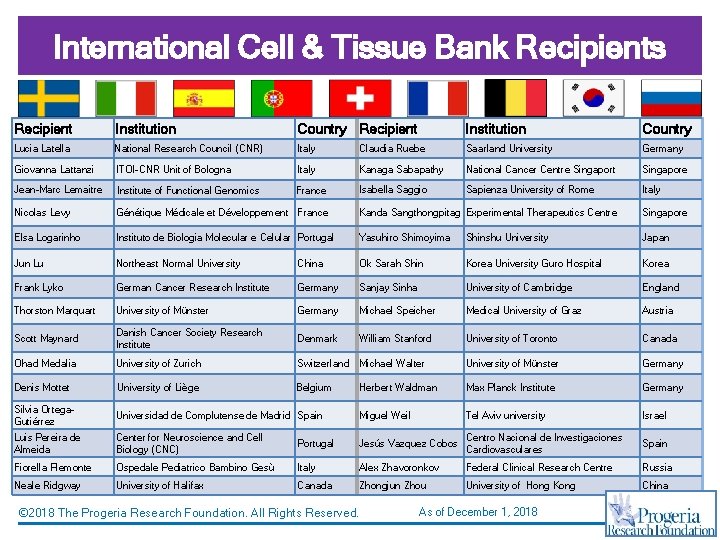
International Cell & Tissue Bank Recipients Recipient Institution Country Lucia Latella National Research Council (CNR) Italy Claudia Ruebe Saarland University Germany Giovanna Lattanzi ITOI-CNR Unit of Bologna Italy Kanaga Sabapathy National Cancer Centre Singaport Singapore Jean-Marc Lemaitre Institute of Functional Genomics France Isabella Saggio Sapienza University of Rome Italy Nicolas Levy Génétique Médicale et Développement France Kanda Sangthongpitag Experimental Therapeutics Centre Singapore Elsa Logarinho Instituto de Biologia Molecular e Celular Portugal Yasuhiro Shimoyima Shinshu University Japan Jun Lu Northeast Normal University China Ok Sarah Shin Korea University Guro Hospital Korea Frank Lyko German Cancer Research Institute Germany Sanjay Sinha University of Cambridge England Thorston Marquart University of Münster Germany Michael Speicher Medical University of Graz Austria Scott Maynard Danish Cancer Society Research Institute Denmark William Stanford University of Toronto Canada Ohad Medalia University of Zurich Switzerland Michael Walter University of Münster Germany Denis Mottet University of Liège Belgium Herbert Waldman Max Planck Institute Germany Silvia Ortega. Gutiérrez Universidad de Complutense de Madrid Spain Miguel Weil Tel Aviv university Israel Luis Pereira de Almeida Center for Neuroscience and Cell Biology (CNC) Portugal Jesús Vazquez Cobos Centro Nacional de Investigaciones Cardiovasculares Spain Fiorella Piemonte Ospedale Pediatrico Bambino Gesù Italy Alex Zhavoronkov Federal Clinical Research Centre Russia Neale Ridgway University of Halifax Canada Zhongjun Zhou University of Hong Kong China © 2018 The Progeria Research Foundation. All Rights Reserved. As of December 1, 2018
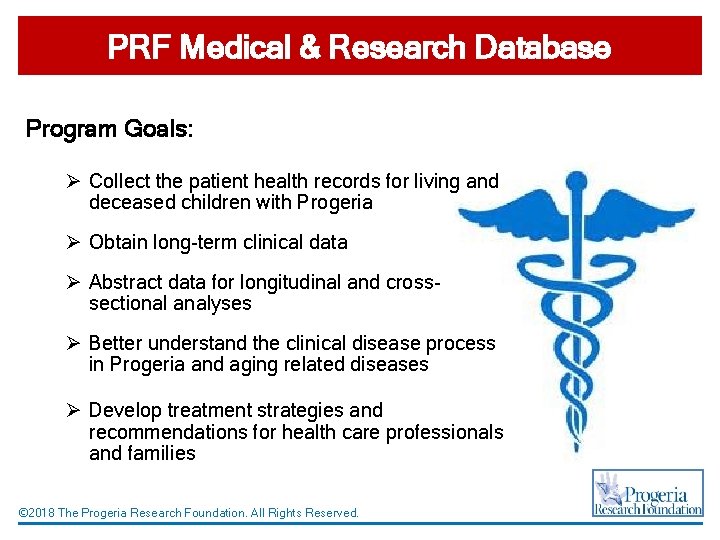
PRF Medical & Research Database Program Goals: Ø Collect the patient health records for living and deceased children with Progeria Ø Obtain long-term clinical data Ø Abstract data for longitudinal and crosssectional analyses Ø Better understand the clinical disease process in Progeria and aging related diseases Ø Develop treatment strategies and recommendations for health care professionals and families © 2018 The Progeria Research Foundation. All Rights Reserved.
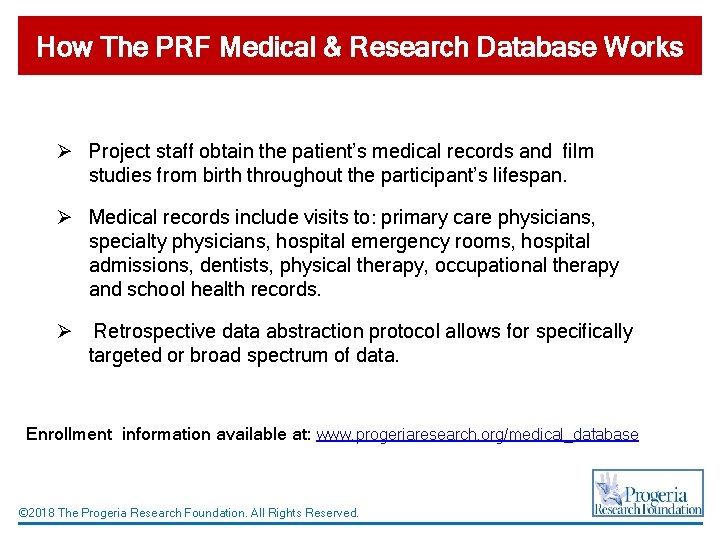
How The PRF Medical & Research Database Works Ø Project staff obtain the patient’s medical records and film studies from birth throughout the participant’s lifespan. Ø Medical records include visits to: primary care physicians, specialty physicians, hospital emergency rooms, hospital admissions, dentists, physical therapy, occupational therapy and school health records. Ø Retrospective data abstraction protocol allows for specifically targeted or broad spectrum of data. Enrollment information available at: www. progeriaresearch. org/medical_database © 2018 The Progeria Research Foundation. All Rights Reserved.
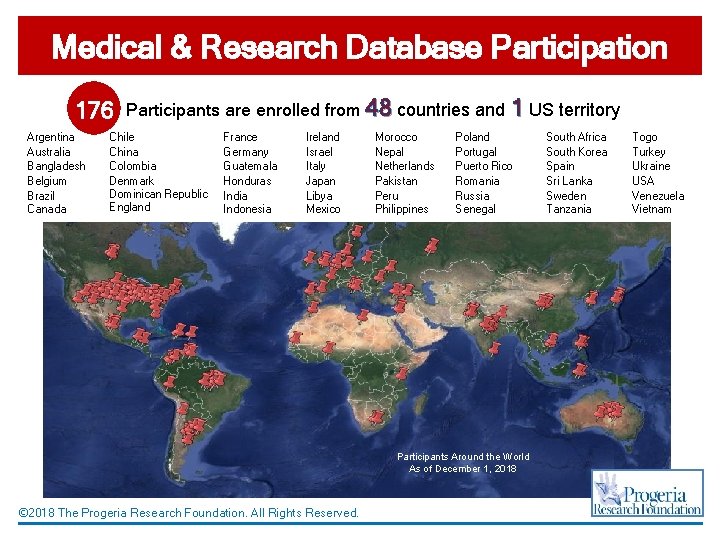
Medical & Research Database Participation 176 Argentina Australia Bangladesh Belgium Brazil Canada Participants are enrolled from 48 countries and 1 US territory Chile China Colombia Denmark Dominican Republic England France Germany Guatemala Honduras India Indonesia Ireland Israel Italy Japan Libya Mexico Morocco Nepal Netherlands Pakistan Peru Philippines Poland Portugal Puerto Rico Romania Russia Senegal Participants Around the World As of May 1, 2018 As of December 1, 2018 © 2018 The Progeria Research Foundation. All Rights Reserved. South Africa South Korea Spain Sri Lanka Sweden Tanzania Togo Turkey Ukraine USA Venezuela Vietnam
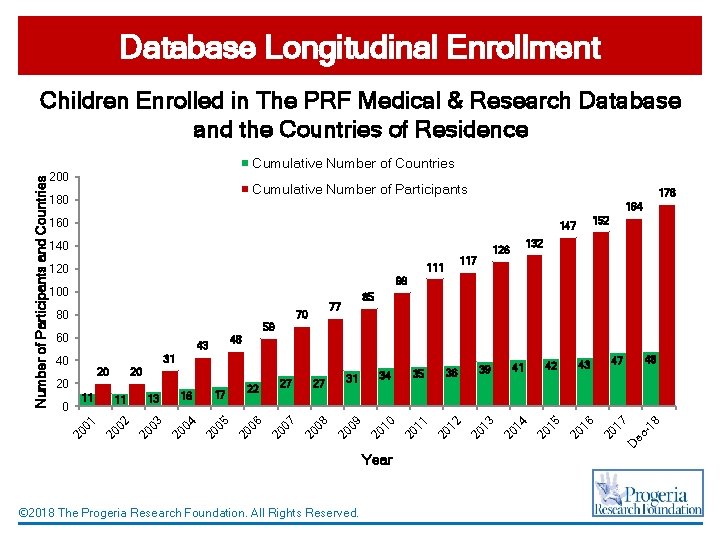
Database Longitudinal Enrollment Cumulative Number of Countries 200 Cumulative Number of Participants 180 176 164 160 140 132 126 117 111 120 99 100 80 85 77 70 59 48 48 D ec - 18 7 47 20 1 6 43 20 1 42 5 41 20 1 39 4 2 36 20 1 1 35 20 1 0 34 20 1 9 31 20 0 8 27 20 0 7 27 20 0 6 22 20 0 5 17 20 0 4 16 20 0 13 3 20 0 11 02 11 20 20 20 1 31 40 3 43 20 1 60 0 152 147 1 Number of Participants and Countries Children Enrolled in The PRF Medical & Research Database and the Countries of Residence Year © 2018 The Progeria Research Foundation. All Rights Reserved.
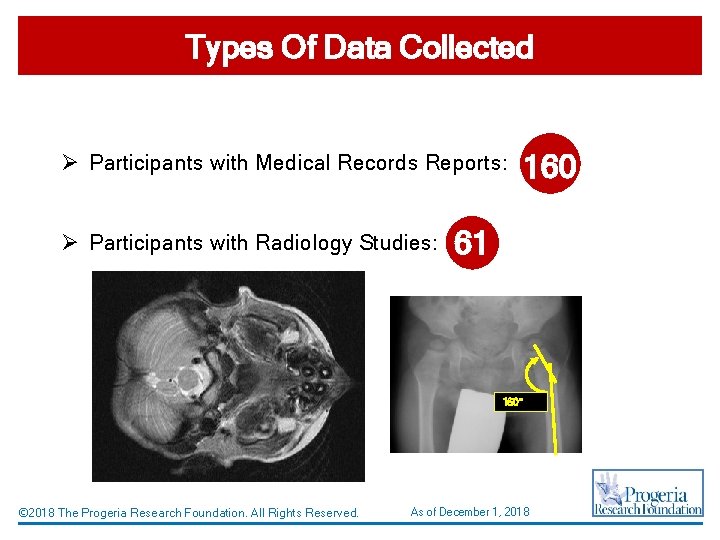
Types Of Data Collected Ø Participants with Medical Records Reports: Ø Participants with Radiology Studies: 160 61 160° © 2018 The Progeria Research Foundation. All Rights Reserved. As of December 1, 2018
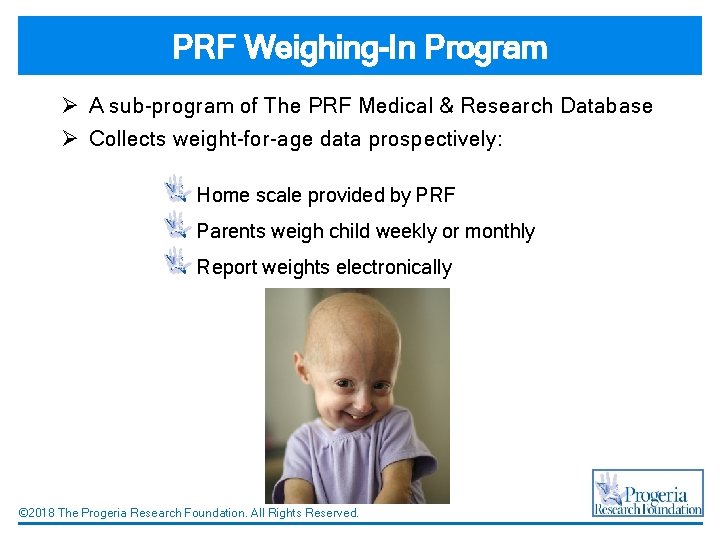
PRF Weighing-In Program Ø A sub-program of The PRF Medical & Research Database Ø Collects weight-for-age data prospectively: Home scale provided by PRF Parents weigh child weekly or monthly Report weights electronically © 2018 The Progeria Research Foundation. All Rights Reserved.
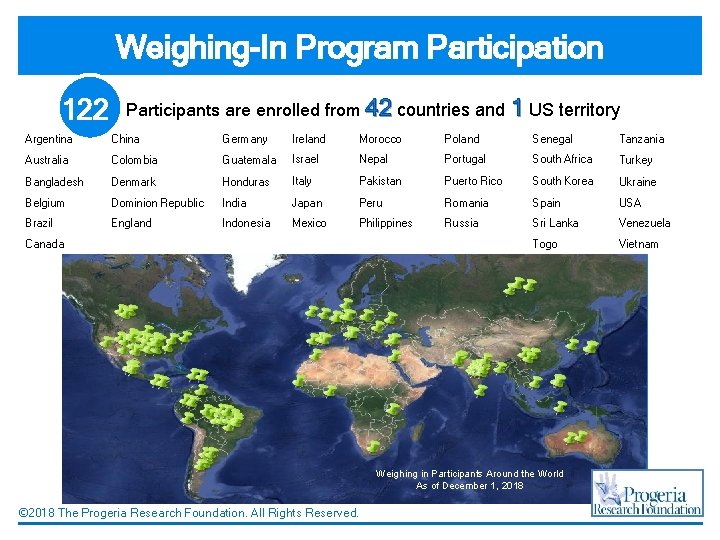
Weighing-In Program Participation 122 Participants are enrolled from 42 countries and 1 US territory Argentina China Germany Ireland Morocco Poland Senegal Tanzania Australia Colombia Guatemala Israel Nepal Portugal South Africa Turkey Bangladesh Denmark Honduras Italy Pakistan Puerto Rico South Korea Ukraine Belgium Dominion Republic India Japan Peru Romania Spain USA Brazil England Indonesia Mexico Philippines Russia Sri Lanka Venezuela Togo Vietnam Canada Weighing-In Participants Around the World Weighing As in of Participants May 1, 2017 Around the World As of December 1, 2018 © 2018 The Progeria Research Foundation. All Rights Reserved.
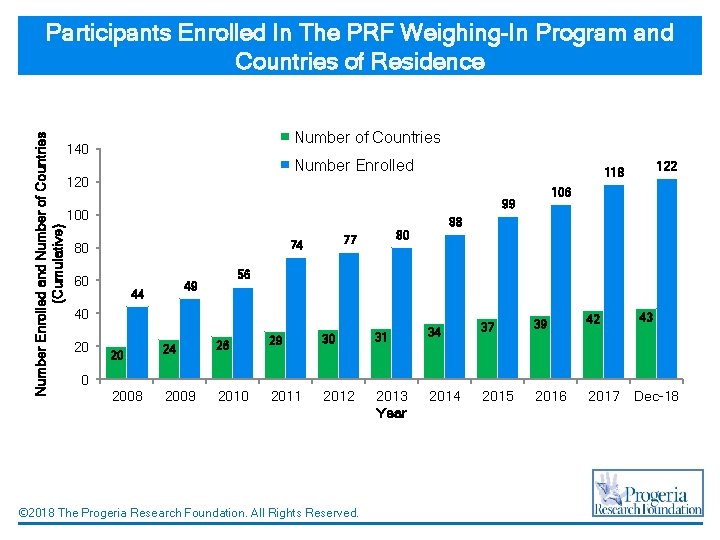
Number Enrolled and Number of Countries (Cumulative) Participants Enrolled In The PRF Weighing-In Program and Countries of Residence Number of Countries 140 Number Enrolled 120 100 56 49 44 88 80 77 74 60 40 20 106 99 80 20 122 118 30 31 34 24 26 29 37 2009 2010 2011 2012 2013 Year 2014 2015 39 42 2016 2017 43 0 2008 © 2018 The Progeria Research Foundation. All Rights Reserved. Dec-18
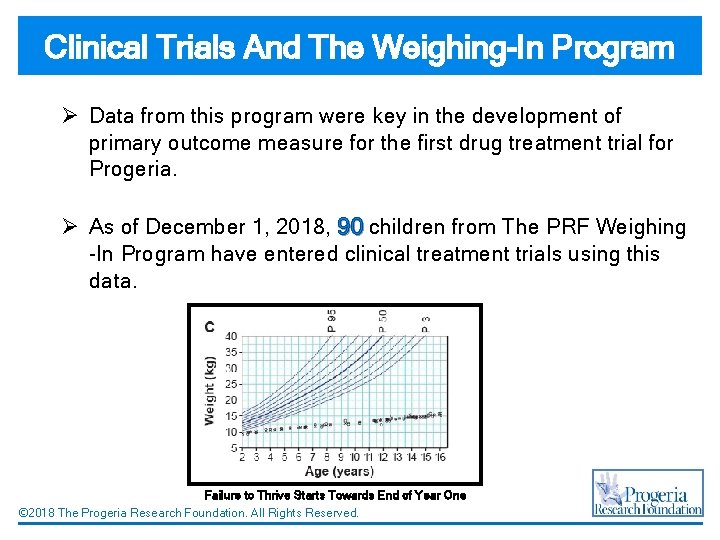
Clinical Trials And The Weighing-In Program Ø Data from this program were key in the development of primary outcome measure for the first drug treatment trial for Progeria. Ø As of December 1, 2018, 90 children from The PRF Weighing -In Program have entered clinical treatment trials using this data. Failure to Thrive Starts Towards End of Year One © 2018 The Progeria Research Foundation. All Rights Reserved.
PRF-Funded Clinical Treatment Trials © 2018 The Progeria Research Foundation. All Rights Reserved.
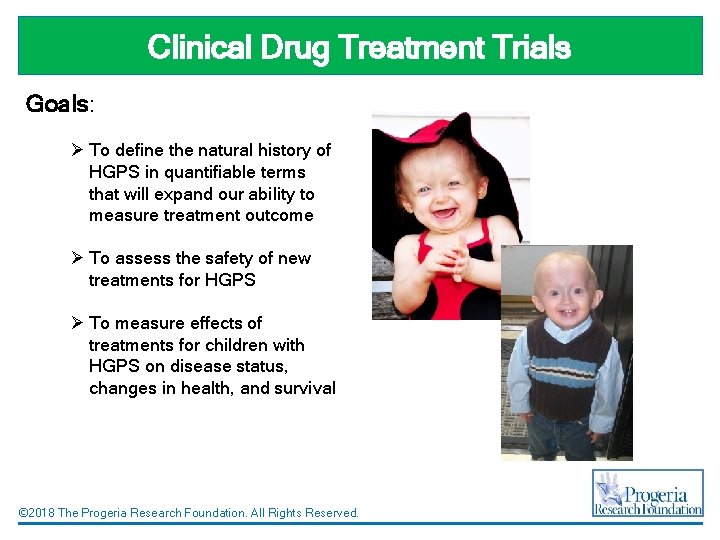
Clinical Drug Treatment Trials Goals: Ø To define the natural history of HGPS in quantifiable terms that will expand our ability to measure treatment outcome Ø To assess the safety of new treatments for HGPS Ø To measure effects of treatments for children with HGPS on disease status, changes in health, and survival © 2018 The Progeria Research Foundation. All Rights Reserved.
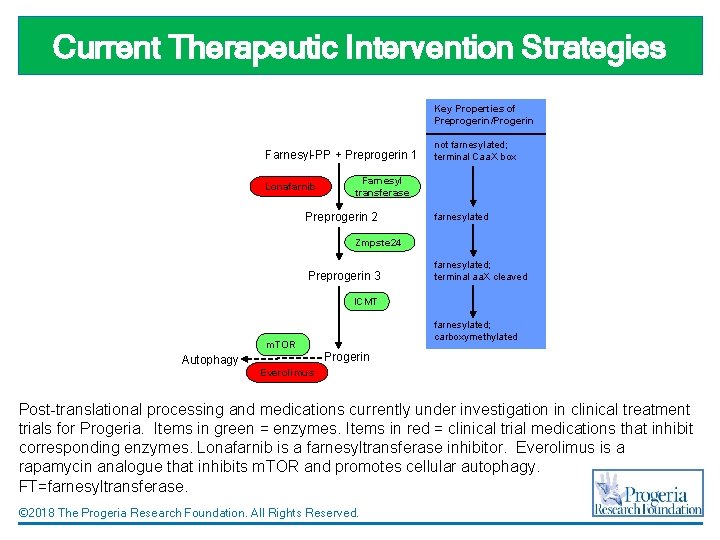
Current Therapeutic Intervention Strategies Key Properties of Preprogerin/Progerin Farnesyl-PP + Preprogerin 1 Lonafarnib not farnesylated; terminal Caa. X box Farnesyl transferase Preprogerin 2 farnesylated Zmpste 24 Preprogerin 3 farnesylated; terminal aa. X cleaved ICMT farnesylated; carboxymethylated m. TOR Progerin Autophagy Everolimus Post-translational processing and medications currently under investigation in clinical treatment trials for Progeria. Items in green = enzymes. Items in red = clinical trial medications that inhibit corresponding enzymes. Lonafarnib is a farnesyltransferase inhibitor. Everolimus is a rapamycin analogue that inhibits m. TOR and promotes cellular autophagy. FT=farnesyltransferase. © 2018 The Progeria Research Foundation. All Rights Reserved.
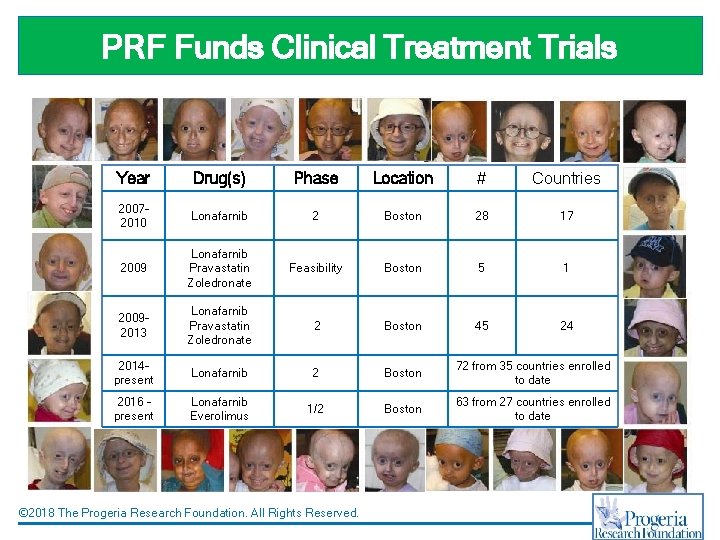
PRF Funds Clinical Treatment Trials Year Drug(s) Phase Location # Countries 20072010 Lonafarnib 2 Boston 28 17 2009 Lonafarnib Pravastatin Zoledronate Feasibility Boston 5 1 20092013 Lonafarnib Pravastatin Zoledronate 2 Boston 45 24 2014 present Lonafarnib 2 Boston 72 from 35 countries enrolled to date 2016 – present Lonafarnib Everolimus 1/2 Boston 63 from 27 countries enrolled to date © 2018 The Progeria Research Foundation. All Rights Reserved.
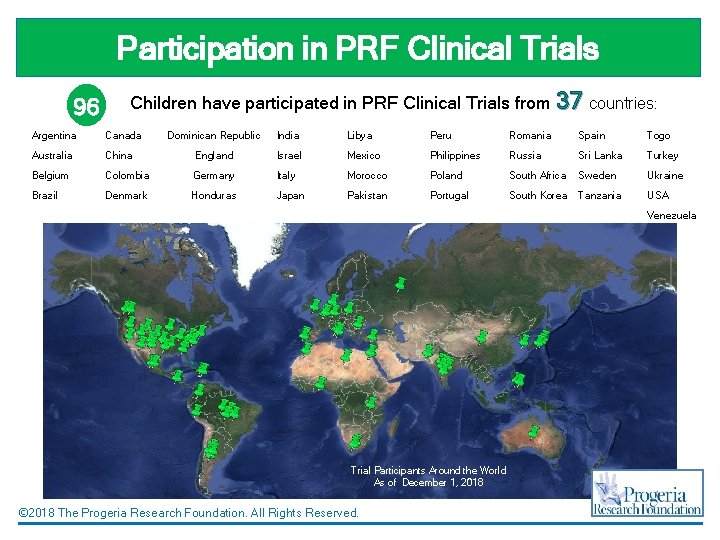
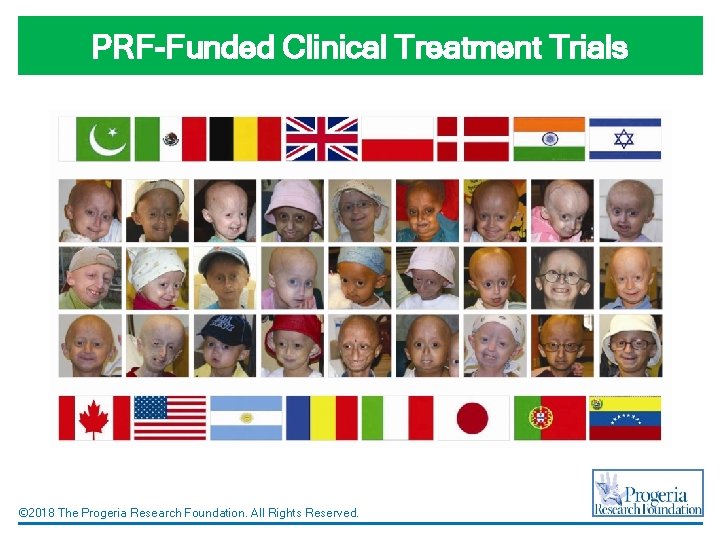
Participation in PRF Clinical Trials 96 Children have participated in PRF Clinical Trials from 37 countries: Argentina Canada Dominican Republic India Libya Peru Romania Spain Togo Australia China England Israel Mexico Philippines Russia Sri Lanka Turkey Belgium Colombia Germany Italy Morocco Poland South Africa Sweden Ukraine Brazil Denmark Honduras Japan Pakistan Portugal South Korea Tanzania USA Venezuela Trial Participants Around the World As of December 1, 2018 © 2018 The Progeria Research Foundation. All Rights Reserved.
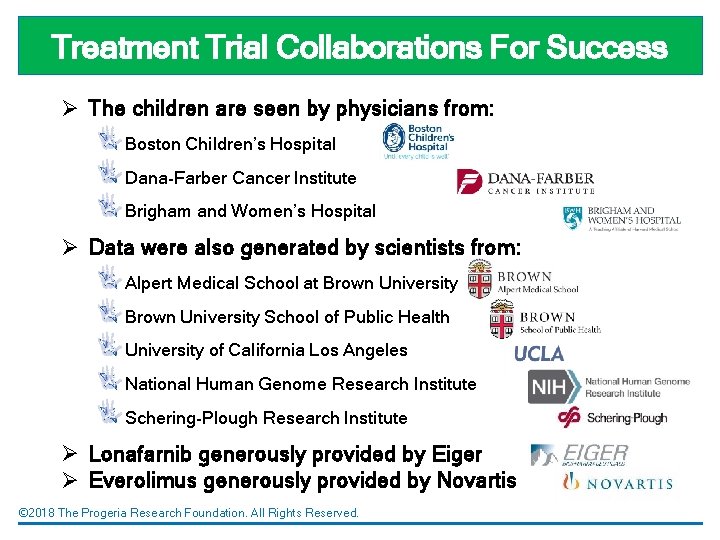
Treatment Trial Collaborations For Success Ø The children are seen by physicians from: Boston Children’s Hospital Dana-Farber Cancer Institute Brigham and Women’s Hospital Ø Data were also generated by scientists from: Alpert Medical School at Brown University School of Public Health University of California Los Angeles National Human Genome Research Institute Schering-Plough Research Institute Ø Lonafarnib generously provided by Eiger Ø Everolimus generously provided by Novartis © 2018 The Progeria Research Foundation. All Rights Reserved.
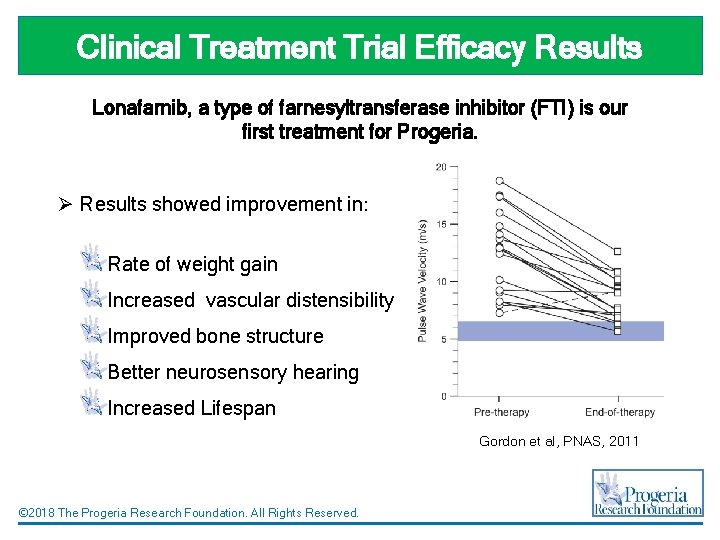
Clinical Treatment Trial Efficacy Results Lonafarnib, a type of farnesyltransferase inhibitor (FTI) is our first treatment for Progeria. Ø Results showed improvement in: Rate of weight gain Increased vascular distensibility Improved bone structure Better neurosensory hearing Increased Lifespan Gordon et al, PNAS, 2011 © 2018 The Progeria Research Foundation. All Rights Reserved.
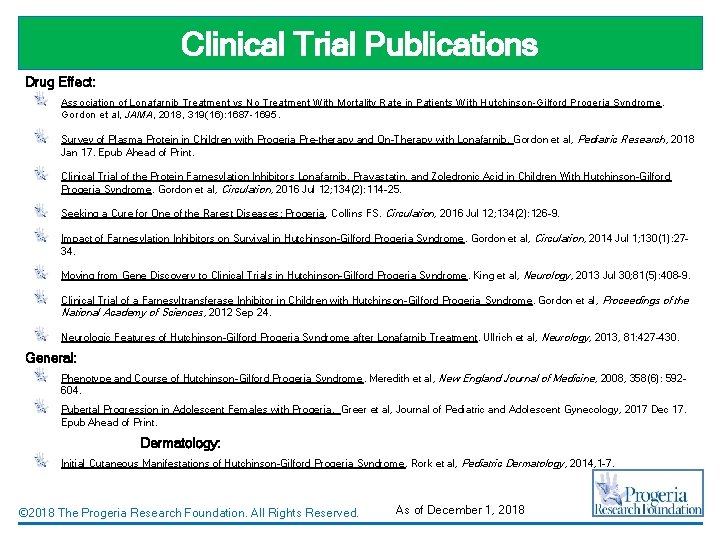
Clinical Trial Publications Drug Effect: Association of Lonafarnib Treatment vs No Treatment With Mortality Rate in Patients With Hutchinson-Gilford Progeria Syndrome. Gordon et al, JAMA, 2018, 319(16): 1687 -1695. Survey of Plasma Protein in Children with Progeria Pre-therapy and On-Therapy with Lonafarnib. Gordon et al, Pediatric Research, 2018 Jan 17. Epub Ahead of Print. Clinical Trial of the Protein Farnesylation Inhibitors Lonafarnib, Pravastatin, and Zoledronic Acid in Children With Hutchinson-Gilford Progeria Syndrome. Gordon et al, Circulation, 2016 Jul 12; 134(2): 114 -25. Seeking a Cure for One of the Rarest Diseases: Progeria. Collins FS. Circulation, 2016 Jul 12; 134(2): 126 -9. Impact of Farnesylation Inhibitors on Survival in Hutchinson-Gilford Progeria Syndrome. Gordon et al, Circulation, 2014 Jul 1; 130(1): 2734. Moving from Gene Discovery to Clinical Trials in Hutchinson-Gilford Progeria Syndrome. King et al, Neurology, 2013 Jul 30; 81(5): 408 -9. Clinical Trial of a Farnesyltransferase Inhibitor in Children with Hutchinson-Gilford Progeria Syndrome. Gordon et al, Proceedings of the National Academy of Sciences, 2012 Sep 24. Neurologic Features of Hutchinson-Gilford Progeria Syndrome after Lonafarnib Treatment. Ullrich et al, Neurology, 2013, 81: 427 -430. General: Phenotype and Course of Hutchinson-Gilford Progeria Syndrome. Meredith et al, New England Journal of Medicine , 2008, 358(6): 592604. Pubertal Progression in Adolescent Females with Progeria. Greer et al, Journal of Pediatric and Adolescent Gynecology, 2017 Dec 17. Epub Ahead of Print. Dermatology: Initial Cutaneous Manifestations of Hutchinson-Gilford Progeria Syndrome. Rork et al, Pediatric Dermatology, 2014, 1 -7. © 2018 The Progeria Research Foundation. All Rights Reserved. As of December 1, 2018
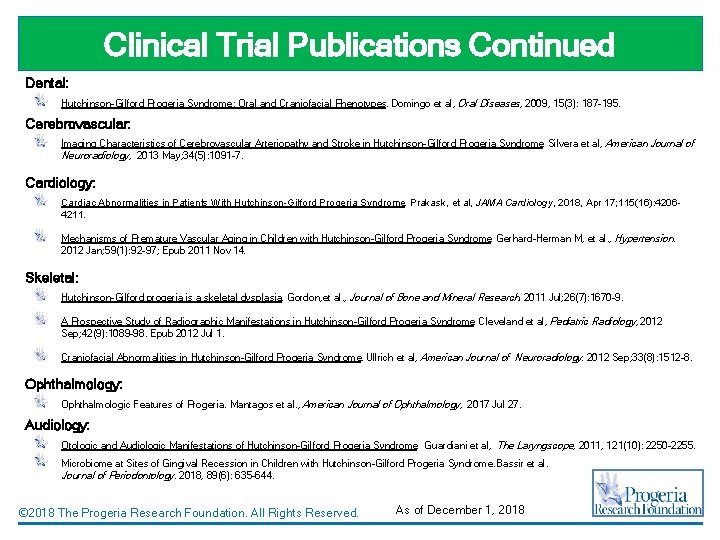
Clinical Trial Publications Continued Dental: Hutchinson-Gilford Progeria Syndrome: Oral and Craniofacial Phenotypes. Domingo et al, Oral Diseases, 2009, 15(3): 187 -195. Cerebrovascular: Imaging Characteristics of Cerebrovascular Arteriopathy and Stroke in Hutchinson-Gilford Progeria Syndrome. Silvera et al, American Journal of Neuroradiology, 2013 May; 34(5): 1091 -7. Cardiology: Cardiac Abnormalities in Patients With Hutchinson-Gilford Progeria Syndrome. Prakask, et al, JAMA Cardiology, 2018, Apr 17; 115(16): 42064211. Mechanisms of Premature Vascular Aging in Children with Hutchinson-Gilford Progeria Syndrome. Gerhard-Herman M, et al. , Hypertension. 2012 Jan; 59(1): 92 -97; Epub 2011 Nov 14. Skeletal: Hutchinson-Gilford progeria is a skeletal dysplasia. Gordon, et al. , Journal of Bone and Mineral Research. 2011 Jul; 26(7): 1670 -9. A Prospective Study of Radiographic Manifestations in Hutchinson-Gilford Progeria Syndrome. Cleveland et al, Pediatric Radiology, 2012 Sep; 42(9): 1089 -98. Epub 2012 Jul 1. Craniofacial Abnormalities in Hutchinson-Gilford Progeria Syndrome. Ullrich et al, American Journal of Neuroradiology. 2012 Sep; 33(8): 1512 -8. Ophthalmology: Ophthalmologic Features of Progeria. Mantagos et al. , American Journal of Ophthalmology, 2017 Jul 27. Audiology: Otologic and Audiologic Manifestations of Hutchinson-Gilford Progeria Syndrome. Guardiani et al, The Laryngscope, 2011, 121(10): 2250 -2255. Microbiome at Sites of Gingival Recession in Children with Hutchinson-Gilford Progeria Syndrome. Bassir et al. Journal of Periodontology. 2018, 89(6): 635 -644. © 2018 The Progeria Research Foundation. All Rights Reserved. As of December 1, 2018
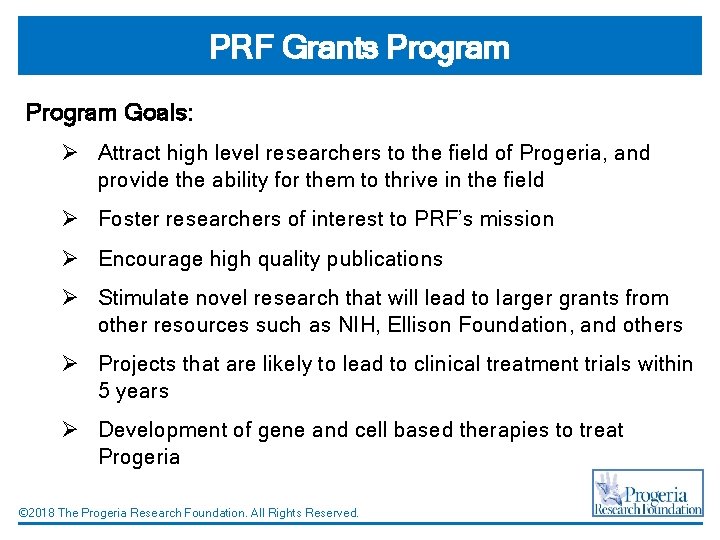
PRF Grants Program Goals: Ø Attract high level researchers to the field of Progeria, and provide the ability for them to thrive in the field Ø Foster researchers of interest to PRF’s mission Ø Encourage high quality publications Ø Stimulate novel research that will lead to larger grants from other resources such as NIH, Ellison Foundation, and others Ø Projects that are likely to lead to clinical treatment trials within 5 years Ø Development of gene and cell based therapies to treat Progeria © 2018 The Progeria Research Foundation. All Rights Reserved.
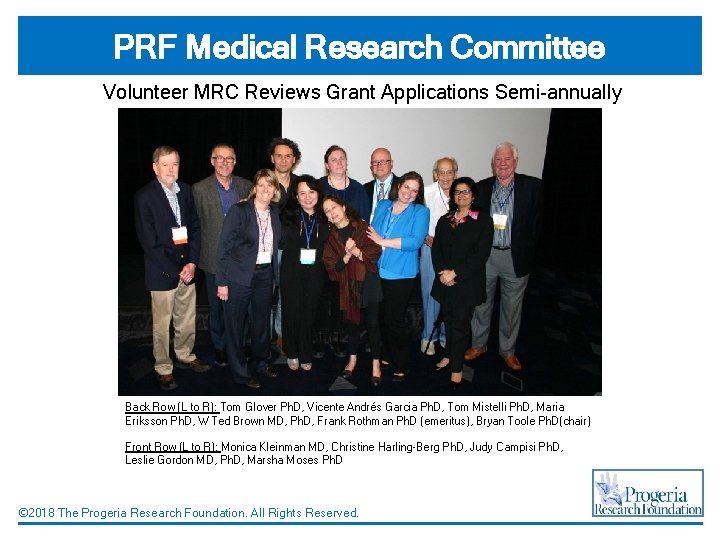
PRF Medical Research Committee Volunteer MRC Reviews Grant Applications Semi-annually Back Row (L to R): Tom Glover Ph. D, Vicente Andrés Garcia Ph. D, Tom Mistelli Ph. D, Maria Eriksson Ph. D, W Ted Brown MD, Ph. D, Frank Rothman Ph. D (emeritus), Bryan Toole Ph. D(chair) Front Row (L to R): Monica Kleinman MD, Christine Harling-Berg Ph. D, Judy Campisi Ph. D, Leslie Gordon MD, Ph. D, Marsha Moses Ph. D © 2018 The Progeria Research Foundation. All Rights Reserved.
PRF Granting Structure PRF’s research focus is highly translational. Topics must fall within the following research priorities: Ø Projects that are likely to lead to clinical treatment trials within 5 years. This includes the discovery and/or testing of candidate treatment compounds in cell-based or animal models of HGPS. Only proposals that test compounds in a progerin-producing animal or cell model will normally be considered. Analyses in non progerin-producing models are acceptable, but only as a comparison to progerin-producing models and with strong justification. Ø Development of gene-and cell-based therapies to treat Progeria Ø Assessment of natural history of disease that may be important to developing outcome measures in treatment trials (preclinical or clinical) Phase I Proposals: Awards are typically for 1 -2 years in the range of $75, 000/year. PRF will conduct a thorough cost analysis for each project during evaluations of submissions. Required Qualifications. Principal investigators must hold a faculty appointment or equivalent. Awards will be granted only to applicants affiliated with institutions with 501(c)3 tax-exempt status, or the equivalent foreign institutions. Letter of Intent (LOI). A letter of intent is required and must be approved before a full application will be considered. Instructions to submit a Letter of Intent and grant application information, can be found at https: //www. progeriaresearch. org/grant-application/. © 2018 The Progeria Research Foundation. All Rights Reserved.
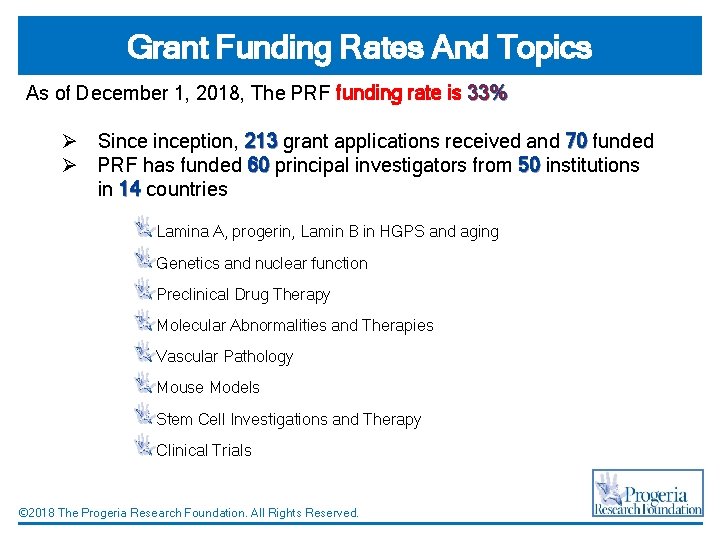
Grant Funding Rates And Topics As of December 1, 2018, The PRF funding rate is 33% Ø Sinception, 213 grant applications received and 70 funded 70 Ø PRF has funded 60 principal investigators from 50 institutions 60 in 14 countries 14 Lamina A, progerin, Lamin B in HGPS and aging Genetics and nuclear function Preclinical Drug Therapy Molecular Abnormalities and Therapies Vascular Pathology Mouse Models Stem Cell Investigations and Therapy Clinical Trials © 2018 The Progeria Research Foundation. All Rights Reserved.
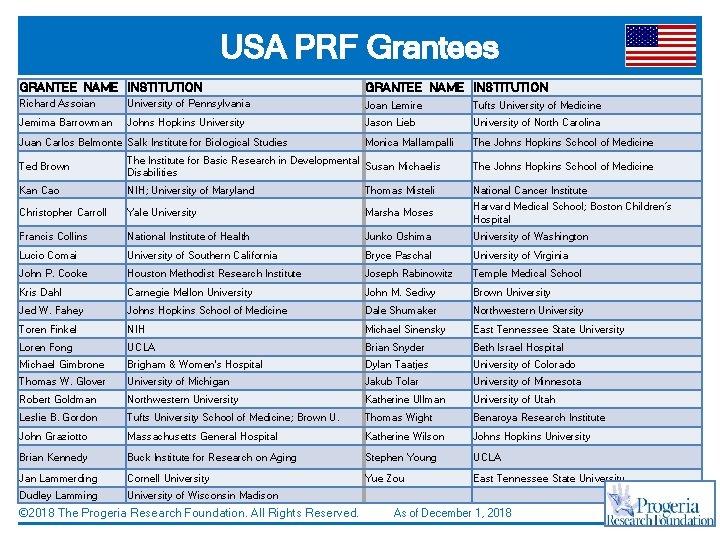
USA PRF Grantees GRANTEE NAME INSTITUTION Richard Assoian University of Pennsylvania Joan Lemire Tufts University of Medicine Jemima Barrowman Johns Hopkins University Jason Lieb University of North Carolina Monica Mallampalli The Johns Hopkins School of Medicine Juan Carlos Belmonte Salk Institute for Biological Studies Ted Brown The Institute for Basic Research in Developmental Susan Michaelis Disabilities The Johns Hopkins School of Medicine Kan Cao NIH; University of Maryland Thomas Misteli National Cancer Institute Christopher Carroll Yale University Marsha Moses Harvard Medical School; Boston Children’s Hospital Francis Collins National Institute of Health Junko Oshima University of Washington Lucio Comai University of Southern California Bryce Paschal University of Virginia John P. Cooke Houston Methodist Research Institute Joseph Rabinowitz Temple Medical School Kris Dahl Carnegie Mellon University John M. Sedivy Brown University Jed W. Fahey Johns Hopkins School of Medicine Dale Shumaker Northwestern University Toren Finkel NIH Michael Sinensky East Tennessee State University Loren Fong UCLA Brian Snyder Beth Israel Hospital Michael Gimbrone Brigham & Women's Hospital Dylan Taatjes University of Colorado Thomas W. Glover University of Michigan Jakub Tolar University of Minnesota Robert Goldman Northwestern University Katherine Ullman University of Utah Leslie B. Gordon Tufts University School of Medicine; Brown U. Thomas Wight Benaroya Research Institute John Graziotto Massachusetts General Hospital Katherine Wilson Johns Hopkins University Brian Kennedy Buck Institute for Research on Aging Stephen Young UCLA Jan Lammerding Cornell University Yue Zou East Tennessee State University Dudley Lamming University of Wisconsin Madison © 2018 The Progeria Research Foundation. All Rights Reserved. As of December 1, 2018
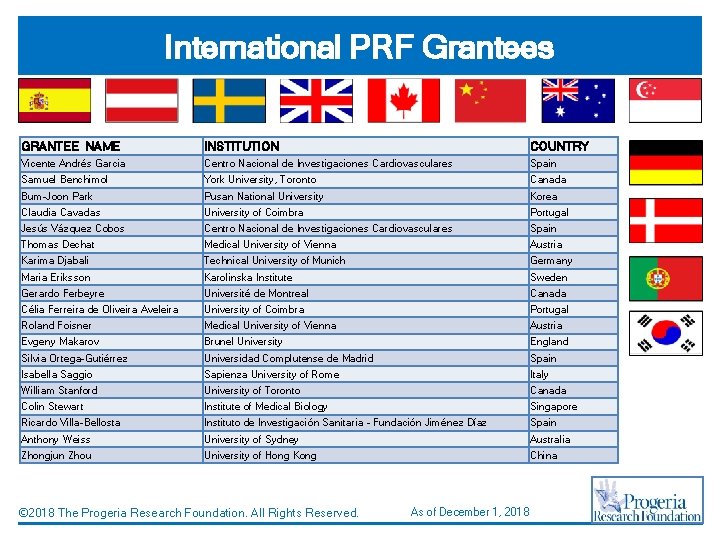
International PRF Grantees GRANTEE NAME INSTITUTION COUNTRY Vicente Andrés Garcia Centro Nacional de Investigaciones Cardiovasculares Spain Samuel Benchimol York University, Toronto Canada Bum-Joon Park Pusan National University Korea Claudia Cavadas University of Coimbra Portugal Jesús Vázquez Cobos Centro Nacional de Investigaciones Cardiovasculares Spain Thomas Dechat Medical University of Vienna Austria Karima Djabali Technical University of Munich Germany Maria Eriksson Karolinska Institute Sweden Gerardo Ferbeyre Université de Montreal Canada Célia Ferreira de Oliveira Aveleira University of Coimbra Portugal Roland Foisner Medical University of Vienna Austria Evgeny Makarov Brunel University England Silvia Ortega-Gutiérrez Universidad Complutense de Madrid Spain Isabella Saggio Sapienza University of Rome Italy William Stanford University of Toronto Canada Colin Stewart Institute of Medical Biology Singapore Ricardo Villa-Bellosta Instituto de Investigación Sanitaria - Fundación Jiménez Díaz Spain Anthony Weiss University of Sydney Australia Zhongjun Zhou University of Hong Kong China © 2018 The Progeria Research Foundation. All Rights Reserved. As of December 1, 2018
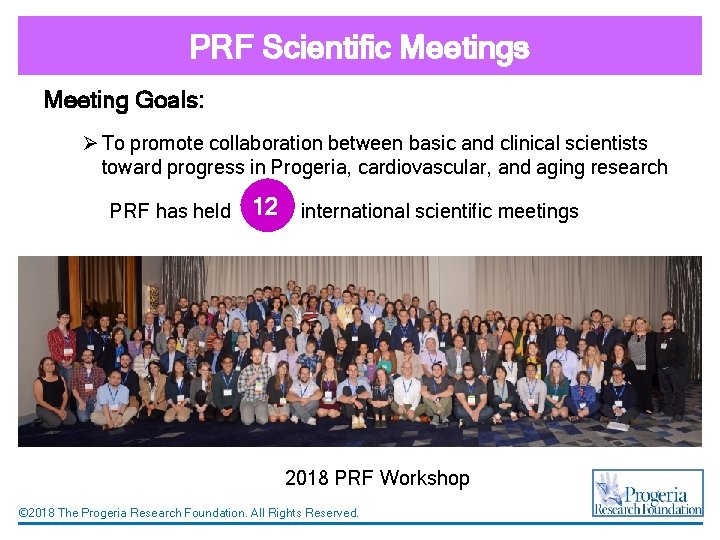
PRF Scientific Meetings Meeting Goals: Ø To promote collaboration between basic and clinical scientists toward progress in Progeria, cardiovascular, and aging research PRF has held 12 international scientific meetings 2018 PRF Workshop © 2018 The Progeria Research Foundation. All Rights Reserved.
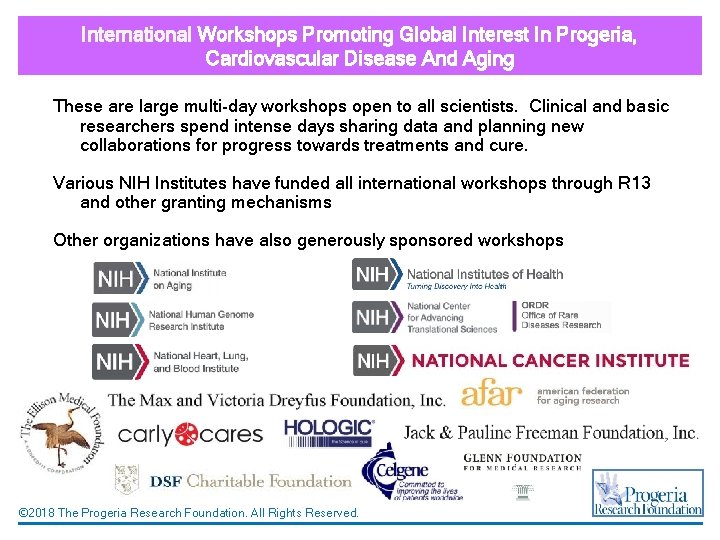
International Workshops Promoting Global Interest In Progeria, Cardiovascular Disease And Aging These are large multi-day workshops open to all scientists. Clinical and basic researchers spend intense days sharing data and planning new collaborations for progress towards treatments and cure. Various NIH Institutes have funded all international workshops through R 13 and other granting mechanisms Other organizations have also generously sponsored workshops © 2018 The Progeria Research Foundation. All Rights Reserved.
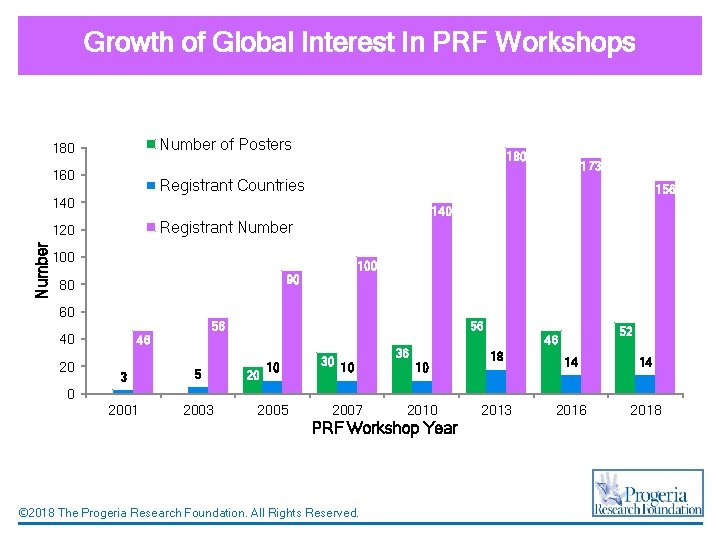
Growth of Global Interest In PRF Workshops Number of Posters 180 160 156 140 Registrant Number 120 100 90 80 60 56 46 20 0 173 Registrant Countries 140 Number 180 0 3 2001 52 46 0 5 2003 20 10 2005 30 10 2007 36 10 2010 PRF Workshop Year © 2018 The Progeria Research Foundation. All Rights Reserved. 18 14 14 2013 2016 2018
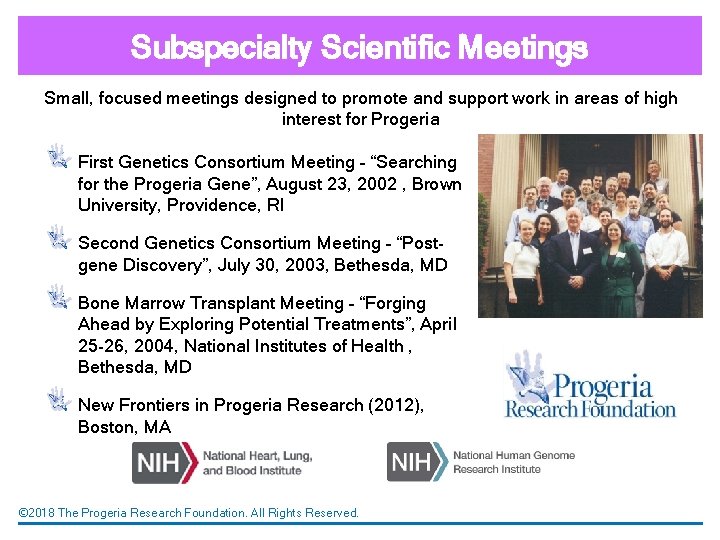
Subspecialty Scientific Meetings Small, focused meetings designed to promote and support work in areas of high interest for Progeria First Genetics Consortium Meeting – “Searching for the Progeria Gene”, August 23, 2002 , Brown University, Providence, RI Second Genetics Consortium Meeting – “Postgene Discovery”, July 30, 2003, Bethesda, MD Bone Marrow Transplant Meeting – “Forging Ahead by Exploring Potential Treatments”, April 25 -26, 2004, National Institutes of Health , Bethesda, MD New Frontiers in Progeria Research (2012), Boston, MA © 2018 The Progeria Research Foundation. All Rights Reserved.
Scientific Publications As of December 1, 2018: 75 Scientific articles have been published citing PRF Cell & Tissue Bank resources: Publication list at www. progeriaresearch. org/prf-cell-and-tissuebank-publications/ Ø Scientific articles have been published citing The PRF Medical & Research Database: 32 Publication list at www. progeriaresearch. org/medical-database/ 21 Scientific articles have been published from clinical trial data See slide #54 and #55 © 2018 The Progeria Research Foundation. All Rights Reserved.
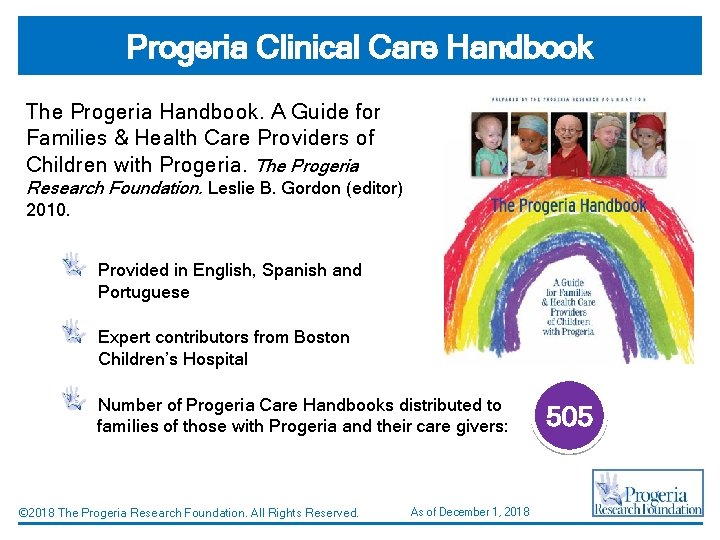
Progeria Clinical Care Handbook The Progeria Handbook. A Guide for Families & Health Care Providers of Children with Progeria. The Progeria Research Foundation. Leslie B. Gordon (editor) 2010. Provided in English, Spanish and Portuguese Expert contributors from Boston Children’s Hospital Number of Progeria Care Handbooks distributed to families of those with Progeria and their care givers: © 2018 The Progeria Research Foundation. All Rights Reserved. As of December 1, 2018 505
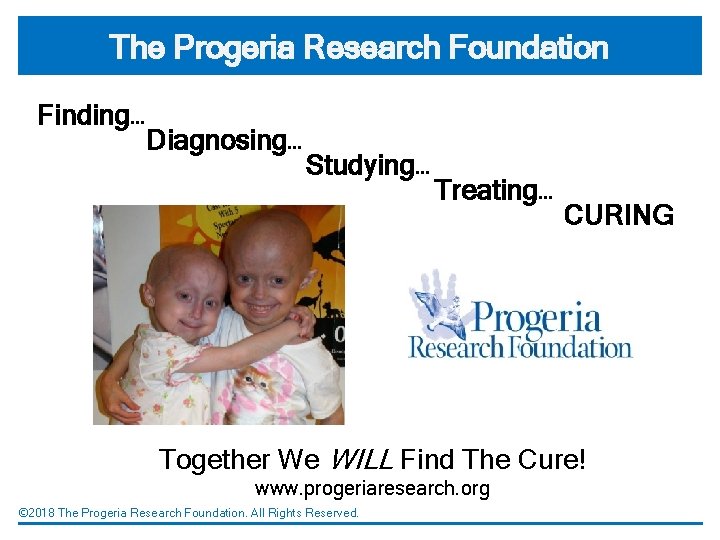
The Progeria Research Foundation Finding… Diagnosing… Studying… Treating… CURING Together We WILL Find The Cure! www. progeriaresearch. org © 2018 The Progeria Research Foundation. All Rights Reserved.
- Slides: 68