
PreWWII Japan and its Influence on Business today
Pre-WWII Japan and its Influence on Business today Presented by
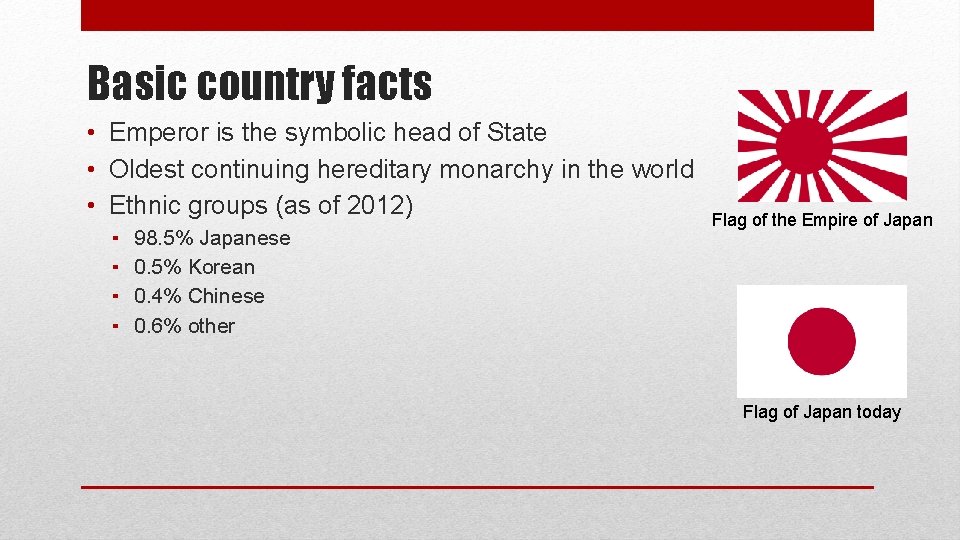
Basic country facts • Emperor is the symbolic head of State • Oldest continuing hereditary monarchy in the world • Ethnic groups (as of 2012) ▪ ▪ 98. 5% Japanese 0. 5% Korean 0. 4% Chinese 0. 6% other Flag of the Empire of Japan Flag of Japan today
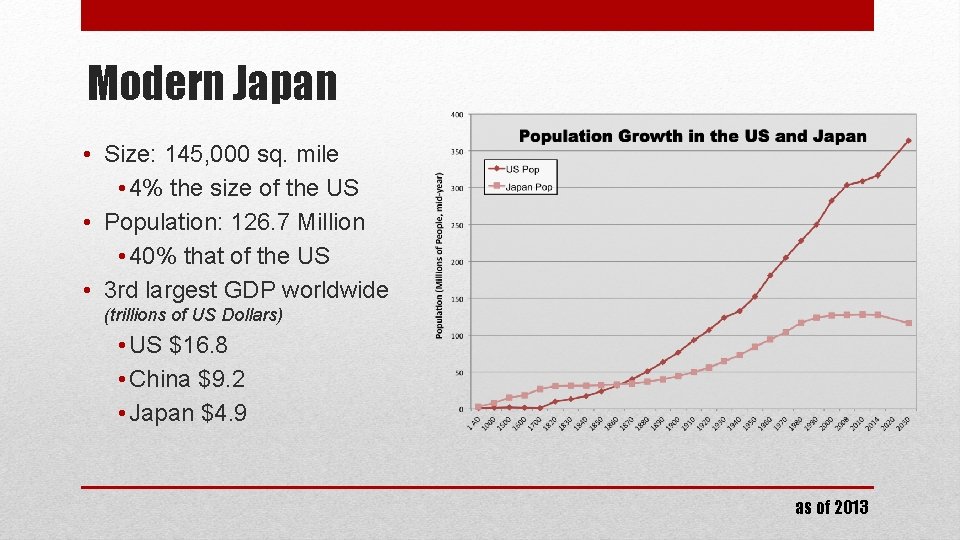
Modern Japan • Size: 145, 000 sq. mile • 4% the size of the US • Population: 126. 7 Million • 40% that of the US • 3 rd largest GDP worldwide (trillions of US Dollars) • US $16. 8 • China $9. 2 • Japan $4. 9 as of 2013
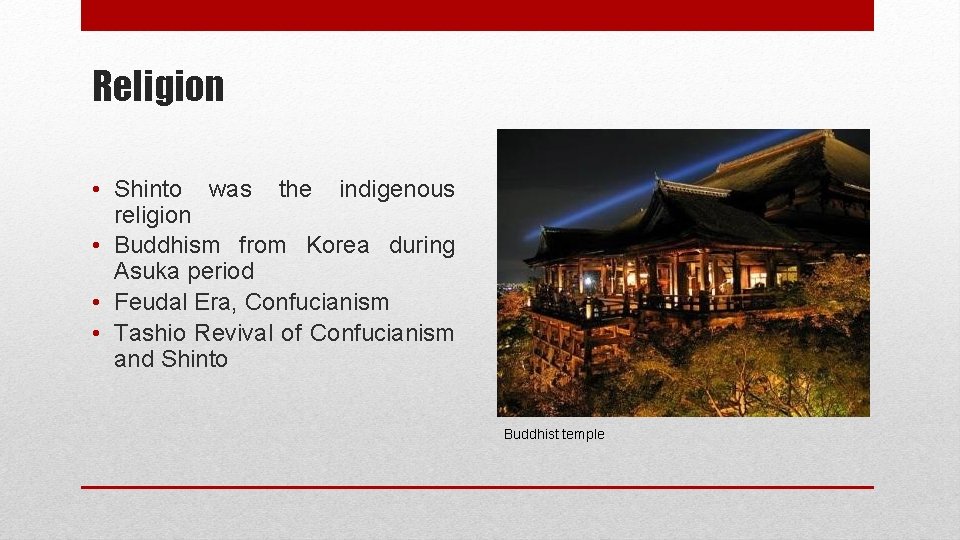
Religion • Shinto was the indigenous religion • Buddhism from Korea during Asuka period • Feudal Era, Confucianism • Tashio Revival of Confucianism and Shinto Buddhist temple
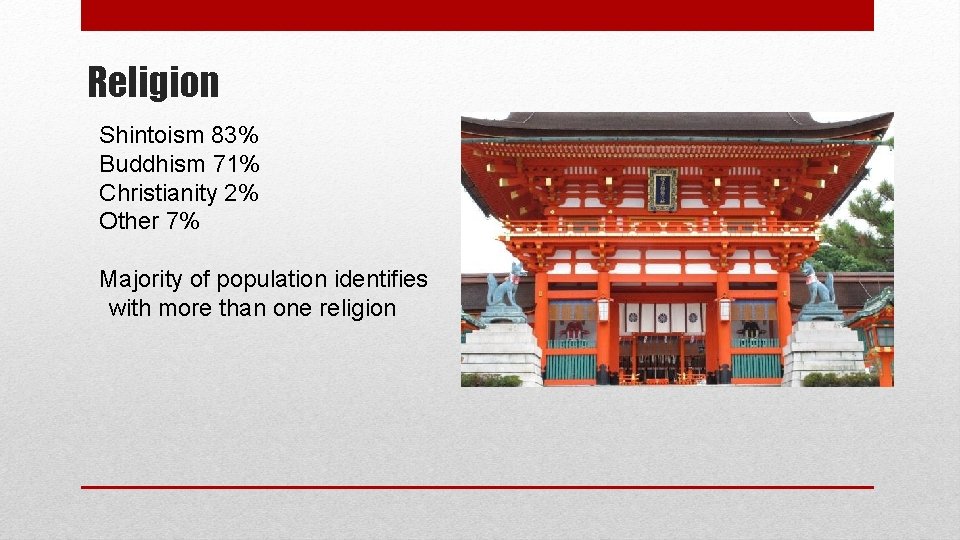
Religion Shintoism 83% Buddhism 71% Christianity 2% Other 7% Majority of population identifies with more than one religion
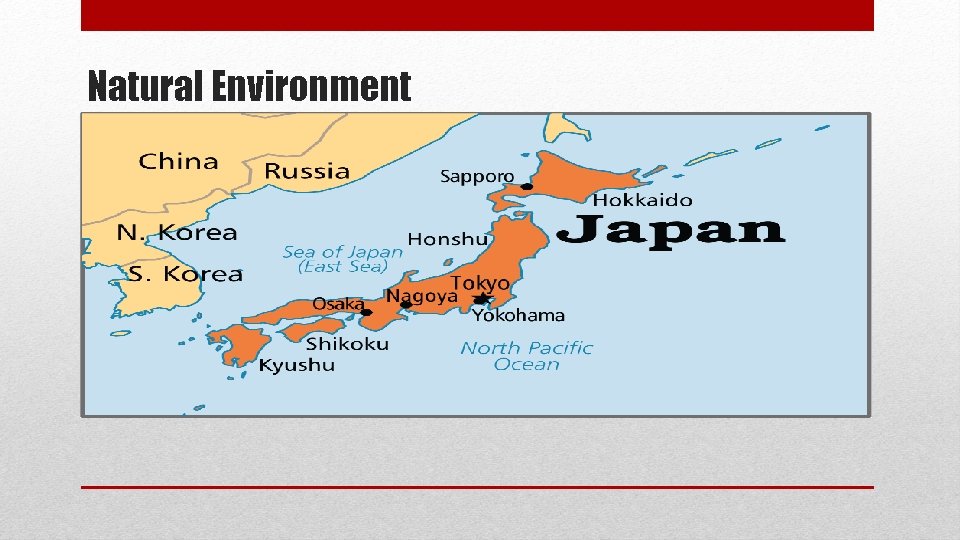
Natural Environment
Ancient Japan: 14000 BC to 538 AD Classical Japan: 538 – 1185
POLITICS AND THE LEGAL SYSTEM • Jōmon Period (14000 BC to 300 BC) ▪ ▪ Social ranking was present No superordinate chiefs emerged • Yayoi period (300 BC to 250 AD) ▪ ▪ Development of distinct social classes Wealth accumulation through land ownership • Kofun period (250 -538 AD) ▪ Yamato rulers gained control of Japan and neighboring states Ancient Japan (14000 BC to 538 AD)
POLITICS AND THE LEGAL SYSTEM • Centralized state • Emperor ruled by ‘Mandate of Heaven’ • Asuka Period (552 – 645) • introduction of Buddhism from Korea • adoption of a Chinese form of government • Nara period • height and decline of the Chinese-inspired system of government Classical Japan (538 – 1185)
POLITICS AND THE LEGAL SYSTEM • Imperial authority diminished by: • powerful retired emperors • regents ruling on behalf of child emperors • local officials seizing land for themselves, reducing government income and control • 1180 -1185: Shogunate established by Minamoto no Yorimoto Classical Japan (538 – 1185)
Economic Environment • Rice economy • Allocation of land taxes based on rice and produce • Country divided into provinces • each with governor • land grab Classical Japan (538 – 1185)
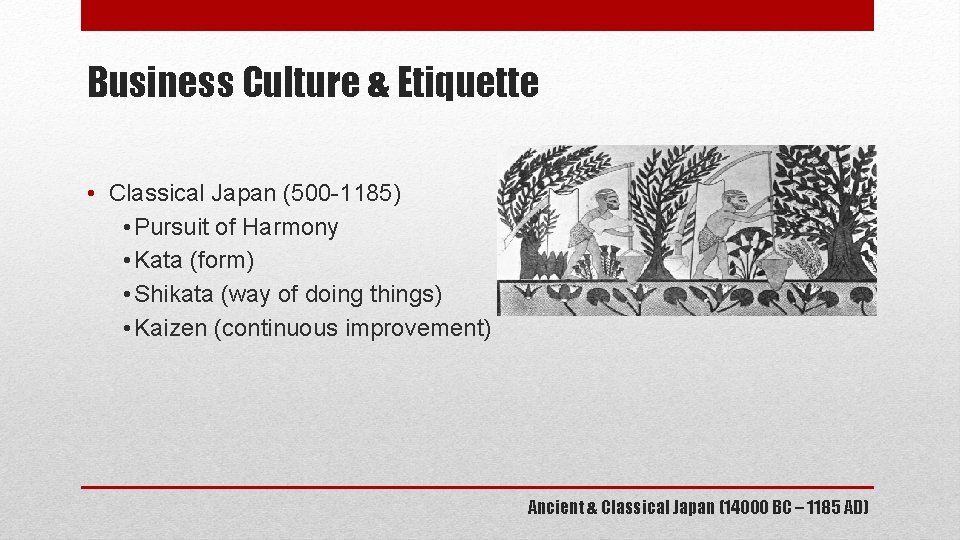
Business Culture & Etiquette • Classical Japan (500 -1185) • Pursuit of Harmony • Kata (form) • Shikata (way of doing things) • Kaizen (continuous improvement) Ancient & Classical Japan (14000 BC – 1185 AD)
Feudal (or Medieval) Periods Kamakura: 1185– 1333 Muromachi: 1336– 1573 Azuchi–Momoyama: 1568– 1603
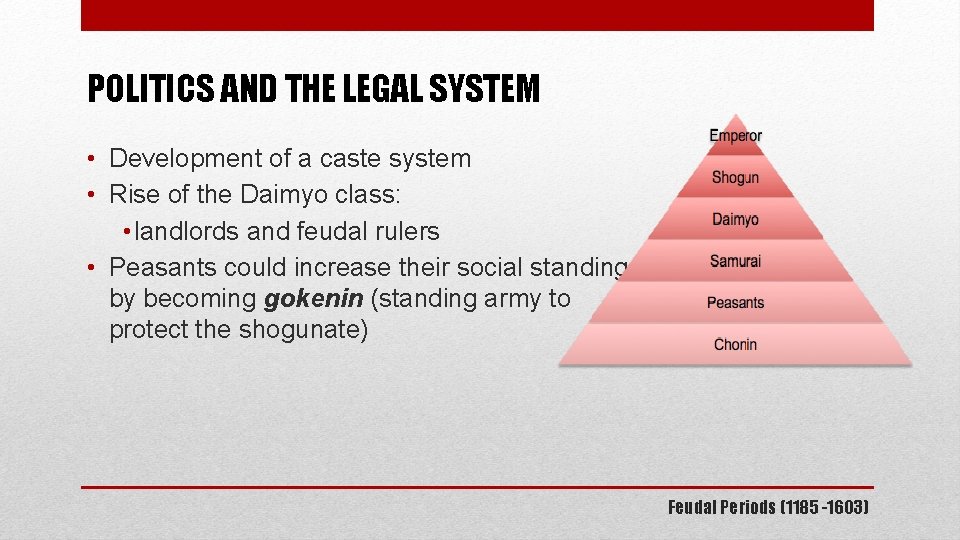
POLITICS AND THE LEGAL SYSTEM • Development of a caste system • Rise of the Daimyo class: • landlords and feudal rulers • Peasants could increase their social standing by becoming gokenin (standing army to protect the shogunate) Feudal Periods (1185 -1603)
POLITICS AND THE LEGAL SYSTEM • The Kenmu Restoration took place from 1333 to 1336 • Emperor Go-Daigo attempted to regain control from the shogunate. He lost and the shogunate system was reestablished. • He would be the last emperor to hold any power for the next 500 years. Feudal Periods (1185 -1603)
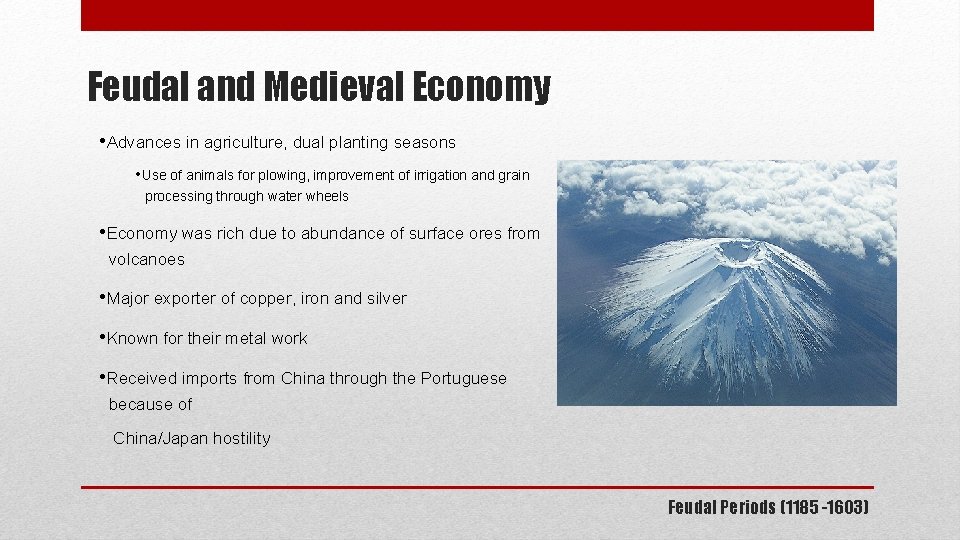
Feudal and Medieval Economy • Advances in agriculture, dual planting seasons • Use of animals for plowing, improvement of irrigation and grain processing through water wheels • Economy was rich due to abundance of surface ores from volcanoes • Major exporter of copper, iron and silver • Known for their metal work • Received imports from China through the Portuguese because of China/Japan hostility Feudal Periods (1185 -1603)
Edo Period: 1603 - 1868
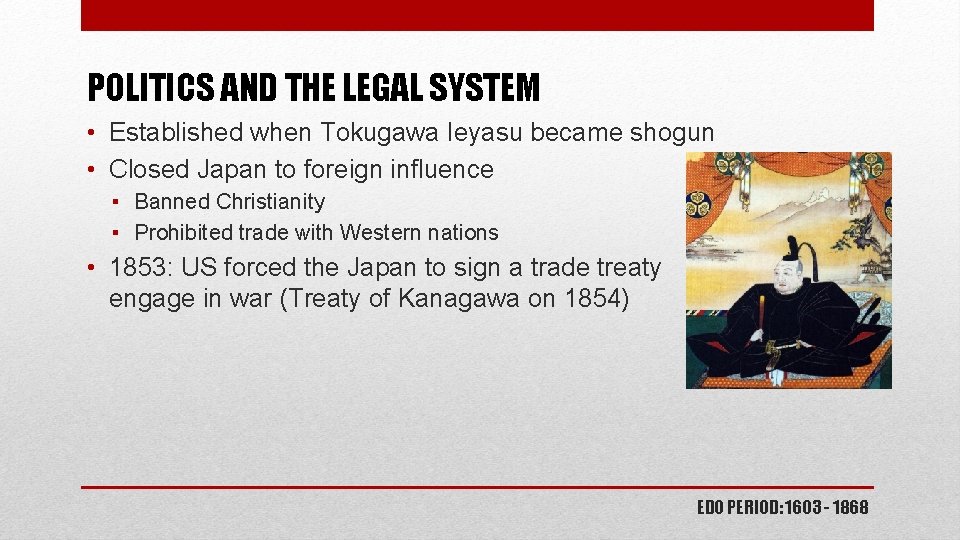
POLITICS AND THE LEGAL SYSTEM • Established when Tokugawa Ieyasu became shogun • Closed Japan to foreign influence ▪ Banned Christianity ▪ Prohibited trade with Western nations • 1853: US forced the Japan to sign a trade treaty or engage in war (Treaty of Kanagawa on 1854) EDO PERIOD: 1603 - 1868
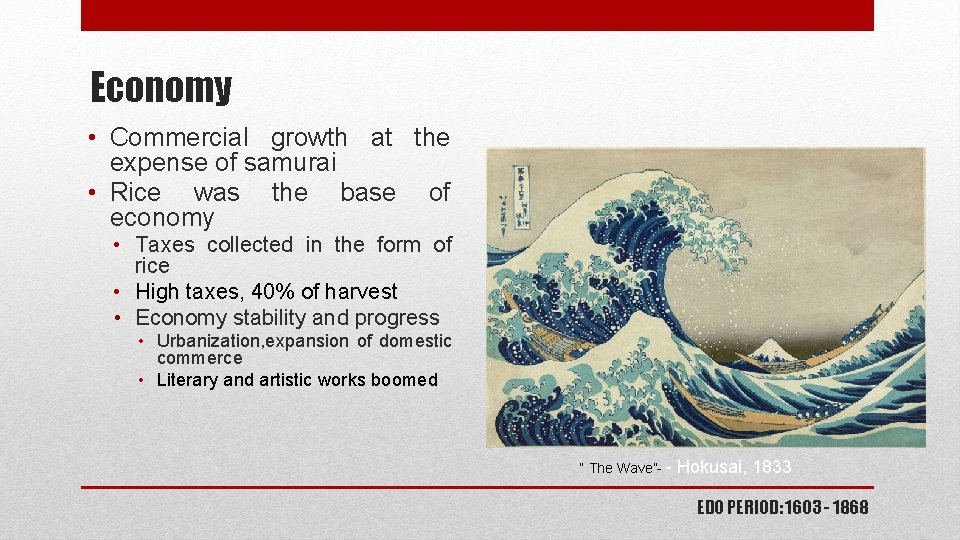
Economy • Commercial growth at the expense of samurai • Rice was the base of economy • Taxes collected in the form of rice • High taxes, 40% of harvest • Economy stability and progress • Urbanization, expansion of domestic commerce • Literary and artistic works boomed “ The Wave”- - Hokusai, 1833 EDO PERIOD: 1603 - 1868
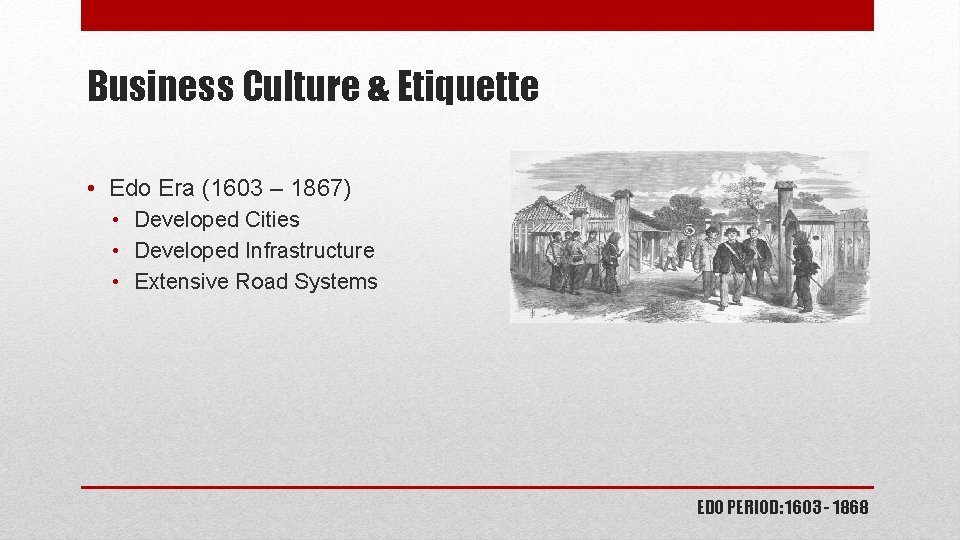
Business Culture & Etiquette • Edo Era (1603 – 1867) • Developed Cities • Developed Infrastructure • Extensive Road Systems EDO PERIOD: 1603 - 1868
Meiji Period: 1868 -1912 Taishō Period: 1912 - 1926 Shōwa Period, Pre-WWII: 1926 - 1945
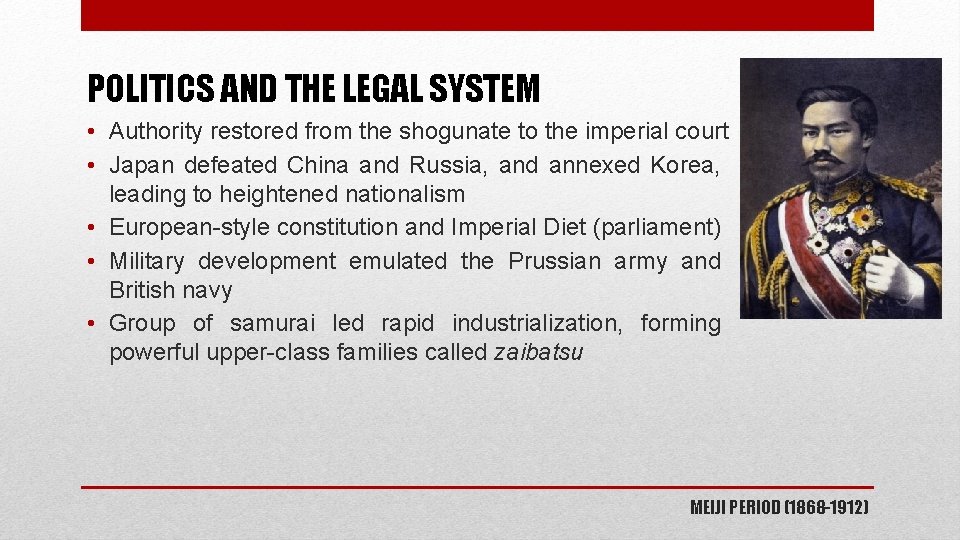
POLITICS AND THE LEGAL SYSTEM • Authority restored from the shogunate to the imperial court • Japan defeated China and Russia, and annexed Korea, leading to heightened nationalism • European-style constitution and Imperial Diet (parliament) • Military development emulated the Prussian army and British navy • Group of samurai led rapid industrialization, forming powerful upper-class families called zaibatsu MEIJI PERIOD (1868 -1912)
POLITICS AND THE LEGAL SYSTEM • Opened country to Western commerce - Textile industry grew fastest • More educated (western influenced) population lead to industrial growth and capitalism • Developed technology for military purposes • Financial crisis - Spent too much on domestic and overseas investments and defense programs • End of feudal system - Loose social structure, easier to move through ranks of society MEIJI PERIOD (1868 -1912)
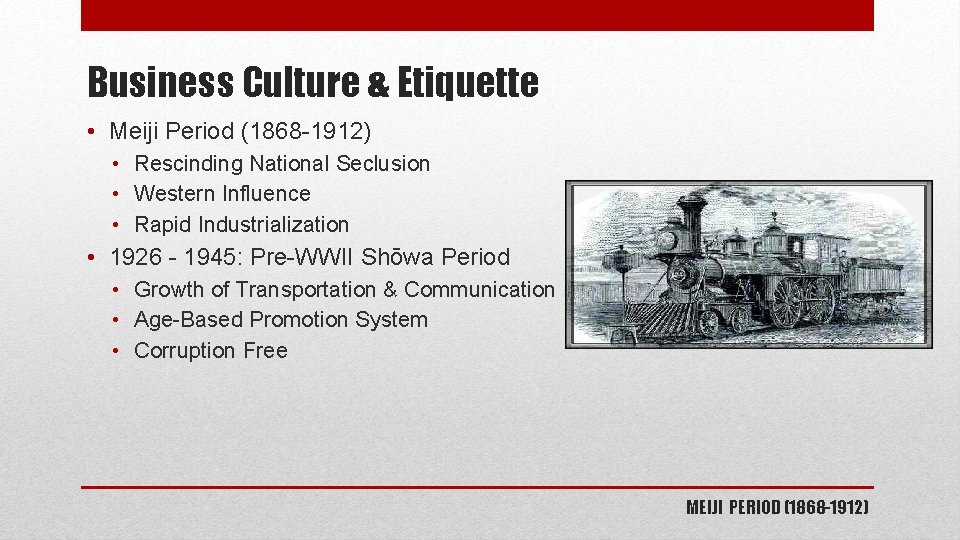
Business Culture & Etiquette • Meiji Period (1868 -1912) • Rescinding National Seclusion • Western Influence • Rapid Industrialization • 1926 - 1945: Pre-WWII Shōwa Period • Growth of Transportation & Communication • Age-Based Promotion System • Corruption Free MEIJI PERIOD (1868 -1912)
Influence on the Business Environment • Keiretsu (powerful corporations) and Keibatsu (family groups) established • Emerged from Zaibatsu of the Meiji Period • Controlled 75% of Japanese assets till World War II • Keiretsu each centered around one bank • Minimized risk of hostile takeovers MEIJI PERIOD (1868 -1912)
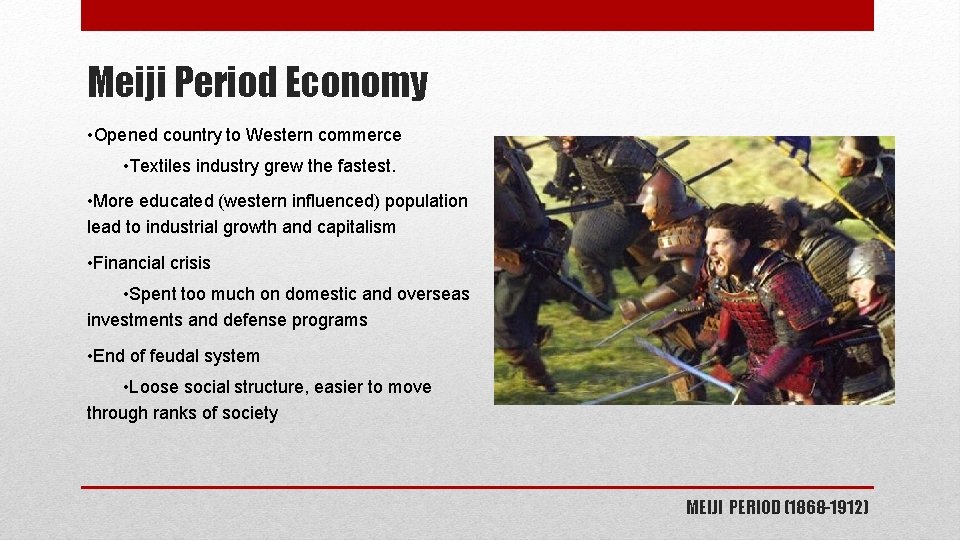
Meiji Period Economy • Opened country to Western commerce • Textiles industry grew the fastest. • More educated (western influenced) population lead to industrial growth and capitalism • Financial crisis • Spent too much on domestic and overseas investments and defense programs • End of feudal system • Loose social structure, easier to move through ranks of society MEIJI PERIOD (1868 -1912)
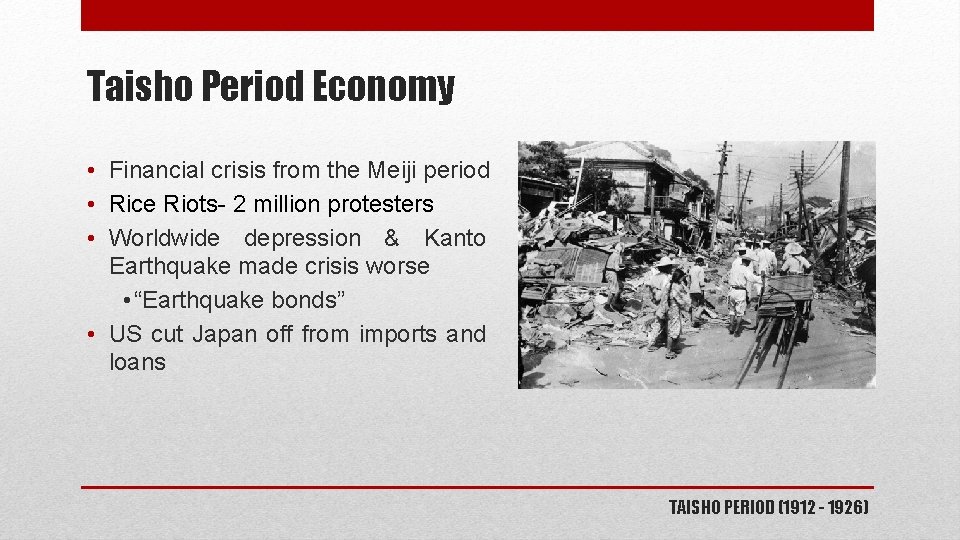
Taisho Period Economy • Financial crisis from the Meiji period • Rice Riots- 2 million protesters • Worldwide depression & Kanto Earthquake made crisis worse • “Earthquake bonds” • US cut Japan off from imports and loans TAISHO PERIOD (1912 - 1926)
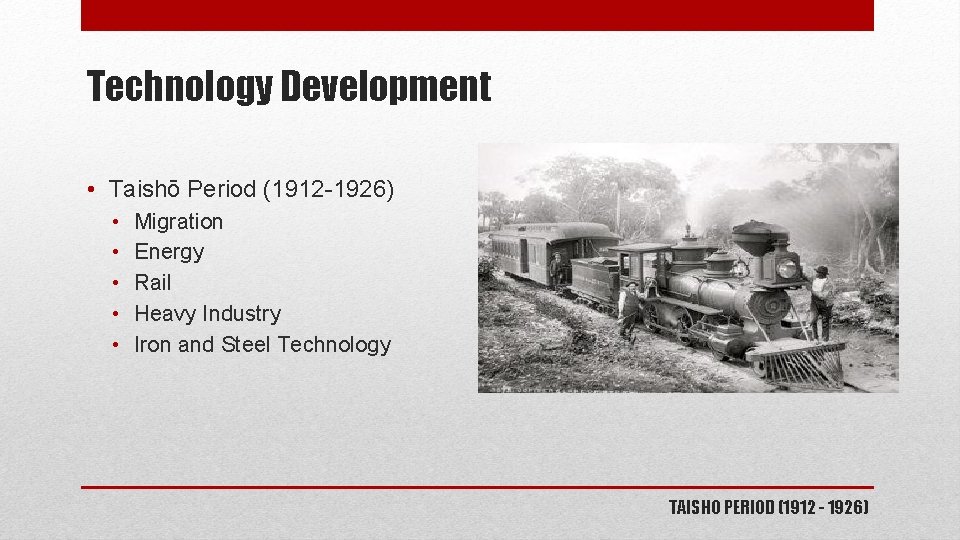
Technology Development • Taishō Period (1912 -1926) • • • Migration Energy Rail Heavy Industry Iron and Steel Technology TAISHO PERIOD (1912 - 1926)
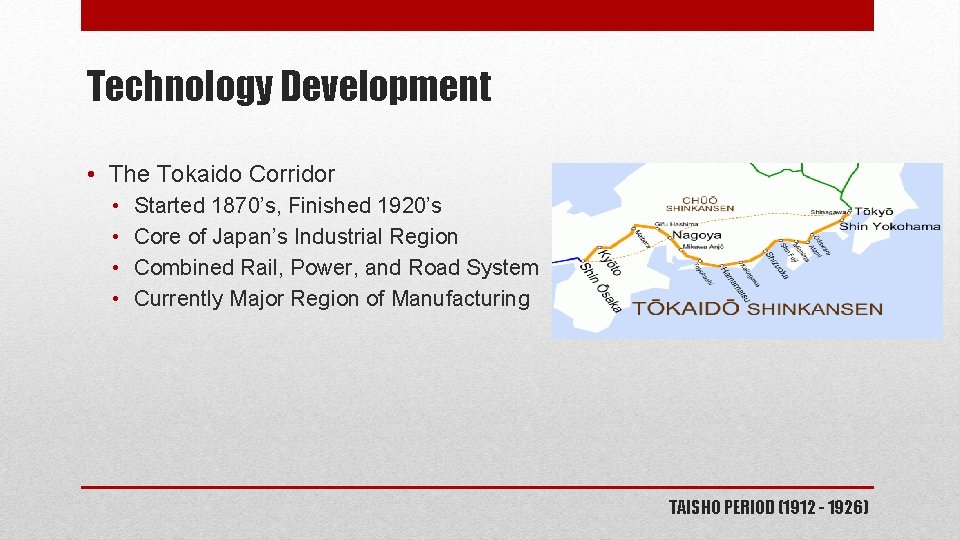
Technology Development • The Tokaido Corridor • • Started 1870’s, Finished 1920’s Core of Japan’s Industrial Region Combined Rail, Power, and Road System Currently Major Region of Manufacturing TAISHO PERIOD (1912 - 1926)
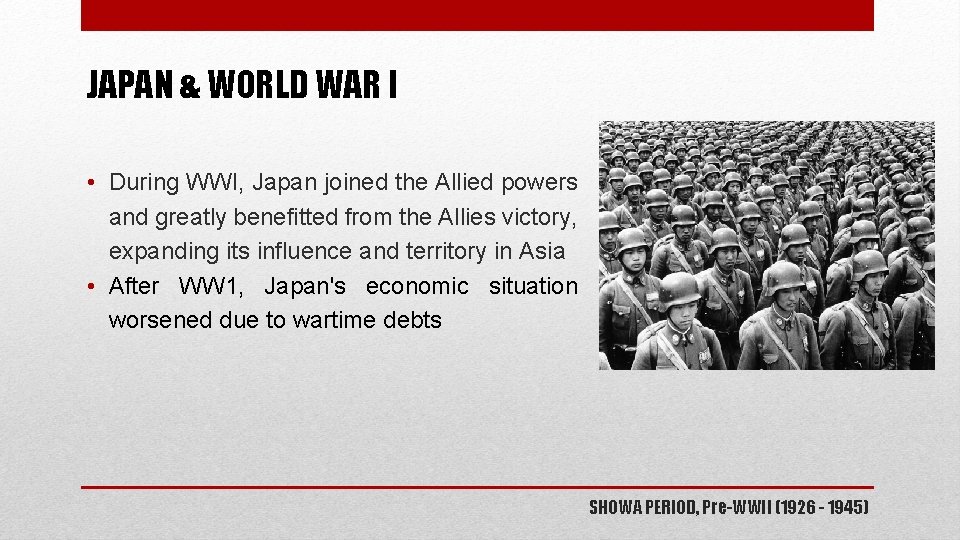
JAPAN & WORLD WAR I • During WWI, Japan joined the Allied powers and greatly benefitted from the Allies victory, expanding its influence and territory in Asia • After WW 1, Japan's economic situation worsened due to wartime debts SHOWA PERIOD, Pre-WWII (1926 - 1945)
POLITICS AND THE LEGAL SYSTEM • Emperor Hirohito ascended the throne in 1926 • In 1931, the Japanese Army acted independently of the government to invade Manchuria • Japan withdrew membership to League of Nations • 1937 saw the 2 nd Sino-Japanese War sanctioned by the emperor. • Japan decided to utilize Hitler’s war to unify Asia SHOWA PERIOD, Pre-WWII (1926 - 1945)
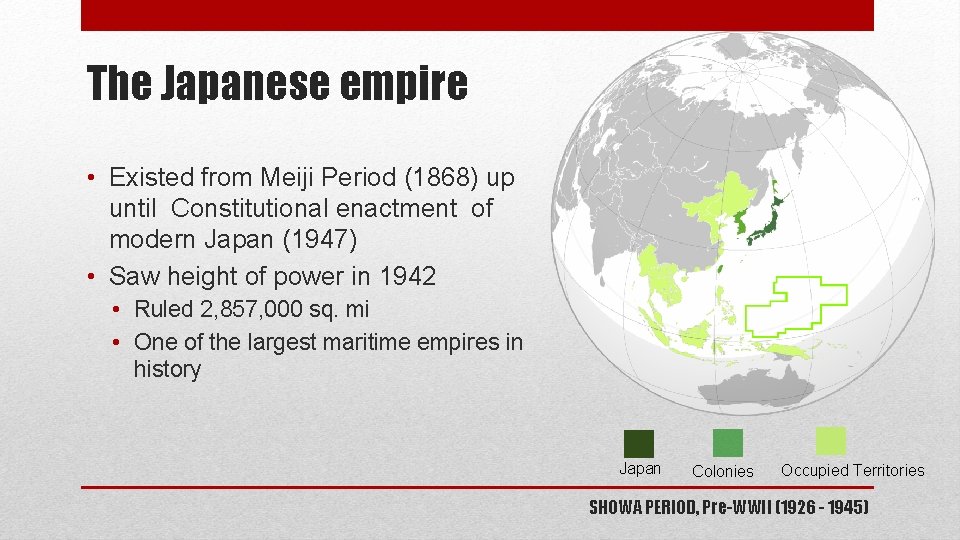
The Japanese empire • Existed from Meiji Period (1868) up until Constitutional enactment of modern Japan (1947) • Saw height of power in 1942 • Ruled 2, 857, 000 sq. mi • One of the largest maritime empires in history Japan Colonies Occupied Territories SHOWA PERIOD, Pre-WWII (1926 - 1945)
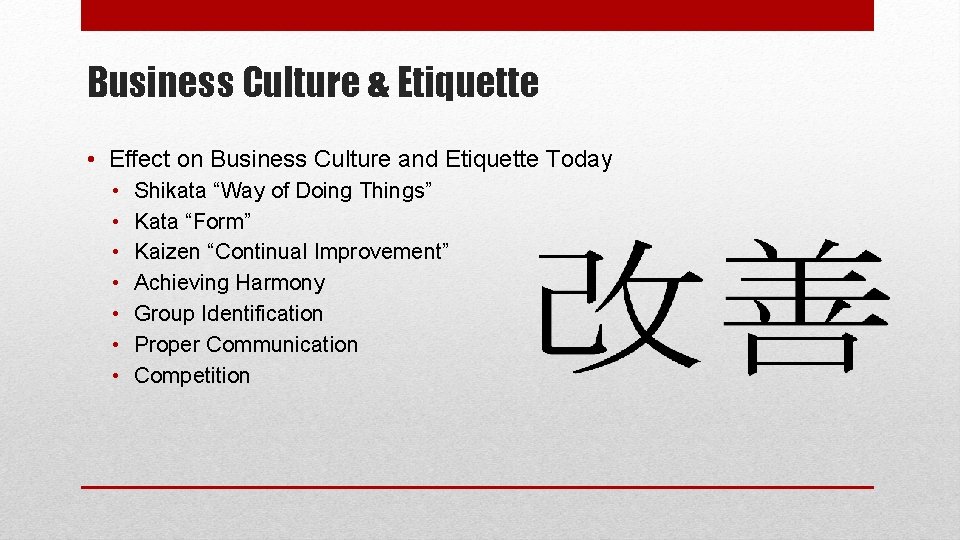
Business Culture & Etiquette • Effect on Business Culture and Etiquette Today • • Shikata “Way of Doing Things” Kata “Form” Kaizen “Continual Improvement” Achieving Harmony Group Identification Proper Communication Competition
- Slides: 34