
Previous TL Updates Teaching and Learning Improvement Dashboard
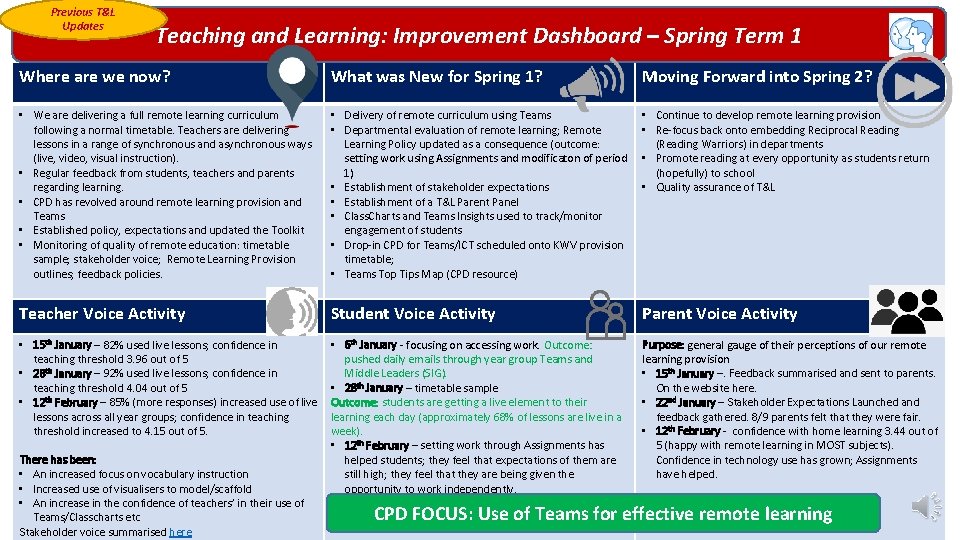
Previous T&L Updates Teaching and Learning: Improvement Dashboard – Spring Term 1 Where are we now? What was New for Spring 1? Moving Forward into Spring 2? • We are delivering a full remote learning curriculum following a normal timetable. Teachers are delivering lessons in a range of synchronous and asynchronous ways (live, video, visual instruction). • Regular feedback from students, teachers and parents regarding learning. • CPD has revolved around remote learning provision and Teams • Established policy, expectations and updated the Toolkit • Monitoring of quality of remote education: timetable sample; stakeholder voice; Remote Learning Provision outlines; feedback policies. • Delivery of remote curriculum using Teams • Departmental evaluation of remote learning; Remote Learning Policy updated as a consequence (outcome: setting work using Assignments and modificaton of period 1) • Establishment of stakeholder expectations • Establishment of a T&L Parent Panel • Class. Charts and Teams Insights used to track/monitor engagement of students • Drop-in CPD for Teams/ICT scheduled onto KWV provision timetable; • Teams Top Tips Map (CPD resource) • Continue to develop remote learning provision • Re-focus back onto embedding Reciprocal Reading (Reading Warriors) in departments • Promote reading at every opportunity as students return (hopefully) to school • Quality assurance of T&L Teacher Voice Activity Student Voice Activity Parent Voice Activity • 15 th January – 82% used live lessons; confidence in teaching threshold 3. 96 out of 5 • 28 th January – 92% used live lessons; confidence in teaching threshold 4. 04 out of 5 • 12 th February – 85% (more responses) increased use of live lessons across all year groups; confidence in teaching threshold increased to 4. 15 out of 5. • 6 th January - focusing on accessing work. Outcome: pushed daily emails through year group Teams and Middle Leaders (SIG). • 28 th January – timetable sample Outcome: students are getting a live element to their learning each day (approximately 68% of lessons are live in a week). • 12 th February – setting work through Assignments has helped students; they feel that expectations of them are still high; they feel that they are being given the opportunity to work independently. Purpose: general gauge of their perceptions of our remote learning provision • 15 th January –. Feedback summarised and sent to parents. On the website here. • 22 nd January – Stakeholder Expectations Launched and feedback gathered. 8/9 parents felt that they were fair. • 12 th February - confidence with home learning 3. 44 out of 5 (happy with remote learning in MOST subjects). Confidence in technology use has grown; Assignments have helped. There has been: • An increased focus on vocabulary instruction • Increased use of visualisers to model/scaffold • An increase in the confidence of teachers’ in their use of Teams/Classcharts etc Stakeholder voice summarised here CPD FOCUS: Use of Teams for effective remote learning
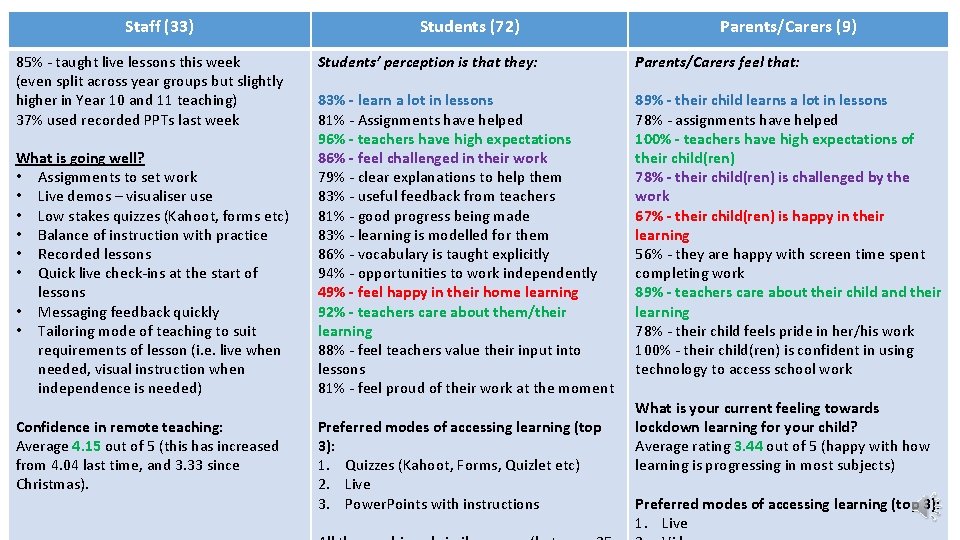
Staff (33) 85% - taught live lessons this week (even split across year groups but slightly higher in Year 10 and 11 teaching) 37% used recorded PPTs last week What is going well? • Assignments to set work • Live demos – visualiser use • Low stakes quizzes (Kahoot, forms etc) • Balance of instruction with practice • Recorded lessons • Quick live check-ins at the start of lessons • Messaging feedback quickly • Tailoring mode of teaching to suit requirements of lesson (i. e. live when needed, visual instruction when independence is needed) Confidence in remote teaching: Average 4. 15 out of 5 (this has increased from 4. 04 last time, and 3. 33 since Christmas). Students (72) Parents/Carers (9) Students’ perception is that they: Parents/Carers feel that: 83% - learn a lot in lessons 81% - Assignments have helped 96% - teachers have high expectations 86% - feel challenged in their work 79% - clear explanations to help them 83% - useful feedback from teachers 81% - good progress being made 83% - learning is modelled for them 86% - vocabulary is taught explicitly 94% - opportunities to work independently 49% - feel happy in their home learning 92% - teachers care about them/their learning 88% - feel teachers value their input into lessons 81% - feel proud of their work at the moment 89% - their child learns a lot in lessons 78% - assignments have helped 100% - teachers have high expectations of their child(ren) 78% - their child(ren) is challenged by the work 67% - their child(ren) is happy in their learning 56% - they are happy with screen time spent completing work 89% - teachers care about their child and their learning 78% - their child feels pride in her/his work 100% - their child(ren) is confident in using technology to access school work Preferred modes of accessing learning (top 3): 1. Quizzes (Kahoot, Forms, Quizlet etc) 2. Live 3. Power. Points with instructions What is your current feeling towards lockdown learning for your child? Average rating 3. 44 out of 5 (happy with how learning is progressing in most subjects) Preferred modes of accessing learning (top 3): 1. Live
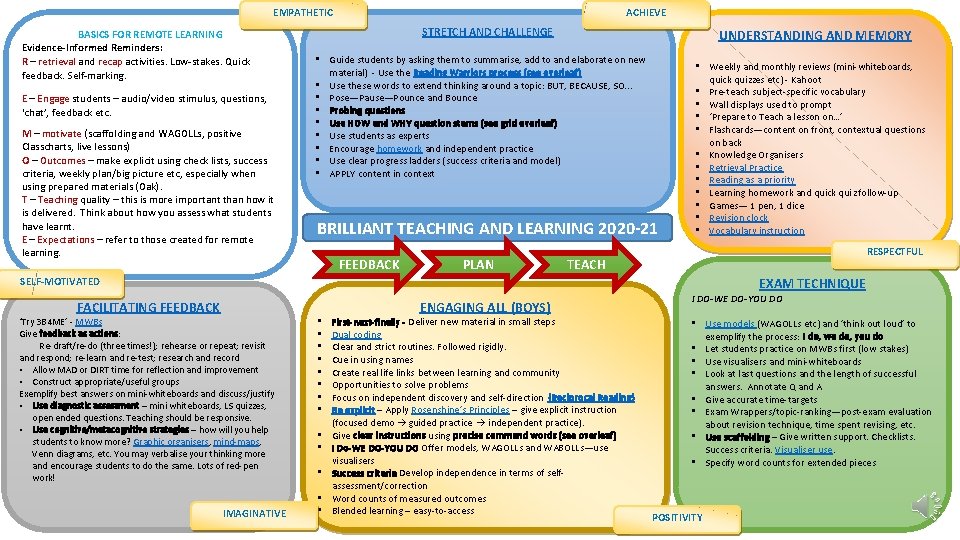
EMPATHETIC BASICS FOR REMOTE LEARNING Evidence-Informed Reminders: R – retrieval and recap activities. Low-stakes. Quick feedback. Self-marking. E – Engage students – audio/video stimulus, questions, ‘chat’, feedback etc. M – motivate (scaffolding and WAGOLLs, positive Classcharts, live lessons) O – Outcomes – make explicit using check lists, success criteria, weekly plan/big picture etc, especially when using prepared materials (Oak). T – Teaching quality – this is more important than how it is delivered. Think about how you assess what students have learnt. E – Expectations – refer to those created for remote learning. ACHIEVE STRETCH AND CHALLENGE UNDERSTANDING AND MEMORY • Guide students by asking them to summarise, add to and elaborate on new material) - Use the Reading Warriors process (see overleaf) • Use these words to extend thinking around a topic: BUT, BECAUSE, SO. . . • Pose—Pause—Pounce and Bounce • Probing questions • Use HOW and WHY question stems (see grid overleaf) • Use students as experts • Encourage homework and independent practice • Use clear progress ladders (success criteria and model) • APPLY content in context BRILLIANT TEACHING AND LEARNING 2020 -21 FEEDBACK PLAN • Weekly and monthly reviews (mini-whiteboards, quick quizzes etc) - Kahoot • Pre-teach subject-specific vocabulary • Wall displays used to prompt • ‘Prepare to Teach a lesson on…’ • Flashcards—content on front, contextual questions on back • Knowledge Organisers • Retrieval Practice • Reading as a priority • Learning homework and quick quiz follow-up • Games— 1 pen, 1 dice • Revision clock • Vocabulary instruction RESPECTFUL TEACH SELF-MOTIVATED EXAM TECHNIQUE FACILITATING FEEDBACK ‘Try 3 B 4 ME’ - MWBs Give feedback as actions: Re-draft/re-do (three times!); rehearse or repeat; revisit and respond; re-learn and re-test; research and record • Allow MAD or DIRT time for reflection and improvement • Construct appropriate/useful groups Exemplify best answers on mini-whiteboards and discuss/justify • Use diagnostic assessment – mini whiteboards, LS quizzes, open ended questions. Teaching should be responsive. • Use cognitive/metacognitive strategies – how will you help students to know more? Graphic organisers, mind-maps, Venn diagrams, etc. You may verbalise your thinking more and encourage students to do the same. Lots of red-pen work! IMAGINATIVE • • • • ENGAGING ALL (BOYS) First-next-finally - Deliver new material in small steps Dual coding Clear and strict routines. Followed rigidly. Cue in using names Create real life links between learning and community Opportunities to solve problems Focus on independent discovery and self-direction (Reciprocal Reading) Be explicit – Apply Rosenshine’s Principles – give explicit instruction (focused demo guided practice independent practice). Give clear instructions using precise command words (see overleaf) I Do-WE DO-YOU DO Offer models, WAGOLLs and WABOLLs—use visualisers Success criteria Develop independence in terms of selfassessment/correction Word counts of measured outcomes Blended learning – easy-to-access I DO-WE DO-YOU DO • Use models (WAGOLLs etc) and ‘think out loud’ to exemplify the process: I do, we do, you do • Let students practice on MWBs first (low stakes) • Use visualisers and mini-whiteboards • Look at last questions and the length of successful answers. Annotate Q and A • Give accurate time-targets • Exam Wrappers/topic-ranking—post-exam evaluation about revision technique, time spent revising, etc. • Use scaffolding – Give written support. Checklists. Success criteria. Visualiser use. • Specify word counts for extended pieces POSITIVITY
- Slides: 3