
Previous Lesson RECAP Formal or informal education 1





- Slides: 16
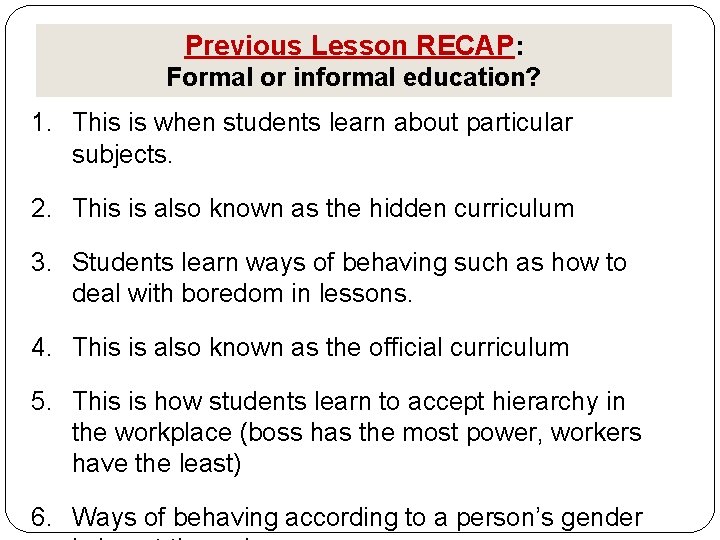
Previous Lesson RECAP: Formal or informal education? 1. This is when students learn about particular subjects. 2. This is also known as the hidden curriculum 3. Students learn ways of behaving such as how to deal with boredom in lessons. 4. This is also known as the official curriculum 5. This is how students learn to accept hierarchy in the workplace (boss has the most power, workers have the least) 6. Ways of behaving according to a person’s gender
Social class and educational achievement • Grade A/A* - evaluate the reasons for class differences in educational achievement. • Grade B –explain the reasons for class differences in educational achievement.
Starter HOW DO YOU THINK YOUR TEACHERS TALK ABOUT YOU? - Start by listing some of the key words that YOU think describe you … - Then, list some key words you think your teachers would use in describing you… - Do you think the ‘labels’ your teachers have about you affect how they behave towards you?
Types of schools Comprehensive – free education provided by the state, accept all students regardless of their background or abilities. Independent/private schools • • Public schools – older and more famous independent schools such as Eton Charge fees Can choose who enters their school based on pre-entry ability tests.
Working class children are: �Less likely to go to nursery �More likely to start school unable to read �More likely to fall behind in reading, writing and numeracy �More likely to be placed in lower sets ? TASK: Working in pairs, write down a list of possible reasons for the points above. Then rank your reasons from the most to the least
Class and achievement �Statistics show that students from working class backgrounds, on average, achieve less well in school than middle class students �Sociologists have suggested different reasons for the underachievement of working
Factors leading to working class underachievement Home background: �Material deprivation �Cultural deprivation �Parents’ attitudes School factors: �Teacher labelling �Streaming/setting �Anti-school subcultures
Notes �Make your own notes on the factors leading to the underachievement of working class students �Think about carefully about how you set your work out using CAPITALS, underlining, colour and spacing to make your work easy to read. �Extension: Rank the factors from the most to the least important
4 Marks Questions ACTIVITY – Working in pairs, you have 10 mins to plan your answers together for the first two 4 marks questions. Extension Questions: Explain what sociologists mean by cultural capital Explain what sociologists mean by a self-fulfilling prophecy
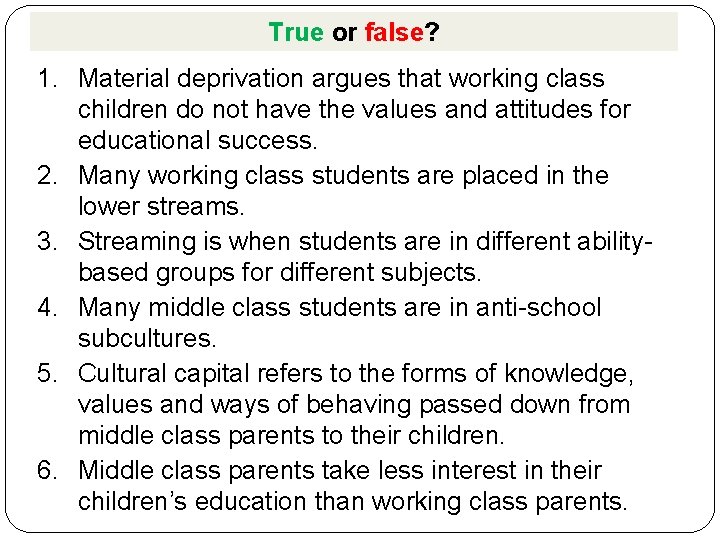
True or false? 1. Material deprivation argues that working class children do not have the values and attitudes for educational success. 2. Many working class students are placed in the lower streams. 3. Streaming is when students are in different abilitybased groups for different subjects. 4. Many middle class students are in anti-school subcultures. 5. Cultural capital refers to the forms of knowledge, values and ways of behaving passed down from middle class parents to their children. 6. Middle class parents take less interest in their children’s education than working class parents.
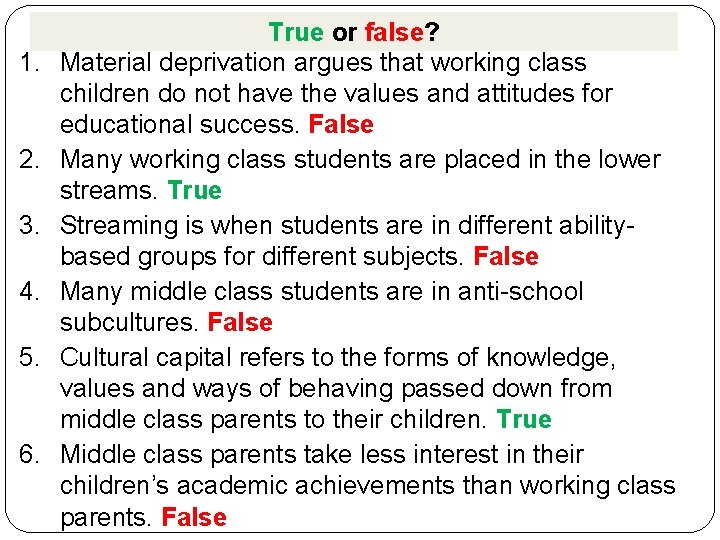
1. 2. 3. 4. 5. 6. True or false? Material deprivation argues that working class children do not have the values and attitudes for educational success. False Many working class students are placed in the lower streams. True Streaming is when students are in different abilitybased groups for different subjects. False Many middle class students are in anti-school subcultures. False Cultural capital refers to the forms of knowledge, values and ways of behaving passed down from middle class parents to their children. True Middle class parents take less interest in their children’s academic achievements than working class parents. False
Material deprivation �Many working class children suffer from material deprivation �A lack of money which leads to disadvantages such as an unhealthy diet, overcrowded housing and not being able to afford educational resources. How might material deprivation affect the achievement of working class pupils?
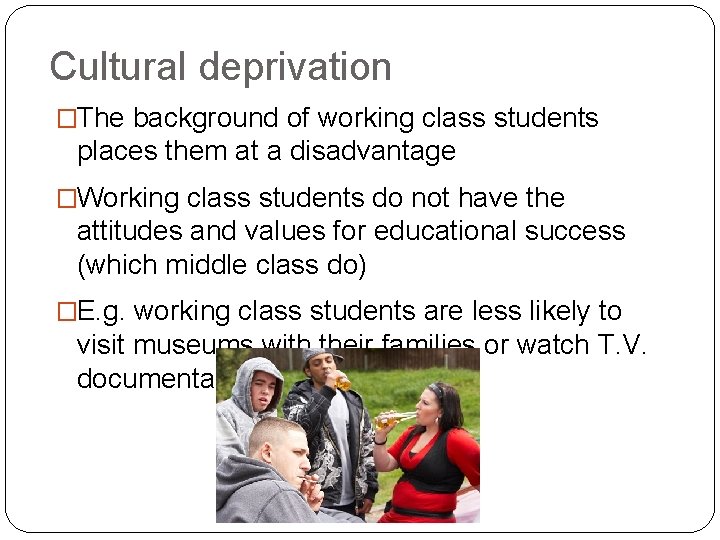
Cultural deprivation �The background of working class students places them at a disadvantage �Working class students do not have the attitudes and values for educational success (which middle class do) �E. g. working class students are less likely to visit museums with their families or watch T. V. documentaries
Video Activity Watch the video carefully, for the working class pupil write down examples of: �Material deprivation �Cultural deprivation
Brainstorm Why do children from middle class backgrounds get better results?
What rule do you need to follow when answering 4 marks questions? Define Explain Example Criticise/compare