
Preview Bem 2011 claimed that through nine experiments
Preview • Bem, 2011, claimed that through nine experiments he had demonstrated the existence of precognition • Failure to replicate: “Across seven experiments (N= 3, 289), we replicate the procedure of Experiments 8 and 9 from Bem (2011), which had originally demonstrated retroactive facilitation of recall. We failed to replicate that finding. ” Galek et. al. 2012 • Sampling error, something unique about the participants in the Bem experiments. – Related to inter-individual variability • Research methodology

Inter- and Intra-individual Differences • “Among the most striking characteristics of human cognition is its variability, which is present both between people (interindividual variability) and within a given person (intra-individual variability). ” Siegler 2006 – Intra-individual variability (within a person) • an indicator of the functioning of the central nervous system – inter-individual variability (between people) • Source of sampling error • Example: Reaction Time Test experiments – http: //www. bbc. co. uk/science/humanbody/sleep/sheep/reacti on_version 5. swf – Record a series of reaction times

Example data from reaction time test
Variability • A measure of how spread out the scores are in a distribution • Usually accompanies a measure of central tendency as basic descriptive statistics for a set of scores • As a descriptive measure variability measures the degree to which the scores are spread out or clustered together in a distribution. • As an important component of most inferential statistics variability provides a measure of how accurately any individual score or sample represents the entire population
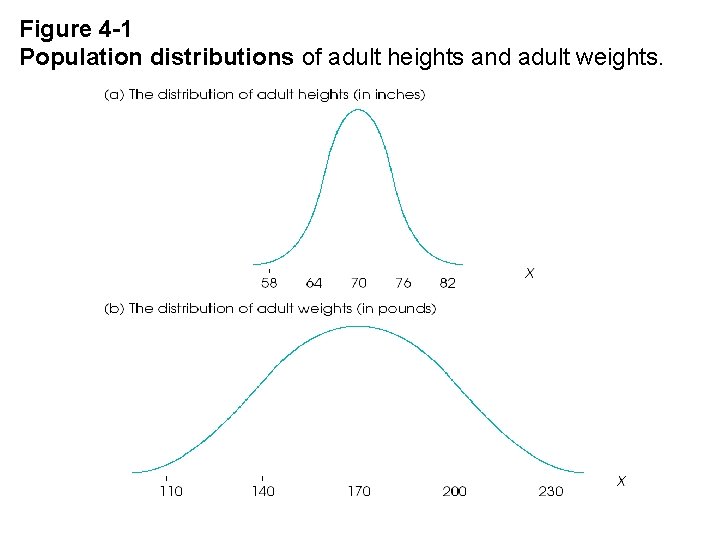
Figure 4 -1 Population distributions of adult heights and adult weights.
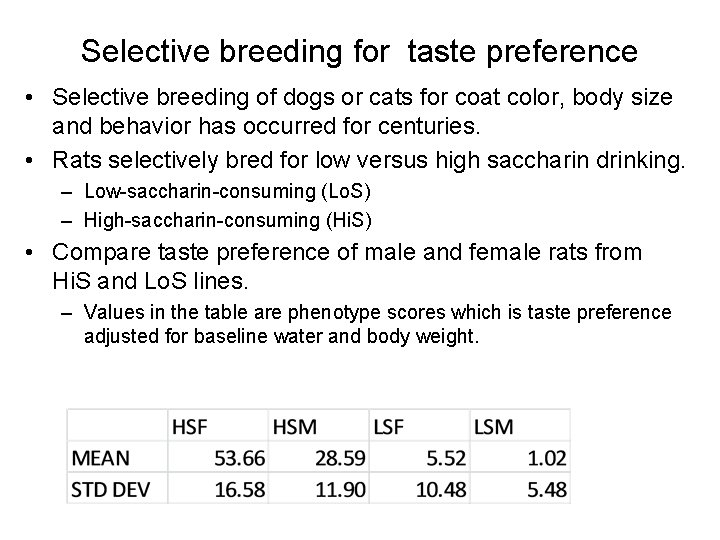
Selective breeding for taste preference • Selective breeding of dogs or cats for coat color, body size and behavior has occurred for centuries. • Rats selectively bred for low versus high saccharin drinking. – Low-saccharin-consuming (Lo. S) – High-saccharin-consuming (Hi. S) • Compare taste preference of male and female rats from Hi. S and Lo. S lines. – Values in the table are phenotype scores which is taste preference adjusted for baseline water and body weight.

Measuring Variability • Variability can be measured with – range is the total distance covered by the distribution, from the highest score to the lowest score – variance average square distance from the mean – standard deviation measures the standard distance between a score and the mean • In each case, variability is determined by measuring distance.
The Range • The range is the total distance covered by the distribution • The range tells us the number of measurement categories. – from the highest score (MAX) to the lowest score (MIN) • For continuous variables • From Upper Real Limit for Xmax to Lower Real Limit for Xmin • Scores from 1 to 5 ; from 5. 5 to 0. 5 = 5 • Alternative definition of range: – When scores are whole numbers or discrete variables with numerical scores, • Xmax – Xmin + 1 • Scores from 0 to 4 4 – 0 + 1 = 5
The Range • Commonly the range can be defined as the difference between the largest score (max) and the smallest score (min). • Used by SPSS computer program • Scores from 1 to 5 5 -1 = 4 • OK for discrete but not continuous variables • Which calculation is used usually does not matter • Range usually is not an accurate measurement of variability. • Completely determined by two scores (max – min) • An extreme large or small score will inflate the range • Can be used as an adjunctive measure with variance
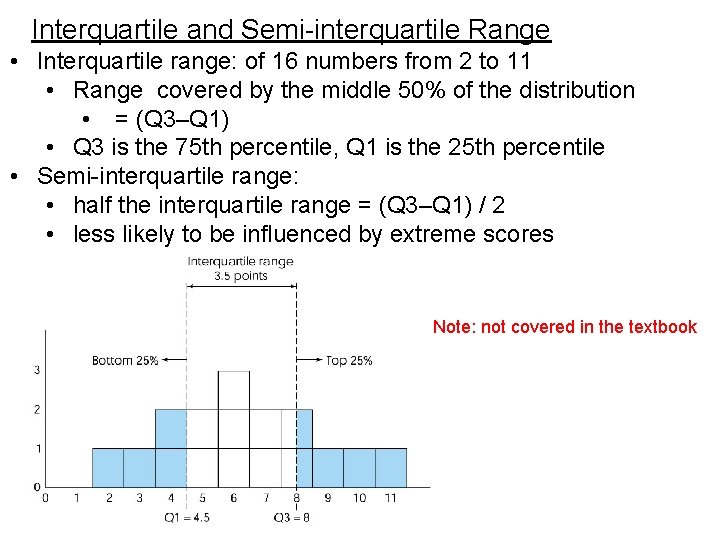
Interquartile and Semi-interquartile Range • Interquartile range: of 16 numbers from 2 to 11 • Range covered by the middle 50% of the distribution • = (Q 3–Q 1) • Q 3 is the 75 th percentile, Q 1 is the 25 th percentile • Semi-interquartile range: • half the interquartile range = (Q 3–Q 1) / 2 • less likely to be influenced by extreme scores Note: not covered in the textbook
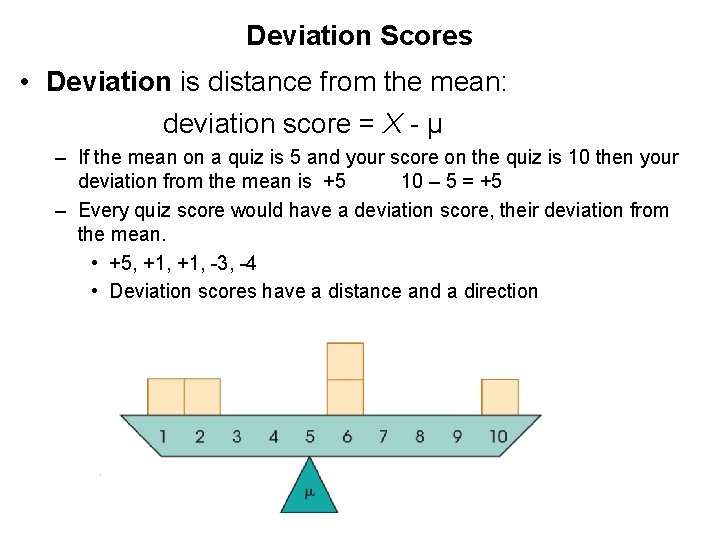
Deviation Scores • Deviation is distance from the mean: deviation score = X - µ – If the mean on a quiz is 5 and your score on the quiz is 10 then your deviation from the mean is +5 10 – 5 = +5 – Every quiz score would have a deviation score, their deviation from the mean. • +5, +1, -3, -4 • Deviation scores have a distance and a direction
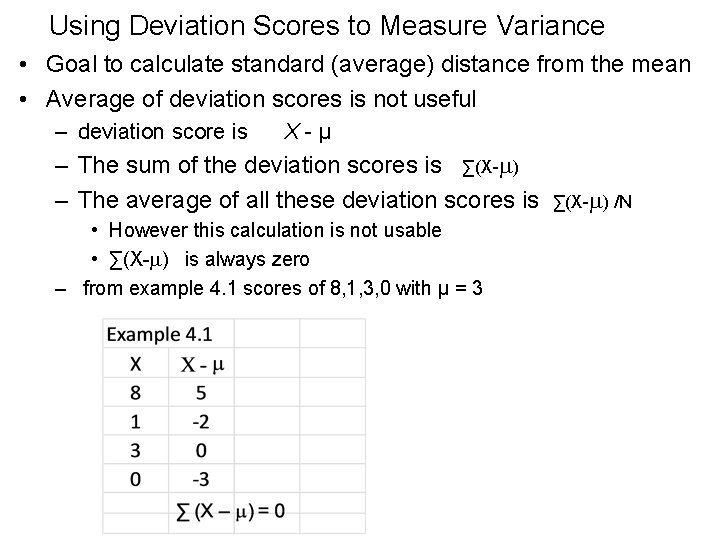
Using Deviation Scores to Measure Variance • Goal to calculate standard (average) distance from the mean • Average of deviation scores is not useful – deviation score is X-µ – The sum of the deviation scores is ∑(X-m) – The average of all these deviation scores is • However this calculation is not usable • ∑(X-m) is always zero – from example 4. 1 scores of 8, 1, 3, 0 with µ = 3 ∑(X-m) /N
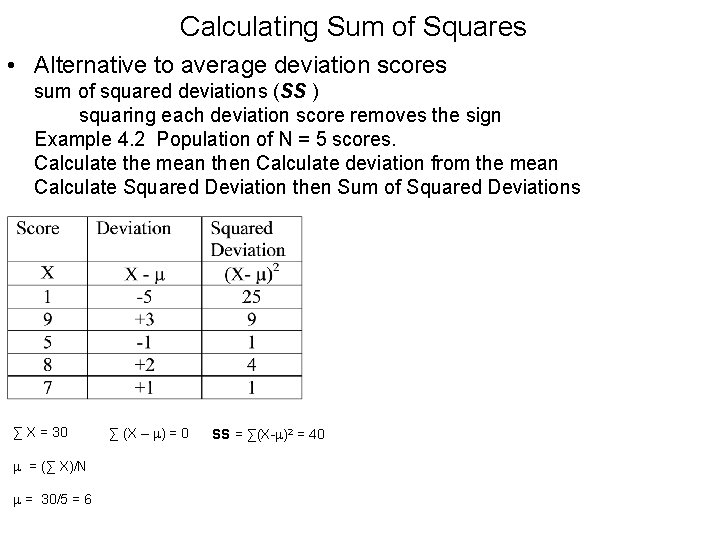
Calculating Sum of Squares • Alternative to average deviation scores sum of squared deviations (SS ) squaring each deviation score removes the sign Example 4. 2 Population of N = 5 scores. Calculate the mean then Calculate deviation from the mean Calculate Squared Deviation then Sum of Squared Deviations ∑ X = 30 m = (∑ X)/N m = 30/5 = 6 ∑ (X – m) = 0 SS = ∑(X-m)2 = 40
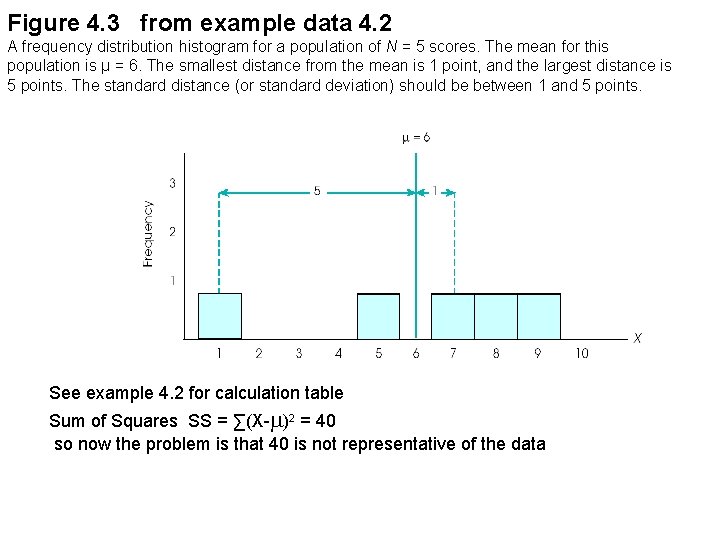
Figure 4. 3 from example data 4. 2 A frequency distribution histogram for a population of N = 5 scores. The mean for this population is µ = 6. The smallest distance from the mean is 1 point, and the largest distance is 5 points. The standard distance (or standard deviation) should be between 1 and 5 points. See example 4. 2 for calculation table Sum of Squares SS = ∑(X-m)2 = 40 so now the problem is that 40 is not representative of the data
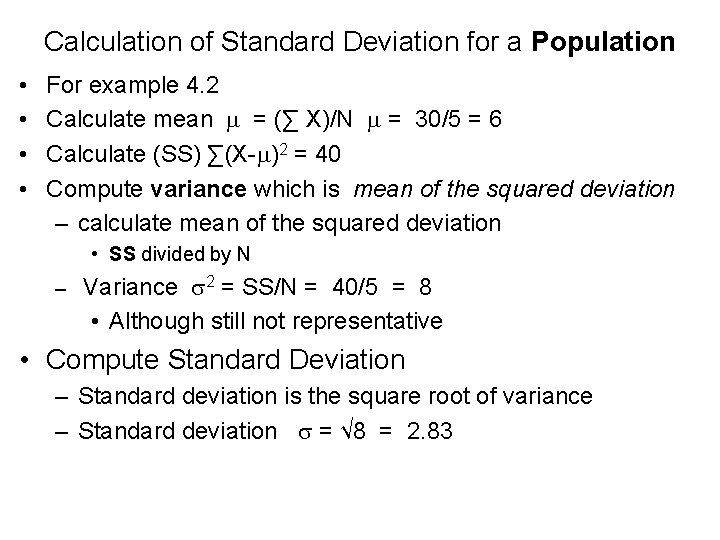
Calculation of Standard Deviation for a Population • • For example 4. 2 Calculate mean m = (∑ X)/N m = 30/5 = 6 Calculate (SS) ∑(X-m)2 = 40 Compute variance which is mean of the squared deviation – calculate mean of the squared deviation • SS divided by N – Variance s 2 = SS/N = 40/5 = 8 • Although still not representative • Compute Standard Deviation – Standard deviation is the square root of variance – Standard deviation s = √ 8 = 2. 83
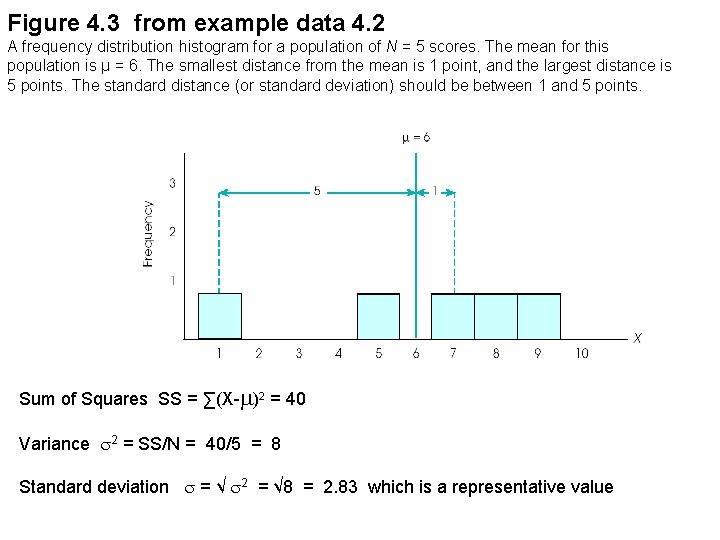
Figure 4. 3 from example data 4. 2 A frequency distribution histogram for a population of N = 5 scores. The mean for this population is µ = 6. The smallest distance from the mean is 1 point, and the largest distance is 5 points. The standard distance (or standard deviation) should be between 1 and 5 points. Sum of Squares SS = ∑(X-m)2 = 40 Variance s 2 = SS/N = 40/5 = 8 Standard deviation s = √ s 2 = √ 8 = 2. 83 which is a representative value
Variance and Standard Deviation • Variance equals the mean of the squared deviations. – Variance is the average squared distance from the mean. • Standard deviation is the square root of the variance and provides a measure of the standard, or average distance from the mean.
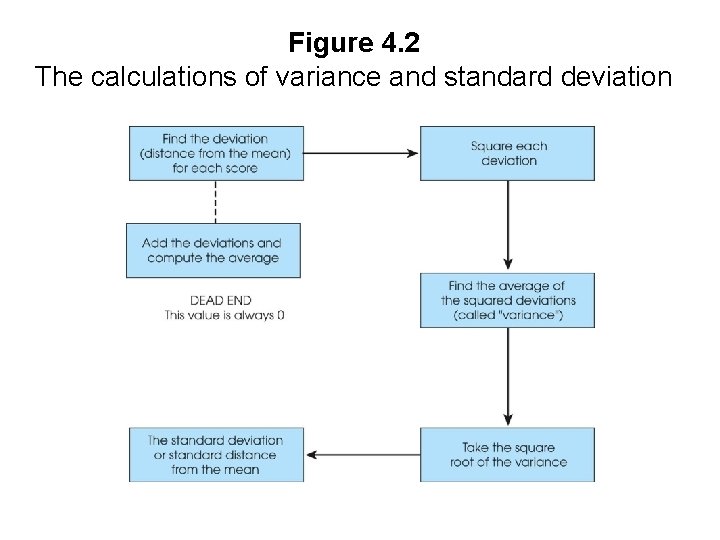
Figure 4. 2 The calculations of variance and standard deviation
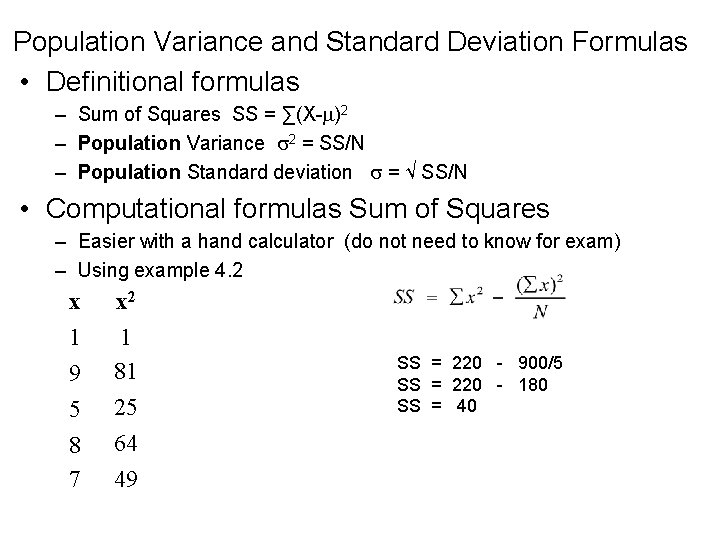
Population Variance and Standard Deviation Formulas • Definitional formulas – Sum of Squares SS = ∑(X-m)2 – Population Variance s 2 = SS/N – Population Standard deviation s = √ SS/N • Computational formulas Sum of Squares – Easier with a hand calculator (do not need to know for exam) – Using example 4. 2 x 1 9 5 x 2 1 81 25 8 7 64 49 SS = 220 - 900/5 SS = 220 - 180 SS = 40
Relationship with Other Statistical Measures • Variance and standard deviation are mathematically related to the mean. They are computed from the squared deviation scores (squared distance of each score from the mean). • Median and semi-interquartile range are both based on percentiles and therefore are used together. When the median is used to report central tendency, semiinterquartile range is often used to report variability. • Range has no direct relationship to any other statistical measure.
Population Variability • Effects on sampling – When the population variability is small “homogeneous” • all of the scores are clustered close together • A sample of scores will provide a good representation of the entire set – When population variability is large “heterogeneous” • scores are widely spread • A sample of scores will have one or two extreme scores which can give a distorted picture of the general population – More sampling error
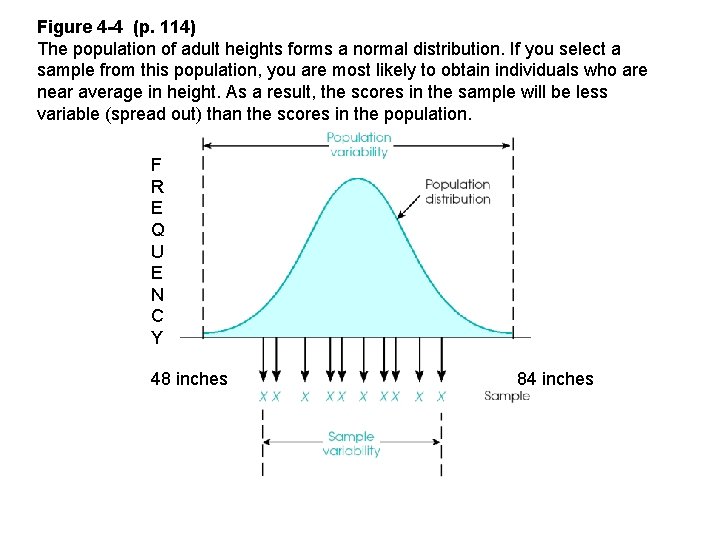
Figure 4 -4 (p. 114) The population of adult heights forms a normal distribution. If you select a sample from this population, you are most likely to obtain individuals who are near average in height. As a result, the scores in the sample will be less variable (spread out) than the scores in the population. F R E Q U E N C Y 48 inches 84 inches
Calculation of Standard Deviation for a Sample 1. Compute the deviation (distance from the mean) for each score. X-M 2. Sum the Squared deviations SS = ∑(X-M)2 3. Compute the mean of the squared deviation • called the variance or mean square • for samples dividing (SS) by n - 1, rather than N s 2 = SS/n-1 • n - 1, is know as degrees of freedom (df) • used so that the sample variance will provide an unbiased estimate of the population variance 4. take the square root of the variance to obtain the standard deviation s = √ s 2
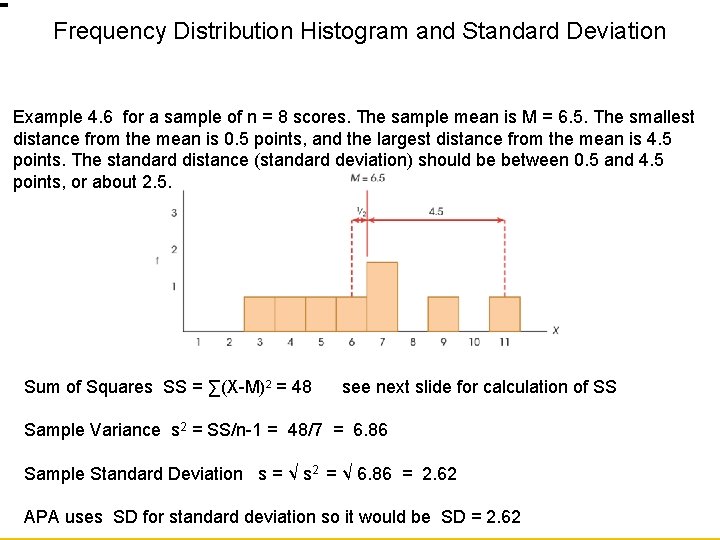
Frequency Distribution Histogram and Standard Deviation Example 4. 6 for a sample of n = 8 scores. The sample mean is M = 6. 5. The smallest distance from the mean is 0. 5 points, and the largest distance from the mean is 4. 5 points. The standard distance (standard deviation) should be between 0. 5 and 4. 5 points, or about 2. 5. Sum of Squares SS = ∑(X-M)2 = 48 see next slide for calculation of SS Sample Variance s 2 = SS/n-1 = 48/7 = 6. 86 Sample Standard Deviation s = √ s 2 = √ 6. 86 = 2. 62 APA uses SD for standard deviation so it would be SD = 2. 62
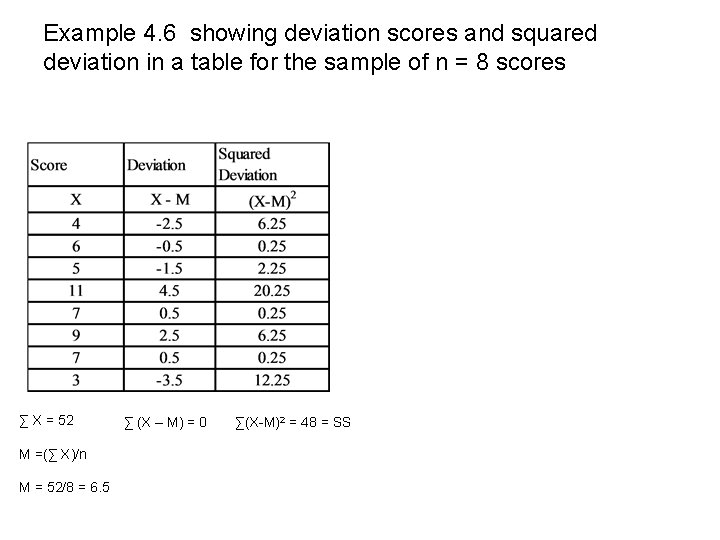
Example 4. 6 showing deviation scores and squared deviation in a table for the sample of n = 8 scores ∑ X = 52 M =(∑ X)/n M = 52/8 = 6. 5 ∑ (X – M) = 0 ∑(X-M)2 = 48 = SS
Degrees of Freedom (df) • Sample variability is biased, tends to under report population variability see figure 4. 4 • Using n – 1 corrects for that bias • Sample variance is an unbiased estimate of population variance • For a single sample of size n; degrees of freedom is n-1 • Used as the denominator when calculating sample variance s 2 = SS/n-1 • BTW: Degrees of freedom refers to number of scores that are free to vary – For a sample of n = 3 and a M = 5, where the first two scores are X = 4 and X = 5, the third score must be? – X = 6, it has to be, i. e. has no freedom to vary – So when n = 3 there are only 2 degrees of freedom
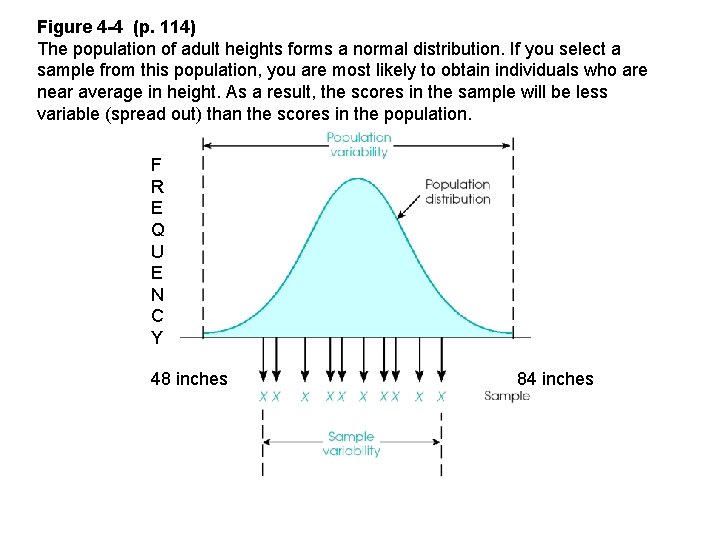
Figure 4 -4 (p. 114) The population of adult heights forms a normal distribution. If you select a sample from this population, you are most likely to obtain individuals who are near average in height. As a result, the scores in the sample will be less variable (spread out) than the scores in the population. F R E Q U E N C Y 48 inches 84 inches
- Slides: 27