
Prevention through Design Assessment Process MSS Prevention through
- Slides: 30
Prevention through Design Assessment Process MSS Prevention through Design Panel November 2019
Overview • Prevention through Design Concept – Benefits & Motivation – Background on Development – Relationship to Engineering Manual Risk Assessment (ERA) • Prevention through Design (Pt. D) Assessment Tool – Hazard Identification – Risk Assessment and Mitigation – Residual Risk and Status 2 Nov 2019 Prevention through Design Assessment Process
Prevention through Design Concept • This concept emphasizes eliminating hazards and controlling risks to workers “at the source” or as early as possible in the life cycle of equipment, products, or workplaces – The process is also referred to as Safety by Design in industry – The more general term Prevention through Design was chosen for Fermilab since the same assessment process can also be used for non-safety risks (e. g. engineering, quality, cost, & schedule risks) 3 Nov 2019 Prevention through Design Assessment Process
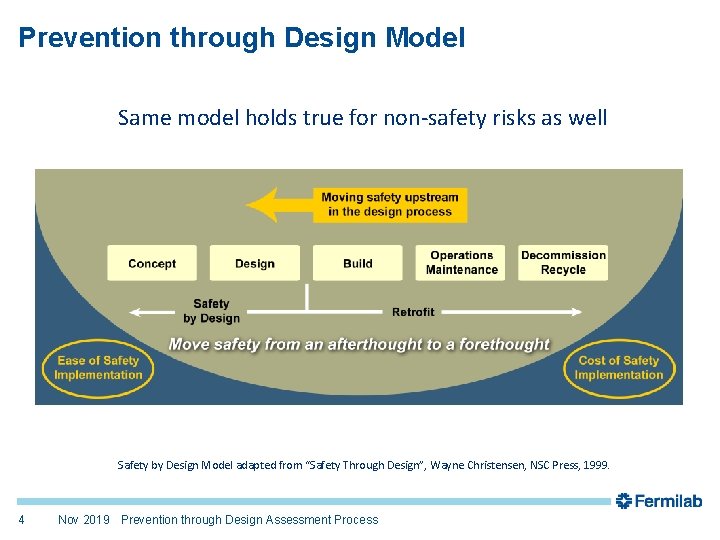
Prevention through Design Model Same model holds true for non-safety risks as well Safety by Design Model adapted from “Safety Through Design”, Wayne Christensen, NSC Press, 1999. 4 Nov 2019 Prevention through Design Assessment Process
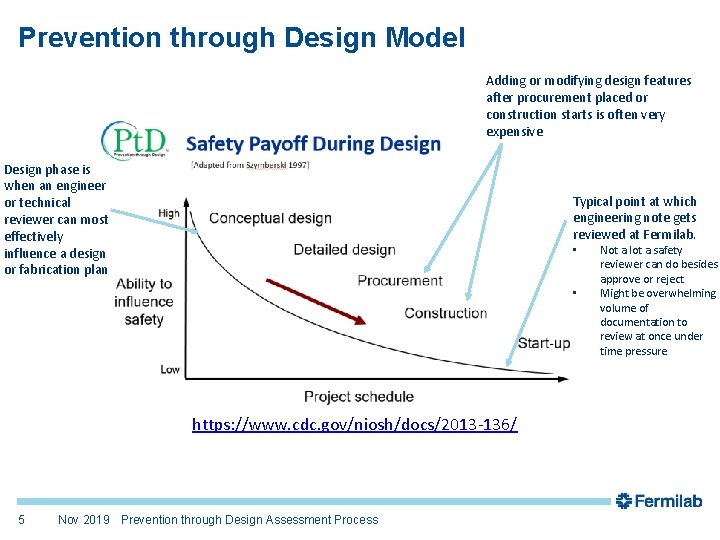
Prevention through Design Model Adding or modifying design features after procurement placed or construction starts is often very expensive Design phase is when an engineer or technical reviewer can most effectively influence a design or fabrication plan Typical point at which engineering note gets reviewed at Fermilab. • • https: //www. cdc. gov/niosh/docs/2013 -136/ 5 Nov 2019 Prevention through Design Assessment Process Not a lot a safety reviewer can do besides approve or reject Might be overwhelming volume of documentation to review at once under time pressure
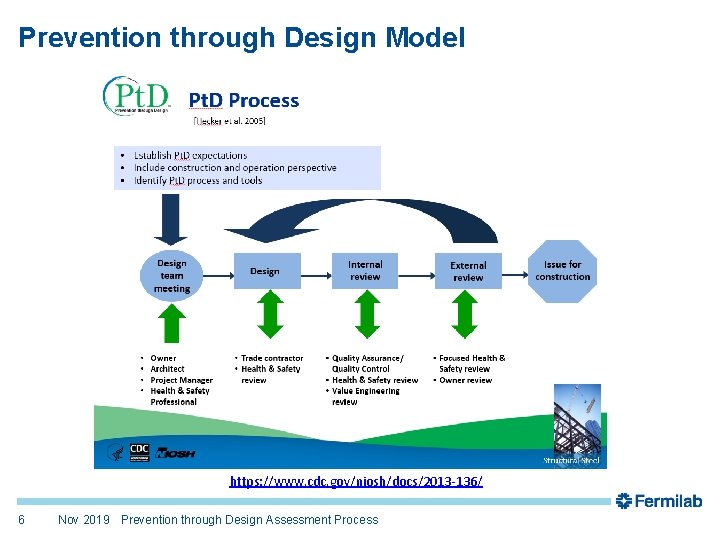
Prevention through Design Model https: //www. cdc. gov/niosh/docs/2013 -136/ 6 Nov 2019 Prevention through Design Assessment Process
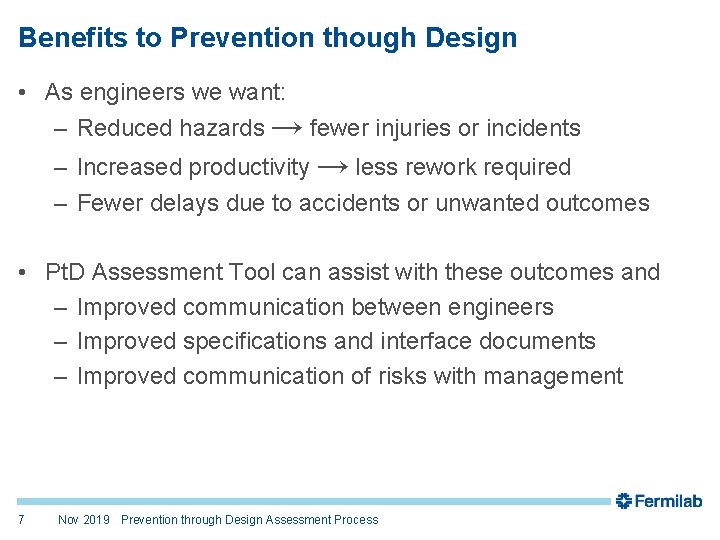
Benefits to Prevention though Design • As engineers we want: – Reduced hazards → fewer injuries or incidents – Increased productivity → less rework required – Fewer delays due to accidents or unwanted outcomes • Pt. D Assessment Tool can assist with these outcomes and – Improved communication between engineers – Improved specifications and interface documents – Improved communication of risks with management 7 Nov 2019 Prevention through Design Assessment Process
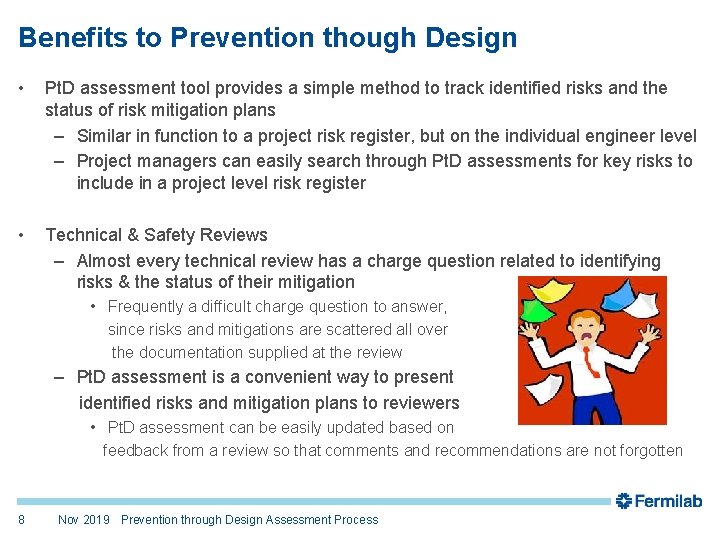
Benefits to Prevention though Design • Pt. D assessment tool provides a simple method to track identified risks and the status of risk mitigation plans – Similar in function to a project risk register, but on the individual engineer level – Project managers can easily search through Pt. D assessments for key risks to include in a project level risk register • Technical & Safety Reviews – Almost every technical review has a charge question related to identifying risks & the status of their mitigation • Frequently a difficult charge question to answer, since risks and mitigations are scattered all over the documentation supplied at the review – Pt. D assessment is a convenient way to present identified risks and mitigation plans to reviewers • Pt. D assessment can be easily updated based on feedback from a review so that comments and recommendations are not forgotten 8 Nov 2019 Prevention through Design Assessment Process
Benefits to Prevention though Design • Transferring Responsibility – An up-to-date Pt. D assessment is a quick and robust method of transferring knowledge of risks and mitigations when a task is transferred from one engineer to another • Conducive to Graded Approach – Left to judgement of engineer and management as to level of detail to apply – Small simple projects may only have a few risks. Large complex projects may have many. The assessment tool readily scales to the project • Reducing paperwork – Making a design change late in the engineering process will often require a number of documents to get updated. Locating all of the spots where documents need updating can be quite tedious and time consuming. – The goal of Prevention through Design is to minimize the probability that changes will need to be made late in the engineering process (or even later!) 9 Nov 2019 Prevention through Design Assessment Process
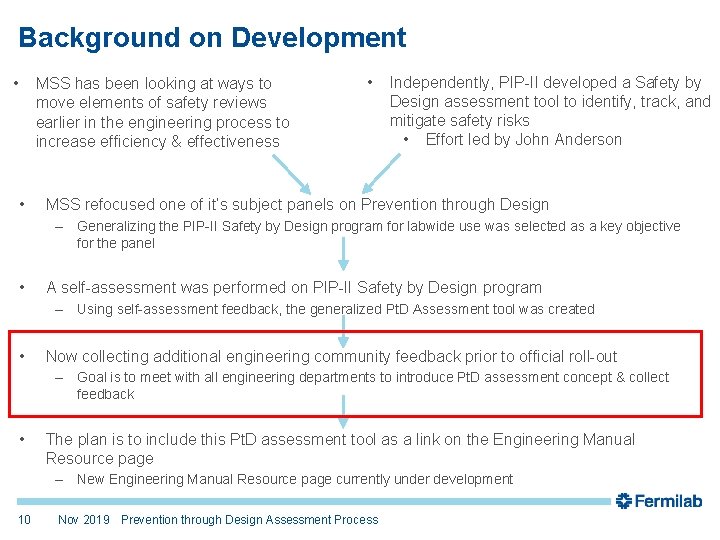
Background on Development • • MSS has been looking at ways to move elements of safety reviews earlier in the engineering process to increase efficiency & effectiveness • Independently, PIP-II developed a Safety by Design assessment tool to identify, track, and mitigate safety risks • Effort led by John Anderson MSS refocused one of it’s subject panels on Prevention through Design – Generalizing the PIP-II Safety by Design program for labwide use was selected as a key objective for the panel • A self-assessment was performed on PIP-II Safety by Design program – Using self-assessment feedback, the generalized Pt. D Assessment tool was created • Now collecting additional engineering community feedback prior to official roll-out – Goal is to meet with all engineering departments to introduce Pt. D assessment concept & collect feedback • The plan is to include this Pt. D assessment tool as a link on the Engineering Manual Resource page – New Engineering Manual Resource page currently under development 10 Nov 2019 Prevention through Design Assessment Process
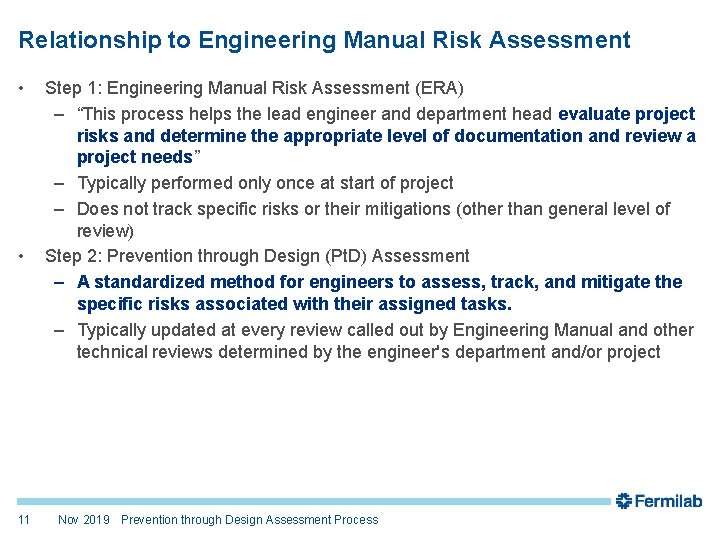
Relationship to Engineering Manual Risk Assessment • • 11 Step 1: Engineering Manual Risk Assessment (ERA) – “This process helps the lead engineer and department head evaluate project risks and determine the appropriate level of documentation and review a project needs” – Typically performed only once at start of project – Does not track specific risks or their mitigations (other than general level of review) Step 2: Prevention through Design (Pt. D) Assessment – A standardized method for engineers to assess, track, and mitigate the specific risks associated with their assigned tasks. – Typically updated at every review called out by Engineering Manual and other technical reviews determined by the engineer's department and/or project Nov 2019 Prevention through Design Assessment Process
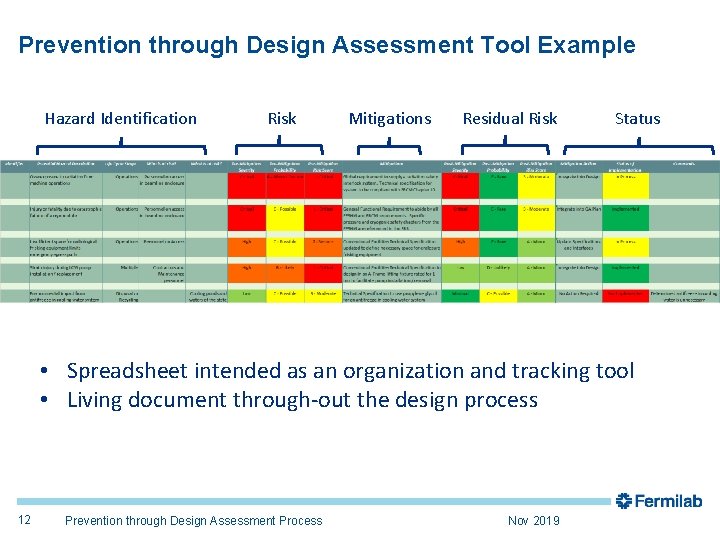
Prevention through Design Assessment Tool Example Hazard Identification Risk Mitigations Residual Risk Status • Spreadsheet intended as an organization and tracking tool • Living document through-out the design process 12 Prevention through Design Assessment Process Nov 2019
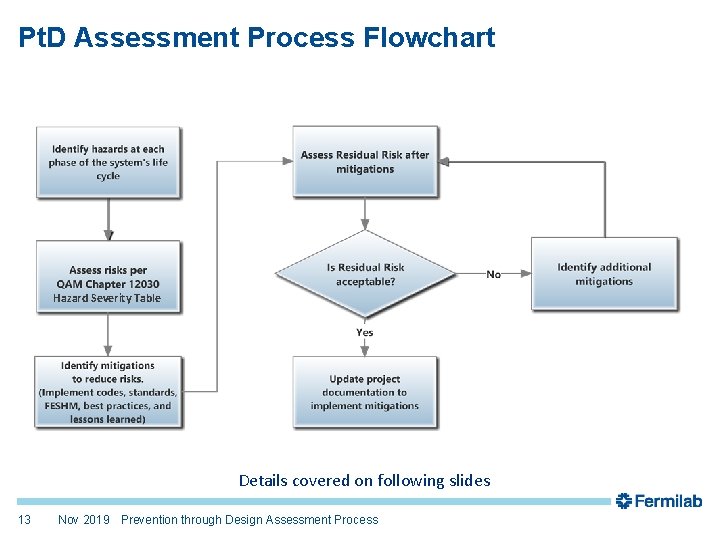
Pt. D Assessment Process Flowchart Hazard Severity Table Details covered on following slides 13 Nov 2019 Prevention through Design Assessment Process
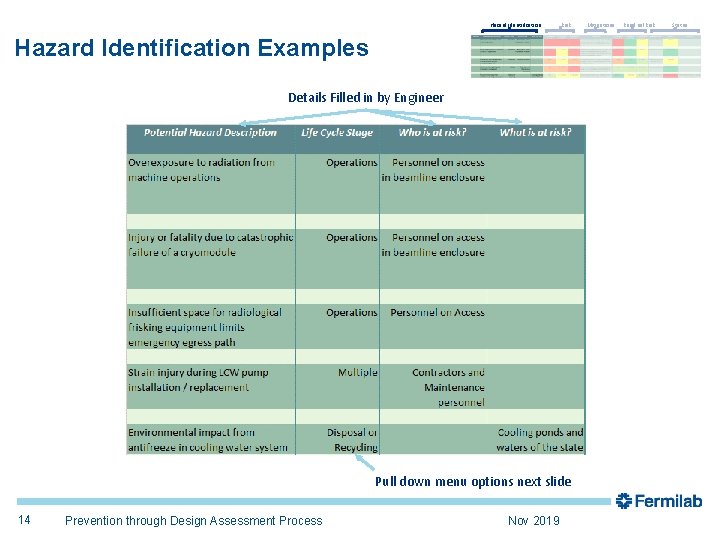
Hazard Identification Risk Hazard Identification Examples Details Filled in by Engineer Pull down menu options next slide 14 Prevention through Design Assessment Process Nov 2019 Mitigations Residual Risk Status
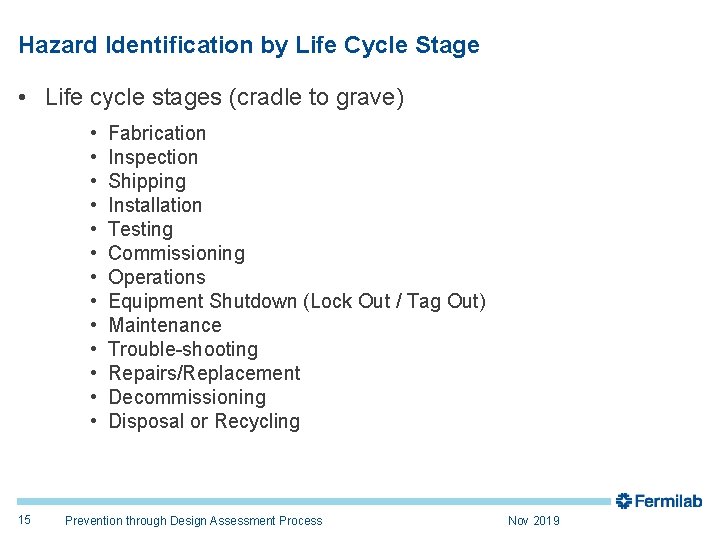
Hazard Identification by Life Cycle Stage • Life cycle stages (cradle to grave) • • • • 15 Fabrication Inspection Shipping Installation Testing Commissioning Operations Equipment Shutdown (Lock Out / Tag Out) Maintenance Trouble-shooting Repairs/Replacement Decommissioning Disposal or Recycling Prevention through Design Assessment Process Nov 2019
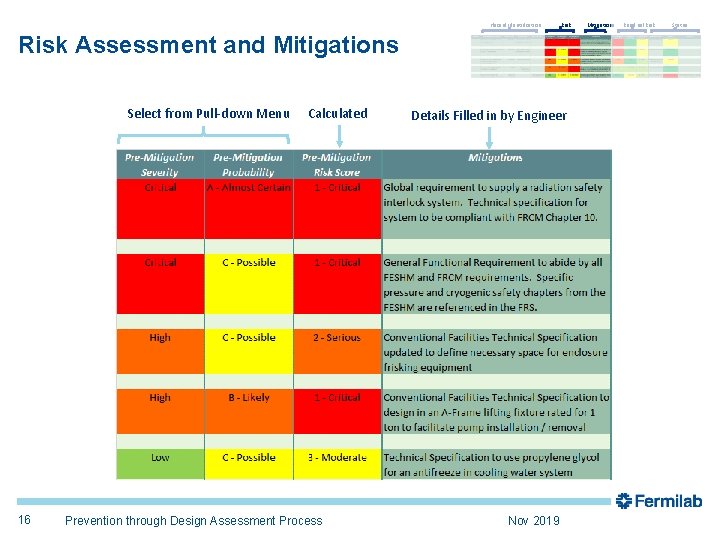
Hazard Identification Risk Assessment and Mitigations Select from Pull-down Menu 16 Calculated Prevention through Design Assessment Process Details Filled in by Engineer Nov 2019 Mitigations Residual Risk Status
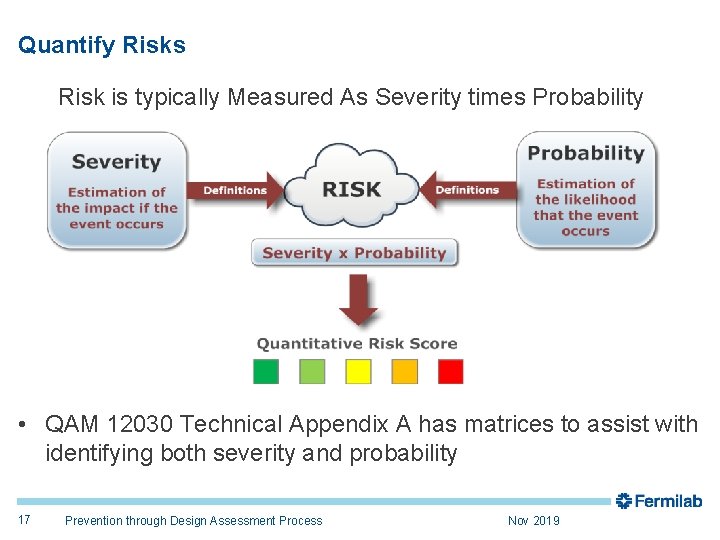
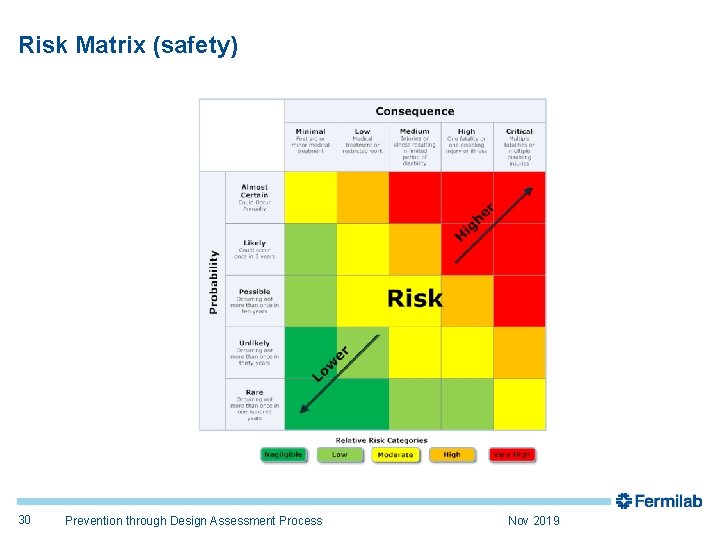
Quantify Risks Risk is typically Measured As Severity times Probability • QAM 12030 Technical Appendix A has matrices to assist with identifying both severity and probability 17 Prevention through Design Assessment Process Nov 2019
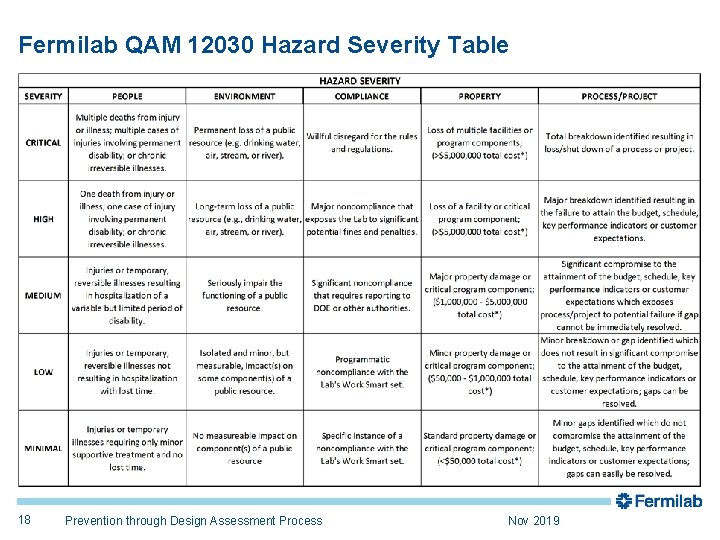
Fermilab QAM 12030 Hazard Severity Table 18 Prevention through Design Assessment Process Nov 2019
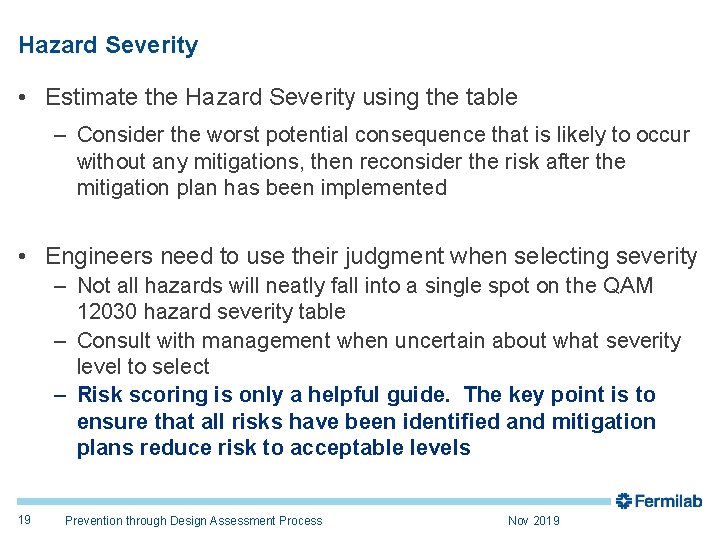
Hazard Severity • Estimate the Hazard Severity using the table – Consider the worst potential consequence that is likely to occur without any mitigations, then reconsider the risk after the mitigation plan has been implemented • Engineers need to use their judgment when selecting severity – Not all hazards will neatly fall into a single spot on the QAM 12030 hazard severity table – Consult with management when uncertain about what severity level to select – Risk scoring is only a helpful guide. The key point is to ensure that all risks have been identified and mitigation plans reduce risk to acceptable levels 19 Prevention through Design Assessment Process Nov 2019
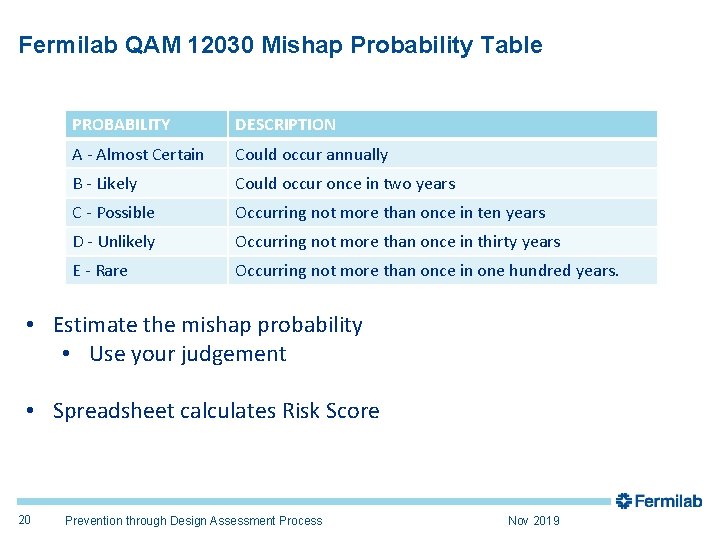
Fermilab QAM 12030 Mishap Probability Table PROBABILITY DESCRIPTION A - Almost Certain Could occur annually B - Likely Could occur once in two years C - Possible Occurring not more than once in ten years D - Unlikely Occurring not more than once in thirty years E - Rare Occurring not more than once in one hundred years. • Estimate the mishap probability • Use your judgement • Spreadsheet calculates Risk Score 20 Prevention through Design Assessment Process Nov 2019
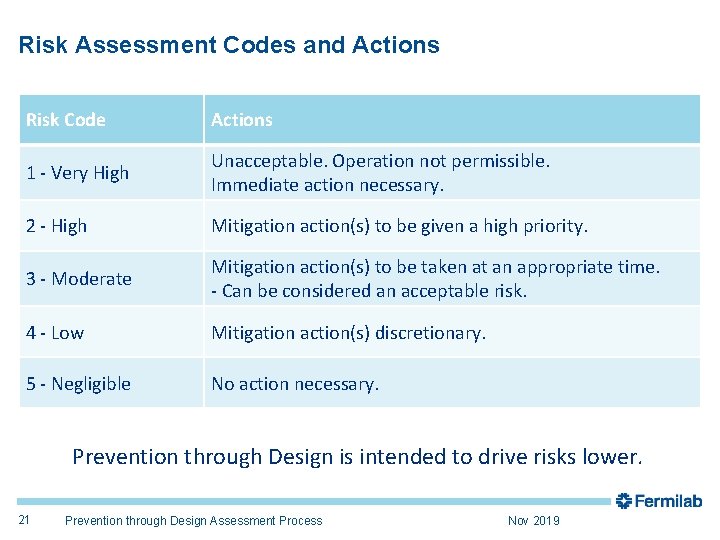
Risk Assessment Codes and Actions Risk Code Actions 1 - Very High Unacceptable. Operation not permissible. Immediate action necessary. 2 - High Mitigation action(s) to be given a high priority. 3 - Moderate Mitigation action(s) to be taken at an appropriate time. - Can be considered an acceptable risk. 4 - Low Mitigation action(s) discretionary. 5 - Negligible No action necessary. Prevention through Design is intended to drive risks lower. 21 Prevention through Design Assessment Process Nov 2019
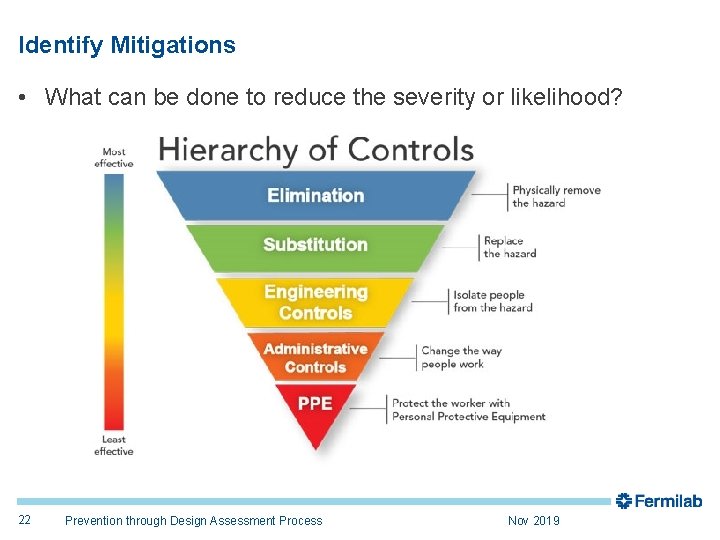
Identify Mitigations • What can be done to reduce the severity or likelihood? 22 Prevention through Design Assessment Process Nov 2019
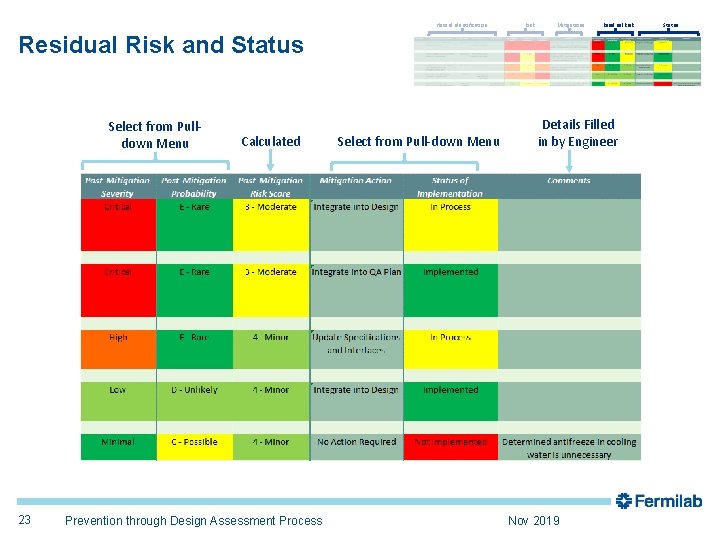
Hazard Identification Risk Mitigations Residual Risk and Status Select from Pulldown Menu 23 Calculated Prevention through Design Assessment Process Select from Pull-down Menu Details Filled in by Engineer Nov 2019 Status
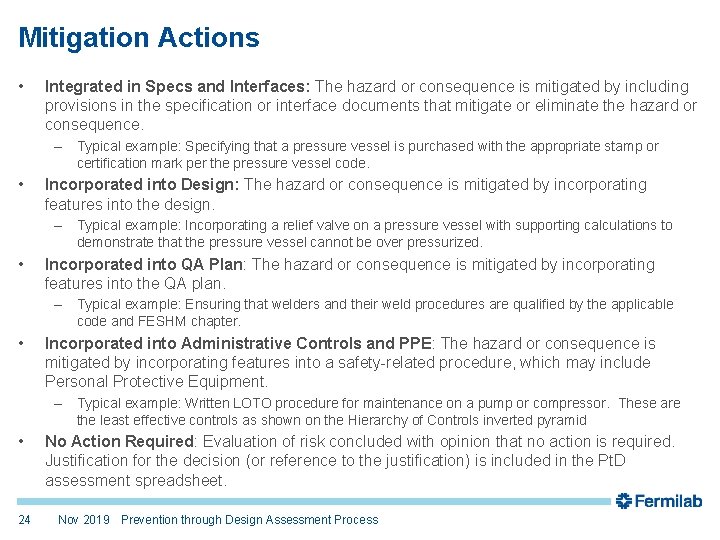
Mitigation Actions • Integrated in Specs and Interfaces: The hazard or consequence is mitigated by including provisions in the specification or interface documents that mitigate or eliminate the hazard or consequence. – Typical example: Specifying that a pressure vessel is purchased with the appropriate stamp or certification mark per the pressure vessel code. • Incorporated into Design: The hazard or consequence is mitigated by incorporating features into the design. – Typical example: Incorporating a relief valve on a pressure vessel with supporting calculations to demonstrate that the pressure vessel cannot be over pressurized. • Incorporated into QA Plan: The hazard or consequence is mitigated by incorporating features into the QA plan. – Typical example: Ensuring that welders and their weld procedures are qualified by the applicable code and FESHM chapter. • Incorporated into Administrative Controls and PPE: The hazard or consequence is mitigated by incorporating features into a safety-related procedure, which may include Personal Protective Equipment. – Typical example: Written LOTO procedure for maintenance on a pump or compressor. These are the least effective controls as shown on the Hierarchy of Controls inverted pyramid • 24 No Action Required: Evaluation of risk concluded with opinion that no action is required. Justification for the decision (or reference to the justification) is included in the Pt. D assessment spreadsheet. Nov 2019 Prevention through Design Assessment Process
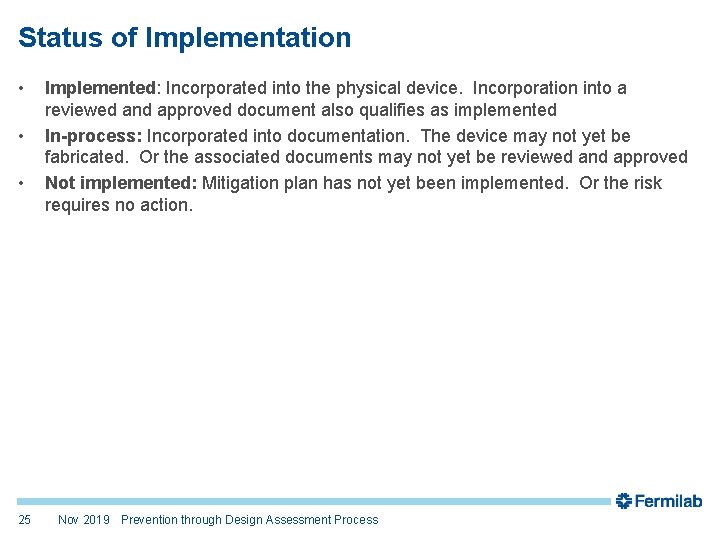
Status of Implementation • • • 25 Implemented: Incorporated into the physical device. Incorporation into a reviewed and approved document also qualifies as implemented In-process: Incorporated into documentation. The device may not yet be fabricated. Or the associated documents may not yet be reviewed and approved Not implemented: Mitigation plan has not yet been implemented. Or the risk requires no action. Nov 2019 Prevention through Design Assessment Process
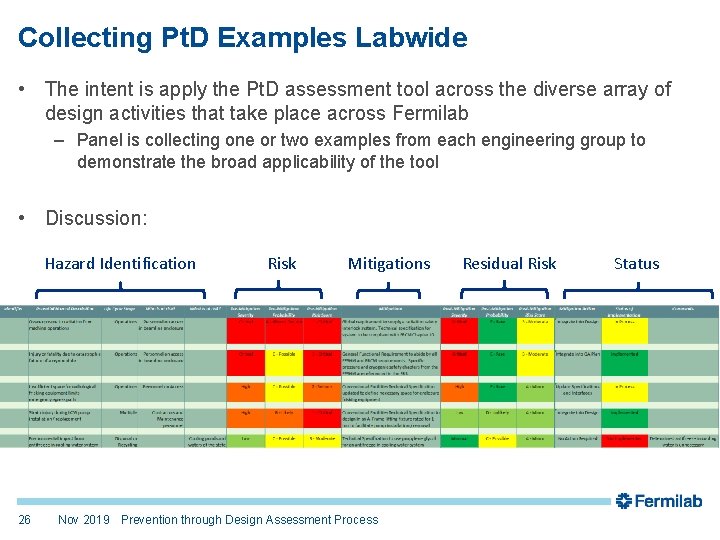
Collecting Pt. D Examples Labwide • The intent is apply the Pt. D assessment tool across the diverse array of design activities that take place across Fermilab – Panel is collecting one or two examples from each engineering group to demonstrate the broad applicability of the tool • Discussion: Hazard Identification 26 Risk Mitigations Nov 2019 Prevention through Design Assessment Process Residual Risk Status
Summary • Prevention through Design Assessment Tool – Assists with identifying hazards and mitigations to minimize risk early in the design process – Documents the hazard assessment, risks and controls – Tracks progress on implementation of mitigations – High level hazards may be rolled up into the project risk registry – One of the deliverables presented at each technical review phase – Spreadsheet is intended to be a living document where hazards and mitigations can be added to or updated as necessary 27 Prevention through Design Assessment Process Nov 2019
Contributors • • John Anderson (PIP-II ES&H) Tom Di. Grazia (Quality Section) Joe Hurd (APS-TD Cryo) Dave Mertz (ESS Chair, ES&H) Matt Slabaugh (AD/MS) Bill Soyars (CSS Chair, APS-TD Cryo) Mike White (MSS Chair, APS-TD Cryo)* *Primary contact for feedback about Pt. D Assessment Tool 28 Nov 2019 Prevention through Design Assessment Process
Backup slides 29 Nov 2019 Prevention through Design Assessment Process
Risk Matrix (safety) 30 Prevention through Design Assessment Process Nov 2019