
Prevention of Wrong Site Surgery Evidence Based Actions
Prevention of Wrong Site Surgery Evidence Based Actions
Lisa R. Spruce DNP, RN, ACNS, ACNP, ANP, CNOR Director, Evidence-Based Perioperative Practice Association of peri. Operative Registered Nurses Mary J. Ogg MSN, RN, CNOR Perioperative Nursing Specialist Association of peri. Operative Registered Nurses
Objectives 1. Discuss the evidence presented for the prevention of wrong site surgery. 2. Discuss best practices to minimize the potential for wrong site surgery. 3. Identify the barriers to implementing best practices for the prevention of wrong site surgery.

The Wrong way to do a Time Out
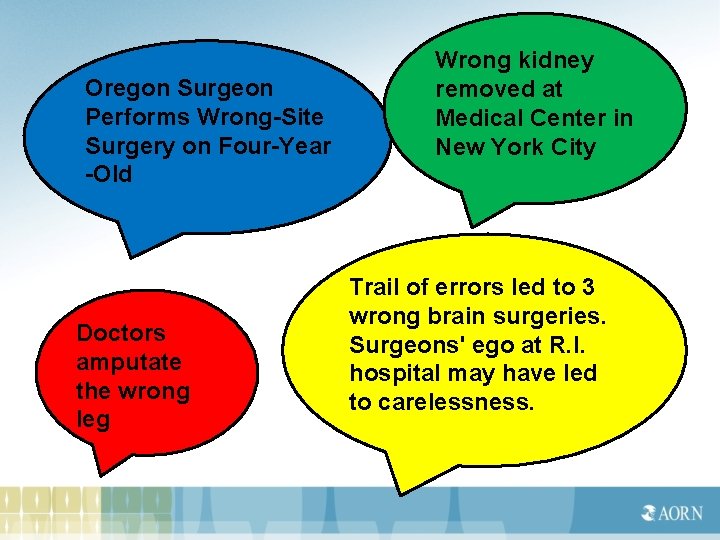
Oregon Surgeon Performs Wrong-Site Surgery on Four-Year -Old Doctors amputate the wrong leg Wrong kidney removed at Medical Center in New York City Trail of errors led to 3 wrong brain surgeries. Surgeons' ego at R. I. hospital may have led to carelessness.
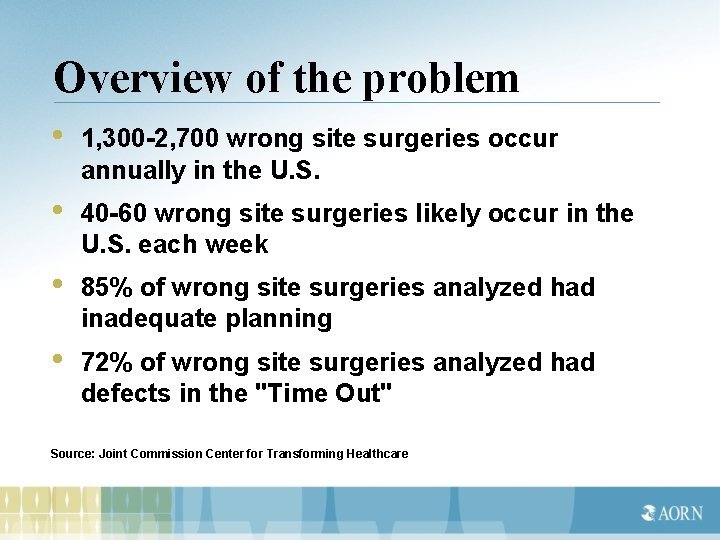
Overview of the problem • 1, 300 -2, 700 wrong site surgeries occur annually in the U. S. • 40 -60 wrong site surgeries likely occur in the U. S. each week • 85% of wrong site surgeries analyzed had inadequate planning • 72% of wrong site surgeries analyzed had defects in the "Time Out" Source: Joint Commission Center for Transforming Healthcare
Cochrane Review-Background • • - Wrong site surgery Potentially disastrous error Clinical interventions are needed to prevent Risk factors Variable Complex Organizational and professional strategies Role in minimizing wrong site surgery Cochrane review-Mahar P, Wasiak J, Batty L, Fowler S, Cleland H, Gruen RL. Interventions for reducing wrong-site surgery and invasive procedures. Cochrane Database Syst Rev. 2012; 9: CD 009404.
Cochrane Review • Randomized controlled trail - Difficult to compare the use of a pre-op checklist against a control group • • Controlled before-after studies (CBA) Case-controlled studies Mahar P, Wasiak J, Batty L, Fowler S, Cleland H, Gruen RL. Interventions for reducing wrong-site surgery and invasive procedures. Cochrane Database Syst Rev. 2012; 9: CD 009404.
Steelman- Top Patient Safety Issue Anonymous electronic survey of AORN member database - 68. 6 % identified preventing wrong site, procedure/patient surgery as one of the five highest priorities Identified more than any other issue in all five regions of the US. Steelman VM, Graling PR, Perkhounkova Y. Priority patient safety issues identified by perioperative nurses. AORN J. 2013; 97(4): 402 -418.
Birnbach • Discussion about a framework for patient safety. • 7 principles for patient safety discussed.
Bohmer • Study to evaluate peri-op safety standards and the quality of interprofessional cooperation before and after the introduction of a safety checklist from staff members’ point of view. • Methods: Surveyed employees 3 months after the introduction of an adapted surgical safety check list. • Results: From the staff perspective, safety factors can be handled significantly better and with greater awareness by implementing a safety checklist. Bohmer, A. B. , F. Wappler, T. Tinschmann, P. Kindermann, D. Rixen, M. Bellendir, et al. "The implementation of a perioperative checklist increases patients’ perioperative safety and staff satisfaction. "ACTA ANAESTHESIOLOGICA SCANDINAVICA. 56. (2012): 332 -338. Print.
Braff • Literature review that explored the role of documents and documentation in communication failure among HCPs across the peri-op, intra-op, and post-op areas. • Results: highlighted that documentation such as surgery notes, anesthesia records, and nurses peri-op notes that are deficient contribute to the development of communication failures leading to WSS. • Conclusion: Effective communication is vital to the delivery of safe patient care. • Braff, S, E Manias, and R Riley. "The role of documents and documentation in communication failure across the perioperative pathway. A literature review. "International Journal of Nursing Studies. 48. (2011): 1024 -1038. Print.
Clark • Pennsylvania Patient Safety Authority study to identify the barriers to implementation and strategies for successful implementation of the 21 PPSA recommendations for preventing WSS. • • Surveyed 417 facilities (160 hospitals and 257 ambulatory facilities). Results: 1. Physician behavior-surgeon intimidation, resistance, non-compliance, lack of accountability, acceptance, commitment, engagement, cooperation from surgeon officers, lack of percieived value, surgeons unavailable, surgeons overriding protocols. 2. Difficulty with accurate pre-op information. 3. Barriers to 2 nd verification of intra-op spinal level
Clark, cont’d 4. Need to change policy 5. Need to monitor compliance 6. Time pressures 7. Educate personnel 8. Inability to see site markings 9. General communication problems 10. Need to change culture - Clark, J. "What Keeps Facilities from Implementing Best Practices to Prevent Wrong-Site Surgery? Barriers and Strategies for Overcoming Them. "Pennsylvania Patient Safety Advisory. 9. Suppl 1 (2012): 1 -16. Print.
Gibbs • • • Expert opinion Discusses TJC Targeted Solutions Toolkit Provides a step by step process to measure performance. TJC project showed that in 39% of WSS cases errors usually involved inadequate information about the patient and scheduling confusion. Gibbs, V. "Thinking in three's: Changing surgical patient safety practices in the complex modern operating room. " World Journal of Gastroenterology. 18. 46 (2012): 6712 -6719. Print.
Hu • Discussion of the importance of video-based observations on the study of OR safety and human factors. • Case study presented, a video observation of OR team dealing with an equipment issue. • Team maintained situational awareness, circulator led the team, directed them and they cooperated; allowed for a quick recovery and prevention of a catastrophic event. Hu, Y. Y. , et al. "Protecting Patients from an Unsafe System: The Etiology and Recovery of Intraoperative Deviations in Care. " Annals of Surgery 256. 2 (2012): 203 -10. .
Hyman • Children’s Hospital of Colorado began placing patient pictures into the medical record to determine if it would decrease unintended patient orders and increase patient verification. • Before initiative: 24% of reported errors were due to placement of orders in the incorrect chart. • After the initiative: 15 months after the initiative there was no unintended care and no patient’s with pictures received wrong orders. • Strategy could be used to improve patient verification to prevent WSS. Hyman, D. , et al. "The use of Patient Pictures and Verification Screens to Reduce Computerized Provider Order Entry Errors. " Pediatrics 130. 1 (2012): e 211 -9.
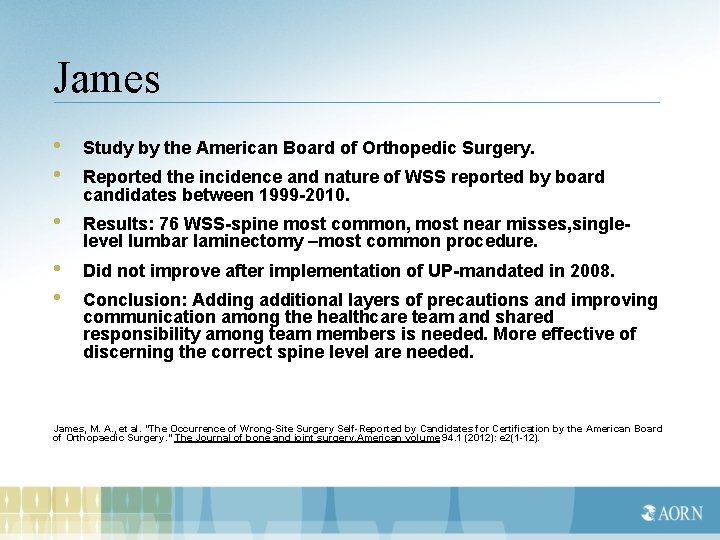
James • • Study by the American Board of Orthopedic Surgery. • Results: 76 WSS-spine most common, most near misses, singlelevel lumbar laminectomy –most common procedure. • • Did not improve after implementation of UP-mandated in 2008. Reported the incidence and nature of WSS reported by board candidates between 1999 -2010. Conclusion: Adding additional layers of precautions and improving communication among the healthcare team and shared responsibility among team members is needed. More effective of discerning the correct spine level are needed. James, M. A. , et al. "The Occurrence of Wrong-Site Surgery Self-Reported by Candidates for Certification by the American Board of Orthopaedic Surgery. " The Journal of bone and joint surgery. American volume 94. 1 (2012): e 2(1 -12).
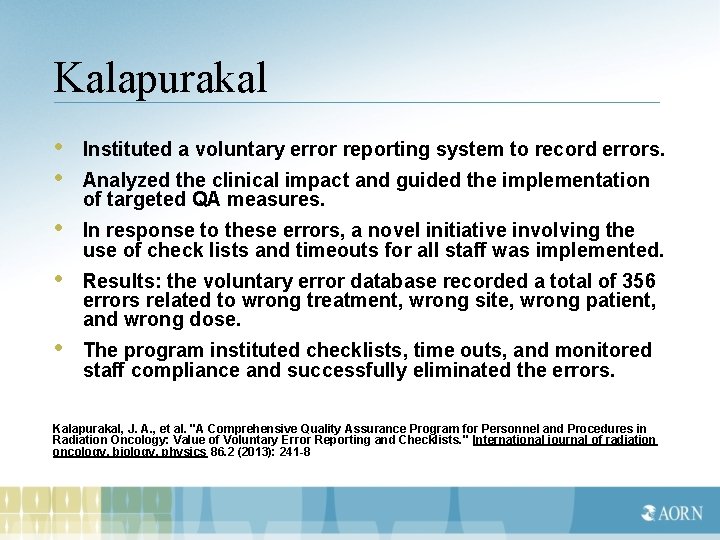
Kalapurakal • • Instituted a voluntary error reporting system to record errors. • In response to these errors, a novel initiative involving the use of check lists and timeouts for all staff was implemented. • Results: the voluntary error database recorded a total of 356 errors related to wrong treatment, wrong site, wrong patient, and wrong dose. • The program instituted checklists, time outs, and monitored staff compliance and successfully eliminated the errors. Analyzed the clinical impact and guided the implementation of targeted QA measures. Kalapurakal, J. A. , et al. "A Comprehensive Quality Assurance Program for Personnel and Procedures in Radiation Oncology: Value of Voluntary Error Reporting and Checklists. " International journal of radiation oncology, biology, physics 86. 2 (2013): 241 -8
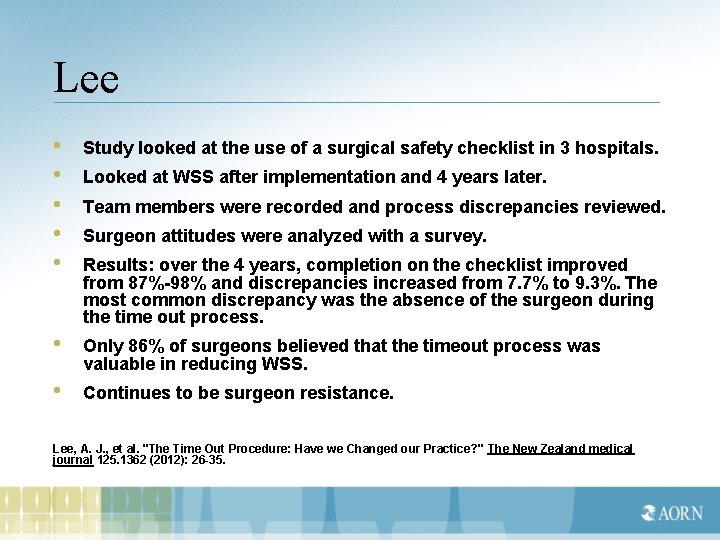
Lee • • • Study looked at the use of a surgical safety checklist in 3 hospitals. • Only 86% of surgeons believed that the timeout process was valuable in reducing WSS. • Continues to be surgeon resistance. Looked at WSS after implementation and 4 years later. Team members were recorded and process discrepancies reviewed. Surgeon attitudes were analyzed with a survey. Results: over the 4 years, completion on the checklist improved from 87%-98% and discrepancies increased from 7. 7% to 9. 3%. The most common discrepancy was the absence of the surgeon during the time out process. Lee, A. J. , et al. "The Time Out Procedure: Have we Changed our Practice? " The New Zealand medical journal 125. 1362 (2012): 26 -35.
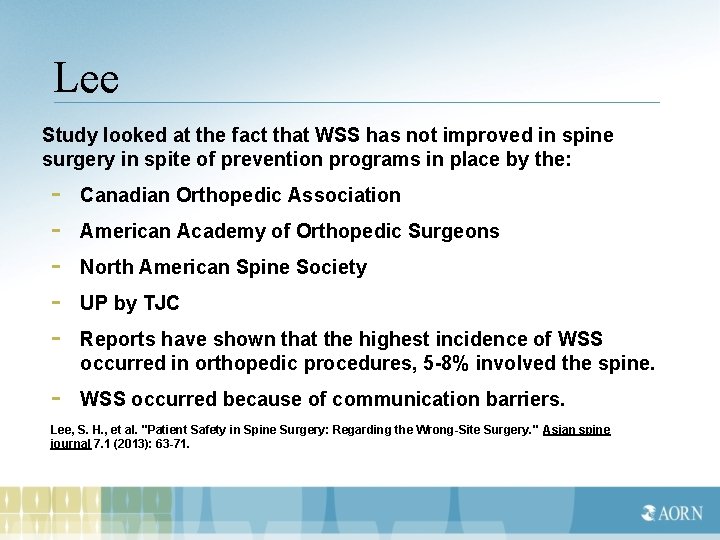
Lee Study looked at the fact that WSS has not improved in spine surgery in spite of prevention programs in place by the: - Canadian Orthopedic Association - WSS occurred because of communication barriers. American Academy of Orthopedic Surgeons North American Spine Society UP by TJC Reports have shown that the highest incidence of WSS occurred in orthopedic procedures, 5 -8% involved the spine. Lee, S. H. , et al. "Patient Safety in Spine Surgery: Regarding the Wrong-Site Surgery. " Asian spine journal 7. 1 (2013): 63 -71.
Liou • • • Literature review of WSS in head and neck surgery. • Conclusions: standardizing protocols to confirm imaging accuracy, a specialty or procedure specific check list and a standardized alternative to site marking when marking is impractical and other innovative ideas. Results: 0. 3 -4. 5% of all WSS are otolaryngology procedures. Particular issues are inverted imaging and ambiguity on site marking. Liou, T. N. , and B. Nussenbaum. "Wrong Site Surgery in Otolaryngology-Head and Neck Surgery. " The Laryngoscope (2013).
Longo • Errors of level in spine surgery-an evidence based systematic review. • Looked at incidence and prevalence of WSS and prevention strategies. • • 12 studies reviewed. • Studies demonstrated that current site verification protocols did not prevent about 1/3 of cases. • Further prevention strategies need to be developed to reduce the risk of WSS in spinal procedures. 10 studies looked at lumbar. 2 looked at lumbar, thoracic, or c-spine. Higher frequency of wrong level surgery in lumbar procedures than in cervical procedures. Longo, U. G. , et al. "Errors of Level in Spinal Surgery: An Evidence-Based Systematic Review. " The Journal of bone and joint surgery. British volume 94. 11 (2012): 1546 -50.
Mainthia -Electronic whiteboard • • • - Background Evidence that time out is effective Low compliance with completion of checklist Prospective observational study Interactive electronic checklist system (i. ECS) Pre-intervention observations 49. 7% of core elements Mainthia R, Lockney T, Zotov A, et al. Novel use of electronic whiteboard in the operating room increases surgical team compliance with pre-incision safety practices. Surgery. 2012; 151(5): 660 -666.
Mainthia -Interactive electronic checklist • • Visible to entire team • • • Completed time out steps turn green Referenced during the pre-incision time out Required time out steps- red Each item is announced and checked by circulator when completed Completed checklist – “time out complete” Completion time- > 1 minute ( average 35 seconds)
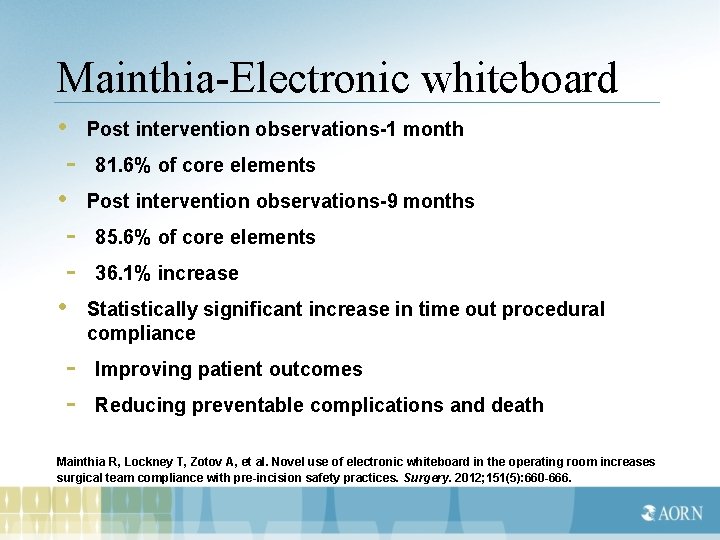
Mainthia-Electronic whiteboard • • • - Post intervention observations-1 month 81. 6% of core elements Post intervention observations-9 months 85. 6% of core elements 36. 1% increase Statistically significant increase in time out procedural compliance Improving patient outcomes Reducing preventable complications and death Mainthia R, Lockney T, Zotov A, et al. Novel use of electronic whiteboard in the operating room increases surgical team compliance with pre-incision safety practices. Surgery. 2012; 151(5): 660 -666.
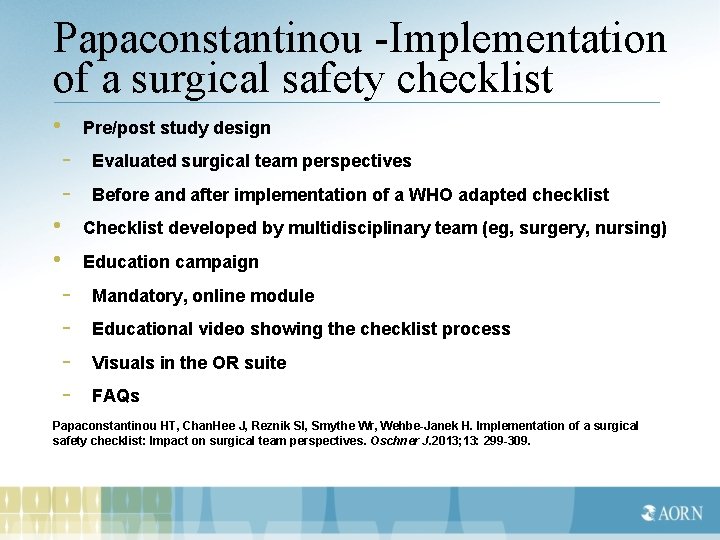
Papaconstantinou -Implementation of a surgical safety checklist • • • - Pre/post study design Evaluated surgical team perspectives Before and after implementation of a WHO adapted checklist Checklist developed by multidisciplinary team (eg, surgery, nursing) Education campaign Mandatory, online module Educational video showing the checklist process Visuals in the OR suite FAQs Papaconstantinou HT, Chan. Hee J, Reznik SI, Smythe Wr, Wehbe-Janek H. Implementation of a surgical safety checklist: Impact on surgical team perspectives. Oschner J. 2013; 13: 299 -309.
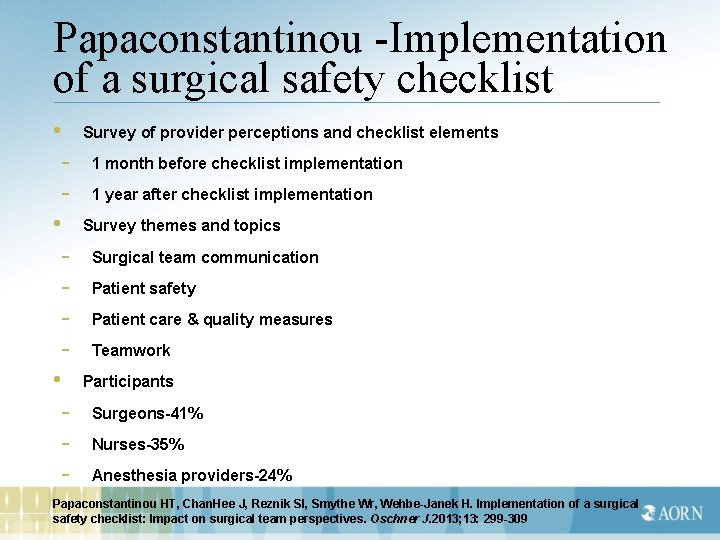
Papaconstantinou -Implementation of a surgical safety checklist • Survey of provider perceptions and checklist elements • 1 month before checklist implementation 1 year after checklist implementation Survey themes and topics • Surgical team communication Patient safety Patient care & quality measures Teamwork Participants - Surgeons-41% Nurses-35% Anesthesia providers-24% Papaconstantinou HT, Chan. Hee J, Reznik SI, Smythe Wr, Wehbe-Janek H. Implementation of a surgical safety checklist: Impact on surgical team perspectives. Oschner J. 2013; 13: 299 -309
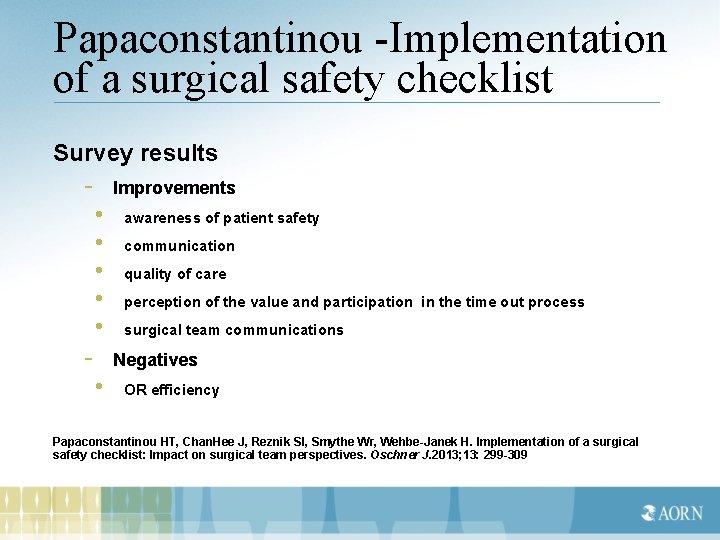
Papaconstantinou -Implementation of a surgical safety checklist Survey results - - Improvements • • • awareness of patient safety communication quality of care perception of the value and participation in the time out process surgical team communications Negatives • OR efficiency Papaconstantinou HT, Chan. Hee J, Reznik SI, Smythe Wr, Wehbe-Janek H. Implementation of a surgical safety checklist: Impact on surgical team perspectives. Oschner J. 2013; 13: 299 -309
Thakkar -Visibility of site marking Background - Very important component of the time out is the visibility of the surgical site marking Prospective randomized controlled trial - Quantitatively and qualitatively evaluated the visibility of the surgical site markings after using 2 skin prep solutions - Black permanent marker used to mark the patients skin Randomly assigned to chlorhexidine or iodine based skin prep Digital photographs before and after skin prep application Quantitative and qualitative analysis by 10 orthopedic surgeons Thakkar SC, Mears SC. Visibility of surgical site marking: A prospective randomized trial of two skin preparation solutions. J Bone Joint Surg Am. 2012; 94(2): 97 -102.
Thakkar -Visibility of site marking Results • • • Chlorhexidine-based skin preparation solution erases surgical markings more frequently than iodine-based skin preparations. Additional research is needed to find a skin prep that has maximal effect to prevent infections and does not erase site markings. Chosen marker may be more susceptible to the effects of chlorhexidine. Thakkar SC, Mears SC. Visibility of surgical site marking: A prospective randomized trial of two skin preparation solutions. J Bone Joint Surg Am. 2012; 94(2): 97 -102.
Case study-wrong knee surgery • • Patient scheduled for a left ACL repair Surgeon operated on right knee Site marking not visible Surgeon assumed that prep had washed off the markings
Vachhan-Neurosurgical wrong-site surgeries before & after implementation of Universal protocol Background - Neurosurgery wrong site surgeries • • 2 -3 per 10, 000 craniotomies 6 -14 per 10, 000 spine surgeries Method - Retrospective review Number of neurosurgical wrong site surgeries at a Midwestern university hospital from 1999 -2011 Vachhani JA, Klopfenstein JD. Incidence of neurosurgical wrong-site surgery before and after implementation of the universal protocol. Neurosurgery. 2013; 72(4): 590 -5; discussion 595.
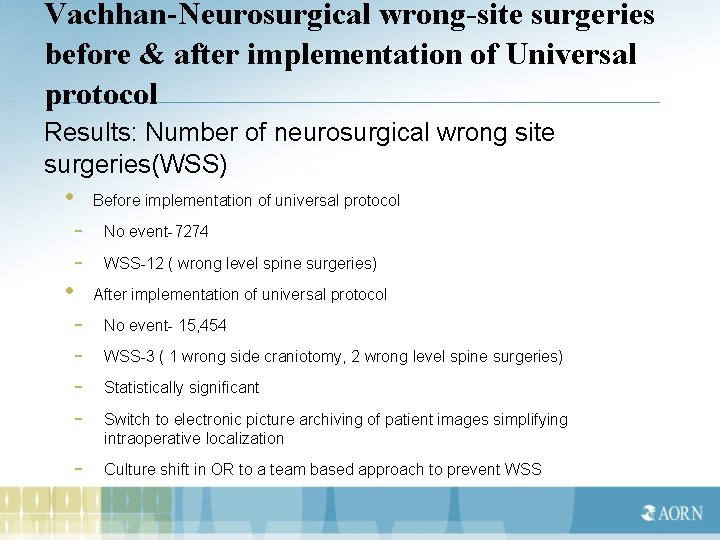
Vachhan-Neurosurgical wrong-site surgeries before & after implementation of Universal protocol Results: Number of neurosurgical wrong site surgeries(WSS) • Before implementation of universal protocol - • No event-7274 WSS-12 ( wrong level spine surgeries) After implementation of universal protocol - No event- 15, 454 - Culture shift in OR to a team based approach to prevent WSS-3 ( 1 wrong side craniotomy, 2 wrong level spine surgeries) Statistically significant Switch to electronic picture archiving of patient images simplifying intraoperative localization
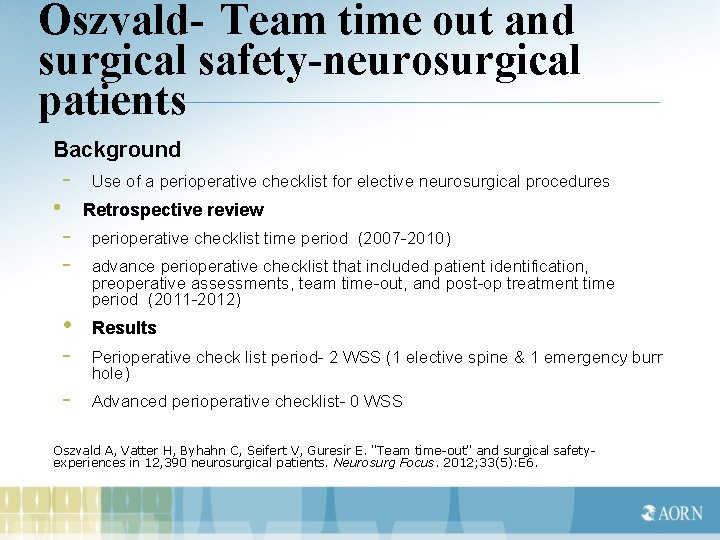
Oszvald- Team time out and surgical safety-neurosurgical patients Background • - • Use of a perioperative checklist for elective neurosurgical procedures Retrospective review perioperative checklist time period (2007 -2010) advance perioperative checklist that included patient identification, preoperative assessments, team time-out, and post-op treatment time period (2011 -2012) Results - Perioperative check list period- 2 WSS (1 elective spine & 1 emergency burr hole) - Advanced perioperative checklist- 0 WSS Oszvald A, Vatter H, Byhahn C, Seifert V, Guresir E. "Team time-out" and surgical safetyexperiences in 12, 390 neurosurgical patients. Neurosurg Focus. 2012; 33(5): E 6.
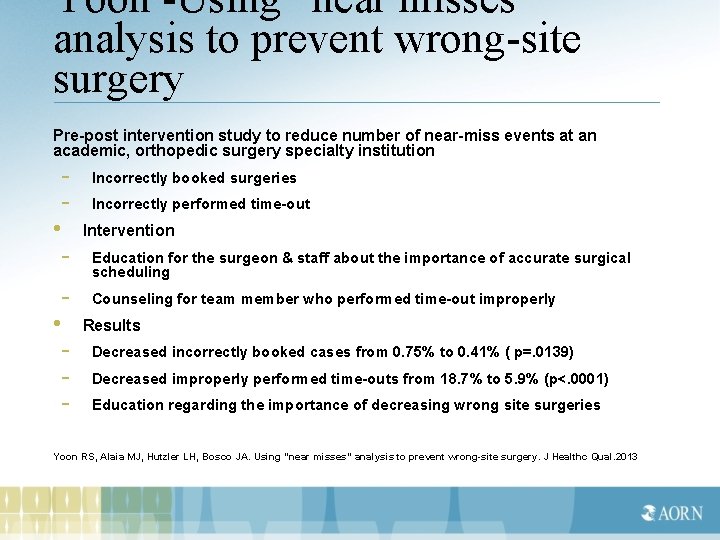
Yoon -Using “near misses” analysis to prevent wrong-site surgery Pre-post intervention study to reduce number of near-miss events at an academic, orthopedic surgery specialty institution • Incorrectly booked surgeries Incorrectly performed time-out Intervention - Education for the surgeon & staff about the importance of accurate surgical scheduling - Counseling for team member who performed time-out improperly • Results - Decreased incorrectly booked cases from 0. 75% to 0. 41% ( p=. 0139) Decreased improperly performed time-outs from 18. 7% to 5. 9% (p<. 0001) Education regarding the importance of decreasing wrong site surgeries Yoon RS, Alaia MJ, Hutzler LH, Bosco JA. Using “near misses” analysis to prevent wrong-site surgery. J Healthc Qual. 2013
Case study-outpatient surgery • • - Incorrect operation on a hand Scheduled for release of trigger finger- left ring finger Left carpal tunnel procedure performed Surgeon Several procedures-major and minor Served as translator for the patient in pre-op Pre-op nurse marked the wrist Performed a carpal tunnel on another patient Case moved to another room to accommodate surgery schedule Different OR crew Left OR suite to do a consultation
Case study-outpatient surgery • - Surgeon Counseled an upset, previous patient Anxiety producing No tourniquet-circulator left room Patient prepped-wiped off site marking Communicated in Spanish to the patient Circulator thought it was the time out Team was relieved in the middle of the procedure Realized mistake when dictating Discussed with patient & performed correct procedure
Case study-outpatient surgery Breakdown in skill-based behavior, rule-based behavior, & knowledge-based behavior - Distraction Personnel change Inpatient consult Previous patient’s needs Patient's language needs Familiarity with the task at hand
Papaconstantinou- Barriers to implementation of the checklist • • • Redundancy Duplication of items in existing checklists Poor communication between surgical team members Negative perception of efficiency Time spent completing the checklist Lack of understanding & commitment to the process Buy-in of all surgical care providers Ambiguity Papaconstantinou HT, Chan. Hee J, Reznik SI, Smythe Wr, Wehbe-Janek H. Implementation of a surgical safety checklist: Impact on surgical team perspectives. Oschner J. 2013; 13: 299 -309.
Papaconstantinou-Effective implementation strategies of a checklist • • Explaining why & showing how Active leadership Deliberate enrollment Extensive discussion & training Piloting Multidisciplinary communication Real-time coaching Ongoing feedback Papaconstantinou HT, Chan. Hee J, Reznik SI, Smythe Wr, Wehbe-Janek H. Implementation of a surgical safety checklist: Impact on surgical team perspectives. Oschner J. 2013; 13: 299 -309
Rydrych-Successful time out process 1. 2. 3. 4. 5. 6. Details matter Focus on implementation as much as process development Go with the (work) flow …. & acknowledge our “humanness” Focus on key elements Align activities with other initiatives Persistence is key Rydrych D, Apold J, Harder K. Preventing wrong-site surgery in Minnesota: A 5 year journey. Patient Saf Qual Healthc. 2012; 9(6): 24 -34
Rydrych- #1 Details matter - Perform a robust time-out - Develop clear, detailed policies & procedures Do not rely on memory or perform in a rote manner Follow all steps in the policies & procedures Actively participate in the time out with all members of the procedure team Rydrych D, Apold J, Harder K. Preventing wrong-site surgery in Minnesota: A 5 -year journey. Patient Saf Qual Healthc. 2012; 9(6): 24 -34
Rydrych- #2 Focus on implementation as much as process development - Plan the implementation Devote sufficient resources Engage surgeon champion Educate all team members Support & coach staff Communicate with key stakeholders Monitor ongoing compliance Provide ongoing training and refresher training Involve process leaders to identify strategies with front-line staff to overcome roadblocks
Rydrych-Acknowledge our “Humanness” Regardless of our training or intelligence - Humans forget things - Humans make mistakes - Humans downplay risks - Humans go on auto-pilot Overconfidence - Errors are due to other’s insufficient skill or intelligence Automated behaviors - Example-driving the same route to work every day and when you arrive at work not remembering the details of the drive
Rydrych- # 3 Go with the (work) flow …. & acknowledge our “humanness Be aware of, account for, and develop strategies. - Confirmation bias - Risk perception - Discounting info that disagrees with preconceived ideas (eg, site marking is different from informed consent) Assuming errors or mistakes will happen to someone else Overconfidence Automated behaviors - Going through the motions of a time out without paying attention to the steps
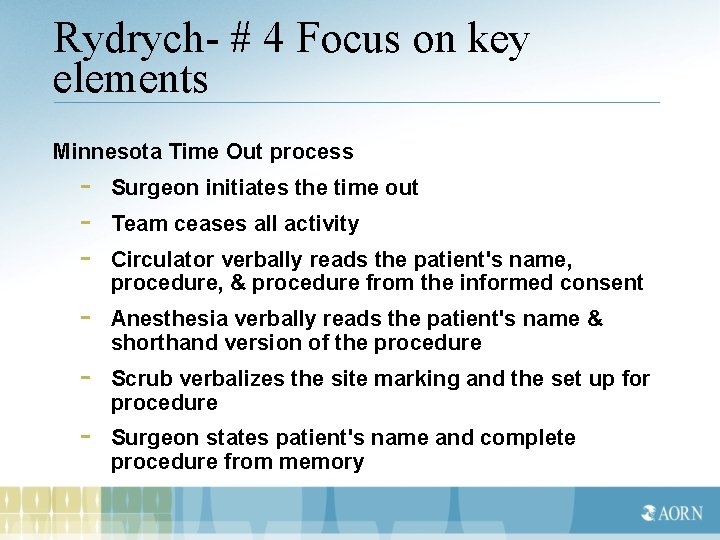
Rydrych- # 4 Focus on key elements Minnesota Time Out process - Surgeon initiates the time out - Anesthesia verbally reads the patient's name & shorthand version of the procedure - Scrub verbalizes the site marking and the set up for procedure - Surgeon states patient's name and complete procedure from memory Team ceases all activity Circulator verbally reads the patient's name, procedure, & procedure from the informed consent
Rydrych- #5 Align activities with other initiatives - Integrate into current efforts (eg, WHO checklist, Joint Commission’s universal protocol) - May facilitate buy-in from surgeons and administration
Rydrych- #6 Persistence is key - Adaptive change does not happen quickly - Executive & clinical leaders Time out process is an evolving practice Support of staff, physicians, & leaders is needed for long term change • Communicate expectations to physicians & staff - • • • Keeps the circulating nurse from playing the policeman trying to enforce policies and procedures with surgeons and staff who do not want to modify their practice Provide resources Be a visible support Recognize individual & organizational successes
Birnbach -Evidence-based Actions to Prevent WSS • • • Leadership commitment. • • Eliminate preventable harm. • Mandate reporting of safety issues, errors, and near misses. • Cultivate learning as part of the organizational mentality. Everyone is responsible. Empower governing bodies to create and enforce safety policies. Establish a universal, uniform approach for safety management.
Evidence-based Actions to Prevent WSS • Develop policies where medical staff is educated, performance monitored, and feedback provided. • Leadership promotes patient safety and encourages medical staff to voluntarily participate in safety initiatives. • Multiple procedures on the same patient should have individual time outs and should be done separately after changing the position. • Eliminate the hierarchy. All must feel free to speak up when a patient safety issue is noticed. • Emphasize the team approach and team responsibility, eliminate name-blame-shame.
Steelman-Recommendations • Improve accuracy of scheduling information (eg, checklist for scheduling surgery) • Verify necessary documentation and site marking in pre-op area • • • Enforce time out procedure Avoid workarounds Engage all team members with no deviations Steelman VM, Graling PR. Top 10 patient safety issues: What more can we do? AORN J. 2013; 97(6): 679 -98, quiz 699 -701.
Pennsylvania Patient Safety Authority Resources • • • OR scheduling form • Independent verification Observational monitoring tool Compliance monitoring tool Wrong-site surgery error analysis Self-assessment checklist for program elements http: //patientsafetyauthority. org/Educational. Tools/Patient. Safety. Tools/PWSS/Pages/home. aspx
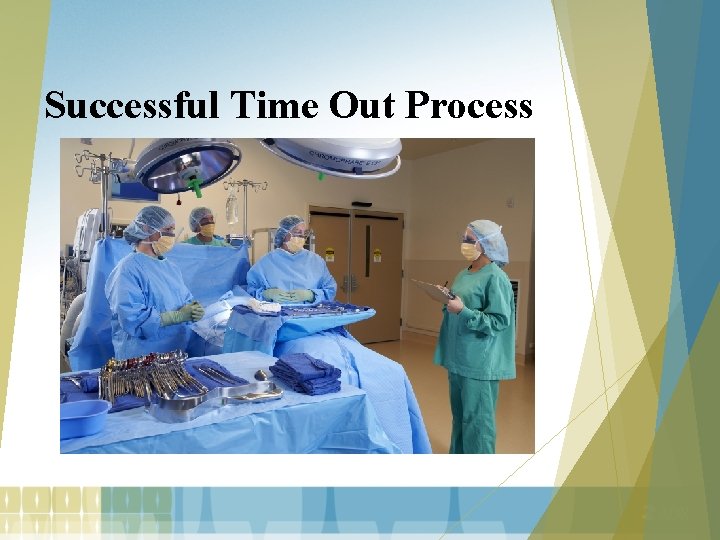
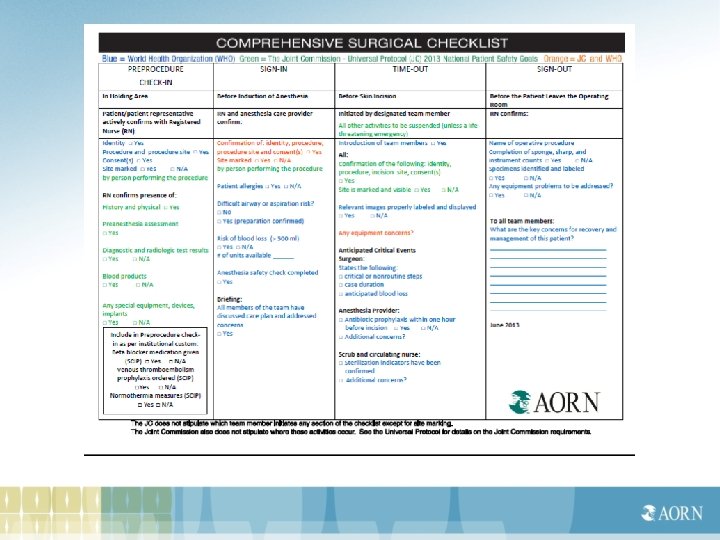
Successful Time Out Process
Summary • • • Checklists Education Active team participation Visible site marking Administrative support
References Birnbach DJ, Rosen LF, Williams L, Fitzpatrick M, Lubarsky DA, Menna JD. A framework for patient safety: A defense nuclear industry-based high-reliability model. Jt Comm J Qual Patient Saf. 2013; 39(5): 233 -240. Bohmer AB, Wappler F, Tinschmann T, et al. The implementation of a perioperative checklist increases patients' perioperative safety and staff sa. Lee SH, Kim JS, Jeong YC, Kwak DK, Chun JH, Lee HM. Patient safety in spine surgery: Regarding the wrong-site surgery. Asian Spine J. 2013; 7(1): 63 -71. tisfaction. Acta Anaesthesiol Scand. 2012; 56(3): 332 -338. Braaf S, Manias E, Riley R. The role of documents and documentation in communication failure across the perioperative pathway. A literature review. Int J Nurs Stud. 2011; 48(8): 1024 -1038. Clarke JR. What keeps facilities from implementing best practices to prevent wrong-site surgery? barriers and strategies for overcoming them. PA Patient Saf Advis. 2012; 9((Suppl 1)): 1 -15. Gibbs VC. Thinking in three's: Changing surgical patient safety practices in the complex modern operating room. World J Gastroenterol. 2012; 18(46): 6712 -6719. Hu YY, Arriaga AF, Roth EM, et al. Protecting patients from an unsafe system: The etiology and recovery of intraoperative deviations in care. Ann Surg. 2012; 256(2): 203 -210. Hyman D, Laire M, Redmond D, Kaplan DW. The use of patient pictures and verification screens to reduce computerized provider order entry errors. Pediatrics. 2012; 130(1): e 211 -9. James MA, Seiler JG, 3 rd, Harrast JJ, Emery SE, Hurwitz S. The occurrence of wrong-site surgery self-reported by candidates for certification by the american board of orthopaedic surgery. J Bone Joint Surg Am. 2012; 94(1): e 2(1 -12). Kalapurakal JA, Zafirovski A, Smith J, et al. A comprehensive quality assurance program for personnel and procedures in radiation oncology: Value of voluntary error reporting and checklists. Int J Radiat Oncol Biol Phys. 2013; 86(2): 241 -248.
References Longo UG, Loppini M, Romeo G, Maffulli N, Denaro V. Errors of level in spinal surgery: An evidence-based systematic review. J Bone Joint Surg Br. 2012; 94(11): 1546 -1550. Mahar P, Wasiak J, Batty L, Fowler S, Cleland H, Gruen RL. Interventions for reducing wrong-site surgery and invasive procedures. Cochrane Database Syst Rev. 2012; 9: CD 009404. Mainthia R, Lockney T, Zotov A, et al. Novel use of electronic whiteboard in the operating room increases surgical team compliance with pre-incision safety practices. Surgery. 2012; 151(5): 660 -666. Oszvald A, Vatter H, Byhahn C, Seifert V, Guresir E. "Team time-out" and surgical safety-experiences in 12, 390 neurosurgical patients. Neurosurg Focus. 2012; 33(5): E 6. Papaconstantinou HT, Chan. Hee J, Reznik SI, Smythe Wr, Wehbe-Janek H. Implementation of a surgical safety checklist: Impact on surgical team perspectives. Oschner J. 2013; 13: 299 -309. Rydrych D, Apold J, Harder K. Preventing wrong-site surgery in Minnesota: A 5 -year journey. Patient Saf Qual Healthc. 2012; 9(6): 24 -34. Steelman VM, Graling PR. Top 10 patient safety issues: What more can we do? AORN J. 2013; 97(6): 679 -98, quiz 699 -701. Steelman VM, Graling PR, Perkhounkova Y. Priority patient safety issues identified by perioperative nurses. AORN J. 2013; 97(4): 402 -418. Thakkar SC, Mears SC. Visibility of surgical site marking: A prospective randomized trial of two skin preparation solutions. J Bone Joint Surg Am. 2012; 94(2): 97 -102. Vachhani JA, Klopfenstein JD. Incidence of neurosurgical wrong-site surgery before and after implementation of the universal protocol. Neurosurgery. 2013; 72(4): 590 -5; discussion 595. Yoon RS, Alaia MJ, Hutzler LH, Bosco JA. Using “near misses” analysis to prevent wrong-site surgery. J Healthc Qual. 2013
- Slides: 58