
Prevention management of postoperative recurrence in Crohns disease

- Slides: 23
Prevention & management of post-operative recurrence in Crohn’s disease Dr Gill Watermeyer IBD Clinic Division of Gastroenterology Department of Medicine Groote Schuur Hospital and University of Cape Town
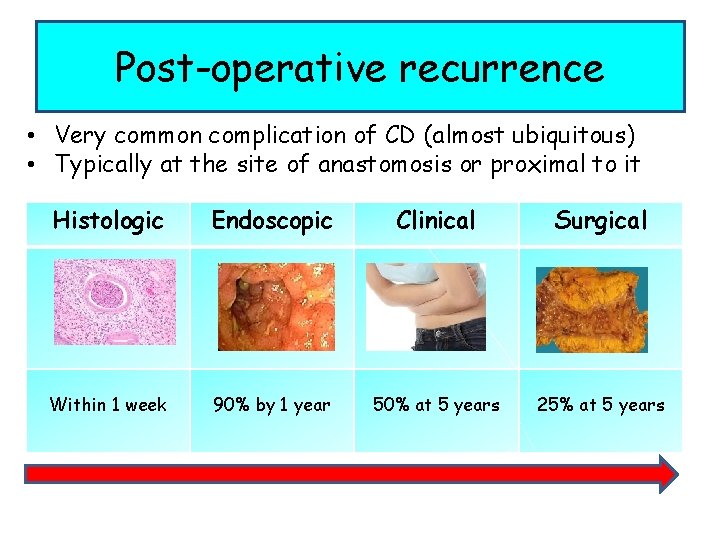
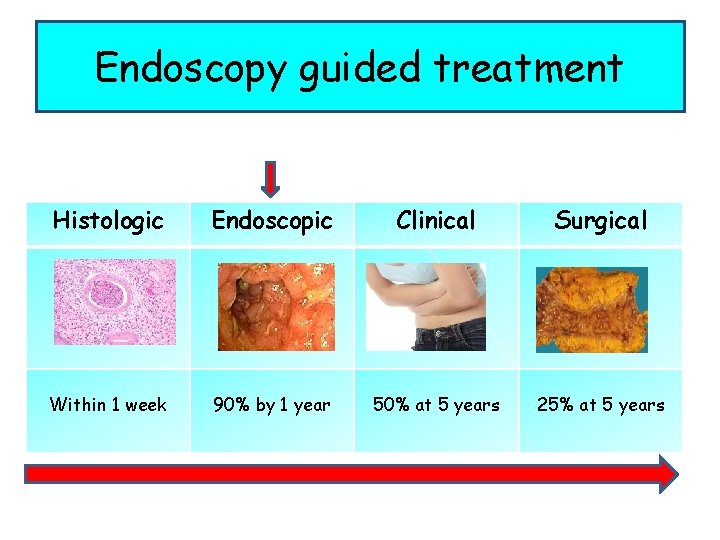
Post-operative recurrence • Very common complication of CD (almost ubiquitous) • Typically at the site of anastomosis or proximal to it Histologic Endoscopic Clinical Surgical Within 1 week 90% by 1 year 50% at 5 years 25% at 5 years
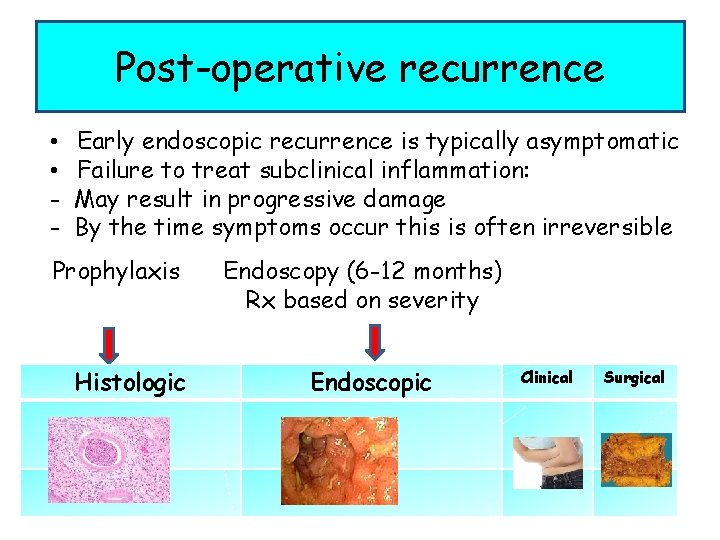
Post-operative recurrence • • - Early endoscopic recurrence is typically asymptomatic Failure to treat subclinical inflammation: May result in progressive damage By the time symptoms occur this is often irreversible Prophylaxis Histologic Endoscopy (6 -12 months) Rx based on severity Endoscopic Clinical Surgical
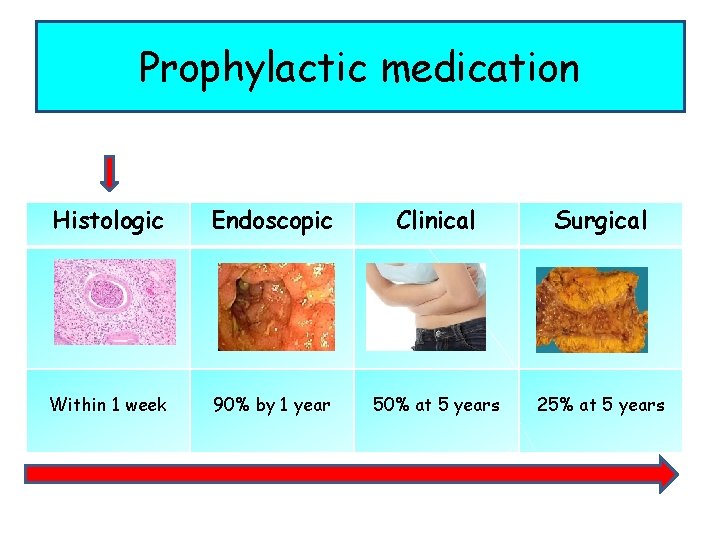
Prophylactic medication Histologic Endoscopic Clinical Surgical Within 1 week 90% by 1 year 50% at 5 years 25% at 5 years
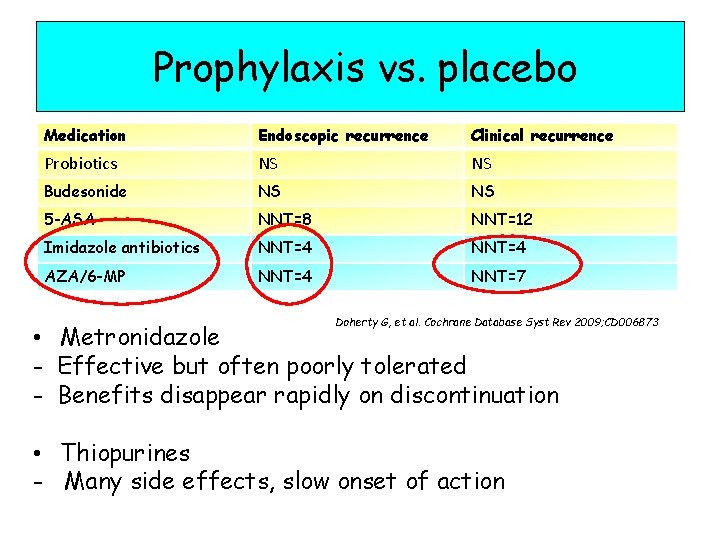
Prophylaxis vs. placebo Medication Endoscopic recurrence Clinical recurrence Probiotics NS NS Budesonide NS NS 5 -ASA NNT=8 NNT=12 Imidazole antibiotics NNT=4 AZA/6 -MP NNT=4 NNT=7 Doherty G, et al. Cochrane Database Syst Rev 2009; CD 006873 • Metronidazole - Effective but often poorly tolerated - Benefits disappear rapidly on discontinuation • Thiopurines - Many side effects, slow onset of action
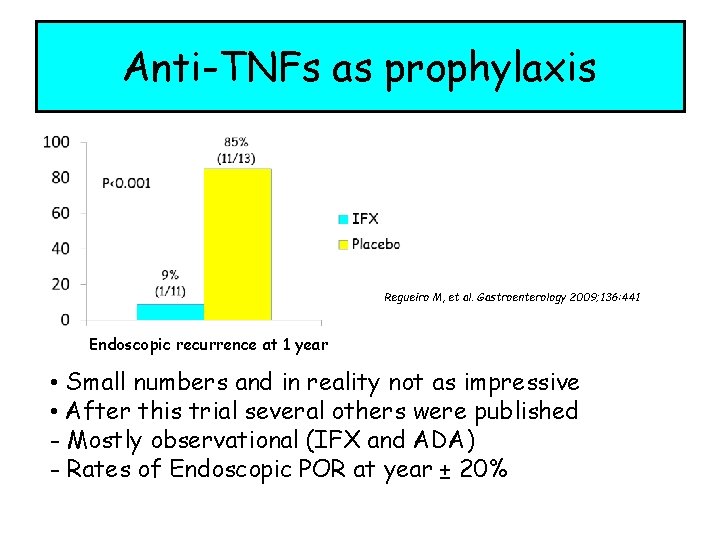
Anti-TNFs as prophylaxis Regueiro M, et al. Gastroenterology 2009; 136: 441 Endoscopic recurrence at 1 year • Small numbers and in reality not as impressive • After this trial several others were published - Mostly observational (IFX and ADA) - Rates of Endoscopic POR at year ± 20%
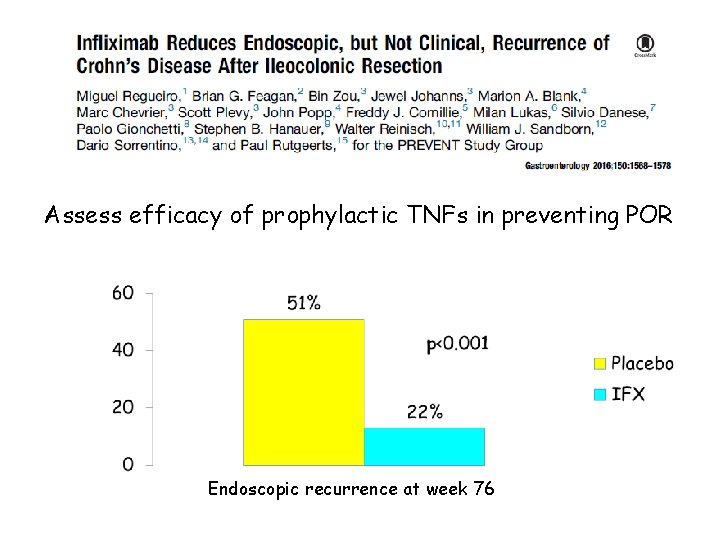
Assess efficacy of prophylactic TNFs in preventing POR Endoscopic recurrence at week 76
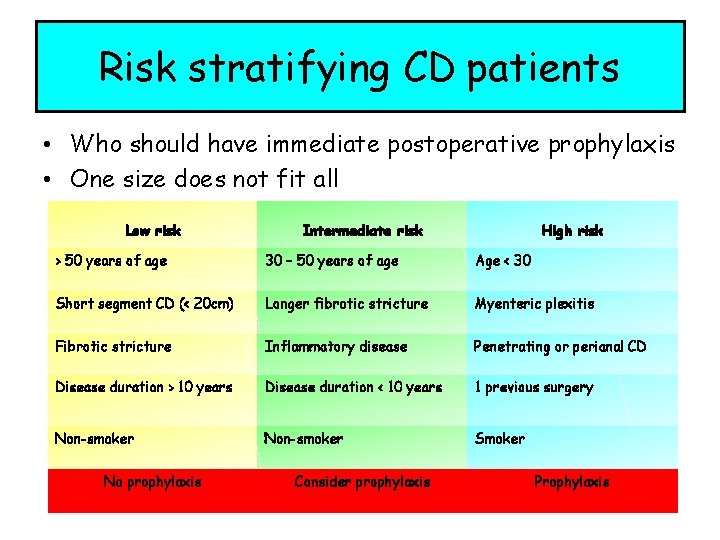
Risk stratifying CD patients • Who should have immediate postoperative prophylaxis • One size does not fit all Low risk Intermediate risk High risk > 50 years of age 30 – 50 years of age Age < 30 Short segment CD (< 20 cm) Longer fibrotic stricture Myenteric plexitis Fibrotic stricture Inflammatory disease Penetrating or perianal CD Disease duration > 10 years Disease duration < 10 years 1 previous surgery Non-smoker Smoker No prophylaxis Consider prophylaxis Prophylaxis
Endoscopy guided treatment Histologic Endoscopic Clinical Surgical Within 1 week 90% by 1 year 50% at 5 years 25% at 5 years
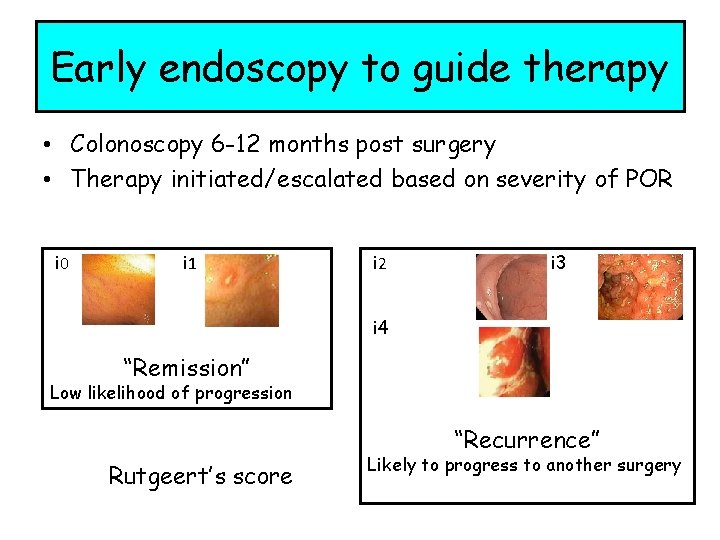
Early endoscopy to guide therapy • Colonoscopy 6 -12 months post surgery • Therapy initiated/escalated based on severity of POR і 0 і 1 і 2 і 3 і 4 “Remission” Low likelihood of progression “Recurrence” Rutgeert’s score Likely to progress to another surgery
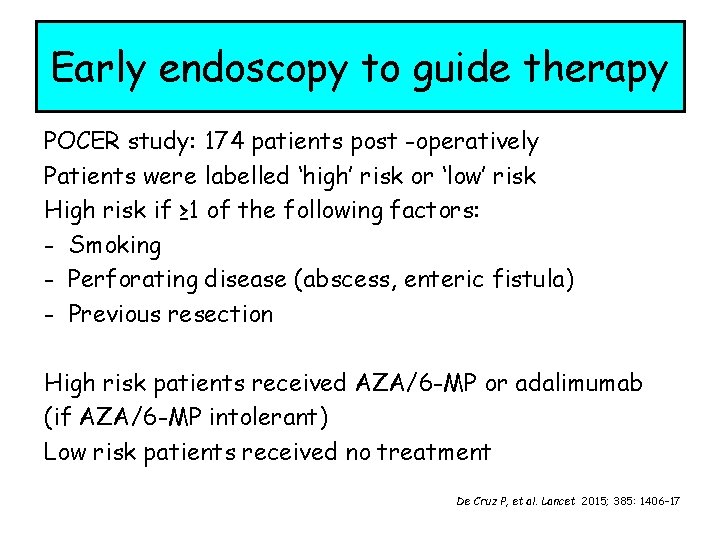
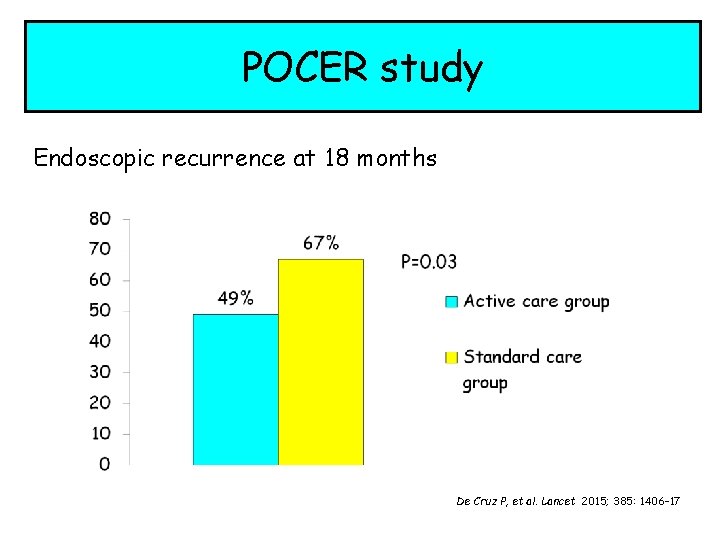
Early endoscopy to guide therapy POCER study: 174 patients post -operatively Patients were labelled ‘high’ risk or ‘low’ risk High risk if ≥ 1 of the following factors: - Smoking - Perforating disease (abscess, enteric fistula) - Previous resection High risk patients received AZA/6 -MP or adalimumab (if AZA/6 -MP intolerant) Low risk patients received no treatment De Cruz P, et al. Lancet 2015; 385: 1406– 17
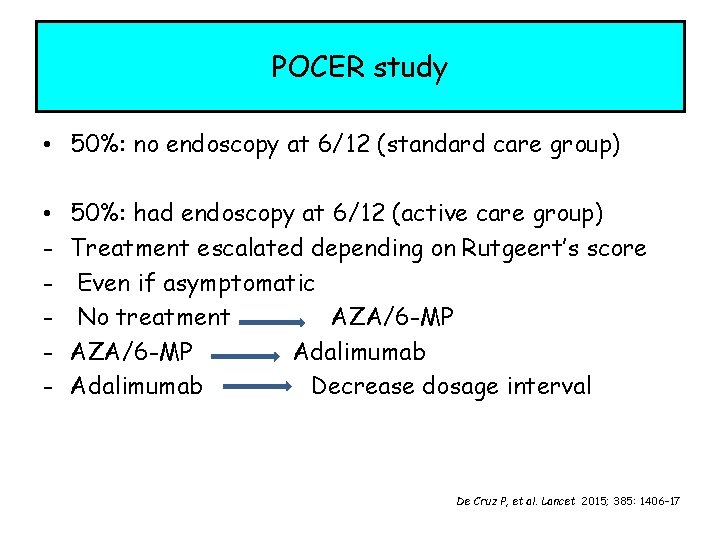
POCER study • 50%: no endoscopy at 6/12 (standard care group) • - 50%: had endoscopy at 6/12 (active care group) Treatment escalated depending on Rutgeert’s score Even if asymptomatic No treatment AZA/6 -MP Adalimumab Decrease dosage interval De Cruz P, et al. Lancet 2015; 385: 1406– 17
POCER study Endoscopic recurrence at 18 months De Cruz P, et al. Lancet 2015; 385: 1406– 17
POR in 2017 AGA Guidelines. Gastroenterology 2017; 152: 271 – 275
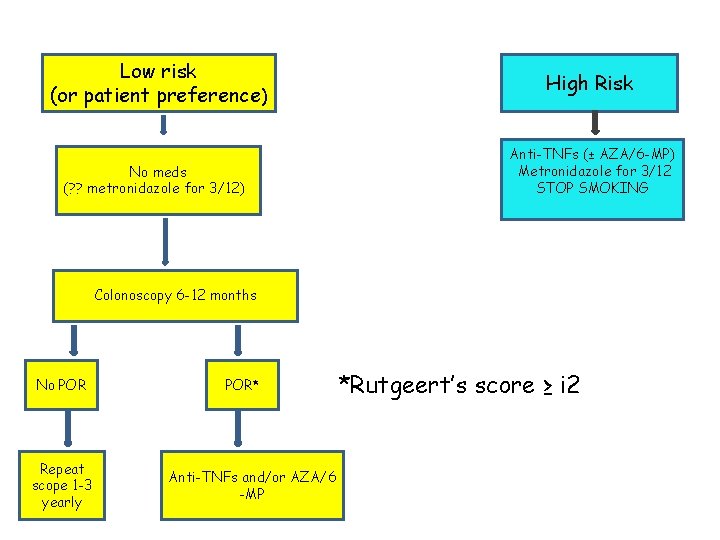
Low risk (or patient preference) No meds (? ? metronidazole for 3/12) High Risk Anti-TNFs (± AZA/6 -MP) Metronidazole for 3/12 STOP SMOKING Colonoscopy 6 -12 months No POR Repeat scope 1 -3 yearly POR* Anti-TNFs and/or AZA/6 -MP *Rutgeert’s score ≥ і 2
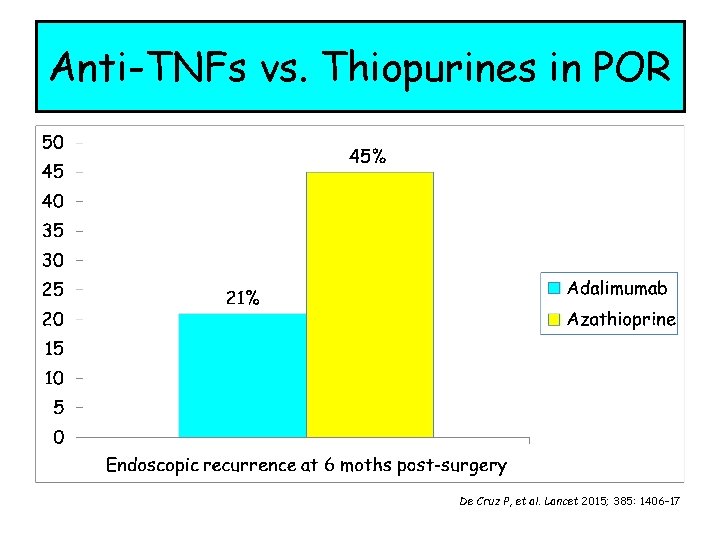
Anti-TNFs vs. Thiopurines in POR De Cruz P, et al. Lancet 2015; 385: 1406– 17
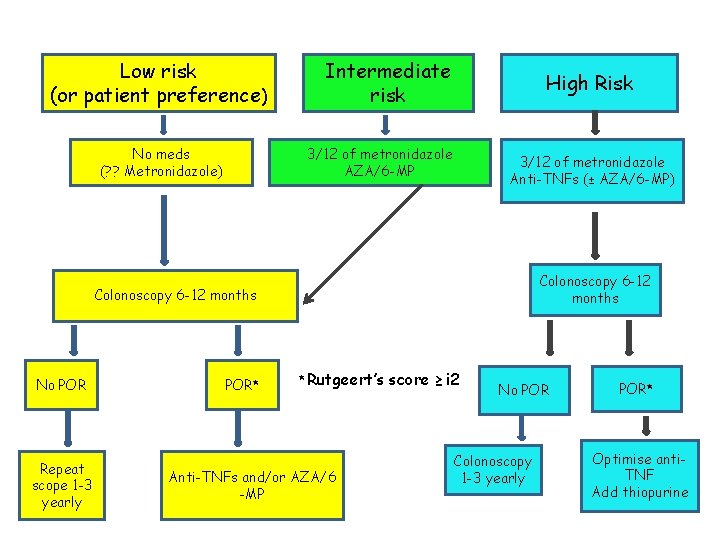
Low risk (or patient preference) No meds (? ? Metronidazole) Intermediate risk High Risk 3/12 of metronidazole AZA/6 -MP 3/12 of metronidazole Anti-TNFs (± AZA/6 -MP) Colonoscopy 6 -12 months No POR Repeat scope 1 -3 yearly POR* *Rutgeert’s score ≥ і 2 Anti-TNFs and/or AZA/6 -MP No POR Colonoscopy 1 -3 yearly POR* Optimise anti. TNF Add thiopurine
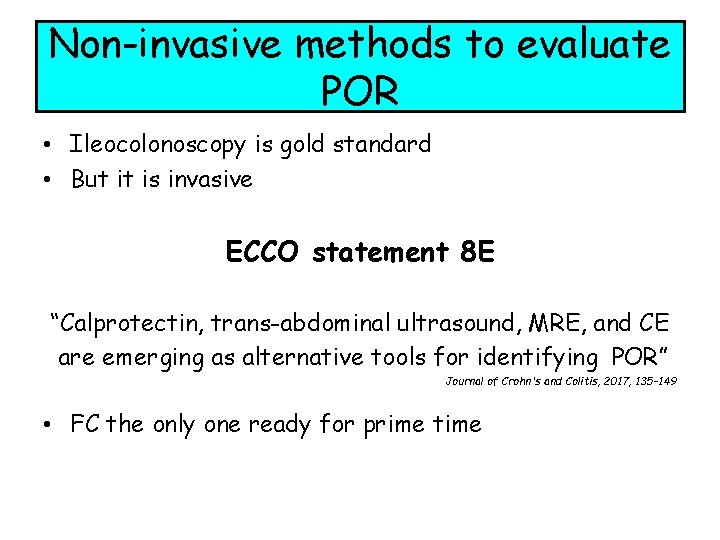
Non-invasive methods to evaluate POR • Ileocolonoscopy is gold standard • But it is invasive ECCO statement 8 E “Calprotectin, trans-abdominal ultrasound, MRE, and CE are emerging as alternative tools for identifying POR” Journal of Crohn's and Colitis, 2017, 135– 149 • FC the only one ready for prime time
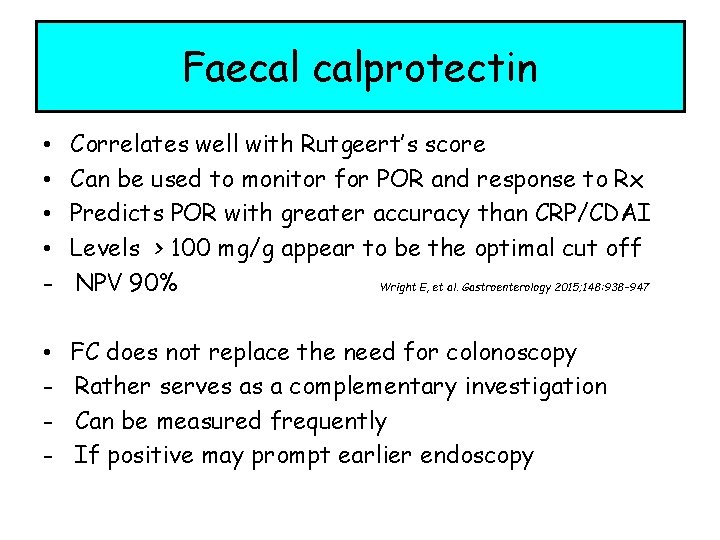
Faecal calprotectin • • - Correlates well with Rutgeert’s score Can be used to monitor for POR and response to Rx Predicts POR with greater accuracy than CRP/CDAI Levels > 100 mg/g appear to be the optimal cut off NPV 90% Wright E, et al. Gastroenterology 2015; 148: 938– 947 • - FC does not replace the need for colonoscopy Rather serves as a complementary investigation Can be measured frequently If positive may prompt earlier endoscopy
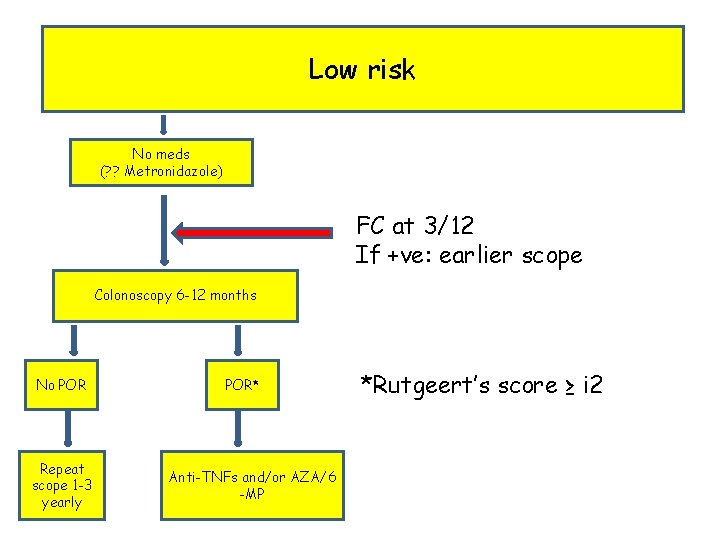
Low risk No meds (? ? Metronidazole) FC at 3/12 If +ve: earlier scope Colonoscopy 6 -12 months No POR Repeat scope 1 -3 yearly POR* Anti-TNFs and/or AZA/6 -MP *Rutgeert’s score ≥ і 2
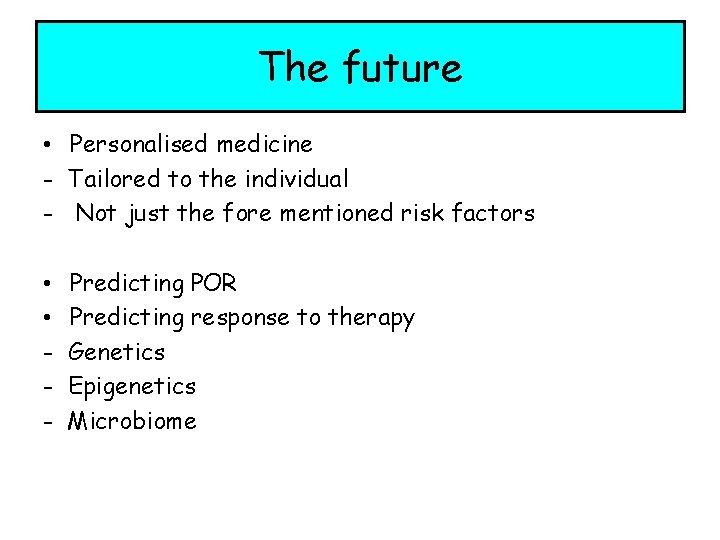
The future • Personalised medicine - Tailored to the individual - Not just the fore mentioned risk factors • • - Predicting POR Predicting response to therapy Genetics Epigenetics Microbiome
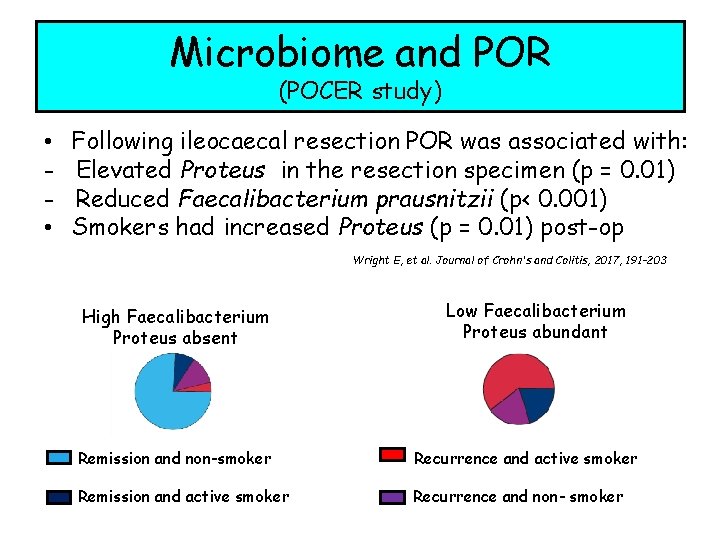
Microbiome and POR (POCER study) • • Following ileocaecal resection POR was associated with: Elevated Proteus in the resection specimen (p = 0. 01) Reduced Faecalibacterium prausnitzii (p< 0. 001) Smokers had increased Proteus (p = 0. 01) post-op Wright E, et al. Journal of Crohn's and Colitis, 2017, 191– 203 High Faecalibacterium Proteus absent Low Faecalibacterium Proteus abundant Remission and non-smoker Recurrence and active smoker Remission and active smoker Recurrence and non- smoker
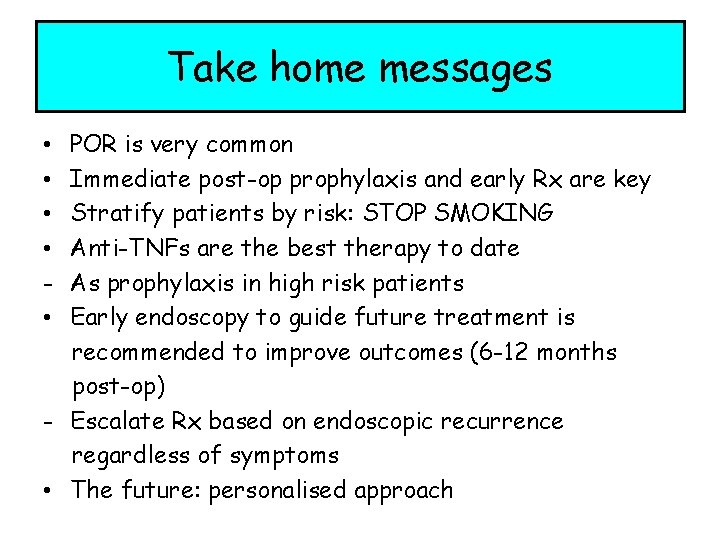
Take home messages POR is very common Immediate post-op prophylaxis and early Rx are key Stratify patients by risk: STOP SMOKING Anti-TNFs are the best therapy to date As prophylaxis in high risk patients Early endoscopy to guide future treatment is recommended to improve outcomes (6 -12 months post-op) - Escalate Rx based on endoscopic recurrence regardless of symptoms • The future: personalised approach • • •